


Vegetables need nutrients, but the right fertilizer depends on what you grow, how you apply it, and how often you want to feed. This guide to Best Organic Fertilizer For Vegetables compares granular blends, liquid concentrates, and pre-measured spikes for home beds and containers.
We reviewed 10 relevant products using listed NPK analyses, application directions, intended crops, and organic-program claims. The useful choice is not always the highest nutrient number: match the product to your crop, soil needs, feeding routine, and label directions. For bed upkeep, see our guide to why raised-bed soil sinks.
Jobes Organic Vegetable Fertilizer Spikes for Simple Outdoor Feeding Jobe’s Organics 2-5-3 Granular Vegetable Fertilizer for Seasonal Feeding Farmer’s Secret Fruit & Bloom Booster Fertilizer for Flowering Plants Down To Earth 4-4-4 Organic Vegetable Fertilizer for Beds and Garden Crops Prices and availability can change. We may earn a commission from qualifying purchases.


Pros
- Organic certification information is provided through the OMRI listing.
- Spike format offers a straightforward option for routine vegetable feeding.
- Suitable for common outdoor crops such as tomatoes and peppers.
Cons
- The published information does not list nutrient analysis or application amounts, so gardeners must check product directions for dosing.
- Spike format may be less suitable for gardeners who prefer liquid or spreadable fertilizers.
- Who should skip it: gardeners seeking fertilizer for indoor plants or non-vegetable use.
Jobes Organic Fertilizer Vegetable Spikes are pre-measured plant food for outdoor vegetable gardens. They suit home gardeners who want a simple feeding format for crops such as tomatoes and peppers.
The product information says the spikes promote beneficial microbial action at the roots and provide continuous nutrition for up to 8 weeks. The formula is OMRI listed and approved for use in organic food production.
Pre-measured spikes remove the need to mix fertilizer or measure each application. Listed dimensions are 6 x 9 x 6 inches, but package contents and individual spike dimensions are not provided.
These spikes may fit outdoor beds or containers where vegetable plants need routine feeding. Follow the package directions for placement and quantity, since the published information does not specify application amounts or nutrient analysis.
The spike format may not suit gardeners who prefer liquid feeding or need a fertilizer for indoor plants and non-vegetable crops. Consider another option if you need detailed nutrient information before choosing; otherwise, this product offers a straightforward organic-listed feeding format for outdoor vegetables.
Best For / Avoid If
Best for buyers prioritizing
- Organic certification information is provided through the OMRI listing.
- Spike format offers a straightforward option for routine vegetable feeding.
- Suitable for common outdoor crops such as tomatoes and peppers.
Consider another option if
- The published information does not list nutrient analysis or application amounts, so gardeners must check product directions for dosing.
- Spike format may be less suitable for gardeners who prefer liquid or spreadable fertilizers.
- Who should skip it: gardeners seeking fertilizer for indoor plants or non-vegetable use.
Pros
- Made without synthetic chemicals, according to the product information.
- Identified as OMRI listed for organic gardening.
- Designed for vegetable and tomato plants, with a stated NPK ratio.
Cons
- Coverage area and application amount are not provided in the published specifications, so gardeners must consult product directions for dosing.
- Who should skip it: gardeners seeking a fertilizer for crops beyond vegetables and tomatoes, or those who need a specified coverage area.
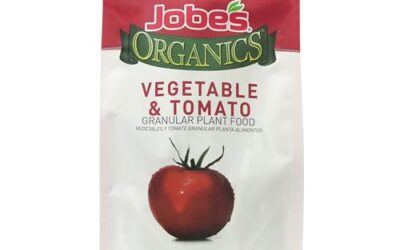
Jobe’s Organics Granular Garden Fertilizer is a 4 lb fertilizer formulated for vegetable gardens and tomato plants. Its intended task is routine crop feeding, making it a potential fit for home gardeners who want a granular product for edible garden beds.
The listed 2-5-3 NPK ratio identifies the fertilizer’s nutrient formulation. Product information describes the granules as providing nutrients for vegetables and tomatoes, and recommends application every 4 to 6 weeks or as needed during the growing season.
The product is granular and described as easy to measure, which can help gardeners portion applications. The published information does not give an application rate or coverage area, so check the package directions to determine how much to use for each bed or plant.
For backyard vegetable plots, raised beds, or tomato plantings, this product offers a crop-focused option in a 4 lb bag. The product information also says it is made without synthetic chemicals and is OMRI listed for organic gardening.
The listed feeding interval requires repeat applications during the growing season. Avoid guessing at the dose, and follow package directions; the available specifications do not state coverage or a per-plant amount. Who should skip it: gardeners who need a fertilizer for other plant types or require a stated coverage area before buying.
Best For / Avoid If
Best for buyers prioritizing
- Made without synthetic chemicals, according to the product information.
- Identified as OMRI listed for organic gardening.
- Designed for vegetable and tomato plants, with a stated NPK ratio.
Consider another option if
- Coverage area and application amount are not provided in the published specifications, so gardeners must consult product directions for dosing.
- Who should skip it: gardeners seeking a fertilizer for crops beyond vegetables and tomatoes, or those who need a specified coverage area.
Pros
- Provides a specific dilution rate and application interval.
- Can be applied by pouring or spraying, according to the product information.
- Listed for a broad range of fruiting, flowering, and vegetable plants.
Cons
- Requires measuring and diluting before use, so gardeners seeking a ready-to-use product may prefer another format.
- The product information does not list nutrient analysis or plant-specific dosing. Who should skip it: gardeners who need those details before choosing fertilizer.
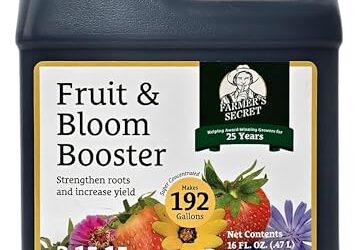
Farmer’s Secret Fruit & Bloom Booster is a concentrated liquid fertilizer intended for plants that produce fruit, flowers, or vegetables. It may suit home gardeners who want a water-diluted product for mixed garden plantings.
The product information describes a formula intended to strengthen roots and support nutrient uptake. It is listed for plants such as citrus, avocados, raspberries, cantaloupe, roses, and petunias, though results can vary by plant and growing conditions.
Use the stated dilution of 1 teaspoon per 2 gallons of water, then pour or spray it onto plants. The suggested repeat interval is every 2 to 4 weeks as part of a regular watering routine.
The 16-ounce bottle measures 2.5 by 2.5 by 7.5 inches and weighs 1.4 pounds. Its concentrated format may fit gardeners who prefer mixing smaller amounts for containers, raised beds, or backyard plantings; the product information does not specify coverage per bottle.
Because this fertilizer must be diluted, measure carefully and follow the listed rate and schedule. Nutrient analysis and detailed plant-specific instructions are not provided in the published information, so gardeners who need those details should consider another fertilizer. Overall, it may fit gardeners seeking one concentrate for several types of fruiting and flowering plants.
Best For / Avoid If
Best for buyers prioritizing
- Provides a specific dilution rate and application interval.
- Can be applied by pouring or spraying, according to the product information.
- Listed for a broad range of fruiting, flowering, and vegetable plants.
Consider another option if
- Requires measuring and diluting before use, so gardeners seeking a ready-to-use product may prefer another format.
- The product information does not list nutrient analysis or plant-specific dosing. Who should skip it: gardeners who need those details before choosing fertilizer.
Pros
- Balanced 4-4-4 formula is suitable for a range of vegetable crops.
- Slow-release feeding may help reduce nutrient leaching.
- Flexible application works for direct soil use or mixing into beds.
Cons
- The product information does not provide application rates or coverage, so gardeners must consult package directions to determine how much to use.
- A 5 lb box may be less suitable for large gardens or frequent feeding across many beds.
- Who should skip it: Gardeners seeking a fertilizer formulated for a specific nutrient deficiency or a different NPK ratio may prefer another product.
Down To Earth Organic Vegetable Garden is a 5 lb fertilizer with a listed 4-4-4 NPK ratio. It is intended for vegetables, herbs, and greens, making it a practical option for home gardeners feeding mixed edible beds.
The balanced ratio provides equal listed proportions of the three primary fertilizer nutrients. Its slow-release formula is described as delivering nutrients gradually and reducing the risk of nutrient leaching, though results depend on garden conditions and use.
The product information says it can be applied directly to soil or mixed into garden beds. No application rate, coverage area, or detailed instructions are provided here, so follow the package directions rather than estimating a dose.
For a backyard or raised-bed garden, the 5 lb box offers a manageable amount for routine use across vegetables, herbs, and greens. The listed uses do not specify crop-by-crop directions or a particular growing method.
The fertilizer is described as made from all-natural organic materials and as non-toxic to beneficial insects, pollinators, pets, and the surrounding ecosystem. Store and apply it according to package directions, and keep it away from children and pets during application.
This may suit gardeners who want one slow-release, balanced fertilizer for several edible crops. Gardeners with large growing areas, specific nutrient needs, or a need for stated coverage and application rates should consider an option with those details clearly listed.
Best For / Avoid If
Best for buyers prioritizing
- Balanced 4-4-4 formula is suitable for a range of vegetable crops.
- Slow-release feeding may help reduce nutrient leaching.
- Flexible application works for direct soil use or mixing into beds.
Consider another option if
- The product information does not provide application rates or coverage, so gardeners must consult package directions to determine how much to use.
- A 5 lb box may be less suitable for large gardens or frequent feeding across many beds.
- Who should skip it: Gardeners seeking a fertilizer formulated for a specific nutrient deficiency or a different NPK ratio may prefer another product.
Pros
- Broad listed use across indoor plants and several outdoor garden types.
- Mixing instructions provide a clear starting point for preparing liquid feed.
- Includes listed soil-related components such as mycorrhizae and humic acids.
Cons
- Requires measuring and mixing before each application, unlike ready-to-use liquid feed.
- Who should skip it: gardeners who need a fertilizer with a clearly stated nutrient analysis or detailed plant-specific dosing on the published information.
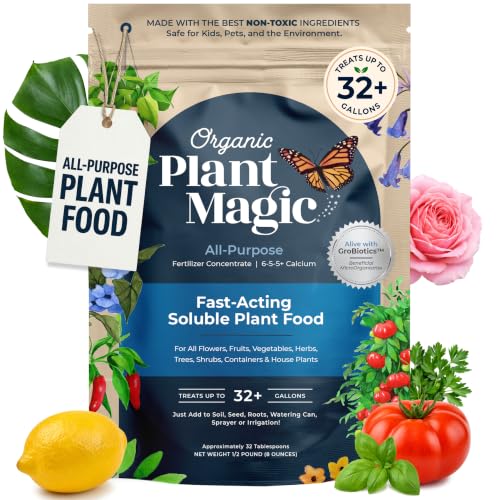
Organic Plant Magic is a water-soluble fertilizer concentrate intended for indoor and outdoor plants. The listed uses include houseplants, vegetables, flowers, herbs, fruit, trees, seedlings, transplants, potted plants, and garden beds, making it a possible fit for gardeners who want one product for several growing areas.
The product information says the 1/2 lb bag makes 32+ gallons and gives a mixing rate of 1 tablespoon per gallon of water. Gardeners can apply the diluted feed to soil or use it as a foliar feed with a watering can or sprayer. The listed ingredients include macro and micronutrients, helpful bacteria, mycorrhizae, amino acids, humic acids, and trace minerals from kelp.
This is a concentrate, so it needs measuring and mixing rather than direct application from the package. The listed package dimensions are 6 x 9 x 3 inches and its weight is 0.5 lb. No nutrient analysis or detailed plant-specific schedule appears in the published specifications, so follow the package application chart and avoid assuming every plant needs the same feeding frequency.
For a backyard, patio, or indoor plant collection, the broad listed use could simplify choosing fertilizer for containers and beds. The stated mixing rate may also help gardeners prepare smaller batches for potted plants or larger batches for garden watering. Application requires a watering can or sprayer, neither of which is listed as included.
The product information describes the formula as organic and says it is safe for children, pets, and pollinators, but no certification or supporting safety documentation is supplied here. Store and apply it according to package directions, and keep concentrate and prepared solution away from children and pets. Consider another option if you need a stated nutrient analysis or precise crop-specific dosing; otherwise, this may suit gardeners seeking a multipurpose water-soluble concentrate.
Best For / Avoid If
Best for buyers prioritizing
- Broad listed use across indoor plants and several outdoor garden types.
- Mixing instructions provide a clear starting point for preparing liquid feed.
- Includes listed soil-related components such as mycorrhizae and humic acids.
Consider another option if
- Requires measuring and mixing before each application, unlike ready-to-use liquid feed.
- Who should skip it: gardeners who need a fertilizer with a clearly stated nutrient analysis or detailed plant-specific dosing on the published information.

Pros
- Listed for indoor and outdoor use across several common plant types.
- Nutrient release starts immediately and continues for up to 3 months.
- 4 lb bag offers a manageable format for home gardens and containers.
Cons
- Application rates are not provided here, so gardeners need to consult the bag for correct amounts.
- Who should skip it: gardeners seeking a liquid feed, a plant-specific formula, or a product with stated nutrient ratios.
Burpee Natural Purpose is a granular organic plant food intended for vegetables, flowers, herbs, seed starting, bedding plants, trees, shrubs, and containers. Its broad listed uses suit home gardeners who want one fertilizer for several parts of a garden.
The product information says major nutrients, calcium, minor nutrients, and some beneficial microbes release immediately and continue feeding plants for up to 3 months. That extended feeding period may help simplify routine care, though the listing does not provide nutrient ratios or crop-specific results.
The 4 lb product comes in a bag measuring 4 x 10.25 x 12.5 inches. It is a granular mix, and the published information does not specify an application tool or detailed rate, so follow the directions printed on the bag for each use.
For backyard beds, the listed vegetable and flower uses make it a flexible option; patio gardeners can also use it for flowers, vegetables, and herbs in containers. Its stated suitability for seed starting and bedding plants may appeal to gardeners establishing new plantings, while exact directions should guide those applications.
OMRI listing supports its use in organic gardening, but gardeners should still apply only the amount directed on the package. The product may be less suitable for anyone who needs a liquid feed, a formula with specified nutrient ratios, or detailed dosing information before purchase. Overall, it is a versatile granular option for gardeners who value multi-purpose use and longer-lasting feeding.
Best For / Avoid If
Best for buyers prioritizing
- Listed for indoor and outdoor use across several common plant types.
- Nutrient release starts immediately and continues for up to 3 months.
- 4 lb bag offers a manageable format for home gardens and containers.
Consider another option if
- Application rates are not provided here, so gardeners need to consult the bag for correct amounts.
- Who should skip it: gardeners seeking a liquid feed, a plant-specific formula, or a product with stated nutrient ratios.
Pros
- Covers a range of common vegetable crops and herbs.
- No mixing is required before application.
- Made in the USA by Espoma Company.
Cons
- The listed directions call for watering thoroughly after application, so gardeners need access to water.
- Who should skip it: Gardeners seeking a liquid fertilizer, a different nutrient analysis, or fertilizer for crops not listed may prefer another product.
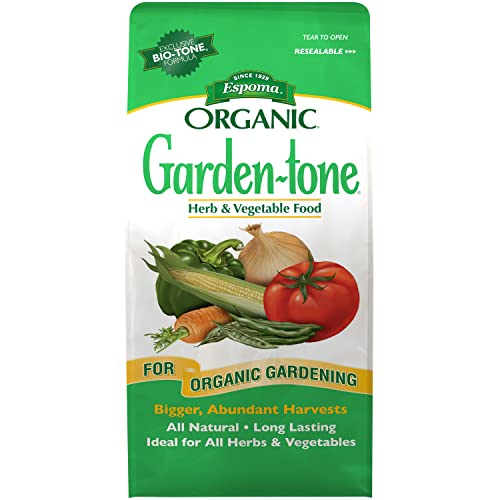
Espoma Garden-Tone is a ready-to-use organic fertilizer for vegetable and herb gardens. Its listed uses include leafy crops such as lettuce, kale, and cabbage, as well as warm-season vegetables including tomatoes, peppers, squash, and melons.
The 3-4-4 fertilizer analysis includes 5% calcium. Product information describes a blend of natural and organic ingredients with Espoma’s Bio-tone formula, and states that it contains no sludges or fillers. These details help gardeners compare its listed formulation with their crop-feeding needs.
Use Garden-Tone monthly throughout the growing season. Apply it to soil around a plant’s drip line or on either side of planting rows, then water thoroughly. It is ready to use and requires no mixing.
A 4 lb. bag measures 8 x 5 x 5 inches, according to the published specifications. The application directions suit garden beds and rows, including backyard plots and raised beds where gardeners can reach the soil around plants. The product information does not specify coverage area.
Follow the package directions and water thoroughly after applying. Gardeners should select fertilizer based on their crops and feeding requirements, since this product has a specific 3-4-4 analysis and listed crop uses. It is approved for organic gardening and registered as an Organic Input Material.
Garden-Tone may suit home gardeners who want a no-mix fertilizer for several common vegetables and herbs. Who should skip it: Gardeners who need liquid feeding, a different nutrient analysis, or fertilizer for crops outside the listed uses may want another option.
Best For / Avoid If
Best for buyers prioritizing
- Covers a range of common vegetable crops and herbs.
- No mixing is required before application.
- Made in the USA by Espoma Company.
Consider another option if
- The listed directions call for watering thoroughly after application, so gardeners need access to water.
- Who should skip it: Gardeners seeking a liquid fertilizer, a different nutrient analysis, or fertilizer for crops not listed may prefer another product.

Pros
- Formulated for tomatoes, vegetables, and houseplants.
- Listed dilution rates distinguish outdoor use from houseplant use.
- Root and foliar application give gardeners more than one listed feeding method.
Cons
- Requires measuring and dilution before application, so gardeners wanting a ready-to-use feed may prefer another format.
- Feed frequency requires regular attention, especially for weekly houseplant use.
- Who should skip it: gardeners seeking a dry fertilizer or a product specifically formulated for plants outside the listed uses.
Neptune’s Harvest Organic Tomato & Vegetable Plant Fertilizer is a liquid 2-4-2 plant food intended for tomatoes, vegetables, and houseplants. It may suit home growers who want one diluted fertilizer for outdoor beds and indoor pots.
The listed ingredients include fish, seaweed, molasses, humate, yucca extract, biological microbes, and liquid calcium. Product information presents it as a source of nitrogen, phosphorus, and potassium, with use as either root feed or foliar feed.
Application requires mixing with water: use 1 oz. per gallon for outdoor plants, feeding every 1-2 weeks, or 1 tablespoon per gallon for houseplants, feeding weekly. The pint bottle is listed at 3 x 3 x 6 inches; product information does not specify a measuring tool or application equipment.
For a backyard vegetable bed, gardeners can prepare diluted feed for crops such as tomatoes and other vegetables. The separate houseplant rate also offers a stated option for indoor pots, while the foliar and root-feed directions allow different application approaches.
This is a concentrate, so gardeners need to measure and dilute it and follow the stated schedule. Keep use aligned with the product directions, and store and handle it according to its label. Who should skip it: gardeners who prefer dry or ready-to-use fertilizer, or need a formula specifically described for other plant types.
Best For / Avoid If
Best for buyers prioritizing
- Formulated for tomatoes, vegetables, and houseplants.
- Listed dilution rates distinguish outdoor use from houseplant use.
- Root and foliar application give gardeners more than one listed feeding method.
Consider another option if
- Requires measuring and dilution before application, so gardeners wanting a ready-to-use feed may prefer another format.
- Feed frequency requires regular attention, especially for weekly houseplant use.
- Who should skip it: gardeners seeking a dry fertilizer or a product specifically formulated for plants outside the listed uses.

Pros
- Formulated for tomatoes, vegetables, and houseplants.
- Includes multiple listed ingredients beyond nitrogen, phosphorus, and potassium.
- Provides separate dilution guidance for outdoor plants and houseplants.
Cons
- Requires dilution and recurring applications, which may not suit gardeners seeking a ready-to-use feed.
- Who should skip it: gardeners who need a dry, slow-release fertilizer or a formula with a different nutrient ratio.
Neptune’s Harvest Organic Tomato & Vegetable Plant Fertilizer is a liquid 2-4-2 plant food intended for tomatoes, vegetables, and houseplants. Its listed uses make it a practical option for home growers tending outdoor beds, containers, or indoor pots.
The ingredient list includes fish, seaweed, molasses, humate, yucca extract, biological microbes, and liquid calcium. Product information presents it as a feed for the vegetative growth stage and for supporting foliage, stems, and roots, but results can vary with plant, soil, and growing conditions.
The quart container measures 4 x 4 x 10 inches, based on the published specifications. Use requires mixing with water: directions list 1 oz. per gallon for outdoor plants and 1 tablespoon per gallon for houseplants. The product information also lists root and foliar application.
For a backyard vegetable bed or patio containers, the outdoor dilution and every-1-to-2-week schedule provide a stated routine. Indoor gardeners can follow the separate houseplant dilution and weekly schedule. Follow the product label for application details and handling.
This is a concentrated liquid that requires measuring and dilution, so it may be less convenient than ready-to-use plant food. Gardeners needing a dry or slow-release product, or a different nutrient ratio, should consider another option. Keep fertilizer handled and stored according to its label, especially around children and pets.
Best For / Avoid If
Best for buyers prioritizing
- Formulated for tomatoes, vegetables, and houseplants.
- Includes multiple listed ingredients beyond nitrogen, phosphorus, and potassium.
- Provides separate dilution guidance for outdoor plants and houseplants.
Consider another option if
- Requires dilution and recurring applications, which may not suit gardeners seeking a ready-to-use feed.
- Who should skip it: gardeners who need a dry, slow-release fertilizer or a formula with a different nutrient ratio.

Pros
- Several application methods fit new planting and established beds.
- Broad listed plant range makes it useful across many garden types.
- 4 lb bag has a stated coverage area of 1,000 square feet.
Cons
- Application amounts are not specified, so gardeners may need to consult package directions for suitable amounts by plant or area.
- The product information does not list nutrient percentages or a detailed ingredient breakdown, which may matter to gardeners comparing formulas.
- Who should skip it: Gardeners seeking a fertilizer with listed nutrient ratios or crop-specific application amounts may prefer a product that provides those details.
Organic Plant Magic Truly Organic is a slow-release granular fertilizer in a 4 lb bag. It is listed for indoor and outdoor flowers, vegetable gardens, fruit trees, shrubs, and houseplants, making it a potential all-purpose choice for home gardeners.
The listed application methods include adding granules to planting holes, mixing them with soil, or top dressing. Product information recommends applying granules monthly or more and watering as usual. It also states that one bag covers 1,000 square feet.
The blend is described as containing essential plant nutrients, more than 55 trace minerals, amino acids, humic acids, kelp, and beneficial GroBiotics including mycorrhizae. Nutrient percentages and specific amounts per application are not provided in the published details, so follow the bag directions for dosing.
For a backyard garden, the granules could be used across vegetable beds, flower plantings, shrubs, and fruit trees. The product is also listed for houseplants, though gardeners should use the package directions to determine suitable amounts for containers.
The 4 lb bag measures 8 by 12 by 4 inches. Application is described as hand spreading or using a spreader, but no spreader settings or plant-specific rates are listed. Store and handle fertilizer according to package instructions, and keep it away from children and pets.
This may suit gardeners seeking one granular product for several plant types and application methods. Gardeners who need a formula with stated nutrient percentages or precise crop-specific rates should consider another option.
Best For / Avoid If
Best for buyers prioritizing
- Several application methods fit new planting and established beds.
- Broad listed plant range makes it useful across many garden types.
- 4 lb bag has a stated coverage area of 1,000 square feet.
Consider another option if
- Application amounts are not specified, so gardeners may need to consult package directions for suitable amounts by plant or area.
- The product information does not list nutrient percentages or a detailed ingredient breakdown, which may matter to gardeners comparing formulas.
- Who should skip it: Gardeners seeking a fertilizer with listed nutrient ratios or crop-specific application amounts may prefer a product that provides those details.
Best Organic Fertilizer For Vegetables buying guide
1. Start with crop and soil needs
Leafy greens, tomatoes, peppers, and other vegetables do not all have identical nutrient needs. A soil test can help identify nutrient levels and pH before you add fertilizer. Without one, avoid assuming that weak growth means plants need more food: watering, light, temperature, and root conditions can also affect growth.
2. Read NPK as a comparison, not a score
NPK lists nitrogen, phosphorus, and potassium as percentages by weight. The listed products include Jobe’s 2-5-3, Espoma Garden-Tone 3-4-4, Neptune’s Harvest 2-4-2, and Down to Earth 4-4-4. A higher number is not automatically a better match. Consider the crop, soil test, and label rate; excess fertilizer can waste product and harm plants or contribute to runoff.
3. Choose granular, liquid, or spikes
Granules suit gardeners who prefer applying fertilizer to soil without mixing a watering can. Products listed here range from monthly use for Garden-Tone to every 4 to 6 weeks for Jobe’s granular blend. Liquids require measuring and mixing, but suit gardeners who already water on a schedule. Spikes skip mixing and measuring, though they offer less flexibility in where nutrients are placed.
4. Compare feeding intervals and workload
Frequent liquid feeding can be practical for a few containers, but adds repeated measuring and watering tasks. Neptune’s Harvest directions specify outdoor feeding every 1 to 2 weeks; Farmer’s Secret lists every 2 to 4 weeks. By contrast, product details describe Burpee as feeding for up to 3 months and vegetable spikes as providing nutrition for up to 8 weeks. These are product claims, not a reason to exceed the package directions.
5. Account for beds and containers
Raised beds and in-ground rows make granular top-dressing straightforward. Containers have less soil volume, so accurate dosing matters and the label should explicitly cover container use. Burpee’s listing names containers, and Organic Plant Magic’s water-soluble formula lists pots and garden beds. Do not transfer a garden-bed rate to a pot without checking the product instructions. For related soil care, read how to manage compost that attracts rats.
6. Check organic claims and label fit
Some listings identify products as OMRI listed, including Jobe’s granular fertilizer, Burpee, and the vegetable spikes. Espoma is described as a registered Organic Input Material. Verify the current package and listing if organic-production eligibility matters to you; claims and permitted uses can depend on the exact product and context. Organic does not mean suitable at any dose.
7. Prevent overapplication and store carefully
Measure using the package directions rather than a handful estimate, especially for concentrated liquids and container plants. Keep a simple record of application dates to avoid stacking products with overlapping feeding schedules. Close and store fertilizer as its label directs, away from children and pets. Follow label precautions, local rules, and manufacturer safety instructions; do not assume an organic product is harmless because of its ingredients.
8. Balance convenience against cost per use
Package price alone does not show value. Concentrates may make many gallons, while dry products vary in weight and application rate. Compare the label’s dose and number of applications for your garden size. The published prices range from $9.99 to $39.97, but prices change and package formats differ, so confirm current details before buying.
Product fit: strengths and tradeoffs
Down to Earth All Natural Fertilizers Organic lists a 4-4-4 analysis and gradual nutrient delivery for vegetables. Pros: balanced listed NPK and broad vegetable use. Cons: listing does not provide a feeding interval or application rate. Who should skip it: gardeners who need detailed dosing information before purchase.
Jobe’s Organics Granular Garden Fertilizer is a 2-5-3 granular blend for vegetables and tomatoes, with directions for application every 4 to 6 weeks. Pros: crop-specific use, measurable granules, and listed OMRI status. Cons: listed phosphorus is higher than nitrogen and potassium, so soil needs should guide selection. Who should skip it: gardeners whose soil test indicates they should avoid added phosphorus.
Espoma Organic Garden-Tone 3-4-4 Organic is intended for leafy greens and warm-season vegetables, with 5% calcium and monthly-use directions. Pros: named crop range, ready-to-use granules, and no mixing. Cons: monthly application still requires tracking and label-based measuring. Who should skip it: gardeners seeking a liquid feed or a product limited to one crop type.
Burpee Natural Purpose Granular 4-Lb Organic Food is listed for vegetables, herbs, seed starting, and containers, with nutrients described as feeding for up to 3 months. Pros: broad listed uses and a less frequent claimed feeding period. Cons: the published details do not state its NPK analysis. Who should skip it: gardeners who want to compare a specific NPK ratio before choosing.
Organic Fertilizer Vegetable Spikes | Fertilizers are pre-measured and listed for outdoor vegetables, with up to 8 weeks of feeding. Pros: no mixing and less measuring. Cons: the published information does not list an NPK analysis or detailed crop-by-crop rate. Who should skip it: gardeners who need flexible application across mixed rows or want a published NPK comparison.
Neptune’s Harvest Organic Tomato & Vegetable Plant is a 2-4-2 liquid containing listed fish, seaweed, molasses, and other ingredients. Pros: vegetable-focused use and clear outdoor dilution directions. Cons: regular feeding requires measuring and mixing; fish-derived ingredients may not suit every gardener. Who should skip it: anyone who wants a dry product or does not want fish-based fertilizer.
Neptune’s Harvest Organic Tomato & Vegetable Plant is the listed quart option of the same 2-4-2 liquid formula. Pros: same stated vegetable use and dilution directions in a larger package format. Cons: it still needs mixing and frequent applications, and published data does not establish how long the package will last for a particular garden. Who should skip it: gardeners feeding only a few plants who prefer a small package or granular application.
Farmer’s Secret Fruit & Bloom Booster Fertilizer is a concentrated liquid for fruiting and flowering plants, including vegetables; the listed dilution is 1 teaspoon per 2 gallons of water. Pros: precise concentrate and a stated 2-to-4-week interval. Cons: published data does not include an NPK analysis or organic-program listing. Who should skip it: gardeners who require a documented organic listing or a vegetable-specific NPK comparison.
Organic Plant Magic Fertilizer & Plant Food is a water-soluble all-purpose concentrate, listed to make 32 or more gallons and used at 1 tablespoon per gallon. Pros: supports vegetables and other listed plants, with soil drench or foliar application options. Cons: requires measuring and mixing, and published data does not list an NPK ratio. Who should skip it: gardeners who want a ready-to-apply granular fertilizer.
Organic Plant Magic – Truly Organic™ Slow Release is a granular all-purpose option listed for monthly application, with claimed coverage of 1,000 square feet per 4 lb bag. Pros: dry application and broad listed garden use. Cons: the published details do not provide an NPK analysis, and coverage should be checked against package directions. Who should skip it: gardeners who need a vegetable-specific ratio or a smaller, clearly measured dose for a few pots.
Research methodology and trust
We screened the published listings for products explicitly intended for vegetables, vegetable gardens, or plants that include vegetables. Each included item is a fertilizer, not an accessory or unrelated garden product. Neptune’s Harvest pint and quart listings are treated as separate package options, not separate formulas.
Our comparison weighs stated NPK ratios, listed ingredients, crop fit, application format, feeding interval, and organic-program details where provided. We also consider whether directions appear practical for beds, containers, or gardeners who want less measuring. Missing specifications are identified rather than inferred.
This is research-based product analysis, not physical product evaluation. Published ratings show 0 reviews for several listings, so ratings are not treated as dependable evidence of owner satisfaction. Product descriptions include manufacturer or seller claims; they do not establish guaranteed harvest, soil, or plant outcomes. Information was prepared for October 2026, and package directions and listings can change.
Frequently asked questions
How do I choose the best organic fertilizer for vegetables?
Start with crop type and soil needs, then compare NPK, application format, and feeding interval. Choose a product whose label covers your plants and garden setup.
Is granular or liquid fertilizer easier for vegetables?
Granules avoid repeated mixing, while liquids suit gardeners comfortable measuring and feeding during watering. Neither format is automatically better; follow its label schedule and dose.
Can I use these fertilizers in containers?
Some published listings name pots or containers, including Burpee and Organic Plant Magic water-soluble fertilizer. Confirm the package gives a container rate before applying fertilizer to a pot.
How often should I feed vegetables with organic fertilizer?
Schedules vary by product: listed directions include monthly use, every 4 to 6 weeks, and liquid feeding every 1 to 2 weeks. Use the selected product’s label rather than combining schedules.
Can I use more fertilizer if plants look weak?
Do not exceed label rates based only on appearance. Check watering, light, and other growing conditions, and consider a soil test before adding more nutrients.
How should I store organic vegetable fertilizer?
Follow the package storage instructions, keep containers closed, and store fertilizer away from children and pets. Do not rely on the word organic as a substitute for label precautions.
Continue your garden research
Browse more practical guides in Compost, Soil & Mulch.
For product comparisons, see Best Compost Bin For Small Backyard: Reviews and Buying Guide.
See how Dove Creek Gardens researches and compares products.