

Choosing liquid fertilizer for vegetables means matching the product to crop stage and garden needs, not selecting the strongest-sounding label. This guide helps beginner gardeners, homeowners, and small-space growers compare options while weighing nutrient balance, intended use, and the product information available.
We reviewed 20 listed products for vegetable-garden relevance and compared their supplied names, specifications, sizes, brands, and prices. The useful distinctions include whether a fertilizer is described for vegetables, whether its NPK ratio is stated, and whether the listing gives enough information to choose an application plan. For soil context, see our guide to using finished compost in a garden.
FoxFarm Grow Big 6-4-4 Liquid Plant Food for Vegetables and Roses Farmer’s Secret Fruit & Bloom Booster Fertilizer for Flowering Plants Farmer’s Secret Fruit & Bloom Booster Fertilizer for Flowering Plants TPS NUTRIENTS 10-10-10 Liquid Vegetable Fertilizer for Balanced Feeding Prices and availability can change. We may earn a commission from qualifying purchases.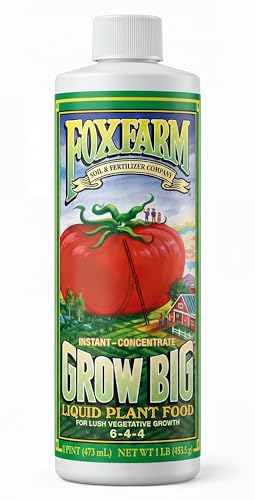


Pros
- Supports multiple listed plant types rather than a single crop.
- Offers two application methods: foliar feeding or regular watering.
- Product information identifies quick nutrient uptake as a formula feature.
Cons
- Application rates and dilution details are not included in the published product information, so consult the label and feeding schedule.
- Concentrate requires following preparation directions rather than applying as a ready-to-use product.
- Who should skip it: gardeners seeking a fertilizer specifically formulated for plants outside its listed use range.
FoxFarm Grow Big is a 6-4-4 liquid plant food concentrate intended for vegetative growth. Product information lists roses, tomatoes, vegetables, and indoor or outdoor plants, making it a possible option for home gardeners feeding several types of plants.
The formula is described as supporting plant size and structure, with quick nutrient uptake as a stated feature. It is also presented for use during different growth stages, though the published information does not specify application rates for particular plants or stages.
Gardeners can apply it through regular watering or foliar feeding. The product information says its low pH helps maintain stability during storage and keep micronutrients available. The container is listed as 1 pint and measures 2.5 x 7.81 x 2.5 inches.
Its listed plant range can suit a home setup that includes tomatoes or vegetables in garden beds or containers, roses outdoors, and indoor plants. The product information does not give a coverage area, so gardeners should not assume one bottle will feed a particular number of plants or beds.
This is a concentrate, and the published details do not include mixing amounts. Follow the container directions and feeding schedule, and avoid guessing at dilution or application frequency. The information also does not specify crop-specific rates or additional handling guidance.
Consider Grow Big if you want a liquid fertilizer listed for roses, tomatoes, vegetables, and indoor or outdoor plants, with watering and foliar application options. Gardeners who want ready-to-use fertilizer or need a formula tailored to a different plant group should consider another product.
Best For / Avoid If
Best for buyers prioritizing
- Supports multiple listed plant types rather than a single crop.
- Offers two application methods: foliar feeding or regular watering.
- Product information identifies quick nutrient uptake as a formula feature.
Consider another option if
- Application rates and dilution details are not included in the published product information, so consult the label and feeding schedule.
- Concentrate requires following preparation directions rather than applying as a ready-to-use product.
- Who should skip it: gardeners seeking a fertilizer specifically formulated for plants outside its listed use range.
Pros
- Directions specify both dilution and application timing.
- One formula is listed for flowers, fruits, and vegetables.
- Can be poured or sprayed after dilution.
Cons
- Concentrated formula requires careful measuring and dilution before use.
- Product data does not list nutrient analysis, so gardeners seeking specific nutrient ratios may prefer a fertilizer with that information.
- Who should skip it: Gardeners wanting a ready-to-use product or fertilizer directions tailored to one specific plant.
Farmer’s Secret Fruit & Bloom Booster is a concentrated fertilizer intended for plants that produce flowers, fruit, or vegetables. Product information lists examples such as citrus, avocados, raspberries, cantaloupe, roses, and petunias, making it a possible fit for gardeners tending mixed edible and ornamental beds.
The listed directions call for 1 teaspoon diluted in 2 gallons of water, followed by application every 2 to 4 weeks. Product information says gardeners can pour or spray the diluted mixture during regular watering. It describes root strengthening and increased nutrient uptake as intended benefits, but does not provide measured results.
The 32-ounce bottle is described as super concentrated. Gardeners need to measure the small dilution amount and mix it with water before applying. Product specifications list dimensions of 8 x 3 x 10 inches; no application tool or other included accessory is specified.
For backyard use, the stated plant range includes fruit trees, berry plants, vegetables, and flowering plants. The dilution directions may be useful for gardeners who already water these plants regularly and want one listed product for several types of plants.
The published product information does not list nutrient analysis or plant-specific dilution rates. Follow product directions, measure carefully, and avoid assuming that one schedule suits every plant or growing condition. Gardeners who need a ready-to-use formula or precise nutrient ratios may prefer another option.
Best For / Avoid If
Best for buyers prioritizing
- Directions specify both dilution and application timing.
- One formula is listed for flowers, fruits, and vegetables.
- Can be poured or sprayed after dilution.
Consider another option if
- Concentrated formula requires careful measuring and dilution before use.
- Product data does not list nutrient analysis, so gardeners seeking specific nutrient ratios may prefer a fertilizer with that information.
- Who should skip it: Gardeners wanting a ready-to-use product or fertilizer directions tailored to one specific plant.
Pros
- Provides a specific dilution rate and application interval.
- Can be applied by pouring or spraying, according to the product information.
- Listed for a broad range of fruiting, flowering, and vegetable plants.
Cons
- Requires measuring and diluting before use, so gardeners seeking a ready-to-use product may prefer another format.
- The product information does not list nutrient analysis or plant-specific dosing. Who should skip it: gardeners who need those details before choosing fertilizer.
Farmer’s Secret Fruit & Bloom Booster is a concentrated liquid fertilizer intended for plants that produce fruit, flowers, or vegetables. It may suit home gardeners who want a water-diluted product for mixed garden plantings.
The product information describes a formula intended to strengthen roots and support nutrient uptake. It is listed for plants such as citrus, avocados, raspberries, cantaloupe, roses, and petunias, though results can vary by plant and growing conditions.
Use the stated dilution of 1 teaspoon per 2 gallons of water, then pour or spray it onto plants. The suggested repeat interval is every 2 to 4 weeks as part of a regular watering routine.
The 16-ounce bottle measures 2.5 by 2.5 by 7.5 inches and weighs 1.4 pounds. Its concentrated format may fit gardeners who prefer mixing smaller amounts for containers, raised beds, or backyard plantings; the product information does not specify coverage per bottle.
Because this fertilizer must be diluted, measure carefully and follow the listed rate and schedule. Nutrient analysis and detailed plant-specific instructions are not provided in the published information, so gardeners who need those details should consider another fertilizer. Overall, it may fit gardeners seeking one concentrate for several types of fruiting and flowering plants.
Best For / Avoid If
Best for buyers prioritizing
- Provides a specific dilution rate and application interval.
- Can be applied by pouring or spraying, according to the product information.
- Listed for a broad range of fruiting, flowering, and vegetable plants.
Consider another option if
- Requires measuring and diluting before use, so gardeners seeking a ready-to-use product may prefer another format.
- The product information does not list nutrient analysis or plant-specific dosing. Who should skip it: gardeners who need those details before choosing fertilizer.
Pros
- Balanced formula is suited to gardeners looking for general vegetable feeding.
- Includes iron and micronutrients in addition to N-P-K.
- Can be used across several vegetable-growing setups, including containers.
Cons
- The 8 oz bottle may be less suitable for gardeners feeding large planting areas or many containers.
- The published product details do not specify dilution rates or feeding frequency, so consult the label before use.
- Who should skip it: gardeners seeking a fertilizer tailored to a specific crop or a different nutrient ratio.
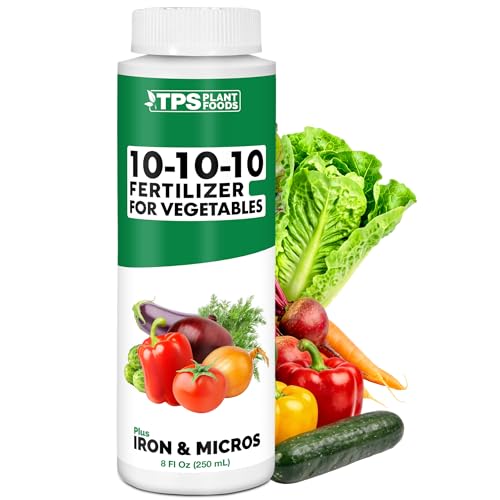
TPS NUTRIENTS 10-10-10 is a concentrated liquid fertilizer intended for vegetables. Its balanced N-P-K ratio, with added iron and micronutrients, makes it an option for home gardeners seeking general-purpose feeding across several crops.
The product information says the formula supports roots, foliage, and yield. These are stated aims, not guaranteed results, and plant response can vary with growing conditions and care.
The bottle holds 8 oz and measures 1.5 x 1.5 x 6 inches. The compact size may be convenient to store, but the published details do not include a measuring cap, dilution rate, or application instructions.
Listed uses include garden beds, rows, raised planters, and container vegetables. That range may suit a backyard vegetable patch or patio containers where one general-purpose fertilizer is preferred.
Follow the product label for mixing, application, and storage directions. The published information does not give feeding frequency or coverage, so gardeners should check those details before applying it.
Consider this fertilizer if you want a balanced liquid blend for vegetables and value added iron and micronutrients. Gardeners with large areas, crop-specific feeding needs, or a preference for a different N-P-K ratio may want another option.
Best For / Avoid If
Best for buyers prioritizing
- Balanced formula is suited to gardeners looking for general vegetable feeding.
- Includes iron and micronutrients in addition to N-P-K.
- Can be used across several vegetable-growing setups, including containers.
Consider another option if
- The 8 oz bottle may be less suitable for gardeners feeding large planting areas or many containers.
- The published product details do not specify dilution rates or feeding frequency, so consult the label before use.
- Who should skip it: gardeners seeking a fertilizer tailored to a specific crop or a different nutrient ratio.

Pros
- Suitable for a broad range of flowering and edible plants.
- Provides a specific dilution rate and repeat interval.
- Can be applied by pouring or spraying.
Cons
- The published details do not list nutrient analysis, so gardeners cannot compare its nutrient balance from this information.
- Mixing is required before each application, which adds a step to watering.
- Who should skip it: gardeners seeking a ready-to-use formula or a fertilizer with a clearly listed nutrient analysis.
Farmer’s Secret Fruit & Bloom Booster is a concentrated liquid fertilizer for plants grown for flowers, fruits, or vegetables. Its stated use across these plant types may suit home gardeners tending mixed beds, containers, or fruiting plants.
The product information says the formula works by strengthening roots to increase nutrient uptake, with the intended goal of supporting blooms and fruit production. Results can vary with plant type and growing conditions, so treat these as intended benefits rather than guaranteed outcomes.
Use requires dilution: the listed recommendation is 1 teaspoon per 2 gallons of water. Apply by pouring or spraying alongside regular watering, then repeat every 2 to 4 weeks according to the product directions.
That routine may fit backyard vegetable patches, patio containers, and ornamental flower plantings where one feeding product is convenient across several plant types. Listed examples include citrus, avocados, raspberries, cantaloupe, roses, and petunias.
The published details do not provide nutrient analysis or specific directions for individual plant types. Measure the dilution carefully, follow the label, and avoid assuming this replaces other care or fertilizer needs. Gardeners who want a ready-to-use product or a formula with listed nutrient balance may prefer another option.
Best For / Avoid If
Best for buyers prioritizing
- Suitable for a broad range of flowering and edible plants.
- Provides a specific dilution rate and repeat interval.
- Can be applied by pouring or spraying.
Consider another option if
- The published details do not list nutrient analysis, so gardeners cannot compare its nutrient balance from this information.
- Mixing is required before each application, which adds a step to watering.
- Who should skip it: gardeners seeking a ready-to-use formula or a fertilizer with a clearly listed nutrient analysis.

Pros
- Includes three distinct fertilizers intended to work together.
- Listed plant uses include common ornamental and edible garden plants.
- Tiger Bloom’s stated 2-8-4 formulation gives gardeners a specific nutrient ratio to consider.
Cons
- Using three separate formulas may require more measuring and application steps than a single plant food.
- The published product details do not include application rates or a feeding schedule, so gardeners must consult product directions before use. Who should skip it: gardeners who prefer a single-formula fertilizer or need a clearly specified feeding schedule in the listing.
FoxFarm Soil Liquid Trio Pack combines Big Bloom, Grow Big, and Tiger Bloom as a liquid fertilizer program for supporting plant growth, bud development, and fruit production. It may suit home gardeners who want a set of formulas for common flowers, vegetables, and houseplants.
The listed roles differ by formula: Big Bloom is described for use across growth stages, while Grow Big is intended for plants including roses, tomatoes, houseplants, and vegetables. Tiger Bloom is listed as a 2-8-4 fertilizer with low pH, which the product information says helps maintain micronutrient availability during storage.
The set contains three pint bottles. The published specifications do not describe bottle controls, application rates, dilution instructions, or a feeding schedule, so follow the directions on product packaging and avoid assuming the formulas use identical application steps.
For backyard beds, patio containers, or indoor plant collections, the range of listed plant uses may make this set relevant to gardeners tending both ornamental and edible plants. Its three-formula approach may also suit growers who want to follow a coordinated nutrition program.
Using several fertilizers can involve more measuring and planning than using one plant food. Check each formula’s directions and use only as directed for the plant and growing conditions. Gardeners who want a single product or need application instructions included in the listing may prefer another option.
Best For / Avoid If
Best for buyers prioritizing
- Includes three distinct fertilizers intended to work together.
- Listed plant uses include common ornamental and edible garden plants.
- Tiger Bloom’s stated 2-8-4 formulation gives gardeners a specific nutrient ratio to consider.
Consider another option if
- Using three separate formulas may require more measuring and application steps than a single plant food.
- The published product details do not include application rates or a feeding schedule, so gardeners must consult product directions before use. Who should skip it: gardeners who prefer a single-formula fertilizer or need a clearly specified feeding schedule in the listing.

Pros
- Suitable for several common plant groups and turf grasses.
- Concentrated format can make up to 32 gallons of diluted fertilizer.
- Squeezable measure-and-pour bottle supports controlled dosing.
Cons
- The listed rate varies from 1-2 oz per gallon, so gardeners must choose a dilution rate suited to their use and follow product directions.
- Who should skip it: gardeners seeking a dry, slow-release fertilizer or a formulation tailored to one specific plant type.
Pendelton Turf Supply Triple 10 is a concentrated liquid fertilizer with a 10-10-10 formula, 5.5% amino acids, and seaweed extract. Product information lists it for general use across plant growth stages, making it a potential fit for homeowners caring for mixed garden beds or turf.
Listed uses include gardens, flowers, fruits, vegetables, and turf grasses, indoors or outdoors. The broad range may suit gardeners who want one fertilizer for several of these areas, rather than separate products for each listed use.
Mix 1-2 oz per gallon of water, with the product directions recommending that users start at the lower rate and increase as needed. The instructions also call for generous watering and continued use every 1-2 weeks. The 32 fl oz bottle is listed as making up to 32 gallons, which corresponds to the lower dilution rate.
The bottle has a squeeze-to-measure design intended to dispense a specific dose. This can make measuring and pouring more straightforward when mixing small batches for containers, garden beds, or other listed uses. Product data does not specify bottle dimensions or additional application equipment.
The broad-purpose formula may be less suitable for gardeners who need a fertilizer selected for a particular crop or growing condition. Follow the label directions, start at the lower listed rate, and avoid applying more often or at a stronger dilution than directed. Gardeners seeking a dry, slow-release product should consider a different format.
Best For / Avoid If
Best for buyers prioritizing
- Suitable for several common plant groups and turf grasses.
- Concentrated format can make up to 32 gallons of diluted fertilizer.
- Squeezable measure-and-pour bottle supports controlled dosing.
Consider another option if
- The listed rate varies from 1-2 oz per gallon, so gardeners must choose a dilution rate suited to their use and follow product directions.
- Who should skip it: gardeners seeking a dry, slow-release fertilizer or a formulation tailored to one specific plant type.

Pros
- Works with a broad range of listed uses, including vegetables, herbs, flowers, houseplants, and garden plants.
- Plant-derived ingredients align with organic gardening preferences.
- Diluted yield may make one container useful across multiple watering sessions.
Cons
- Requires dilution with water according to label directions, adding a mixing step.
- Who should skip it: gardeners who prefer ready-to-use fertilizer or need a product with a specified nutrient analysis, which is not provided here.
Miracle-Gro Organic Plant Food is a liquid fertilizer for indoor and outdoor plants. Its listed uses include houseplants, container plants, vegetables, herbs, flowers, raised beds, and in-ground gardens, making it a flexible option for home gardeners feeding several types of plants.
The product information says it is made from 94% plant-based fertilizer ingredients and feeds plants when used as directed. It is OMRI Listed according to the title. These details may appeal to gardeners looking for plant-derived fertilizer for routine feeding.
Apply by diluting with water according to label directions, then soak the soil around each plant. The listed schedule is every 7 to 14 days for outdoor garden and balcony plants, and every two weeks for indoor plants. Follow the product label for exact dilution and application instructions.
The 32 fl. oz. container makes up to 10.75 gallons of diluted plant food, according to the product details. That format can suit a home with a mix of patio containers, raised beds, and indoor pots, though it requires access to water and a separate mixing step.
The published details do not provide a nutrient analysis or specific dosing amount, so check the label before use and avoid guessing at dilution. Gardeners who want ready-to-use feed or need stated nutrient proportions may prefer another product. For plant-derived liquid feeding across indoor and outdoor spaces, this is a practical option to consider.
Best For / Avoid If
Best for buyers prioritizing
- Works with a broad range of listed uses, including vegetables, herbs, flowers, houseplants, and garden plants.
- Plant-derived ingredients align with organic gardening preferences.
- Diluted yield may make one container useful across multiple watering sessions.
Consider another option if
- Requires dilution with water according to label directions, adding a mixing step.
- Who should skip it: gardeners who prefer ready-to-use fertilizer or need a product with a specified nutrient analysis, which is not provided here.

Pros
- Includes earthworm castings and bat guano.
- Directions provide a clear mixing rate and feeding frequency.
- Listed for flowering and fruiting plants as well as all growth stages.
Cons
- Requires measuring and mixing before application.
- The listed 0-0.5-0.7 NPK may not suit gardeners seeking a fertilizer with more nitrogen.
- Who should skip it: Gardeners who prefer ready-to-use plant food or need a different nutrient balance.
FoxFarm Big Bloom is a liquid plant food for flowering and fruiting plants. Its listed 0-0.5-0.7 NPK and blend of earthworm castings and bat guano make it an option for home gardeners seeking a bloom-focused feed for plants at different growth stages.
The product information says the formula supports flowering, fruiting, and seed formation, and is designed for quick nutrient uptake. These are product claims, not a guarantee of a particular bloom or harvest. Plant response can vary with growing conditions and care.
Directions call for mixing 4 tablespoons (60 mL) per gallon (4L) of water every other watering. The product can also be used with a hose-end sprayer, siphon mixer, or drip irrigation, according to the published information. The 1-pint size measures 2.5 x 7.81 x 2.5 inches and weighs 1 lb.
For backyard beds, patio containers, or other growing spaces, the liquid format can fit into an existing watering routine for flowering and fruiting plants. Follow the stated mixing rate, and check the instructions on the product label for application details before using any alternate delivery method.
Feeding requires measuring and mixing, and gardeners seeking a fertilizer with more nitrogen may prefer a different nutrient balance. The published information does not specify application rates beyond the listed mixing directions. Store and handle the product according to its label.
Big Bloom may suit gardeners who want a liquid feed with earthworm castings and bat guano for flowering and fruiting plants. Who should skip it: Gardeners who want ready-to-use food or a fertilizer formulated with a different NPK balance.
Best For / Avoid If
Best for buyers prioritizing
- Includes earthworm castings and bat guano.
- Directions provide a clear mixing rate and feeding frequency.
- Listed for flowering and fruiting plants as well as all growth stages.
Consider another option if
- Requires measuring and mixing before application.
- The listed 0-0.5-0.7 NPK may not suit gardeners seeking a fertilizer with more nitrogen.
- Who should skip it: Gardeners who prefer ready-to-use plant food or need a different nutrient balance.

Pros
- Combines balanced NPK, seaweed extract, and chelated iron in one liquid formula.
- Listed for several common garden settings, from houseplants to lawns.
- Mix-with-water format can fit into an existing watering routine.
Cons
- Dilution rate and application frequency are not provided in the published product details, so gardeners need to consult the label.
- An 8 fl oz bottle may be less convenient for gardeners treating large areas frequently.
- Who should skip it: gardeners seeking a fertilizer tailored to a specific crop or soil condition may prefer a product with more targeted directions.
GARDENWISE ASTEVORA is an 8 fl oz liquid fertilizer intended for indoor and outdoor plants. Its listed 10-10-10 NPK blend makes it a general-purpose option for homeowners who want one formula for common garden and houseplant care.
The product information lists nitrogen, phosphorus, and potassium at 10% each, plus seaweed extract and 6% chelated iron. This combination is intended to support general plant nutrition, while the iron may be relevant where iron-related yellowing is a concern. Results depend on plant needs and correct use.
The concentrate is described as mixing with water and being applied during watering. Listed bottle dimensions are 3 x 3 x 6 inches, and listed weight is 0.5 lb. The published details do not specify a measuring control, dilution rate, or application schedule, so check the product label before mixing.
Its stated uses include vegetables, flowers, lawns, shrubs, and indoor houseplants. That range may suit gardeners managing a mix of containers, backyard beds, and lawn areas, though the small bottle may be more practical for limited use than repeated treatment of a large lawn.
Do not assume one feeding schedule suits every plant. Follow label directions for dilution and frequency, and avoid applying more than directed. The published information does not provide crop-specific instructions or coverage estimates.
Consider this fertilizer if you want a liquid, general-purpose formula with listed seaweed extract and chelated iron. Gardeners needing precise crop-specific guidance, a larger quantity, or a different nutrient balance should consider another option.
Best For / Avoid If
Best for buyers prioritizing
- Combines balanced NPK, seaweed extract, and chelated iron in one liquid formula.
- Listed for several common garden settings, from houseplants to lawns.
- Mix-with-water format can fit into an existing watering routine.
Consider another option if
- Dilution rate and application frequency are not provided in the published product details, so gardeners need to consult the label.
- An 8 fl oz bottle may be less convenient for gardeners treating large areas frequently.
- Who should skip it: gardeners seeking a fertilizer tailored to a specific crop or soil condition may prefer a product with more targeted directions.

Pros
- Suitable for several common garden plant groups, reducing need for separate formulas.
- Lists both major plant nutrients and additional minerals.
- Concentrated format makes up to 32 gallons, according to the title.
Cons
- Fish-based ingredients may not suit gardeners avoiding animal-derived fertilizers.
- Application directions and feeding frequency are not provided in published details. Who should skip it: gardeners needing a vegan formula or clear feeding instructions on the product listing.
FOOP Organic All-Purpose Liquid Plant Food is a concentrated fertilizer for vegetables, herbs, flowers, trees, and shrubs. Its broad intended use may suit home gardeners who want one product for mixed plantings.
The listed nutrient blend includes nitrogen, phosphorus, potassium, calcium, magnesium, and silica. Product information also lists soil-enriching microbes, including mycorrhizae, alongside fish emulsion, kelp, and fish manure.
This is a 1-quart concentrate, and the title states that 32 ounces makes 32 gallons. Published details do not specify application directions or feeding frequency, so follow the product label when mixing and applying.
Its general-purpose format could fit vegetable beds, herb planters, flower beds, or established trees and shrubs. The concentrate may also be practical for gardeners who prepare fertilizer in batches, though the published information does not specify a measuring cap or other accessories.
Fish-based ingredients may not fit vegan gardening preferences. Because application guidance is not included in the published details, gardeners who need a stated feeding schedule should check the label before use.
Consider FOOP if you want a concentrated organic nutrient blend for varied garden plants. Choose another option if you need a vegan formula or application instructions confirmed before purchase.
Best For / Avoid If
Best for buyers prioritizing
- Suitable for several common garden plant groups, reducing need for separate formulas.
- Lists both major plant nutrients and additional minerals.
- Concentrated format makes up to 32 gallons, according to the title.
Consider another option if
- Fish-based ingredients may not suit gardeners avoiding animal-derived fertilizers.
- Application directions and feeding frequency are not provided in published details. Who should skip it: gardeners needing a vegan formula or clear feeding instructions on the product listing.
Pros
- Supports use across several listed fruit and vegetable crops.
- Works with in-ground and container plantings.
- Coverage stated as up to 400 sq. ft. per bottle.
Cons
- Requires a Miracle-Gro LiquaFeed Feeder or Universal Feeder, sold separately.
- Who should skip it: gardeners without a compatible feeder, or those seeking plant food for crops outside the listed fruit and vegetable use.
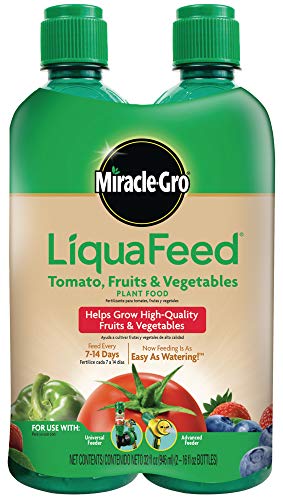
Miracle-Gro LiquaFeed Tomato, Fruits and Vegetables Plant Food is a liquid fertilizer refill for outdoor fruit and vegetable plants. It is intended for gardeners who want to feed plants while watering and have a compatible LiquaFeed feeder.
The listed uses include in-ground and container-grown vegetables and fruit plants, including peppers, strawberries, and blueberries. Product information says each 16 fl. oz. bottle feeds up to 400 sq. ft., which can help with planning garden coverage.
This refill pack contains two bottles. Application requires a Miracle-Gro LiquaFeed Feeder or Universal Feeder, sold separately, so check feeder availability before choosing this product.
It may suit a backyard vegetable bed, patio containers, or a mixed planting of listed fruit and vegetable crops. The stated coverage can help gardeners compare bottle supply with their planting area, though actual application should follow product label directions.
The main limitation is feeder dependence, and the published information does not specify a feeding schedule or fertilizer analysis. Follow the bottle label for application and storage instructions. Gardeners seeking a feeder-free option or plant food for other plant types should consider a different product.
Best For / Avoid If
Best for buyers prioritizing
- Supports use across several listed fruit and vegetable crops.
- Works with in-ground and container plantings.
- Coverage stated as up to 400 sq. ft. per bottle.
Consider another option if
- Requires a Miracle-Gro LiquaFeed Feeder or Universal Feeder, sold separately.
- Who should skip it: gardeners without a compatible feeder, or those seeking plant food for crops outside the listed fruit and vegetable use.

Pros
- Suitable for several common flower and food crops.
- Offers two listed application methods.
- Quart-size concentrate comes in a bottle measuring 3.3 x 3.2 x 9 inches.
Cons
- Mixing rates and feeding schedule are not provided here, so consult the product label before use.
- Who should skip it: gardeners seeking a dry, ready-to-use fertilizer or a formula with a different nutrient ratio.
FoxFarm Grow Big is a quart-size liquid plant food with a listed 6-4-4 nutrient ratio. It is intended for vegetative growth and named for roses, tomatoes, and vegetables, making it a potential fit for home gardeners feeding both indoor and outdoor plants.
Product information describes the formula as supporting quick nutrient uptake for newly sprouted and established plants. It also says the fertilizer is intended to support plant size and structure. These are product claims, not guaranteed outcomes; results depend on plant needs and use.
The fertilizer can be applied through regular watering or foliar feeding. Its low pH is described as helping maintain storage stability and keep micronutrients available. The listed bottle measures 3.3 x 3.2 x 9 inches and weighs 2.7 lb.
For a patio tomato, vegetable bed, or indoor plant collection, the listed range of uses offers flexibility when one liquid fertilizer suits the plants being grown. Follow the product label for dilution, feeding frequency, and application directions, since those details are not included in the available information.
This concentrate may be less suitable for gardeners who want a dry product, a ready-to-use formula, or a different nutrient ratio. Store and handle it according to its label, and avoid applying more than directed. Gardeners seeking a clear feeding schedule should check the label before buying.
Best For / Avoid If
Best for buyers prioritizing
- Suitable for several common flower and food crops.
- Offers two listed application methods.
- Quart-size concentrate comes in a bottle measuring 3.3 x 3.2 x 9 inches.
Consider another option if
- Mixing rates and feeding schedule are not provided here, so consult the product label before use.
- Who should skip it: gardeners seeking a dry, ready-to-use fertilizer or a formula with a different nutrient ratio.

Pros
- Suitable for a broad range of indoor potted plants.
- Offers two application methods: mix with water or apply to soil and water.
- Directions specify a recurring two-week feeding interval.
Cons
- The product information does not list nutrient analysis or a detailed dosage for direct soil application.
- Regular feeding requires remembering to reapply every two weeks.
- Who should skip it: gardeners seeking a granular, slow-release, or outdoor-specific fertilizer should consider another product.
Miracle-Gro Indoor Plant Food is a liquid fertilizer for indoor container plants. Its listed uses include houseplants, flowers, vegetables, and herbs, making it a practical option for beginners and homeowners feeding a mixed indoor collection.
The product information says it feeds instantly and contains nutrients intended to support healthier, stronger plants compared with unfed plants when used as directed. It is designed for routine feeding, not as a treatment for a specific plant problem.
Directions give two application options: apply the food directly to soil and then water, or mix it in 1 quart of water while watering plants. Reapply every two weeks. The listing does not provide a nutrient analysis or a detailed quantity for direct soil application, so follow the product label for exact use.
The two 8 fl. oz. bottles can suit households caring for several indoor pots, from kitchen herbs to ornamental plants. The listed indoor-container use does not establish suitability for outdoor beds or lawns.
This fertilizer requires regular reapplication, and gardeners wanting a slow-release or outdoor-specific product may prefer a different format. Store and apply it according to the label, and avoid overfeeding by following its directions.
Consider it if you want liquid plant food with two listed application methods for a variety of indoor pots. Who should skip it: gardeners who need a product with published nutrient percentages, a specified direct-application dose, or use beyond indoor containers.
Best For / Avoid If
Best for buyers prioritizing
- Suitable for a broad range of indoor potted plants.
- Offers two application methods: mix with water or apply to soil and water.
- Directions specify a recurring two-week feeding interval.
Consider another option if
- The product information does not list nutrient analysis or a detailed dosage for direct soil application.
- Regular feeding requires remembering to reapply every two weeks.
- Who should skip it: gardeners seeking a granular, slow-release, or outdoor-specific fertilizer should consider another product.

Pros
- Formulated for tomatoes, vegetables, and houseplants.
- Includes multiple listed ingredients beyond nitrogen, phosphorus, and potassium.
- Provides separate dilution guidance for outdoor plants and houseplants.
Cons
- Requires dilution and recurring applications, which may not suit gardeners seeking a ready-to-use feed.
- Who should skip it: gardeners who need a dry, slow-release fertilizer or a formula with a different nutrient ratio.
Neptune’s Harvest Organic Tomato & Vegetable Plant Fertilizer is a liquid 2-4-2 plant food intended for tomatoes, vegetables, and houseplants. Its listed uses make it a practical option for home growers tending outdoor beds, containers, or indoor pots.
The ingredient list includes fish, seaweed, molasses, humate, yucca extract, biological microbes, and liquid calcium. Product information presents it as a feed for the vegetative growth stage and for supporting foliage, stems, and roots, but results can vary with plant, soil, and growing conditions.
The quart container measures 4 x 4 x 10 inches, based on the published specifications. Use requires mixing with water: directions list 1 oz. per gallon for outdoor plants and 1 tablespoon per gallon for houseplants. The product information also lists root and foliar application.
For a backyard vegetable bed or patio containers, the outdoor dilution and every-1-to-2-week schedule provide a stated routine. Indoor gardeners can follow the separate houseplant dilution and weekly schedule. Follow the product label for application details and handling.
This is a concentrated liquid that requires measuring and dilution, so it may be less convenient than ready-to-use plant food. Gardeners needing a dry or slow-release product, or a different nutrient ratio, should consider another option. Keep fertilizer handled and stored according to its label, especially around children and pets.
Best For / Avoid If
Best for buyers prioritizing
- Formulated for tomatoes, vegetables, and houseplants.
- Includes multiple listed ingredients beyond nitrogen, phosphorus, and potassium.
- Provides separate dilution guidance for outdoor plants and houseplants.
Consider another option if
- Requires dilution and recurring applications, which may not suit gardeners seeking a ready-to-use feed.
- Who should skip it: gardeners who need a dry, slow-release fertilizer or a formula with a different nutrient ratio.

Pros
- Specific dilution and every-other-watering directions make feeding straightforward.
- A low-listed NPK formula of 0-0.5-0.7 is clearly stated on the product title.
- The quart bottle is a manageable size for home gardeners to store and handle.
Cons
- Requires mixing with water, so it is less convenient than a ready-to-use feed.
- Gardeners seeking a fertilizer with higher listed nitrogen may prefer a different formula.
- Who should skip it: gardeners who do not want to mix fertilizer or whose plants need a different nutrient balance.
FoxFarm Big Bloom is a liquid plant food intended for flowering and fruiting plants, with product information also describing use at every stage of growth. It may suit home gardeners looking for a water-diluted feed for flowers, vegetables, and other fruiting plants.
The listed formula is 0-0.5-0.7 NPK, and the ingredients include earthworm castings and bat guano. The product is formulated to support blooms and seed formation, but gardeners should match fertilizer choice to their plants’ needs rather than assume one formula suits every situation.
Directions call for mixing 4 tablespoons, or 60 mL, per gallon of water and applying every other watering. The liquid can also be used with a hose-end sprayer, siphon mixer, or drip irrigation, according to the product information. Follow label directions for application and handling.
A 1-quart bottle measures 3.2 by 3.2 by 8.9 inches and weighs 2 lb, based on the listed specifications. Its compact bottle format can fit ordinary garden supply storage, while the concentrate requires measuring and mixing before use.
For patio containers, raised beds, or backyard flower and vegetable gardens, this may be a practical option when a liquid feed and the listed nutrient profile fit the planting plan. The product information does not specify coverage, so the number of applications will depend on mixing and watering habits.
Choose another formula if plants need a different nutrient balance or if you prefer ready-to-use fertilizer. Who should skip it: gardeners unwilling to measure and mix liquid feed, or those seeking a fertilizer with higher listed nitrogen.
Best For / Avoid If
Best for buyers prioritizing
- Specific dilution and every-other-watering directions make feeding straightforward.
- A low-listed NPK formula of 0-0.5-0.7 is clearly stated on the product title.
- The quart bottle is a manageable size for home gardeners to store and handle.
Consider another option if
- Requires mixing with water, so it is less convenient than a ready-to-use feed.
- Gardeners seeking a fertilizer with higher listed nitrogen may prefer a different formula.
- Who should skip it: gardeners who do not want to mix fertilizer or whose plants need a different nutrient balance.

Pros
- Broad listed plant range covers common indoor and outdoor growing needs.
- Concentrated liquid format supports mixing for different watering tasks.
- Product information identifies both soil and hydroponic use.
Cons
- The provided information does not give a dilution ratio, so gardeners must check the product label before mixing.
- Who should skip it: gardeners who need a published nutrient analysis or precise feeding schedule should choose a fertilizer with those details clearly listed.
Pegmapri Organic Liquid Plant Food is a concentrated fertilizer intended for houseplants, tropicals, flowers, vegetables, and herbs. Its listed indoor and outdoor uses make it a possible fit for gardeners managing containers alongside raised beds.
The product information describes a blend of organic nutrients and says the liquid mixes with water for feeding. It also states that the formula is designed for rapid nutrient uptake, though the supplied details do not identify nutrient percentages or document specific plant results.
The 8.45 fl oz bottle is described as concentrated, but no dilution ratio is provided in the available specifications. Check the product label for mixing directions before use, and follow those instructions for the plant and growing method.
For a patio gardener, the liquid format may work with a watering can for container plants. The product is also listed for soil drenching, raised beds, and hydroponic systems, which gives it potential use across several small-space setups.
Product information describes it as water-soluble and low-residue for drip irrigation, but system suitability depends on following the label directions. Gardeners who need a stated nutrient analysis or exact feeding schedule should consider an option with those details published. This may suit growers seeking one broadly listed liquid feed, while those requiring precise formulation data should skip it.
Best For / Avoid If
Best for buyers prioritizing
- Broad listed plant range covers common indoor and outdoor growing needs.
- Concentrated liquid format supports mixing for different watering tasks.
- Product information identifies both soil and hydroponic use.
Consider another option if
- The provided information does not give a dilution ratio, so gardeners must check the product label before mixing.
- Who should skip it: gardeners who need a published nutrient analysis or precise feeding schedule should choose a fertilizer with those details clearly listed.

Pros
- Application rate and frequency are clearly provided.
- Suitable for in-ground and container growing, indoors and outdoors, according to the product information.
- Soy protein hydrolysate is a specifically named ingredient.
Cons
- Requires dilution and repeat applications, which may not suit gardeners seeking a ready-to-use feed.
- Who should skip it: gardeners who need a fertilizer with a disclosed nutrient analysis or specific nutrient ratio, since those details are not provided here.
True Organic Liquid Tomato & Vegetable Food is a liquid fertilizer intended for fruit and vegetable plants. Its listed uses include in-ground and container gardens, making it a possible fit for homeowners feeding a vegetable bed, patio pots, or indoor plantings.
The directions call for mixing 2 ounces of product per gallon of water and applying every two weeks during the growing season. The product description identifies soy protein hydrolysate in its formula and presents it as a nutrient-rich option for garden plants.
The bottle is listed as 32 fluid ounces, with approximately 60 square feet of coverage. The supplied information does not give a nutrient analysis or specify application volume per square foot, so gardeners should follow the label directions for their particular plants and avoid assuming a precise dose beyond the stated dilution.
For a backyard bed or a group of containers, the diluted format can fit into a regular watering routine. The product information also lists indoor and outdoor use, though it does not provide specific instructions for different plant types or growing systems.
This fertilizer requires measuring, mixing, and repeat applications. Gardeners who prefer ready-to-use products or need a disclosed nutrient ratio may want a different option. Overall, it may suit growers seeking a liquid tomato and vegetable food with a stated schedule, provided they are comfortable preparing each application according to the label.
Best For / Avoid If
Best for buyers prioritizing
- Application rate and frequency are clearly provided.
- Suitable for in-ground and container growing, indoors and outdoors, according to the product information.
- Soy protein hydrolysate is a specifically named ingredient.
Consider another option if
- Requires dilution and repeat applications, which may not suit gardeners seeking a ready-to-use feed.
- Who should skip it: gardeners who need a fertilizer with a disclosed nutrient analysis or specific nutrient ratio, since those details are not provided here.

Pros
- Broad plant labeling may simplify feeding in gardens with different crop types.
- Listed dilution and frequency give beginners a straightforward starting point.
- Liquid format can be mixed with water for container or in-ground applications.
Cons
- The two-week schedule requires recurring mixing and application during the growing season.
- Fish-derived ingredients may not suit gardeners who prefer fertilizers without fish solubles.
- Who should skip it: gardeners seeking a dry, slow-release fertilizer or a formula tailored to one plant type.
True Organic Liquid All Purpose Plant Food is a liquid fertilizer labeled for fruits, flowers, vegetables, herbs, and foliage. It is intended for indoor and outdoor plants, in containers or in-ground beds, so it may suit home gardeners feeding a mix of crops and ornamentals.
The listed nutrient analysis is 3% nitrogen, 2% phosphate, and 2% potash, with 2.9% of the nitrogen identified as water-soluble. Product information lists fish solubles, soy protein hydrolysate, and kelp extract as sources. These details describe the formula, but do not establish a guaranteed result for every plant or growing condition.
Application instructions call for mixing 2 oz. per gallon of water and applying every two weeks during the growing season. The 32 fl. oz. bottle is listed to cover approximately 60 sq. ft. Follow the product label for application directions, and avoid applying more often or at a stronger dilution than directed.
For a backyard vegetable bed, patio containers, or a group of indoor foliage plants, one labeled formula can reduce the need to keep separate feeds for each plant category. Check that each plant's care needs fit the label, especially when growing a varied collection in limited space.
The recurring schedule means gardeners need to measure, mix, and apply fertilizer regularly. The listed fish solubles may also make this a poor fit for anyone avoiding fish-derived ingredients. Store and handle the product according to its label, and keep it away from children and pets during use and storage.
Consider this option if you want a liquid feed labeled for several common plant types and can follow a regular watering-based schedule. Who should skip it: gardeners who want slow-release granules, a plant-specific formula, or fertilizer without fish-derived ingredients.
Best For / Avoid If
Best for buyers prioritizing
- Broad plant labeling may simplify feeding in gardens with different crop types.
- Listed dilution and frequency give beginners a straightforward starting point.
- Liquid format can be mixed with water for container or in-ground applications.
Consider another option if
- The two-week schedule requires recurring mixing and application during the growing season.
- Fish-derived ingredients may not suit gardeners who prefer fertilizers without fish solubles.
- Who should skip it: gardeners seeking a dry, slow-release fertilizer or a formula tailored to one plant type.

Pros
- 2-15-15 formula is specifically positioned for flowering and fruiting rather than general-purpose feeding.
- Several application methods are listed, including soil drench, foliar spray, drip irrigation, and hose-end use.
- Suitable plant list spans common vegetables, strawberries, flowers, and fruit trees.
Cons
- Mixing ratios and application frequency are not provided in the supplied product information, so gardeners should check the label before use.
- Low nitrogen formula may be less suitable for plants that need a nitrogen-focused feed during leafy growth.
- Who should skip it: gardeners seeking an all-purpose fertilizer or a product with clearly stated dosage guidance in the available listing.
YARDi Fruit & Bloom is a 32-ounce liquid outdoor fertilizer with an NPK ratio of 2-15-15 and added micronutrients. It is intended for flowering and fruiting stages, making it a potential fit for home gardeners feeding vegetables, fruiting plants, and flowers.
The low-nitrogen formula has higher listed phosphorus and potassium levels. Product information recommends applying once buds appear and names tomatoes, peppers, squash, cucumbers, strawberries, dahlias, roses, and fruit trees among its intended uses. These are stated uses, not a guarantee of bloom or yield results.
The fertilizer mixes with water and is listed for soil drenching, foliar spraying, drip irrigation, or hose-end application. The listing does not provide mixing ratios or application frequency, so follow the product label for dilution and use instructions. The bottle size is 32 ounces, and its weight is listed as 2 lb.
For a backyard garden, one bottle could serve both vegetable beds and flower plantings, provided the plants are at the appropriate growth stage and label directions cover the intended application method. The listed methods may also suit gardeners who already use drip irrigation or prefer feeding directly to soil.
The main limitation is the missing dosage detail in the supplied information. Its low nitrogen content may not suit plants needing more support for leafy growth, and gardeners should avoid assuming every plant requires bloom-stage feeding. Follow label directions and avoid applying more than instructed.
Consider this fertilizer if you want a liquid feed aimed at outdoor flowering and fruiting plants with several listed application methods. Choose a general-purpose or nitrogen-focused fertilizer instead if your main goal is leafy growth or you need dosage guidance clearly stated before purchase.
Best For / Avoid If
Best for buyers prioritizing
- 2-15-15 formula is specifically positioned for flowering and fruiting rather than general-purpose feeding.
- Several application methods are listed, including soil drench, foliar spray, drip irrigation, and hose-end use.
- Suitable plant list spans common vegetables, strawberries, flowers, and fruit trees.
Consider another option if
- Mixing ratios and application frequency are not provided in the supplied product information, so gardeners should check the label before use.
- Low nitrogen formula may be less suitable for plants that need a nitrogen-focused feed during leafy growth.
- Who should skip it: gardeners seeking an all-purpose fertilizer or a product with clearly stated dosage guidance in the available listing.
Start with the crop and growth stage
Leafy crops and fruiting crops do not necessarily call for identical feeding approaches. Product names and listed NPK values can help narrow choices, but they do not replace the full label. FoxFarm Grow Big is listed as 6-4-4 and named for vegetative growth, while Fox Farm Big Bloom is listed as 0-0.5-0.7 and described for flowering and fruiting plants. Those descriptions indicate different intended emphases, not guaranteed results.
Read the NPK ratio as a comparison tool
NPK numbers represent nitrogen, phosphorus, and potassium in that order. A 10-10-10 product lists equal percentages of these nutrients; 2-4-2 lists a different balance. Neither ratio is automatically right for every vegetable bed. Consider existing soil fertility and the crop’s needs before adding nutrients, and use a soil test or local extension guidance when uncertainty could lead to excess application.
Check whether product details support your decision
Several published listings provide a name, package size, or NPK ratio but no dilution rate, feeding interval, or full label instructions. Do not infer those details from another product in the same brand line. Before buying, confirm the current package label for vegetable suitability, mixing instructions, application method, and any crop-specific restrictions.
Choose package size for likely use
Small containers can suit a few patio pots or a first-season garden, while larger packages may be more practical for repeated use across a larger planting. The listings include several sizes of Farmer’s Secret Fruit & Bloom Booster Fertilizer and different bottle sizes among other products. Concentration and application rate affect how much a package covers, so volume alone cannot establish value.
Avoid feeding by habit
More frequent or stronger feeding is not automatically better. Excess fertilizer can contribute to nutrient imbalance or runoff, and a plant problem may have causes unrelated to nutrition. Follow the selected product’s label exactly, avoid combining products unless their instructions permit it, and do not use an application schedule borrowed from a different fertilizer.
Consider odor and handling preferences
Neptune’s Harvest Organic Tomato & Vegetable Plant is described as containing fresh fish, seaweed, molasses, yucca extract, and humic acids. Gardeners who prefer to avoid fish-based ingredients may favor a different listed product. Product data does not establish odor intensity or storage behavior, so check label directions and packaging guidance before purchase.
Plan storage and safe application
Store fertilizer in its original, closed container and follow the manufacturer’s storage and disposal instructions. Keep it away from children and pets, prevent spills, and avoid contact with eyes or skin. Apply only as directed on the label, including precautions about edible crops, watering, and handling. Local rules may also govern fertilizer use near waterways.
Treat organic wording and extras carefully
Some names identify a product as organic or list ingredients such as seaweed, amino acids, earthworm castings, or bat guano. Such wording does not by itself establish certification, suitability for a particular growing standard, or better results. Check the package label and certification details if those are important to your gardening practices.
Research methodology and trust
We screened the published listings for liquid fertilizer products with clear relevance to vegetables, fruiting plants, or general plant feeding. We excluded no relevant fertilizer solely because the listing lacked detail, but limited each assessment to facts present in the published product data. The provided list contains 10 fully described entries for this comparison, although the listed product count is 20.
Comparison focused on vegetable relevance, stated NPK ratios, named ingredients or intended use, package size, and whether the published information supports a practical choice. Product names and descriptions are listing claims, not independent confirmation of performance. Price and review information were supplied, but the listed rating data shows zero reviews for each entry, so owner-feedback trends cannot be assessed from this dataset.
This is research-based editorial analysis, not physical product evaluation. The available data omits application rates and full label directions for many products. We updated this guide during October using the published information; confirm current package instructions and product details before purchase or use.
Frequently asked questions
How do I choose the best liquid fertilizer for vegetables?
Match intended use and NPK ratio to your crops and existing soil conditions. Confirm vegetable suitability, dilution, and frequency on the product label before applying.
Does a 10-10-10 fertilizer work for every vegetable?
The ratio indicates equal listed percentages of nitrogen, phosphorus, and potassium, not universal suitability. Soil fertility, crop needs, and label directions should guide the choice.
Is liquid fertilizer a good fit for a small garden?
It can be convenient where a gardener wants a liquid product, but package volume alone does not show how many plants it will feed. Check concentration and label application rates to estimate use for pots or a small bed.
How often should I apply liquid fertilizer?
Use the schedule on the specific product label. The published listings do not provide consistent application intervals, so do not assume products share a feeding schedule.
How should I store liquid vegetable fertilizer?
Keep it in its original container and follow manufacturer storage instructions. Secure the container away from children and pets, and follow label guidance for spills and disposal.
Are organic liquid fertilizers always the better choice?
Organic wording alone does not show that a product fits every garden or growing standard. Compare the label, nutrient information, ingredients, and any certification requirements that matter to you.
Continue your garden research
Browse more practical guides in Compost, Soil & Mulch.
For product comparisons, see Best Compost Bin For Small Backyard: Reviews and Buying Guide.
See how Dove Creek Gardens researches and compares products.