

Ants in a vegetable garden do not always mean crops are being damaged. Before choosing a control, identify where ants are active and what the product is labeled to target. This guide to Best Ant Killer For Vegetable Gardens focuses on the listed option that explicitly names ants and outdoor use, while explaining why several other listed products are not clear matches for this task.
We compared 20 published listings for target pest, control method, stated use setting, and relevance to a food-growing garden. Product names and descriptions provide limited evidence, so recommendations stay narrow. If you want to reduce pesticide use, consider the practical approaches in our guide to protecting a garden without pesticides.
Garden Safe Diatomaceous Earth Outdoor Crawling Insect Killer Sevin Ready-to-Use Insecticide Dust for Garden and Lawn Pests Sevin Insect Killer Dust for Contact Control in Gardens and Lawns Garden Safe Multi-Purpose Insect Killer Spray for Home Gardens Prices and availability can change. We may earn a commission from qualifying purchases.


Pros
- Lists several common crawling garden pests as targets.
- Can be dusted directly onto insects for contact treatment.
- Specified for outdoor use around plants and on soil.
Cons
- Not intended for indoor use according to the published product information.
- Fine powder may be less convenient in windy conditions; coverage area and reapplication guidance are not provided here. Who should skip it: gardeners needing indoor treatment or precise coverage instructions.
Garden Safe Crawling Insect Killer is a 4 lb diatomaceous earth product for outdoor control of listed crawling insects. It may suit homeowners who want to treat insects around garden plants and on soil.
The product information says it kills by contact. When dusted onto insects, the fine granules absorb oils and fats and cut into their outer shells, contributing to dehydration. Listed targets include German cockroaches, ants, beetles, fleas, and mealybugs.
Instructions specify applying a thin layer of the powdery granules to plants and soil around plants. The package weighs 4.14 lb and measures 3.5 x 11 x 16 inches. Product information does not give a coverage area or application controls.
For backyard beds or planted areas, gardeners can use it where listed crawling insects are present, dusting insects directly when possible. It is designated for outdoor use, so it is not the choice for indoor pest treatment.
Apply only as directed on the product label, and take care when handling fine, powdery granules. The product is described as suitable for organic gardening, but no certification is specified. Gardeners who need indoor use, coverage estimates, or more application guidance should consider another option.
Best For / Avoid If
Best for buyers prioritizing
- Lists several common crawling garden pests as targets.
- Can be dusted directly onto insects for contact treatment.
- Specified for outdoor use around plants and on soil.
Consider another option if
- Not intended for indoor use according to the published product information.
- Fine powder may be less convenient in windy conditions; coverage area and reapplication guidance are not provided here. Who should skip it: gardeners needing indoor treatment or precise coverage instructions.
Pros
- Ready-to-use format avoids preparing a liquid spray.
- Lists several familiar garden pests among its targets.
- Product information says people and pets can return after dust has settled.
Cons
- Dust may be less suitable for gardeners who prefer liquid application or want to avoid airborne powder.
- Who should skip it: gardeners whose pest is not listed, or anyone unwilling to follow pesticide label directions carefully.
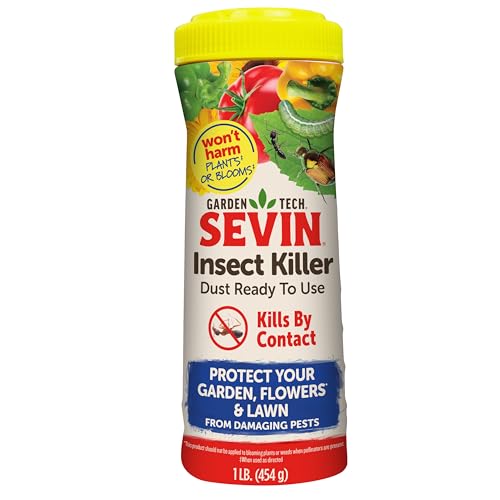
Sevin Insect Killer Dust is a ready-to-use insecticide powder for listed pests on gardens, flowers, and lawns. It may suit homeowners who want a shake-on product for addressing insect activity without mixing a spray.
The product information lists contact action against more than 150 insects, including ants, Japanese beetles, whiteflies, and aphids. It also states that the dust will not harm plants or blooms when used as directed; check the product label to confirm that your plant and pest are included.
The package contains 1 lb of white dust, and the stated application method is to shake it onto the treatment area. No coverage area or application rate is provided here, so use the label for how much to apply and how often.
For backyard use, the listed application areas include flower beds and lawns. Applying early or at the first signs of insect damage follows the product information, but identification matters: this product is intended for listed insects, not every garden pest.
Dust can become airborne during application, so follow all label precautions and avoid breathing or spreading it beyond the intended area. Product information says people and pets may return once the dust has settled. Keep them away until then, and follow the label for any additional restrictions.
This is a practical option for gardeners comfortable using a dust insecticide and able to verify target pests on the label. Gardeners who prefer liquid products, need a specified coverage area, or want to manage unlisted pests should consider another approach.
Best For / Avoid If
Best for buyers prioritizing
- Ready-to-use format avoids preparing a liquid spray.
- Lists several familiar garden pests among its targets.
- Product information says people and pets can return after dust has settled.
Consider another option if
- Dust may be less suitable for gardeners who prefer liquid application or want to avoid airborne powder.
- Who should skip it: gardeners whose pest is not listed, or anyone unwilling to follow pesticide label directions carefully.
Pros
- No mixing step is needed before application.
- Listed targets include several common garden pests.
- Compact 3 lb package measures 4 x 4 x 11.23 inches.
Cons
- Dust application may be less suitable for gardeners who prefer liquid products or do not want to handle loose powder.
- Who should skip it: gardeners whose pest or intended treatment area is not listed on the product label.
Sevin Insect Killer Dust is a ready-to-use insecticide powder intended for listed pests on gardens, flowers, and lawns. It may suit homeowners who want a shake-to-apply product for responding to early insect damage.
The product information says the dust kills listed insects by contact and covers more than 150 listed insects. Named examples include ants, Japanese beetles, whiteflies, and aphids. It is intended for use on flowers and lawns, and the product information states it will not harm plants or blooms.
The 3 lb package measures 4 x 4 x 11.23 inches. The powder is ready to use, so no mixing is needed. Apply by shaking, following the product label for application details and precautions.
For a backyard lawn or flower bed, the listed use cases make this a possible option when one of the named pests appears. Gardeners can also consider it for other areas only when those uses and target insects appear on the label.
Dust may be less convenient for people who prefer liquid treatments or want to avoid handling powder. Follow label directions, keep people and pets away during application, and allow them to return only once dust has settled, as product information directs. Who should skip it: gardeners treating an unlisted pest or area.
This may fit gardeners seeking a ready-to-use contact insecticide for listed pests on flowers and lawns. Check the label before use to confirm the target insect, application method, and safety directions match your garden.
Best For / Avoid If
Best for buyers prioritizing
- No mixing step is needed before application.
- Listed targets include several common garden pests.
- Compact 3 lb package measures 4 x 4 x 11.23 inches.
Consider another option if
- Dust application may be less suitable for gardeners who prefer liquid products or do not want to handle loose powder.
- Who should skip it: gardeners whose pest or intended treatment area is not listed on the product label.
Pros
- Named pest examples include common vegetable-garden pests such as aphids and tomato hornworms.
- Use on edible crops through harvest day offers flexibility for crop care.
- Listed for several plant types and growing settings, including home greenhouses.
Cons
- Contact action means gardeners need to apply it to insects; the published information does not describe residual protection.
- Who should skip it: gardeners seeking a product for pests or plants not listed on its label.
Garden Safe Multi-Purpose Garden Insect Killer is a garden spray for listed insect pests. Its stated uses include homes, home gardens, and home greenhouses, so it may suit homeowners managing pests across several growing areas.
The product information says it kills insects on contact and lists aphids, tomato hornworms, green fruitworms, and more than 100 other insects. Check the product label to confirm your specific pest is included and follow its application directions.
It is listed for vegetables and herbs, fruits and nuts, ornamental trees and shrubs, flowers, and houseplants. The information also says it may be used on edible crops up to and including harvest day. The published details do not specify application controls or coverage area.
For a backyard vegetable patch, patio herbs, or home greenhouse, its listed plant range may reduce the need to seek separate products for each setting. Use remains dependent on the label's directions for the crop and pest.
The product information identifies it for organic gardening, but does not provide a certification claim or active ingredient details. Follow label precautions, and do not assume it controls pests beyond those listed. Gardeners needing a pest solution not named on the label should consider another option.
Best For / Avoid If
Best for buyers prioritizing
- Named pest examples include common vegetable-garden pests such as aphids and tomato hornworms.
- Use on edible crops through harvest day offers flexibility for crop care.
- Listed for several plant types and growing settings, including home greenhouses.
Consider another option if
- Contact action means gardeners need to apply it to insects; the published information does not describe residual protection.
- Who should skip it: gardeners seeking a product for pests or plants not listed on its label.

Pros
- Broad listed use across lawns, ornamental plants, and some food-producing plants.
- Names several common lawn and garden pests among its contact-kill targets.
- 32-ounce bottle weighs 2.4 pounds, making its listed dimensions and weight straightforward to assess for storage and handling.
Cons
- Mixing and application details depend on the specific product format and label directions.
- The non-staining claim applies to most home siding and depends on its age and cleanliness.
- Who should skip it: gardeners seeking a nonchemical approach or a product specifically confirmed for an unlisted plant or pest.
Spectracide Triazicide is a 32-ounce insecticide concentrate for lawns and landscapes. Product information lists use on vegetables, fruit and nut trees, roses, flowers, trees, and shrubs, making it relevant to homeowners managing pests across several garden areas.
The listed contact-kill targets include more than 260 insects, with grubs, most ants, fleas, deer ticks, and Japanese beetles among the examples. The product information describes activity against pests above and below ground, but does not provide a coverage area in the published specifications.
The bottle measures 6 by 3 by 12 inches and weighs 2.4 pounds. The feature information describes concentrate that can be diluted with water, and also mentions a QuickFlip format that attaches to a garden hose. Confirm the format and mixing directions on the specific bottle label before use.
Its listed plant uses span lawn edges, ornamental beds, and some fruit, nut, and vegetable plantings. That range may suit a yard with mixed plantings, but gardeners should check the label to confirm the intended plant, pest, and application method.
Follow the product label for mixing, application, approved sites, and precautions. The non-staining statement applies to most home siding depending on age and cleanliness, so consult label directions before treating siding. This may not suit gardeners seeking nonchemical pest control or a product for uses not listed on its label.
Best For / Avoid If
Best for buyers prioritizing
- Broad listed use across lawns, ornamental plants, and some food-producing plants.
- Names several common lawn and garden pests among its contact-kill targets.
- 32-ounce bottle weighs 2.4 pounds, making its listed dimensions and weight straightforward to assess for storage and handling.
Consider another option if
- Mixing and application details depend on the specific product format and label directions.
- The non-staining claim applies to most home siding and depends on its age and cleanliness.
- Who should skip it: gardeners seeking a nonchemical approach or a product specifically confirmed for an unlisted plant or pest.

Pros
- Ready-to-use stake design makes placement straightforward.
- Transparent stations allow visual monitoring of bait activity.
- The 12-pack supports placement at several ant activity areas.
Cons
- Intended for outdoor use, so it may not suit gardeners seeking an indoor bait solution.
- Who should skip it: anyone needing control for ant types not listed or a non-bait approach.
- The published information does not specify how often stations need replacement.
TERRO Outdoor Liquid Ant Bait Stakes are ready-to-use bait stations for placing near outdoor ant activity. They are suited to homeowners looking to address ants around the yard before they enter the home.
The listed approach relies on worker ants carrying bait back to the colony, so the stations target ants beyond those visible at the bait. Product information lists acrobat, crazy, ghost, and little black ants as target household ants. Results are not guaranteed.
Each green station measures 4.25 x 1.63 x 0.5 inches. Setup involves pushing a stake into the ground where ants are active and cutting the tab. The clear station lets you check bait consumption, but the published information does not give a replacement schedule.
Use the 12 stations at outdoor points where ant activity is noticed, such as near likely entry areas around the home. Placement at the activity site is central to the listed use; no coverage area is provided.
The product information describes the stations as weatherproof, but does not specify weather conditions or service life. Follow the product label for placement and handling, and keep bait stations away from children and pets. Who should skip it: gardeners seeking indoor control, a non-bait option, or a product listed for different ant types.
Best For / Avoid If
Best for buyers prioritizing
- Ready-to-use stake design makes placement straightforward.
- Transparent stations allow visual monitoring of bait activity.
- The 12-pack supports placement at several ant activity areas.
Consider another option if
- Intended for outdoor use, so it may not suit gardeners seeking an indoor bait solution.
- Who should skip it: anyone needing control for ant types not listed or a non-bait approach.
- The published information does not specify how often stations need replacement.

Pros
- Broad stated use across lawns, vegetables, fruits, ornamentals, shrubs, and flowers.
- Granular format comes in an easy-to-use shaker can.
- Listed control period of up to 3 months may reduce how often gardeners need to reapply.
Cons
- Application rate varies from 1/4 to 1 lb per 250 sq. ft., so users must identify the correct label rate for their target pest and area.
- Who should skip it: gardeners seeking selective or non-insecticidal pest control, or those unable to follow pesticide label directions.
Sevin Garden Perimeter Insect Killer Granules II is a granular outdoor insecticide for lawn and garden pest control. Its listed uses include fruits, vegetables, ornamentals, shrubs, and flowers, making it a possible fit for homeowners managing pests across mixed planting areas.
The product information describes control of listed insects above and below the surface, with one application providing up to 3 months of control. It also states that the product kills over 100 listed lawn insects by contact and protects over 175 listed fruits and vegetables. These claims apply to listed pests and plants, so check the label for the specific target.
The 3 lb product comes in a shaker can, which avoids needing a separate application tool. Listed directions give a rate of 1/4 to 1 lb per 250 sq. ft. Since the rate varies, use the package label to determine the amount for the treatment area and intended pest.
For a backyard, this format may suit gardeners treating lawn edges or garden beds where listed pests are a concern. Its stated plant uses include vegetables and ornamental plantings, but the published information does not specify a treatment schedule for individual crops or application method beyond the shaker-can format.
Use only as directed on the product label, including listed application rates and precautions. The available information does not identify active ingredients or provide details about effects on beneficial insects, so gardeners concerned about pollinators or other non-target insects should review the label before use.
This may suit gardeners who want one granular product listed for lawns and several garden plant types. Those seeking selective pest control or a non-insecticidal approach should consider a different option.
Best For / Avoid If
Best for buyers prioritizing
- Broad stated use across lawns, vegetables, fruits, ornamentals, shrubs, and flowers.
- Granular format comes in an easy-to-use shaker can.
- Listed control period of up to 3 months may reduce how often gardeners need to reapply.
Consider another option if
- Application rate varies from 1/4 to 1 lb per 250 sq. ft., so users must identify the correct label rate for their target pest and area.
- Who should skip it: gardeners seeking selective or non-insecticidal pest control, or those unable to follow pesticide label directions.

Pros
- Targets both visible and hidden mounds.
- Lists several outdoor ant types beyond imported and native fire ants.
- Includes timing guidance and cautions against applying to wet grass or before expected heavy rain.
Cons
- Coverage area and application rate are not provided in the published product details.
- Who should skip it: Gardeners seeking a non-chemical or indoor ant-control option should consider a different product.
Amdro Fire Ant Killer for Mounds is a 2 lb outdoor granule product intended for mound treatment. It may suit homeowners who want to address fire ant activity in a lawn or other outdoor area.
The product information describes a dual-action treatment for visible and hidden mounds. It is listed for imported and native fire ants, as well as Argentine, bigheaded, and harvester ants. The listed information says ants are attracted and killed, with fewer ants expected within one week, but results can vary.
The package measures 4.6 x 7.25 x 10.25 inches and weighs 2 lb. Application guidance recommends early morning or late afternoon, when ants are most active, and says not to apply when grass or ground is wet or heavy rain is expected.
This mound-focused format is intended for outdoor areas where ant mounds are a concern. Amdro recommends using it with Amdro Fire Ant Killer for Lawns for its two-step approach, though the published details do not specify coverage area or application rate.
Follow the product label for application and safety directions, and keep the granules away from people and pets as directed on the label. The lack of supplied coverage details may make planning harder for larger areas. Who should skip it: Gardeners looking for non-chemical control or indoor ant treatment should choose a different option.
Best For / Avoid If
Best for buyers prioritizing
- Targets both visible and hidden mounds.
- Lists several outdoor ant types beyond imported and native fire ants.
- Includes timing guidance and cautions against applying to wet grass or before expected heavy rain.
Consider another option if
- Coverage area and application rate are not provided in the published product details.
- Who should skip it: Gardeners seeking a non-chemical or indoor ant-control option should consider a different product.

Pros
- Combines two listed ingredients, diatomaceous earth and peppermint oil.
- Product information names several common crawling pests it is intended to control.
- Indoor and outdoor use offers flexibility around home and garden areas.
Cons
- Effectiveness depends on keeping the application dry, so damp or frequently washed areas may need reapplication.
- Who should skip it: gardeners seeking a liquid spray or a product with stated coverage instructions should consider another option.
Geomust is a 1 lb crawling-pest control product made with food-grade diatomaceous earth and peppermint oil. The product information lists use against ants, roaches, fleas, bed bugs, and silverfish, making it a possible fit for homeowners addressing pest activity in indoor or outdoor areas.
Its listed action is physical, and the product is described as working best when kept dry. That makes placement important: dry areas near entry points, baseboards, and pest problem spots may better suit its intended use than locations exposed to moisture.
The listed package dimensions are 2.05 x 7.01 x 10.28 inches, and its weight is 1 lb. The data does not specify an applicator, application rate, or coverage area, so check the product label for placement and use instructions before applying.
For backyard gardeners, the product information includes gardens as an intended setting, while indoor use includes kitchens and basements. Peppermint oil is described as leaving a fresh scent indoors, but the published information does not establish how long that scent lasts.
Reapplication may be needed, particularly if treated areas become damp. Although the listing describes the product as safe around children and pets, follow label directions and prevent access to treated areas as directed. Avoid disturbing or inhaling airborne dust during application.
This may suit homeowners who want a dry-applied option for several listed crawling pests and can keep treated areas dry. Those needing a liquid spray, a stated coverage rate, or control for pests not listed should consider another product.
Best For / Avoid If
Best for buyers prioritizing
- Combines two listed ingredients, diatomaceous earth and peppermint oil.
- Product information names several common crawling pests it is intended to control.
- Indoor and outdoor use offers flexibility around home and garden areas.
Consider another option if
- Effectiveness depends on keeping the application dry, so damp or frequently washed areas may need reapplication.
- Who should skip it: gardeners seeking a liquid spray or a product with stated coverage instructions should consider another option.

Pros
- Ready-to-spray hose connection simplifies application.
- Broad list of more than 500 listed insects.
- Product information states plants and blooms are not harmed when used as directed.
Cons
- The stated three-month duration excludes fire ants, fleas, ticks, and mosquitoes.
- Application requires a garden hose, so it may be less convenient for small indoor or container-only spaces.
- Who should skip it: gardeners seeking a non-insecticide approach or control for pests not listed on the product label.
Sevin Ready to Spray II is a hose-attach insecticide for listed pests in lawns, gardens, flowers, and vegetable gardens. Its ready-to-spray format may suit homeowners who want to apply a garden product without preparing a separate mixture.
The product information says it kills listed insects by contact and covers more than 500 listed insects. It also states that protection lasts three months, except for fire ants, fleas, ticks, and mosquitoes. Check the product label to confirm that a specific pest and intended use are included.
The 32-ounce container connects to a hose. The listed use is straightforward: attach the hose, turn on the water, and spray. No coverage area or flow-control details are provided, so plan application according to the label rather than assuming a particular treated area.
For backyard use, the listed lawn and garden applications may fit routine treatment of affected garden areas, flowers, or vegetable plants. The product information recommends applying early or at the first signs of insect damage, and says plants and blooms are not harmed when used as directed.
Follow label directions for application and precautions. The product information says people and pets can return to treated areas once the spray dries. Its stated residual duration does not apply to fire ants, fleas, ticks, or mosquitoes, and gardeners seeking non-insecticide pest control should consider another approach.
This may suit gardeners who want hose-connected application for pests named on the label. Who should skip it: anyone whose target pest or intended application is not listed, or who prefers a non-insecticide method.
Best For / Avoid If
Best for buyers prioritizing
- Ready-to-spray hose connection simplifies application.
- Broad list of more than 500 listed insects.
- Product information states plants and blooms are not harmed when used as directed.
Consider another option if
- The stated three-month duration excludes fire ants, fleas, ticks, and mosquitoes.
- Application requires a garden hose, so it may be less convenient for small indoor or container-only spaces.
- Who should skip it: gardeners seeking a non-insecticide approach or control for pests not listed on the product label.

Pros
- Broad range of listed garden and houseplant uses.
- Product information identifies both common vegetable pests and ornamental plant pests.
- The 32 oz size provides a ready-to-use format, with no mixing instructions listed in the published data.
Cons
- Contact action depends on spray reaching listed insects; it is not described as ongoing or residual control.
- Specific application rates, repeat-use intervals, and plant-by-plant directions are not provided here, so consult the product label before use.
- Who should skip it: gardeners seeking control for pests not listed on the label or who do not want to apply insect spray.
Garden Safe Houseplant & Garden Insect Killer is a 32 oz insect spray for listed pests on edible crops, ornamentals, and houseplants. Its stated uses make it relevant to homeowners managing insects across a home garden, greenhouse, or indoor plant collection.
The product information lists more than 100 insect pests, including aphids, tomato hornworms, and green fruitworms. It kills listed insects on contact, so the spray must reach the target insects; the published information does not describe residual control.
At 2.72 x 5.37 x 11.32 inches and 2.29 lb, the container is sized for household gardening use. The published details do not specify a nozzle design, application controls, dilution requirements, or coverage area.
Its listed plant uses include vegetables and herbs, fruits and nuts, ornamental trees and shrubs, flowers, and houseplants. That range may suit gardeners treating several types of plants around a home, including crops in a home greenhouse.
The product may be used on edible crops up to and including the day of harvest, according to the listed feature. Follow the product label for application directions, crop restrictions, protective precautions, and any repeat-use guidance. Keep spray away from unintended targets and use only as directed.
Consider this spray if its listed pests and plant uses match your garden needs. Gardeners who need control for an unlisted pest or prefer not to use insect spray should consider another approach.
Best For / Avoid If
Best for buyers prioritizing
- Broad range of listed garden and houseplant uses.
- Product information identifies both common vegetable pests and ornamental plant pests.
- The 32 oz size provides a ready-to-use format, with no mixing instructions listed in the published data.
Consider another option if
- Contact action depends on spray reaching listed insects; it is not described as ongoing or residual control.
- Specific application rates, repeat-use intervals, and plant-by-plant directions are not provided here, so consult the product label before use.
- Who should skip it: gardeners seeking control for pests not listed on the label or who do not want to apply insect spray.

Pros
- Names a broad range of target ant species, helping homeowners assess whether it fits their pest problem.
- Intended for several common outdoor garden and yard settings.
- Compact 12-ounce size weighs 0.75 lb.
Cons
- Outdoor use only, so gardeners seeking an indoor-only solution should choose a product labeled for that use.
- Application has weather and temperature limits: avoid wet ground or grass, rain within 24 hours, and temperatures below 50°F.
- Who should skip it: homeowners needing a stated coverage area or a solution for pests other than ants.
Amdro Ant Killer for Outdoor Home Perimeter is an outdoor ant bait for lawns, landscaped areas, and ornamental gardens. It is aimed at homeowners who want to address ants around the yard and home perimeter.
The product information lists 25 target ant species, including Argentine, carpenter, pavement, and Pharaoh ants. It also states that protection lasts up to 3 months, though results can depend on conditions and correct application.
The package contains 12 ounces and measures 4.25 x 3 x 8.25 inches, with a listed weight of 0.75 lb. The published details do not specify application rate or area coverage, so check the product label for those instructions before use.
For backyard use, its listed settings include lawn edges, planted landscape areas, and ornamental gardens. Amdro says the bait can be paired with its bait stations or stakes inside or around the home for additional protection.
Apply only under suitable conditions: do not use on wet ground or grass, when rain is expected within 24 hours, or below 50°F. During hot weather, the listed guidance favors cool early morning or early evening. Follow label directions for placement and handling.
This may suit homeowners seeking outdoor ant control across several garden settings. Gardeners who need indoor-only use, a stated coverage area, or control of pests other than ants should consider a different option.
Best For / Avoid If
Best for buyers prioritizing
- Names a broad range of target ant species, helping homeowners assess whether it fits their pest problem.
- Intended for several common outdoor garden and yard settings.
- Compact 12-ounce size weighs 0.75 lb.
Consider another option if
- Outdoor use only, so gardeners seeking an indoor-only solution should choose a product labeled for that use.
- Application has weather and temperature limits: avoid wet ground or grass, rain within 24 hours, and temperatures below 50°F.
- Who should skip it: homeowners needing a stated coverage area or a solution for pests other than ants.

Pros
- Slow-acting formula is designed for worker ants to transport bait toward the nest.
- Listed for several common household ant types.
- Adhesive-backed station design can help keep units in place on suitable flat surfaces.
Cons
- Product data gives no station dimensions or gel quantity per station, so placement scale is difficult to assess.
- Bait placement depends on ants finding and feeding on it, and results may vary.
- Who should skip it: gardeners seeking a non-bait approach or a product with clearly stated active ingredient and use directions.
FLODTEEK’s 80-pack consists of ant gel bait stations intended for common household ant control indoors and outdoors. It may suit homeowners who want multiple placement points around kitchens, basements, garages, patios, or garden areas.
The listed slow-acting formula is designed to attract foraging ants, which may carry bait back toward the nest. Product information names carpenter, odorous house, pavement, Argentine, pharaoh, and ghost ants among its targets, but does not guarantee control of every infestation.
Each station has a lid and is intended to be secured to a floor, baseboard, or other flat surface with included double-sided tape. The listing does not provide station dimensions, gel quantity, or details about how long bait remains usable.
Multiple stations may be useful when ant activity appears in more than one area, such as a kitchen and garage or near a patio. Place units where ants are observed and follow the product label for placement and use.
Results depend on ants finding and consuming the bait. Keep bait stations away from children, pets, food, and food-contact surfaces, and follow all label precautions. The listing does not identify an active ingredient or provide detailed safety directions.
Consider this option if you want many fixed bait stations for indoor and outdoor placement. Gardeners who prefer non-bait control or need a product with clearly stated ingredients and detailed use instructions should consider another option.
Best For / Avoid If
Best for buyers prioritizing
- Slow-acting formula is designed for worker ants to transport bait toward the nest.
- Listed for several common household ant types.
- Adhesive-backed station design can help keep units in place on suitable flat surfaces.
Consider another option if
- Product data gives no station dimensions or gel quantity per station, so placement scale is difficult to assess.
- Bait placement depends on ants finding and feeding on it, and results may vary.
- Who should skip it: gardeners seeking a non-bait approach or a product with clearly stated active ingredient and use directions.

Pros
- Colony-targeting bait is carried back by ants.
- Outdoor, weather-resistant stations suit exterior placement.
- Listed duration of up to 3 months may reduce replacement frequency.
Cons
- Coverage area and recommended spacing are not provided, so placement needs may be unclear.
- Results may vary, and bait stakes may not suit gardeners seeking a physical barrier or a non-bait approach.
- Who should skip it: households that cannot place outdoor bait stations where children and pets cannot access them.
Spectracide Ant Shield Outdoor Killing Stakes are outdoor ant bait stations intended to target ants and their colony. They may suit homeowners looking for a ready-to-place bait option around a home's exterior.
The product information says ants eat the bait and return to the colony, where they can kill other ants. Killing is described as starting in hours, with bait activity lasting up to 3 months. These are listed claims, not a guarantee of results in every yard.
The package contains six stakes. The stations are described as weather-resistant and intended for outdoor use. The published information does not specify placement spacing, coverage area, or installation steps, so follow the product label for setup and replacement guidance.
These stakes may fit areas around a home's exterior where ants are active. The six stations allow placement at multiple points, but the product data does not establish how much ground they cover or whether they address every ant problem.
Keep bait stations in locations inaccessible to children and pets, and follow all label directions for placement and handling. Weather resistance does not mean the stations are suitable for every exposure or condition.
Choose this product if outdoor bait stations and colony-targeting action match your needs. Gardeners who prefer physical barriers, need defined coverage information, or cannot keep bait inaccessible to children and pets should consider another approach.
Best For / Avoid If
Best for buyers prioritizing
- Colony-targeting bait is carried back by ants.
- Outdoor, weather-resistant stations suit exterior placement.
- Listed duration of up to 3 months may reduce replacement frequency.
Consider another option if
- Coverage area and recommended spacing are not provided, so placement needs may be unclear.
- Results may vary, and bait stakes may not suit gardeners seeking a physical barrier or a non-bait approach.
- Who should skip it: households that cannot place outdoor bait stations where children and pets cannot access them.

Pros
- Ready-to-use shaker format avoids measuring and mixing.
- Several listed outdoor use areas suit different parts of a home landscape.
- The stated coverage may reduce the need for multiple packages in larger areas.
Cons
- Outdoor use only, so it may not suit gardeners seeking an indoor pest-control product.
- Who should skip it: gardeners needing treatment for pests other than ants and spiders, or who prefer a non-chemical approach.
Amdro Quick Kill is a granular ant and spider killer in a 3 lb shaker bag. It is intended for outdoor use on lawns, ornamentals, home perimeters, and flower gardens, making it a possible option for homeowners addressing these pests around their yard.
The product information lists coverage of up to 3,000 square feet, a claim of killing up to 100 insects, and activity lasting up to three months. These are stated product claims, not guarantees of results in every yard or condition.
The shaker bag requires no mixing or separate equipment, which may make application more straightforward than products that need preparation. Listed dimensions are 3 x 9.1 x 16.54 inches, and the bag weighs 3 lb.
For a lawn, flower garden, or home perimeter, the listed use areas give homeowners several outdoor locations to consider. The stated coverage may be useful when treating a broader area, while smaller spaces may need less product.
This is not an indoor treatment, and the product information does not specify application rates or detailed precautions. Read and follow the product label for application and safety directions, and store it securely away from children and pets.
Consider this product if you want a ready-to-apply outdoor option for ants and spiders. Who should skip it: gardeners seeking indoor control, treatment for other pests, or a non-chemical approach.
Best For / Avoid If
Best for buyers prioritizing
- Ready-to-use shaker format avoids measuring and mixing.
- Several listed outdoor use areas suit different parts of a home landscape.
- The stated coverage may reduce the need for multiple packages in larger areas.
Consider another option if
- Outdoor use only, so it may not suit gardeners seeking an indoor pest-control product.
- Who should skip it: gardeners needing treatment for pests other than ants and spiders, or who prefer a non-chemical approach.

Pros
- Indoor and outdoor residential use supports treatment in several parts of a home and garden.
- Odorless formula may suit gardeners who prefer a product without noticeable odor.
- One-pound package is a manageable size for targeted home and garden applications.
Cons
- Application rates vary by insect and location, so users must check label directions for each use.
- Dust may be less suitable for gardeners who prefer liquid application or need to treat areas not listed on the label.
- Who should skip it: Anyone unable to follow the label directions or seeking a non-insecticide pest-control option.
Ortho Orthene Ant & Roach Killer is a ready-to-use insecticide dust for listed pests around residential homes and gardens. It may suit homeowners who need to treat indoor insect hiding places as well as outdoor perimeters or eligible plants.
The product information lists ants, roaches, fleas, ticks, spiders, scorpions, stink bugs, and other listed insects as targets. It states that control can last up to 8 months, though results and application needs depend on the pest and location.
The 1 lb. package measures 9.75 x 4 x 4 inches. The dust requires no watering in, and the listed indoor application areas include cracks, crevices, hiding places, and insect runways. Application rates vary, so follow the product label for the specific pest and use area.
Outdoor uses listed include home perimeters, ornamentals, flowers, and specified vegetable plants. This gives homeowners options for treating areas around the house and garden, but vegetable-plant use should stay within the plants and directions named on the label.
As with any insecticide, read and follow all label directions before applying, including instructions for placement and any precautions. The product may not suit people who prefer liquid treatments or non-insecticide methods.
Consider this dust if you want one ready-to-use product for listed indoor and outdoor applications. Who should skip it: Gardeners who cannot follow the label directions or need treatment for pests or areas not listed.
Best For / Avoid If
Best for buyers prioritizing
- Indoor and outdoor residential use supports treatment in several parts of a home and garden.
- Odorless formula may suit gardeners who prefer a product without noticeable odor.
- One-pound package is a manageable size for targeted home and garden applications.
Consider another option if
- Application rates vary by insect and location, so users must check label directions for each use.
- Dust may be less suitable for gardeners who prefer liquid application or need to treat areas not listed on the label.
- Who should skip it: Anyone unable to follow the label directions or seeking a non-insecticide pest-control option.

Pros
- Addresses both existing fire ant mounds and new mound formation.
- Designed for two common outdoor treatment areas: lawns and home foundations.
- Lists multiple additional insects beyond fire ants.
Cons
- No coverage area or application rate is provided, so quantity needed for a yard is unclear.
- Who should skip it: gardeners seeking a non-chemical pest option or treatment for insects not listed.
Spectracide Fire Ant Shield is a 10 lb container of yard protection granules intended for fire ant control outdoors. It is aimed at homeowners treating lawns or areas around house foundations.
The product information says it targets the fire ant queen and colony, kills mounds, and helps prevent new mound formation. It also states control against red imported fire ants can last up to 3 months, but results may depend on conditions and application according to the label.
The listed package weighs 10.14 lb and measures 2.75 x 11 x 18 inches. The published information does not specify coverage area, application rate, or application equipment, so check the product label to determine how much to apply and how to use it.
For a backyard, the listed uses include lawns and areas near a home's foundation. The product also lists crickets, chinch bugs, armyworms, billbugs, cutworms, earwigs, fleas, roaches, grubs, sod webworms, ticks, and other listed insects as targets.
Use only as directed on the product label, and follow its handling, placement, and storage precautions. Coverage details are not supplied here, which makes planning treatment for larger yards less straightforward.
This may suit homeowners looking for outdoor granules with fire ants and several other listed insects among their targets. Gardeners who prefer non-chemical approaches or need control of unlisted pests should consider a different option.
Best For / Avoid If
Best for buyers prioritizing
- Addresses both existing fire ant mounds and new mound formation.
- Designed for two common outdoor treatment areas: lawns and home foundations.
- Lists multiple additional insects beyond fire ants.
Consider another option if
- No coverage area or application rate is provided, so quantity needed for a yard is unclear.
- Who should skip it: gardeners seeking a non-chemical pest option or treatment for insects not listed.

Pros
- Works in outdoor soil, mulch, garden beds, and indoor potted plants.
- Reusable design can reduce the need to replace the station after each use.
- Product information lists several target sweet-eating ants, including Argentine, pavement, and odorous house ants.
Cons
- Liquid ant bait is not included, so a separate bait purchase is needed.
- Not identified as effective against carpenter, fire, or Pharaoh ants. Who should skip it: gardeners targeting those species.
Catchmaster DEFIANT Garden Stake Ant Bait Stations are reusable holders for liquid ant bait, supplied in a five-pack. They are intended for placing bait in soil, mulch, garden beds, or potted plants, making them relevant to homeowners managing listed sweet-eating ants around growing areas.
The triple-entry design gives ants several access points to the bait. Product information describes ants carrying bait back to the colony, but results depend on the ant species and bait used, and the stations do not guarantee colony elimination.
Each station has a stake for positioning in soil or mulch and a locking cover that encloses the bait. The stations are described as washable and reusable. Liquid bait is not included; the product information recommends 20 generous drops of DEFIANT Liquid Ant Bait or use of a preferred liquid ant bait.
These stations may suit garden beds, mulched borders, and indoor pots where ants are active. The five-pack allows placement at multiple points, but the published information does not specify a coverage area or spacing guidance.
The listed target ants include little black, Argentine, crazy, ghost, odorous house, and pavement ants. The product information says the stations are not effective against carpenter, fire, or Pharaoh ants. Keep stations securely closed and place them where children and pets cannot reach them; the cover helps limit access but should not replace careful placement.
Choose this set if you want reusable stake-in stations and already have suitable liquid bait. Who should skip it: gardeners who need bait included or are targeting ant species listed as ineffective.
Best For / Avoid If
Best for buyers prioritizing
- Works in outdoor soil, mulch, garden beds, and indoor potted plants.
- Reusable design can reduce the need to replace the station after each use.
- Product information lists several target sweet-eating ants, including Argentine, pavement, and odorous house ants.
Consider another option if
- Liquid ant bait is not included, so a separate bait purchase is needed.
- Not identified as effective against carpenter, fire, or Pharaoh ants. Who should skip it: gardeners targeting those species.

Pros
- Covers several named insect types rather than focusing on only one listed pest.
- The stated coverage may suit gardeners managing larger beds or outdoor areas.
- Garden and home perimeter uses offer more than one labeled application setting.
Cons
- The full pest list, application rate, and approved plant uses require checking the product label.
- Who should skip it: gardeners seeking a nonchemical or beneficial-insect-based approach may prefer another option.
Hi-Yield Vegetable & Ornamental Insect Control Granules is a 4 lb lambda-cyhalothrin insecticide intended for listed soil and foliage insects in vegetable and ornamental gardens. Product information also identifies home perimeter use, making it a possible fit for gardeners managing insect concerns around both planting areas and the home.
The listed target insects include ants, grubs, crickets, and earwigs, among others. The product information says the formula starts working quickly and kills insects within 24 hours. These claims do not replace the label, which determines target pests, approved sites, and directions for use.
The bag is listed at 4 lb and measures 4 x 6.5 x 12.5 inches. Product information states that it can treat up to 3,000 square feet, though actual coverage depends on label directions and the area being treated. No application tool or control mechanism is specified.
For a backyard, this product may suit gardeners treating larger vegetable or ornamental areas, or using it in a listed home perimeter setting. The stated coverage can help with planning, but gardeners with small beds should check the label for application amounts and whether their specific plants and locations are approved.
Read and follow the full label before use, including directions for application, handling, and precautions around edible plants and other organisms. The available information does not specify application rates or all restrictions, so do not assume every garden plant or setting is covered.
Consider this option if you want granules for listed garden insects and value the stated coverage. Skip it if you prefer nonchemical pest management or need a product whose label specifically confirms a pest, crop, or application method not verified in the published information.
Best For / Avoid If
Best for buyers prioritizing
- Covers several named insect types rather than focusing on only one listed pest.
- The stated coverage may suit gardeners managing larger beds or outdoor areas.
- Garden and home perimeter uses offer more than one labeled application setting.
Consider another option if
- The full pest list, application rate, and approved plant uses require checking the product label.
- Who should skip it: gardeners seeking a nonchemical or beneficial-insect-based approach may prefer another option.

Pros
- Lists several common crawling insects as targets.
- Offers multiple application methods for placing powder in selected areas.
- Can be used around garden beds and planters as well as indoors.
Cons
- Rain or mopping can reduce its persistence, so reapplication may be needed.
- Powder may be less suitable for damp locations or surfaces where dust is unwanted.
- Who should skip it: gardeners seeking a ready-made barrier, a liquid treatment, or a product with a stated coverage area.
Syngreen Diatomaceous Earth Food Grade Powder with Peppermint is a dry pest-control product intended for crawling insects. Its listed uses include indoor areas and outdoor garden beds, planters, and home perimeters, making it an option for homeowners who want targeted placement rather than a liquid application.
The product combines diatomaceous earth with peppermint oil. Its description says the powder acts physically on insects, while the scent is intended to deter them. Listed target pests include ants, roaches, fleas, and bed bugs, though the information does not establish a guaranteed result for every infestation.
The 1 lb product is applied as a fine layer with a salt shaker, glove, or paintbrush. The description says no duster is needed and recommends reapplying after rain or mopping. No coverage area or detailed application rate is provided, so use the product directions to guide placement.
For backyard or patio gardening, the listed outdoor uses include garden beds, planters, and home perimeters. Indoors, the product information suggests baseboards, areas under appliances, and pantry corners. Apply only where appropriate for the site and keep the powder from being disturbed or becoming airborne.
Its dry-powder format may be inconvenient in damp areas, and outdoor applications may need refreshing after rain. Follow the product label, take care to avoid breathing dust or getting it in eyes, and do not assume that food-grade means safe for every use or exposure. Gardeners who want targeted powder application may find the format practical; those needing a specified coverage rate or a non-powder option should consider another product.
Best For / Avoid If
Best for buyers prioritizing
- Lists several common crawling insects as targets.
- Offers multiple application methods for placing powder in selected areas.
- Can be used around garden beds and planters as well as indoors.
Consider another option if
- Rain or mopping can reduce its persistence, so reapplication may be needed.
- Powder may be less suitable for damp locations or surfaces where dust is unwanted.
- Who should skip it: gardeners seeking a ready-made barrier, a liquid treatment, or a product with a stated coverage area.
Best Ant Killer For Vegetable Gardens buying guide
Confirm ants are the problem
Ant activity alone does not establish that plants need treatment. Observe trails and nest locations, then look for a specific garden issue before applying a pesticide. If the concern is crop damage, identify the organism causing it rather than assuming ants are responsible.
Match listed use to your garden
For vegetables, check the product label for the crop, target ant, application site, and any harvest interval. A listing that says “outdoors” does not by itself establish that treatment is permitted in a vegetable bed. Follow the label and local rules, even when a product is described as suitable for organic gardening.
Choose control method for the location
The matching listed option is a diatomaceous-earth insect killer described for outdoor use and contact control of ants and other listed crawling insects. Contact products depend on ants encountering treated material. The published data does not state coverage, application rate, or how long control lasts, so check the package label before deciding whether it suits a particular bed or path.
Do not substitute broad insect control automatically
Several listings describe control of many insects or use on vegetables, but the provided information does not identify ants as a target for those specific products. Others target household ants or fire-ant mounds without establishing that they are labeled for application in vegetable beds. A broader claim is not a substitute for confirming the exact pest and site on the label.
Consider harvest and beneficial insects
Edible crops require careful label review. Check which plants may be treated, where application is allowed, how to avoid contaminating produce, and any interval before harvest. Follow label directions for protecting pollinators and other nontarget organisms. The published data does not provide product-specific pollinator instructions.
Keep placement precise and practical
In a small bed or raised planter, avoid spreading a product beyond the labeled treatment area. Keep the package accessible so directions remain available, and store the product according to its label. Do not assume that a product can be used around children, pets, or food-contact surfaces unless its directions expressly address those situations.
Use nonchemical measures when appropriate
If ants are present but no meaningful crop problem is evident, monitoring and nonchemical prevention may be a more proportionate first step. Our row-cover guide explains a physical barrier approach for pests that can be excluded this way. A barrier is not an ant treatment, so choose measures that fit the pest you have identified.
Product relevance and review method
We screened the published listings for an explicit match to ants and outdoor gardening. Only Garden Safe Crawling Insect Killer has product information that clearly identifies ants, outdoor use, and contact control. This makes it the closest supported match, not proof that it is labeled for every vegetable crop or application location.
We compared stated target pests, control methods, and use settings, then considered how those details relate to food gardens and small growing spaces. The published data contains no owner reviews for this product, and it does not provide coverage, application directions, crop-specific permissions, or harvest intervals. We do not infer those details.
This is research-based product analysis, not physical testing. The guide is reviewed for relevance during October 2026. Before buying or applying any pesticide, read the current package label and follow manufacturer instructions and local regulations.
Frequently asked questions
Which listed product is the clearest match for ants outdoors?
Garden Safe Crawling Insect Killer is the only published listing that explicitly names ants and outdoor use. Its vegetable-crop permissions still need confirmation on the current label.
Can I use an outdoor ant killer directly in a vegetable bed?
Not based on “outdoor use” alone. Confirm that the label permits the specific crop, site, and application method, and follow any harvest interval and other restrictions.
Does contact control mean the product kills ants in a nest?
The published description says the product kills listed crawling insects by contact. It does not say that it controls a colony or nest, so do not assume that outcome.
What should I check before treating edible plants?
Check the label for allowed crops, treatment locations, application directions, harvest intervals, and precautions for people, animals, and nontarget organisms. If a required direction is unclear, do not apply until you have reliable label guidance.
Is diatomaceous earth automatically safe for a food garden?
No. A product description is not a substitute for its pesticide label. Follow the specific product’s directions and confirm that its use is permitted for your crop and site.
How should I store ant-control products?
Use the storage and disposal directions on the product label. The published listing does not state a storage method or shelf life, so those details should not be assumed.
Continue your garden research
Browse more practical guides in Garden Pest & Wildlife.
For product comparisons, see Best Deer Repellent For Vegetable Gardens: Reviews and Buying Guide.
See how Dove Creek Gardens researches and compares products.