


Kitchen food scrap collection starts indoor composting cycle. Scraps decompose fast on warm counters. Anaerobic bacteria produce volatile sulfur compounds and foul smells. Best countertop compost bin with charcoal filter captures odors, maintains airflow, blocks pests, and protects kitchen surfaces before transfer to garden beds.
We compared 10 listings and recommend three countertop bins: the Epica Kitchen Compost Bin in Silver, the Epica Kitchen Compost Bin in Copper, and the Veinvify 1.3 Gal Kitchen Countertop Compost Bin. Analysis prioritizes odor capture, seal integrity, rust resistance, and filter longevity for daily food waste management.
Epica SYNCHKG123584 Stainless Steel Countertop Compost Bin for Odor-Controlled Food Scrap Collection Epica Copper Kitchen Compost Bin for Cleaner Countertop Food-Scrap Collection Veinvify 1.3-Gallon Countertop Compost Bin for Neat Kitchen Scrap Storage Prices and availability can change. We may earn a commission from qualifying purchases.

Pros
- Good countertop size for small households, apartment gardeners, and daily food scrap collection.
- Stainless steel body provides a durable, easy-to-clean surface based on the listed product materials.
- Charcoal filter is replaceable, so odor-control maintenance does not require replacing the entire bin.
- Reviewers commonly mention that it looks attractive on the counter and is simple to clean.
Cons
- It is a collection bin, not a full composting system, so scraps still need to be emptied into an outdoor pile, curbside organics bin, or other compost setup.
- Gardeners who cook heavily or generate large amounts of scraps may need to empty the 1.3-gallon bin frequently.
- Odor control depends on filter condition, scrap type, and emptying habits, and at least one reviewer reported odor escaping through the lid area.
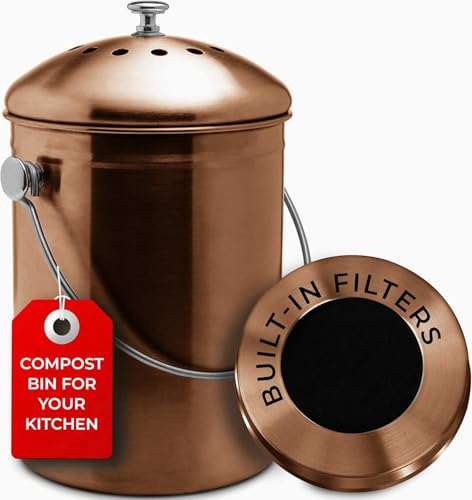
The Epica SYNCHKG123584 is an in-home composting bin designed for kitchen countertops, not a backyard composter that finishes compost on its own. It gives gardeners and homeowners a tidy place to collect food scraps indoors before carrying them to an outdoor compost pile, raised-bed compost trench, community organics container, or municipal food-waste bin.
Based on the listed specifications, the main value is convenience. The 1.3-gallon capacity is large enough for regular kitchen prep scraps while staying small enough for visible counter use. For beginner composters, that matters because a bin that is easy to reach is more likely to be used consistently than a hidden container under the sink.
The product information indicates a stainless steel cylindrical body measuring 7.16 inches in diameter and 11 inches high. The one-piece molded design is described as resistant to leaks and rust, and it avoids welded seams that can be harder to maintain over time. The lid includes a replaceable activated-charcoal filter intended to help control odors naturally.
For small-space gardeners, patio growers, and homeowners with vegetable beds, this bin can serve as the indoor link between meal prep and soil building. It is well suited for collecting items such as produce trimmings and coffee grounds until they can be transferred outside. Reviewers commonly mention that the bin looks good on the counter, is easy to clean, and fits everyday kitchen use without feeling oversized.
There are some practical limits to keep in mind. This bin will not turn scraps into finished compost by itself, and it should be emptied regularly to reduce odor pressure, moisture buildup, and fruit fly risk. The charcoal filter is replaceable, but it will need maintenance over time, and odor control can vary depending on what is placed inside and how long scraps are stored.
This is a sensible choice for gardeners who want a compact, stainless steel food-scrap pail that can stay out on the counter. If you produce a large volume of kitchen waste, want foot-pedal operation, or prefer a fully sealed container without lid ventilation, a larger or different style of indoor organics bin may be a better fit.
Best For / Avoid If
Best for buyers prioritizing
- Good countertop size for small households, apartment gardeners, and daily food scrap collection.
- Stainless steel body provides a durable, easy-to-clean surface based on the listed product materials.
- Charcoal filter is replaceable, so odor-control maintenance does not require replacing the entire bin.
Consider another option if
- It is a collection bin, not a full composting system, so scraps still need to be emptied into an outdoor pile, curbside organics bin, or other compost setup.
- Gardeners who cook heavily or generate large amounts of scraps may need to empty the 1.3-gallon bin frequently.
- Odor control depends on filter condition, scrap type, and emptying habits, and at least one reviewer reported odor escaping through the lid area.
Pros
- Compact size can fit conveniently on a kitchen counter while holding a useful amount of food scraps.
- Odor-control features are more practical for indoor collection than an uncovered container.
- Stainless steel and one-piece construction should make the bin straightforward to maintain.
Cons
- It is a collection bin, not a complete outdoor composting system, so scraps still need to be transferred elsewhere.
- The 11-inch height and 7.16-inch diameter may require a dedicated countertop location.
- Users will need to monitor and replace the charcoal filter as needed for continued odor control.
The Epica Copper Kitchen Compost Bin is designed for collecting compostable kitchen scraps on a countertop before they are moved to an outdoor composting area or another appropriate collection point. Its 1.3-gallon capacity and compact cylindrical footprint make it most suitable for homeowners, apartment gardeners, and small-space growers who want food-scrap storage close to meal preparation areas.
The main practical benefit is odor management. The listed airtight lid and replaceable activated-charcoal filter are intended to help control unpleasant kitchen odors, while the product information states that the filter can last over six months with proper handling. This feature set may be especially useful when scraps cannot be emptied immediately.
Based on the listed dimensions, the bin measures 7.16 inches in diameter and 11 inches high. Its one-piece molded design is described as resistant to leaks and rust, which should make routine emptying and cleaning simpler than maintaining a container with welded seams. No assembly or installation is indicated in the published information.
For backyard gardeners, the bin can serve as an indoor staging container for fruit and vegetable scraps, coffee grounds, and other suitable compostable materials before transfer to a household compost system. Its countertop placement may also help beginners build a consistent scrap-collection routine without adding a large container to a small kitchen or utility area.
The bin does not make compost on its own, so gardeners will still need a separate composting method and should empty the container regularly according to their preferred routine. Cleaning the interior and replacing the charcoal filter when needed are part of ongoing maintenance. The Epica is a sensible choice for accessible indoor food-scrap collection, while gardeners needing a larger outdoor compost vessel or an all-in-one composting system should consider a different product.
Best For / Avoid If
Best for buyers prioritizing
- Compact size can fit conveniently on a kitchen counter while holding a useful amount of food scraps.
- Odor-control features are more practical for indoor collection than an uncovered container.
- Stainless steel and one-piece construction should make the bin straightforward to maintain.
Consider another option if
- It is a collection bin, not a complete outdoor composting system, so scraps still need to be transferred elsewhere.
- The 11-inch height and 7.16-inch diameter may require a dedicated countertop location.
- Users will need to monitor and replace the charcoal filter as needed for continued odor control.
Pros
- Compact 1.3-gallon capacity is practical for everyday kitchen scrap collection.
- Stainless steel body is rust-resistant according to the product information and intended for repeated use.
- Odor-control features may make countertop storage more comfortable between trips to a larger compost system.
Cons
- Its roughly 7.3 to 7.5-inch diameter and 11-inch height still require a dedicated countertop or under-sink location.
- The charcoal filter will eventually need replacement, and the product information does not specify replacement-filter availability.
- This is a collection bin, so gardeners will need a separate outdoor composting method or compost service to process the scraps.
The Veinvify 1.3-gallon countertop compost bin is designed to collect kitchen food scraps before they are moved to an outdoor compost pile, tumbler, municipal program, or other processing system. It is a practical fit for homeowners and apartment gardeners who want a dedicated container for daily organic waste without placing a large bin in the kitchen.
The most useful feature set centers on odor management and easy handling. The airtight lid and activated charcoal filter are intended to help contain and neutralize odors, while the listed filter life exceeds six months with proper care. This can make it more convenient to hold several days of scraps between trips outside or to a collection point.
Product information lists a compact footprint of about 7.3 to 7.5 inches in diameter and an overall height of about 11 inches. The smooth, seamless one-piece construction is described as leak-proof and rust-resistant, which should simplify wiping and reduce concern about residue collecting in welded joints. No assembly, controls, drainage system, or installation is indicated.
For backyard gardeners, the bin can serve as an indoor staging container for vegetable trimmings, coffee grounds, and other suitable compost inputs before transfer to a separate composting setup. Its vertical shape may also work under a sink if the available clearance accommodates the listed height, though users should measure their space first.
This container does not process scraps into finished compost on its own, so it is not a substitute for an outdoor composter or composting service. Routine emptying, cleaning, and filter care will still be necessary, and the charcoal filter may require replacement over time. Based on the listed specifications, it is a sensible choice for compact kitchen scrap storage, while gardeners needing larger capacity or an integrated composting system should consider a different product.
Best For / Avoid If
Best for buyers prioritizing
- Compact 1.3-gallon capacity is practical for everyday kitchen scrap collection.
- Stainless steel body is rust-resistant according to the product information and intended for repeated use.
- Odor-control features may make countertop storage more comfortable between trips to a larger compost system.
Consider another option if
- Its roughly 7.3 to 7.5-inch diameter and 11-inch height still require a dedicated countertop or under-sink location.
- The charcoal filter will eventually need replacement, and the product information does not specify replacement-filter availability.
- This is a collection bin, so gardeners will need a separate outdoor composting method or compost service to process the scraps.
Activated Charcoal Filter Function and Airflow Dynamics
Activated charcoal relies on microporous carbon structures. Pores create broad surface area trapping volatile organic compounds, fatty acids, and moisture-laden smells through physical adsorption. Compost scrap bins do not seal like vacuum food containers. Scraps require passive airflow to delay anaerobic putrefaction.
Lids feature ventilation perforations over filter cavities. Fresh air passes through carbon media while odors bind to charcoal pores. Bins without charcoal filters either trap moisture completely, creating sour slime, or release rotting onion and brassica smells into open living areas.
Stainless Steel vs Alternative Bucket Construction
Stainless steel dominates countertop compost caddies for hygienic utility. High-grade stainless steel resists fruit acid corrosion, tomato acidity, and pungent garlic residues. Metal body will not absorb food pigments or sour aromas over repeated seasonal usage.
Seamless one-piece molded construction prevents leak points. Welded seams degrade over time from acidic leachate, causing counter stains and structural failure. Solid molded bodies like Epica and Veinvify models prevent rust and pinhole seepage entirely.
Capacity and Counter Footprint Tradeoffs
Countertop buckets standardly range around 1.3 gallons (approximately 5 liters). Dimensions measure roughly 7.16 to 7.3 inches diameter and 11 inches total height. Sizing balances counter space against emptying frequency.
Volume holds roughly 3 to 5 days of daily vegetable trimmings, coffee grounds, and fruit skins for average households. Smaller bins overflow within single dinner preparations. Larger containers encourage scraps sitting too long, saturating filters and breeding anaerobic odors.
Filter Thickness, Sizing, and Saturation Limits
Charcoal filters range from 5 mm (0.2 inch) to 10 mm (0.4 inch) thickness. Denser 10 mm pads provide longer odor capture paths and hold up better against rising moisture. Filter diameters for round lids typically span 6.5 to 7.25 inches.
Filters saturate over time. Normal lifespan spans 3 to 6 months depending on scrap moisture and ambient room temperatures. Once carbon pores fill with airborne molecules and grease, smell containment drops. Filters must remain dry; direct washing ruins activated carbon bonding structures.
Fruit Fly and Pest Exclusion Mechanics
Indoor composting attracts Drosophila melanogaster (fruit flies) and fungus gnats. Pests detect fermenting sugar volatiles through millimeter gaps. Lids must sit flush on rim edges without gaps.
Charcoal filter functions as physical barrier inside lid housing. Insects cannot navigate carbon fiber matrix to reach decaying matter below. Ensures clean food prep zones without pesticide sprays or messy counter fly traps.
Routine Cleaning and Acid Management
Empty scraps onto outdoor garden pile or municipal collection before liquid pools deep at bottom. Acidic liquid fermenting at base accelerates bin staining and filter deterioration. Clean steel shell with mild soap and warm water during routine disposal runs.
Remove carbon filter from lid before washing lid assembly. Allow metal lid to air-dry completely before reinserting dry charcoal disc. Wet filters breed mildew and lose vapor absorption capability.
Specifications Comparison of Matching Bins
Review key technical specifications across confirmed countertop models featuring charcoal filtration systems:
| Model | Capacity | Dimensions | Material | Filter Life Claim |
|---|---|---|---|---|
| Epica Silver | 1.3 Gallon | 7.16 in D x 11 in H | Stainless Steel | 6+ Months |
| Epica Copper | 1.3 Gallon | 7.16 in D x 11 in H | Stainless Steel | 6+ Months |
| Veinvify Countertop | 1.3 Gallon | 7.3 in D x 11 in H | Stainless Steel | 6+ Months |
Countertop Compost Bin with Charcoal Filter: How We Researched This Guide
Analysis evaluates published specifications, material grades, filter compatibility charts, and real-world owner usage patterns across indoor food scrap management categories. Review updates reflect current catalog data gathered during September 2026.
Entries representing standalone replacement filter packs (such as MOWPOG, BRENSTEN, Jynprosper, RED FACTOR, ENLOY, and Simply Carbon refills) provide replacement guidance but do not constitute complete functional bins. ARKALIS bin entry explicitly omits charcoal filter mechanisms and relies solely on tight basket seals, excluding it from top filtered recommendations.
Dove Creek Gardens relies on practical horticultural knowledge and material science analysis. Findings present unvarnished trade-offs without brand sponsorship. Evaluation emphasizes durability, scrap containment safety, corrosion prevention, and seamless integration with backyard soil composting workflows.
Frequently Asked Questions
How does best countertop compost bin with charcoal filter stop odors?
Activated carbon inside lid filter traps volatile organic compounds through adsorption. Micropores capture gas molecules while allowing tiny amounts of oxygen flow. Aerobic ventilation delays foul anaerobic scrap decomposition.
How often should kitchen compost bin charcoal filters be replaced?
Replace charcoal filters every 3 to 6 months under standard household use. High ambient heat, excessive moisture, or pungent scraps like onions saturate carbon pores faster. Replace immediately if smells escape closed lid.
Can you wash and reuse activated charcoal compost bin filters?
Do not wash activated charcoal filters with water and soap. Moisture clogs active pore matrix and causes mold growth inside dense fibers. Remove filter before washing metal lid, replacing pad only with dry spare refills.
What scraps belong inside countertop compost bin?
Deposit fruit trimmings, vegetable peels, coffee grounds, crushed eggshells, and tea leaves. Avoid dairy, raw meat, bones, and fatty oils in countertop pails. Animal fats decompose with severe odors and attract house pests.
How do charcoal filters stop fruit flies from invading compost bins?
Snug-fitting lids create physical perimeter seal against adult fruit flies. Ventilation holes on lid route directly into thick carbon filter pad. Dense charcoal fibers block fly entry, stopping egg deposition on decaying scraps.
Continue your garden research
Browse more practical guides in Compost, Soil & Mulch.
For product comparisons, see Best Compost Bin For Small Backyard 2026: Reviews and Buying Guide.
See how Dove Creek Gardens researches and compares products.