

High branches can be awkward to reach and difficult to cut cleanly with ordinary hand pruners. This guide to Best Tree Loppers For High Branches helps homeowners compare manual pole pruners and long-handled loppers for routine yard work, with attention to reach, cutting method, stated capacity, grip, and storage.
We compare 5 products from Suchtale, KingsCountyTools, Heancare, Likeem, and Walensee. Their listed prices range from 33.89–75.99. Product descriptions do not provide owner-review detail, so recommendations rely on the published specifications, not independent performance claims. For related pruning-tool advice, see our guide to why pruning shears tear branches.
Suchtale 10FT Manual Pole Pruner with Saw for High-Branch Trimming Kings County Tools KC8807-09 Extendable Bypass Lopper for Higher Branch Pruning 4.6-10 Ft Tree Trimmers Long Handle Pruner with Long Reach Tree Pruner Saw | Extendable Tree Pruner Cut and Hold Branch Trimmer, Telescoping Pole Pruner for Branches Bypass Lopper Likeem 27-Foot Manual Pole Pruner for High Branch Trimming Prices and availability can change. We may earn a commission from qualifying purchases.


Pros
- Combines rope-operated pruning shears and a saw in one tool.
- Adjustable pole length supports different trimming heights.
- Listed weight is about 4.94 pounds.
Cons
- The stated 1.2-inch capacity applies to the pruning shears; saw capacity is not specified.
- At full extension, the long pole may be harder to position precisely than a shorter hand pruner.
- The pole’s maximum working reach depends on the user’s height and handling position.
Suchtale’s 10-foot manual pole pruner combines pull-rope pruning shears with an integrated saw. It is intended for routine trimming of high branches in yards, gardens, and orchards, and may suit homeowners who want ground-based access to overhead growth.
The pruning shears use a 65Mn steel blade and are designed for branches up to approximately 1.2 inches in diameter. A four-pulley system increases leverage on the pull rope, which the product information indicates can help make operating the shears easier. The saw provides an additional cutting option, though its capacity is not specified.
The sectional pole adjusts by adding or removing sections, with working length reaching up to approximately 10 feet. Threaded connections and wing nuts allow setup and disassembly without additional tools. The listed weight is about 4.94 pounds, and taking the pole apart can make storage and transport more convenient.
For backyard use, this tool may help with routine trimming on fruit trees, small branches, palms, and shrubs where overhead reach is useful. Choose a shorter pole configuration when it offers better control for the branch being trimmed.
Keep clear of falling branches, and check that pole connections are secure before cutting. Use the shears within their stated approximate capacity; product information does not specify saw capacity or maintenance instructions. This is a practical option for light, routine high-branch work, while gardeners dealing with larger branches may need a tool rated for that task.
Best For / Avoid If
Best for buyers prioritizing
- Combines rope-operated pruning shears and a saw in one tool.
- Adjustable pole length supports different trimming heights.
- Listed weight is about 4.94 pounds.
Consider another option if
- The stated 1.2-inch capacity applies to the pruning shears; saw capacity is not specified.
- At full extension, the long pole may be harder to position precisely than a shorter hand pruner.
- The pole’s maximum working reach depends on the user’s height and handling position.
Pros
- Extendable handle range adds useful reach for small trees, tall shrubs, and overgrown landscape plantings.
- Bypass blade type is well matched to cleaner cuts on live, green wood.
- Ratcheting action and long handles provide added leverage compared with compact pruners.
- Ambidextrous hand orientation makes it usable for right- or left-handed gardeners.
Cons
- At roughly 3.75 to 3.99 pounds based on the listed data, it may feel tiring during long overhead pruning sessions.
- The 2 inch cutting capacity may not be enough for larger limbs, where a pruning saw or pole saw would be more appropriate.
- Long telescoping handles need more storage room than short loppers or hand pruners.
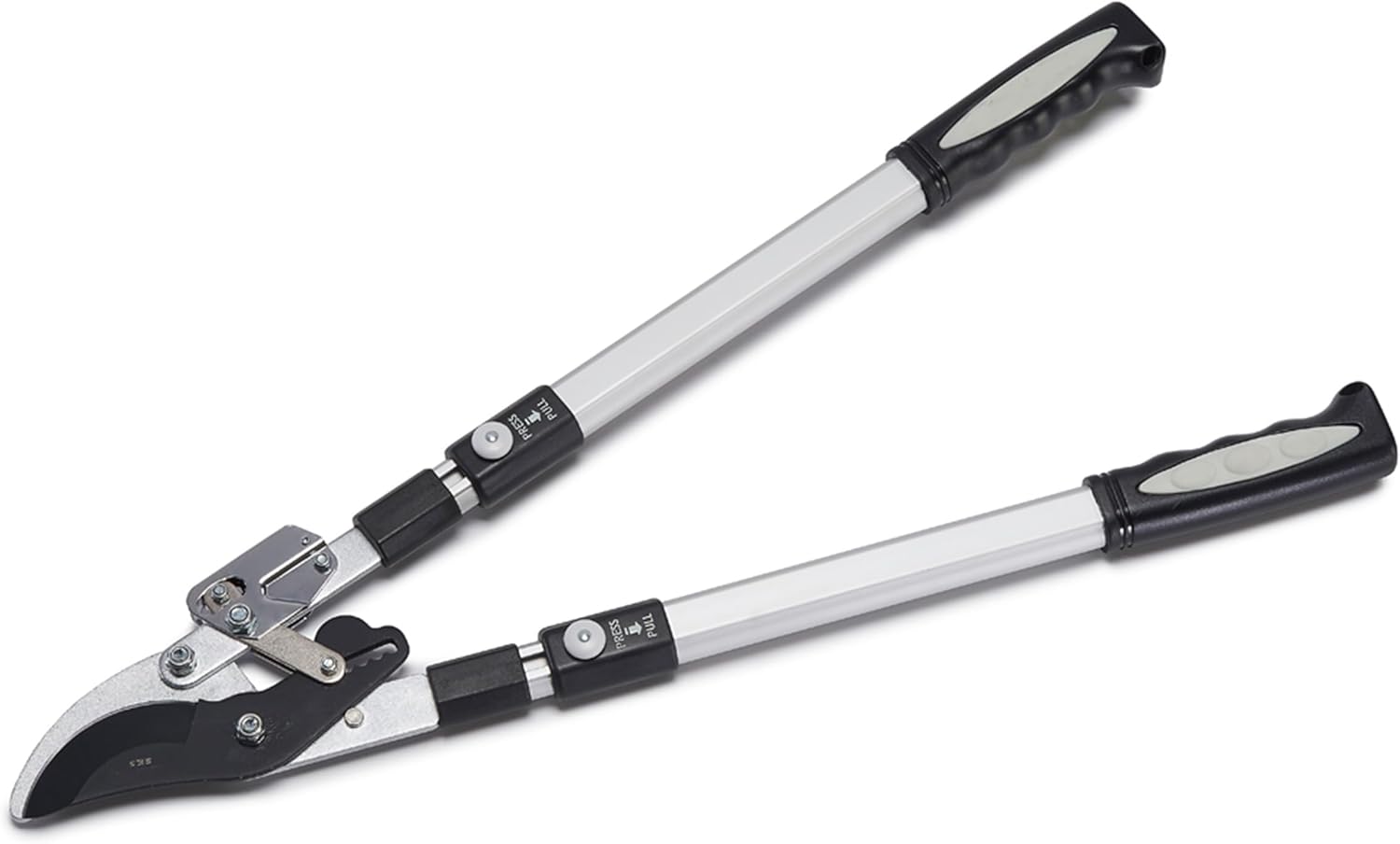
The Kings County Tools KC8807-09 is an extendable bypass lopper made for pruning green wood, including living branches, tree limbs, and shrub growth. It is a good fit for homeowners who want more reach and cutting leverage than a hand pruner provides, especially for routine yard cleanup and seasonal shaping.
The standout feature is the combination of a bypass blade, a double ratcheting mechanism, and a listed 2 inch jaw capacity. In plain terms, the bypass design is intended for cleaner cuts on live growth, while the ratcheting action is designed to build cutting force in stages rather than relying only on one hard squeeze.
The handles telescope from 26 to 40 inches and use 6 pin-locked position stops, giving gardeners a choice between shorter control and longer reach. Rubber grips help with hand placement, and the product information lists alloy steel for the blade material. The lopper is also described as ambidextrous, so it is not limited to one hand orientation.
In a typical backyard, this tool makes sense for trimming reachable branches on ornamental trees, cutting back overgrown shrubs, and maintaining fruit or shade trees within its capacity. It can also be useful around raised beds, fence lines, and small yards where branches need to be cut back without bringing out powered pruning equipment.
There are some practical limits to keep in mind. The listed weight is around 3.75 to 3.99 pounds, so overhead work may become tiring, particularly for older gardeners or anyone with shoulder fatigue. The 2 inch capacity should also be respected, since forcing a larger branch can reduce control and may damage the tool or create an unsafe cut.
This lopper is best for gardeners who regularly prune live branches and want adjustable reach in a manual tool. Gardeners dealing mostly with thick, dry, or very high limbs may want to consider a pruning saw, pole pruner, or another tool better matched to that work.
Pros
- Long reach is useful for elevated branches and taller shrubs.
- Two cutting functions provide more flexibility than a single-purpose pole tool.
- Manual operation avoids batteries, fuel, and charging requirements.
Cons
- The spring-action jaws are specified for smaller branches, so larger limbs may require a different tool.
- A fully extended 27-foot manual pole may be more demanding to control, especially for gardeners with limited upper-body strength.
- The published information does not specify the system's collapsed length, total weight, or storage requirements.
The Likeem 27-Foot Manual Pole Pruner is designed for trimming branches and foliage from ground level. Its extendable pole system, saw blade, and pruning jaws make it a practical option for homeowners maintaining trees, shrubs, and other taller landscape growth without routinely reaching with a short hand tool.
Based on the listed specifications, the main benefit is access. The system can extend up to 27 feet, helping users reach elevated branches while reducing the need to climb a ladder. The product information also indicates that it can be used at ground level without bending or kneeling, which may be useful for gardeners who want a more upright working position.
The cutting head combines an alloy steel saw blade with pulley-operated, spring-action pruning jaws made from hardened carbon steel. The jaws are described as suitable for smaller branches, while the saw is intended for sawing and cutting. The head is listed as fitting a 25 mm telescopic rod, although the published information refers to both an epoxy resin pole and an aluminum telescopic rod, so buyers should confirm the included pole construction and package details before ordering.
This tool could be useful for routine backyard tree and shrub maintenance, especially where branches are high but accessible from stable ground. It is less relevant for container gardens, raised beds, or small patio spaces unless those areas include tall shrubs or vines that need extended reach.
Because this is a manual pole tool, control and fatigue may become concerns when it is fully extended, particularly in windy conditions or for gardeners with limited strength. Use it from firm, level ground, keep the cutting area clear, and do not treat the pole as a substitute for professional tree work or a guarantee against falling branches. Clean, dry storage and attention to the steel cutting parts are sensible for routine upkeep.
This Likeem pruner is a reasonable fit for homeowners who need occasional high-branch access and want both sawing and shearing functions in one manual system. Gardeners who regularly cut large limbs, need a lighter compact tool, or require precise specifications for weight and storage should consider a different option or verify those details before purchase.
Best For / Avoid If
Best for buyers prioritizing
- Long reach is useful for elevated branches and taller shrubs.
- Two cutting functions provide more flexibility than a single-purpose pole tool.
- Manual operation avoids batteries, fuel, and charging requirements.
Consider another option if
- The spring-action jaws are specified for smaller branches, so larger limbs may require a different tool.
- A fully extended 27-foot manual pole may be more demanding to control, especially for gardeners with limited upper-body strength.
- The published information does not specify the system's collapsed length, total weight, or storage requirements.

Pros
- Combines two cutting options for different branch sizes.
- Extended reach can reduce the need to climb for high pruning tasks.
- Detachable pole sections simplify storage and transport.
Cons
- Manual operation requires repeated pulling and sawing, which may be tiring during longer sessions.
- The listed 14-foot length may not reach every branch, depending on tree height and working position.
The Walensee 14FT is a manual pole saw and tree pruner for trimming high branches, shrubs, and other landscape plants. It suits homeowners who want ground-based reach for routine pruning tasks.
Its saw is intended for thicker limbs, while the pruning shears handle smaller branches. The four-pulley system is designed to improve leverage and make overhead pulling smoother, though cutting still requires manual effort.
The adjustable pole has a listed 14-foot size. Reinforced sections and threaded connections are intended to provide support during use, and detachable sections make the tool easier to transport and store.
It may be useful for maintaining fruit trees, palms, and yard trees, as well as reaching plants that are awkward to access with short-handled pruners. Check the branch position and available working space before extending the pole.
Manual sawing and pulling can become tiring during extended work. Keep clear of falling branches, maintain a stable stance, and check that pole connections are secure before trimming. The published information does not specify cutting capacity or pole weight.
Consider this tool if you need both saw and shear functions with extended reach. Gardeners who need frequent all-day pruning or precise capacity details may prefer a product with documented weight and cutting limits.
Best For / Avoid If
Best for buyers prioritizing
- Combines two cutting options for different branch sizes.
- Extended reach can reduce the need to climb for high pruning tasks.
- Detachable pole sections simplify storage and transport.
Consider another option if
- Manual operation requires repeated pulling and sawing, which may be tiring during longer sessions.
- The listed 14-foot length may not reach every branch, depending on tree height and working position.
Best Tree Loppers For High Branches: practical buying guide
1. Match tool type to branch size
Pole pruners combine a long shaft with a cutting head, often offering shears for smaller branches and a saw for thicker ones. Loppers use two handles to operate bypass blades, making them more suitable for branches within their stated jaw capacity when those branches remain within reach.
Check the listed capacity before buying. Suchtale specifies pruning up to approximately 1.2 inches; Heancare lists up to 1/2 inch for its shears; Kings County Tools lists a 2-inch jaw capacity. These figures describe stated limits, not a promise that every cut will be easy. Use the saw function for branches beyond shear capacity when the product provides one.
2. Choose enough reach, not maximum reach
Listed pole lengths vary: Heancare adjusts from 4.6 to 10 feet, Suchtale reaches up to approximately 10 feet, Walensee is listed as 14 feet, and Likeem describes a system extending up to 27 feet. Kings County Tools has telescoping handles from 26 to 40 inches. These are product lengths, not guaranteed cutting heights; your height, stance, and branch position affect actual reach.
A longer pole can access higher limbs from the ground, but extended tools may be harder to position and control overhead. Select the shortest length that reaches the intended work area while allowing stable footing and clear sight of the cutting head.
3. Consider leverage and handle comfort
Suchtale and Walensee list four-pulley systems intended to increase leverage on their pull-rope shears. That mechanism may matter when making repeated cuts, but published data does not quantify effort. Kings County Tools lists rubber grips and a double-ratcheting mechanism; its listed weight is 3.99 lb. Heancare describes an aluminum-alloy pole, a non-slip handle, and a safety lock.
For gardeners who value comfort or have limited strength, weigh the assembled tool’s length and balance as well as its listed weight. Pole tools transfer load overhead, so a long reach can still feel demanding. Product data does not give weights for most models, making direct comfort comparisons uncertain.
4. Understand shear and saw tradeoffs
Bypass blades pass one another like scissors and are commonly specified for living or green wood; Kings County Tools explicitly describes its loppers for wet wood. A saw is a separate cutting option on the Suchtale, Heancare, Likeem, and Walensee pole pruners. Sawing can suit limbs too thick for the shear mechanism, but the published descriptions do not state saw capacities.
Do not force a branch into a shear head that is outside its listed capacity. For guidance on cutting behavior and blade choice, read our article on secateurs and pruning shears.
5. Check assembly and storage needs
Sectional poles can be taken apart for storage. Suchtale lists threaded connections with wing nuts and removable sections; Walensee also describes detachable sections and threaded connections. Heancare uses a telescoping pole, while Likeem describes a pole-pruner head that fits a 25 mm telescopic rod. Confirm what the listing includes and how the head attaches before purchase, especially for the Likeem system.
Long tools need a storage spot where blades cannot snag people or damage other equipment. Keep cutting heads protected and follow the manufacturer’s care instructions. See our practical advice on storing long-handled garden tools.
6. Plan for maintenance and repeated use
Inspect blades, rope, pulleys, pole sections, and connections before each use. Remove plant residue after pruning and keep cutting parts clean and dry before storage, following the maker’s instructions. Published details do not establish service life, replacement-part availability, or maintenance intervals, so check those points with the seller if frequent seasonal use is planned.
For occasional small branches, a compact pole pruner may be enough. Frequent work across different branch sizes may favor a model with both shears and a saw. A separate saw can be preferable when the primary task is cutting limbs beyond the shear capacity.
7. Use pole tools with a safety-first setup
Work from stable ground, keep other people clear of the drop zone, and check overhead for wires and obstacles before raising a pole. Wear appropriate eye and hand protection, keep the cutting head pointed away from your body, and follow the manufacturer’s instructions. Do not climb a ladder while handling an extended pole tool; for large, unstable, or difficult-to-reach limbs, consult a qualified tree-care professional.
Research method and selection notes
We screened the listed products for relevance to high-branch pruning in Garden Tools & Pruning. Each listed item is a manual lopper or pole pruner intended for branch cutting, so all five remain in this comparison. We compared stated reach, cutting method, capacity where specified, pole design, grip details, materials when listed, and storage features.
Recommendations reflect likely fit for different garden tasks, not a universal ranking of cutting performance. Descriptions report ratings alongside zero reviews for these products, and no detailed owner feedback was supplied for analysis. We therefore do not treat the ratings as evidence of reliability or durability.
This is research-based product analysis, not physical evaluation. Specifications and product details can change; the guide is reviewed during October 2026. Confirm current listing details, included components, and instructions before purchase and use.
Frequently asked questions
What should I look for in best tree loppers for high branches?
Start with branch height and diameter, then compare pole length, shear capacity, and whether a saw is included. Choose a length you can control from stable ground rather than selecting by maximum reach alone.
Are longer pole pruners always better?
No. More reach can help access high limbs, but an extended pole can be harder to position. Match the tool to the branch locations you need to reach and leave room to control the cutting head safely.
How thick a branch can these loppers cut?
Capacity differs by model. Published specifications list approximately 1.2 inches for Suchtale, 1/2 inch for Heancare shears, and a 2-inch jaw capacity for Kings County Tools. Use the saw option where provided for branches beyond a shear’s stated capacity.
Can I use pole loppers for thick limbs?
Only within the specified capacity of the shear head. Several listed pole pruners include a saw for other cuts, but their saw capacities are not stated here. For large or difficult limbs, use a suitable tool or seek professional help.
How should I maintain and store a pole pruner?
Inspect the blade, rope, pulleys, and pole connections before use. Clean cutting parts after work, store the tool securely with the cutting head protected, and follow the manufacturer’s maintenance instructions.
Are pole pruners suitable for small yards?
They can suit yards with a few high branches, but long poles need room to maneuver and a safe place to store. Sectional models such as Suchtale and Walensee can be disassembled for storage, according to their published descriptions.
Continue your garden research
Browse more practical guides in Garden Tools & Pruning.
For product comparisons, see Best Pruning Shears For Small Hands: Reviews and Buying Guide.
See how Dove Creek Gardens researches and compares products.