

Potato grow bags provide a practical alternative when digging an in-ground bed is inconvenient or space is limited. They can work on patios, in small yards, and in other locations where runoff can drain safely. The best grow bags for potatoes balance sufficient growing volume with breathable material, manageable watering, sturdy seams, and a footprint that fits the available space.
We compared 10 products priced from $12.99 to $34.99, including options from VIVOSUN, Gardzen, AGOLEAM and more. The most important differences are 5- to 20-gallon capacity, pack count, harvest-window design, listed fabric construction, reinforced handles, and owner-feedback history. Gardeners planning several container crops may also find our guide to a tomato planter with a trellis helpful.
The short answer is that a 10- or 15-gallon fabric bag offers a useful middle ground for many home gardeners. Choose a windowed model if side access is important, a basic fabric pot if simplicity and pack value matter more, or a 20-gallon bag only if you can accommodate its larger soil requirement and filled weight.
VIVOSUN 15-Gallon Fabric Grow Bags with Handles for Portable Container Gardening Mulctun 15-Gallon Potato Grow Bags with Harvest Windows for Flexible Patio Growing AGOLEAN 10-Gallon Potato Grow Bags with Handles for Flexible Patio and Small-Space Gardening Gsonia 15-Gallon Potato Grow Bags, 4-Pack with Harvest Windows and Reinforced Handles Prices and availability can change. We may earn a commission from qualifying purchases.


Pros
- Five 15-gallon bags provide substantial container capacity for several plantings.
- Reinforced handles make the bags easier to move than containers without built-in grips.
- Nonwoven fabric allows excess water to pass through and helps roots receive air.
- BPA-free fabric material is listed for the pots.
Cons
- A 15-gallon bag filled with soil and a plant may still be heavy to move, even with reinforced handles.
- Fabric containers may need more frequent watering than less permeable pots, depending on weather and growing conditions.
- The listed dimensions are provided, but the product information does not explain the bags' exact filled shape or usable planting footprint.
The VIVOSUN 5-Pack 15-Gallon Plant Grow Bags are flexible fabric containers for gardeners who want to grow plants without committing to permanent beds or rigid pots. With five bags in the set, they can suit homeowners, patio gardeners, and beginners managing several container plantings.
The most relevant growing benefit is the moderately permeable 300g nonwoven fabric. The product information indicates that the material allows excess water to drain away and gives roots access to air, which may help reduce problems associated with water remaining in a container. The listed BPA-free construction is another useful material detail.
Each bag includes reinforced handles sewn on with serger stitching rather than simple fabric strips. This design suggests better support when repositioning a filled bag, although a 15-gallon container can still become difficult to lift after soil and a mature plant are added. The listed dimensions are 12.99 x 2.36 x 11.81 inches, but the supplied information does not clarify the bag's exact filled shape.
These grow bags can be useful where growing space changes throughout the season, such as patios, compact yards, or areas that need to be rearranged for access. Their flexible construction also makes them an option for gardeners who prefer movable containers instead of fixed planters.
Gardeners should monitor moisture because permeable fabric can allow water to leave the container more readily than less breathable pots. The bags should also be lifted by the reinforced handles and checked periodically for cleanliness and fabric condition. Overall, they are a practical choice for portable container gardening and gardeners who value drainage, while those seeking a rigid-sided planter or a clearly specified footprint may prefer another option.
Best For / Avoid If
Best for buyers prioritizing
- Five 15-gallon bags provide substantial container capacity for several plantings.
- Reinforced handles make the bags easier to move than containers without built-in grips.
- Nonwoven fabric allows excess water to pass through and helps roots receive air.
Consider another option if
- A 15-gallon bag filled with soil and a plant may still be heavy to move, even with reinforced handles.
- Fabric containers may need more frequent watering than less permeable pots, depending on weather and growing conditions.
- The listed dimensions are provided, but the product information does not explain the bags' exact filled shape or usable planting footprint.
Pros
- Harvest and observation windows offer convenient access to the growing medium and developing crop.
- Reinforced handles support easier movement than handle-free fabric containers.
- Flexible indoor and outdoor use suits gardeners without traditional planting beds.
- Four 15-gallon bags provide substantial container-growing capacity.
Cons
- A filled 15-gallon bag may still be difficult to move, even with reinforced handles.
- Highly permeable fabric may require closer attention to watering than a less breathable container.
- The supplied information does not specify whether the bags include planting instructions, soil, or additional accessories.
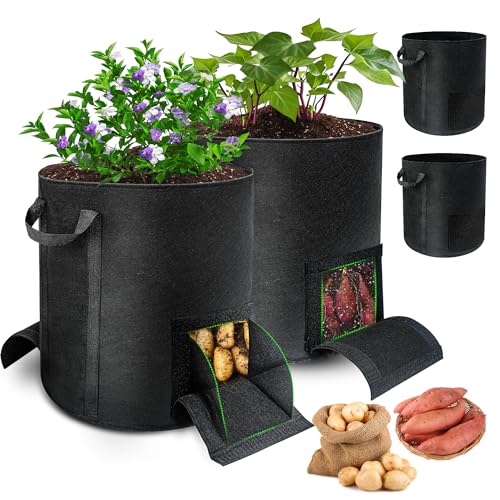
The Mulctun set includes four black, 15-gallon potato grow bags measuring 15 by 15 by 17 inches. They are intended for growing potatoes in containers, while the product information also lists tomatoes, strawberries, flowers, and other vegetables as possible uses. This makes the set suitable for beginners, homeowners with limited planting space, and gardeners who want movable containers instead of a permanent bed.
The main convenience feature is the dual-window design. A downward-opening window provides access for harvesting potatoes, while the clear observation window is intended to help gardeners check soil moisture and monitor ripeness without digging through the entire container. This can make crop checks more accessible and may help reduce unnecessary disturbance during the growing season.
Each bag is made from nonwoven fabric described as breathable and water permeable. That construction is designed to allow excess water to pass through and give roots more air than a sealed container. The bags also have extended handles reinforced with stitching from the bottom, which should provide a more secure grip when repositioning them, although a filled 15-gallon container can still be heavy.
These grow bags can be placed on a patio, balcony, garden area, or indoor growing location where suitable light and drainage are available. Using four bags makes it possible to separate crops or stagger plantings, but the supplied information does not include assembly requirements, soil recommendations, or specific spacing guidance. Place them on a surface that can handle drainage and protect nearby areas from excess water or soil.
Gardeners should monitor watering closely because breathable, water-permeable fabric may lose moisture more readily than a less permeable planter. Check the bags and handles regularly for wear, avoid lifting them when overloaded, and follow safe practices when moving filled containers. Overall, this set is a useful option for accessible container growing and window-based potato harvesting, while gardeners wanting rigid walls, built-in support, or detailed planting guidance may prefer another type of planter.
Best For / Avoid If
Best for buyers prioritizing
- Harvest and observation windows offer convenient access to the growing medium and developing crop.
- Reinforced handles support easier movement than handle-free fabric containers.
- Flexible indoor and outdoor use suits gardeners without traditional planting beds.
Consider another option if
- A filled 15-gallon bag may still be difficult to move, even with reinforced handles.
- Highly permeable fabric may require closer attention to watering than a less breathable container.
- The supplied information does not specify whether the bags include planting instructions, soil, or additional accessories.
Pros
- Includes four separate 10-gallon grow bags for multiple crops or planting areas.
- Breathable nonwoven fabric provides airflow and water movement through the container.
- Handles offer a practical way to move or position the bags.
- Suitable for vegetables, flowers, herbs, and other container-grown plants.
Cons
- A filled 10-gallon bag may be difficult to move despite the handles, especially after watering.
- Fabric containers can require more frequent watering than less porous planters, depending on conditions and plant needs.
- The listed dimensions may be too limited for gardeners who want deep-rooted plants or larger permanent crops.
The AGOLEAN set includes four black nonwoven fabric grow bags listed at 10 gallons each, with individual dimensions of 13.8 by 13.8 by 17.8 inches. They are intended for container gardening with potatoes, vegetables, flowers, herbs, and similar plants, making them a practical option for beginners, homeowners with limited yard space, and gardeners using patios or balconies.
The main growing-use benefit is the fabric construction. Based on the product information, the nonwoven material allows air and water to pass through and is described as tear-resistant, reusable, and moisture-wicking. The listed drainage design may help limit water pooling, but plants will still need watering suited to the crop, weather, and location.
Each bag has sturdy handles for repositioning, which is useful when arranging containers or changing their location during the season. However, a bag filled with soil and a mature plant can be heavy, so the handles should be used carefully and lifted only when the contents and bag appear secure. No assembly is indicated in the supplied information.
These grow bags fit planting situations where permanent beds are impractical, including small gardens, patios, balconies, rooftops, and indoor growing areas. Four containers can be used for separate crops, succession planting, or a mix of vegetables, flowers, and herbs while keeping the growing area flexible.
Gardeners should account for the porous fabric when choosing a location and watering routine, since water can pass through the sides and bottom. Emptying the bags after the growing season and storing them clean and dry may help support reuse. This set is a sensible choice for portable container gardening, while gardeners needing rigid sides, built-in supports, or larger planting dimensions may prefer a different planter style.
Best For / Avoid If
Best for buyers prioritizing
- Includes four separate 10-gallon grow bags for multiple crops or planting areas.
- Breathable nonwoven fabric provides airflow and water movement through the container.
- Handles offer a practical way to move or position the bags.
Consider another option if
- A filled 10-gallon bag may be difficult to move despite the handles, especially after watering.
- Fabric containers can require more frequent watering than less porous planters, depending on conditions and plant needs.
- The listed dimensions may be too limited for gardeners who want deep-rooted plants or larger permanent crops.
Pros
- Accessible windows simplify crop inspection and harvesting.
- Handles and metal grommets add practical flexibility for moving plants and supporting training.
- Drainage-focused fabric design may be preferable to non-draining plastic containers.
Cons
- Gardeners must still provide suitable soil, watering, and plant support, none of which are included in the listed features.
- The listed dimensions may require careful placement planning, especially in narrow patios or apartment spaces.
- Growers seeking rigid-sided containers may prefer a different option because these are fabric planting bags.
Gsonia's four-pack of 15-gallon grow bags is designed for container gardening with potatoes and other vegetables. The bags suit beginners, homeowners with limited garden space, and gardeners who want to place plants on a deck, patio, greenhouse area, or apartment corner instead of planting directly in the ground.
The most useful feature is the dual-window layout. The larger viewing window lets gardeners monitor growth with less disturbance, while the top-down harvest window is intended to provide access to crops while helping limit soil spillage. This can make inspection and harvesting more approachable for gardeners who prefer not to empty the entire container.
Each bag includes two reinforced extended handles, with the product information indicating support for loads up to 66 pounds. The built-in metal rings can be used with zip ties for low-stress training, so gardeners can guide growth without cutting the fabric or creating their own attachment points. The listed size is 15 gallons, with specifications showing dimensions of 12 x 5 x 10 inches.
The non-woven planter design is intended to provide airflow and drainage, allowing excess water to escape more readily than it might from a container without adequate drainage. The four bags can be used for potatoes, carrots, tomatoes, onions, strawberries, flowers, and other plants suited to container growing, provided the gardener supplies appropriate soil, water, and support.
These bags will require regular watering and monitoring because the product information does not specify a watering system or moisture-retention feature. Before moving a filled bag, gardeners should distribute the weight carefully and use the reinforced handles as intended. Overall, the feature set suggests a flexible option for accessible container growing, while gardeners who need rigid containers or a precise footprint should compare the listed dimensions with their available space.
Best For / Avoid If
Best for buyers prioritizing
- Accessible windows simplify crop inspection and harvesting.
- Handles and metal grommets add practical flexibility for moving plants and supporting training.
- Drainage-focused fabric design may be preferable to non-draining plastic containers.
Consider another option if
- Gardeners must still provide suitable soil, watering, and plant support, none of which are included in the listed features.
- The listed dimensions may require careful placement planning, especially in narrow patios or apartment spaces.
- Growers seeking rigid-sided containers may prefer a different option because these are fabric planting bags.

Pros
- Generous 10-gallon size is useful for common container crops such as tomatoes, potatoes, peppers, strawberries, eggplants, and herbs
- Fabric construction provides built-in drainage without requiring gardeners to drill or cut holes
- Handles are a helpful feature for moving or rotating planters, and reviewers commonly mention that the bags feel sturdy
- Set format is convenient for gardeners starting several containers at once
Cons
- Fabric grow bags can dry out faster than solid plastic pots, so watering may need closer attention in hot or windy conditions
- A filled 10-gallon bag can become heavy, so older gardeners or anyone with lifting limitations may want to move it before watering or filling completely
- The soft-sided shape may be less tidy-looking than rigid planters for gardeners who prefer a more formal patio setup
The Songrey 10-gallon grow bags are soft-sided fabric planters intended for vegetables, herbs, flowers, and fruiting plants in spaces where in-ground planting is not available or convenient. They are a good fit for homeowners building a flexible container garden, balcony growers, renters, and gardeners who want to expand planting space without installing a permanent raised bed.
The product information highlights breathable nonwoven fabric, fast drainage, and air pruning. In plain terms, fabric planters allow water and air to move through the sides more readily than many rigid pots. That can help prevent water from sitting at the bottom of the container, while the air-pruning design is intended to reduce root circling as plants grow.
Each bag is listed at 10 gallons with dimensions of 15.7 inches by 15.7 inches by 11.8 inches, giving it a compact but useful footprint for patios, decks, walkways, and small yards. The cylindrical shape is simple to fill with potting mix, and the reinforced handles are meant to make repositioning easier. As with any large planter, it is safest to move the bag before it is fully watered or heavily loaded.
These bags are suited to practical seasonal crops such as tomatoes, potatoes, peppers, strawberries, eggplants, herbs, and flowers, based on the listed product uses. They can also help keep a growing area organized because each plant or crop group has its own container. Reviewers commonly mention sturdiness, drainage, and the ability to move the bags, though those comments should be treated as user experience rather than controlled testing.
The main tradeoff is watering management. Because fabric planters breathe and drain well, they may need more frequent checks in hot, dry, or windy weather than a solid plastic pot. Place them where runoff will not damage flooring, and use an appropriate container mix rather than heavy garden soil for better handling and drainage.
Overall, the Songrey 10-gallon grow bag set is a practical choice for gardeners who want multiple portable containers with breathable drainage and compact storage. Gardeners looking for decorative planters, rigid walls, or extra-large root volume for very large crops may prefer a different style or larger size.
Best For / Avoid If
Best for buyers prioritizing
- Generous 10-gallon size is useful for common container crops such as tomatoes, potatoes, peppers, strawberries, eggplants, and herbs
- Fabric construction provides built-in drainage without requiring gardeners to drill or cut holes
- Handles are a helpful feature for moving or rotating planters, and reviewers commonly mention that the bags feel sturdy
Consider another option if
- Fabric grow bags can dry out faster than solid plastic pots, so watering may need closer attention in hot or windy conditions
- A filled 10-gallon bag can become heavy, so older gardeners or anyone with lifting limitations may want to move it before watering or filling completely
- The soft-sided shape may be less tidy-looking than rigid planters for gardeners who prefer a more formal patio setup

Pros
- Includes four 20-gallon grow bags for planting multiple crops or varieties.
- Breathable nonwoven fabric and listed drainage help suit container vegetable growing.
- Side windows are especially useful for potatoes, where checking and harvesting can disturb the plant if done from the top.
- Reviewers commonly mention sturdy construction, good drainage, and useful handles.
- Floor-standing round shape works for patios, balconies, terraces, sun rooms, and small gardens.
Cons
- A filled 20-gallon fabric bag can become heavy, so gardeners should move it cautiously even with reinforced handles.
- Fabric containers may dry faster than solid plastic pots in hot or windy conditions, so watering should be monitored.
- Gardeners who want a decorative rigid planter may prefer a more finished container style.
The Pamazy 20-Gallon Potato Grow Bags are fabric growing containers made for potatoes and other container-friendly crops. Each set includes four round, floor-standing bags, giving home gardeners a flexible way to grow vegetables on a patio, balcony, terrace, sun room, or small garden area without installing a permanent raised bed.
The standout feature is the two-window design. The product information describes one hinged harvest window and one visible window positioned toward the lower part of the bag. For potato growing, this can make it easier to check what is happening below the soil surface and harvest through the side instead of digging through the whole container from above.
Based on the listed specifications, each bag has a 20-gallon capacity and measures 15.74 inches by 15.74 inches by 17.71 inches. The polypropylene nonwoven fabric is described as breathable and drainable, which is helpful for container growing because roots need oxygen and excess water needs a path out of the bag. The reinforced longer handles are stitched from the bottom area, a useful design detail for careful repositioning.
These bags are most relevant for gardeners who want to grow potatoes, sweet potatoes, tomatoes, garlic, onions, carrots, strawberries, or flowers in a compact footprint. Reviewers commonly mention that the bags feel sturdy, hold their shape when filled, drain well, and have handles that make movement more manageable. One reviewer also noted placing the bags on a folding table to keep plants away from farm animals, which points to their flexibility in small or protected growing setups.
There are a few practical considerations. A 20-gallon container can be very heavy once filled with moist potting mix, so it is better to place the bag close to its final location before planting and move it only when necessary. Fabric grow bags can also need closer watering attention than rigid plastic pots, especially in warm, sunny, or windy spots. After harvest, the product information indicates the bags can be folded, washed, and reused or repurposed for storage.
Overall, this Pamazy set is a sensible choice for gardeners who want a reusable, space-saving way to grow potatoes and other vegetables with easier side access than a plain grow bag. Gardeners looking for a decorative planter, a raised working height, or a container that holds moisture longer may want to compare it with rigid planters or elevated raised beds.
Best For / Avoid If
Best for buyers prioritizing
- Includes four 20-gallon grow bags for planting multiple crops or varieties.
- Breathable nonwoven fabric and listed drainage help suit container vegetable growing.
- Side windows are especially useful for potatoes, where checking and harvesting can disturb the plant if done from the top.
Consider another option if
- A filled 20-gallon fabric bag can become heavy, so gardeners should move it cautiously even with reinforced handles.
- Fabric containers may dry faster than solid plastic pots in hot or windy conditions, so watering should be monitored.
- Gardeners who want a decorative rigid planter may prefer a more finished container style.

Pros
- Visible access points can simplify crop monitoring and potato harvesting.
- Fabric construction and reinforced handles support a movable container-gardening setup.
- Four bags and included accessories offer a convenient starting set for small-space growing.
- Foldable storage and reusable construction may be practical between seasons.
Cons
- The 10-gallon capacity and listed dimensions may be less suitable for gardeners who need larger containers or extensive root space.
- Gardeners who prefer rigid planters may find fabric bags less structured for permanent placement.
- The visible sections and blackout cloth may require occasional adjustment to keep developing potatoes protected from excess light.
The ROADPLUM set includes four 10-gallon black fabric grow bags measuring 13.4 by 13.4 by 17.3 inches. It is intended for container growing, particularly potatoes and other vegetables, and should appeal to beginners, patio gardeners, and homeowners with limited planting space.
The product information highlights a 360-degree visible design and a harvest window, giving gardeners a way to monitor plant development and access root vegetables without fully disturbing the plant. The listed breathable non-woven fabric is intended to support root aeration, while the added blackout cloth helps block excess light around developing potatoes.
Each bag has two reinforced handles for carrying, which can be useful when repositioning containers around a patio, sunroom, or small garden. The set also includes four sunshade cloths, a small garden shovel, a pair of gloves, and 10 T-type plant tags, so gardeners have basic accessories for planting, labeling, and routine care.
These bags can be used for potatoes, sweet potatoes, garlic, onions, carrots, strawberries, tomatoes, other vegetables, and flowers. Their movable format is useful when a growing area needs to be rearranged, and the four separate containers make it possible to organize crops individually rather than combining them in one planter.
The bags are described as washable, foldable, and reusable, but gardeners should follow the product care guidance when cleaning and storing them. The listed 10-gallon size may not meet the needs of plants requiring larger containers, while gardeners seeking a rigid, permanent planter may prefer another format. Overall, this set is a practical option for accessible container growing where portability and crop monitoring are priorities.
Best For / Avoid If
Best for buyers prioritizing
- Visible access points can simplify crop monitoring and potato harvesting.
- Fabric construction and reinforced handles support a movable container-gardening setup.
- Four bags and included accessories offer a convenient starting set for small-space growing.
Consider another option if
- The 10-gallon capacity and listed dimensions may be less suitable for gardeners who need larger containers or extensive root space.
- Gardeners who prefer rigid planters may find fabric bags less structured for permanent placement.
- The visible sections and blackout cloth may require occasional adjustment to keep developing potatoes protected from excess light.

Pros
- Large multi-pack is convenient for setting up several container plantings at once.
- Breathable fabric design provides drainage and aeration for common vegetable, herb, fruit, and flower growing.
- Handles and cross-stitching are useful for moving or rotating bags when needed.
- Washable and foldable construction supports seasonal cleanup and compact storage.
- Reviewers commonly mention sturdy fabric, good drainage, and easy relocation.
Cons
- A filled 10-gallon bag can become heavy, so gardeners with limited lifting strength may want to place it before fully loading it with soil.
- Because the fabric drains, indoor use or placement on finished surfaces may require a saucer or waterproof tray to manage runoff.
- One reviewer noted the bags seemed smaller than other 10-gallon grow bags, so gardeners matching existing containers should check the listed 16-inch by 12-inch dimensions.
The Gardzen GGB-10G is a 10-pack of round 10-gallon fabric grow bags intended for container gardening. Each bag is listed at 16 inches in diameter and 12 inches high, giving home gardeners a flexible way to grow vegetables, herbs, flowers, or fruit crops where in-ground beds are not available. This format is especially useful for patio growers, renters, small-yard gardeners, and anyone who wants a container that stores flatter than a rigid pot.
The main gardening advantage is the breathable 300G thickened nonwoven fabric. According to the product information, the material allows moderate permeability for root respiration, supports airflow, and promotes air pruning to reduce root circling. In plain terms, the bag is designed to let roots meet air at the container wall, encouraging a more fibrous root system rather than the tight spiral that can happen in solid-sided pots.
Drainage is another important part of the design. The product information says the permeable fabric drains excess water without needing extra holes, which can help gardeners avoid the common problem of water sitting at the bottom of a container. For best results, these bags should still be filled with an appropriate container mix rather than heavy garden soil, and they should not be set inside a water-holding outer container unless runoff is being managed intentionally.
The built-in handles use reinforced X-shaped stitching, which is helpful when shifting containers to catch more sun, make room on a patio, or reorganize a seasonal garden. That said, a 10-gallon container full of moist soil can weigh a lot, so it is wise to position the bag close to its final location before filling it completely. The bags are also described as washable, lightweight, and foldable, making cleanup and off-season storage simpler than with bulky plastic pots.
In backyard and patio use, this size is well matched to the brand-listed crops such as larger tomato varieties, peppers, and eggplants, while also leaving room for herbs, flowers, or mixed container plantings. Reviewers commonly mention thick fabric, stable filled bags, good drainage, and easy relocation, though those comments should be treated as user feedback rather than controlled testing. The 10-pack format also helps keep a container garden visually consistent.
These grow bags are a strong fit for gardeners who want breathable, movable containers and do not need the structure or elevated height of a raised bed. Gardeners who prefer decorative planters, need a self-watering reservoir, or plan to keep containers indoors on finished floors may want a different setup or should add suitable trays for runoff. Overall, based on the listed features, the Gardzen GGB-10G offers a practical, space-efficient container option for seasonal food and flower growing.
Best For / Avoid If
Best for buyers prioritizing
- Large multi-pack is convenient for setting up several container plantings at once.
- Breathable fabric design provides drainage and aeration for common vegetable, herb, fruit, and flower growing.
- Handles and cross-stitching are useful for moving or rotating bags when needed.
Consider another option if
- A filled 10-gallon bag can become heavy, so gardeners with limited lifting strength may want to place it before fully loading it with soil.
- Because the fabric drains, indoor use or placement on finished surfaces may require a saucer or waterproof tray to manage runoff.
- One reviewer noted the bags seemed smaller than other 10-gallon grow bags, so gardeners matching existing containers should check the listed 16-inch by 12-inch dimensions.

Pros
- Set of four bags is convenient for growing multiple crops or staggering potato plantings.
- Dual access windows add practical visibility and harvesting convenience for root vegetables.
- Breathable non-woven polypropylene fabric has drainage and is intended for indoor or outdoor use.
- Reviewers commonly mention sturdy stitching, roomy size, and useful handles.
Cons
- A filled 15-gallon grow bag can still be heavy, so moving it may require care, especially for older gardeners or anyone with lifting limits.
- Flexible fabric planters may need careful filling and placement to keep their shape better than a rigid pot.
- Window flaps should be kept closed properly around root crops to limit unnecessary light exposure and soil disturbance.
The Pamazy 15-gallon potato grow bags are fabric container planters made for gardeners who want to grow vegetables without digging an in-ground bed. Each set includes four round black bags, and the product information lists them for potatoes, tomatoes, garlic, onions, carrots, strawberries, flowers, and similar plantings. They are a good fit for homeowners with patios, balconies, terraces, sun rooms, or small garden spaces where flexible container growing is easier than building a raised bed.
The standout feature is the upgraded two-window layout. One visible window is intended to help gardeners observe conditions inside the bag, while the lower harvest door provides access near the bottom of the planter. For potatoes and some other root crops, this can make checking growth or harvesting less disruptive than digging through the top of the container, though results will still depend on the crop, soil mix, and how carefully the flap is used.
Based on the listed specifications, each bag measures about 15.74 inches wide by 17.71 inches high and holds 15 gallons. The material is polypropylene non-woven fabric, which the product information describes as breathable and drainable. That matters in container gardening because excess water needs a way out, while roots still benefit from a growing medium that does not dry instantly. As with any grow bag, gardeners should monitor moisture more often during hot or windy weather.
The reinforced handles are another useful design detail. The product information says the longer handles are stitched from the bottom area for better support when moving the bag. This is helpful for positioning empty or partly filled bags, but a full 15-gallon planter can be quite heavy, so it is still wise to place the bag close to its final location before filling it completely. Reviewers commonly mention the bags feeling sturdy, roomy, and helpful for potatoes and sweet potatoes.
For backyard and small-space use, these bags make sense for gardeners who want seasonal vegetable containers that can be folded and stored after harvest. They can be washed and reused according to the product description, and they take less storage room than rigid pots. They may be less ideal for gardeners who prefer a very structured planter wall, a decorative patio pot, or a raised planting height, since these are floor-standing fabric bags and will sit low to the ground.
Overall, this Pamazy set is a practical choice for container gardeners who want generous grow bag capacity, drainage, and easier root-crop access in one package. Keep the window flaps closed when not checking the crop, fill the bags in a stable location, and avoid dragging heavy filled containers by the fabric. Gardeners who need maximum structure or waist-high access may want a rigid planter or elevated raised bed instead.
Best For / Avoid If
Best for buyers prioritizing
- Set of four bags is convenient for growing multiple crops or staggering potato plantings.
- Dual access windows add practical visibility and harvesting convenience for root vegetables.
- Breathable non-woven polypropylene fabric has drainage and is intended for indoor or outdoor use.
Consider another option if
- A filled 15-gallon grow bag can still be heavy, so moving it may require care, especially for older gardeners or anyone with lifting limits.
- Flexible fabric planters may need careful filling and placement to keep their shape better than a rigid pot.
- Window flaps should be kept closed properly around root crops to limit unnecessary light exposure and soil disturbance.

Pros
- Includes five 5-gallon grow bags for setting up several container plantings at once.
- Nonwoven fabric provides drainage and breathability according to the product information.
- Reinforced handles are a practical feature for moving containers before plants become too large or heavy.
- Reusable design may appeal to gardeners who want a flexible alternative to rigid planters.
Cons
- Fabric containers can dry out faster than solid pots, so gardeners may need to monitor watering more closely in hot or windy conditions.
- A filled 5-gallon bag can still be heavy, so moving it should be done carefully to avoid strain or damaging plants.
- Gardeners who need a decorative finished look may prefer ceramic, resin, or wood planters over plain black fabric bags.
The VIVOSUN 311001 5-Pack 5-Gallon Grow Bags are fabric planting containers intended for container gardening in patios, yards, raised-bed areas, grow tents, and other indoor or outdoor growing spaces. Each bag is listed as a 5-gallon size with a 20-liter capacity, making the set useful for gardeners who want several movable planting stations without installing a permanent bed.
The main advantage of these bags is the nonwoven fabric construction. The product information describes the material as thickened 300g fabric that is moderately permeable, BPA-free, and designed for drainage and airflow. In practical terms, that can help reduce the risk of overly wet soil compared with containers that trap water, although watering needs will still depend on the plant, potting mix, sunlight, and weather.
For handling, the bags include reinforced handles sewn with serger stitching. That matters because soil becomes heavy once watered, and handles make it easier to shift containers for better sun exposure, patio cleanup, or seasonal rearranging. Reviewers commonly mention sturdy fabric, strong stitching, and easy movement, but those comments should be understood as user feedback rather than controlled testing.
The 5-gallon size is a flexible middle ground for home gardeners. It can fit into small-space growing plans more easily than large raised beds, while still offering more root room than many small nursery pots. These bags are especially practical for gardeners experimenting with container vegetables, herbs, flowers, or patio plantings where drainage and portability are priorities.
There are a few limitations to keep in mind. Fabric grow bags can lose moisture more quickly than hard-sided containers, especially in summer heat, so regular watering checks are important. If using them on a deck, balcony, or indoor surface, plan for runoff with an appropriately sized saucer or tray. Filled bags should also be lifted carefully, ideally before plants become tall or top-heavy.
Overall, this VIVOSUN set is a sensible option for gardeners who want simple, reusable, breathable containers with handles and minimal setup. It is best for practical growing rather than decorative display, and gardeners wanting a rigid, ornamental planter or a much larger root zone may want to consider a different container style or size.
Choose capacity before comparing extra features
The supplied bags range from 5 to 20 gallons. Five-gallon bags have the smallest listed volume and may be easier to place, but they leave less room for growing medium than the 10-, 15-, and 20-gallon choices. Ten-gallon bags offer a compact middle option, while 15-gallon models provide more volume without reaching the size and cost of the 20-gallon Pamazy bags.
Capacity affects more than plant space. A larger container takes more growing medium, occupies a larger area, and becomes harder to reposition after filling. Decide how many bags you can fill and maintain rather than buying the largest pack solely because its cost per bag looks attractive.
Understand what a harvest window can and cannot do
Mulctun, Pamazy, Gsonia, and ROADPLUM list viewing or harvest-window features. A side opening can provide access without immediately emptying the entire container, while a separate clear section may help with visual checks. Pamazy and Mulctun describe downward-opening or hinged designs intended to contain soil better during access.
A window is a convenience rather than a growing requirement. Soil can press against an opening, and a visual check does not replace monitoring the planting medium from the top. Gardeners who expect to harvest everything at once may prefer the simpler construction of VIVOSUN, Songrey, AGOLEAM, or Gardzen bags.
Compare fabric, drainage, and watering demands
All 10 options use listed nonwoven fabric construction, and their manufacturers emphasize airflow and drainage. VIVOSUN and Gardzen specify 300g fabric, while the other listings do not provide a directly comparable fabric weight. A heavier stated fabric specification may help comparison, but it does not establish seam, handle, or window durability by itself.
Fabric sides allow water to escape, so bags should sit on a stable surface where runoff will not create stains, property damage, or a slippery walking area. They can also require closer moisture monitoring in warm or dry conditions. If watering capacity is part of the setup, compare options in our guide to the best rain barrel for a small garden.
Treat handles as positioning aids, not a lifting guarantee
Every listed option includes handles, with several manufacturers describing reinforced stitching. Gardzen specifies X-shaped stitching, VIVOSUN describes serger-stitched handles, and Gsonia lists a handle capacity of up to 66 pounds. These are manufacturer specifications rather than independently verified lifting results.
A wet, soil-filled bag can still be awkward even when its handles are reinforced. Place each empty bag in its intended location before filling it, lift with both handles only when manageable, and get assistance rather than straining your back or grip. Older gardeners or anyone with joint limitations may benefit from doing routine work with an ergonomic hand trowel for arthritis.
Match pack count to your space and workload
The comparison includes four-, five-, and 10-packs. Songrey and Gardzen supply 10 bags, which may suit gardeners establishing multiple containers or dividing bags among different crops. Four-packs from Mulctun, Pamazy, Gsonia, AGOLEAM, and ROADPLUM reduce the number of containers that need placement, filling, watering, and end-of-season cleaning.
Measure the usable footprint rather than assuming a balcony or patio can accommodate an entire pack. Leave working clearance around harvest windows, keep drainage paths open, and verify that the supporting surface is appropriate for filled containers. Do not place a bag where runoff crosses a doorway or frequently used walkway.
Use owner feedback carefully
Review depth varies substantially. Gardzen has a listed 4.7 out of 5 rating from 21,551 reviews, the 5-gallon VIVOSUN has 4.6 from 62,762 reviews, Pamazy’s 15-gallon bags have 4.7 from 405 reviews, and Songrey has 4.8 from 124 reviews. The Mulctun, 15-gallon VIVOSUN, Gsonia, AGOLEAM, and ROADPLUM entries show ratings paired with zero reviews, so those displayed scores do not provide usable owner-feedback evidence.
Established feedback can reduce uncertainty, but it does not make a product ideal for every potato setup. Give capacity, access, pack size, and construction priority over small differences in star ratings.
Plan cleaning, inspection, and storage
Songrey, Gardzen, Pamazy, and ROADPLUM explicitly describe washable, foldable construction. After harvest, remove the growing medium, follow the manufacturer’s cleaning directions, and let the bag dry completely before folding it. Inspect the base, seams, handles, and window edges before another season; discontinue lifting by the handles if stitching or fabric is damaged.
Reusable does not mean a fixed service life. Exposure, handling, cleaning, and storage conditions can affect longevity, and the supplied listings do not establish how many growing seasons each bag will last.
Avoid common potato grow-bag mistakes
- Do not fill a bag before deciding on its final location.
- Do not block drainage by pressing the fabric tightly against an unsuitable surface.
- Do not assume a harvest window eliminates the need to check moisture from the top.
- Do not compare pack prices without accounting for individual capacity and the growing medium required.
- Do not carry a filled bag by one handle or lift more than you can control safely.
- Do not fold and store fabric bags while they are damp or heavily soiled.
Research Methodology and Trust
We screened the supplied products for direct relevance to potato container growing. All 10 qualify because their listings identify them as fabric grow bags and either specifically name potatoes or provide a container format suitable for the requested task. No unrelated accessories were included as standalone recommendations.
Ranking considerations included individual capacity, number of bags, nonwoven fabric specifications, drainage language, handle construction, harvest and observation access, cleaning and storage information, price, and the depth of listed owner feedback. Windowed products were evaluated for convenient side access, while basic fabric pots were considered for straightforward construction and multipack value.
This guide is based on supplied specifications and listing data, not physical testing. We did not fill, move, water, or harvest from these bags. Manufacturer statements about drainage, reuse, handle strength, and plant outcomes have therefore been treated as claims rather than independently verified results.
Prices, ratings, review counts, availability, and specifications can change. The comparison is prepared for updates during August 2026, but readers should confirm current listing details and follow the manufacturer’s filling, moving, cleaning, and storage instructions.
Best Grow Bags for Potatoes FAQ
What size grow bag should I choose for potatoes?
The compared products range from 5 to 20 gallons. Ten- and 15-gallon bags offer a practical balance for many home setups, while a 20-gallon bag requires more medium and space. Five gallons is the most compact listed option but also provides the least growing volume.
Do the best grow bags for potatoes need a harvest window?
No. A harvest window provides optional side access, but potatoes can also be harvested from a basic fabric container. Choose a windowed model for convenient inspection and access, or a simpler bag if fewer components and multipack value are more important.
Are fabric potato bags suitable for a patio?
They can suit a patio when there is adequate placement space and runoff can drain without damaging the surface or creating a slipping hazard. Measure for the full pack, leave maintenance clearance, and position the bags before filling them.
How often should potato grow bags be watered?
The supplied data does not support one watering schedule for every climate and setup. Check the growing medium regularly because breathable fabric permits drainage, then adjust watering to weather, exposure, and container conditions rather than relying on a fixed interval.
Can I move a grow bag after filling it?
These products include handles, but a filled and watered bag may be heavy and unstable. Position it while empty whenever possible, use both handles if manageable, and ask for help instead of attempting an uncomfortable lift.
How do I store potato grow bags after harvest?
Remove remaining medium, clean the bags according to their instructions, and let them dry fully. Foldable models can then be stored in a dry area, but inspect their seams, handles, fabric, and windows before reuse.
How long do fabric potato grow bags last?
Several manufacturers describe their bags as reusable, but the supplied listings do not document a fixed lifespan. Longevity depends on handling, exposure, cleaning, storage, and the condition of seams and handles, so inspect each bag before every growing season.