

Keeping a greenhouse cooler and better ventilated can be difficult when sunlight, humidity, and still air build up faster than manual venting can manage. A fan with thermostat control can automate ventilation by switching on or off at a selected temperature, while some models also add timers, speed settings, humidity monitoring, or solar power.
For this Best Greenhouse Fan With Thermostat guide, we screened 20 product listings and focused on products that clearly function as greenhouse exhaust fans or greenhouse ventilation equipment. The valid options range from $18.99 – $198.89 across brands such as BN-LINK, BioGreenUSAInc, iLiving and more. We compared airflow, thermostat range, control options, installation details, power source, noise claims, shutter design, greenhouse fit, and available owner feedback. For broader moisture-management advice, see our guide to greenhouse humidity control for beginners.
Bio Green PAL 2.0/USDT Palma Greenhouse Heater and Fan for Frost Protection iLIVING ILG8SF12V-ST 12-Inch Wall-Mounted Exhaust Fan for Greenhouse and Workshop Ventilation Ehiair 8-Inch Shutter Exhaust Fan with Thermostat for Greenhouse and Shed Ventilation Amico 12-Inch Shutter Exhaust Fan with Thermostat for Greenhouses, Garages, and Sheds Prices and availability can change. We may earn a commission from qualifying purchases.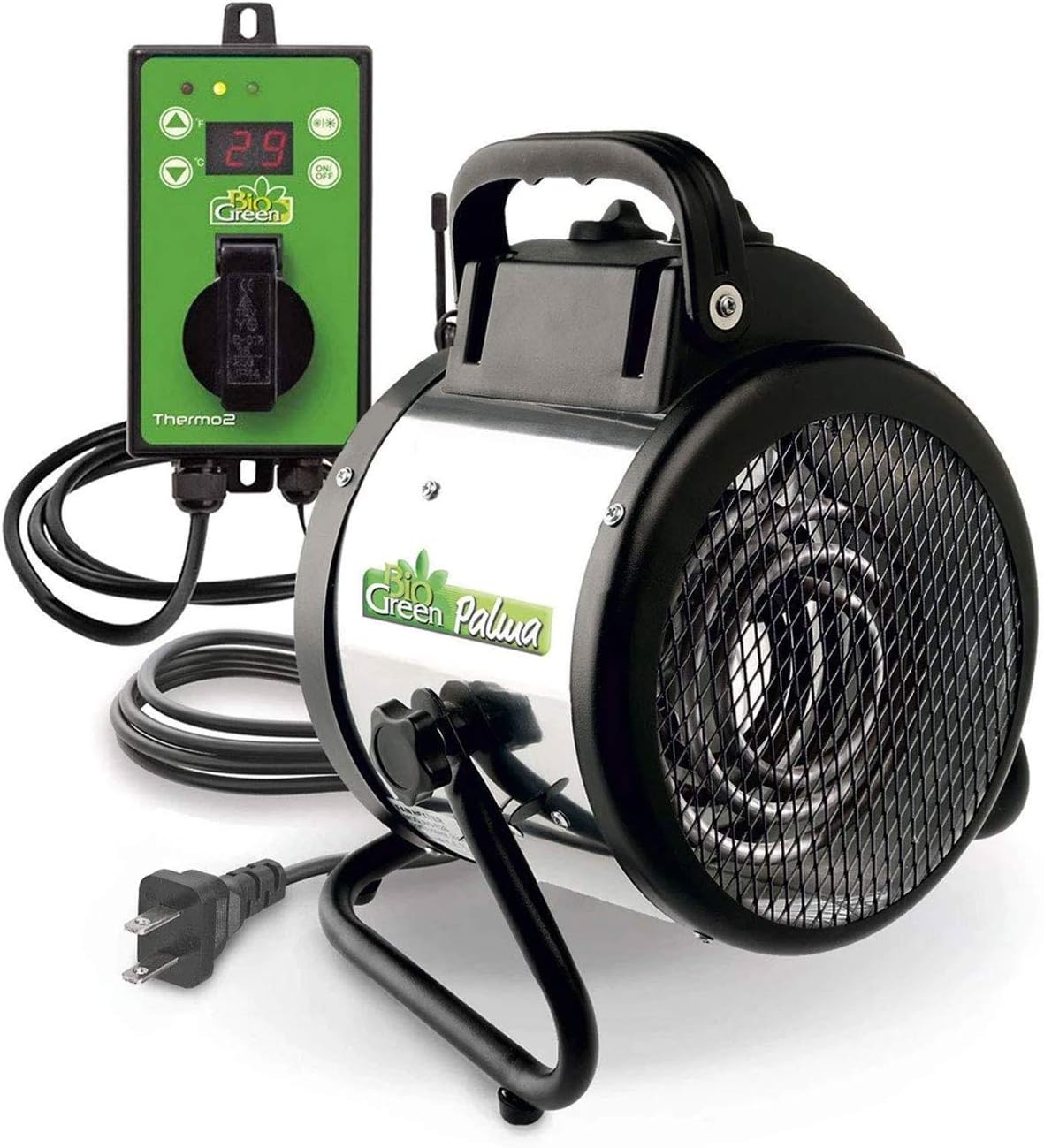


Pros
- Designed specifically around greenhouse heating and air circulation rather than general patio comfort heating.
- Includes adjustable temperature control and two power settings for more flexible cold-weather use.
- Stainless steel housing and splash-resistant IPX4 design suit the damp conditions often found in greenhouses.
- Portable form factor is easier to place, move, and store than many larger heater setups.
- Reviewers commonly mention easy adjustment and good temperature control, although experiences with durability and support are mixed.
Cons
- The listed 120 square foot coverage may be limiting for larger, poorly insulated, or very cold greenhouses.
- At 1500 watts and 15 amps, it may require careful outlet and circuit planning, especially around GFCI-protected greenhouse power.
- Some reviewers report heater, thermostat, cord, or breaker-tripping issues, so buyers may want to inspect and monitor the unit closely when first setting it up.
The Bio Green PAL 2.0/USDT Palma is an electric forced-air greenhouse heater and fan built for small growing spaces that need frost protection and steadier air movement. Its listed coverage is up to 120 square feet with an average height of 6.6 feet, making it a practical match for hobby greenhouses, seed-starting spaces, and compact garden structures rather than large commercial houses.
The main gardening benefit is controlled warmth paired with circulation. The heater offers 750 watt and 1500 watt settings, with heat output listed at 5118 BTU, so users can choose a lower or higher output depending on conditions. The digital thermostat is designed to switch the heater on and off at the selected temperature, and the listed temperature control range is 32°F to 185°F.
Air movement is a major part of the Palma design. The product information lists circulation up to 5800 cubic feet per hour, and the fan-only mode allows the unit to circulate air when heat is not required. In a greenhouse, that can be useful because warm air often collects near the roof while corners and low areas stay cooler.
The heater is compact at 11 by 8 by 12.5 inches and weighs 11 pounds. It has a portable floor-standing form factor, rubber feet, and a carrying handle, which should make placement and seasonal storage manageable for many home gardeners. The stainless steel housing and IPX4 splash protection are also relevant for damp greenhouse use, where watering, humidity, and condensation are routine concerns.
For realistic backyard use, this unit makes the most sense for keeping a small greenhouse above freezing, taking the chill off seed-starting benches, or improving circulation in a garden room or tent listed as a recommended use. Gardeners should still size expectations carefully, since actual heating performance depends on greenhouse insulation, outdoor temperature, air leaks, and where the heater and thermostat probe are placed.
The balanced takeaway is that the Palma offers a strong feature set for a small greenhouse heater: adjustable power, thermostat control, fan circulation, portability, and splash resistance. It may be less suitable for gardeners trying to heat a larger structure or maintain high temperatures during severe cold. Because it is a 120 volt, 15 amp electric heater, it should be used only with an appropriate outlet, kept clear of obstructions, and set up according to the manual, especially in wet greenhouse environments.
Best For / Avoid If
Best for buyers prioritizing
- Designed specifically around greenhouse heating and air circulation rather than general patio comfort heating.
- Includes adjustable temperature control and two power settings for more flexible cold-weather use.
- Stainless steel housing and splash-resistant IPX4 design suit the damp conditions often found in greenhouses.
Consider another option if
- The listed 120 square foot coverage may be limiting for larger, poorly insulated, or very cold greenhouses.
- At 1500 watts and 15 amps, it may require careful outlet and circuit planning, especially around GFCI-protected greenhouse power.
- Some reviewers report heater, thermostat, cord, or breaker-tripping issues, so buyers may want to inspect and monitor the unit closely when first setting it up.
Pros
- Strong listed airflow for greenhouse, garage, workshop, and similar ventilation tasks
- Adjustable airflow and temperature controls offer more flexibility than a basic on-or-off exhaust fan
- UL/cUL Listed design with wire guards and a corrosion-resistant metal construction
Cons
- Wall mounting and 115V electrical installation may require more planning than a portable ventilation solution
- The listed noise level is below 65 dB, so it may be less suitable for gardeners seeking very quiet operation
- Its 12-inch fan size and 15-inch housing may not fit every wall opening or small indoor growing setup
The iLIVING ILG8SF12V-ST is a 12-inch wall-mounted shutter exhaust fan designed to remove air from utility and growing spaces. Its listed applications include greenhouses, garages, workshops, warehouses, and dust extraction areas, making it a practical option for homeowners who need fixed ventilation rather than a portable fan.
Based on the listed specifications, the fan exchanges air at up to 960 cubic feet per minute and is described as covering areas up to 1,400 square feet. In a greenhouse, that airflow can support general air exchange, while in a workshop or garage it can help move warm or stale air out of the space. Actual results will depend on the room layout, wall opening, and installation conditions.
The fan uses a direct-drive motor with 12-inch blades, a galvanized steel frame, aluminum shutters, and aluminum fan blades. Variable speed control allows the airflow to be adjusted, and the included thermal control has a stated range of 32 to 130°F. The automatic shutter design is intended for wall-mounted use, but the supplied information does not specify installation hardware or the exact wall-opening requirements.
For backyard gardeners, the most relevant use is fixed ventilation in a greenhouse or garden workshop. It may also suit a garage used for potting, tool maintenance, or seasonal plant work. The 15 x 15 x 5.75-inch dimensions and 10.15-pound weight should be considered when planning the mounting location, especially where wall space is limited.
This is a 115V electrical appliance, so installation should follow applicable electrical requirements and the product's instructions. The listed noise level is below 65 dB, which is not necessarily quiet for a nearby patio or living area. Overall, it is a reasonable choice for users who need adjustable, wall-mounted ventilation in a greenhouse or utility space, while gardeners seeking a small, silent, or easily movable fan may prefer a different design.
Best For / Avoid If
Best for buyers prioritizing
- Strong listed airflow for greenhouse, garage, workshop, and similar ventilation tasks
- Adjustable airflow and temperature controls offer more flexibility than a basic on-or-off exhaust fan
- UL/cUL Listed design with wire guards and a corrosion-resistant metal construction
Consider another option if
- Wall mounting and 115V electrical installation may require more planning than a portable ventilation solution
- The listed noise level is below 65 dB, so it may be less suitable for gardeners seeking very quiet operation
- Its 12-inch fan size and 15-inch housing may not fit every wall opening or small indoor growing setup
Pros
- Strong listed airflow for clearing warm, humid, or stale air from enclosed garden areas.
- Thermostat, timer, speed settings, and remote offer flexible hands-free control.
- Automatic shutters and corrosion-resistant materials add practical value for utility spaces.
Cons
- An 8-inch fan may be less suitable for large structures or spaces that need broader air exchange.
- Wall installation still requires a correctly sized opening and a suitable location near power, even though the unit uses a plug-and-play design.
The Ehiair 8-inch shutter exhaust fan is designed to move stale air out of enclosed spaces such as greenhouses, sheds, workshops, garages, attics, basements, and chicken coops. For home gardeners, it is most relevant when heat, humidity, odors, smoke, or dust build up in a utility area and passive vents do not provide enough air movement.
Based on the listed specifications, the fan delivers 760 CFM airflow through a three-blade design, which should provide useful ventilation for an appropriately sized space. The thermostat includes Low-Temp and High-Temp modes, a 32°F to 140°F range, three speeds, and an 18-hour timer, allowing gardeners to adjust operation as conditions change rather than running the fan continuously.
The wall-mounted design measures 5 x 10.95 x 10.55 inches and weighs 6.2 pounds. Installation is presented as plug and play, with a cutout template and no wiring required, but the wall opening and placement still need to be planned carefully. The controller-to-plug cord is 4.9 feet, while the fan-to-controller cable is 2.6 feet, so check the layout and nearby outlet before mounting.
In a backyard greenhouse, the thermostat could help manage warm daytime conditions, while a shed or workshop may benefit from scheduled ventilation after dusty or odor-producing tasks. The remote is listed with a 66-foot range, which may be convenient when the fan is mounted high or in a less accessible area. For small-space gardening, the unit is more suitable for ventilating an enclosed structure than for moving air across an open patio or yard.
The galvanized steel frame, aluminum blades, grounded power cord, ETL certification, dual ball bearings, and stated noise level of 40 dB or less are useful design details for regular operation. Gardeners should keep the fan opening and blades clear of accumulated dust, confirm that the installation location is appropriate for the intended environment, and follow electrical and mounting instructions. This is a sensible choice for homeowners who want adjustable ventilation in a small to medium utility space, while those with larger structures or a need for broad-area air circulation may prefer a larger ventilation system.
Best For / Avoid If
Best for buyers prioritizing
- Strong listed airflow for clearing warm, humid, or stale air from enclosed garden areas.
- Thermostat, timer, speed settings, and remote offer flexible hands-free control.
- Automatic shutters and corrosion-resistant materials add practical value for utility spaces.
Consider another option if
- An 8-inch fan may be less suitable for large structures or spaces that need broader air exchange.
- Wall installation still requires a correctly sized opening and a suitable location near power, even though the unit uses a plug-and-play design.
Pros
- Strong airflow for ventilating larger enclosed garden and utility spaces.
- Automatic temperature control plus eight manual speed options.
- Compact 12-inch fan size with a durable metal-and-aluminum construction.
Cons
- Installation still requires a correctly sized wall or window opening, and the listed dimensions should be checked before cutting.
- A 120V outlet must be available because this is a plug-in fan, not a battery-powered unit.
- Gardeners needing quiet, low-volume circulation for a small patio greenhouse may find this type of exhaust fan more capacity than necessary.
The Amico 12-inch shutter exhaust fan is designed to remove warm, humid, or stale air from enclosed spaces such as greenhouses, sheds, workshops, garages, and similar utility areas. Its 1282 CFM airflow makes it more appropriate for larger spaces than for gentle air circulation around a small patio growing area.
For garden use, the main benefit is active ventilation rather than direct plant lighting or watering. The fan can help move heated or moisture-laden air out of a greenhouse or shed, while the thermostat probe is intended to turn the fan on when the selected temperature is reached. Eight speed settings provide more control than a simple single-speed exhaust fan.
The unit measures 14.2 by 14.2 by 6.3 inches and uses a 12-inch fan format. It has a galvanized steel frame, aluminum blades, automatic gravity louvers, and a pre-wired 120V plug with an extra-long power cord. Before installation, confirm that the available wall or window opening can accommodate the fan and that the outlet and mounting location are suitable.
Possible applications include exhausting hot air from a greenhouse during warm weather, reducing stale air in a garden shed, or improving ventilation in a workshop where odors and moisture accumulate. The thermostat and power-off memory may be useful for homeowners who want repeatable settings without readjusting the controls after every power interruption.
The listed design includes louvers intended to close when the fan is off and help block drafts, rain, and insects, but the fan should still be installed according to the manufacturer's instructions and protected from conditions beyond its stated use. This model is a practical choice for larger enclosed spaces needing powered exhaust, while gardeners seeking only gentle circulation, cordless operation, or a compact tabletop fan should consider a different type of product.
Best For / Avoid If
Best for buyers prioritizing
- Strong airflow for ventilating larger enclosed garden and utility spaces.
- Automatic temperature control plus eight manual speed options.
- Compact 12-inch fan size with a durable metal-and-aluminum construction.
Consider another option if
- Installation still requires a correctly sized wall or window opening, and the listed dimensions should be checked before cutting.
- A 120V outlet must be available because this is a plug-in fan, not a battery-powered unit.
- Gardeners needing quiet, low-volume circulation for a small patio greenhouse may find this type of exhaust fan more capacity than necessary.

Pros
- Combines heating, ventilation, and thermostat control in one portable unit.
- Compact form is practical for small growing spaces and work areas.
- Supports multiple uses, including seedlings, plant tents, chick brooding, and drying projects.
- Overheat protection adds a useful safety measure during extended operation.
Cons
- The supplied information does not specify a heating coverage area or thermostat temperature range, so suitability for larger greenhouses is unclear.
- IP20 protection is listed, but no outdoor or weather-resistance rating is provided, so the heater may require placement away from rain, splashes, and direct moisture.
- Gardeners seeking detailed installation, mounting, or storage guidance may need to confirm those details before purchase.
The VEVOR greenhouse heater is a compact electric heating and ventilation unit intended for small greenhouses, grow tents, flower rooms, and similar enclosed spaces. Its independent thermostat makes it most relevant for gardeners who want more consistent conditions for seedlings or plants that are sensitive to temperature changes.
Based on the listed specifications, the 1500W PTC heating system provides fast warmth, with a stated output of 6800 BTU. The product information also describes low-noise operation and dehumidifying and air-circulation use, which may help gardeners manage stagnant air and humidity concerns alongside heating.
The heater measures approximately 8.27 x 6.30 x 8.66 inches and weighs 4.54 pounds, giving it a relatively compact footprint for a small growing area or work surface. Controls include an independent thermostat, hot and cold operating modes, and a three-level adjustment knob. Assembly requirements and mounting options are not provided.
For backyard growers, this unit could fit a small greenhouse, plant tent, flower room, or indoor seed-starting area where localized temperature control is needed. The fan-only ventilation mode also provides a practical option for warmer conditions, while the multi-scene design may suit non-gardening tasks such as chick brooding or drying projects.
The listed IP20 protection, overheat protection, and ETL certification are useful safety details, but no outdoor weather-resistance rating or water-protection capability is provided. Keep the heater away from rain, splashes, standing water, and flammable materials, and follow the manufacturer's operating guidance. It is a reasonable option for gardeners needing compact heating and airflow control, while those with large greenhouses or specific temperature-range requirements should look for confirmed coverage and thermostat specifications.
Best For / Avoid If
Best for buyers prioritizing
- Combines heating, ventilation, and thermostat control in one portable unit.
- Compact form is practical for small growing spaces and work areas.
- Supports multiple uses, including seedlings, plant tents, chick brooding, and drying projects.
Consider another option if
- The supplied information does not specify a heating coverage area or thermostat temperature range, so suitability for larger greenhouses is unclear.
- IP20 protection is listed, but no outdoor or weather-resistance rating is provided, so the heater may require placement away from rain, splashes, and direct moisture.
- Gardeners seeking detailed installation, mounting, or storage guidance may need to confirm those details before purchase.

Pros
- Useful temperature control range of 40 to 108°F for several greenhouse and home ventilation tasks.
- Includes a 4.92-foot temperature probe and 3.94-foot three-prong power cord for flexible placement.
- ETL listed and equipped with visible power and cooling status indicators.
Cons
- It is designed for cooling devices only, so it is not suitable for directly controlling heaters.
- Gardeners using equipment above the listed 8.3-amp or 1000-watt maximum will need a different controller or setup.
- The supplied product information does not specify weather resistance, so outdoor placement may require protection from moisture.
The BN-LINK Digital Cooling Thermostat Temperature Controller is an outlet switch for automatically controlling compatible cooling equipment. It is intended for tasks such as greenhouse ventilation, attic fans, exhaust fans, swamp coolers, and temperature management in garages, coops, brewing, or fermentation areas. Its straightforward controls make it a practical option for homeowners and beginner gardeners who want temperature-based cooling without a complicated setup.
The controller operates within a listed range of 40 to 108°F and displays readings in either Fahrenheit or Celsius. That range can help keep a small greenhouse or enclosed growing area from becoming excessively warm when paired with a compatible cooling device. The controller responds to the temperature detected by its separate probe, allowing the sensing point to be placed away from the main outlet housing.
Setup involves placing the probe, plugging in the controller, and using the three-button interface to select the desired temperature. The 4.92-foot probe and 3.94-foot three-prong power cord provide some placement flexibility. A bright display, power and cooling indicator lights, and a hanging tab are useful details for installation in spaces where visibility and access may otherwise be limited.
In a backyard greenhouse, this controller could be paired with a compatible ventilation fan to help manage warm conditions. It may also be useful in an attic, garage, chicken coop, or other enclosed area where a cooling device needs to respond to temperature changes. Its compact 4.5 by 3.5 by 1.6 inch size may fit installations where a larger control panel would be inconvenient, although the supplied information does not specify outdoor weather resistance.
This is a cooling-only controller, so it should not be used to operate heaters. Connected equipment must remain within the listed 120VAC, 8.3-amp, and 1000-watt maximums, and users should follow safe electrical practices when installing it. Overall, it is a focused choice for temperature-triggered cooling in small growing and utility spaces, while gardeners needing heating control, higher electrical capacity, or confirmed weatherproof construction should consider a different option.
Best For / Avoid If
Best for buyers prioritizing
- Useful temperature control range of 40 to 108°F for several greenhouse and home ventilation tasks.
- Includes a 4.92-foot temperature probe and 3.94-foot three-prong power cord for flexible placement.
- ETL listed and equipped with visible power and cooling status indicators.
Consider another option if
- It is designed for cooling devices only, so it is not suitable for directly controlling heaters.
- Gardeners using equipment above the listed 8.3-amp or 1000-watt maximum will need a different controller or setup.
- The supplied product information does not specify weather resistance, so outdoor placement may require protection from moisture.

Pros
- Strong listed airflow capacity for ventilating larger enclosed spaces.
- Adjustable speed and temperature controls provide more control than a basic exhaust fan.
- UL/cUL-listed construction with wire guards and a permanently lubricated motor.
Cons
- At 26 pounds and approximately 23 by 23 inches, it may require a sturdy wall opening and careful installation.
- The listed noise level is below 69 dB, so gardeners seeking especially quiet greenhouse or backyard operation may prefer a quieter model.
- This is a wall-mounted exhaust unit, so it may be less suitable for temporary, portable, or small patio ventilation needs.
The iLIVING ILG8SF20V-ST is a 20-inch wall-mounted shutter exhaust fan intended for moving air through utility spaces such as greenhouses, garages, workshops, warehouses, and areas used for dust extraction. For home gardeners, it is most relevant when a growing space needs active exhaust ventilation rather than a small clip-on or portable fan.
Based on the listed specifications, the fan can exchange air at up to 3,368 cubic feet per minute and is described for coverage up to 5,000 square feet. That airflow capacity may help remove hot, stale, or dusty air from a larger greenhouse or work area, although actual results will depend on the room layout, wall opening, and other ventilation paths.
The unit includes variable-speed control and temperature regulation through the listed Thermospeed controller, with a control range of 32 to 130°F. Its automatic shutters are designed to open with the fan, while the galvanized steel frame, aluminum shutters, and fan blades provide a utility-focused design. The approximately 23 by 23 inch body weighs 26 pounds, so installation should be planned around a suitably strong wall and an appropriate electrical connection.
In a backyard greenhouse, this fan could serve as a primary exhaust point for managing warm air when paired with a suitable air intake. It may also be useful in a garden workshop or garage where tools, soil handling, or other projects create heat and airborne dust. Wall mounting preserves floor and bench space, which is helpful when the available work area is limited.
The listed noise level is below 69 dB, which may be noticeable in a quiet backyard or greenhouse. Users should follow applicable electrical and installation requirements, keep the guarded fan clear of obstructions, and confirm that the wall opening and support structure are appropriate before installation. The fan is a strong candidate for gardeners needing high-volume, adjustable exhaust ventilation, while those with a small patio setup or a need for portable, very quiet airflow may prefer a different design.
Best For / Avoid If
Best for buyers prioritizing
- Strong listed airflow capacity for ventilating larger enclosed spaces.
- Adjustable speed and temperature controls provide more control than a basic exhaust fan.
- UL/cUL-listed construction with wire guards and a permanently lubricated motor.
Consider another option if
- At 26 pounds and approximately 23 by 23 inches, it may require a sturdy wall opening and careful installation.
- The listed noise level is below 69 dB, so gardeners seeking especially quiet greenhouse or backyard operation may prefer a quieter model.
- This is a wall-mounted exhaust unit, so it may be less suitable for temporary, portable, or small patio ventilation needs.

Pros
- Useful temperature-based automation for greenhouses, sheds, and other enclosed growing or work areas.
- Compact 8-inch format with a lightweight 5.07-pound body and remote operation.
- Automatic shutters provide a practical barrier when the fan is not running.
- ETL listing and a grounded cord add useful safety information for a powered ventilation product.
Cons
- Wall-mounted installation requires creating or preparing an appropriately sized opening, so it is not a plug-in solution for every space.
- The 4.9-foot and 2.6-foot cord lengths may limit controller and outlet placement in some installations.
- Gardeners needing ventilation for a large or unusually shaped structure may need to determine whether one 8-inch fan provides enough airflow for that specific space.
The Windigaga 8-inch shutter exhaust fan is a wall-mounted ventilation product for enclosed areas such as greenhouses, sheds, garages, workshops, basements, and chicken coops. For gardeners, its main job is to move warm, damp, smoky, or stale air out of a growing or utility space, making it a practical option for homeowners who need more controlled air circulation.
Its listed 760 CFM airflow, three fan speeds, and thermostat range of 32°F to 140°F provide several ways to manage ventilation. In Auto Mode, the fan can turn on or off around a selected temperature, which may reduce the need for frequent manual adjustments in a greenhouse or shed. The 18-hour timer and remote control add convenience for routine operation.
The fan has a galvanized steel frame, aluminum blades, and automatic louvers that open while operating and close when powered off. The louvers are designed to help block rain, dust, wind, and pests, while built-in sound-absorbing padding is intended to reduce vibration. The listed dimensions are 7.8 by 11 by 10.8 inches, and the unit weighs 5.07 pounds.
In a backyard greenhouse, this fan could help move excess heat and moisture, while a shed or workshop may benefit from removing odors and stagnant air. The compact format may also suit smaller utility spaces, but the product information does not specify a coverage area, so users should match the airflow to the size and layout of their structure rather than assume one fan will serve every space.
Installation still requires a suitable wall cutout and access to power. The included template and prewired 4.9-foot controller-to-plug cord and 2.6-foot fan-to-controller cable may simplify setup, but their lengths can affect placement. The ETL-listed grounded cord is a useful safety feature, and users should follow the installation instructions and confirm that the wall location, opening, and electrical setup are appropriate. This fan is a good fit for gardeners wanting automated ventilation in an enclosed space, while those needing portable airflow or a specified large-area capacity may prefer a different solution.
Best For / Avoid If
Best for buyers prioritizing
- Useful temperature-based automation for greenhouses, sheds, and other enclosed growing or work areas.
- Compact 8-inch format with a lightweight 5.07-pound body and remote operation.
- Automatic shutters provide a practical barrier when the fan is not running.
Consider another option if
- Wall-mounted installation requires creating or preparing an appropriately sized opening, so it is not a plug-in solution for every space.
- The 4.9-foot and 2.6-foot cord lengths may limit controller and outlet placement in some installations.
- Gardeners needing ventilation for a large or unusually shaped structure may need to determine whether one 8-inch fan provides enough airflow for that specific space.

Pros
- Combines temperature and humidity sensing with manual speed control.
- Automatic shutters provide a barrier when the fan is not running.
- Plug-in installation can be more approachable than a fully hardwired fan setup.
- The remote is listed with a range of up to 50 feet, allowing control from a distance.
Cons
- It still requires a suitable window or wall opening, and cutting or mounting work may be needed for permanent installation.
- The supplied information does not specify an outdoor weather-resistance rating, so placement and protection should be considered carefully.
- Gardeners needing a fan with a different voltage, smaller footprint, or documented airflow coverage may prefer another model.
The Amico 10-inch shutter exhaust fan is designed to remove hot or humid air from an enclosed space. For garden-related use, it may suit a chicken coop, garden outbuilding, or another appropriate window or wall opening where controlled ventilation is needed. Its automatic controls make it more suitable for gardeners who do not want to monitor conditions constantly.
Based on the listed specifications, the fan delivers 1068 CFM through a 13W brushless DC motor running at 2035 RPM. The system can respond to selected high and low temperature settings, while its auto mode increases speed as temperature or humidity rises. These controls could help maintain more consistent airflow, but actual results will depend on the room, opening, layout, and outside conditions.
The fan includes eight speed settings, a 24-hour timer, a sensor probe, and a remote listed with up to 50 feet of range. It measures 6.3 by 10 by 10 inches and has a pre-wired 120V plug with an extra-long power cord. The included paper template may help with cutting a wall opening, although permanent installation still requires careful measuring, secure mounting, and suitable electrical placement.
Possible backyard applications include ventilating a chicken coop or helping move stale, warm air from a garden shed or similar enclosed space. The automatic gravity shutters are intended to close when the fan stops, which may help limit drafts, rain, and insects. The product information also lists 45 dB operation, a feature that may be helpful when the fan is located near animals, work areas, or the home.
Before installation, confirm that the opening, power source, and mounting location are appropriate for a 120V plug-in fan. The supplied information does not state an outdoor weather-resistance rating or define a recommended coverage area, so avoid assuming it is suitable for fully exposed locations or every greenhouse setup. The fan should be kept clear of obstructions, and the shutters and sensor should be checked periodically for dirt or blockage.
This model is a reasonable option for gardeners who want adjustable ventilation, automatic temperature and humidity response, and a plug-in setup. Consider a different option if you need documented outdoor weather protection, a hardwired installation, a smaller unit, or published guidance for a specific room size.
Best For / Avoid If
Best for buyers prioritizing
- Combines temperature and humidity sensing with manual speed control.
- Automatic shutters provide a barrier when the fan is not running.
- Plug-in installation can be more approachable than a fully hardwired fan setup.
Consider another option if
- It still requires a suitable window or wall opening, and cutting or mounting work may be needed for permanent installation.
- The supplied information does not specify an outdoor weather-resistance rating, so placement and protection should be considered carefully.
- Gardeners needing a fan with a different voltage, smaller footprint, or documented airflow coverage may prefer another model.

Pros
- Variable speed and temperature controls allow more precise airflow management.
- High listed airflow capacity is suitable for larger enclosed areas.
- Galvanized steel construction and direct-drive operation are practical for routine use.
- Wall-mounted format preserves valuable floor space in a greenhouse or workshop.
Cons
- Wall installation may require a properly sized opening, secure mounting, and suitable electrical work.
- The 14-inch fan size and 15 x 8 x 15-inch dimensions may be more equipment than needed for a small greenhouse or compact shed.
- Gardeners seeking quiet, low-power ventilation may prefer a smaller fan, since the listed noise level is below 63 dB and the unit draws 2.85 amps.
The iLiving 14-inch variable-speed gable exhaust fan is designed to move air from enclosed spaces such as greenhouses, attics, garages, and workshops. Its wall-mounted format makes it a practical option for homeowners who need powered ventilation without placing a fan on the floor, bench, or growing area.
Based on the listed specifications, the fan can exchange air at up to 2339 CFM and can be adjusted down to 600 CFM. That range gives gardeners and homeowners more control over ventilation during changing conditions, while the 32°F to 130°F temperature control range may help coordinate operation with the temperature of the space.
The unit measures 15 x 8 x 15 inches and weighs 11.5 pounds. Its 14-inch steel blades use a deep-pitch angle for air movement, while the galvanized steel housing and direct-drive motor are intended for regular use. The Thermospeed controller combines variable speed and temperature regulation in one control system.
In a greenhouse, this fan could help move stale or overheated air out of the growing structure when paired with an appropriate ventilation layout. It may also suit an attic, garage, or workshop where wall-mounted air exchange is more useful than a portable floor fan. The defined dimensions are especially relevant when planning the available wall area before installation.
This is a powered wall-mounted appliance, so installation should account for the required opening, secure support, electrical connection, and safe access for maintenance. The listed noise level is below 63 dB, which may be noticeable in quiet areas. Overall, it is a reasonable choice for larger enclosed spaces needing adjustable exhaust airflow, while users with a small growing area or no suitable wall and electrical setup may prefer a smaller or simpler ventilation option.
Best For / Avoid If
Best for buyers prioritizing
- Variable speed and temperature controls allow more precise airflow management.
- High listed airflow capacity is suitable for larger enclosed areas.
- Galvanized steel construction and direct-drive operation are practical for routine use.
Consider another option if
- Wall installation may require a properly sized opening, secure mounting, and suitable electrical work.
- The 14-inch fan size and 15 x 8 x 15-inch dimensions may be more equipment than needed for a small greenhouse or compact shed.
- Gardeners seeking quiet, low-power ventilation may prefer a smaller fan, since the listed noise level is below 63 dB and the unit draws 2.85 amps.

Pros
- Cordless solar setup is useful for sheds, small greenhouses, chicken coops, and other outbuildings away from household power.
- Thermostat control adds convenience compared with a basic always-on solar fan.
- Battery backup provides a supported option for continued ventilation beyond direct sunlight, depending on charge and conditions.
- Wall or window mounting gives homeowners flexibility for exhaust placement.
- Anti-backflow exhaust fan design is appropriate for moving air out of an enclosed space.
Cons
- Solar charging and fan output can be reduced in cloudy weather, shaded locations, or poor panel placement.
- The listed 220 CFM capacity may be too small for larger greenhouses, sheds, or animal shelters that need stronger air exchange.
- Some users may need to plan controller placement carefully because installation height and cable routing can affect everyday access.
The ecoCalm KP-SEF23124 is an 8-inch solar exhaust fan intended for outdoor ventilation in small greenhouses, sheds, chicken coops, animal houses, garages, barns, and similar enclosed spaces. It is designed to pull air out rather than blow fresh air in, so it works best when paired with an appropriate intake opening or existing vent on the opposite side of the space.
The main practical benefit is cord-free air movement. The product information lists 220 CFM airflow and suitability for spaces up to 380 cubic feet, which makes it most relevant for compact structures rather than large greenhouses. The included 4400mAh rechargeable battery is listed to provide up to 8 hours of operation after a full sunlight charge, although the manufacturer notes that charging and fan performance are affected by sunlight conditions.
The fan uses a bifacial solar panel that can generate power from both sides when light conditions allow. It also includes an adjustable temperature control system in the battery box, allowing the fan to turn on and off automatically according to the selected ambient temperature. For gardeners who do not want to manually manage ventilation throughout the day, that thermostat feature is a meaningful upgrade over a simple direct-solar fan.
Installation is listed as wall or window mount, with a permanent installation type, DC connectors, a waterproof plug, and a 14.8-foot cable. The fan body measures 3.74 inches deep by 9.06 inches wide by 9.06 inches high. The IP44 waterproof fan blades and outdoor-focused design are useful for garden structures, but the solar panel should still be positioned for strong sun exposure and mounted securely against wind or weather.
In a backyard setup, this fan makes the most sense for a small greenhouse that overheats in afternoon sun, a potting shed that holds warm air, or a coop where air exchange is needed without running electrical wiring. Reviewers commonly mention use in chicken coops and sheds, with several noting easy setup and quiet operation, while others report that airflow or battery performance did not meet their needs in larger or less ideal conditions.
Gardeners should size ventilation carefully before buying. A single 8-inch, 220 CFM exhaust fan may not be enough for a larger greenhouse, a very humid shed, or an animal shelter that needs substantial air exchange. This is a practical choice for small-space solar ventilation, but anyone needing dependable all-weather airflow, more capacity, or powered ventilation independent of sunlight may want to consider a larger or hardwired system.
Best For / Avoid If
Best for buyers prioritizing
- Cordless solar setup is useful for sheds, small greenhouses, chicken coops, and other outbuildings away from household power.
- Thermostat control adds convenience compared with a basic always-on solar fan.
- Battery backup provides a supported option for continued ventilation beyond direct sunlight, depending on charge and conditions.
Consider another option if
- Solar charging and fan output can be reduced in cloudy weather, shaded locations, or poor panel placement.
- The listed 220 CFM capacity may be too small for larger greenhouses, sheds, or animal shelters that need stronger air exchange.
- Some users may need to plan controller placement carefully because installation height and cable routing can affect everyday access.

Pros
- Simple plug-in installation can be more approachable than wiring a thermostat into a ventilation system.
- Listed temperature accuracy is suited to users who want more consistent fan control.
- Alloy steel casing and built-in overload protection are practical features for a utility-space controller.
Cons
- The supplied information does not provide a temperature adjustment range, so buyers should confirm that the available settings suit their ventilation needs.
- Compatibility with a specific fan, outlet setup, or motor type is not documented and should be checked before purchase.
- This controller requires a powered exhaust fan and electrical connection, so it is not a standalone ventilation solution.
The Makevivi Attic Fan Thermostat Controller is a plug-in temperature controller for an exhaust fan. For gardening, it may be useful in a grow tent or storage area where a fan needs to respond to changing temperatures without requiring frequent manual switching. It is also aimed at utility spaces such as attics, basements, garages, and laundry rooms.
The main performance feature is the listed circuit-board temperature sensor, which the product information says limits temperature error to within ±1.8°F. In practical terms, that suggests more precise temperature-responsive fan operation than the bimetal-sensor comparison described by the manufacturer. The controller is intended to help avoid both inadequate ventilation and unnecessary continuous fan operation, although actual results depend on the connected fan and the space.
Setup is designed to be straightforward: plug the exhaust fan into the controller's external socket, then plug the controller into a power supply. The product is listed with a 5-foot size designation, a 0.5-pound weight, and dimensions of 1 x 1 x 1 inches. The supplied information does not describe the control interface, adjustment range, mounting method, or storage features, so those details should be confirmed before installation.
For backyard and small-space growing, this controller could fit a grow tent, greenhouse utility area, garage propagation space, or storage room where an existing exhaust fan provides air circulation. Its listed 1600W maximum load at 120V may accommodate suitable equipment within that limit, but gardeners should verify the fan's electrical requirements and plug compatibility rather than assuming every exhaust fan will work with it.
The product information lists overload protection, a UL-listed controller, and a UL-certified power extension cord, along with an alloy steel casing. Use it only within the stated electrical load and keep the setup appropriate for the connected equipment and location. Because no temperature range, fan compatibility list, weather-resistance information, or detailed mounting instructions are provided, buyers needing outdoor exposure protection, specialized controls, or confirmed motor compatibility may prefer a controller with those specifications clearly documented.
Best For / Avoid If
Best for buyers prioritizing
- Simple plug-in installation can be more approachable than wiring a thermostat into a ventilation system.
- Listed temperature accuracy is suited to users who want more consistent fan control.
- Alloy steel casing and built-in overload protection are practical features for a utility-space controller.
Consider another option if
- The supplied information does not provide a temperature adjustment range, so buyers should confirm that the available settings suit their ventilation needs.
- Compatibility with a specific fan, outlet setup, or motor type is not documented and should be checked before purchase.
- This controller requires a powered exhaust fan and electrical connection, so it is not a standalone ventilation solution.
Pros
- Works without a conventional power outlet, useful for remote sheds, greenhouses, barns, and chicken coops.
- Thermostat control reduces the need to manually switch the fan on during hot parts of the day.
- Included battery provides backup ventilation after charging, rather than limiting operation only to direct sun.
- Reviewers commonly mention straightforward installation and effective airflow in greenhouse or coop uses.
- Metal build and screw-together style wiring noted in reviews suggest a more substantial setup than many lightweight plastic fan kits.
Cons
- Fan and battery performance may drop in cloudy weather or poorly positioned solar panel locations.
- Control setup may take patience, as at least one reviewer found the settings less intuitive at first.
- Gardeners needing guaranteed all-night ventilation or code-compliant attic ventilation should confirm the system meets their space and safety requirements before relying on it.
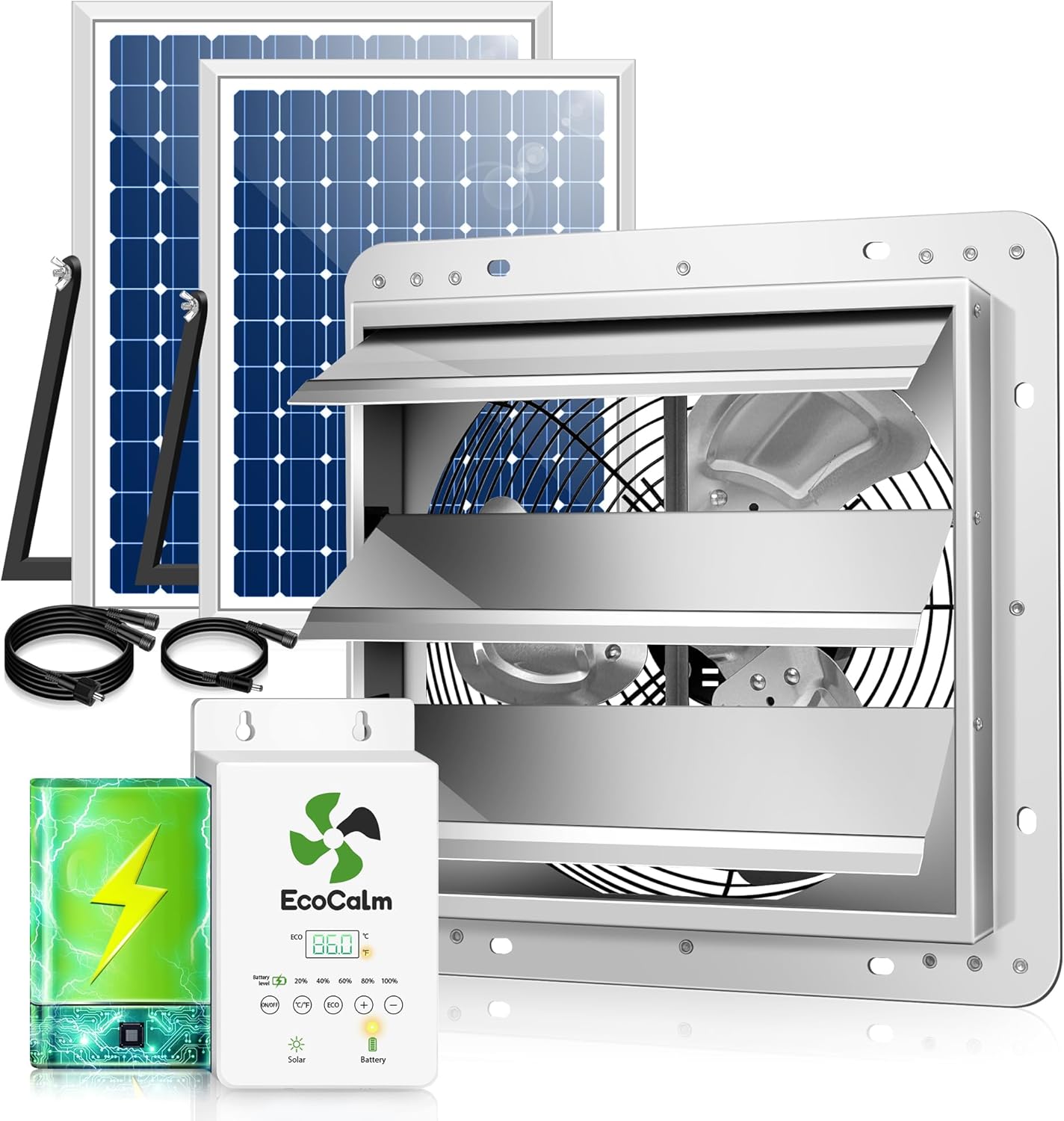
The ecoCalm KP-SEF240812 is a 12-inch solar powered exhaust fan made for moving hot, humid, or stale air out of enclosed spaces such as greenhouses, garden sheds, garages, attics, barns, and chicken coops. For gardeners, its most useful role is greenhouse ventilation, especially in backyard structures that do not have convenient access to a household electrical outlet.
Based on the listed specifications, the fan is rated at 680 CFM and is intended for spaces up to 1600 cubic feet. That puts it in a useful range for many small to midsize hobby greenhouses and outbuildings, provided there is also an intake opening so replacement air can enter. The product information also highlights cooling indoor temperatures, helping reduce mold-friendly conditions, and improving air quality through circulation.
The system includes two 30W bifacial solar panels, a 5000mAh rechargeable battery, and an intelligent power system that switches according to sunlight conditions. The battery is described as providing up to 6 hours of operation after a full charge in sunlight, though the product information clearly notes that fan output and battery charging are affected by cloudy weather. For best results, the panels need to be placed where they receive strong sun for much of the day.
Installation is listed for window or wall mounting, and the 14.8-foot cable gives some flexibility in locating the solar panels away from the fan opening. The fan uses metal construction, a DC motor, touch control, and IP44 waterproof fan blades. Reviewers commonly mention straightforward setup, quiet operation, and good results in small greenhouses and coops, although those comments should be treated as user experiences rather than guaranteed performance.
The adjustable thermostat is one of the more gardener-friendly features because it can cycle the fan on and off according to the temperature setting rather than requiring constant attention. That is helpful for seed starting areas, summer greenhouse use, or animal shelters where heat can build quickly. One practical setup tip is to think through both exhaust and intake placement, since an exhaust fan works best when fresh air can enter from the opposite side or lower part of the structure.
This is a good fit for homeowners who want off-grid ventilation for a greenhouse, shed, or coop and are willing to mount solar panels in a sunny location. It may be less suitable for shaded yards, spaces that need dependable ventilation through long dark periods, or installations where electrical safety and building-code compliance are critical. As with any powered outdoor equipment, keep wiring protected, follow the manufacturer instructions, and inspect the fan and connections periodically for damage, vibration, or moisture issues.
Best For / Avoid If
Best for buyers prioritizing
- Works without a conventional power outlet, useful for remote sheds, greenhouses, barns, and chicken coops.
- Thermostat control reduces the need to manually switch the fan on during hot parts of the day.
- Included battery provides backup ventilation after charging, rather than limiting operation only to direct sun.
Consider another option if
- Fan and battery performance may drop in cloudy weather or poorly positioned solar panel locations.
- Control setup may take patience, as at least one reviewer found the settings less intuitive at first.
- Gardeners needing guaranteed all-night ventilation or code-compliant attic ventilation should confirm the system meets their space and safety requirements before relying on it.
Pros
- Useful airflow capacity for greenhouse, shed, garage, attic, workshop, basement, and chicken-coop ventilation.
- Hands-free temperature control with three speeds, a timer, and remote access.
- Closing shutters and corrosion-resistant materials are practical features for enclosed garden spaces.
- Grounded power cord and ETL certification provide documented electrical safety features.
Cons
- A 10-inch wall-mounted fan may be less suitable for large buildings or spaces that need multiple ventilation points.
- Installation still requires a properly sized wall opening and secure mounting, even though the power connection is plug-and-play.
- The supplied cable lengths may limit controller and outlet placement in some layouts.
The Ehiair 10-inch shutter exhaust fan is designed to move air through enclosed spaces such as greenhouses, sheds, workshops, garages, basements, attics, and chicken coops. For gardeners, its main use is helping remove excess heat, humidity, dust, smoke, and odors where natural airflow is not enough. The feature set is most relevant to homeowners managing a dedicated growing or utility area.
Based on the listed specifications, the fan provides 890 CFM airflow from a 36W motor. That combination suggests a practical balance between strong ventilation and modest electrical demand, although the suitable space size will depend on the building layout and other ventilation openings. Three speed settings allow users to adjust airflow, while the thermostat can operate in Low-Temp or High-Temp mode within a 32°F to 140°F range.
The wall-mounted design includes a controller, a 66-foot remote, an 18-hour timer, and automatic shutters. The shutters open while the fan runs and close when it stops, helping reduce the entry of rain, dust, wind, and insects. A galvanized steel frame, aluminum blades, and sound-absorbing padding on the shutter edges are listed design features for humid or dusty areas. The fan measures 5 by 10.8 by 10.8 inches and weighs 6.39 pounds.
In a backyard greenhouse, this fan could help exchange warm, humid air during periods of high temperature. It may also be useful in a garden shed or workshop where odors, dust, or stagnant air build up, and in a chicken coop where automatic temperature-based operation is convenient. The included cutout template can make it easier to mark the opening, while the 4.9-foot controller-to-plug cord and 2.6-foot fan-to-controller cable help define placement options.
Users should confirm that the wall can accommodate the listed dimensions and that the installation location provides a suitable opening, secure mounting, and safe access to grounded power. The product information does not specify a coverage area, so larger structures may need a different ventilation arrangement. Gardeners seeking a compact, adjustable fan for an enclosed greenhouse or outbuilding may find this feature set useful, while those needing whole-building ventilation or a battery-powered option should consider alternatives.
Best For / Avoid If
Best for buyers prioritizing
- Useful airflow capacity for greenhouse, shed, garage, attic, workshop, basement, and chicken-coop ventilation.
- Hands-free temperature control with three speeds, a timer, and remote access.
- Closing shutters and corrosion-resistant materials are practical features for enclosed garden spaces.
Consider another option if
- A 10-inch wall-mounted fan may be less suitable for large buildings or spaces that need multiple ventilation points.
- Installation still requires a properly sized wall opening and secure mounting, even though the power connection is plug-and-play.
- The supplied cable lengths may limit controller and outlet placement in some layouts.

Pros
- Includes a separate thermostat rather than relying only on basic onboard controls.
- Compact 8.27 x 6.3 x 8.66 inch size and 4.4 pound weight make it manageable for small spaces.
- Offers both heating and fan modes for seasonal flexibility.
- PTC ceramic forced-air design and 140 CFM listed air volume support active air movement.
- Overheat protection is included for added operational safety.
Cons
- Listed for indoor use, so it should not be treated as an outdoor, weather-exposed heater.
- Actual heating performance may vary with greenhouse insulation, humidity, outside temperature, and enclosure size.
- Gardeners heating a large or poorly sealed structure may need a different heating plan or additional equipment.
The VEVOR BGP1606-150 is a compact electric greenhouse heater designed for indoor growing spaces such as greenhouses, grow tents, flower rooms, and similar enclosed work areas. It uses a 1500W PTC ceramic heating element with forced-air output, making it a practical option for gardeners who need supplemental warmth rather than a permanent heating system.
The key gardening value is temperature control. The included independent thermostat lets you set a target temperature from 40°F to 108°F, which can be helpful when starting seedlings, protecting tender plants indoors, or keeping a small greenhouse workspace more comfortable during cold periods. The product information also lists low and high heat modes, so users can adjust the output to suit changing conditions.
Air movement is another useful feature. The heater includes both warm-air and fan modes, allowing it to circulate air when heat is not required. Based on the listed specifications, it provides 140 CFM air volume and a maximum air speed of 3.6 m/s. The 15° manually adjustable angle helps aim airflow toward benches, trays, or a specific work zone rather than leaving the heat fixed in one direction.
The unit measures 8.27 x 6.3 x 8.66 inches and weighs 4.4 pounds, so it should fit more easily in small indoor garden areas than a bulky utility heater. It is a floor-mount pedestal style heater with a portable handle and a stable grip base. The housing is listed as cold-rolled steel, and the package includes the heater, independent thermostat, and user manual.
For backyard gardeners, this type of heater makes the most sense in a protected indoor greenhouse, grow tent, flower room, small sunroom, or utility space where a standard 120V AC electric heater is appropriate. It may also suit gardeners who want one device for both spot warmth and air circulation. A listed customer review described it as compact and useful in a small well house, but that should be viewed as one user’s experience rather than a guaranteed result for every setup.
The main limitation is that heating coverage is not fixed and will depend on insulation, air leaks, humidity, outside temperature, and the size of the enclosure. Because the specifications list indoor use, it should be kept away from rain, irrigation spray, and exposed outdoor conditions. Gardeners with large, drafty, or uninsulated structures may want a more robust greenhouse heating solution, while those with small indoor growing areas may find this model’s thermostat, fan mode, compact size, and overheat shutoff a practical fit.
Best For / Avoid If
Best for buyers prioritizing
- Includes a separate thermostat rather than relying only on basic onboard controls.
- Compact 8.27 x 6.3 x 8.66 inch size and 4.4 pound weight make it manageable for small spaces.
- Offers both heating and fan modes for seasonal flexibility.
Consider another option if
- Listed for indoor use, so it should not be treated as an outdoor, weather-exposed heater.
- Actual heating performance may vary with greenhouse insulation, humidity, outside temperature, and enclosure size.
- Gardeners heating a large or poorly sealed structure may need a different heating plan or additional equipment.

Pros
- Strong listed airflow for large garden structures and work areas
- Automatic temperature-based operation with adjustable speed control
- Shutter design helps close the opening when the fan is not running
- Compact 22.8-by-22.8-by-6.3-inch housing for a high-capacity fixed fan
- Three-year limited coverage and 24/7 support are included according to the product information
Cons
- The 20-inch housing and fixed installation may be less suitable for small sheds, patios, or compact grow spaces
- A stated operating level of 65 dB may be noticeable in areas close to living spaces
- The product information does not specify mounting hardware, installation instructions, or electrical requirements
The Amico 20-inch shutter exhaust fan is a fixed ventilation unit for large greenhouses, barns, workshops, warehouses, and other garden-related buildings. Its high listed airflow makes it a better fit for moving substantial amounts of hot or stale air than for small enclosed spaces or portable spot cooling.
Based on the listed specifications, the fan delivers up to 3800 CFM and uses a 70W EC motor with a stated operating level of 65 dB. For growers, this combination may help improve air exchange in a large structure, especially during hot conditions, although the fan is a ventilation device rather than a complete temperature-control system.
The built-in thermostat uses a probe on a 3-foot wire to trigger operation when the selected temperature is reached. Eight speed settings allow more control over airflow, while power-off memory is intended to retain preferred settings after an outage. The housing measures 22.8 by 22.8 by 6.3 inches, so the available opening and mounting surface should be checked before purchase.
Practical uses include exhausting warm air from a large greenhouse, ventilating a barn or chicken coop, or clearing heat and stale air from an expansive workshop. The automatic gravity shutters open when the fan runs and close when it stops, helping limit drafts, rain, and insects according to the product description. The galvanized steel frame and aluminum blades are listed for demanding environments.
This fan may be less suitable for patios, small sheds, or gardeners who need a quiet, movable unit. Installation details such as mounting hardware and electrical requirements are not provided in the supplied information, so buyers should confirm fit and follow applicable installation and electrical safety guidance. Overall, it is a practical choice for large-space ventilation when thermostat control and high airflow are priorities.
Best For / Avoid If
Best for buyers prioritizing
- Strong listed airflow for large garden structures and work areas
- Automatic temperature-based operation with adjustable speed control
- Shutter design helps close the opening when the fan is not running
Consider another option if
- The 20-inch housing and fixed installation may be less suitable for small sheds, patios, or compact grow spaces
- A stated operating level of 65 dB may be noticeable in areas close to living spaces
- The product information does not specify mounting hardware, installation instructions, or electrical requirements
Pros
- Temperature-based operation is useful for enclosed growing and storage areas where heat buildup can be a concern.
- The compact 10-inch design and 5.07-pound weight may fit a range of wall-mounted ventilation projects.
- The listed 36W motor and noise level as low as 40 dB suggest a relatively efficient, quieter option for ongoing airflow.
- Automatic shutters provide a practical barrier when the fan is not running.
Cons
- As a wall-mounted exhaust fan, it requires a suitable opening, power outlet, and installation location, so it is not a portable ventilation solution.
- The product information does not specify a coverage area, so gardeners must determine whether 890 CFM fits the volume and ventilation needs of their space.
- Users needing detailed installation guidance, hardwiring, or specialized ducting compatibility may need information beyond the listed plug-in setup.
The Windigaga 10-inch shutter exhaust fan is designed to remove warm, damp, smoky, or stale air from enclosed utility and growing spaces. Its listed applications include greenhouses, sheds, workshops, garages, attics, basements, and chicken coops, making it most relevant for homeowners and gardeners who need fixed ventilation rather than a portable fan.
Its main performance feature is listed airflow of 890 CFM, which may help improve air movement and reduce heat or moisture buildup when the fan is correctly sized and installed for the space. A thermostat covering 32°F to 140°F can automatically turn the fan on or off at a selected temperature, while three speeds and an 18-hour timer provide additional control.
The fan has a black galvanized steel frame, aluminum blades, and a three-blade design. It measures 7.8 by 10.8 by 10.8 inches and weighs 5.07 pounds. The automatic louvers open during operation and close when powered off, helping limit exposure to rain, dust, wind, and pests. The package information also lists a wall cutout template, a 5.9-foot power cord, and a 2.6-foot fan-to-controller cable.
For backyard use, this fan could be considered for a greenhouse wall, a garden shed, or a workshop where heat and humidity accumulate. The remote control, with a listed range of 66 feet, may be useful when the fan is mounted above normal reach. Its thermostat mode can also reduce the need to enter the space repeatedly to adjust ventilation.
The product information does not provide a recommended room volume, installation depth, or detailed ducting compatibility, so sizing and wall preparation should be checked before purchase. Installation still requires a suitable wall opening and electrical location, and users should follow applicable electrical and building requirements. Based on the listed specifications, it is a practical choice for fixed ventilation in enclosed garden and utility spaces, while those needing portability or a documented coverage area may prefer a different option.
Best For / Avoid If
Best for buyers prioritizing
- Temperature-based operation is useful for enclosed growing and storage areas where heat buildup can be a concern.
- The compact 10-inch design and 5.07-pound weight may fit a range of wall-mounted ventilation projects.
- The listed 36W motor and noise level as low as 40 dB suggest a relatively efficient, quieter option for ongoing airflow.
Consider another option if
- As a wall-mounted exhaust fan, it requires a suitable opening, power outlet, and installation location, so it is not a portable ventilation solution.
- The product information does not specify a coverage area, so gardeners must determine whether 890 CFM fits the volume and ventilation needs of their space.
- Users needing detailed installation guidance, hardwiring, or specialized ducting compatibility may need information beyond the listed plug-in setup.

Pros
- Useful combination of manual speed control, automatic temperature and humidity response, and timed operation.
- Suitable for several backyard utility spaces, including greenhouses, chicken coops, garages, attics, barns, and sheds.
- Compact 15-by-15-inch housing and included cutout template may simplify planning for a wall installation.
- Rust-resistant construction and automatic closing shutters are practical features for a ventilation fan.
Cons
- Wall installation requires a correctly sized opening, and the listed dimensions should be checked against the intended location before cutting.
- The fan requires access to a 110V outlet, so it may be less suitable for spaces without nearby electrical service.
- The remote requires two AAA batteries, which are not included.
The VIVOHOME 12-inch shutter exhaust fan is designed to move stale, warm, dusty, or odorous air from utility spaces. For gardeners, its most relevant uses include ventilating a greenhouse, chicken coop, garden shed, barn, or garage where heat and humidity can build up. It is best suited to homeowners and DIY users who have a suitable wall location and access to a 110V outlet.
Based on the listed specifications, the brushless EC motor provides airflow up to 1300 CFM across nine speed settings while operating below 60 dB. That range should make it easier to choose gentler airflow for a smaller space or stronger exhaust for a larger utility area. The product information indicates coverage for spaces up to 1400 square feet, although actual ventilation results will depend on the room layout and available air inlets.
The control system is more advanced than a basic on-off exhaust fan. It monitors temperature from 32 to 120°F and humidity from 30% to 90%, with automatic operation and an alarm when either level becomes too high. The remote shows the selected mode, speed, temperature, and humidity, and it can be mounted with the included adhesive and screws or kept handheld. A 12-hour timer adds another way to manage operation.
Installation is intended for wall mounting, with a 12.4-by-12.4-inch cutout template, a 5-foot plug-in cord, and a housing measuring about 15 by 15 inches. The listed specifications also give a depth of 8.1 inches, so gardeners should measure the wall, confirm clearance, and plan how replacement air will enter the space before installation. A greenhouse or coop may benefit from this type of exhaust when passive vents alone do not move enough air.
The fan has a listed rust-resistant design, and its automatic shutters with foam are intended to reduce noise and help block rain and dust when closed. It is not described as a complete weatherproof system, so placement, electrical connections, and local installation requirements still deserve careful attention. The remote needs two AAA batteries, which are not included.
This fan is a reasonable fit for gardeners who want adjustable, sensor-assisted ventilation in a greenhouse, coop, shed, or garage and are comfortable planning a wall installation. Gardeners seeking a portable fan, a battery-powered option, or a product requiring no permanent opening may prefer a different design.
Best For / Avoid If
Best for buyers prioritizing
- Useful combination of manual speed control, automatic temperature and humidity response, and timed operation.
- Suitable for several backyard utility spaces, including greenhouses, chicken coops, garages, attics, barns, and sheds.
- Compact 15-by-15-inch housing and included cutout template may simplify planning for a wall installation.
Consider another option if
- Wall installation requires a correctly sized opening, and the listed dimensions should be checked against the intended location before cutting.
- The fan requires access to a 110V outlet, so it may be less suitable for spaces without nearby electrical service.
- The remote requires two AAA batteries, which are not included.

Pros
- High listed airflow is suitable for ventilating larger enclosed garden-related spaces.
- Variable-speed and thermal controls provide more flexible ventilation management.
- Wall-mounted design preserves usable floor and growing space.
- Corrosion-resistant construction and permanently lubricated motor may simplify routine upkeep.
Cons
- At 18 inches and 16.7 pounds, it may be more fan than needed for a small greenhouse, shed, or patio growing area.
- Wall mounting requires a suitable opening, structure, and electrical installation, none of which are detailed in the supplied information.
- The listed noise level is below 65 dB, so gardeners seeking very quiet operation may prefer a smaller or quieter ventilation option.
The iLIVING ILG8SF18V-ST is a wall-mounted shutter exhaust fan intended to remove warm or stale air from enclosed utility and growing spaces. For home gardeners, it is most relevant to larger greenhouses, workshops, garages, and garden storage areas where a small portable fan may not provide enough exhaust capacity.
Based on the listed specifications, the fan can exchange air at up to 1,736 cubic feet per minute and is identified for coverage up to 2,600 square feet. The variable-speed controller allows airflow to be adjusted, while the thermal control provides temperature-based regulation from 32 to 130°F. These features may help gardeners manage heat buildup more precisely than a basic single-speed exhaust fan.
The unit uses an 18-inch fan assembly in a galvanized steel frame with aluminum shutters and fan blades. It measures 5.75 by 21 by 21 inches and weighs 16.7 pounds, so the wall and opening must be able to accommodate its size and weight. Its automatic shutters and wall-mounted design keep the ventilation equipment organized and leave floor, bench, and growing space available.
Possible uses include exhausting hot air from a greenhouse, clearing air from a garden workshop, or improving ventilation in a garage used for potting and tool maintenance. The product information also identifies it for dust extraction, although the supplied data does not specify filtration or dust-handling procedures, so users should plan the installation and work practices accordingly.
The listed noise level is below 65 dB, which may be noticeable in a quiet backyard or small growing room. Electrical installation should follow applicable requirements, and users should confirm that the wall opening, mounting surface, airflow path, and intended controls are appropriate before installation. The permanently lubricated motor may reduce routine lubrication needs, but the supplied information does not detail cleaning intervals or replacement parts.
This fan is a sensible fit for gardeners who need substantial, controllable exhaust in a greenhouse, garage, or workshop and have a suitable wall location. Those with a compact greenhouse, patio setup, or low ventilation demand may prefer a smaller fan that takes less space and produces less operating noise.
Best For / Avoid If
Best for buyers prioritizing
- High listed airflow is suitable for ventilating larger enclosed garden-related spaces.
- Variable-speed and thermal controls provide more flexible ventilation management.
- Wall-mounted design preserves usable floor and growing space.
Consider another option if
- At 18 inches and 16.7 pounds, it may be more fan than needed for a small greenhouse, shed, or patio growing area.
- Wall mounting requires a suitable opening, structure, and electrical installation, none of which are detailed in the supplied information.
- The listed noise level is below 65 dB, so gardeners seeking very quiet operation may prefer a smaller or quieter ventilation option.
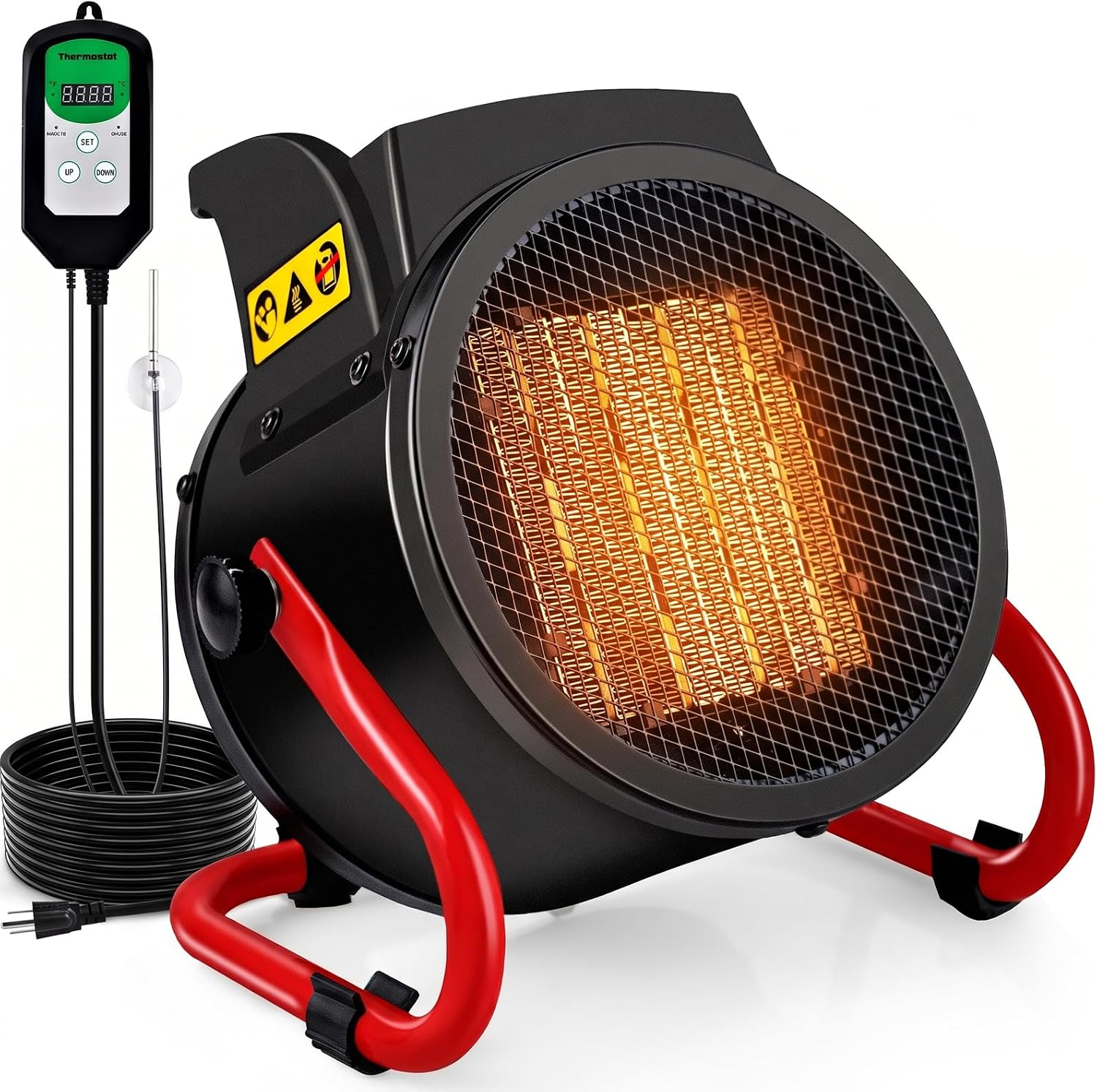
Pros
- Includes both the heater and an independent digital thermostat, so gardeners do not need to source a controller separately.
- The product information lists automatic temperature control, adjustable temperature, adjustable speed, and fan-only operation.
- Small footprint may be easier to place in tight greenhouse aisles, grow tents, or compact plant rooms.
- Reviewers commonly mention quick heat output and find the thermostat helpful for greenhouse or small-space use.
Cons
- Listed coverage is limited to spaces up to 120 sq. ft., so it may be less suitable for larger, drafty garages or poorly insulated structures.
- As a 1500W electric heater, it requires a suitable electrical setup and careful placement with open space around the unit.
- Some reviewer feedback notes possible thermostat confusion or calibration needs, so gardeners may want to compare readings with a separate thermometer.
The SmterCon GHH is an electric greenhouse heater kit designed for supplemental temperature control in small protected growing spaces. It includes a heater, a separate digital thermostat, and a user manual, making it a practical option for gardeners trying to protect winter plants, seedlings, or tender potted plants in a greenhouse, grow tent, flower room, or similar area.
The main gardening benefit is automatic temperature control. The product information indicates that the thermostat monitors temperature and turns the heater on or off based on the set point, which can reduce the need to check the space constantly during cold snaps. The 1500W convection heating design is listed for spaces up to 120 sq. ft., and the fast-heating feature is meant to bring warmth quickly to a small enclosed area.
For placement, the unit measures 9.5 inches deep by 8.5 inches wide by 9.5 inches high and is specified as a floor-mount heater. The adjustable tilt head helps aim airflow, while adjustable speed, adjustable temperature, and fan-only ventilation give gardeners more control over how air moves around plants. The separate thermostat is especially useful because the temperature sensor can be positioned away from the heater for a more representative reading of the growing area.
In a backyard greenhouse, this heater is best viewed as a small-space support tool rather than a whole-building heating system. It may suit a compact greenhouse bench area, a grow tent, a flower room, or a patio plant shelter where the goal is to take the edge off cold weather. Reviewers commonly mention quick warming and useful thermostat control, though those comments should be considered user feedback rather than verified test results.
Safety matters with any electric heater around plants, pots, plastic covers, and irrigation equipment. The listed over-temperature protection, fireproof-material description, and 15A thermostat controller are helpful features, but the unit should still be kept stable, unobstructed, and away from anything that could block airflow or contact hot surfaces. Gardeners should also confirm their outlet and extension setup, if used, is appropriate for a 1500W heater.
This is a good fit for gardeners who need a compact, thermostat-controlled heater for a small greenhouse or grow tent and value automatic on/off operation. Those trying to warm a large garage, a very leaky greenhouse, or an uninsulated outdoor area may want a more powerful or purpose-built heating plan.
Best For / Avoid If
Best for buyers prioritizing
- Includes both the heater and an independent digital thermostat, so gardeners do not need to source a controller separately.
- The product information lists automatic temperature control, adjustable temperature, adjustable speed, and fan-only operation.
- Small footprint may be easier to place in tight greenhouse aisles, grow tents, or compact plant rooms.
Consider another option if
- Listed coverage is limited to spaces up to 120 sq. ft., so it may be less suitable for larger, drafty garages or poorly insulated structures.
- As a 1500W electric heater, it requires a suitable electrical setup and careful placement with open space around the unit.
- Some reviewer feedback notes possible thermostat confusion or calibration needs, so gardeners may want to compare readings with a separate thermometer.
Best Greenhouse Fan With Thermostat Buying Guide
Choose an exhaust fan for active cooling
The clearest matches for this topic are wall-mounted or solar exhaust fans that remove hot, humid air from the greenhouse. The Windigaga, Ehiair, iLIVING, VIVOHOME, and Ecocalm models are designed around ventilation rather than heating. The VEVOR and SmterCon products include fan modes, but their primary function is heating, so they are not included in the recommendations below.
Exhaust fans work best as part of a ventilation plan. Before buying, consider where hot air will leave the structure and whether another opening can allow replacement air to enter. Our guide on how to ventilate a small greenhouse explains the role of fan placement and passive openings.
Match airflow and fan size to the space
Airflow is listed in cubic feet per minute, or CFM. Higher CFM generally means more air-moving capacity, but a larger fan also needs more wall space and may be unnecessary in a small greenhouse. The 8-inch Windigaga and Ehiair models are rated at 760 CFM, while the 10-inch Windigaga is rated at 890 CFM and the 12-inch iLIVING model at 960 CFM.
For larger structures, the iLIVING 18-inch model lists 1,736 CFM and coverage up to 2,600 square feet, while the 20-inch model lists 3,368 CFM and coverage up to 5,000 square feet. These stated coverage figures come from the product information and should be treated as manufacturer specifications rather than a guarantee for every greenhouse layout.
Check thermostat range and automatic controls
Thermostat range determines how precisely the fan can respond to temperature changes. The Windigaga and Ehiair fans list a 32°F to 140°F range, while iLIVING models list 32°F to 130°F. Their controllers also provide automatic operation, so the fan can turn on or off around a selected temperature instead of requiring constant manual adjustment.
The VIVOHOME adds temperature and humidity monitoring, with a listed temperature range of 32°F to 120°F and humidity monitoring from 30% to 90%. It also has an alarm when either monitored level becomes too high. This may appeal to gardeners who want more information than temperature alone, although the available data does not specify how the alarm should be calibrated for particular crops.
Consider speed settings, timers, and remote access
Multiple speeds help you choose between gentler ventilation and stronger air removal. Windigaga and Ehiair list three speeds and an 18-hour timer. The VIVOHOME offers nine manual speed settings and a 12-hour timer. Its remote displays mode, speed, temperature, and humidity, which can make adjustments easier for gardeners who prefer not to reach the fan controller.
The iLIVING models use variable-speed and thermal controls. The product data does not provide a remote-control claim for those models, so they may suit gardeners who prefer a straightforward wall-mounted control rather than remote operation.
Review power-source and installation requirements
Most listed fans use household electrical power and include prewired cords or plug-in installation details. Windigaga and Ehiair include wall cutout templates, a controller cord, and a fan-to-controller cable. VIVOHOME also includes a cutout template and a 5-foot plug-in cord. Confirm the outlet location, wall opening, mounting surface, and electrical requirements before cutting or installing.
The Ecocalm is the only clearly solar-powered option in the available data. It includes two 30W bifacial panels, a 5,000mAh rechargeable battery, a listed 720 CFM airflow rate, and a built-in temperature-control system. Its product information says performance and battery charging are affected by sunlight, especially in cloudy conditions, so it is not equivalent to a continuously powered fan.
Look at shutters, materials, and greenhouse exposure
Automatic shutters open while the Windigaga, Ehiair, iLIVING, and VIVOHOME fans operate and close when power is off. The product listings say these shutters help block rain, dust, wind, or insects, depending on the model. This feature can be useful for a greenhouse wall opening, but it does not replace careful sealing and installation around the frame.
The Windigaga and Ehiair models list galvanized steel frames and aluminum blades. The iLIVING models list galvanized steel frames with aluminum shutters and blades. VIVOHOME lists a rust-resistant fan and auto-shutdown shutters. Ecocalm lists IP44 waterproof fan blades. Follow each manufacturer’s installation and safety instructions, especially where electrical equipment is exposed to moisture.
Balance noise, accessibility, and small-space fit
Noise specifications vary. Windigaga and Ehiair list operation as low as 40 dB, VIVOHOME lists operation below 60 dB, and the iLIVING 18-inch and 20-inch models list noise levels below 65 dB and 69 dB respectively. These are published specifications, not independent measurements, and larger fans may be more noticeable in a compact backyard greenhouse.
For older gardeners or anyone who values easier access, a remote control can reduce the need to reach a wall-mounted controller. The Windigaga, Ehiair, and VIVOHOME models include remote-control features. In a small greenhouse, measure the available wall area and leave enough clearance for the shutter to open freely.
Avoid common setup and maintenance mistakes
Do not select a fan based on CFM alone. A fan that is too large for the opening may be difficult to mount, while a small fan may not move enough air for the structure. Also avoid placing the temperature sensor where direct sunlight, a heater, or a strong airflow stream could give a misleading reading.
Keep shutters, blades, and guards clear of dust and plant debris, and inspect cords, controllers, mounting hardware, and moving parts periodically. Disconnect electrical equipment before cleaning, keep water away from plugs and controls, and use only the power source and installation method specified by the manufacturer. Store seasonal equipment in a dry location when it is not being used, unless the product instructions state otherwise.
Research Methodology and Trust
We first screened the product listings for a clear connection to greenhouse ventilation and thermostat-controlled fan use. Products primarily described as heaters were excluded from the fan recommendations, even when they included a fan mode. The remaining products were compared by stated airflow, fan diameter, thermostat range, control features, power source, shutter design, installation information, and intended greenhouse use.
Owner feedback was considered where it was available, but review volume was uneven. Ecocalm lists a 4.4/5 rating from 64 reviews, while the other valid products available here show ratings with zero reviews. Ratings can help provide context, but they do not replace checking the specifications, greenhouse size, wall opening, electrical setup, and local conditions.
This is research-based analysis rather than physical testing. We did not install or operate these fans. The guide was reviewed and updated during August 2026 to keep the comparison aligned with the available product information and the needs of home gardeners using greenhouses, grow spaces, sheds, and other garden structures.
Final Recommendations
Beginner Pick: The Ehiair 8” Upgraded Shutter Exhaust Fan with Thermostat & Remote Control is a practical choice for gardeners who want 760 CFM airflow, three speeds, a 32°F to 140°F thermostat range, an 18-hour timer, a remote, automatic shutters, and a plug-and-play setup. Its $49.99 listed price is also below the prices of the larger iLIVING models.
Small-Space Pick: The iLIVING 12" Wall Mounted Shutter Exhaust Fan lists 960 CFM, coverage up to 1,400 square feet, variable-speed control, automatic shutters, and a 32°F to 130°F thermal-control range. For a greenhouse that needs stronger airflow than the 8-inch models but cannot accommodate a large industrial fan, it offers a middle-ground specification set.
Heavy-Duty Pick: The iLIVING 20" Wall Mounted Shutter Exhaust Fan lists 3,368 CFM and coverage up to 5,000 square feet, making it the most powerful conventional exhaust option in the available data. Gardeners with smaller structures may prefer a smaller model, while those considering solar operation should look at the Ecocalm and account for sunlight-dependent performance.
FAQ
What should I look for in the best greenhouse fan with thermostat?
Start with the fan’s intended use, airflow rating, size, thermostat range, and installation requirements. Automatic shutters, variable speeds, timers, remote controls, and humidity monitoring can add convenience, but only if they suit your greenhouse and daily routine.
Is a 760 CFM greenhouse fan enough?
The Windigaga and Ehiair 8-inch fans are both rated at 760 CFM. Whether that is enough depends on the greenhouse size, openings, layout, and heat load, so compare the stated airflow with the space you need to ventilate rather than choosing by fan diameter alone.
Are thermostat-controlled greenhouse fans difficult to install?
Windigaga and Ehiair list plug-and-play installation, prewired cords, and wall cutout templates. Even so, wall mounting and electrical connections require careful measuring and adherence to the manufacturer’s instructions, particularly in a damp greenhouse.
Does a solar greenhouse fan work at night?
The Ecocalm solar fan includes a 5,000mAh rechargeable battery and states that the battery can support the fan for six hours after a full charge in sunlight. Its performance and charging can decrease in cloudy conditions, so consider whether the available sunlight matches your ventilation needs.
How do I maintain a greenhouse exhaust fan?
Inspect and clean accessible blades, shutters, guards, and surrounding openings as needed. Before cleaning, disconnect electrical models from power and follow the manufacturer’s maintenance instructions. Check cords and controllers for damage before seasonal use.
Can a heater with a fan mode replace an exhaust fan?
Not necessarily. The VEVOR and SmterCon products are primarily greenhouse heaters that also provide fan or ventilation modes, while the Windigaga, Ehiair, iLIVING, VIVOHOME, and Ecocalm products are described as exhaust fans. Choose based on whether your main need is heating, air removal, or both.
What safety steps matter when using a greenhouse fan?
Follow the product manual, electrical requirements, and local rules. Keep plugs, controllers, and cords protected from water, disconnect power before cleaning, secure the fan to the specified opening, and make sure shutters and guards can move or operate without obstruction.