

A greenhouse can warm rapidly in direct sun and cool just as quickly after sunset. Relative humidity also changes with watering, condensation, ventilation, and temperature. The best greenhouse thermometer and hygrometer lets you see both readings together so you can recognize changing conditions instead of relying on how the space feels.
For this guide, we compared 10 products for beginners, small-greenhouse owners, seed starters, and gardeners who want a readable display with minimal setup. The main criteria were stated accuracy, measurement range, update speed, high/low records, mounting choices, moisture resistance, and remote data access. If you are building a propagation area, our guide to a seed-starting heat mat with a thermostat explains a separate tool for managing root-zone warmth.
Based on the listed specifications, the IPX5-rated TempPro model is the most greenhouse-focused general choice, while the Bluetooth TempPro is more useful when historical data matters. Budget two-packs can cover separate greenhouse zones, but their small displays and lack of documented moisture protection require more careful placement.
TempPro TempAir Digital Hygrometer for Greenhouses and Grow Tents TempPro TempAir Digital Hygrometer and Indoor Thermometer for Greenhouse Humidity Monitoring TempPro TP49 Digital Hygrometer Indoor Thermometer for Greenhouse Humidity Checks AXHHTVCGY Large-Dial Thermometer Hygrometer for Greenhouses and Indoor Growing Prices and availability can change. We may earn a commission from qualifying purchases.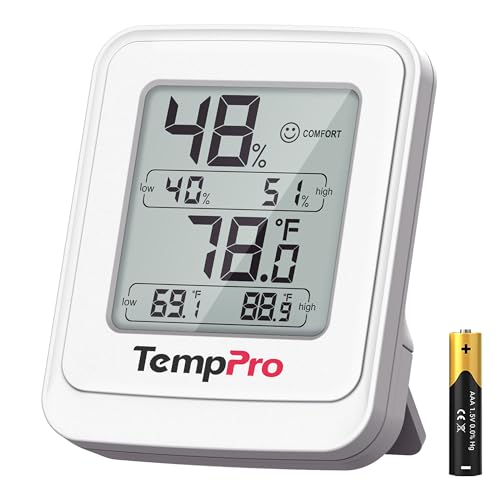


Pros
- Provides both temperature and humidity information in one compact monitor.
- High and low records add useful context beyond the current reading.
- Flexible placement suits shelves, greenhouse metal surfaces, and other indoor garden areas.
Cons
- The supplied information does not list battery type, battery life, or power requirements.
- It provides local readings, but no remote alerts or data logging system is listed.
- Gardeners needing outdoor weather monitoring or a larger display may prefer a different type of device.
The TempPro TempAir is a digital indoor thermometer and hygrometer designed to show temperature and relative humidity in one compact unit. For gardeners, it is most relevant to greenhouse shelves, grow tents, propagation areas, and indoor plant spaces where changing conditions are important to track.
Based on the listed specifications, the sensor provides temperature accuracy of ±1°F and humidity accuracy of ±2% RH. It updates readings every 10 seconds and records the highest and lowest temperature and humidity readings from the previous 24 hours, giving gardeners a clearer picture of daily swings instead of relying only on the current display.
The monitor has a large LCD with bold digits, along with simple dry, comfort, and wet face icons. A table stand supports shelf placement, while the magnetic back can attach to compatible metal surfaces. The listed dimensions are 3.43 by 3.43 by 2.83 inches, and the product information identifies the color as white.
In a backyard greenhouse or grow tent, the unit could help check conditions near plants, trays, or shelving. It may also suit a home office, bedroom plant area, or other small indoor growing space where a quick visual check is more convenient than using a separate thermometer and humidity meter.
The IPX5 waterproof design is listed for use in high-humidity environments, but the supplied information does not describe submersion resistance, outdoor weather suitability, battery life, or remote alerts. Keep the monitor positioned where its display remains readable and follow the product instructions for placement and care. It is a sensible choice for gardeners who want straightforward local monitoring, while growers needing automated alerts, stored historical data, or full outdoor weather tracking should consider a more advanced device.
Best For / Avoid If
Best for buyers prioritizing
- Provides both temperature and humidity information in one compact monitor.
- High and low records add useful context beyond the current reading.
- Flexible placement suits shelves, greenhouse metal surfaces, and other indoor garden areas.
Consider another option if
- The supplied information does not list battery type, battery life, or power requirements.
- It provides local readings, but no remote alerts or data logging system is listed.
- Gardeners needing outdoor weather monitoring or a larger display may prefer a different type of device.
Pros
- Provides both temperature and relative humidity readings in one monitor.
- Fast 10-second refreshes are useful for watching changing conditions in a greenhouse or indoor growing space.
- High-low records make it easier to compare environmental changes over time.
- Tabletop and magnetic placement options offer flexible positioning around the home or garden area.
Cons
- The product information does not list dimensions, so available shelf or wall space cannot be confirmed in advance.
- It is a monitoring device rather than an automatic humidifier, fan, heater, or irrigation controller, so any corrections must be made separately.
- Gardeners needing remote alerts, data logging, or a dedicated outdoor weather monitor may prefer a different type of product.
The TempPro TempAir is a digital indoor thermometer and hygrometer for checking temperature and relative humidity in household spaces, indoor growing areas, and greenhouse environments. Its simple display and DRY, COMFORT, and WET indicator make it suitable for beginners, homeowners, and gardeners who want a quick environmental check without using separate meters.
Based on the listed specifications, the monitor measures temperature to within +/-1°F and humidity to within +/-2 to 3%RH. Readings refresh every 10 seconds, which is useful when observing changing conditions near plants, in a greenhouse, or in a room where humidity may shift during watering, ventilation, or heating.
The unit includes a tabletop stand and a magnetic back, allowing placement on a counter, shelf, or compatible metal surface such as a refrigerator. A Fahrenheit/Celsius selector supports different record-keeping preferences, while the included three AAA batteries simplify initial setup. Product dimensions and specific mounting details are not provided.
For backyard and small-space gardening, this monitor could help track conditions in an indoor seed-starting area, plant room, greenhouse, or enclosed growing space. The high and low records can also help gardeners compare conditions between day and night or before and after making ventilation or humidity adjustments.
This device reports environmental conditions but does not automatically change them, provide remote alerts, or control fans, heaters, humidifiers, or irrigation equipment. Keep the monitor positioned where its readings represent the area you want to observe, and follow the product information for battery handling and placement. It is a practical choice for straightforward local monitoring, while users needing automation, outdoor weather resistance, or connected data logging may want a different option.
Best For / Avoid If
Best for buyers prioritizing
- Provides both temperature and relative humidity readings in one monitor.
- Fast 10-second refreshes are useful for watching changing conditions in a greenhouse or indoor growing space.
- High-low records make it easier to compare environmental changes over time.
Consider another option if
- The product information does not list dimensions, so available shelf or wall space cannot be confirmed in advance.
- It is a monitoring device rather than an automatic humidifier, fan, heater, or irrigation controller, so any corrections must be made separately.
- Gardeners needing remote alerts, data logging, or a dedicated outdoor weather monitor may prefer a different type of product.
Pros
- Combines temperature and humidity monitoring in one compact display.
- Useful visual comfort indicator simplifies quick condition checks for beginners.
- Flexible placement options suit small greenhouses, grow tents, patios, offices, and indoor garden areas.
Cons
- The supplied information does not list remote monitoring, data logging, or alarm functions.
- Weather-resistance details are not provided, so gardeners should be cautious about placing it in exposed outdoor conditions.
- Its small display may be less convenient for anyone who needs readings visible from a much greater distance.
The TempPro TP49 is a small digital thermometer and hygrometer for checking temperature and relative humidity. For gardeners, its main use is monitoring the air around indoor plants, a greenhouse, grow tent, seed-starting area, or chick brooder. The compact format is especially suitable for beginners, homeowners, and small-space growers who want a simple reading rather than a larger environmental monitoring system.
The listed sensor accuracy is up to ±1°F/°C for temperature and ±2% to 3% relative humidity. Those specifications can help gardeners notice changes in growing conditions and decide when a humidifier or dehumidifier may need adjustment. The DRY, COMFORT, and WET face icons provide a quick visual interpretation, although gardeners should still use plant-specific humidity guidance when managing sensitive crops.
The monitor measures 2.2 x 0.7 x 2.6 inches and weighs approximately 0.077 pounds. It can stand on a tabletop, attach through its magnetic back, or hang from a suitable location. Large, bold LCD digits are intended to remain readable from different angles and distances, while the 10-second refresh rate provides updated readings as conditions change.
In a backyard growing setup, this unit could sit on a greenhouse shelf, hang in a grow tent, or rest near seedlings in a nursery or craft room. It may also be useful in a cellar, office, RV, or indoor garden area where humidity affects storage or plant care. The listed patio use is noted in the product information, but no weather-resistance details are provided.
The product information does not list remote alerts, data logging, battery runtime, or weatherproof construction, so gardeners needing those functions should consider a more advanced monitor. Placement should allow air to circulate around the sensor, and the unit should be kept away from direct water spray or condensation unless its environmental protection is confirmed. Overall, it is a straightforward option for quick temperature and humidity checks in compact indoor or protected growing spaces.
Best For / Avoid If
Best for buyers prioritizing
- Combines temperature and humidity monitoring in one compact display.
- Useful visual comfort indicator simplifies quick condition checks for beginners.
- Flexible placement options suit small greenhouses, grow tents, patios, offices, and indoor garden areas.
Consider another option if
- The supplied information does not list remote monitoring, data logging, or alarm functions.
- Weather-resistance details are not provided, so gardeners should be cautious about placing it in exposed outdoor conditions.
- Its small display may be less convenient for anyone who needs readings visible from a much greater distance.
Pros
- Clear analog display with visual temperature zones
- No batteries or liquids required
- Flexible wall-mount or freestanding installation
- Covers temperature and humidity in one device
Cons
- The listed humidity tolerance is plus or minus 5% RH, so gardeners needing highly precise readings may prefer a calibrated digital monitor.
- The product information does not provide physical dimensions, so available shelf or wall space should be checked before placement.
- Outdoor use is listed, but weatherproofing or protection from direct exposure is not specified.
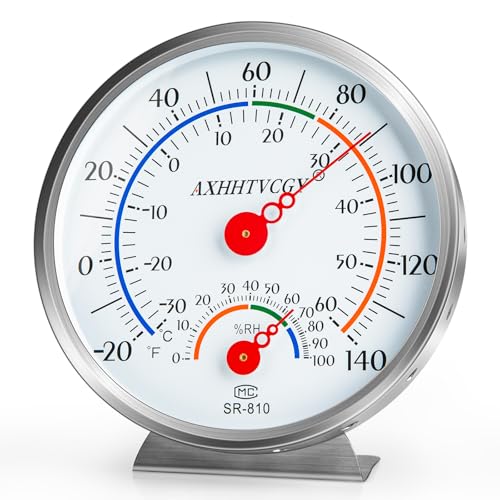
The AXHHTVCGY is an analog thermometer and hygrometer designed to show temperature and relative humidity in one glance. For gardeners, its most relevant task is monitoring the general climate around seedlings, greenhouse plants, moisture-sensitive storage areas, or indoor growing spaces. The large dial makes it a reasonable choice for beginners and homeowners who prefer a simple, non-digital readout.
Based on the listed specifications, the unit measures humidity from 0% to 99% RH with a stated tolerance of plus or minus 5% RH. Its listed temperature range spans from -20 to 140°F, with the specification also showing -30 to 60°C. These readings can help a gardener notice unusually dry, damp, hot, or cold conditions before deciding whether ventilation, watering, or other adjustments may be needed.
The mechanically operated design does not require batteries or liquids, which simplifies routine use. A hook hole supports vertical wall installation, while the detachable bracket allows the gauge to stand on a suitable flat surface. The product information does not include dimensions, so users should confirm that the available shelf, bench, or wall area can accommodate the dial.
Potential uses include checking conditions inside a greenhouse, near indoor plants, in a cellar, or in a moisture chamber. It may also be useful in reptile enclosures or incubators where temperature and humidity awareness is important, although the supplied information does not specify enclosure size, mounting clearances, or specialized calibration requirements.
The stainless steel humidity sensor is described as durable and easy to clean, but the product information does not state that the unit is weatherproof or suitable for prolonged direct exposure to rain. The stated humidity tolerance also means it is better suited to general environmental monitoring than precision climate control. Overall, it fits gardeners who want a simple, battery-free reference gauge, while users needing documented calibration, exact digital readings, or specified outdoor protection may want a different option.
Best For / Avoid If
Best for buyers prioritizing
- Clear analog display with visual temperature zones
- No batteries or liquids required
- Flexible wall-mount or freestanding installation
Consider another option if
- The listed humidity tolerance is plus or minus 5% RH, so gardeners needing highly precise readings may prefer a calibrated digital monitor.
- The product information does not provide physical dimensions, so available shelf or wall space should be checked before placement.
- Outdoor use is listed, but weatherproofing or protection from direct exposure is not specified.

Pros
- Provides both temperature and humidity readings in one compact device.
- Two-piece set supports monitoring separate rooms or locations at the same time.
- Flexible placement with a kickstand and built-in magnets.
Cons
- Readings may fluctuate for 3 to 5 minutes after startup before stabilizing.
- The listed accuracy of plus or minus 2°F for temperature and plus or minus 5% RH for humidity may be less suitable for gardeners needing highly precise environmental control.
The Antonki 2-pack is an indoor thermometer and hygrometer designed to show room temperature and relative humidity on a digital display. For home gardeners, it can help monitor conditions in an indoor growing area, greenhouse, basement, garage, or plant storage space, and the two units make it practical to check more than one location.
Based on the listed specifications, the thermometer covers -58 to 158°F, while the hygrometer measures humidity from 10% to 99% RH. Separate temperature and humidity sensors are intended to provide more consistent readings over time, although the display may fluctuate for 3 to 5 minutes after startup before settling closer to the surrounding air conditions.
The larger LCD uses bigger digital characters intended to be readable from different angles and distances. Each unit measures 2.9 by 2.7 by 0.67 inches and includes a kickstand for a shelf or table. Built-in magnets offer another placement option on a suitable metal surface, so no assembly or permanent installation is indicated.
In a backyard growing setup, one unit could be placed near an indoor seed-starting area while the second monitors a basement, garage, or greenhouse location. The pair may also help identify differences between a plant shelf and the surrounding room, but the product information does not specify plant thresholds, alarms, data logging, or automated control of heating, cooling, or ventilation.
The stated accuracy is plus or minus 2°F for temperature and plus or minus 5% RH for humidity, so gardeners requiring tightly controlled conditions may prefer a more precise monitoring system. Users should allow the initial readings to stabilize and keep the device in an appropriate indoor location. Its simple display, compact form, flexible placement, and two-unit format make it a reasonable choice for basic environmental checks rather than advanced greenhouse automation.
Best For / Avoid If
Best for buyers prioritizing
- Provides both temperature and humidity readings in one compact device.
- Two-piece set supports monitoring separate rooms or locations at the same time.
- Flexible placement with a kickstand and built-in magnets.
Consider another option if
- Readings may fluctuate for 3 to 5 minutes after startup before stabilizing.
- The listed accuracy of plus or minus 2°F for temperature and plus or minus 5% RH for humidity may be less suitable for gardeners needing highly precise environmental control.

Pros
- Combines temperature and humidity monitoring in one compact unit.
- Listed accuracy is within plus or minus 2 to 3 percent relative humidity and plus or minus 1 degree Fahrenheit.
- High and low records provide more context than a single current reading.
- Flexible placement with both a tabletop stand and magnetic back.
Cons
- The feature set is designed for monitoring rather than automatically controlling humidity or temperature.
- The product information does not provide weather-resistance or outdoor-use details, so it may be less suitable for exposed garden locations.
- Gardeners needing remote alerts, data logging, or scheduled environmental controls may prefer a more advanced monitor.
The TempPro TP50 is a compact digital hygrometer and indoor thermometer for checking temperature and relative humidity in household spaces. For gardeners, its most relevant use is monitoring a greenhouse, indoor growing area, plant room, or other enclosed space where changing humidity can affect routine care decisions. It is best suited to homeowners and beginner gardeners who want a simple local readout rather than an automated climate-control system.
Based on the listed specifications, the TP50 provides accuracy of plus or minus 2 to 3 percent relative humidity and plus or minus 1 degree Fahrenheit. Readings refresh every 10 seconds, which can be useful in a greenhouse or indoor area where conditions fluctuate. The DRY, COMFORT, and WET indicator gives a quick visual interpretation, while high and low records help compare current conditions with recent temperature and humidity extremes.
The unit measures about 3.11 by 0.84 by 2.62 inches and weighs approximately 0.13 pounds. Its tabletop stand supports placement on a shelf, counter, or other flat surface, while the magnetic back can be used on a compatible metal surface such as a refrigerator. A Fahrenheit and Celsius selector provides basic control flexibility, and the product information states that one AAA battery is included.
In a small greenhouse or indoor seed-starting area, a gardener could use the display to observe whether conditions are trending drier or wetter before adjusting ventilation, watering routines, or other environmental practices. It may also be useful in a plant room, storage area, refrigerator, freezer, reptile enclosure, humidor, or similar enclosed setting, as those applications are identified in the product information.
This is a monitoring device, so it does not provide automatic humidification, ventilation, heating, cooling, remote alerts, or scheduled controls. The supplied information also does not document weather resistance, outdoor placement suitability, calibration procedures, or long-term battery life. Keep it in a suitable protected location and treat its readings as an aid to observation rather than a replacement for checking plants and growing conditions directly.
The TP50 is a reasonable fit for gardeners who want an uncomplicated, compact temperature and humidity display with high and low records. Those needing outdoor durability, remote data access, automation, or advanced greenhouse controls should consider a different type of environmental monitoring system.
Best For / Avoid If
Best for buyers prioritizing
- Combines temperature and humidity monitoring in one compact unit.
- Listed accuracy is within plus or minus 2 to 3 percent relative humidity and plus or minus 1 degree Fahrenheit.
- High and low records provide more context than a single current reading.
Consider another option if
- The feature set is designed for monitoring rather than automatically controlling humidity or temperature.
- The product information does not provide weather-resistance or outdoor-use details, so it may be less suitable for exposed garden locations.
- Gardeners needing remote alerts, data logging, or scheduled environmental controls may prefer a more advanced monitor.

Pros
- Two units can track conditions in different areas at the same time.
- Fast automatic updates and selectable Fahrenheit or Celsius readings simplify routine checks.
- The listed accuracy and broad operating ranges are practical for basic garden-space monitoring.
Cons
- The supplied information does not list dimensions, mounting options, or display size, so placement and readability cannot be assessed in detail.
- Although described for indoor and outdoor use, no weather-resistance or waterproofing information is provided, so exposed outdoor placement may require protection.
- Button-cell power may be less convenient for gardeners who prefer rechargeable or commonly available batteries.
The Serundo Auto Digital Hygrometer Thermometer is a compact temperature and humidity monitor sold as a two-piece set. For gardeners, it is most relevant for checking conditions in indoor growing areas, greenhouse spaces, storage areas, terrariums, and other locations where environmental readings help guide routine care.
The feature set supports quick reference checks rather than complex environmental control. Readings automatically update every 10 seconds, and the stated accuracy is ±1°F for temperature and ±3% RH for humidity. The ability to switch between Fahrenheit and Celsius also makes the units easier to use with gardening instructions that rely on either scale.
Based on the listed specifications, each monitor operates from 32°F to 158°F and in humidity levels from 10% to 99% RH. The product information does not provide dimensions, display measurements, mounting hardware, or installation instructions, so placement will depend on the surface or enclosure where the unit is used.
In a backyard gardening setup, one unit could be placed near seed-starting supplies while the other monitors a separate greenhouse shelf or indoor plant area. They may also be useful in a reptile or other small habitat, a garage used for garden storage, or a room where gardeners want to observe temperature and humidity changes over time.
The monitors use LR44 button cells and include one backup button cell per unit, with each cell listed for up to 9 months of working time. No weather-resistance or waterproofing details are supplied, so outdoor users should avoid assuming the units can withstand rain, irrigation spray, or prolonged exposure. This pair is a reasonable choice for simple, low-effort monitoring in sheltered locations, while gardeners needing remote alerts, data logging, weatherproof construction, or detailed controls should consider a more specialized system.
Best For / Avoid If
Best for buyers prioritizing
- Two units can track conditions in different areas at the same time.
- Fast automatic updates and selectable Fahrenheit or Celsius readings simplify routine checks.
- The listed accuracy and broad operating ranges are practical for basic garden-space monitoring.
Consider another option if
- The supplied information does not list dimensions, mounting options, or display size, so placement and readability cannot be assessed in detail.
- Although described for indoor and outdoor use, no weather-resistance or waterproofing information is provided, so exposed outdoor placement may require protection.
- Button-cell power may be less convenient for gardeners who prefer rechargeable or commonly available batteries.

Pros
- Combines temperature and humidity monitoring in a small, portable unit.
- Listed accuracy of ±1°F for temperature and ±5%RH for humidity supports routine condition checks.
- Multiple placement options make it easy to position near plants, shelves, or indoor growing equipment.
- Clear icons and large digits reduce the need to interpret small or complicated displays.
Cons
- The listed data does not specify battery type, battery life, or whether batteries are included.
- As an indoor hygrometer, it may be less suitable for exposed outdoor placement or locations subject to weather.
- Gardeners needing calibration information or advanced data logging may prefer a more specialized monitor.
The DOQAUS Digital Hygrometer Indoor Thermometer is a compact monitor for checking temperature and relative humidity in indoor garden-related spaces. It is well suited to beginners, homeowners, and small-space growers who want a simple way to observe conditions around seedlings, houseplants, terrariums, stored materials, or a greenhouse area.
Based on the listed specifications, the sensor provides temperature accuracy of plus or minus 1°F and humidity accuracy of plus or minus 5%RH. Readings refresh every five seconds, which can help users notice changing conditions after watering, ventilation changes, or adjustments to a humidifier or dehumidifier.
The 2.3-inch LCD uses large, bold numbers, while the DRY, COMFORT, and WET icons provide a quick visual interpretation of humidity. A Fahrenheit/Celsius switch keeps the controls straightforward. The unit measures 1.8 by 1.8 by 2.3 inches and weighs about 0.07 pounds, so it should be easy to place on a shelf or carry between monitoring locations.
Three mounting choices, including a hanging hole, tabletop stand, and magnet attachment, give it flexibility in a greenhouse, seed-starting area, cellar, kitchen, bedroom, or reptile terrarium. For patio and backyard gardeners, it can be useful for checking an enclosed or sheltered growing space, but the supplied information does not establish outdoor weather resistance.
The product information does not specify battery type, battery life, calibration options, or included accessories, so those details should be confirmed before purchase if they matter for your setup. It also should not be treated as a replacement for specialized equipment when data logging, calibration, or advanced environmental controls are required.
This monitor is a sensible fit for routine indoor temperature and humidity checks where a compact display and flexible placement are priorities. Gardeners needing outdoor durability, documented calibration features, or long-term data recording should consider a different type of environmental monitor.
Best For / Avoid If
Best for buyers prioritizing
- Combines temperature and humidity monitoring in a small, portable unit.
- Listed accuracy of ±1°F for temperature and ±5%RH for humidity supports routine condition checks.
- Multiple placement options make it easy to position near plants, shelves, or indoor growing equipment.
Consider another option if
- The listed data does not specify battery type, battery life, or whether batteries are included.
- As an indoor hygrometer, it may be less suitable for exposed outdoor placement or locations subject to weather.
- Gardeners needing calibration information or advanced data logging may prefer a more specialized monitor.

Pros
- Long-distance Bluetooth monitoring is useful when the sensor is placed away from the main living area.
- Data storage and export can help gardeners review environmental trends over time.
- The display, icon indicator, and compact dimensions support simple day-to-day checks.
Cons
- Bluetooth range may be reduced by walls, structures, or other obstructions.
- The product information does not specify weather resistance, so outdoor greenhouse placement may require protection from moisture.
- Users should confirm the correct ThermoPro Sensor app, since the listing references both the current app and a future app name.
The TempPro TempAir is a Bluetooth thermometer and hygrometer designed to track temperature and humidity in spaces such as greenhouses, plant rooms, bedrooms, and other enclosed areas. It is best suited to gardeners who want a simple way to check growing conditions without repeatedly visiting the sensor.
The listed accuracy is plus or minus 0.9°F for temperature and plus or minus 2% relative humidity, with readings refreshed every 10 seconds. These specifications suggest useful monitoring for spotting environmental changes, although the sensor should not be treated as a substitute for professional climate-control equipment.
The unit measures approximately 1.26 by 1.26 by 2.72 inches and weighs about 0.22 pounds, based on the supplied specifications. A large backlit display supports quick reading in low light, while the comfort icon provides a simple visual indication of changing conditions. The listing does not describe assembly, mounting hardware, battery runtime, or weather protection.
In a greenhouse or small growing area, gardeners could use the app to check conditions from a nearby location and review stored data when deciding whether adjustments may be needed. The listed 260-foot Bluetooth range applies when there are no obstructions, so walls, glazing, shelving, and other structures may reduce the practical distance.
The two-year data storage and export feature can help reveal recurring temperature and humidity patterns, but users should follow the app instructions carefully. The product information directs users to the ThermoPro Sensor app and also references a future TempPro Sensor app, so confirming the current app name before setup is sensible. Because weather resistance is not specified, protect the unit from direct water and excessive moisture unless the manufacturer provides different guidance.
This monitor is a reasonable choice for beginners, indoor gardeners, and small greenhouse owners who value app-based records and straightforward readings. Gardeners needing a clearly weather-rated outdoor sensor, automated climate control, or a specified mounting system should consider a product with those features documented.
Best For / Avoid If
Best for buyers prioritizing
- Long-distance Bluetooth monitoring is useful when the sensor is placed away from the main living area.
- Data storage and export can help gardeners review environmental trends over time.
- The display, icon indicator, and compact dimensions support simple day-to-day checks.
Consider another option if
- Bluetooth range may be reduced by walls, structures, or other obstructions.
- The product information does not specify weather resistance, so outdoor greenhouse placement may require protection from moisture.
- Users should confirm the correct ThermoPro Sensor app, since the listing references both the current app and a future app name.

Pros
- Compact format suits small spaces and enclosed growing environments.
- Frequent 10-second updates provide current readings for temperature and humidity changes.
- The two-pack offers flexibility for monitoring more than one location.
- Fahrenheit and Celsius settings support different gardening preferences.
Cons
- The small display may be less convenient for gardeners who need large, highly visible readings from a distance.
- The listed temperature and humidity ranges support monitoring, but the product information does not specify outdoor weather resistance or waterproofing.
- Button-cell batteries may require replacement, and the supplied data does not describe how easily they can be changed.
The JEDEW 2-pack is a compact digital thermo-hygrometer for checking temperature and relative humidity in spaces such as greenhouses, terrariums, plant areas, jars, garages, or homes. It is best suited to gardeners who want quick environmental readings without using a larger monitoring device.
Based on the listed specifications, the built-in sensor takes a reading every 10 seconds and covers temperatures from 32°F to 158°F and humidity from 10% to 99% RH. The stated accuracy is ±1°F for temperature and ±3% RH for humidity, which can help users make more informed adjustments to humidifiers, dehumidifiers, or other humidity-control equipment.
Each monitor measures 1.77 by 1.77 by 0.59 inches and weighs about 0.088 pounds, making it suitable for small monitoring locations. The display supports both Fahrenheit and Celsius, while the product information does not describe mounting hardware, installation steps, drainage features, or weatherproof construction.
For backyard gardening, one unit could be placed in a greenhouse area while the second is used in a terrarium, seed-starting space, or indoor plant location. The two-monitor format is also useful when comparing conditions in separate enclosed spaces, although placement should allow the display to remain visible and the device should be protected from direct water exposure unless additional resistance is confirmed.
The monitors use LR44 button cells, with the listed information stating up to 10 months of working time per cell and one backup button cell. Gardeners should check readings regularly and replace batteries when needed. This is a practical choice for simple temperature and humidity checks in small spaces, while users needing remote alerts, large displays, mounting options, or confirmed outdoor weather resistance should consider a different type of monitor.
Best For / Avoid If
Best for buyers prioritizing
- Compact format suits small spaces and enclosed growing environments.
- Frequent 10-second updates provide current readings for temperature and humidity changes.
- The two-pack offers flexibility for monitoring more than one location.
Consider another option if
- The small display may be less convenient for gardeners who need large, highly visible readings from a distance.
- The listed temperature and humidity ranges support monitoring, but the product information does not specify outdoor weather resistance or waterproofing.
- Button-cell batteries may require replacement, and the supplied data does not describe how easily they can be changed.
Start with the greenhouse conditions you need to observe
A basic thermo-hygrometer reports air temperature and relative humidity. It does not measure soil temperature, soil moisture, light, or the temperature inside a seed tray unless the manufacturer explicitly provides the appropriate probe. Treat it as an observation tool rather than an automatic climate controller.
One display may be enough for a compact greenhouse with fairly even conditions. A longer structure, packed shelving, or separate propagation and mature-plant areas may benefit from two sensors. The Antonki, Serundo Auto, and JEDEW options are supplied as two-packs, making them practical for comparing zones without assuming one location represents the entire greenhouse.
Compare accuracy specifications carefully
Accuracy is the stated tolerance around a reading. The IPX5 TempPro lists ±1°F temperature accuracy and ±2% relative humidity accuracy. The Bluetooth TempPro lists ±0.9°F and ±2% RH. Several less expensive models list humidity tolerances of ±3% or ±5% RH. A tighter stated tolerance can be helpful when comparing modest changes, although these figures are manufacturer specifications rather than independent verification.
Consistency is also useful. Place two units side by side temporarily if you plan to monitor separate zones, allow them to stabilize, and note whether they differ. The Antonki instructions specifically indicate that readings may fluctuate for three to five minutes after startup. Avoid reacting to a single brief change before a sensor has adjusted to its location.
Choose records or app history based on your routine
A current reading only tells you what is happening while you are looking. High/low records are more informative if overheating occurs while you are away. The IPX5 TempPro records temperature and humidity maximums and minimums over the previous 24 hours. The TempPro TP50 and the higher-priced TempAir model also list high/low records, although the available data does not define the record period for those two products.
The TempPro TempAir Bluetooth Hygrometer Thermometer is the stronger fit for trend tracking. Its manufacturer lists app monitoring, two-year data storage and export, and a maximum Bluetooth range of 260 feet without obstructions. Greenhouse panels, walls, shelving, and distance may reduce real-world wireless range. It requires the ThermoPro Sensor app, so gardeners who prefer not to use a phone should choose a stand-alone display instead.
Do not confuse fast refresh with better accuracy
Most of the digital products update every 10 seconds, while the DOQAUS lists a five-second refresh. Refresh rate describes how frequently the display changes, not whether the sensor is more accurate. For ordinary greenhouse decisions, records, placement, and readable numbers are generally more consequential than the difference between five- and 10-second updates.
Measurement range deserves attention in an unheated structure. The Serundo Auto and JEDEW models list an operating range beginning at 32°F, while Antonki lists a wider temperature measurement range. A listed range does not establish weather resistance, however. Check both the operating range and the manufacturer’s placement instructions before leaving any electronic unit in freezing or wet conditions.
Prioritize moisture resistance and protected placement
High humidity is not the same as direct water exposure. Of the supplied digital options, only the B0FP54Q28Y TempPro explicitly lists an IPX5 water-resistance rating. That makes it the clearest match for a humid greenhouse, but it should still be installed according to the manufacturer’s instructions rather than submerged or placed where water can pool.
The other digital models should not be assumed waterproof. Position them away from irrigation spray, roof drips, and wet growing media while leaving their sensor vents unobstructed. If you use captured water in the garden, plan the watering system separately with guidance such as our comparison of rain barrels for small gardens.
Place the sensor at plant level, not at an extreme
Avoid mounting the meter against sun-heated glazing, immediately beside a heater, directly over damp soil, or in the path of a misting nozzle. Those locations can describe a local extreme rather than the air surrounding most plants. A shaded, ventilated position near the relevant plant canopy is generally more representative.
Magnetic backs work only on suitable metal surfaces. Tabletop stands are convenient on stable shelves, while hanging holes can keep a unit visible and reduce the need to bend. The TP49 and DOQAUS provide stand, magnet, and hanging options. For a growing setup that already includes vertical support, see the practical considerations in our tomato planter with trellis guide.
Match the display to eyesight and greenhouse size
Large digits reduce bending and make routine checks easier for gardeners with limited vision or mobility. The IPX5 TempPro, TP49, Antonki, and DOQAUS descriptions emphasize readable digits or larger displays. The Bluetooth TempPro adds a backlight, which may be useful in a dim greenhouse. Mini two-pack models save shelf space but may require closer viewing.
The AXHHTVCGY is the only analog option in the group. Its large dial, wall hook, detachable stand, and battery-free mechanical operation suit someone who wants simple local readings. Its listed humidity tolerance is ±5% RH, and it does not provide digital records or remote monitoring.
Plan for batteries, cleaning, and seasonal storage
Battery formats vary. The TP50 uses one AAA battery, the higher-priced TempAir includes three AAA batteries, Antonki uses a CR2032, and the Serundo Auto and JEDEW models use LR44 cells. Check the correct polarity and battery type before replacement, and keep button cells away from children and pets.
Keep sensor vents free of soil and debris, and follow the manufacturer’s cleaning directions. Do not soak an electronic meter merely because it is used in a humid space. For seasonal storage, remove leaking or depleted batteries, keep the unit dry, and recheck side-by-side readings when returning multiple sensors to service.
Research Methodology and Trust
We screened the available products for the ability to display both air temperature and relative humidity. All 10 meet that basic definition and have a stated greenhouse use or specifications that make greenhouse monitoring plausible. We did not include unrelated controllers, soil probes, or weather stations.
Rankings were based on documented greenhouse-relevant factors: stated temperature and humidity tolerances, measurement range, refresh interval, high/low records, data history, display design, mounting options, battery requirements, and explicit moisture resistance. Greater weight was given to features that help a gardener identify daily swings rather than decorative comfort icons intended primarily for indoor rooms.
This is research-based analysis, not physical testing. The supplied ratings report zero reviews for every product, so they do not provide meaningful owner-feedback evidence and were not treated as proof of performance or durability. Specifications, product names, pricing, and app details were reviewed for the August 2026 update and may change.
Frequently Asked Questions
Where should I place a greenhouse thermometer and hygrometer?
Place it in a shaded, ventilated location near the plants you want to monitor. Keep it away from direct sun, heaters, irrigation spray, wet soil, and roof drips unless the manufacturer specifically approves that exposure.
Do I need more than one meter?
A single unit may suit a compact greenhouse. Consider two sensors when the structure has multiple levels, dense shelving, separate growing zones, or noticeable differences between sunny and shaded areas.
Are indoor hygrometers suitable for a greenhouse?
They can monitor greenhouse air if their stated operating range covers the expected conditions and they are protected from water. Do not interpret an indoor/outdoor product name as proof of waterproofing; look for an explicit rating or manufacturer instruction.
Are maximum and minimum records worth having?
Yes, especially if you cannot inspect the greenhouse throughout the day. Records can reveal temperature or humidity extremes that a current-only display may miss, although the record period should be confirmed for the individual model.
How can I check whether two sensors agree?
Place them together in the same shaded location and allow the readings to stabilize. A small difference may fall within their listed tolerances; a persistent large difference warrants checking batteries, vents, operating limits, and manufacturer guidance.
How should I maintain and store a greenhouse hygrometer?
Keep the sensor openings clear and clean the housing only as directed. Store electronic units in a dry place, inspect batteries for leakage, and remove depleted batteries before extended seasonal storage.
Does a thermometer and hygrometer control greenhouse conditions?
No. These products report conditions but do not automatically operate vents, fans, heaters, or irrigation based on the available specifications. Use their readings as one input when checking the greenhouse and follow the safety instructions for any separate climate-control equipment.
Continue your garden research
Browse more practical guides in Greenhouses & Garden Storage.
For product comparisons, see Best Portable Greenhouse for Backyard Use Right Now.
See how Dove Creek Gardens researches and compares products.