

Tomatoes need a container with room for growing medium, reliable drainage, and a way to support upright growth. Choosing a planter also means weighing watering frequency, filled-container weight, available patio or yard space, and whether you want one plant or several. This guide compares 4 options for Best Planter For Tomatoes, including grow bags and planters with trellises or reservoirs.
We compared listed capacity, support design, drainage and watering features, mobility, storage, and package contents. The best fit depends on how much space you have and how you plan to water. For broader container and bed ideas, see our guide to vegetables that grow well in raised beds. Listed prices range from 13.99–68.45; check current listings for updated prices and package details.
MQHUAYU 57-Inch Tomato Planter with Trellis, Self-Watering Raised Bed for Vertical Growing FEEDGARDEN JC-ZZD-10G-4 10 Gallon Grow Bags for Patio Vegetables and Compact Storage TeCreatio 56.5-Inch Self-Watering Tomato Planter with Trellis for Patio Growing ANPHSIN Adjustable Tomato Cage Set with 10-Gallon Grow Bags for Climbing Vegetables Prices and availability can change. We may earn a commission from qualifying purchases.


Pros
- Combines container growing and vertical plant support in one setup.
- Self-watering reservoir design may reduce how often plants need immediate watering.
- Adjustable one-to-four-layer trellis offers flexibility for different plant sizes.
- Lightweight 2.2-pound design should be easier to reposition than a large raised bed.
- Sold as a 2-pack, allowing gardeners to create separate growing stations.
Cons
- The listed dimensions provide a compact footprint, so gardeners growing large or heavily rooted plants may need more space.
- The exact soil capacity and construction material are not specified, which makes long-term durability and filling requirements harder to judge.
- Indoor use may require careful placement and watering to protect floors and nearby surfaces.
The MQHUAYU 2-Pack Tomato Planter is a compact raised container with a 57-inch climbing frame for tomatoes, vines, vegetables, and flowers. It is aimed at gardeners who want to combine container growing with vertical support, particularly those working with patios, small yards, balconies, or indoor growing corners.
Its main growing feature is the bottom water reservoir, which the product information describes as a continuing moisture source. The air-hole circulation system is intended to provide oxygen around the roots, while the heightened planter walls allow more nutrient-rich soil than a shallow container. These features may help create a more forgiving setup for gardeners who cannot water constantly, although plants still need monitoring based on conditions and crop needs.
The planter measures 9.8 by 9.8 inches, while the assembled height reaches 57 inches. The four-corner tower design directs growth upward and helps make use of vertical space instead of relying only on a wide planting area. The trellis can be assembled with one to four layers, so gardeners can choose a shorter support for young plants or add layers as climbing growth develops. The planter and trellis may also be used separately.
Two planters can be positioned beside a patio wall, along a sunny walkway, or in separate indoor and outdoor locations. They may work well for supporting climbing vegetables or decorative vines where a traditional raised bed would take up too much room. Because the listed weight is 2.2 pounds, the units should be relatively easy to move before they are filled, though the soil and plants will add considerable weight.
The product information does not specify the planter material, soil capacity, or detailed filling and cleaning instructions. Gardeners should confirm that the growing location receives suitable light, keep the reservoir and air holes clear, and use a stable position for the tall trellis, especially after plants become top-heavy. Overall, this is a practical choice for compact vertical growing and adjustable plant support, while gardeners needing a broad root zone, a stated capacity, or detailed durability information may prefer a larger or more fully specified raised bed.
Best For / Avoid If
Best for buyers prioritizing
- Combines container growing and vertical plant support in one setup.
- Self-watering reservoir design may reduce how often plants need immediate watering.
- Adjustable one-to-four-layer trellis offers flexibility for different plant sizes.
Consider another option if
- The listed dimensions provide a compact footprint, so gardeners growing large or heavily rooted plants may need more space.
- The exact soil capacity and construction material are not specified, which makes long-term durability and filling requirements harder to judge.
- Indoor use may require careful placement and watering to protect floors and nearby surfaces.
Pros
- Breathable nonwoven fabric with drainage supports container growing and helps manage excess water.
- Reinforced handles are useful for rearranging bags before plants become too large or heavy.
- Collapsible design takes less storage space than rigid plastic or ceramic pots.
- Round 10 gallon format is suitable for many common vegetables, herbs, fruits, and flowers listed by the product information.
Cons
- Fabric grow bags may dry out faster than plastic pots in hot or windy conditions, so watering may need closer attention.
- A filled 10 gallon bag can be heavy, so gardeners with limited lifting strength may prefer to position it before fully planting.
- Because the bag drains freely, indoor use would require careful placement and a suitable tray or waterproof surface.
The FEEDGARDEN JC-ZZD-10G-4 is a 4-pack of round 10 gallon grow bags made for container gardening with vegetables, herbs, fruits, and flowers. It is aimed at gardeners who want flexible planting space without building raised beds or storing bulky pots. The format is especially practical for patios, balconies, small backyards, and seasonal garden expansions.
The main growing benefit is the breathable 300G nonwoven fabric. According to the product information, the material is designed to allow airflow and fast drainage, which can help reduce water pooling around roots. That makes these bags a sensible option for crops that need both root space and good moisture management, including tomatoes, potatoes, peppers, cucumbers, and herbs.
Each bag is listed at 10 gallons with dimensions of 11.8 by 15.7 by 15.7 inches, giving more depth than many smaller patio pots. The reinforced double-stitched handles are meant to make movement easier, and the foldable fabric body stores compactly when the season is over. Reviewers commonly mention sturdy fabric, useful handles, and easy storage, but those comments should be read as user feedback rather than controlled testing.
In a backyard garden, these bags can add extra planting stations along a sunny fence, beside a raised bed, or on a driveway edge where in-ground planting is not available. On a patio or balcony, they can separate crops so one bag holds herbs while another holds a tomato or potato plant. The black fabric and round shape also make them simple to arrange in rows or clusters.
There are a few practical cautions. Like most fabric grow bags, they may need more frequent watering than rigid plastic pots during hot weather because the sides breathe and moisture can evaporate. A filled 10 gallon container can also become heavy, so it is wise to place the bag near its final location before adding all the soil and planting. For indoor use, drainage means the bag should sit on a protected surface with an appropriate tray.
Overall, this FEEDGARDEN set is a good fit for gardeners who want affordable, space-saving fabric planters with drainage and handles. Gardeners who need a decorative planter, a raised working height, or a container that holds moisture longer may prefer a different style, but for practical patio vegetable growing, the listed feature set is well matched to everyday home garden use.
Best For / Avoid If
Best for buyers prioritizing
- Breathable nonwoven fabric with drainage supports container growing and helps manage excess water.
- Reinforced handles are useful for rearranging bags before plants become too large or heavy.
- Collapsible design takes less storage space than rigid plastic or ceramic pots.
Consider another option if
- Fabric grow bags may dry out faster than plastic pots in hot or windy conditions, so watering may need closer attention.
- A filled 10 gallon bag can be heavy, so gardeners with limited lifting strength may prefer to position it before fully planting.
- Because the bag drains freely, indoor use would require careful placement and a suitable tray or waterproof surface.
Pros
- Combines planter, trellis, reservoir, water indicator, and wheels in one compact setup.
- Movable design is helpful for gardeners who need to adjust light exposure or bring plants under cover.
- Tall 56.5-inch form provides vertical support without taking up much floor space.
- Reviewers commonly mention easy assembly, sturdy feel, and convenient mobility.
Cons
- The 12.8-inch square planting area may be limiting for gardeners who grow very large indeterminate tomato varieties.
- Some reviewers reported that the water gauge can stick or overfill, so careful filling and outdoor placement or a drip tray may be wise.
- The planter ships as one unit only, despite images that may show more than one planter.
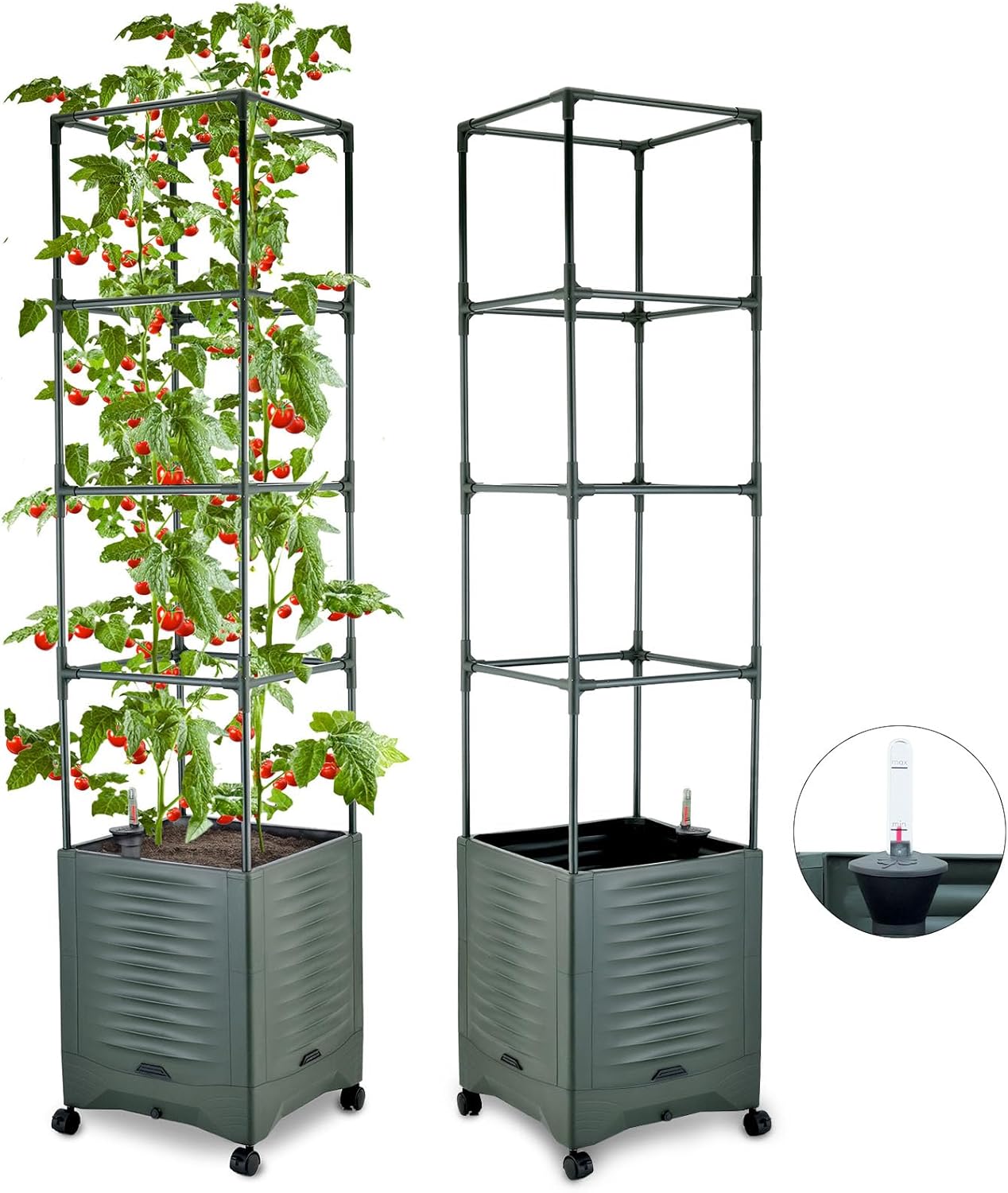
The TeCreatio 56.5-inch tomato planter is a vertical container gardening system built for tomatoes and other climbing plants. Based on the listed specifications, it includes a square planter box, a self-watering reservoir, a water level indicator, a metal trellis, and a wheeled floor-standing base. It is aimed at gardeners who want to grow upward in a small footprint rather than dedicating a full raised bed or in-ground row.
The main growing benefit is the combination of plant support and water management. The 2-gallon reservoir is designed to reduce frequent watering, while the top water inlet lets you refill the reservoir without washing soil away from the plant stem. The water indicator is intended to show when refilling is needed, which can be especially useful for newer gardeners who are still learning container moisture management.
At 12.8 inches deep by 12.8 inches wide and 56.5 inches high, this planter is compact at the base but tall enough to provide vertical structure. The included metal trellis supports climbing growth, and the planter also has two drainage outlets plus four ventilation holes. Five wheels, with four locking brakes, make it easier to move the planter across suitable surfaces without lifting a soil-filled container.
In everyday use, this design makes sense for patios, decks, balconies with adequate load capacity, greenhouses, sunrooms, and small yards. Gardeners can roll the planter toward stronger sun, move it away from harsh afternoon exposure, or bring it under cover during cooler weather. Reviewers commonly mention that they appreciate the mobility and that assembly is generally manageable, although one reviewer noted that the planter has several parts and requires attention during setup.
There are a few practical cautions. Because the base is only 12.8 inches square, gardeners growing especially vigorous indeterminate tomato varieties may prefer a larger container. A few user comments also mention water gauge sticking or accidental overfilling, so it is smart to fill slowly, check drainage, and consider a drip tray if using it indoors or on a surface that should stay dry. As with any wheeled planter, lock the brakes when the plant is in position, especially once the trellis is supporting heavier growth.
This is a good fit for gardeners who want an all-in-one tomato or vine planter with support, wheels, and self-watering convenience. Gardeners who want multiple plants in one container, a wider root zone, or a simpler one-piece planter may want to compare larger raised planters before choosing this model.
Best For / Avoid If
Best for buyers prioritizing
- Combines planter, trellis, reservoir, water indicator, and wheels in one compact setup.
- Movable design is helpful for gardeners who need to adjust light exposure or bring plants under cover.
- Tall 56.5-inch form provides vertical support without taking up much floor space.
Consider another option if
- The 12.8-inch square planting area may be limiting for gardeners who grow very large indeterminate tomato varieties.
- Some reviewers reported that the water gauge can stick or overfill, so careful filling and outdoor placement or a drip tray may be wise.
- The planter ships as one unit only, despite images that may show more than one planter.
Pros
- Includes three complete cage-and-bag sets.
- Adjustable pole assembly can extend to 48 inches.
- Grow bags have two carrying handles for moving.
Cons
- The listed dimensions are 12.5 x 12.5 x 48 inches, so each cage has a relatively narrow footprint.
- Assembly requires connecting multiple poles, rods, and joints.
- The product information does not specify drainage details or how securely the cages anchor in different growing conditions.
The ANPHSIN set pairs three plant cages with three 10-gallon non-woven fabric grow bags. It is designed to support upward-growing plants, making it a practical option for gardeners growing tomatoes, peppers, or other listed climbing and upright plants in containers.
The cage height can be adjusted by adding poles as plants grow, up to a listed maximum of 48 inches. Steel-core stakes with plastic coating make up the supports, while connecting rods and joints complete each cage structure.
Each bag has two carrying handles, which can help when repositioning a planted container. The product listing gives dimensions of 12.5 x 12.5 x 48 inches and identifies the bags as 10 gallons; check available space before setting up all three.
These sets may suit patios, small yards, or other areas where container growing is useful. The product information also lists cucumbers, eggplants, flowers, fruits, and climbing plants as intended uses, though plant needs and final fit will vary.
Assembly involves connecting the supplied poles, rods, and joints. The listing does not explain drainage details or cage anchoring, so inspect the assembled supports and confirm the bags and setup suit your growing conditions.
Consider this set if you want several movable grow bags with adjustable plant supports. Gardeners needing wider containers, a taller support structure, or clearly specified drainage and anchoring details may prefer a different option.
Best For / Avoid If
Best for buyers prioritizing
- Includes three complete cage-and-bag sets.
- Adjustable pole assembly can extend to 48 inches.
- Grow bags have two carrying handles for moving.
Consider another option if
- The listed dimensions are 12.5 x 12.5 x 48 inches, so each cage has a relatively narrow footprint.
- Assembly requires connecting multiple poles, rods, and joints.
- The product information does not specify drainage details or how securely the cages anchor in different growing conditions.
Best Planter For Tomatoes buying guide
Start with plant count and usable space
Decide how many tomato plants you want to grow, then check the planter’s capacity and footprint against your available space. The FEED GARDEN and ANPHSIN options list three or four separate grow bags, respectively; these allow separate containers rather than one shared bed. MQHUAYU is a two-pack, while the TeCreatio listing specifies one planter. Package count is not the same as the number of plants each container can support, so do not assume every bag or planter should hold multiple tomatoes.
Before buying, confirm current product dimensions and leave room for the trellis and access for watering. The supplied MQHUAYU product title lists a 57-inch trellis and dimensions of 57 × 9.8 × 9.8 inches; the TeCreatio title lists a 56.5-inch overall height. These tall supports can take vertical space even when the container footprint is compact.
Compare growing volume, not just container count
Capacity helps you estimate how much growing medium a container can hold. FEED GARDEN and ANPHSIN list 10-gallon bags. MQHUAYU describes a raised planter with heightened walls but does not provide a volume in the published specifications. TeCreatio describes pot depth as suitable for determinate and indeterminate tomatoes, but does not give a volume or depth measurement here. Check the listing before comparing these planters by root space.
Growing medium adds substantial weight, particularly after watering. Plan where each container will sit before filling it. If access height matters for comfort, compare the planter’s actual height and where its growing surface will sit; a tall trellis does not automatically mean the planting area is raised to a comfortable working level. Our guide to raised-bed height and sizing explains the access considerations.
Match drainage and watering design to your routine
Fabric grow bags drain through their breathable material. The FEED GARDEN listing highlights airflow and fast drainage, while ANPHSIN describes breathable nonwoven bags. This design may suit gardeners who prefer containers that drain freely, but it also means you need to monitor moisture and water as conditions require. Do not treat a product’s drainage description as a guarantee against overwatering or plant problems.
MQHUAYU lists a bottom water reservoir and air holes. TeCreatio lists a 2.0-gallon reservoir, water inlet, and water-level indicator. Its listing claims one fill can supply water for 7–10 days depending on weather; treat that as a manufacturer claim, not a dependable schedule for every location or plant. A reservoir can reduce routine refilling, but it does not remove the need to check moisture and follow the product’s filling instructions.
Choose support for the way you will train plants
A built-in or included trellis keeps container and support in one purchase. MQHUAYU’s trellis can be assembled in one to four layers and used with the planter or separately. TeCreatio lists a metal trellis. ANPHSIN includes three adjustable three-layer cages, with a listed maximum height of 48 inches. FEED GARDEN bags do not include a support structure in the published information, so plan for a separate support if needed.
Check the stated height against the tomato variety and the space above the planter. Product descriptions do not establish how a support will perform in every wind or with every mature plant. Assemble each frame according to its instructions, inspect connections, and avoid relying on a support beyond its documented configuration.
Consider mobility before filling
TeCreatio lists five wheels, four with brakes, for moving the planter. That may help gardeners who need to reposition a container, but the listing does not provide a loaded weight or confirm how easily it rolls over different surfaces. Check the floor or patio surface and engage the brakes when the planter is parked, following the manufacturer’s instructions.
Both grow-bag listings describe handles for carrying or moving bags. Filled bags can be heavy, so handles do not make a full container effortless or safe for every gardener to lift. Decide whether you can move the filled planter, or position it first and avoid moving it after adding soil. This is especially important for small patios, balconies, and gardeners who prioritize accessibility.
Check assembly, stability, and listing details
The ANPHSIN package includes cages, grow bags, and a manual, with multiple poles, rods, and joints to assemble. MQHUAYU offers adjustable trellis layers. These configurations provide flexibility but involve putting components together. Review the manual and package contents before assembly, and verify that connectors are secure before adding plants.
Compare the product’s base, support connections, and intended placement rather than assuming a tall planter is automatically stable. The published data does not give a tested wind rating or a load limit for these products. Keep planters on a suitable level surface and follow manufacturer guidance for assembly and placement.
Plan for upkeep and off-season storage
At the end of the growing period, empty and clean containers as directed by the manufacturer. The FEED GARDEN listing says its bags fold for compact storage; ANPHSIN’s included cage has separable components. The listings do not specify an expected service life for either product. Store components dry and inspect fabric, seams, joints, and supports before using them again.
For self-watering models, follow the maker’s cleaning and storage instructions for the reservoir and indicator. The TeCreatio listing mentions three years of parts support through Amazon messaging; verify current terms with the seller. For more soil-care advice, see how to refresh raised-bed soil and prepare beds for winter.
Research methodology and trust
We screened the listed products for direct relevance to growing tomatoes in containers. Each option listed a planter, grow bag, or tomato-supporting planter system, so all four fit the requested task. We compared documented capacity, package count, trellis or cage features, drainage, reservoir design, mobility, storage, and stated support information.
This is research-based analysis of published product information, not physical testing. Manufacturer descriptions are presented as listed features or claims, not independently verified results. We did not receive substantive owner-review text; the published ratings show zero reviews for each product, so they cannot establish owner satisfaction or a meaningful review trend.
Ranking favors fit for specific gardening needs: multi-plant value, integrated support, watering convenience, portability, and storage. Prices and product details can change, so verify current listing information before purchase. This guide was reviewed for the published product data in October 2026.
Frequently asked questions
What should I look for in best planter for tomatoes?
Compare container capacity, drainage, support, package count, and watering design. Also check dimensions and where the planter will sit before filling it.
Are 10-gallon grow bags included in these options?
FEED GARDEN lists four 10-gallon bags, and ANPHSIN lists three 10-gallon bags with cages. Confirm the current product listing and package contents before ordering.
Do self-watering tomato planters need regular checking?
Yes. A reservoir can reduce routine watering, but weather and plant use affect how quickly water is used. Check the level and growing medium, and follow the planter’s instructions rather than assuming a fixed interval.
Can I move a planter after filling it?
Movement depends on the planter, surface, and filled weight. TeCreatio lists wheels and ANPHSIN and FEED GARDEN list bag handles, but the published specifications do not state loaded weights. Position containers before filling when lifting or rolling could be difficult.
Which best planter for tomatoes option stores most compactly?
FEED GARDEN specifically describes its bags as foldable for compact off-season storage. ANPHSIN’s cage components separate, but the published information does not give their packed dimensions.
How long will these tomato planters last?
The published data does not establish expected service life for these products. FEED GARDEN describes its bags as designed for multi-season use, and TeCreatio lists three years of parts support; these statements are not independent durability testing. Check current seller terms and inspect components regularly.
Are tall trellis planters a good fit for small patios?
They may suit a limited footprint if there is enough vertical clearance and room to access the container. Check the listed height and footprint, plus any space needed to assemble or move the planter. For a lower-profile setup, compare the grow-bag options and plan support separately.
Continue your garden research
Browse more practical guides in Raised Beds & Planters.
For product comparisons, see Best Galvanized Raised Garden Beds.
See how Dove Creek Gardens researches and compares products.