


Kitchen scraps can be useful garden inputs, but storing them until they reach an outdoor pile or community drop-off can be inconvenient. The right indoor composter depends on whether you mainly want to reduce waste volume, produce material for a garden, or keep a small collection bin by the sink.
This guide compares nine options, from basic countertop bins to electric machines. Capacity, processing approach, filter upkeep, cleaning, and the space available in your kitchen are the practical factors to weigh. For a traditional composting starting point, see our guide on how to start a compost bin.
Ouaken 4L Electric Countertop Composter for Convenient Kitchen Food-Scrap Reduction Ouaken 4L Electric Composter for Kitchen Food-Scrap Reduction and Indoor Composting Reencle Prime 14L Electric Composter for Fast, Low-Odor Kitchen Food Waste Processing Reencle Prime Electric Composter for Indoor Food-Waste Reduction Prices and availability can change. We may earn a commission from qualifying purchases.


Pros
- Compact countertop design can suit kitchens, apartments, and small-space homes without requiring an outdoor composting area.
- Multiple operating modes provide more flexibility than a simple food-waste storage container.
- Transparent lid and touch controls make it easier to monitor and start the selected cycle.
- The product information includes a specific empty-the-bucket instruction that helps reduce clumping and protect the fan and blades.
Cons
- A 4L capacity may require frequent emptying in households that produce large amounts of food waste.
- Users need to remove each processed batch before starting another cycle, adding a routine handling step.
- The product information does not specify which finished materials are suitable for direct garden application, so gardeners may need to follow the manufacturer's guidance before using the output around plants.
The Ouaken 4L Electric Composter is a countertop food-waste processing appliance designed for kitchens rather than traditional outdoor compost piles. It is best suited to homeowners, apartment dwellers, and small-space gardeners who want to reduce kitchen-scrap volume and create a processed material that may support garden use according to the manufacturer's directions.
Based on the listed feature set, the unit uses high-temperature drying, grinding, and cooling, with a separate Ferment mode intended to support accelerated fermentation. The product information indicates waste reduction of up to 90% within hours, while low-speed, high-torque blades are designed to handle most food materials. The Crush mode emphasizes lower-energy volume and odor reduction, so the choice of mode depends on whether convenience or fermentation is the priority.
The white unit measures approximately 12.6 by 10.2 by 13.0 inches and weighs about 15.8 pounds. Its 4L capacity, transparent lid, and easy-touch controls support routine countertop use, while the detachable bucket is listed as dishwasher safe. No assembly requirements are provided, and the compact footprint may be easier to accommodate than an outdoor bin for kitchens with limited space.
For a patio or backyard gardener, this composter could help process daily vegetable scraps before transferring the resulting material according to the manufacturer's recommendations. It may also suit households without room for a tumbler or open compost pile, especially where odor control matters. The carbon filter is listed for up to five months of use, and operation below 40 dBA may make the appliance more suitable for use in shared indoor spaces.
Routine handling is important. The bucket should be emptied after every cycle, because leaving processed material inside for another run can extend operation, increase power use, and contribute to clumping that may affect the fan and blades. The published information does not identify the exact finished-output requirements for direct use around plants, so gardeners should confirm those instructions before applying it to soil or beds. Overall, this is a convenient waste-reduction option for smaller households, but gardeners seeking high-volume composting may prefer a larger outdoor system.
Best For / Avoid If
Best for buyers prioritizing
- Compact countertop design can suit kitchens, apartments, and small-space homes without requiring an outdoor composting area.
- Multiple operating modes provide more flexibility than a simple food-waste storage container.
- Transparent lid and touch controls make it easier to monitor and start the selected cycle.
Consider another option if
- A 4L capacity may require frequent emptying in households that produce large amounts of food waste.
- Users need to remove each processed batch before starting another cycle, adding a routine handling step.
- The product information does not specify which finished materials are suitable for direct garden application, so gardeners may need to follow the manufacturer's guidance before using the output around plants.
Pros
- Compact countertop design is convenient for indoor kitchens and small-space households.
- Multiple modes provide more flexibility than a single-purpose food-waste grinder.
- Odor control and a dishwasher-safe bucket support easier day-to-day maintenance.
Cons
- The 4L capacity may be less suitable for households producing large amounts of food waste between cycles.
- Users will need to monitor carbon-filter replacement needs and follow the appropriate mode for their intended end use.
- Gardeners seeking traditional outdoor composting may prefer a larger bin that supports longer-term aeration and decomposition.
The Ouaken 4L Electric Composter is an indoor countertop appliance intended to process kitchen food scraps before the material is used as compost or fertilizer. It is best suited to homeowners, apartment residents, and small-space gardeners who want to reduce food-waste volume without maintaining a full outdoor compost pile.
Based on the listed specifications, the machine combines high-temperature drying, grinding, and cooling to reduce waste by up to 90% within three hours. Crush Mode is described as a lower-energy option for reducing volume and odor, while Ferment Mode is intended for accelerated processing toward compost or fertilizer use.
The black unit measures 10.4 by 13.3 by 12.8 inches and weighs about 18.6 pounds, so users should reserve a stable countertop area with enough clearance for the lid and controls. Its transparent lid, touch interface, and selectable Crush, Ferment, and Clean modes make the operating process relatively straightforward, while the detachable bucket is dishwasher safe.
For a patio container gardener or small backyard grower, the processed material may offer a convenient way to keep kitchen scraps in the household nutrient-cycling routine. The compact format is particularly relevant where an outdoor compost bin is impractical, although the product information does not specify the final material's application rates or which plants it should be used around.
The carbon filter is intended to control indoor odors and is listed for up to five months of use, but it will require periodic replacement. Users should also follow the manufacturer's operating guidance for acceptable food materials and avoid assuming that every processed batch is equivalent to mature outdoor compost. This is a convenient waste-reduction option for small households, while gardeners needing high-volume compost production may prefer a larger traditional bin.
Best For / Avoid If
Best for buyers prioritizing
- Compact countertop design is convenient for indoor kitchens and small-space households.
- Multiple modes provide more flexibility than a single-purpose food-waste grinder.
- Odor control and a dishwasher-safe bucket support easier day-to-day maintenance.
Consider another option if
- The 4L capacity may be less suitable for households producing large amounts of food waste between cycles.
- Users will need to monitor carbon-filter replacement needs and follow the appropriate mode for their intended end use.
- Gardeners seeking traditional outdoor composting may prefer a larger bin that supports longer-term aeration and decomposition.
Pros
- Designed for indoor food-scrap processing with odor control features.
- High stated daily processing capacity for regular household kitchen waste.
- Quiet operation may be suitable for open kitchens and nearby living spaces.
- Includes starter materials, filters, and a shovel.
Cons
- Its 20.1-pound weight and 18.4-inch height may make frequent moving or countertop placement less convenient.
- The listed processing time can range from 2 to 24 hours, so results may not be immediate for every load.
- Gardeners seeking a large-volume outdoor composting system may prefer a traditional bin with greater physical capacity.
The Reencle Prime is an electric kitchen composter intended for turning household food scraps into a compost-like material for gardening use. Its 14L size and stated ability to process up to 2.2 pounds of food waste daily make it most relevant to homeowners, apartment users, and small-space gardeners who want to manage kitchen scraps indoors.
The product information indicates that it uses aerobic composting and patented microbe technology to speed decomposition. Processing is listed at 2 to 24 hours, and the feature set is designed to reduce food waste while producing nutrient-rich compost or fertilizer, although actual results can vary with the material added and operating conditions.
For placement planning, the Star White unit measures 12 by 13 by 18.4 inches and weighs 20.1 pounds. The published specifications do not describe controls, assembly steps, cord length, or a dedicated storage system, so buyers should confirm the operating and placement requirements before setting it up in a kitchen or other indoor area.
The composter may fit households that regularly collect food scraps but do not have convenient access to an outdoor compost pile. Its low listed operating noise of 28 dB and three-layer filtration system are particularly relevant for kitchens, utility areas, or other spaces where odor and appliance noise are concerns.
Routine use will still require managing food scraps and the processed material, and the included carbon filters may eventually need attention or replacement according to the manufacturer's instructions. The 2 to 24 hour processing range also means it should not be treated as an instant disposal system. Overall, it is a practical choice for indoor food-waste processing when convenience and odor control matter more than large-volume composting capacity.
Best For / Avoid If
Best for buyers prioritizing
- Designed for indoor food-scrap processing with odor control features.
- High stated daily processing capacity for regular household kitchen waste.
- Quiet operation may be suitable for open kitchens and nearby living spaces.
Consider another option if
- Its 20.1-pound weight and 18.4-inch height may make frequent moving or countertop placement less convenient.
- The listed processing time can range from 2 to 24 hours, so results may not be immediate for every load.
- Gardeners seeking a large-volume outdoor composting system may prefer a traditional bin with greater physical capacity.
Pros
- Indoor format makes food-scrap processing accessible for homes without outdoor composting space.
- Listed daily processing capacity is useful for regular kitchen food waste.
- Low-noise design and odor-filtration features are well suited to shared living areas.
Cons
- At 20.1 pounds, it may be less convenient to move frequently despite its countertop-oriented design.
- Gardeners with larger amounts of yard waste or food scraps may need a separate outdoor composting method.
- The listed information does not explain routine filter replacement, cleaning steps, or control details.
The Reencle Prime is an indoor electric composter for processing household food scraps rather than a conventional outdoor bin for leaves, grass, and other yard materials. Its 14-liter format is aimed at homeowners, apartment residents, and small-space gardeners who want to manage kitchen waste close to where it is generated.
According to the product information, the aerobic system uses microbial decomposition to process up to 2.2 pounds of food scraps per day, with a listed decomposition timeframe of approximately 2 to 24 hours. That can make routine kitchen waste management more convenient and may provide material for later garden use, although the published information does not specify how the finished output should be applied.
The unit measures about 13.03 by 12.01 by 18.39 inches and weighs 20.1 pounds. Its silver finish and compact, upright design are intended to fit into a kitchen setting, while operation as low as 28 dB may help limit disturbance in living areas. The package includes a carbon filter, compost starter pack, and shovel, but the available specifications do not describe the controls, assembly process, or storage requirements in detail.
For a patio container gardener, raised-bed gardener, or homeowner with limited outdoor space, the main benefit is having a dedicated place for food scraps without waiting for a traditional pile to break down. It can also complement an outdoor compost system by handling kitchen waste indoors, while yard debris remains managed separately.
The three-layer filter system is designed to control odors, but routine care will still be important for any appliance that handles moist food waste. Users should follow the manufacturer’s instructions for acceptable scraps, cleaning, filter care, and use of the processed material. The unit may be less suitable for gardeners needing to compost substantial volumes of yard waste or those who prefer a passive, electricity-free method.
This composter is best suited to households seeking a convenient indoor food-waste solution with low listed noise and included startup accessories. Gardeners who have adequate outdoor space, produce large amounts of organic material, or want a traditional composting process may prefer an outdoor bin or pile instead.
Best For / Avoid If
Best for buyers prioritizing
- Indoor format makes food-scrap processing accessible for homes without outdoor composting space.
- Listed daily processing capacity is useful for regular kitchen food waste.
- Low-noise design and odor-filtration features are well suited to shared living areas.
Consider another option if
- At 20.1 pounds, it may be less convenient to move frequently despite its countertop-oriented design.
- Gardeners with larger amounts of yard waste or food scraps may need a separate outdoor composting method.
- The listed information does not explain routine filter replacement, cleaning steps, or control details.

Pros
- Compact 1.3-gallon capacity is practical for everyday kitchen scrap collection.
- Stainless steel body is rust-resistant according to the product information and intended for repeated use.
- Odor-control features may make countertop storage more comfortable between trips to a larger compost system.
Cons
- Its roughly 7.3 to 7.5-inch diameter and 11-inch height still require a dedicated countertop or under-sink location.
- The charcoal filter will eventually need replacement, and the product information does not specify replacement-filter availability.
- This is a collection bin, so gardeners will need a separate outdoor composting method or compost service to process the scraps.
The Veinvify 1.3-gallon countertop compost bin is designed to collect kitchen food scraps before they are moved to an outdoor compost pile, tumbler, municipal program, or other processing system. It is a practical fit for homeowners and apartment gardeners who want a dedicated container for daily organic waste without placing a large bin in the kitchen.
The most useful feature set centers on odor management and easy handling. The airtight lid and activated charcoal filter are intended to help contain and neutralize odors, while the listed filter life exceeds six months with proper care. This can make it more convenient to hold several days of scraps between trips outside or to a collection point.
Product information lists a compact footprint of about 7.3 to 7.5 inches in diameter and an overall height of about 11 inches. The smooth, seamless one-piece construction is described as leak-proof and rust-resistant, which should simplify wiping and reduce concern about residue collecting in welded joints. No assembly, controls, drainage system, or installation is indicated.
For backyard gardeners, the bin can serve as an indoor staging container for vegetable trimmings, coffee grounds, and other suitable compost inputs before transfer to a separate composting setup. Its vertical shape may also work under a sink if the available clearance accommodates the listed height, though users should measure their space first.
This container does not process scraps into finished compost on its own, so it is not a substitute for an outdoor composter or composting service. Routine emptying, cleaning, and filter care will still be necessary, and the charcoal filter may require replacement over time. Based on the listed specifications, it is a sensible choice for compact kitchen scrap storage, while gardeners needing larger capacity or an integrated composting system should consider a different product.
Best For / Avoid If
Best for buyers prioritizing
- Compact 1.3-gallon capacity is practical for everyday kitchen scrap collection.
- Stainless steel body is rust-resistant according to the product information and intended for repeated use.
- Odor-control features may make countertop storage more comfortable between trips to a larger compost system.
Consider another option if
- Its roughly 7.3 to 7.5-inch diameter and 11-inch height still require a dedicated countertop or under-sink location.
- The charcoal filter will eventually need replacement, and the product information does not specify replacement-filter availability.
- This is a collection bin, so gardeners will need a separate outdoor composting method or compost service to process the scraps.
Pros
- Useful volume reduction for households that want to handle food scraps indoors before garden use.
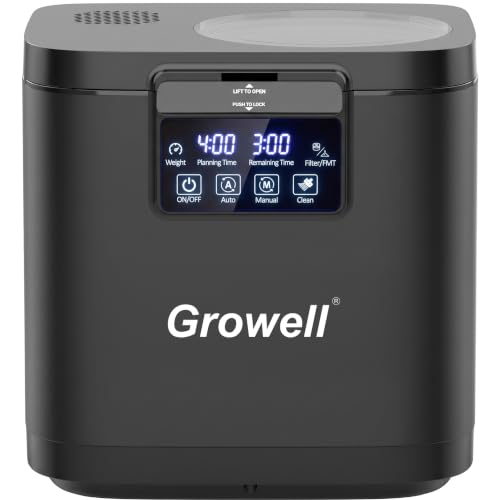
- Compact countertop format with a viewing window and sealed design suited to apartments and small kitchens.
- Removable dishwasher-safe bucket and dedicated cleaning cycle reduce the effort involved in routine upkeep.
- The listed 4L capacity and multiple processing modes offer flexibility for regular kitchen waste management.
Cons
- The 22.7-pound weight may make it less convenient to move frequently between counters or storage areas.
- The dried output may require an additional 10-hour FMD process and manual-guided fermentation before being used as plant fertilizer.
- Ongoing filter replacement is part of maintenance, with the product information recommending activated-carbon replacement about every three months.
The Growell 4L Electric Composter is an indoor countertop food-waste processor designed for households that want to reduce kitchen scraps before incorporating the processed material into a garden routine. It is especially relevant for apartment dwellers, small-space gardeners, and homeowners who do not want a full outdoor compost bin for everyday food waste.
Its listed Auto cycle combines grinding, high-temperature drying, and cooling to reduce food-waste volume by up to 90% in 4 to 6 hours. The feature set includes vegetables, peels, meat, and soft bones, while the separate FMD mode provides a 10-hour fermentation step for further processing into plant fertilizer. Users should follow the manual for the appropriate fermentation procedure and final garden use.
The unit measures 13.2 by 10.2 by 13.3 inches and weighs 22.7 pounds, so its compact footprint can fit a countertop, but its weight may make frequent relocation less convenient. A clear viewing window lets users monitor the cycle without opening the lid, and the LED touch panel provides Auto, Manual, FMD, and auto-clean selections with time information.
For a small kitchen or patio gardening setup, the composter can provide a more manageable form of food waste for later garden use. The sealed design and dual activated-carbon filters are intended to limit odors and help keep insects out, while the below-40dB brushless motor specification supports quieter indoor operation based on the product information.
Maintenance is simpler than with a container that must be scrubbed by hand because the machine includes a 30-minute water-based auto-clean cycle and a removable, top-rack dishwasher-safe inner bucket. Activated-carbon filters still require attention, with replacement recommended about every three months. This product is a reasonable fit for gardeners who value indoor convenience and food-waste reduction, while those seeking traditional outdoor composting, larger batch capacity, or a passive no-electricity method may prefer a different option.
Best For / Avoid If
Best for buyers prioritizing
- Useful volume reduction for households that want to handle food scraps indoors before garden use.
- Compact countertop format with a viewing window and sealed design suited to apartments and small kitchens.
- Removable dishwasher-safe bucket and dedicated cleaning cycle reduce the effort involved in routine upkeep.
Consider another option if
- The 22.7-pound weight may make it less convenient to move frequently between counters or storage areas.
- The dried output may require an additional 10-hour FMD process and manual-guided fermentation before being used as plant fertilizer.
- Ongoing filter replacement is part of maintenance, with the product information recommending activated-carbon replacement about every three months.

Pros
- Durable coated galvanized iron construction
- Useful 5-liter capacity for regular household food scraps
- Included charcoal filter helps manage odors between emptying
- Handles support easier transport to an outdoor compost area
Cons
- The 5-liter size may take up noticeable space in a small kitchen or compact countertop area.
- The charcoal cartridge requires periodic replacement, with each cartridge listed for about three to four months.
- It is a food-scrap collection bin, so gardeners still need a separate composting method or destination to turn scraps into finished compost.
The Holismo Kitchen Countertop Compost Bin is designed to collect food scraps indoors before they are moved to a compost pile, tumbler, or other outdoor composting method. Its 5-liter capacity and lidded design make it a practical option for homeowners, apartment gardeners, and beginners who want a dedicated place for kitchen waste.
The feature set focuses on odor management and routine convenience. An activated charcoal filter in the lid is intended to adsorb unpleasant odors, while ventilation holes promote air circulation. These features may help keep the collection area fresher, although odor control will still depend on the type of scraps stored and how often the bin is emptied.
At 7.08 by 7.08 by 8.66 inches, the bin has a compact footprint but enough listed capacity for regular food scraps. The galvanized iron body has an epoxy resin coating for added rust resistance, and the built-in handles make it easier to carry when transferring scraps. The published information does not specify assembly requirements, liner compatibility, or whether the container is dishwasher safe.
For backyard gardeners, the bin can serve as a kitchen-side collection point for coffee grounds, vegetable peels, fruit cores, eggshells, tea leaves, and other listed organic waste. It can also be useful in small-space homes where scraps need to be gathered indoors before being taken to a community composting location or an outdoor garden compost system.
Routine maintenance includes emptying the container and replacing the charcoal cartridge approximately every three to four months as listed. Users should keep expectations realistic because this product collects scraps rather than completing the full composting process by itself. It is a sensible choice for organized indoor food-waste storage, while gardeners seeking a complete composting system should consider a separate outdoor or indoor processing solution.
Best For / Avoid If
Best for buyers prioritizing
- Durable coated galvanized iron construction
- Useful 5-liter capacity for regular household food scraps
- Included charcoal filter helps manage odors between emptying
Consider another option if
- The 5-liter size may take up noticeable space in a small kitchen or compact countertop area.
- The charcoal cartridge requires periodic replacement, with each cartridge listed for about three to four months.
- It is a food-scrap collection bin, so gardeners still need a separate composting method or destination to turn scraps into finished compost.

Pros
- Large 4.2L capacity for routine household food scraps
- Carbon-filter odor control is suited to indoor use
- Crush-and-dry processing may make food waste easier to handle and transport to a garden area
- Below-45dB operation may be less disruptive in living spaces
Cons
- The processed output is described as pre-compost, so it may require further breakdown or careful soil mixing before garden use
- The bucket must be emptied completely after every cycle to help prevent clumping and blade or motor problems
- Gardeners needing finished compost or a larger outdoor composting volume may prefer a traditional bin or tumbler
The Soliddis 4.2L Electric Composter is an indoor food-waste recycler designed to crush and dry kitchen scraps into a reduced-volume biomass or pre-compost material. Its main garden-related purpose is to make daily food waste easier to manage before it is mixed with soil or moved to an outdoor composting setup. The capacity and countertop format make it a practical fit for households, apartment residents, and gardeners working with limited outdoor space.
The listed crush-and-dry process focuses on fast volume reduction rather than long fermentation. The product title states a 4-6 hour processing time, while the feature set describes the output as dry pre-compost. This can reduce the bulk and wetness of food scraps, making them easier to store or incorporate into a broader composting routine. The supplied guidance recommends mixing the processed material with garden soil at a 1:10 ratio rather than applying it directly to indoor plants.
The unit measures 12.9 by 12.6 by 10.6 inches and weighs 14.33 pounds, so placement should account for both its footprint and the need to remove the bucket after processing. No assembly requirements are listed. Starting the cycle requires pressing and holding the power button for 1.5 seconds, not a quick tap. Its stated operating noise below 45dB may be helpful in kitchens, apartments, or open living areas where a louder appliance would be distracting.
For a patio or small-space garden, the composter could provide a convenient way to process vegetable trimmings and other accepted kitchen scraps before adding the material to soil or an outdoor compost system. The carbon filter is intended to help manage odors indoors, and the product information describes self-cleaning functionality. The available data does not specify which food items are accepted, so users should follow the manufacturer's operating instructions rather than assuming all kitchen waste is suitable.
Routine care is important. The supplied warning says to empty the bucket completely after each cycle because adding fresh scraps on top of a dried batch can cause severe clumping and may damage the motor or blades. The material should also be treated as pre-compost, not automatically as finished compost. Overall, this is a convenient waste-reduction option for gardeners who value indoor processing and manageable output, while those seeking finished compost, high-volume processing, or a traditional outdoor decomposition system may prefer a different approach.
Best For / Avoid If
Best for buyers prioritizing
- Large 4.2L capacity for routine household food scraps
- Carbon-filter odor control is suited to indoor use
- Crush-and-dry processing may make food waste easier to handle and transport to a garden area
Consider another option if
- The processed output is described as pre-compost, so it may require further breakdown or careful soil mixing before garden use
- The bucket must be emptied completely after every cycle to help prevent clumping and blade or motor problems
- Gardeners needing finished compost or a larger outdoor composting volume may prefer a traditional bin or tumbler

Pros
- Produces listed real compost through microbial degradation instead of simply dehydrated food waste.
- Continuous add-and-go operation can simplify everyday kitchen scrap management.
- Permanent built-in filter may reduce maintenance compared with systems that require regular filter changes.
- Large stated capacity and up to 11-pound daily processing claim may fit an active household.
Cons
- The listed specifications show a 42-pound weight, so moving or repositioning the unit may be inconvenient.
- The published dimensions are shown as 1 x 1 x 1 inches and appear incomplete, so buyers should confirm the actual footprint before planning counter or floor space.
- Gardeners who want a large volume of finished compost may prefer a traditional outdoor composting system or another larger-capacity option.
The GEME Smart 19L is an indoor electric composter for households that want to manage kitchen food scraps without maintaining a conventional outdoor compost pile. Its intended gardening role is to convert food waste into the listed organic compost, making it potentially useful for homeowners, apartment gardeners, and small-space growers who have limited room for outdoor composting.
The feature set centers on microbial degradation rather than simple dehydration. The product information states that it reduces food waste by 95 percent, leaving 5 percent nutrient-rich organic compost, and that processing can take 6 to 8 hours. These claims may appeal to gardeners who want a quicker way to handle scraps, although the published information does not explain how the finished material should be incorporated into soil or used around specific plants.
Operation is designed to be simple: users can add food scraps at any time, and the machine is described as operating continuously without buttons to press or cycles to wait for. A permanent built-in filter is intended to eliminate filter changes, while the listed deodorization and quiet-operation features are aimed at making indoor use more comfortable. The specifications list a 42-pound weight, and the stated 1 x 1 x 1 inch dimensions appear incomplete, so confirm the actual size and placement requirements before buying.
For a patio container gardener, raised-bed grower, or homeowner with a small yard, this unit could provide a convenient way to process kitchen scraps close to where they are generated. The 19L capacity and stated ability to process up to 11 pounds per day may be useful for an active household, while the product information identifies it as suitable for a family of three. It is less relevant for gardeners who need to process large amounts of yard waste, since the published data focuses on kitchen food scraps.
The main considerations are the appliance's substantial listed weight, the need to verify its actual footprint, and the absence of published details about electrical requirements, accepted materials, and how to apply the finished compost. Buyers should follow the manufacturer's operating guidance and confirm that the unit fits their intended indoor location. Overall, it appears best suited to households seeking convenient indoor food-scrap processing and reduced filter maintenance, while traditional composters may be a better choice for larger garden waste volumes.
Best For / Avoid If
Best for buyers prioritizing
- Produces listed real compost through microbial degradation instead of simply dehydrated food waste.
- Continuous add-and-go operation can simplify everyday kitchen scrap management.
- Permanent built-in filter may reduce maintenance compared with systems that require regular filter changes.
Consider another option if
- The listed specifications show a 42-pound weight, so moving or repositioning the unit may be inconvenient.
- The published dimensions are shown as 1 x 1 x 1 inches and appear incomplete, so buyers should confirm the actual footprint before planning counter or floor space.
- Gardeners who want a large volume of finished compost may prefer a traditional outdoor composting system or another larger-capacity option.
Indoor composter buying guide
Choose between a collection bin and an electric machine
A countertop bin holds scraps for later transfer; it does not process them into finished compost. The Veinvify and Holismo bins use charcoal filters to help manage odors while scraps wait to be moved. They are a lower-complexity choice if you already have a compost pile, municipal collection, or another place to take scraps.
Electric units use drying and grinding, or a microbial process, to handle scraps differently. A dried, ground output is not automatically the same as mature compost. If your priority is a biologically decomposed material, compare the Reencle and GEME approaches with the manual guidance for how to use the output.
Match capacity to your kitchen routine
Capacity is useful only when it suits how often you want to empty or run the unit. The Ouaken and Growell machines have 4-liter capacities, while the Soliddis is 4.2 liters. Reencle lists a 14-liter capacity, and GEME lists 19 liters. The Veinvify and Holismo collection bins each list 1.3 gallons.
For a small household or limited counter space, a compact electric machine or collection bin may be easier to accommodate. A larger unit can reduce how often scraps need attention, but it also takes more room. Measure the intended counter or under-sink area and consider how you will lift and empty the container.
Understand what the processing time means
Ouaken describes high-temperature drying, grinding, and cooling, with a claim of up to 90% waste-volume reduction in about three hours. Growell describes a four-to-six-hour drying and grinding cycle, followed by a separate fermentation mode. Soliddis also describes crush-and-dry processing and calls its output pre-compost. These are manufacturer descriptions, not a guarantee that the output can be used as finished compost straight from the machine.
Reencle and GEME describe microbial processing. Reencle lists a processing range of two to 24 hours, while GEME claims six to eight hours. Times and results can depend on the materials and use instructions, so consult the manual before adding scraps or applying the output to plants.
Plan for odor control and filter replacement
Carbon filters are a maintenance item, not a permanent promise of odor-free operation. Ouaken says its filter can last up to five months. Growell recommends replacing its activated carbon every three months, and Holismo says its charcoal cartridge lasts three to four months. Reencle uses a three-layer filter system and includes one or two carbon filters depending on the version.
GEME describes a built-in filter that does not need replacement. Because filter design and service needs differ, check replacement availability and care instructions before buying. Keep the lid and filter areas clean as directed, and do not assume a filter will control every odor under every kitchen condition.
Compare cleaning and routine upkeep
Removable parts can make emptying and washing more manageable. Ouaken says its bucket is detachable and dishwasher safe. Growell describes a removable, top-rack dishwasher-safe bucket and a water-based cleaning cycle. Read the relevant manual to confirm which parts can be washed and how to clean the unit safely.
Some electric models need a completely empty bucket before the next cycle. Ouaken warns that repeating a cycle on processed material can cause clumping and may contribute to fan or blade problems; Soliddis also warns against adding fresh scraps on top of a dried batch. Follow the model-specific instructions rather than treating all countertop machines alike.
Consider noise, controls, and kitchen placement
Manufacturer noise figures vary: Ouaken and Growell claim operation below 40 dB, Reencle says as low as 28 dB, and Soliddis lists below 45 dB. Treat these as brand specifications, not a guarantee of how loud a unit will seem in your room. A steady motor sound may be more noticeable in a quiet, open-plan kitchen than in a separate utility space.
Check the controls and routine before choosing. Soliddis requires a 1.5-second press of its start button, while Ouaken offers Crush, Ferment, and Clean modes. Clear access to the lid and removable bucket matters, especially for anyone who wants to avoid bending, twisting, or lifting a heavy container from a low cabinet.
Budget for ownership, not just purchase
Consider electricity use, replacement filters, cleaning, and whether the output will actually serve your garden. Filter-based bins have a lower-complexity role but still require transfer and cleaning. Electric machines add powered processing and may need replacement filters or other routine care. A premium continuous-process model may make sense for a household producing frequent scraps, but its larger capacity is less valuable if you generate little waste.
Manufacturer claims about energy use, long service life, or reduced maintenance should be checked against the manual and warranty terms before purchase. The information here does not establish long-term operating cost for every household. Compare recurring upkeep with your actual scrap volume and gardening habits.
Use processed material carefully in the garden
Do not assume dried scraps are ready to use as potting mix or as a direct top dressing. Soliddis recommends mixing its biomass with soil rather than placing it directly on indoor plants, and Growell describes a separate fermentation mode after drying. Follow the machine’s instructions and use conservative amounts while learning how the material behaves in your garden.
If you want finished compost for beds or containers, allow for whatever curing or further breakdown the product manual calls for. Our guide to sifting finished compost explains how gardeners can separate coarse material once compost is ready.
How we evaluate indoor composters
We compare indoor composters by their intended role: simple scrap storage, volume reduction through drying and grinding, or microbial decomposition. Capacity, stated processing time, filter arrangement, cleaning features, controls, and the manufacturer’s directions for using the output all influence suitability for a home gardener.
We also assess the practical tradeoffs behind those specifications. A larger bin can mean fewer emptying tasks but takes more kitchen space. A filter may help manage odors but creates a replacement schedule, while a machine with a removable bucket may simplify cleaning but still needs correct cycle-by-cycle care.
During November, we review the recommendations for garden relevance and clarity, including whether a product is a collection bin or a processor and whether its manufacturer describes dried biomass or microbial composting. Claims about noise, processing speed, and odor control are attributed to the brand so readers can weigh them alongside their own household needs.
Frequently asked questions
Does an electric food-scrap machine make finished compost?
It depends on the processing method and the manufacturer’s instructions. Drying and grinding reduce volume, but that output may need further breakdown before garden use. Microbial models describe a different process, so check the manual for how to handle the finished material.
What size countertop composter should I choose?
Estimate how much kitchen waste you collect and how often you are willing to empty or run the unit. Smaller machines fit tighter counters, while larger capacities can accommodate more material but take up more space. Check the product’s capacity and the available placement area before buying.
How often do indoor compost-bin filters need replacing?
It varies by model. Manufacturer guidance ranges from about three months for some charcoal filters to up to five months for Ouaken’s filter; GEME describes a built-in filter that does not need replacement. Follow the specific care schedule and check that replacement filters are available if the design uses them.
Can I add fresh scraps to a batch that has already been processed?
Follow the individual machine’s instructions. Ouaken and Soliddis both advise emptying the bucket after a cycle rather than processing new scraps on top of dried material, which can cause clumping and operating problems.
Where should I place an electric composter?
Choose a stable kitchen location with enough room to open the lid and remove the bucket. Consider the unit’s size, access to power, and whether its motor sound will bother people nearby. Follow the manufacturer’s placement and electrical instructions.
Is a countertop scrap bin enough if I have a garden?
A simple bin can be enough if you have a separate place to compost or a collection service that accepts your scraps. It stores material rather than turning it into finished compost. If you want an indoor processing step, compare electric models and their directions for using the output.