


Vegetable gardens do not all need the same fertilizer. Crop type, existing soil nutrients, and how often you want to feed all affect the right choice. A fertilizer that suits a mixed raised bed may not be the most convenient option for a few container tomatoes.
This guide to Best Fertilizer For Vegetable Garden compares 10 options by nutrient balance, form, stated feeding interval, and fit for common home-garden situations. It covers organic and conventional choices, granular and liquid products, and practical tradeoffs so beginners and experienced gardeners can select a fertilizer without treating one formula as right for every bed.
Start with your soil and the crops you grow, then consider how much area you need to feed and whether you prefer measured liquid applications or granules. If you make your own soil amendment, our guide to starting a compost bin explains one way to handle garden and kitchen scraps.
Jobe’s Organics 2-5-3 Granular Vegetable Fertilizer for Seasonal Feeding Farmer’s Secret Fruit & Bloom Booster Fertilizer for Flowering Plants Down To Earth 4-4-4 Organic Vegetable Fertilizer for Beds and Garden Crops Farmer’s Secret Fruit & Bloom Booster Fertilizer for Flowering Plants Prices and availability can change. We may earn a commission from qualifying purchases.


Pros
- Made without synthetic chemicals, according to the product information.
- Identified as OMRI listed for organic gardening.
- Designed for vegetable and tomato plants, with a stated NPK ratio.
Cons
- Coverage area and application amount are not provided in the published specifications, so gardeners must consult product directions for dosing.
- Who should skip it: gardeners seeking a fertilizer for crops beyond vegetables and tomatoes, or those who need a specified coverage area.
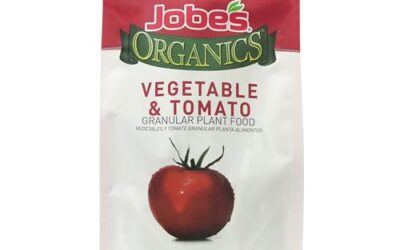
Jobe’s Organics Granular Garden Fertilizer is a 4 lb fertilizer formulated for vegetable gardens and tomato plants. Its intended task is routine crop feeding, making it a potential fit for home gardeners who want a granular product for edible garden beds.
The listed 2-5-3 NPK ratio identifies the fertilizer’s nutrient formulation. Product information describes the granules as providing nutrients for vegetables and tomatoes, and recommends application every 4 to 6 weeks or as needed during the growing season.
The product is granular and described as easy to measure, which can help gardeners portion applications. The published information does not give an application rate or coverage area, so check the package directions to determine how much to use for each bed or plant.
For backyard vegetable plots, raised beds, or tomato plantings, this product offers a crop-focused option in a 4 lb bag. The product information also says it is made without synthetic chemicals and is OMRI listed for organic gardening.
The listed feeding interval requires repeat applications during the growing season. Avoid guessing at the dose, and follow package directions; the available specifications do not state coverage or a per-plant amount. Who should skip it: gardeners who need a fertilizer for other plant types or require a stated coverage area before buying.
Best For / Avoid If
Best for buyers prioritizing
- Made without synthetic chemicals, according to the product information.
- Identified as OMRI listed for organic gardening.
- Designed for vegetable and tomato plants, with a stated NPK ratio.
Consider another option if
- Coverage area and application amount are not provided in the published specifications, so gardeners must consult product directions for dosing.
- Who should skip it: gardeners seeking a fertilizer for crops beyond vegetables and tomatoes, or those who need a specified coverage area.
Pros
- Provides a specific dilution rate and application interval.
- Can be applied by pouring or spraying, according to the product information.
- Listed for a broad range of fruiting, flowering, and vegetable plants.
Cons
- Requires measuring and diluting before use, so gardeners seeking a ready-to-use product may prefer another format.
- The product information does not list nutrient analysis or plant-specific dosing. Who should skip it: gardeners who need those details before choosing fertilizer.
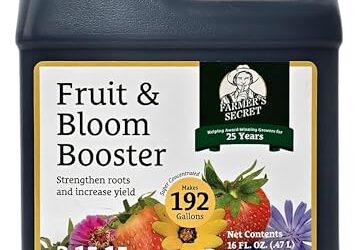
Farmer’s Secret Fruit & Bloom Booster is a concentrated liquid fertilizer intended for plants that produce fruit, flowers, or vegetables. It may suit home gardeners who want a water-diluted product for mixed garden plantings.
The product information describes a formula intended to strengthen roots and support nutrient uptake. It is listed for plants such as citrus, avocados, raspberries, cantaloupe, roses, and petunias, though results can vary by plant and growing conditions.
Use the stated dilution of 1 teaspoon per 2 gallons of water, then pour or spray it onto plants. The suggested repeat interval is every 2 to 4 weeks as part of a regular watering routine.
The 16-ounce bottle measures 2.5 by 2.5 by 7.5 inches and weighs 1.4 pounds. Its concentrated format may fit gardeners who prefer mixing smaller amounts for containers, raised beds, or backyard plantings; the product information does not specify coverage per bottle.
Because this fertilizer must be diluted, measure carefully and follow the listed rate and schedule. Nutrient analysis and detailed plant-specific instructions are not provided in the published information, so gardeners who need those details should consider another fertilizer. Overall, it may fit gardeners seeking one concentrate for several types of fruiting and flowering plants.
Best For / Avoid If
Best for buyers prioritizing
- Provides a specific dilution rate and application interval.
- Can be applied by pouring or spraying, according to the product information.
- Listed for a broad range of fruiting, flowering, and vegetable plants.
Consider another option if
- Requires measuring and diluting before use, so gardeners seeking a ready-to-use product may prefer another format.
- The product information does not list nutrient analysis or plant-specific dosing. Who should skip it: gardeners who need those details before choosing fertilizer.
Pros
- Balanced 4-4-4 formula is suitable for a range of vegetable crops.
- Slow-release feeding may help reduce nutrient leaching.
- Flexible application works for direct soil use or mixing into beds.
Cons
- The product information does not provide application rates or coverage, so gardeners must consult package directions to determine how much to use.
- A 5 lb box may be less suitable for large gardens or frequent feeding across many beds.
- Who should skip it: Gardeners seeking a fertilizer formulated for a specific nutrient deficiency or a different NPK ratio may prefer another product.
Down To Earth Organic Vegetable Garden is a 5 lb fertilizer with a listed 4-4-4 NPK ratio. It is intended for vegetables, herbs, and greens, making it a practical option for home gardeners feeding mixed edible beds.
The balanced ratio provides equal listed proportions of the three primary fertilizer nutrients. Its slow-release formula is described as delivering nutrients gradually and reducing the risk of nutrient leaching, though results depend on garden conditions and use.
The product information says it can be applied directly to soil or mixed into garden beds. No application rate, coverage area, or detailed instructions are provided here, so follow the package directions rather than estimating a dose.
For a backyard or raised-bed garden, the 5 lb box offers a manageable amount for routine use across vegetables, herbs, and greens. The listed uses do not specify crop-by-crop directions or a particular growing method.
The fertilizer is described as made from all-natural organic materials and as non-toxic to beneficial insects, pollinators, pets, and the surrounding ecosystem. Store and apply it according to package directions, and keep it away from children and pets during application.
This may suit gardeners who want one slow-release, balanced fertilizer for several edible crops. Gardeners with large growing areas, specific nutrient needs, or a need for stated coverage and application rates should consider an option with those details clearly listed.
Best For / Avoid If
Best for buyers prioritizing
- Balanced 4-4-4 formula is suitable for a range of vegetable crops.
- Slow-release feeding may help reduce nutrient leaching.
- Flexible application works for direct soil use or mixing into beds.
Consider another option if
- The product information does not provide application rates or coverage, so gardeners must consult package directions to determine how much to use.
- A 5 lb box may be less suitable for large gardens or frequent feeding across many beds.
- Who should skip it: Gardeners seeking a fertilizer formulated for a specific nutrient deficiency or a different NPK ratio may prefer another product.
Pros
- Directions specify both dilution and application timing.
- One formula is listed for flowers, fruits, and vegetables.
- Can be poured or sprayed after dilution.
Cons
- Concentrated formula requires careful measuring and dilution before use.
- Product data does not list nutrient analysis, so gardeners seeking specific nutrient ratios may prefer a fertilizer with that information.
- Who should skip it: Gardeners wanting a ready-to-use product or fertilizer directions tailored to one specific plant.
Farmer’s Secret Fruit & Bloom Booster is a concentrated fertilizer intended for plants that produce flowers, fruit, or vegetables. Product information lists examples such as citrus, avocados, raspberries, cantaloupe, roses, and petunias, making it a possible fit for gardeners tending mixed edible and ornamental beds.
The listed directions call for 1 teaspoon diluted in 2 gallons of water, followed by application every 2 to 4 weeks. Product information says gardeners can pour or spray the diluted mixture during regular watering. It describes root strengthening and increased nutrient uptake as intended benefits, but does not provide measured results.
The 32-ounce bottle is described as super concentrated. Gardeners need to measure the small dilution amount and mix it with water before applying. Product specifications list dimensions of 8 x 3 x 10 inches; no application tool or other included accessory is specified.
For backyard use, the stated plant range includes fruit trees, berry plants, vegetables, and flowering plants. The dilution directions may be useful for gardeners who already water these plants regularly and want one listed product for several types of plants.
The published product information does not list nutrient analysis or plant-specific dilution rates. Follow product directions, measure carefully, and avoid assuming that one schedule suits every plant or growing condition. Gardeners who need a ready-to-use formula or precise nutrient ratios may prefer another option.
Best For / Avoid If
Best for buyers prioritizing
- Directions specify both dilution and application timing.
- One formula is listed for flowers, fruits, and vegetables.
- Can be poured or sprayed after dilution.
Consider another option if
- Concentrated formula requires careful measuring and dilution before use.
- Product data does not list nutrient analysis, so gardeners seeking specific nutrient ratios may prefer a fertilizer with that information.
- Who should skip it: Gardeners wanting a ready-to-use product or fertilizer directions tailored to one specific plant.

Pros
- Combines balanced NPK, seaweed extract, and chelated iron in one liquid formula.
- Listed for several common garden settings, from houseplants to lawns.
- Mix-with-water format can fit into an existing watering routine.
Cons
- Dilution rate and application frequency are not provided in the published product details, so gardeners need to consult the label.
- An 8 fl oz bottle may be less convenient for gardeners treating large areas frequently.
- Who should skip it: gardeners seeking a fertilizer tailored to a specific crop or soil condition may prefer a product with more targeted directions.
GARDENWISE ASTEVORA is an 8 fl oz liquid fertilizer intended for indoor and outdoor plants. Its listed 10-10-10 NPK blend makes it a general-purpose option for homeowners who want one formula for common garden and houseplant care.
The product information lists nitrogen, phosphorus, and potassium at 10% each, plus seaweed extract and 6% chelated iron. This combination is intended to support general plant nutrition, while the iron may be relevant where iron-related yellowing is a concern. Results depend on plant needs and correct use.
The concentrate is described as mixing with water and being applied during watering. Listed bottle dimensions are 3 x 3 x 6 inches, and listed weight is 0.5 lb. The published details do not specify a measuring control, dilution rate, or application schedule, so check the product label before mixing.
Its stated uses include vegetables, flowers, lawns, shrubs, and indoor houseplants. That range may suit gardeners managing a mix of containers, backyard beds, and lawn areas, though the small bottle may be more practical for limited use than repeated treatment of a large lawn.
Do not assume one feeding schedule suits every plant. Follow label directions for dilution and frequency, and avoid applying more than directed. The published information does not provide crop-specific instructions or coverage estimates.
Consider this fertilizer if you want a liquid, general-purpose formula with listed seaweed extract and chelated iron. Gardeners needing precise crop-specific guidance, a larger quantity, or a different nutrient balance should consider another option.
Best For / Avoid If
Best for buyers prioritizing
- Combines balanced NPK, seaweed extract, and chelated iron in one liquid formula.
- Listed for several common garden settings, from houseplants to lawns.
- Mix-with-water format can fit into an existing watering routine.
Consider another option if
- Dilution rate and application frequency are not provided in the published product details, so gardeners need to consult the label.
- An 8 fl oz bottle may be less convenient for gardeners treating large areas frequently.
- Who should skip it: gardeners seeking a fertilizer tailored to a specific crop or soil condition may prefer a product with more targeted directions.
Pros
- Balanced 14-14-14 formula fits flowers, vegetables, and perennials.
- Broad outdoor use includes raised beds and mulched planting areas.
- Large container provides approximately 320 square feet of coverage.
- Application instructions are clear and include a scoop.
Cons
- Granular fertilizer requires mixing into the top 1 to 3 inches of soil, so it is less convenient for gardeners seeking a liquid or ready-to-use feed.
- The 8 lb. container may be more than needed for a very small patio garden, and its 4.25 x 7 x 13.5 inch size requires suitable storage space.
- Who should skip it: Gardeners needing a fertilizer formulated for a specific plant, soil condition, or nutrient deficiency should consider a more specialized option.
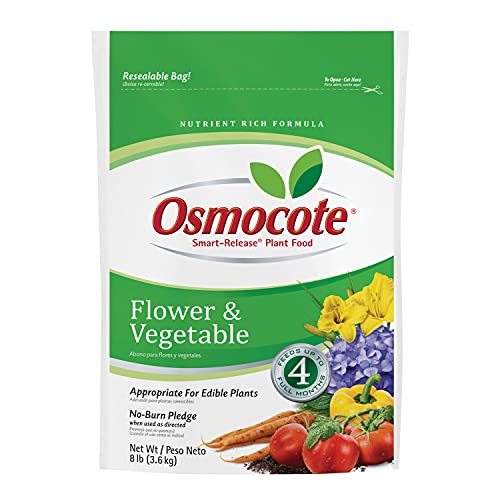
Osmocote Smart-Release Plant Food is a granular 14-14-14 fertilizer for outdoor vegetables, flowers, perennials, raised beds, and mulched areas around ornamental trees and shrubs. It suits homeowners and beginner gardeners who want one product for several seasonal planting tasks.
The balanced nitrogen, phosphorus, and potassium formula is intended to support strong roots and vigorous growth above ground. Soil temperature controls nutrient release and plant uptake, which helps coordinate feeding with changing outdoor growing conditions.
Application is straightforward: use the included scoop at 1 scoopful per 4 square feet, then mix the granules into the top 1 to 3 inches of soil. The 8 lb. container covers approximately 320 square feet, and the container measures 4.25 x 7 x 13.5 inches.
This fertilizer fits backyard vegetable plots, flower borders, raised beds, and mulched planting areas. Coverage can support several beds or planting zones, while smaller patio gardens may use only part of the container.
Gardeners should follow the stated application rate and mix the product into soil as directed. The product description says plants will not burn when fertilizer is applied at up to three times the recommended rate, but measured application remains the practical approach. The container size may be inconvenient for very small gardens.
Buy it for broad outdoor use across flowers, vegetables, and perennials, especially when approximately 320 square feet of coverage is useful. Choose a different option if you need a specialized nutrient formula or a liquid fertilizer.
Best For / Avoid If
Best for buyers prioritizing
- Balanced 14-14-14 formula fits flowers, vegetables, and perennials.
- Broad outdoor use includes raised beds and mulched planting areas.
- Large container provides approximately 320 square feet of coverage.
Consider another option if
- Granular fertilizer requires mixing into the top 1 to 3 inches of soil, so it is less convenient for gardeners seeking a liquid or ready-to-use feed.
- The 8 lb. container may be more than needed for a very small patio garden, and its 4.25 x 7 x 13.5 inch size requires suitable storage space.
- Who should skip it: Gardeners needing a fertilizer formulated for a specific plant, soil condition, or nutrient deficiency should consider a more specialized option.

Pros
- Targets common edible garden crops, including tomatoes, vegetables, and herbs.
- Includes beneficial soil microbes and mycorrhizae in its formula.
- Listed as feeding for several months.
Cons
- The published product details do not list nutrient analysis or application rates, so check package directions to determine how much to use.
- Gardeners seeking a fertilizer for ornamental plants or a specific nutrient ratio may prefer a more targeted formula. Who should skip it: gardeners who do not grow tomatoes, vegetables, or herbs.
Dr. Earth Organic 5 is a bagged fertilizer intended for tomatoes, vegetables, and herbs. Its 4 lb package suits home gardeners preparing edible beds or feeding crops during the growing season.
The product information lists primary plant nutrients and says the formula feeds for several months. It also contains beneficial soil microbes and mycorrhizae, which the manufacturer associates with nutrient availability and plant performance.
The package measures 4 x 10 x 12 inches and weighs 4 lb. The published details do not specify nutrient analysis, application rates, or application method, so use the package directions to guide amounts and timing.
For a backyard vegetable bed, raised bed, or patio planting with tomatoes and herbs, this fertilizer offers a crop-focused option in a compact bag. Its listed ingredients exclude GMOs, chicken manure, and sewage sludge.
One limitation is the lack of a listed nutrient ratio in the published specifications, which makes direct comparison with fertilizers for specific soil needs difficult. Store and apply the product according to its package directions.
Consider it if you want an organic fertilizer for edible crops with listed beneficial microbes and a several-month feeding period. Gardeners growing only ornamental plants, or seeking a particular nutrient ratio, may prefer another formula.
Best For / Avoid If
Best for buyers prioritizing
- Targets common edible garden crops, including tomatoes, vegetables, and herbs.
- Includes beneficial soil microbes and mycorrhizae in its formula.
- Listed as feeding for several months.
Consider another option if
- The published product details do not list nutrient analysis or application rates, so check package directions to determine how much to use.
- Gardeners seeking a fertilizer for ornamental plants or a specific nutrient ratio may prefer a more targeted formula. Who should skip it: gardeners who do not grow tomatoes, vegetables, or herbs.

Pros
- One formula is listed for several common garden plant types.
- The 4-4-4 ratio is straightforward to understand for general-purpose feeding.
- Measured granules offer more control over application than an unmeasured pour.
Cons
- Regular feeding may require repeat applications every 2 to 3 weeks during the growing season.
- Who should skip it: gardeners seeking a liquid fertilizer or a formula tailored to a specific nutrient need.
Jobe’s Organics Granular All Purpose Fertilizer is a 16 lb granular plant food for vegetables, flowers, shrubs, trees, and other plants. Its broad intended use may suit homeowners feeding a mix of garden beds and landscape plantings.
The listed 4-4-4 NPK formula provides equal proportions of nitrogen, phosphorus, and potassium. Product information says it is formulated to provide nutrients for vegetables, plants, and flowers, while its OMRI listing makes it an option for organic gardening.
The granules can be measured before application, which gives gardeners a way to control how much they use. The product information recommends applying every 2 to 3 weeks or as needed during the growing season. Follow package directions for the appropriate amount for each planting.
A 16 lb bag may be useful for gardeners caring for several plant types across a yard, raised beds, or containers. The listed dimensions are 15.38 x 6 x 11.38 inches, though the product data does not state coverage area or how long a bag will last.
Repeat applications require attention to timing and measured amounts. Gardeners needing a liquid feed, a specialized nutrient ratio, or a product for a single specific crop may prefer another option. This is a practical choice for those seeking one granular fertilizer for varied plantings, but who should skip it are gardeners who do not want recurring granular applications.
Best For / Avoid If
Best for buyers prioritizing
- One formula is listed for several common garden plant types.
- The 4-4-4 ratio is straightforward to understand for general-purpose feeding.
- Measured granules offer more control over application than an unmeasured pour.
Consider another option if
- Regular feeding may require repeat applications every 2 to 3 weeks during the growing season.
- Who should skip it: gardeners seeking a liquid fertilizer or a formula tailored to a specific nutrient need.
Pros
- Balanced formula is suited to gardeners looking for general vegetable feeding.
- Includes iron and micronutrients in addition to N-P-K.
- Can be used across several vegetable-growing setups, including containers.
Cons
- The 8 oz bottle may be less suitable for gardeners feeding large planting areas or many containers.
- The published product details do not specify dilution rates or feeding frequency, so consult the label before use.
- Who should skip it: gardeners seeking a fertilizer tailored to a specific crop or a different nutrient ratio.
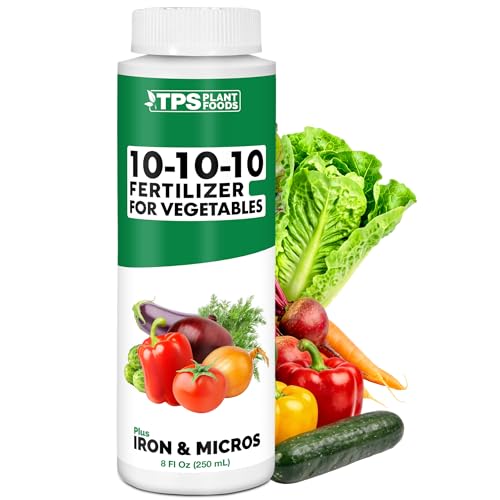
TPS NUTRIENTS 10-10-10 is a concentrated liquid fertilizer intended for vegetables. Its balanced N-P-K ratio, with added iron and micronutrients, makes it an option for home gardeners seeking general-purpose feeding across several crops.
The product information says the formula supports roots, foliage, and yield. These are stated aims, not guaranteed results, and plant response can vary with growing conditions and care.
The bottle holds 8 oz and measures 1.5 x 1.5 x 6 inches. The compact size may be convenient to store, but the published details do not include a measuring cap, dilution rate, or application instructions.
Listed uses include garden beds, rows, raised planters, and container vegetables. That range may suit a backyard vegetable patch or patio containers where one general-purpose fertilizer is preferred.
Follow the product label for mixing, application, and storage directions. The published information does not give feeding frequency or coverage, so gardeners should check those details before applying it.
Consider this fertilizer if you want a balanced liquid blend for vegetables and value added iron and micronutrients. Gardeners with large areas, crop-specific feeding needs, or a preference for a different N-P-K ratio may want another option.
Best For / Avoid If
Best for buyers prioritizing
- Balanced formula is suited to gardeners looking for general vegetable feeding.
- Includes iron and micronutrients in addition to N-P-K.
- Can be used across several vegetable-growing setups, including containers.
Consider another option if
- The 8 oz bottle may be less suitable for gardeners feeding large planting areas or many containers.
- The published product details do not specify dilution rates or feeding frequency, so consult the label before use.
- Who should skip it: gardeners seeking a fertilizer tailored to a specific crop or a different nutrient ratio.

Pros
- Broad use across edible gardens, flowers, shrubs, trees, lawns, and potted plants.
- Balanced nutrients support root development, green growth, and plant resilience.
- Slow-release feeding may reduce repeated application work compared with a fully quick-release fertilizer.
Cons
- The 1 lb quantity may be less suitable for large lawns, extensive beds, or frequent broad-area use.
- No coverage area or application rate is provided, so gardeners must follow package directions for accurate dosing.
- Who should skip it: gardeners seeking a fertilizer formulated for one specific crop, soil condition, or nutrient deficiency.
GARDENWISE 10-10-10 is an all-purpose granular plant fertilizer for outdoor and indoor growing. It suits beginners and homeowners who want one fertilizer for vegetables, flowers, lawns, shrubs, evergreens, fruit trees, and potted plants.
The equal 10% nitrogen, phosphorus, and potassium analysis gives this product a balanced nutrient profile. Nitrogen supports leafy growth, phosphorus supports roots, and potassium supports plant resilience. The formula also combines quick-release nitrogen with slow-release feeding that can last up to 8 weeks.
Fine granules are designed for even spreading across soil, lawns, gardens, and landscape areas. Application involves spreading the granules and watering afterward. No spreader, scoop, coverage rate, or application controls are identified, so dosing should follow the package directions carefully.
Use cases include vegetable beds, tomato plantings, flower borders, rose gardens, shrub beds, evergreen plantings, fig trees, fruit trees, lawns, containers, and indoor growing. The compact 1 lb quantity can suit targeted applications, patio containers, or smaller garden areas better than large landscape projects.
Gardeners should avoid overapplication and keep fertilizer off plant foliage when applying granular feed unless package directions say otherwise. Apply twice per season for gardens and three times per year for trees and shrubs as directed in the product information. The fertilizer suits broad, routine feeding, while gardeners needing crop-specific nutrition, soil amendments, or precise coverage guidance should consider another option.
Best For / Avoid If
Best for buyers prioritizing
- Broad use across edible gardens, flowers, shrubs, trees, lawns, and potted plants.
- Balanced nutrients support root development, green growth, and plant resilience.
- Slow-release feeding may reduce repeated application work compared with a fully quick-release fertilizer.
Consider another option if
- The 1 lb quantity may be less suitable for large lawns, extensive beds, or frequent broad-area use.
- No coverage area or application rate is provided, so gardeners must follow package directions for accurate dosing.
- Who should skip it: gardeners seeking a fertilizer formulated for one specific crop, soil condition, or nutrient deficiency.
How to choose fertilizer for a vegetable garden
Read the NPK ratio for your purpose
The three numbers on a fertilizer label represent nitrogen (N), phosphorus (P), and potassium (K). They describe the nutrient ratio, not a guarantee of results. A balanced formula such as 4-4-4 supplies equal proportions of these primary nutrients, while 2-5-3 has a higher proportion of phosphorus relative to nitrogen and potassium. The right choice depends on the crop and what the soil needs, not simply on choosing the largest numbers.
A soil test can help identify nutrient needs and reduce guesswork, especially if a bed has been fertilized repeatedly. Avoid adding fertilizer just because plants look pale or grow slowly: watering, light, temperature, and other growing conditions can also affect plant appearance.
Choose liquid or granular based on your routine
Granular products are spread over soil or mixed into it, so they suit gardeners who prefer a measured application to a bed. Liquids need to be diluted and applied with water; concentrated formulas can be convenient for smaller gardens, but measuring accurately matters. The label should guide both the amount and application method.
Do not assume that every liquid acts immediately or every granule feeds for the same length of time. Products in this guide make different claims about concentration, release, and application frequency. Follow the specific directions rather than borrowing an interval from another fertilizer.
Match package size to the bed or containers
For a small raised bed or a few containers, a large package may be awkward to store and easy to overbuy. For a larger garden, a bulkier container may mean fewer restocks. Osmocote gives a stated coverage of 320 square feet for its 8-pound package, while many other options here do not give a comparable area figure. Use the product’s own application directions to estimate what you need.
Container growing also calls for careful measurement because there is less soil volume than in an in-ground bed. Check that the label covers the intended setting and crop, and do not increase the amount to compensate for a plant that appears stressed.
Consider organic certification and ingredient preferences
If organic gardening is a priority, check the precise certification and permitted use stated on the package. Jobe’s Organics products are described as OMRI listed for organic gardening. That is a product-specific claim, not a reason to assume every product labeled natural or organic has the same certification.
Organic and synthetic fertilizers can differ in ingredients, nutrient availability, and application guidance. Choose based on the garden’s needs and your own growing standards, and read the complete label before applying any fertilizer to edible crops.
Think about crop type and growth stage
Vegetable beds may contain leafy greens, root crops, and fruiting plants with different nutrient demands. Several products here are marketed for vegetables broadly, while Jobe’s granular garden formula names vegetables and tomatoes and Farmer’s Secret is positioned for fruiting and flowering plants as well as vegetables. Check crop directions before using an all-purpose formula across a mixed bed.
More fertilizer is not automatically better. Applying excess nutrients can create imbalances or contribute to runoff. Keep to the labeled rate, and avoid stacking multiple products unless their directions and your soil information support doing so.
Plan for feeding frequency and storage
Frequent feeding can be manageable in a small garden if you already water regularly, but it adds another task to remember. Other formulas are described as slow-release or continuous-release, which may reduce the number of applications while still requiring label-based timing. Record application dates so you do not accidentally repeat a feeding too soon.
Close and store fertilizer according to the package instructions, in a dry, secure place away from children, pets, and food. Keep liquid concentrates sealed and use clean measuring tools. The product label is the authority for storage, handling, and disposal.
Use fertilizer carefully in accessible and small gardens
For gardeners who want to limit bending or lifting, consider package size, the effort involved in mixing, and whether a container is easy to handle. A small liquid bottle may be easier to move than a large bag, though it requires dilution and precise measuring. A lightweight routine that can be repeated accurately is often more practical than buying a larger package solely for convenience.
In a compact bed, apply only where needed and avoid scattering granules onto paths or foliage unless the label directs that use. Water as instructed, and follow local requirements and manufacturer safety guidance to limit unintended movement into drains or waterways.
How we evaluate vegetable garden fertilizers
We compare fertilizer type, stated NPK ratio, intended crops, package size, application method, and any clearly specified feeding interval or coverage. Those details help distinguish a crop-focused granule from a concentrated liquid or a slow-release formula intended for a larger bed.
We also assess organic-gardening claims and practical limitations. For example, an OMRI listing is relevant to gardeners pursuing organic methods, while a balanced all-purpose formula may be more versatile but less specifically tailored to a particular vegetable group. Manufacturer claims about yield or plant response are treated as claims, not guaranteed outcomes.
Owner feedback is considered where available, alongside specifications and use-case fit. Recommendations are updated during November 2026 as product details and gardening needs change. For any fertilizer, the package directions and local rules remain central to safe, appropriate use.
Frequently asked questions
Should I choose liquid or granular fertilizer for vegetables?
Choose based on the application routine you can follow accurately. Granules are applied to soil, while liquid products must be diluted and measured; check the label for the crops and growing conditions you have.
What does the NPK number on garden fertilizer mean?
NPK indicates the proportions of nitrogen, phosphorus, and potassium in the fertilizer. Compare the ratio with your garden’s needs rather than assuming a higher number is always preferable.
Can I use the same fertilizer for tomatoes and leafy greens?
Some products are labeled for a range of vegetables, but individual crop directions can differ. Read the package to confirm that both crops are included and use the rate specified for each application.
How much fertilizer should I apply to a raised bed?
Follow the product’s labeled rate and calculate the bed area if the directions are given per square foot. Osmocote provides a specific area rate, but other products may use different instructions. Do not estimate by handful or apply extra to compensate for poor growth.
Is organic vegetable fertilizer automatically safe to use anywhere?
No fertilizer should be treated as harmless in every setting. Follow its label for crops, dosage, handling, storage, and disposal, and take care to keep it from children, pets, and waterways.
How should I store fertilizer between growing seasons?
Use the storage directions on the product label, keep the container closed, and store it securely away from food and living areas. Do not transfer fertilizer into an unlabeled container, and follow the manufacturer’s disposal instructions for leftovers.