


Keeping a two-acre lawn trimmed can take a lot of weekend time, especially if the yard has slopes, thick grass, separate mowing zones, or long stretches away from the house. A robotic lawn mower for 2 acres needs more than basic automation: it should have enough stated coverage for the property, reliable navigation, practical cutting-height options, and app controls that make scheduling manageable.
For this July 2026 guide, Dove Creek Gardens compared 16 products reviewed in the Lawn Care & Power Equipment category, then screened them for true two-acre relevance. Several listed robotic mowers are useful for smaller lawns, but only the models with stated coverage above the two-acre mark clearly match this specific task. If your property also has ruts, slopes, or uneven turf, our guide to a lawn mower for uneven ground may help you think through terrain needs before choosing.
The most important selection criteria are documented mowing area, navigation method, slope handling, cutting-height range, cutting power, setup burden, charging behavior, and how much routine trimming or cleanup you may still need to do by hand. Prices in the available set range from $399.00 – $7,999.00, with brands including SegwayNavimowOfficial, YARBO, ANTHBOT and more.
YARBO Wire-Free Robot Lawn Mower for Large Properties and Steep Terrain YARBO Lawn Mower Pro Robotic Mower for Large, Complex Yards YARDCARE M800Plus Robot Lawn Mower with GPS and 3D Vision for Easier Wire-Free Lawn Care NAVIMOW X450 Robot Lawn Mower for Sloped, Wire-Free Yard Care Prices and availability can change. We may earn a commission from qualifying purchases.


Pros
- Large stated coverage area makes it a potential fit for expansive lawns.
- Wide cutting deck and adjustable height provide useful mowing flexibility.
- Tracked construction is intended for challenging slopes and uneven terrain.
Cons
- At 237 pounds, it may require significant effort and two adults for assembly and positioning.
- Installation depends on a suitable 120-degree unobstructed view of the sky for the data center setup.
- Leaf-blowing and snow-blowing functions require separately sold modules.
The YARBO wire-free robot lawn mower is intended for automated lawn maintenance on large residential or estate-style properties. Its listed coverage reaches up to 6.2 acres, making it more relevant to homeowners with extensive lawns than to people maintaining a small urban yard or patio space.
For mowing, the machine combines a 20-inch cutting width with an adjustable cutting height from 1.2 to 4.0 inches. The product information also lists up to 120 minutes of runtime per charge. Together, these specifications suggest a setup aimed at reducing repeated manual mowing while allowing the owner to choose a preferred grass height.
The tracked design is intended for complex terrain, including uneven ground, ditches, and slopes up to 70 percent. The wire-free format can simplify boundary planning compared with systems that require a perimeter wire, but installation still has an important site requirement: the data center needs a 120-degree unobstructed view of the sky.
This mower is best suited to large lawns where scheduled autonomous mowing could save regular time and effort. Its modular design may also appeal to property owners interested in adding leaf-blowing or snow-blowing capabilities later, though those seasonal modules are not included according to the supplied information.
Planning and handling deserve attention before purchase. The mower is shipped in four boxes, weighs 237 pounds according to the specifications, and the product guidance recommends two adults for assembly. Owners should review the installation video first and confirm that the required data center location has a clear sky view.
Overall, the YARBO appears best suited to homeowners managing large, hilly, or uneven properties who are comfortable with a substantial installation. Those with smaller lawns, limited assembly help, or no suitable open-sky location for the data center may prefer a lighter and simpler robotic mower.
Best For / Avoid If
Best for buyers prioritizing
- Large stated coverage area makes it a potential fit for expansive lawns.
- Wide cutting deck and adjustable height provide useful mowing flexibility.
- Tracked construction is intended for challenging slopes and uneven terrain.
Consider another option if
- At 237 pounds, it may require significant effort and two adults for assembly and positioning.
- Installation depends on a suitable 120-degree unobstructed view of the sky for the data center setup.
- Leaf-blowing and snow-blowing functions require separately sold modules.
Pros
- Designed for very large lawns, with listed coverage up to 6 acres.
- Does not require perimeter wire, using RTK, vision, and sensor-based navigation instead.
- Wide 20-inch cutting width helps cover more ground per pass than smaller robotic mowers.
- Tracks, skid shoes, and a 70 percent listed climbing ability make it suitable for more complex terrain.
- Includes both razor blades and straight blades for different grass conditions, according to the product information.
Cons
- At about 215 pounds and shipped in 4 boxes, assembly and placement could be challenging without two adults.
- The Data Center Set needs a 120-degree unobstructed sky view, so heavily treed or obstructed properties may require careful planning.
- Remote control is listed as sold separately, which may matter to users who want manual control capability.
The YARBO Lawn Mower Pro is a robotic lawn mower aimed at homeowners and property managers with large, demanding turf areas. Based on the listed specifications, it is designed for lawns up to 6 acres and uses perimeter wire free navigation, making it a fit for users who want automated mowing without installing a traditional boundary wire system.
Its strongest lawn-care benefits are its large-area capacity, 20-inch cutting width, and adjustable 0.8 to 4.0 inch cutting height. The product information also lists a 300W dual-motor cutting system, straight blades plus razor blades, and a grass ejection design intended to reduce clogging in thick, damp, or overgrown grass.
Navigation is a major part of this mower’s design. YARBO lists RTK-GPS, NetRTK support, binocular vision, and multi-sensor PPVS for positioning and obstacle avoidance. In plain terms, the mower is built to map and move through the lawn using satellite positioning, camera vision, and onboard sensors rather than relying on buried wire.
The mower is large and heavy, measuring 50 inches deep, 27 inches wide, and 20 inches high, with an item weight listed at 215 pounds. It requires assembly, ships in 4 separate boxes, and the manufacturer recommends two adults for assembly. Setup also depends on placing the Data Center Set where it has a 120-degree unobstructed view of the sky, so site planning matters before purchase.
For real backyard use, this model makes the most sense on large residential lawns, estate properties, turf areas, and yards with slopes or uneven ground. The listed multi-terrain tracks, all-steel skid shoes, and 70 percent maximum climbing ability suggest it is built for more challenging terrain than a lightweight mower, though users should still follow the installation guidance and keep children, pets, and loose objects away during operation.
The main tradeoffs are size, setup complexity, and the need for a suitable open-sky location for the navigation equipment. Gardeners with small lawns, narrow passages, heavy tree cover, or limited help for assembly may prefer a smaller robotic mower. For large-property owners who want an autonomous, app-controlled mower with strong terrain capability, the YARBO Lawn Mower Pro is a feature-rich option to consider.
Best For / Avoid If
Best for buyers prioritizing
- Designed for very large lawns, with listed coverage up to 6 acres.
- Does not require perimeter wire, using RTK, vision, and sensor-based navigation instead.
- Wide 20-inch cutting width helps cover more ground per pass than smaller robotic mowers.
Consider another option if
- At about 215 pounds and shipped in 4 boxes, assembly and placement could be challenging without two adults.
- The Data Center Set needs a 120-degree unobstructed sky view, so heavily treed or obstructed properties may require careful planning.
- Remote control is listed as sold separately, which may matter to users who want manual control capability.
Pros
- Wire-free navigation may simplify setup for yards with clearly defined grass boundaries.
- Magnetic-strip no-go zoning offers a flexible way to restrict access to selected lawn areas.
- App scheduling and automatic charging can reduce the need for frequent manual mowing.
- The 28.7-pound design and compact 23 x 15.8 x 9.5-inch dimensions may be practical for homeowners managing limited storage space.
Cons
- It may be less suitable for lawns without clear visual boundaries, since the vision-navigation system is designed around defined grass and non-grass areas.
- Grass taller than 2.6 inches should be manually trimmed before initial use, which adds preparation work.
- Routine blade replacement is recommended, and gardeners with complex obstacles or changing lawn layouts may need to manage no-go zones carefully.
The YARDCARE M800Plus is a robotic lawn mower designed for routine grass cutting on residential lawns up to 8611 square feet. Its cordless GPS and 3D vision navigation is intended for yards with clear visual boundaries, making it a potential fit for homeowners who want scheduled mowing without installing traditional boundary wires.
The feature set focuses on reducing routine lawn-care effort. Vision-based navigation identifies grass and non-grass areas, while obstacle detection is designed to recognize common lawn objects and adjust movement. The mower also supports slopes up to 35 percent, or 20 degrees, which may help it manage many typical residential lawn sections.
Homeowners can use the YARDCARE App to set schedules, adjust mowing patterns, and access firmware updates. The included 32.8-foot magnetic strip provides a no-go zone option without digging or using an external power source. The mower measures 23 by 15.8 by 9.5 inches and weighs 28.7 pounds, so storage planning is still worthwhile even though the listed dimensions are relatively compact for a lawn machine.
The adjustable cutting height spans 0.8 to 2.4 inches, and the three-blade cutting disc has a 7-inch cutting width. Spiral spot mowing is intended for thicker or faster-growing patches, while automatic charging supports unattended mowing sessions. These functions may be useful for homeowners who prefer regular lawn maintenance rather than occasional heavy cutting.
Before initial use, grass taller than 2.6 inches should be manually trimmed according to the product information. Routine blade replacement is also recommended to maintain consistent cutting performance. Because navigation depends on clear visual boundaries, gardeners with highly irregular edges, complex obstacles, or frequently changing lawn layouts may prefer a mower with another boundary-management approach.
This model is a reasonable option for homeowners who want app-controlled, wire-free mowing and have a clearly defined lawn with manageable slopes. It may be less suitable for overgrown lawns at startup or properties where grass boundaries are difficult for a vision-based system to distinguish.
Best For / Avoid If
Best for buyers prioritizing
- Wire-free navigation may simplify setup for yards with clearly defined grass boundaries.
- Magnetic-strip no-go zoning offers a flexible way to restrict access to selected lawn areas.
- App scheduling and automatic charging can reduce the need for frequent manual mowing.
Consider another option if
- It may be less suitable for lawns without clear visual boundaries, since the vision-navigation system is designed around defined grass and non-grass areas.
- Grass taller than 2.6 inches should be manually trimmed before initial use, which adds preparation work.
- Routine blade replacement is recommended, and gardeners with complex obstacles or changing lawn layouts may need to manage no-go zones carefully.
Pros
- Well suited to large or highly sloped lawns where conventional robotic mowers may struggle.
- Wire-free mapping and map editing can simplify setup and changes to mowing zones.
- Zero-turn AWD design may help protect turf while navigating tight spaces and uneven terrain.
- Obstacle recognition, GPS tracking, and lift alerts add useful monitoring features for unattended operation.
Cons
- The 63.7-pound weight and listed 33.5 by 24 by 13.8-inch dimensions may make manual relocation or storage less convenient.
- The garage is shipped separately, so the complete shelter arrangement may require separate delivery and planning.
- Battery runtime, charging details, and maintenance intervals are not provided, making it difficult to assess mowing schedules and long-term upkeep.
The NAVIMOW X450 is a wire-free robotic lawn mower intended for maintaining large residential lawns, including yards with uneven terrain and substantial slopes. Its listed 1.5-acre size makes it more appropriate for homeowners with expansive grass areas than for small urban lawns, while the automated controls may appeal to gardeners who want to reduce routine mowing work.
The most distinctive performance features are its all-wheel-drive system, dual suspension, and listed ability to climb slopes up to 84 percent, or 40 degrees. The mower is also specified to cross obstacles up to 2.8 inches. Zero-turn steering, eccentric front-wheel steering, and traction control are designed to improve maneuverability while helping limit turf scuffing during tight turns.
Setup is based on one-tap auto mapping rather than boundary wire or an antenna, according to the product information. GeoSketch allows map editing, while GPS tracking, geofencing, lift alerts, and voice control through Alexa or Google Home provide additional ways to manage the mower. The 63.7-pound body measures 33.5 by 24 by 13.8 inches, so users should plan a suitable storage location and consider the effort required to move it manually.
This mower could be useful on a large backyard lawn with slopes, irregular ground, fences, or areas where tight turning is important. Its EFLS tri-frequency Network RTK, 360-degree Vision, and VIO positioning are intended to support accurate navigation near trees and fences, while VisionFence is listed as identifying more than 200 obstacle types. EdgeSense may also reduce the amount of grass left along edges, although some hand trimming may still be needed depending on the lawn layout.
Important details are not supplied for battery runtime, charging, weather resistance, maintenance intervals, or the included garage arrangement beyond the note that the Garage X ships separately. Buyers should also verify that the lawn's actual slope, obstacles, and boundaries suit the mower's operating requirements. This is a potentially capable choice for large, challenging lawns and homeowners prioritizing automated, wire-free mowing, while gardeners with small or mostly flat yards may prefer a lighter and simpler robotic mower.
Best For / Avoid If
Best for buyers prioritizing
- Well suited to large or highly sloped lawns where conventional robotic mowers may struggle.
- Wire-free mapping and map editing can simplify setup and changes to mowing zones.
- Zero-turn AWD design may help protect turf while navigating tight spaces and uneven terrain.
Consider another option if
- The 63.7-pound weight and listed 33.5 by 24 by 13.8-inch dimensions may make manual relocation or storage less convenient.
- The garage is shipped separately, so the complete shelter arrangement may require separate delivery and planning.
- Battery runtime, charging details, and maintenance intervals are not provided, making it difficult to assess mowing schedules and long-term upkeep.

Pros
- Designed for lawns up to 1 acre, making it suitable for many larger residential yards.
- Wire-free mapping reduces installation complexity compared with traditional perimeter-wire robot mowers.
- All-wheel drive, smart traction control, and slope capability are useful for challenging terrain.
- 17-inch cutting width and dual cutting discs should help cover ground more efficiently than smaller robotic mower decks.
- Smart home compatibility and GPS-based alerts add convenience for users who prefer app-connected yard equipment.
Cons
- At 63.7 pounds, it may be awkward for some users to lift or reposition when needed.
- Battery runtime and charging time are not listed, so buyers cannot easily estimate exact mowing cycles from the supplied specifications.
- Automatic operation still requires safe setup, map review, blade maintenance, and keeping the lawn clear of small objects that could interfere with mowing.
The NAVIMOW X430 is a battery-powered robotic lawn mower for homeowners who want automated lawn care without installing a physical boundary wire. Based on the listed specifications, it is intended for lawns up to 1 acre and is especially relevant for yards with slopes, uneven areas, trees, fences, or more complex mowing zones.
The main strength of this mower is its terrain-focused feature set. The product information lists all-wheel drive, an ORV-tuned dual suspension system, smart traction control, and the ability to climb slopes up to 84% or 40 degrees. It is also described as crossing obstacles up to 2.8 inches, which may help on bumpy residential lawns where a flatter-yard robotic mower could struggle.
For cutting performance, the X430 uses dual 180W motors, dual cutting discs, 12 blades, and a 17-inch cutting width. The cutting height range of 0.75 to 4 inches gives homeowners room to adjust mowing height for different lawn looks and growing conditions. EdgeSense is listed to reduce trimming margins to under 2 inches, although some hand trimming may still be needed around walls, garden edging, raised beds, and tight corners.
Setup and control are centered around wire-free mapping. The product information lists one-tap Auto Mapping, GeoSketch map editing, GPS tracking, GeoFence and lift alerts, and voice control through Alexa or Google Home. It also lists EFLS tri-frequency Network RTK, 360-degree vision, VIO, and AI-powered VisionFence obstacle recognition, which together are meant to help the mower navigate accurately and avoid common yard obstacles.
The mower measures 33.5 inches deep by 24 inches wide by 13.8 inches high and weighs 63.7 pounds, so storage space and lifting ability are worth considering before purchase. Like any robotic mower, it should be set up carefully, monitored during early runs, and kept away from children, pets, loose toys, hoses, and debris while operating. Blade condition and the mowing area should be checked regularly for safe, consistent results.
This model is best suited to homeowners with a larger lawn who want a smart, wire-free mower with strong listed slope and terrain capabilities. Gardeners with very small, simple lawns, limited storage space, or a preference for manual control may be better served by a lighter mower or a simpler lawn-care setup.
Best For / Avoid If
Best for buyers prioritizing
- Designed for lawns up to 1 acre, making it suitable for many larger residential yards.
- Wire-free mapping reduces installation complexity compared with traditional perimeter-wire robot mowers.
- All-wheel drive, smart traction control, and slope capability are useful for challenging terrain.
Consider another option if
- At 63.7 pounds, it may be awkward for some users to lift or reposition when needed.
- Battery runtime and charging time are not listed, so buyers cannot easily estimate exact mowing cycles from the supplied specifications.
- Automatic operation still requires safe setup, map review, blade maintenance, and keeping the lawn clear of small objects that could interfere with mowing.

Pros
- Automates regular mowing with programmable schedules and self-charging.
- Designed to navigate moderate slopes of approximately 25 to 30 percent, depending on conditions.
- Remote app control and real-time updates provide convenient oversight.
- The listed 41-pound weight and compact dimensions may make the unit manageable for lawn equipment storage.
Cons
- Initial setup requires a one-time activation code before the mower can be used.
- The supplied information does not specify battery capacity, charging time, installation requirements, or detailed maintenance needs.
- Gardeners with heavily uneven terrain or complex obstacles may still need to supervise operation despite the mapping and sensor features.
The BESTMOW is a robotic lawn mower intended to handle recurring grass-cutting duties with less hands-on effort. Its listed feature set makes it a potential fit for homeowners with larger lawns, including properties described as covering up to 1.5 acres, who want scheduled mowing rather than frequent manual passes.
Its main practical benefits are automated scheduling, adjustable cutting height up to 4 inches, GPS-based mapping, and route planning. The product information indicates that it is designed to maintain coverage across lawns with changing elevations and to handle moderate slopes of about 25 to 30 percent, depending on conditions.
When the battery is low, the mower automatically returns to its charging station and resumes work after charging. Smartphone app control allows users to change settings, schedule mowing, and monitor progress remotely. The listed dimensions are 22.4 by 17.98 by 10.2 inches, and the mower weighs 41 pounds, details that may help with planning storage and moving it when needed.
This type of mower may be useful for larger residential lawns where regular trimming is time-consuming. Quiet operation could also be helpful in neighborhoods or households where conventional mower noise is inconvenient. The app and mapping features may be particularly useful for owners who want to check mowing activity without walking the entire yard.
Setup should be planned carefully because the product requires a one-time activation code before first use. Although built-in sensors are described as detecting pets and obstacles, users should not assume that automated detection removes the need for supervision, especially around children, animals, slopes, or cluttered areas. The supplied information does not provide battery specifications, charging duration, installation details, or maintenance instructions.
This mower is best suited to homeowners seeking automated routine lawn care and app-based oversight. Those with highly irregular terrain, complicated lawn boundaries, or a preference for detailed control over every mowing pass may want to compare it with another robotic mower after confirming setup and compatibility requirements.
Best For / Avoid If
Best for buyers prioritizing
- Automates regular mowing with programmable schedules and self-charging.
- Designed to navigate moderate slopes of approximately 25 to 30 percent, depending on conditions.
- Remote app control and real-time updates provide convenient oversight.
Consider another option if
- Initial setup requires a one-time activation code before the mower can be used.
- The supplied information does not specify battery capacity, charging time, installation requirements, or detailed maintenance needs.
- Gardeners with heavily uneven terrain or complex obstacles may still need to supervise operation despite the mapping and sensor features.

Pros
- No perimeter wire is required, which simplifies the physical installation compared with older robotic mower systems.
- Supports app control, virtual boundaries, AI-assisted mapping, and multi-zone lawn management.
- Quiet 58dB(A) operation is well suited to routine residential mowing schedules.
- Includes spare blades and a 3-year warranty according to the product information.
- Battery-powered automatic operation can reduce the amount of weekly push mowing needed on suitable lawns.
Cons
- Assembly and mapping are required, and reviewer feedback commonly suggests setup may take patience and boundary adjustments.
- Rough, dipped, steep, or very thick lawns may be less suitable and could require extra trimming or route changes.
- The 4G module for anti-theft tracking is listed as an optional add-on rather than included.
The NAVIMOW i110N is a robotic lawn mower for homeowners who want regular automated mowing on lawns up to 1/4 acre. It is designed for automatic operation with app control, virtual boundaries, and multi-zone management, making it most relevant for suburban yards, small front-and-back lawns, and homeowners who want to reduce routine mowing time without installing perimeter wire.
The key appeal is its EFLS 2.0 navigation system, which combines customized RTK positioning with vision sensors. In plain terms, the mower uses satellite-based positioning and camera-assisted mapping to understand where it should mow. The product information also lists AI-assisted mapping, planned mowing patterns, intelligent recharging, and continued mowing until the job is done, which are useful features for maintaining a consistent lawn height over repeated mowing sessions.
Design details are practical for residential storage and handling. The mower is battery powered, weighs 24 pounds, and measures 21.5 inches deep by 15.2 inches wide by 11.2 inches high. It has 5 cutting-height positions listed in the specifications, a stated average battery life of 60 minutes, and quiet 58dB(A) operation. Required assembly is noted, and the package includes the charging station, GNSS antenna kit, power supply, extension cable, pegs, installation kits, spare blades and bolts, and user materials.
For backyard use, this mower is best matched to lawns where the charging station and GNSS antenna can be placed with a suitable signal and where the mowing area can be mapped clearly. The multi-zone feature can help with separate front, side, and back lawn areas, while no-go zones and virtual boundaries are useful around beds, trees, drains, or other landscape features. Reviewers commonly mention that repeated mowing helps keep lawns looking consistently maintained, but also that occasional string trimming is still needed along borders and tight edges.
There are important limitations to keep in mind. Robotic mowers are not a full replacement for every lawn task, and this model may need boundary refinements, no-go zones, or manual trimming in areas with roots, dips, curbs, narrow passages, or unclear lawn-to-bed transitions. The obstacle-detection system is a helpful safety feature, but it should not replace basic precautions: clear tools, toys, hoses, and small objects before mowing, and supervise operation around pets, children, and delicate plantings.
The NAVIMOW i110N is a strong candidate for a homeowner with a modest-size lawn who values wire-free setup, quiet operation, and app-based control. Gardeners with very uneven ground, heavy slopes, dense tall grass, or poor antenna placement options may want to consider whether a different mower, added accessories, or some lawn leveling work would be needed before expecting reliable automation.
Best For / Avoid If
Best for buyers prioritizing
- No perimeter wire is required, which simplifies the physical installation compared with older robotic mower systems.
- Supports app control, virtual boundaries, AI-assisted mapping, and multi-zone lawn management.
- Quiet 58dB(A) operation is well suited to routine residential mowing schedules.
Consider another option if
- Assembly and mapping are required, and reviewer feedback commonly suggests setup may take patience and boundary adjustments.
- Rough, dipped, steep, or very thick lawns may be less suitable and could require extra trimming or route changes.
- The 4G module for anti-theft tracking is listed as an optional add-on rather than included.

Pros
- No perimeter wire or RTK antenna is required according to the product information.
- Integrated edge trimming is a useful feature for lawns with hardscape borders and planting beds.
- Smart app controls allow zone-based scheduling and no-go area setup.
- Listed IPX6 waterproof design supports routine outdoor use and cleanup needs.
- Designed for lawns up to 1/2 acre, making it relevant for many suburban yards.
Cons
- The listed cutting width is narrow, so larger or fast-growing lawns may need more frequent scheduled runs.
- App-based mapping and zone setup could take some learning for gardeners who prefer simple manual controls.
- Plastic construction may not appeal to buyers looking for a heavier metal-bodied mower.
The ECOVACS GOAT A2000 LiDAR PRO is a battery-powered robotic lawn mower for homeowners who want to automate routine lawn cutting on yards up to 1/2 acre. It is especially relevant for people who like the idea of robotic mowing but do not want to install a perimeter wire or rely on a separate RTK antenna.
Its standout feature is the HoloScope 360 dual-LiDAR navigation system, which the product information says can automatically map the yard and provide precise positioning, including in shaded areas, near fences, and under trees. For practical lawn care, that means the mower is designed to work in more complicated residential spaces where signal loss can be a concern.
The built-in TruEdge trimmer adds value for homeowners who usually have to clean up along sidewalks, driveways, flower beds, and uneven borders after mowing. The product includes two rolls of trimming line, each listed for about 3 km of edging, and the app allows users to create mowing zones, set no-go areas, adjust cutting height and speed, and define travel paths between zones.
Based on the listed specifications, this model uses a 32V battery-powered platform with a dual-blade disc system and a cutting height range from 1.2 to 3.6 inches across five positions. It has a listed average battery life of 50 minutes and recharges in about 50 minutes, which supports scheduled mowing cycles rather than occasional heavy cutting.
In a typical backyard, this mower is best suited to homeowners with defined lawn areas, borders that benefit from edge trimming, and a willingness to manage settings through the ECOVACS app. It may also be useful for older gardeners or busy households who want to reduce the amount of walking, pushing, and trimming involved in routine lawn maintenance.
As with any robotic mower, users should keep the lawn clear of loose objects, supervise initial mapping, and use no-go areas around places where the mower should not travel. Gardeners with very simple, tiny lawns may not need this level of automation, while those with complex yards who want wire-free navigation and app-based control are the most likely fit.
Best For / Avoid If
Best for buyers prioritizing
- No perimeter wire or RTK antenna is required according to the product information.
- Integrated edge trimming is a useful feature for lawns with hardscape borders and planting beds.
- Smart app controls allow zone-based scheduling and no-go area setup.
Consider another option if
- The listed cutting width is narrow, so larger or fast-growing lawns may need more frequent scheduled runs.
- App-based mapping and zone setup could take some learning for gardeners who prefer simple manual controls.
- Plastic construction may not appeal to buyers looking for a heavier metal-bodied mower.

Pros
- No perimeter wire or RTK antenna required for setup.
- Built-in edge trimming adds functionality many robotic mowers do not include.
- Custom zones, schedules, and no-go areas support more tailored mowing plans.
- Designed for tight paths and shaded yards where navigation can be challenging.
- Reviewers commonly mention easy setup, quiet operation, and even routine cutting.
Cons
- Initial mapping and fine-tuning may take several adjustments, especially in complex yards.
- Edge trimming may still require manual follow-up around sharp corners, raised edges, narrow gaps, fences, or obstacles.
- May be less suitable for lawns with exposed sand, mulch transitions, or very uneven borders based on mixed reviewer feedback.
The ECOVACS GOAT O1000 LiDAR PRO is an automatic, battery-powered robotic lawn mower for homeowners who want frequent mowing support on lawns up to 1/4 acre. It is best understood as a routine maintenance mower rather than a full replacement for every lawn-care task, especially where borders, fences, mulch beds, and tight corners are involved.
The main advantage is its wire-free mapping system. The product information states that its HoloScope 360 degree Dual-LiDAR navigation does not require buried perimeter wire or an RTK antenna, and is designed to work under trees, near fences, and in shaded areas. For gardeners with established beds or hardscaping, avoiding perimeter wire can make installation less disruptive.
This model also includes the TruEdge trimming feature, which is meant to cut closer along driveways, sidewalks, flower beds, and irregular borders than a standard robot mower. That can reduce the amount of string trimming after mowing, but the product information and user feedback both suggest that highly complex corners, narrow gaps, raised edges, and fence lines may still need occasional manual trimming.
Control is handled through the ECOVACS app, where users can create mowing zones, schedule tasks, and set no-go areas. The mower uses AI Vision and 3D ToF LiDAR obstacle detection to navigate around common yard objects, and the narrow body is designed to pass through corridors as slim as 0.8 m. Assembly is required, and the trimmer module installation calls for the included screws and a PH2 Phillips screwdriver.
For small lawns, side yards, compact backyards, and layouts with trees or play equipment, the feature set is well matched to homeowners who prefer frequent light mowing over occasional heavy cutting. The listed cutting width is 8.66 inches, and the cutting height range is 1.2 to 3.6 inches, so gardeners who maintain taller cool-season turf should confirm that this height range fits their grass-care goals.
The balanced verdict is that the GOAT O1000 LiDAR PRO is a strong candidate for tech-comfortable homeowners who want wire-free robotic mowing with more edge help than many basic models provide. Consider a different mower if your lawn has exposed sand, frequent mulch transitions, very rough edges, or if you expect completely hands-off trimming along every fence and corner.
Best For / Avoid If
Best for buyers prioritizing
- No perimeter wire or RTK antenna required for setup.
- Built-in edge trimming adds functionality many robotic mowers do not include.
- Custom zones, schedules, and no-go areas support more tailored mowing plans.
Consider another option if
- Initial mapping and fine-tuning may take several adjustments, especially in complex yards.
- Edge trimming may still require manual follow-up around sharp corners, raised edges, narrow gaps, fences, or obstacles.
- May be less suitable for lawns with exposed sand, mulch transitions, or very uneven borders based on mixed reviewer feedback.

Pros
- No boundary wire or RTK station is required according to the listed setup design.
- Wide 1.2-inch to 3.9-inch cutting-height range can accommodate different lawn preferences.
- The listed package includes a charging tower, power supply, cleaning brush, screws, and a nine-piece blade set.
- A listed three-year warranty and 24/7 after-sales service provide useful ownership support.
Cons
- At 34 x 20 x 16 inches and 30 pounds, it may require a dedicated location for charging and seasonal storage.
- Battery runtime and charging duration are not provided, so mowing schedules and expected daily coverage cannot be assessed from the listed specifications.
- Although obstacle avoidance is included, homeowners should still keep loose toys, cords, and other yard items clear before mowing for safer operation.
The MOVA LiDAX Ultra 2000 is a robotic lawn mower for maintaining lawns up to 0.5 acre. Its wireless, RTK-free design is intended for homeowners who want automated mowing without installing boundary wire, particularly those with complex layouts, sloped sections, or multiple lawn areas.
Its main navigation benefit comes from combining 360° 3D LiDAR with AI vision for automatic three-dimensional yard mapping. The mower also uses U-shaped path planning, returns to its charging station when the battery is low, and resumes mowing where it stopped. These features suggest a more organized approach to routine lawn coverage than random-path operation.
The movable cutting disc is designed to work within 2 inches of walls, hedges, and raised edges, while the mower can ride along flush lawn-to-pavement edges. Cutting height is adjusted through the MOVAhome App from 1.2 inches to 3.9 inches. The product measures 34 x 20 x 16 inches and weighs 30 pounds, so its charging and storage area should be planned before installation.
For backyard use, dual-map support can help manage separate front and back lawns, and the system supports up to 150 mowing zones for tailored schedules. Rear-wheel drive and off-road wheels are listed for slopes up to 45 percent, paths up to 23.6 inches wide, and obstacles up to 1.6 inches high, which may suit uneven yards better than a basic robotic mower.
The mower includes AI-based avoidance for more than 300 types of obstacles and anti-theft features with alerts and real-time tracking when used with the link module. Gardeners should still remove loose objects before mowing and follow the manufacturer's operating guidance. Battery runtime and charging time are not listed, so buyers should confirm whether the scheduling performance fits their lawn. Overall, it is a feature-rich option for homeowners seeking wire-free automated mowing, while those with smaller or very simple lawns may prefer a less complex model.
Best For / Avoid If
Best for buyers prioritizing
- No boundary wire or RTK station is required according to the listed setup design.
- Wide 1.2-inch to 3.9-inch cutting-height range can accommodate different lawn preferences.
- The listed package includes a charging tower, power supply, cleaning brush, screws, and a nine-piece blade set.
Consider another option if
- At 34 x 20 x 16 inches and 30 pounds, it may require a dedicated location for charging and seasonal storage.
- Battery runtime and charging duration are not provided, so mowing schedules and expected daily coverage cannot be assessed from the listed specifications.
- Although obstacle avoidance is included, homeowners should still keep loose toys, cords, and other yard items clear before mowing for safer operation.

Pros
- Well suited to large or sloped lawns where a conventional wheeled mower may have difficulty maintaining traction.
- Wire-free mapping and multi-zone scheduling can simplify mowing around separate lawn sections and protected garden areas.
- The wide cutting system and listed 0.57-acre coverage per three-hour charge may reduce the number of mowing sessions needed.
Cons
- RTK and visual navigation may require careful boundary mapping and could be less dependable in heavily obstructed areas or locations with limited positioning visibility.
- The 22.05-pound listed weight and large dimensions may make storage, transport, or manual repositioning less convenient.
- Gardeners who need a conventional mower for immediate cutting, very small lawns, or detailed trimming around edges may prefer a different option.
The Lymow One Plus is a wire-free robotic lawn mower intended for maintaining residential grass areas with scheduled, automated cutting. Based on the listed specifications, it is aimed most directly at homeowners with larger yards, uneven terrain, steep sections, or multiple lawn zones who want to reduce routine mowing time.
Its main performance advantage is the combination of a tracked drive system, dual SK5 tool steel rotary blades, and a 1785W peak power motor. The product information indicates that it can handle slopes up to 45 degrees and cross obstacles up to 2.8 inches, while the 1.2 to 4-inch cutting range gives gardeners more control over mowing height. The cyclone airflow is designed to lift flattened grass for more even cutting, and the system also finely mulches leaves and clippings.
Navigation is managed through RTK satellite positioning and VSLAM visual mapping, with smartphone setup for virtual boundaries and route planning. Users can manage up to 80 zones, set no-go areas, and assign schedules or cutting heights. The listed dimensions are approximately 29.53 by 12.60 by 23.62 inches, and the listed weight is about 22.05 pounds, so storage space and access to the charging area should be considered before installation.
This mower may be particularly useful on broad backyards with slopes, separate grass sections, flower beds, children's play areas, or stone paths. The listed 16-inch cutting design, three-hour charging cycle, and coverage of up to 0.57 acres per charge, with up to 1.73 acres daily, suggest a better fit for substantial lawns than for tiny patio or townhouse spaces.
As with any autonomous mower, the virtual boundaries and mowing zones should be set carefully, and the lawn should be checked for loose objects before operation even though the mower includes AI vision and ultrasonic obstacle detection. Routine attention may still be needed for the blades, cutting deck, sensors, charging area, and grass buildup. Overall, the Lymow One Plus appears best suited to homeowners prioritizing automated mowing and slope capability, while gardeners needing edging, immediate on-demand cutting, or a compact manually stored mower may prefer another type of equipment.
Best For / Avoid If
Best for buyers prioritizing
- Well suited to large or sloped lawns where a conventional wheeled mower may have difficulty maintaining traction.
- Wire-free mapping and multi-zone scheduling can simplify mowing around separate lawn sections and protected garden areas.
- The wide cutting system and listed 0.57-acre coverage per three-hour charge may reduce the number of mowing sessions needed.
Consider another option if
- RTK and visual navigation may require careful boundary mapping and could be less dependable in heavily obstructed areas or locations with limited positioning visibility.
- The 22.05-pound listed weight and large dimensions may make storage, transport, or manual repositioning less convenient.
- Gardeners who need a conventional mower for immediate cutting, very small lawns, or detailed trimming around edges may prefer a different option.

Pros
- Low-installation approach is convenient for small lawns with clear boundaries.
- Multi-zone support and scheduling can simplify care for lawns with separate sections.
- Wide 3 cm to 8 cm cutting-height range accommodates different mowing preferences.
- Obstacle detection, slope handling, and narrow-passage navigation suit varied backyard layouts.
Cons
- Lawns without clear grass borders may require additional setup with optional ground stakes.
- The listed coverage is intended for lawns up to 0.15 acre, so larger properties may need a different mower.
- Battery runtime and charging time are not provided, making it difficult to estimate mowing cycles.
The RoboUP Raccoon 2 SE is a robotic lawn mower designed to maintain up to 0.15 acre, or 600 square meters, of grass. Its no-RTK, no-buried-wire approach is aimed at homeowners with relatively simple lawns who want to reduce routine mowing without arranging professional installation.
The feature set supports flexible lawn care rather than a single mowing pattern. The mower can manage up to three zones through the app, use separate schedules, and adjust its cutting height electronically from 3 cm to 8 cm. Full cutting, edge trimming, mixed mowing, remote guidance, and spot mowing provide useful options for different lawn areas and occasional problem patches.
For backyard layouts, the listed AI vision and bumper sensors are designed to identify people, pets, flower beds, pool toys, and more than 300 other obstacle types. The mower is also specified to handle slopes up to 20 degrees, climb obstacles up to 1.57 inches high, and pass through spaces as narrow as 31.5 inches. Its dimensions are 30 by 14 by 20.5 inches, so homeowners should compare those measurements with gates, storage areas, and narrow lawn entrances.
Simple lawns under 80 square meters can reportedly be started without mapping, while more involved yards can use app-based mapping and multi-zone scheduling. For open lawns without obvious borders, optional non-electric ground stakes can define restricted areas. The package includes the mower, charging station kit, replacement blades, a QR manual, and passage accessories.
The mower automatically returns to its charging station when the battery is low, at night, or when its rain sensor detects rain. Battery runtime, charging time, warranty details, and specific weather-resistance ratings are not listed, so buyers should verify those points before purchase. As with any autonomous mower, users should keep loose objects and people or pets away from active mowing areas and follow the supplied instructions.
This model is a practical fit for homeowners seeking automated care on a small, clearly defined lawn, especially where avoiding buried wires or RTK equipment is important. Gardeners with larger properties, many unprotected lawn edges, or a need for documented runtime specifications may prefer a mower designed for those requirements.
Best For / Avoid If
Best for buyers prioritizing
- Low-installation approach is convenient for small lawns with clear boundaries.
- Multi-zone support and scheduling can simplify care for lawns with separate sections.
- Wide 3 cm to 8 cm cutting-height range accommodates different mowing preferences.
Consider another option if
- Lawns without clear grass borders may require additional setup with optional ground stakes.
- The listed coverage is intended for lawns up to 0.15 acre, so larger properties may need a different mower.
- Battery runtime and charging time are not provided, making it difficult to estimate mowing cycles.

Pros
- Wire-free navigation is well suited to yards where buried boundary wire would be inconvenient or vulnerable to damage.
- Wide 15.7-inch cutting width and dual cutting discs are practical for maintaining a medium residential lawn on a routine schedule.
- The 26 cutting height positions offer more adjustment than a simple low, medium, high setting.
- Reviewers commonly mention quiet operation, straightforward setup, and consistent mowing, though individual yard conditions can affect results.
Cons
- It may still require periodic string trimming along edges, tight corners, gates, and landscape borders.
- The mapping and app-based setup could take patience, especially on divided yards or properties with narrow transitions.
- Gardeners with larger lawns than the listed 0.37-acre capacity may need to consider a higher-capacity model.
The Mammotion LUBA 3 AWD 1500H is an automatic robotic lawn mower intended for homeowners who want regular lawn maintenance with less push mowing. It is listed for lawns up to 0.37 acre and is especially relevant for yards with slopes, multiple lawn sections, trees, landscape beds, or areas where a buried perimeter wire would be inconvenient.
Its main strengths come from the combination of all-wheel drive, 360-degree LiDAR, dual-camera AI vision, and obstacle detection. In plain terms, the mower is designed to build a map of the yard, recognize many common obstacles, and plan mowing paths with less overlap and fewer missed areas. The listed slope capability of 80% is notable for hilly residential lawns, though safe performance will still depend on surface conditions and the way the yard is mapped.
The mower has a 15.7-inch cutting width, two cutting discs, and an adjustable cutting height from 2.2 to 4.0 inches with 26 positions. That height range fits homeowners who prefer a taller lawn cut rather than a very close trim. The product information also lists a 9.4Ah lithium battery, automatic operation, a charging station, an extra set of blades, other accessories, a product guide, and a garage that ships separately.
For everyday yard care, the 15-zone management is one of the more practical features. A homeowner could create separate areas for the front yard, back yard, side strip, or fenced sections, then define no-go zones around pools, flowerbeds, pet spaces, or delicate landscape features. Available path options include perimeter-only, zigzag, checkerboard, and adaptive zigzag, giving some control over both coverage and the visible mowing pattern.
There are a few realistic limitations to keep in mind. Robotic mowers generally do not replace detail trimming, and reviewer comments specifically note that edging or string trimming may still be needed along borders and tight spaces. Setup and map editing may also require patience, particularly around gates or divided lawns. The vision system and sensors should be kept clean, and users should follow the product guide for safe operation around children, pets, roads, water features, and obstacles.
This model is a strong fit for homeowners who want a wire-free robotic mower for a medium-size lawn with varied terrain and app-based control. Gardeners who have a very small, simple lawn may not need this level of navigation technology, while those with more than the listed lawn capacity should compare larger LUBA 3 AWD versions before choosing.
Best For / Avoid If
Best for buyers prioritizing
- Wire-free navigation is well suited to yards where buried boundary wire would be inconvenient or vulnerable to damage.
- Wide 15.7-inch cutting width and dual cutting discs are practical for maintaining a medium residential lawn on a routine schedule.
- The 26 cutting height positions offer more adjustment than a simple low, medium, high setting.
Consider another option if
- It may still require periodic string trimming along edges, tight corners, gates, and landscape borders.
- The mapping and app-based setup could take patience, especially on divided yards or properties with narrow transitions.
- Gardeners with larger lawns than the listed 0.37-acre capacity may need to consider a higher-capacity model.
Pros
- Combines multiple seasonal yard tasks on one modular platform.
- Tracked design and listed 70 percent slope capability may suit properties with challenging terrain.
- High listed leaf-blower airflow and a 24-inch snow-clearing width support larger cleanup jobs.
Cons
- The snow blower and leaf blower modules are sold separately, so the base product does not provide every advertised function by itself.
- At 327 pounds, it may be less suitable for gardeners who need a lightweight machine that is easy to move or store.
- Its large dimensions and specialized modular design could require more storage planning than a conventional walk-behind mower or handheld blower.
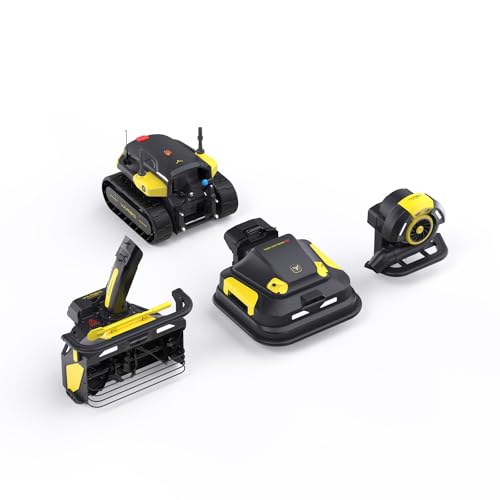
The YARBO 3-in-1 Modular Robot Lawn Mower Pro is designed as a year-round yard maintenance platform. Its primary configuration is a robotic lawn mower, while optional snow blower and leaf blower modules, sold separately, extend it to additional seasonal cleanup tasks. The feature set is most relevant to homeowners with larger or sloped properties, golf courses, and landscaping businesses.
For mowing, the listed dual 300W motors, straight blades, and tracked all-terrain design suggest a machine intended for demanding lawn work rather than light trimming alone. YARBO lists the tracks for slopes up to 70 percent, which may make the platform useful on uneven or inclined ground when the property and operating conditions are suitable.
The product measures 46 x 43 x 60 inches and weighs 327 pounds according to the supplied specifications. Those substantial dimensions and weight should be considered before choosing a storage location or planning how the unit will be positioned. The modular concept may reduce the number of separate machines needed, but each optional attachment still needs appropriate storage.
In a backyard setting, the mower could be suited to maintaining challenging lawn areas, while the optional leaf blower module is listed with a 2000W variable-speed motor, 190 MPH air speed, and 760 CFM airflow for moving thick or wet debris. The optional two-stage cordless snow blower module has a 24-inch clearing width and is listed to go from 0 to 80 percent in approximately 120 minutes.
The main limitations are the need to purchase the seasonal modules separately and the considerable listed weight. Gardeners should review the installation, operating, and safety instructions for each configuration, especially when working on slopes or handling seasonal attachments. Based on the supplied specifications, this is a specialized choice for users who value a modular all-season platform and have the space to accommodate it.
Buyers seeking one system for mowing plus optional leaf and snow cleanup may find the design appealing. Those who prefer lightweight equipment, a simple standalone mower, or tools that can be carried and stored easily may be better served by separate conventional machines.
Best For / Avoid If
Best for buyers prioritizing
- Combines multiple seasonal yard tasks on one modular platform.
- Tracked design and listed 70 percent slope capability may suit properties with challenging terrain.
- High listed leaf-blower airflow and a 24-inch snow-clearing width support larger cleanup jobs.
Consider another option if
- The snow blower and leaf blower modules are sold separately, so the base product does not provide every advertised function by itself.
- At 327 pounds, it may be less suitable for gardeners who need a lightweight machine that is easy to move or store.
- Its large dimensions and specialized modular design could require more storage planning than a conventional walk-behind mower or handheld blower.

Pros
- Large stated coverage area for residential lawn maintenance
- App-based scheduling and setup controls
- Boundary-wire guidance and collision sensors support more controlled operation
- Compact listed dimensions and a weight of about 15.4 pounds
- Suitable for simple or complex lawn shapes and slopes up to 19 degrees
Cons
- Installing and positioning the boundary wire requires planning and hands-on setup before mowing can begin.
- May be less suitable for lawns larger than 8,100 square feet or slopes beyond the listed 35 percent gradient.
- The supplied product information does not specify battery runtime, charging time, or routine blade-maintenance details.
The GARDENA 15101-20 SILENO Life is an automatic robotic lawn mower intended to handle routine grass cutting on residential lawns up to 8,100 square feet. Its feature set makes it a good match for homeowners who want scheduled mowing with less manual pushing, particularly when the lawn includes narrow passages, tight corners, or multiple shapes within a defined mowing area.
The mower is listed with a 57 dBA noise level, which supports quieter operation than many louder lawn-care tools and may make it more comfortable to use while people are relaxing outdoors. Bluetooth EasyApp Control, Auto-Schedule, and EasyConfig are designed to make setup and mowing schedules easier to manage from a compatible mobile device.
Operation depends on installing the included boundary wire around the areas to be mowed. That wire defines the working zone, while collision sensors are intended to help the mower operate more safely around obstacles. The product measures 21.6 by 14.9 by 9.05 inches and weighs about 15.4 pounds based on the listed specifications.
In a backyard, the SILENO Life can be useful for maintaining a regular mowing schedule across a medium to large lawn, including layouts with narrow spaces and slopes up to a 35 percent gradient, or 19 degrees. It is better suited to a defined lawn area than to flexible mowing across changing sections of a property, since the boundary wire establishes where it can travel.
DIY setup is supported by installation videos, user-friendly instructions, and the materials listed as included in the box, but boundary-wire placement still requires careful planning. The supplied information does not provide battery runtime, charging time, or detailed blade-maintenance guidance, so those points should be checked before purchase. Overall, this mower is a reasonable choice for homeowners seeking app-controlled, quieter automated mowing, while gardeners who want no installation or who have larger or steeper lawns may prefer a different option.
Best For / Avoid If
Best for buyers prioritizing
- Large stated coverage area for residential lawn maintenance
- App-based scheduling and setup controls
- Boundary-wire guidance and collision sensors support more controlled operation
Consider another option if
- Installing and positioning the boundary wire requires planning and hands-on setup before mowing can begin.
- May be less suitable for lawns larger than 8,100 square feet or slopes beyond the listed 35 percent gradient.
- The supplied product information does not specify battery runtime, charging time, or routine blade-maintenance details.

Pros
- No perimeter wire is required according to the product information, which can simplify installation compared with traditional robotic mowers.
- Supports app-based mapping, mowing paths, no-go zones, and multi-zone control for more customized lawn care.
- Includes the mower, charging base station, RTK reference station, and a blade set with five blades.
- Compact 7.9-inch cutting width and 21.6-pound listed weight may suit small to medium residential lawns where large equipment feels cumbersome.
Cons
- The listed maximum mowing size is 0.3 acre, so gardeners with larger lawns may need a different model or a more traditional mower.
- The 7.9-inch cutting width may require more passes than wider walk-behind equipment on open lawn areas.
- Because it depends on app control, RTK positioning, and vision technology, setup and routine use may require comfort with connected lawn equipment.
The ANTHBOT M9 is a robotic lawn mower built for homeowners who want to automate routine lawn trimming on small to medium yards. Based on the listed specifications, it is a battery-powered mower with app control, a charging base station, an RTK reference station, and a no-perimeter-wire setup. It is best matched to users who want less time behind a mower and are comfortable managing lawn zones through a mobile app.
The main appeal is its navigation package. The product information describes dual AI vision with full-band RTK positioning, adaptive cruise control, and centimeter-level positioning. In practical terms, these features are intended to help the mower map the lawn, follow planned mowing paths, avoid common objects, and manage complex yard layouts without a buried or staked boundary wire.
For cutting, the M9 lists a 7.9-inch cutting width, five free-rotating blades, and an adjustable cutting height from 1.2 to 2.7 inches. It is also listed for slopes up to a 45% gradient, which may be useful for many residential yards that are not perfectly flat. The app can manage up to 30 work zones, create paths between areas, and set no-go zones, giving homeowners more control around beds, patios, trees, or other landscape features.
The mower measures 19.61 inches deep by 15.43 inches wide by 9.88 inches high and has a listed weight of 21.6 pounds. Assembly is listed as not required, and the package includes the robotic mower, charging base station, blade set, and RTK reference station, though the product information notes that items may ship in separate packages. The self-charging function allows the mower to return to its base and resume work automatically, which is one of the major conveniences of this style of lawn care equipment.
In a typical backyard, the M9 makes the most sense for homeowners with a defined lawn area up to the listed 0.3-acre maximum, especially where quiet operation and frequent light trimming are preferred. The listed 58 dB or lower operating noise may be helpful in neighborhoods where early or frequent mowing with louder equipment would be disruptive. It may also appeal to older gardeners or busy homeowners who want to reduce the physical effort of regular mowing.
There are still practical considerations. Robotic mowers are not a complete substitute for all lawn tools, and edges, tight corners, heavy debris, or areas outside the mapped zones may still need attention. Users should keep children, pets, hoses, toys, and loose garden items clear during mowing and follow the manufacturer’s safety guidance, especially because the mower uses blades. Gardeners with larger properties, very simple open lawns where speed matters most, or those who prefer non-app equipment may be better served by a different mower type.
Best For / Avoid If
Best for buyers prioritizing
- No perimeter wire is required according to the product information, which can simplify installation compared with traditional robotic mowers.
- Supports app-based mapping, mowing paths, no-go zones, and multi-zone control for more customized lawn care.
- Includes the mower, charging base station, RTK reference station, and a blade set with five blades.
Consider another option if
- The listed maximum mowing size is 0.3 acre, so gardeners with larger lawns may need a different model or a more traditional mower.
- The 7.9-inch cutting width may require more passes than wider walk-behind equipment on open lawn areas.
- Because it depends on app control, RTK positioning, and vision technology, setup and routine use may require comfort with connected lawn equipment.
Robotic Lawn Mower For 2 Acres Buying Guide
Start With the Stated Yard-Size Rating
The first filter is simple: a robotic mower should be rated for at least the amount of lawn you need it to maintain. In the available product data, the YARBO Robot Lawn Mower Pro with Modular Design for Large Yard up to 6 Acres and the YARBO Robot Lawn Mower for Large Yard up to 6 Acres both clearly exceed the two-acre requirement.
Models rated for 0.15 acre, 1/4 acre, 0.3 acre, 0.37 acre, 1/2 acre, 1 acre, or 1.5 acres may be fine for smaller homes, side yards, or separate lawn areas, but they do not clearly fit a full two-acre mowing task based on the listed coverage. For a two-acre property, choosing an undersized mower can mean more charging cycles, incomplete coverage, or more manual mowing than expected.
Navigation: RTK, Vision, and Boundary-Free Setup
Large lawns benefit from precise navigation because the mower has to repeat long routes without missing patches or wandering into beds, driveways, or no-mow areas. The YARBO Robot Lawn Mower Pro lists triple-fusion navigation using RTK-GPS, binocular vision, and multi-sensor PPVS. It also uses binocular cameras and ultrasonic sensors for obstacle detection, including suspended obstacles.
The YARBO Robot Lawn Mower for Large Yard up to 6 Acres is also listed as perimeter wire free with AI Vision and RTK for navigation. Wire-free setup can be appealing for homeowners who do not want to bury or pin long boundary wires around a large property, but it still requires careful mapping and attention to the manufacturer’s setup instructions.
Slope and Terrain Handling
Two-acre lawns are often not perfectly flat. If your property includes hills, dips, muddy patches, tree roots, or stony areas, compare the mower’s stated slope rating and traction design before buying. The YARBO Robot Lawn Mower Pro is listed with patented multi-terrain tracks, all-steel skid shoes, and support for a maximum 70% climbing gradient.
The YARBO Robot Lawn Mower for Large Yard up to 6 Acres also lists 70% slopes in its product title. For homeowners with rougher turf, that stated slope capability is one reason these YARBO models are more relevant to a two-acre lawn than smaller robotic mowers designed for compact, relatively simple yards.
For broader lawn upkeep, especially if the soil is compacted from foot traffic or equipment, you may also want to compare tools in our lawn aerator for compacted soil guide.
Cutting Height and Grass Conditions
Cutting-height range matters because cool-season and warm-season grasses are often maintained at different heights. The YARBO Robot Lawn Mower Pro lists an adjustable cutting height from 0.8 to 4.0 inches, while the YARBO Robot Lawn Mower for Large Yard up to 6 Acres lists a 1.2-inch to 4.0-inch range.
The YARBO Robot Lawn Mower Pro also lists a 300W dual-motor system, two blade options, and a grass ejection design intended to reduce clippings buildup. Based on the published specifications, that makes it the stronger match for thick, damp, or overgrown grass among the two-acre-relevant options. Still, no robotic mower should be treated as a substitute for proper seasonal mowing habits or manufacturer-recommended maintenance.
Zones, No-Go Areas, and Large-Yard Layout
A two-acre lawn may include front and back sections, fenced areas, orchard edges, driveways, patios, play spaces, or garden beds. Look for app control, no-go zones, and the ability to manage separate areas. The YARBO Robot Lawn Mower Pro is listed with fully autonomous navigation and app control, and its feature set emphasizes path optimization and obstacle avoidance.
Before setup, walk the property and note narrow passages, gates, exposed roots, steep banks, ponds, irrigation heads, and mulch borders. A robot mower can reduce routine mowing labor, but it still needs a yard that is mapped and prepared carefully.
Setup, Weight, and Accessibility
For older gardeners and homeowners who want less physical mowing, a robotic mower can be a useful comfort upgrade. The tradeoff is that large-yard models may require more planning and heavier initial setup. The YARBO Robot Lawn Mower Pro is listed as shipping in four separate boxes, with a product weight of about 210 lbs, and the available notes recommend two adults for assembly.
The same notes say the Data Center Set needs a 120° unobstructed view of the sky and recommend watching the installation video first. That is important for buyers who want a low-effort experience: the day-to-day mowing may be hands-off, but the initial setup should not be underestimated.
Maintenance, Blades, and Storage
Robotic mowers still need routine care. Expect to check blades, clear grass buildup as directed, keep sensors and cameras clean, inspect the charging area, and follow the manufacturer’s maintenance schedule. The YARBO Robot Lawn Mower Pro specifically mentions razor blades and straight blades, so blade choice and replacement should be part of your ownership plan.
Large robotic mowers also need practical storage space when not in use. If you are organizing outdoor gear, batteries, hand tools, or mower accessories, our deck box for garden tools guide can help with smaller storage needs, though the mower itself should be stored according to its own manual.
Safety-Conscious Use Around People, Pets, and Wildlife
Power equipment should always be used according to the manufacturer’s safety instructions. Even when a mower lists obstacle avoidance, do not assume it can identify every object in every condition. Pick up toys, hoses, loose branches, and garden tools before mowing, and keep children and pets away from the mower while it is operating.
For gardeners who support pollinators or allow clover and flowering weeds in some areas, use no-go zones or scheduling to protect areas you do not want mowed. If you are planning wildlife-friendly beds near the lawn, Dove Creek Gardens also has a guide on attracting pollinators to a vegetable garden.
Research Methodology and Trust
This guide is based on research and comparison of the available product data, not physical hands-on testing. We screened the 16 listed items for product type, category fit, and whether the stated mowing coverage clearly supports a robotic lawn mower for 2 acres.
Only two products reviewed clearly matched the two-acre requirement because both are listed for large yards up to 6 acres: the YARBO Robot Lawn Mower Pro with Modular Design for Large Yard up to 6 Acres and the YARBO Robot Lawn Mower for Large Yard up to 6 Acres. Smaller robotic mowers in the available set were treated as relevant robotic lawn mowers, but not as clear recommendations for a full two-acre lawn.
Our comparison emphasized category-specific factors for Lawn Care & Power Equipment: stated coverage, power source and charging behavior where listed, cutting-height range, slope capability, navigation system, obstacle detection, setup burden, maintenance, storage, and fit for real homeowner yards. Owner feedback was considered through the listed ratings and review counts, but we did not add claims beyond the provided product specifications and feedback data.
This article was updated during July 2026 to reflect the available product list, price range, and available specifications. For more equipment-focused lawn care topics, see the Dove Creek Gardens Lawn Care & Power Equipment category.
Final Recommendations
Overall Pick: The YARBO Robot Lawn Mower Pro with Modular Design for Large Yard up to 6 Acres, Perimeter Wire Free APP Control Robotic Lawnmower with 0.8"-4.0" Cutting Height, AI Vision & RTK for Navigation is the strongest match in the available data for a two-acre property. It is listed for up to 6 acres and includes a 300W dual-motor system, RTK-GPS with binocular vision and multi-sensor PPVS, 70% slope support, multi-terrain tracks, and a 0.8-inch to 4.0-inch cutting-height range.
Heavy-Duty Pick: The YARBO Robot Lawn Mower for Large Yard up to 6 Acres, Hands Free Operation, Perimeter Wire Free, Modular Design, 1.2"-4.0" Cutting Height, 70% Slopes, Auto Recharging, AI Vision & RTK for Navigation is also a valid two-acre option based on its listed 6-acre coverage, perimeter-wire-free setup, 70% slope rating, auto recharging, and AI Vision with RTK navigation.
If your actual mowable area is far below two acres, some smaller models in the available list may be worth comparing separately. For the exact keyword robotic lawn mower for 2 acres, however, the safest shopping approach is to stay with products that clearly state coverage above two acres rather than stretching a smaller mower beyond its listed capacity.
FAQ
What size rating should I choose for a robotic lawn mower for 2 acres?
Choose a mower with stated coverage of at least two acres, and preferably more if the lawn is complex, sloped, or divided into multiple zones. In the available data, the two clear matches are the YARBO models listed for large yards up to 6 acres.
Can a 1-acre robotic mower handle 2 acres?
Based on listed specifications alone, a 1-acre robotic mower is not a clear fit for a two-acre lawn. It may be useful for a smaller section, but for the whole property you should compare models with documented coverage that meets or exceeds the full mowing area.
Is perimeter-wire-free navigation important for a robotic lawn mower for 2 acres?
It can be very helpful on a large property because installing wire around two acres can be time-consuming. The two YARBO models highlighted here are listed as perimeter wire free and use AI Vision with RTK navigation, with the Pro model also listing triple-fusion navigation.
What cutting height should I look for?
Look for a range that fits your grass type and seasonal mowing style. The YARBO Robot Lawn Mower Pro lists 0.8 to 4.0 inches, while the YARBO Robot Lawn Mower for Large Yard up to 6 Acres lists 1.2 to 4.0 inches.
How much maintenance does a robotic lawn mower for 2 acres need?
Plan on regular blade checks, cleaning, sensor care, charging-station inspection, and software or app management as directed by the manufacturer. Larger lawns can mean more operating hours, so routine maintenance matters for consistent cutting.
Are robotic lawn mowers safe around pets and children?
Always follow the manufacturer’s safety instructions and keep pets and children away while the mower is running. Obstacle avoidance is helpful, but it should not replace supervision, yard cleanup, and sensible scheduling.
Where should I store a large robotic mower?
Store it according to the manufacturer’s instructions, especially during off-season periods or severe weather. Also plan space for blades, charging accessories, and any modular components included with the mower.