


Compacted lawn soil can limit how easily water and air move into the root zone. A manual aerator can help with small lawns and problem patches, but tool type matters: hollow tines remove soil plugs, while solid spikes make holes without extracting soil.
This guide compares 6 options for homeowners who want manual control, including gardeners who prefer a long handle or adjustable height. We compare core versus spike designs, tine count and listed length, cleaning features, assembly, handling details, and price. Product descriptions and listed ratings inform this research-based comparison; they do not establish real-world performance.
Choose by lawn area and soil condition, not by the largest tine count alone. For additional yard-equipment guidance, browse our Lawn Care & Power Equipment category.
LawnVigor LV-ALT4-ORANGE Manual Core Aerator for Loosening Compacted Lawn Soil COCTN Lawn-001 Manual Lawn Aerator with Adjustable Handle for Compacted Soil Saker X72945-Black Manual Lawn Aerator for Loosening Compact Soil K.D STONEDGE Patented Rolling Lawn Aerator for Manual Core Plug Soil Loosening Prices and availability can change. We may earn a commission from qualifying purchases.


Pros
- Core-style aeration removes plugs, which is generally more useful for compacted soil than simple spike aeration.
- Reviewers commonly mention easy assembly and a sturdy feel during normal use.
- The three-tine layout can cover more area per step than a single-tine hand tool while still being compact enough for targeted lawn work.
- Product information notes replaceable tines, which is helpful for maintenance-minded gardeners.
Cons
- Like any manual aerator, it can require physical effort and may be less practical for large lawns.
- The manufacturer advises watering dry soil first and avoiding rocking, twisting, or prying the tool side-to-side, so technique matters.
- Some reviewers reported comfort or durability concerns in difficult conditions, including loose handle covers, blisters, or bending when used on very compacted soil.
The LawnVigor LV-ALT4-ORANGE is a manual core aerator designed for lawn care tasks where compacted soil is limiting water, air, and nutrient movement. Instead of relying on a motorized rental machine, it gives homeowners a simple step-in tool for treating small lawns, worn paths, dry patches, and other high-traffic areas that need extra attention.
Its main benefit is the three hollow-tine design, which removes soil plugs from the lawn. Core aeration is different from simply poking holes because it physically creates space in the soil profile. The product information indicates that the tines are designed to create larger and deeper openings for water absorption and root growth, with a non-clogging design intended to help the plugs release as you continue working.
Based on the listed specifications, this aerator is a compact hand tool with a 3.52-pound item weight and package dimensions of 15.67 x 10.91 x 2.91 inches. It is semi-assembled and includes the tools needed for setup. The manufacturer lists sturdy metal construction, heat-treated hollow tines, replaceable tines, and a non-slip ergonomic handle, all of which are useful features for a lawn tool that depends on repeated downward pressure.
In practical backyard use, this type of aerator makes the most sense for targeted work rather than whole-property renovation. It can be useful around compacted walkways, near driveways, in small yards, along play areas, or anywhere grass struggles because the soil has been pressed down. Reviewers commonly mention that assembly is easy and that the tool releases plugs better than some cheaper manual aerators, though those comments should be treated as user experience rather than guaranteed performance.
There are a few important technique and safety considerations. The manufacturer advises watering dry soil before use and specifically warns not to rock, twist, or pry the tool side-to-side while it is in the ground. The white plastic inserts should remain in place because they help release soil plugs. Wearing gloves, changing your grip, and working in manageable sections can also make sense because manual aeration can be tiring.
This is a sensible choice for homeowners who want a compact, non-powered tool for routine lawn aeration and spot repair. Gardeners with very large lawns, extremely hard soil, or limited strength may be better served by a powered or rental aerator, but for small spaces and problem patches, the LawnVigor manual core aerator offers a straightforward way to loosen compacted turf soil.
Best For / Avoid If
Best for buyers prioritizing
- Core-style aeration removes plugs, which is generally more useful for compacted soil than simple spike aeration.
- Reviewers commonly mention easy assembly and a sturdy feel during normal use.
- The three-tine layout can cover more area per step than a single-tine hand tool while still being compact enough for targeted lawn work.
Consider another option if
- Like any manual aerator, it can require physical effort and may be less practical for large lawns.
- The manufacturer advises watering dry soil first and avoiding rocking, twisting, or prying the tool side-to-side, so technique matters.
- Some reviewers reported comfort or durability concerns in difficult conditions, including loose handle covers, blisters, or bending when used on very compacted soil.
Pros
- Adjustable handle design supports more comfortable use for gardeners of different heights.
- Self-cleaning spring structure is a helpful feature when working in damp or sticky soil conditions.
- Iron construction and protected spike layout suggest a sturdier, more safety-conscious design than very basic spike tools.
- Reviewers commonly mention easy assembly, sturdy feel, and effective penetration in compacted areas.
Cons
- As a manual spike aerator, it could require steady foot pressure and repeated passes, especially on larger lawns.
- Gardeners needing deep core aeration or whole-yard renovation may prefer a plug aerator or powered rental machine.
- The listed height is 36.8 inches, so very tall users may still want to confirm the handle range feels comfortable.
The COCTN Lawn-001 is a manual lawn aerator made for homeowners who want to address compacted lawn soil without using powered equipment. It is designed for stepping into the turf with multiple spikes, helping create small channels where air, water, and nutrients can move closer to the grass root zone. Based on the product information, it is best suited to routine lawn care, spot treatment in hard areas, and small to medium yard maintenance.
The main working feature is the set of 15 long spikes, listed as 3 inches, which are intended to penetrate compacted ground and loosen the soil structure. This is a spike-style aerator rather than a core-removing tool, so it is most useful for improving access through the surface layer and giving stressed turf better conditions after watering, feeding, or seasonal lawn care. Reviewers commonly mention that the spikes penetrate compacted soil well, though results from aeration should be judged over time rather than overnight.
Comfort and cleanup are two of the more practical design points. The handle has three height settings with an elastic buckle adjustment, which can help users set a more natural working height instead of bending excessively. The built-in dual-layer spring design is described as self-cleaning, helping remove soil and debris from the spike area during use. The product is mostly assembled on arrival and uses one screw, two washers, and an included wrench for final setup.
At 4.3 inches deep, 9.8 inches wide, and 36.8 inches high, this aerator is compact enough for storage in a shed, garage corner, or small yard tool area. It makes the most sense for gardeners who want to aerate trouble spots near walkways, play areas, dry patches, or other places where foot traffic may have compacted the soil. Because it is manually operated, it also gives users more control around narrow lawn strips and edges where larger machines may be inconvenient.
There are a few realistic limitations to keep in mind. Manual aeration takes time and physical effort, especially if the soil is very dry or the lawn is large. Watering the lawn beforehand, as one reviewer noted doing, may make penetration easier, but the product data does not specify a required soil condition. The spikes are sharp, so users should wear sturdy shoes, keep hands clear of the working end, and store the tool where children and pets cannot contact the spike area.
Overall, the COCTN Lawn-001 looks like a practical choice for homeowners who want an affordable, compact, no-power aeration tool for regular lawn upkeep and compacted spots. Gardeners managing a large property, severely compacted clay, or a full renovation project may want to compare it with a core aerator or powered option before deciding.
Best For / Avoid If
Best for buyers prioritizing
- Adjustable handle design supports more comfortable use for gardeners of different heights.
- Self-cleaning spring structure is a helpful feature when working in damp or sticky soil conditions.
- Iron construction and protected spike layout suggest a sturdier, more safety-conscious design than very basic spike tools.
Consider another option if
- As a manual spike aerator, it could require steady foot pressure and repeated passes, especially on larger lawns.
- Gardeners needing deep core aeration or whole-yard renovation may prefer a plug aerator or powered rental machine.
- The listed height is 36.8 inches, so very tall users may still want to confirm the handle range feels comfortable.
Pros
- Supported by 15 sharp iron spikes for faster hole-making than single-spike hand tools.
- Adjustable handle height can reduce awkward posture for some users.
- Spring-assisted design is intended to release from soil more easily during repeated steps.
- Reviewers commonly mention solid build quality and straightforward assembly.
- Compact manual design avoids fuel, batteries, or cord management.
Cons
- May be time consuming for large lawns or whole-yard aeration projects.
- Spike aeration makes holes but does not remove soil plugs, so gardeners needing core aeration may prefer a plug-style aerator.
- Some reviewers felt the spike holes were smaller than they wanted for their aeration or seeding goals.
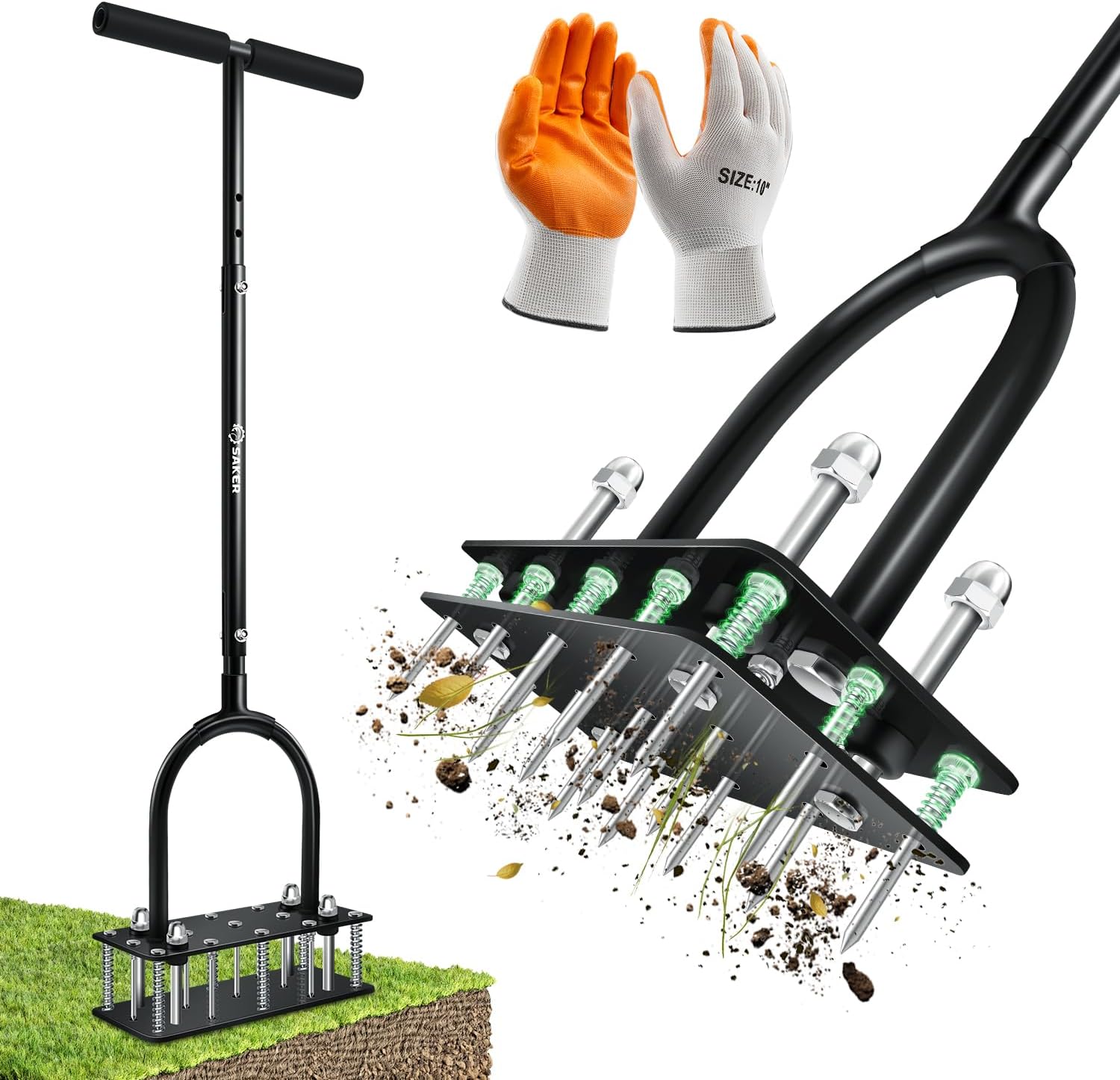
The Saker X72945-Black is a manual lawn aerator designed for loosening compacted soil in yards, gardens, and lawn trouble spots. Instead of using a motor or tow-behind setup, it relies on a step-down foot plate and 15 iron spikes to punch holes into softened soil. This makes it a practical choice for homeowners who want to address smaller areas without renting powered equipment.
Based on the listed product information, the main benefit is improved soil access for water, oxygen, and nutrients. The 2.3-inch spikes are intended to penetrate the ground and open channels in compacted turf, which can be helpful before overseeding or when working on areas that dry out quickly. The product information recommends trimming the lawn and checking soil moisture before use, since softer soil should allow easier penetration.
The tool is made with thickened iron, a rust-resistant coating, and a foot pedal that uses screw connections rather than welded connections. Its handle adjusts from 32.2 to 35.4 inches, which gives users some flexibility in working height. At 6.52 pounds and with listed dimensions of 15.7 x 12.6 x 4.7 inches, it is a hand-operated lawn tool that should be manageable for routine storage in a garage or shed.
For typical backyard use, this aerator makes the most sense on compacted walking paths, patchy grass sections, areas near patios, and small lawns where a larger aerator would be inconvenient. It may also suit gardeners preparing a limited area for grass seed, though expectations should be realistic because this is a spike aerator rather than a plug-removing core aerator. Reviewers commonly describe it as sturdy and easy to assemble, while also noting that larger areas can take time.
The double-layer spring system is designed to help the tool release soil and debris during use, which may reduce interruptions compared with a simple fixed spike plate. Still, manual aeration requires repeated stepping and lifting, so users should work slowly, wear sturdy footwear, and use the included gloves when handling the spikes. Avoid forcing the tool into very hard, dry ground, as the product guidance indicates that proper soil moisture matters.
Overall, the Saker manual lawn aerator is a sensible option for homeowners who want a simple, non-powered way to loosen compacted lawn areas. It is not the best match for large properties or gardeners who specifically need core aeration with larger soil plugs removed, but for targeted maintenance and small-space lawn care, its spike count, adjustable height, and spring-assisted design are useful features.
Best For / Avoid If
Best for buyers prioritizing
- Supported by 15 sharp iron spikes for faster hole-making than single-spike hand tools.
- Adjustable handle height can reduce awkward posture for some users.
- Spring-assisted design is intended to release from soil more easily during repeated steps.
Consider another option if
- May be time consuming for large lawns or whole-yard aeration projects.
- Spike aeration makes holes but does not remove soil plugs, so gardeners needing core aeration may prefer a plug-style aerator.
- Some reviewers felt the spike holes were smaller than they wanted for their aeration or seeding goals.
Pros
- Core-style aeration removes plugs to help loosen compacted soil
- Push roller format can be more efficient than repeated foot-step aeration on modest lawn areas
- No motorized power source is required for operation
- Feature set is focused on lawn health tasks, including soil loosening and improved access for water and nutrients
Cons
- Manual operation could be tiring, especially on larger lawns or very compacted soil
- May be less suitable for gardeners who need a low-effort aeration method or have limited strength or mobility
- The published product data does not list dimensions, plug depth, weight, or storage size, so fit and handling should be checked before purchase
The K.D STONEDGE patented rolling lawn aerator is a manual core aeration tool made for loosening compacted lawn soil by punching holes and pulling plugs. Based on the product information, it is aimed at homeowners maintaining small to medium lawns who want a non-powered alternative to rented or motorized aeration equipment.
Its main lawn-care purpose is to improve the movement of air, water, and nutrients into the root zone. By extracting soil plugs, the tool is intended to relieve compaction rather than simply mark the surface, which can support stronger turf growth when used as part of a regular lawn maintenance routine.
The listed design uses a push roller rotary coring system and a balanced weight approach for plug pulling. Because it is manually operated, there are no batteries, fuel, or cords to manage, but the user should expect physical effort while pushing it across the lawn.
This type of aerator makes the most sense for yards where compacted grass areas appear from foot traffic, routine use, or general soil settling. It may also suit gardeners who prefer simple equipment for seasonal lawn care and have enough open turf area to benefit from a rolling tool.
There are some practical limits to consider. The product data does not provide dimensions, plug depth, total weight, or storage footprint, so shoppers should confirm those details if garage space, handling comfort, or specific aeration depth matters. As with any coring aerator, it is wise to keep hands and feet clear of the working area and clean soil from the tool after use.
Overall, this K.D STONEDGE manual rolling aerator is a focused option for gardeners who want core-style lawn aeration without powered machinery and who are comfortable with a workout. Those with large lawns, limited mobility, or a need for exact depth specifications may want to compare it with larger or more clearly specified aeration tools.
Best For / Avoid If
Best for buyers prioritizing
- Core-style aeration removes plugs to help loosen compacted soil
- Push roller format can be more efficient than repeated foot-step aeration on modest lawn areas
- No motorized power source is required for operation
Consider another option if
- Manual operation could be tiring, especially on larger lawns or very compacted soil
- May be less suitable for gardeners who need a low-effort aeration method or have limited strength or mobility
- The published product data does not list dimensions, plug depth, weight, or storage size, so fit and handling should be checked before purchase

Pros
- Non-powered design is straightforward for basic lawn maintenance and does not require fuel, batteries, or charging.
- Two core tines can remove plugs while the two spike tines help loosen surrounding soil.
- Metal build and heat-treated tines support durability for routine yard use.
- Reviewers commonly mention easy assembly and good performance when the lawn is damp.
- Light enough at the listed 3.5 pounds for many homeowners to move around the yard between patches.
Cons
- Manual aeration can be physically demanding and may be less suitable for very large lawns.
- Hollow tines may need occasional clearing if soil plugs or debris clog the openings.
- One reviewer noted bolts loosening with repetitive use, so checking fasteners during longer sessions is a sensible precaution.
The FLMAQE 001 Manual Core Aerator is a hand-operated lawn tool designed for compacted soil in yards, lawns, and smaller trouble spots. It uses a four-tine layout with two half-open hollow slot tines and two spike tines, giving homeowners a simple way to open the soil without renting or storing powered lawn equipment.
The main benefit of this style of aerator is improved soil access. According to the product information, the tool is intended to reduce compaction so water, oxygen, and nutrients can move more deeply toward plant roots. The hollow tines are designed to pull plugs, while the spike tines help loosen the surrounding soil, which can be useful in areas where foot traffic, dry weather, or routine mowing have left the ground firm.
The listed tines are 4.7 inches long, and the tool is made from metal with heat-treated hollow tines. It is manually powered and weighs 3.5 pounds, so it should be easy to carry from one section of lawn to another, though each step still requires body effort. The product arrives semi-assembled and includes tools for assembly, and reviewers commonly mention that setup is straightforward.
For best results, the product information recommends pre-watering the lawn before use. That is practical advice for most manual aerators, since slightly damp soil is usually easier to penetrate than very dry ground. This tool is a reasonable fit for small yards, lawn edges, patch repair areas, and compacted zones near paths or play areas where a homeowner wants more control than a larger machine provides.
There are some realistic limitations. A manual aerator can feel like a workout, especially across a large lawn, and gardeners with bigger properties may prefer a rolling, tow-behind, or rental aerator. Hollow tines can clog, so it is wise to pause and clear them as needed, and checking bolts during repetitive use is a good maintenance habit. Overall, the FLMAQE 001 looks like a practical choice for targeted lawn aeration when you want a simple metal tool and are comfortable doing the work by hand.
Best For / Avoid If
Best for buyers prioritizing
- Non-powered design is straightforward for basic lawn maintenance and does not require fuel, batteries, or charging.
- Two core tines can remove plugs while the two spike tines help loosen surrounding soil.
- Metal build and heat-treated tines support durability for routine yard use.
Consider another option if
- Manual aeration can be physically demanding and may be less suitable for very large lawns.
- Hollow tines may need occasional clearing if soil plugs or debris clog the openings.
- One reviewer noted bolts loosening with repetitive use, so checking fasteners during longer sessions is a sensible precaution.

Pros
- Manual operation requires no fuel, battery, cord, or complicated setup.
- Three-row, 15-spike head is useful for spot aerating small lawns and problem patches.
- Provides a more stable approach than strap-on aerator shoes for gardeners who prefer a handled tool.
- Foot pedal and 34.6-inch handle are designed to add leverage and reduce bending.
- Compact, detachable design is easier to store than larger lawn aeration equipment.
Cons
- May be less suitable for large lawns or full-yard aeration projects where a powered or rental aerator would save time.
- Not recommended by the product information for heavy sticky clay soil, rocky ground, or very hard dry soil.
- Hard soil may need watering first, so results can depend on ground conditions and preparation.
The Walensee GT-LCA006 is a manual spike lawn aerator made for small-scale lawn maintenance rather than large renovation work. It is designed to press a set of iron spikes into turf, creating small holes that help open the soil surface before watering, fertilizing, or seeding. For homeowners, beginners, and gardeners maintaining smaller lawns or patchy areas, it offers a simple alternative to renting larger equipment.
The main practical benefit is targeted aeration in places that need extra attention, such as lawn edges, bare spots, narrow strips, and lightly compacted patches. The product information lists 15 iron spikes in a three-row layout, with each spike about 2.8 inches long. That arrangement should let the tool cover a modest area more efficiently than a single-row spike tool, while still giving the user control over where each press goes.
Its handled design is also important. Unlike aerator shoes, which can require strap adjustments and careful balance, this tool uses a cushioned T-handle and foot pedal for leverage. The listed 34.6-inch handle is intended to reduce bending, and the detachable construction helps with carrying, assembly, and storage. Based on the specifications, the tool weighs 4.49 pounds, which keeps it in the range of a portable manual lawn tool.
In a typical backyard, this aerator makes the most sense for maintenance passes over compacted walking paths, small front lawns, patio-adjacent grass, or spots being prepared for reseeding. It can also be useful where a bulky aerator would be awkward, such as tight side yards or around landscape borders. Because it is manual, it is best used patiently in sections rather than treated like a fast whole-lawn machine.
There are some clear limitations. The product information says it is not recommended for heavy sticky clay soil, rocky ground, or large-scale aeration jobs. If the soil is hard or dry, watering the lawn first is recommended to soften the ground before use. Gardeners should also use care around the sharp spikes, clean soil from the tool after use, and store it safely where the spike head will not be a tripping or puncture hazard.
Overall, the Walensee GT-LCA006 is a practical choice for gardeners who want a simple, handled spike aerator for small lawn areas and occasional spot work. Those dealing with large lawns, severe compaction, rocky soil, or heavy clay may be better served by a core aerator or a more powerful lawn-care option suited to tougher ground conditions.
Best For / Avoid If
Best for buyers prioritizing
- Manual operation requires no fuel, battery, cord, or complicated setup.
- Three-row, 15-spike head is useful for spot aerating small lawns and problem patches.
- Provides a more stable approach than strap-on aerator shoes for gardeners who prefer a handled tool.
Consider another option if
- May be less suitable for large lawns or full-yard aeration projects where a powered or rental aerator would save time.
- Not recommended by the product information for heavy sticky clay soil, rocky ground, or very hard dry soil.
- Hard soil may need watering first, so results can depend on ground conditions and preparation.
1. Choose core aeration or spike aeration
Core aerators use hollow tines to extract small soil plugs. This creates openings while removing some soil, which is the approach represented by the LawnVigor and FLMAQE tools here. Spike aerators push solid points into the ground and leave the soil in place. The COCTN, Saker, and Walensee models use spikes.
The rolling K.D STONEDGE model is described as a manual coring tool that pulls plugs. Do not treat a spike tool and a core tool as interchangeable: they make different openings and involve different cleanup. Select based on the task and be wary of broad lawn-health claims that product specifications alone cannot verify.
2. Match the tool to lawn size and effort
Manual tools suit spot work and smaller areas better than large lawns that need extensive coverage. A step-on spike tool makes multiple holes per placement, while a handheld corer requires repeated insertion and removal. A rolling corer uses a push operation; its listing describes use on small to medium lawns but does not provide coverage or working-rate figures.
For a large yard or widespread compaction, compare the time and physical effort of manual work with other available aeration options before buying. Product descriptions do not provide enough information to estimate how long any of these tools would take across a particular lawn.
3. Consider tine count, type, and listed length
More contact points can make more holes with each step, but the listing does not prove that a tool will penetrate every soil type. COCTN lists 15 steel spikes, each 3 inches long; Saker lists 15 iron spikes at 2.3 inches; Walensee lists 15 iron spikes at about 2.8 inches. These are spike tools, not plug-removing core tools.
LawnVigor lists three hollow tines. FLMAQE lists two hollow cores and two spikes, with all four tines described as 4.7 inches long. Check that mixed design carefully if you specifically want plug extraction. The product details do not provide a standard test for comparing penetration or hole spacing across models.
4. Check soil moisture and ground conditions
Several listings advise watering dry or hard ground before use. Softer soil can make penetration easier, but avoid working when soil is saturated or so soft that foot traffic damages turf. Walensee specifically says its spike tool is not recommended for heavy sticky clay, rocky ground, or large-scale jobs.
Do not assume a manual tool can handle very hard ground because a listing calls it heavy-duty. If tines resist entry, stop rather than forcing the tool or twisting it in the ground. LawnVigor specifically warns against rocking, twisting, or prying its tool sideways.
5. Make comfort and access part of the choice
Long handles can reduce the need to bend, but comfort depends on height, grip, leverage, and user strength. COCTN offers three handle-height settings. Saker lists an adjustable range of 32.2 to 35.4 inches. Walensee lists a 34.6-inch handle, cushioned T-handle, and foot pedal. Compare those details with your reach and ability to press down repeatedly.
A step-on tool still requires balance and downward force. If balance or foot pressure is a concern, a long-handled core tool may suit you better, but its repeated push-and-pull motion also takes effort. Product descriptions cannot confirm fit for every user, so check assembly and handle details before purchase.
6. Think about clogging, cleaning, and upkeep
Core tines can collect soil. LawnVigor says its three hollow tines are replaceable and uses white plastic inserts to help release plugs; its listing says to keep those inserts in place. FLMAQE describes half-open hollow slots, which may be easier to clear by design, but the published data does not establish comparative clogging performance.
COCTN and Saker describe double-layer spring mechanisms intended to eject debris from spike assemblies. Treat self-cleaning as a listed feature, not a maintenance-free guarantee. After use, clear soil safely, inspect connections and tines, and store the tool according to its instructions. Check fasteners periodically, especially on tools assembled at home.
7. Compare price with task fit, not claims
Listed prices range from $19.99 to $259.00. FLMAQE is the lowest-priced option in this group and has a mixed four-tine design. K.D STONEDGE is the highest-priced option and uses a rolling rotary coring design. That large price difference does not, on its own, prove greater durability, faster work, or better results.
Before paying more, confirm that the tool’s mechanism fits your lawn, that its assembly and storage suit your space, and that replacement parts or tine maintenance are practical. The published information does not state warranty terms or replacement-part availability beyond LawnVigor’s claim of replaceable hollow tines.
8. Use and store the tool carefully
Read the manufacturer instructions before assembly and use. Keep hands and feet clear of sharp points, wear suitable footwear, and use included gloves where provided. Work at a controlled pace; stop if the tool binds or a connection loosens. Do not force tines into rocky ground.
Dry soil from metal parts after use and store the aerator where sharp tines cannot injure people or pets. Detachable construction can help with storage: COCTN and Walensee listings describe detachable designs. Confirm the assembled tool is stable before each session.
Research Methodology and Trust
We screened the six published listings for manual lawn aerators intended to make openings in lawn soil. All six match the requested task: three are described as spike aerators, two as handheld core aerators, and one as a rolling manual coring tool. We compared mechanism, listed tine count and length, handle and spring features, assembly details, maintenance notes, and stated use limitations.
This is research-based editorial analysis, not physical testing. The published product data lists ratings from 4.0/5 to 4.7/5 but reports zero reviews for every item, so those ratings do not provide owner-feedback evidence for this comparison. We do not infer durability, comfort, speed, or lawn results from ratings or marketing claims.
Recommendations reflect likely use-case fit and documented specifications, with particular attention to the difference between spike and core aeration. We review the guide for updates during October 2026; prices and product details can change, so confirm current listing information and manufacturer instructions before purchase and use.
Frequently Asked Questions
Which type of manual lawn aerator should I choose?
Choose a hollow-tine core aerator if removing soil plugs is important. Choose a spike aerator if you want a tool that makes holes without extracting plugs. Compare tool effort and soil conditions before deciding.
Can a manual lawn aerator handle hard soil?
Listings advise watering dry or hard soil before use, but that does not guarantee penetration. Avoid forcing a tool that will not enter the ground, and do not use it in rocky soil unless its instructions allow it. Walensee specifically excludes heavy sticky clay and rocky ground.
Are spike aerators as effective as core aerators?
They work differently. Spike aerators make openings while leaving soil in place; core aerators remove plugs. The published product data does not include comparative test results, so select by the aeration method you want rather than an unsupported claim of equal performance.
How should I maintain a manual lawn aerator?
Remove soil and debris after use, inspect tines and connections, and follow the maker’s care instructions. Keep LawnVigor’s plastic inserts in place as directed. Check whether replacement parts are available before relying on a replaceable-tine feature.
Which manual lawn aerator suits a small yard?
Several listed tools are intended for small-area work. Walensee specifically describes its spike aerator for small lawns, edges, and patches, while the handheld core tools offer plug removal in targeted areas. For larger areas, manual work may require substantial repeated effort.
How long does a manual lawn aerator last?
The published data does not establish service life or include verified durability testing. Construction and maintenance details can help compare listings, but lifespan depends on use and care. Check current seller information for warranty terms and parts support.
What safety steps matter when using a manual lawn aerator?
Follow the product instructions, keep hands and feet clear of sharp tines, and wear suitable footwear. Do not force a tool into resistant or rocky ground, and stop if parts loosen or bind. Store it securely with points away from people and pets.
Continue your garden research
Browse more practical guides in Lawn Care & Power Equipment.
For product comparisons, see Best Cordless Lawn Mower For Small Yards: Reviews and Buying Guide.
See how Dove Creek Gardens researches and compares products.