


A camera bird feeder can bring close-up birdwatching to a phone, but image quality is only part of a useful setup. Feeder capacity, solar design, Wi-Fi requirements, cleaning access, and the app features you plan to use all affect daily ownership.
This guide compares 15 camera-equipped feeders for homeowners and gardeners, including compact-yard users and people who want alerts instead of constant live viewing. The listed models range from $53.99 to $229.99 and include HARYMOR, HEAPETS, Kiwibit and more. Compare stated camera capabilities with placement, upkeep, and connectivity before choosing. For a related garden question, see our guide to why birds peck at seedlings.
HARYMOR Birdnee Smart Bird Feeder Camera for Backyard Bird Watching and Live Video HEAPETS Solar Camera Bird Feeder for Remote Backyard Watching Kiwibit Solar Smart Bird Feeder with Camera, 4K HDR Live Video, AI Bird ID | 4.4W Built-in Dual Solar Powered, 8MP Photos, Wireless Bird House Camera, Two-Way Audio, Bird Watching Gift for Bird Lovers Kiwibit Solar Powered Smart Bird Feeder with Camera 2 Mini, 4K Live Stream | 8MP Photos, AI Bird Species Identification, Slow-Motion Video, Outdoor Bird Watching Gifts for Bird Lovers Prices and availability can change. We may earn a commission from qualifying purchases.


Pros
- Combines feeding, live viewing, motion alerts, and bird identification in one backyard station.
- Large 2L capacity can make routine refilling more convenient.
- Dual solar panels and a 5dBi external antenna are useful for outdoor placement with 2.4GHz WiFi.
Cons
- Detailed AI bird information requires an app subscription, and a memory card is not included.
- The camera supports 2.4GHz WiFi, not 5GHz, which may limit placement for some home networks.
- Who should skip it: Gardeners seeking a simple feeder without app features, camera functions, or network setup may prefer a conventional model.
The HARYMOR Birdnee is a smart bird feeder with an integrated camera for watching and recording backyard visitors. It is a practical fit for beginners, families, and bird enthusiasts who want more than a traditional feeder and enjoy identifying birds through a phone app.
The camera combines 2K resolution, a 120° wide-angle lens, 3X magnification, and motion activation. These features are intended to make visiting birds easier to observe during the day and night, while arrival notifications and snapshots can help you notice activity without watching the feeder continuously.
The feeder measures 8.66 by 8.66 by 10.83 inches and weighs 2.52 lb. Its 2L seed container can reduce refill frequency, while the IP65 waterproof funnel design is intended to help keep food dry. The green housing is suitable for a backyard or patio feeding area, subject to a location with a usable 2.4GHz WiFi signal.
For flexible power and viewing, the unit has a built-in 3W solar panel, an additional 3W external solar panel, and a 5dBi external antenna. The app supports multiple users, and videos can be saved to cloud storage or to a separately purchased memory card with capacity up to 128GB. This setup could work well for family birdwatching or sharing clips with friends.
There are a few practical limits to consider. The detailed AI bird information requires an app subscription, the memory card is not included, and 5GHz WiFi is not supported. Place the feeder where the solar panels can receive useful daylight and where the wireless signal remains available. It is a strong choice for connected birdwatching, but gardeners wanting a low-maintenance feeder without cameras or app requirements should consider a simpler option.
Best For / Avoid If
Best for buyers prioritizing
- Combines feeding, live viewing, motion alerts, and bird identification in one backyard station.
- Large 2L capacity can make routine refilling more convenient.
- Dual solar panels and a 5dBi external antenna are useful for outdoor placement with 2.4GHz WiFi.
Consider another option if
- Detailed AI bird information requires an app subscription, and a memory card is not included.
- The camera supports 2.4GHz WiFi, not 5GHz, which may limit placement for some home networks.
- Who should skip it: Gardeners seeking a simple feeder without app features, camera functions, or network setup may prefer a conventional model.
Pros
- Combines a bird feeder with remote live video and arrival notifications.
- Offers several mounting options and a built-in solar panel, plus wired power.
- Weatherproof design is described as rainproof, snow-resistant, and heat-tolerant.
Cons
- AI bird recognition is available with a one-month free trial, then requires a monthly or yearly subscription.
- App setup and activating the Basic Service for video may take extra steps; who should skip it: gardeners who prefer a simple feeder without camera or app features.
The HEAPETS camera bird feeder pairs a seed feeder with phone-based video, motion alerts, and AI bird recognition. It is intended for backyard birdwatching and may suit homeowners who want to follow visits from indoors or while away.
Its 2K live stream and arrival notifications can help you notice short visits and check recorded footage later. AI recognition is advertised for more than 10,000 species, but it includes a one-month free trial, with monthly or yearly subscriptions available afterward.
The feeder measures 9.56 x 7.48 x 10 inches and weighs about 3.46 lb. It can be mounted on a tree, pole, or wall. The built-in solar panel is intended to reduce charging needs, and wired power is also possible. Video sharing requires activating Basic Service in the app.
In a backyard, place it where birds can approach and the camera has a useful view, while keeping the feeder accessible for refilling and routine care. The product information describes a spill-proof seed container and a weatherproof design for rain, snow, and heat. Two users can watch live at the same time, and clips can be shared with others.
Keep in mind that bird identification beyond the trial requires a subscription, and using video involves app setup and service activation. Solar performance may depend on placement and available sunlight, so wired power is an alternative to consider. This is a feature-rich option for connected birdwatching, but gardeners seeking a straightforward feeder without app features should consider a simpler model.
Best For / Avoid If
Best for buyers prioritizing
- Combines a bird feeder with remote live video and arrival notifications.
- Offers several mounting options and a built-in solar panel, plus wired power.
- Weatherproof design is described as rainproof, snow-resistant, and heat-tolerant.
Consider another option if
- AI bird recognition is available with a one-month free trial, then requires a monthly or yearly subscription.
- App setup and activating the Basic Service for video may take extra steps; who should skip it: gardeners who prefer a simple feeder without camera or app features.

Pros
- Combines a feeder and birdbath with separate camera views.
- Multiple food options can be served using the two chambers and DIY trays.
- Solar power, a rechargeable battery, and the stated IP66 rating suit a cord-free outdoor setup.
Cons
- The camera features depend on using the app, which may not appeal to gardeners who prefer a simple, non-connected feeder.
- Its 12 x 10 x 7-inch footprint and 5 lb weight call for a suitable mounting location.
- Who should skip it: Gardeners seeking a basic feeder or bath without cameras, alerts, or app features may prefer a simpler option.
The WiseBird 2-in-1 combines a bird feeder and birdbath with two cameras, making it a fit for homeowners who want to attract birds and observe visits through an app. It is especially suited to bird enthusiasts interested in both feeding and bathing activity.
The dual 2K cameras provide separate feeder and bath views that can be switched to full screen. The app is described as identifying more than 11,000 bird species and providing names and information, while alerts and sharing add ways to follow and pass along bird visits.
Two independent chambers allow different seeds or treats to be offered at the same time. Included DIY trays are intended for jelly, fruit, or mealworms. The bath has a silicone cover for refilling, and drainage holes are designed to help keep food dry. Dimensions are 12 x 10 x 7 inches, and the unit weighs 5 lb.
The 3W solar panel and 8000mAh battery support a cord-free setup. The stated IP66 rating indicates protection from rain, snow, and dust. It can be mounted on a tree, patio, or pole, so choose a stable location that gives the cameras a useful view and is convenient to access for refilling and cleaning.
This is a more technology-focused garden station than a basic feeder. App use is central to the camera, identification, alert, and sharing features, and the unit still needs regular attention to food and bath cleanliness. Consider the mounting position and routine upkeep before installation.
Choose it if you want combined feeding and bathing with camera views and app-based bird information. Who should skip it: Gardeners looking for a simple feeder or bath without connected features, or those without a suitable mounting spot, may prefer a more basic design.
Best For / Avoid If
Best for buyers prioritizing
- Combines a feeder and birdbath with separate camera views.
- Multiple food options can be served using the two chambers and DIY trays.
- Solar power, a rechargeable battery, and the stated IP66 rating suit a cord-free outdoor setup.
Consider another option if
- The camera features depend on using the app, which may not appeal to gardeners who prefer a simple, non-connected feeder.
- Its 12 x 10 x 7-inch footprint and 5 lb weight call for a suitable mounting location.
- Who should skip it: Gardeners seeking a basic feeder or bath without cameras, alerts, or app features may prefer a simpler option.

Pros
- High-resolution video, a wide-angle view, and infrared night vision support bird watching in varied light conditions.
- Solar charging can make routine power management simpler in a sunny placement.
- Local microSD recording is available without a cloud subscription, though the card must be purchased separately.
Cons
- AI identification and cloud features require a subscription after the one-month trial.
- A microSD card is not included, and the feeder only connects to 2.4GHz Wi-Fi.
- Who should skip it: Gardeners who prefer a simple feeder without a camera, app, network setup, or ongoing cloud-service costs.
The Yinenio Smart Bird Feeder combines a seed feeder with a camera, motion alerts, automatic video recording, and app-based bird identification. It is intended for homeowners who want to watch feeder visitors remotely and are comfortable setting up a connected device.
The camera offers 5MP resolution and a 130° viewing angle. Infrared LEDs provide night vision up to 20 feet, which can help capture activity in low light. AI identification covers more than 15,000 bird species, but AI and cloud features require a subscription after the one-month cloud trial.
A built-in battery works with the solar panel to reduce charging needs when the feeder receives decent sunlight. The feeder measures 7.36 by 7.81 by 11.1 inches and weighs 2.86 lb. It connects through 2.4GHz Wi-Fi, so confirm that your network supports this band before choosing a mounting location.
For a backyard, position it where the camera can view the feeding area and the solar panel can receive sunlight. Cloud storage is available during the trial, while a microSD card up to 128GB offers a local recording option; the card is not included. The app also provides access to technical support.
The IP66 rating is intended to protect the feeder from outdoor weather, and its reinforced chew-resistant cable may help discourage squirrel access. Solar performance depends on sunlight, and the cable should not be treated as a guarantee against squirrels. Consider the subscription terms and keep the feeder maintained as needed.
This is a practical choice for bird enthusiasts who value remote viewing and species identification. Who should skip it: anyone seeking a straightforward, non-connected feeder or a device that works with 5GHz Wi-Fi.
Best For / Avoid If
Best for buyers prioritizing
- High-resolution video, a wide-angle view, and infrared night vision support bird watching in varied light conditions.
- Solar charging can make routine power management simpler in a sunny placement.
- Local microSD recording is available without a cloud subscription, though the card must be purchased separately.
Consider another option if
- AI identification and cloud features require a subscription after the one-month trial.
- A microSD card is not included, and the feeder only connects to 2.4GHz Wi-Fi.
- Who should skip it: Gardeners who prefer a simple feeder without a camera, app, network setup, or ongoing cloud-service costs.
Pros
- Combines seed and suet feeding, which gives birders flexibility in what they offer.
- Free Basic Plan includes unlimited AI bird identification without a paid subscription.
- Solar panel and rechargeable battery reduce the need for frequent manual charging.
Cons
- It works with 2.4 GHz Wi-Fi only, so check your network before choosing a mounting location.
- The camera and app features may be unnecessary for gardeners who prefer a simple feeder without connected technology. Who should skip it: anyone seeking a basic, camera-free feeder.
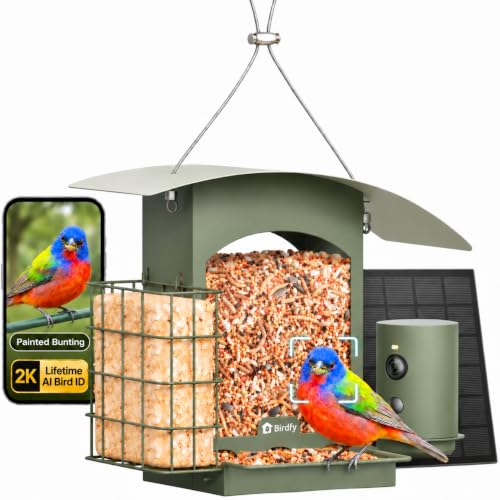
Birdfy’s Metal A is a hanging bird feeder with an integrated camera, intended for homeowners who want to feed backyard birds and view their visits through a phone app. Its combination of seed, suet, and bird identification features may appeal to beginners as well as experienced birdwatchers.
The 1.7 L seed container and built-in side suet cages provide two feeding options in one unit. Birdfy says the camera captures 2K video and offers 60 FPS slow-motion playback, while AI identification and bird facts are available through its free Basic Plan. Optional membership plans cover advanced features.
The feeder measures 6.6 by 10 by 6.6 inches and weighs 1.8 lb. A stainless steel hanging cable is intended for placement on trees, patios, decks, or garden hooks. The 3 W solar panel works with a built-in 5200 mAh rechargeable battery; actual solar charging will depend on sunlight and placement. The system supports 2.4 GHz Wi-Fi only.
For a yard, deck, or patio, the app can make it easier to check bird activity from indoors and share live views with family. The product information also describes color night vision when the built-in white light is on. Consider whether the chosen location receives suitable Wi-Fi and sunlight before hanging the feeder.
The all-metal body is designed to resist everyday squirrel damage better than plastic, but that does not guarantee that squirrels will be kept away. Keep the feeder clean and follow Birdfy’s care guidance; specific cleaning instructions are not stated here. The camera, alerts, and app also add setup and connectivity needs that a basic feeder does not have.
This is a reasonable fit for bird lovers who value remote viewing, species identification, and both seed and suet feeding. Who should skip it: gardeners who want a simple feeder without a camera or who cannot use a 2.4 GHz Wi-Fi network near the intended hanging spot.
Best For / Avoid If
Best for buyers prioritizing
- Combines seed and suet feeding, which gives birders flexibility in what they offer.
- Free Basic Plan includes unlimited AI bird identification without a paid subscription.
- Solar panel and rechargeable battery reduce the need for frequent manual charging.
Consider another option if
- It works with 2.4 GHz Wi-Fi only, so check your network before choosing a mounting location.
- The camera and app features may be unnecessary for gardeners who prefer a simple feeder without connected technology. Who should skip it: anyone seeking a basic, camera-free feeder.

Pros
- Combines feeder viewing, phone alerts, and species identification in one device.
- Offers both local microSD storage and cloud storage options.
- IP65 weather resistance and a chew-proof design are intended for outdoor placement.
Cons
- Works only with 2.4GHz WiFi, so it may not suit households that rely on other WiFi bands at the installation location.
- MicroSD storage requires a separate card, while AI identification and cloud storage involve a subscription after the 30-day trial, which auto-renews unless canceled.
- Who should skip it: gardeners who want a simple feeder without an app, WiFi connection, or ongoing subscription option.
The Cadrali 3K Smart Bird Feeder is a camera-equipped outdoor feeder for homeowners who want to watch visiting birds remotely. Its app alerts and optional AI identification may appeal to beginners learning which species visit their yard as well as experienced bird enthusiasts.
Cadrali describes the camera as offering 3K live streaming day and night and says its AI can identify more than 10,000 bird species. These features can make feeder activity easier to follow from a phone, though identification depends on the service and subscription arrangements.
The feeder supports 2.4GHz WiFi only. Cadrali describes installation on a wall, tree, or pole, with app-guided pairing. A 3W solar panel and 5000mAh battery are intended to support outdoor operation, while the IP65 rating and chew-proof design are specified for outdoor conditions.
It could work near a backyard window, patio, or other spot where birds can visit and the feeder can connect to the home’s 2.4GHz network. For saved footage, users can choose a microSD card up to 128GB, sold separately, or cloud storage through the subscription option.
Consider the ongoing service terms before relying on AI identification or cloud storage: the 30-day trial auto-renews unless canceled. The microSD card is not included, and the manufacturer does not specify battery runtime, so buyers should check whether the camera’s charging and connectivity needs suit their intended location. Overall, it is a feature-rich option for connected birdwatching, but a conventional feeder may suit gardeners who prefer a simpler setup without apps or subscriptions.
Best For / Avoid If
Best for buyers prioritizing
- Combines feeder viewing, phone alerts, and species identification in one device.
- Offers both local microSD storage and cloud storage options.
- IP65 weather resistance and a chew-proof design are intended for outdoor placement.
Consider another option if
- Works only with 2.4GHz WiFi, so it may not suit households that rely on other WiFi bands at the installation location.
- MicroSD storage requires a separate card, while AI identification and cloud storage involve a subscription after the 30-day trial, which auto-renews unless canceled.
- Who should skip it: gardeners who want a simple feeder without an app, WiFi connection, or ongoing subscription option.

Pros
- The wide-angle camera, night vision, and two-way audio offer several ways to observe feeder activity.
- Solar charging can reduce how often the rechargeable battery needs to be removed for charging, depending on available sunlight.
- The feeder can be refilled without taking it down, and detachable parts simplify routine cleaning.
Cons
- AI identification and extended cloud history become subscription features after the 30-day premium trial.
- A feeder pole is sold separately, and a microSD card is also needed for local video storage.
- Who should skip it: Gardeners without suitable 2.4GHz Wi-Fi, or those who prefer a simple feeder without a camera or app features.
Kiwibit’s smart bird feeder combines a seed hopper with a camera for observing backyard visitors remotely. It is intended for bird lovers who want live video, alerts, and recorded visits, rather than gardeners looking for a basic feeder alone.
The camera supports 4K HDR live streaming, has a 132-degree lens and enhanced night vision, and can send motion alerts and automatic recordings. Kiwibit also describes two-way audio and family sharing, with live viewing over 2.4GHz Wi-Fi for up to three simultaneous viewers.
The green feeder measures 8.73 by 7.09 by 11.02 inches and weighs 3.3 lb. Its 1.5L dual-compartment hopper can hold two seed types. Refilling does not require taking the feeder down, and the hopper and tray detach for cleaning. Included accessories allow wall, pole, or tree-strap mounting, but a feeder pole is sold separately.
For a backyard setup, the external 3W solar panel can be positioned using its 9.3-ft cable, while the 5200mAh rechargeable battery can also be charged by USB-C. Kiwibit specifies IP65 weather resistance and an operating range from -4°F to 122°F. Sun exposure can affect solar charging, so USB-C charging may be useful during extended cloudy periods.
AI bird identification and expanded cloud history are part of a 30-day premium trial, after which a subscription is required for those features. The feeder includes free one-day rolling cloud history, and local video storage requires a separately purchased microSD card, up to 512GB. Buyers should also confirm that their Wi-Fi reaches the intended mounting location and clean the detachable feeder parts regularly.
This is a feature-rich option for people who enjoy app-based birdwatching and want remote access to feeder activity. Who should skip it: Anyone seeking a low-maintenance, camera-free feeder or who does not want to depend on Wi-Fi and optional subscription features.
Best For / Avoid If
Best for buyers prioritizing
- The wide-angle camera, night vision, and two-way audio offer several ways to observe feeder activity.
- Solar charging can reduce how often the rechargeable battery needs to be removed for charging, depending on available sunlight.
- The feeder can be refilled without taking it down, and detachable parts simplify routine cleaning.
Consider another option if
- AI identification and extended cloud history become subscription features after the 30-day premium trial.
- A feeder pole is sold separately, and a microSD card is also needed for local video storage.
- Who should skip it: Gardeners without suitable 2.4GHz Wi-Fi, or those who prefer a simple feeder without a camera or app features.

Pros
- The camera combines 4K live viewing with 8MP photos and slow-motion video options.
- Solar charging and a rechargeable backup battery reduce reliance on frequent manual charging.
- Two seed compartments offer flexibility for serving different seed types.
Cons
- Premium FeatherPal AI features require a subscription after the 30-day trial.
- The feeder pole is sold separately, and suitable placement depends on access to Wi-Fi and adequate solar exposure.
- Who should skip it: Birders who want a simple feeder without a camera, wireless setup, or subscription-based features may prefer a conventional feeder.
The Kiwibit Bird Feeder 2 Pro is a camera-equipped outdoor feeder for homeowners who want to observe visiting birds from a phone or share footage with family. Its dual-compartment hopper also lets you offer two seed types in one feeder.
Kiwibit describes 4K live streaming, 8MP photos, and a 132-degree camera view. Slow-motion recording supports up to 4x at 60 frames per second or 8x at 120 frames per second, while autofocus is intended to keep a nearby bird in focus. These features can make quick feeding visits easier to watch and revisit.
A built-in 5W solar panel helps power the camera, with a detachable 5200mAh rechargeable battery as backup when sunlight is limited. The feeder measures 8.65 by 8.95 by 10.04 inches and includes mounting accessories for a wall, tree, or pole. A pole is sold separately, and the camera supports 2.4 GHz and 5 GHz Wi-Fi.
For a backyard, position the feeder where birds can approach comfortably and the camera can connect to Wi-Fi. The 1.7-liter hopper can hold two seed types, and Kiwibit says the design supports filling and cleaning. Up to three people can view live at once, and clips can be shared with up to 20 users.
The IP65-rated design is intended to help protect against dust and water, and the stated operating range is 4°F to 122°F. Keep the solar panel clear of snow to support winter charging. FeatherPal AI identification and other premium features have a 30-day trial, then require a subscription; 4K live streaming, playback, and clip sharing do not require a monthly subscription. A 12-month limited warranty is included.
This feeder is a reasonable fit for birdwatchers who value close-up footage, sharing, and solar-assisted power. Those who prefer a straightforward feeder, do not have reliable Wi-Fi or a suitable mounting location, or do not want to manage camera features and a possible AI subscription should consider a simpler option.
Best For / Avoid If
Best for buyers prioritizing
- The camera combines 4K live viewing with 8MP photos and slow-motion video options.
- Solar charging and a rechargeable backup battery reduce reliance on frequent manual charging.
- Two seed compartments offer flexibility for serving different seed types.
Consider another option if
- Premium FeatherPal AI features require a subscription after the 30-day trial.
- The feeder pole is sold separately, and suitable placement depends on access to Wi-Fi and adequate solar exposure.
- Who should skip it: Birders who want a simple feeder without a camera, wireless setup, or subscription-based features may prefer a conventional feeder.

Pros
- Combines a feeder, camera, live viewing, and bird notifications in one backyard setup.
- Multiple mounting options offer flexibility for gardens, patios, and balconies.
- Live viewing and sharing remain available without an AI subscription.
Cons
- Requires 2.4 GHz Wi-Fi, so it may not suit homes using only 5 GHz Wi-Fi.
- The memory card is not included, and cloud storage on the free plan keeps only a rolling 3-day history.
- Who should skip it: Gardeners who prefer a simple, offline feeder or do not want app features and possible subscription costs.
The onlyfly is a camera-equipped bird feeder for observing backyard visitors through an app. It is intended for birdwatchers and home gardeners who want to follow feeder activity remotely, rather than simply provide a place for birds to feed.
Its camera offers 2K live viewing, 5MP photos, and automatic alerts when birds are detected. AI identification can help users learn about visiting species, although some advanced AI features require a subscription after the 30-day free period.
The feeder has a 1.8 L capacity and includes nectar feeders, fruit forks, and a jelly feeder for offering different foods. The dimensions are 9.8 by 7 by 10 inches. Mounting options include a tree strap, wall or fence screws, pole clips, and tripod compatibility.
Built-in dual solar panels are intended to keep the camera charged without a separate power connection. The feeder can suit a backyard, patio, or balcony where a suitable mounting spot and 2.4 GHz Wi-Fi are available. App sharing supports up to four people watching simultaneously.
Check Wi-Fi compatibility before choosing this feeder, since it does not support 5 GHz networks. A memory card is not included, and the free cloud plan retains a rolling 3-day history; a card up to 128 GB is supported. Who should skip it: Anyone seeking a basic feeder without app connectivity, or who wants to avoid subscription-dependent features.
Best For / Avoid If
Best for buyers prioritizing
- Combines a feeder, camera, live viewing, and bird notifications in one backyard setup.
- Multiple mounting options offer flexibility for gardens, patios, and balconies.
- Live viewing and sharing remain available without an AI subscription.
Consider another option if
- Requires 2.4 GHz Wi-Fi, so it may not suit homes using only 5 GHz Wi-Fi.
- The memory card is not included, and cloud storage on the free plan keeps only a rolling 3-day history.
- Who should skip it: Gardeners who prefer a simple, offline feeder or do not want app features and possible subscription costs.

Pros
- Combines live video, photos and bird-detection alerts in one feeder.
- Includes several food-accessory options beyond the main seed-feeding area.
- Offers multiple mounting methods for different backyard and patio setups.
Cons
- The feeder supports 2.4 GHz Wi-Fi only, so it may not suit a location served only by a 5 GHz network.
- Some AI features require a subscription after the 30-day free trial; a memory card is also sold separately.
- Who should skip it: Gardeners who prefer a simple feeder without an app, Wi-Fi or account features may prefer a conventional model.
The onlyfly smart bird feeder combines a food station with a camera and app connection for backyard birdwatching. It is intended for people who want to view visiting birds remotely, save clips or share observations with family and friends.
The camera offers 2K live video, 5MP photos and a 165-degree view. Bird-detection alerts can prompt you to open the app when activity is noticed, while AI identification is intended to help recognize visiting species. Some AI features require a subscription after the 30-day free trial.
Dual solar panels are designed to help keep the camera charged, and the feeder includes a strap, screws and metal clips for several mounting options, as well as tripod compatibility. Its dimensions are 9.8 by 7 by 10 inches. The app requires 2.4 GHz Wi-Fi, and the manufacturer describes cloud storage with a rolling three-day history on the free plan. A memory card of up to 128 GB can be used, but is not included.
For a yard, patio or balcony, the feeder may suit a spot where birds can visit while the camera has access to the home’s 2.4 GHz network. Included nectar feeders, fruit forks and a jelly feeder provide options for offering different foods. Check mounting stability and place the feeder where you can refill and clean it comfortably.
Consider the ongoing app requirements before choosing this model: live viewing and sharing remain available without an AI subscription, but some advanced identification features do not. Solar charging performance can depend on conditions at the chosen location, and the manufacturer’s stated charging duration should not be treated as guaranteed for every setup. Who should skip it: Anyone seeking a straightforward, offline feeder or a model that works with 5 GHz Wi-Fi should consider a different option.
Best For / Avoid If
Best for buyers prioritizing
- Combines live video, photos and bird-detection alerts in one feeder.
- Includes several food-accessory options beyond the main seed-feeding area.
- Offers multiple mounting methods for different backyard and patio setups.
Consider another option if
- The feeder supports 2.4 GHz Wi-Fi only, so it may not suit a location served only by a 5 GHz network.
- Some AI features require a subscription after the 30-day free trial; a memory card is also sold separately.
- Who should skip it: Gardeners who prefer a simple feeder without an app, Wi-Fi or account features may prefer a conventional model.

Pros
- The combination of 2K video, night vision, and a wide-angle lens supports viewing visits in varied lighting.
- Solar power and the built-in 5,200 mAh battery can reduce the need for frequent charging.
- The feeder includes a mini nectar feeder and supports sharing access with more than 10 users.
Cons
- It requires 2.4 GHz Wi-Fi and does not support 5 GHz networks, so check your network and mounting location before buying.
- AI identification requires a subscription after the 30-day trial, and a memory card for local storage is not included.
- Who should skip it: Gardeners who prefer a simple, offline feeder or do not want app-based features and subscription services may prefer a conventional feeder.
The Minikey solar smart bird feeder combines a seed feeder with a camera and phone app. It is intended for backyard birdwatching, especially for homeowners who want to view visits remotely or introduce beginners to bird identification.
Minikey specifies 2K video, a 160-degree lens, and night vision. App alerts can notify users when birds arrive, while the AI feature identifies bird species and includes a 30-day trial. Identification requires a subscription after that trial.
The blue feeder measures 5.91 by 12.6 by 9.65 inches and holds 1.25 liters. Its solar panel and 5,200 mAh battery are designed to support outdoor use. Mounting options include a wall, tree, or pole, and the detachable tray is intended to make cleaning easier.
For a yard or patio, the app and camera can make it easier to observe feeder visits without standing nearby. The included mini nectar feeder offers another way to attract hummingbirds. Video can be stored with a three-day-loop cloud trial or on a separately purchased memory card up to 128 GB.
Plan for a 2.4 GHz Wi-Fi connection at the mounting spot, since 5 GHz is not supported. Minikey states an operating range of -10°C to 45°C and an IP65 rating for the roof. Keep the feeder and tray clean as part of regular upkeep, and confirm the app, storage, and subscription arrangements suit your needs.
This is a feature-rich option for gardeners who enjoy connected birdwatching and can provide Wi-Fi where the feeder will hang. Those seeking a straightforward feeder without app features, charging considerations, or a paid AI subscription should consider a simpler alternative.
Best For / Avoid If
Best for buyers prioritizing
- The combination of 2K video, night vision, and a wide-angle lens supports viewing visits in varied lighting.
- Solar power and the built-in 5,200 mAh battery can reduce the need for frequent charging.
- The feeder includes a mini nectar feeder and supports sharing access with more than 10 users.
Consider another option if
- It requires 2.4 GHz Wi-Fi and does not support 5 GHz networks, so check your network and mounting location before buying.
- AI identification requires a subscription after the 30-day trial, and a memory card for local storage is not included.
- Who should skip it: Gardeners who prefer a simple, offline feeder or do not want app-based features and subscription services may prefer a conventional feeder.

Pros
- Combines feeder viewing, bird alerts, and species identification in one device.
- Solar panels and a rechargeable battery offer two charging options.
- Detachable feeder design supports easier cleaning and refilling.
Cons
- A 2.4GHz Wi-Fi connection is needed for live streaming and alerts, so it may be less suitable where the feeder cannot connect reliably.
- Who should skip it: gardeners who want a simple feeder without a camera, app features, or connected setup.
Kiwibit’s Solar Smart Bird Feeder is an outdoor feeder with an integrated camera and connected birdwatching features. It is intended for homeowners and bird enthusiasts who want to observe visits remotely, save images, and learn which species stop by.
Kiwibit says the camera captures 8MP photos and 4K video, with a 132-degree field of view and infrared night vision. AI recognition covers more than 10,000 bird species, and the included service also offers visit summaries, highlights, and cloud storage for recordings up to three minutes.
The feeder measures 7.7 by 7.1 by 11 inches and weighs 6.3 pounds. Its 1.5-liter hopper detaches for cleaning and refilling. Dual solar panels supplement the built-in 5,200mAh rechargeable battery, and the package supports wall, pole, and tree mounting. A 2.4GHz Wi-Fi connection is required for connected viewing and alerts.
For a backyard or patio, alerts and shared live access can make feeder activity easier to follow without staying beside a window. The brown unit is IP65 rated, and Kiwibit describes local Micro SD storage up to 512GB as an alternative to cloud storage. Check the mounting location for a suitable Wi-Fi signal and solar exposure before installation.
This is a feature-rich choice for birders interested in remote viewing and identification, but its camera and app functions add setup and connectivity considerations compared with a basic feeder. The manufacturer does not specify battery runtime, so buyers who need a particular interval between charges should check with Kiwibit. Clean the detachable feeder regularly, and follow the mounting instructions when securing it outdoors.
Best For / Avoid If
Best for buyers prioritizing
- Combines feeder viewing, bird alerts, and species identification in one device.
- Solar panels and a rechargeable battery offer two charging options.
- Detachable feeder design supports easier cleaning and refilling.
Consider another option if
- A 2.4GHz Wi-Fi connection is needed for live streaming and alerts, so it may be less suitable where the feeder cannot connect reliably.
- Who should skip it: gardeners who want a simple feeder without a camera, app features, or connected setup.

Pros
- Combines feeding and bathing views in one birdwatching setup.
- Supports local SD card storage from 4 GB to 128 GB, as well as optional cloud storage.
- The app can be shared with up to four users, making it easier for household members to follow activity.
Cons
- It works with 2.4 GHz Wi-Fi only, so households using a different band will need to check their network setup.
- Cloud storage and AI recognition require a subscription after the 30-day trial; who should skip it: shoppers seeking a fully offline or subscription-free camera.
Gyozol’s dual-lens bird feeder and bath combines two backyard bird amenities with cameras aimed at feeding and bathing activity. It is intended for homeowners and birdwatchers who want to follow visits through an app, rather than relying only on direct viewing from a window.
The camera is specified for 2K video, with a wide-angle view, night vision, and automatic recording. App notifications can alert users when birds arrive, while AI identification is offered as an aid to recognizing species. Gyozol says the AI can identify more than 10,000 species, though results may depend on the view and conditions.
The unit measures 7 by 8 by 15 inches and weighs 5.5 lb. Mounting options include an L-shaped bracket for a tree, wall, or fence, and a pole-mount base for poles up to 1 inch in diameter. A 3 W solar panel and 8,000 mAh battery are included; the manufacturer also specifies an IP65 rating. Confirm the intended mounting spot and Wi-Fi signal before installation.
For a backyard or porch, the paired feeder and bath views can help users observe different bird behaviors from a phone. The app supports sharing with up to four users. The system requires 2.4 GHz Wi-Fi, and storage can use a 4 GB to 128 GB SD card; automatic cloud storage is subscription-based after the 30-day trial.
Consider that ongoing AI and cloud features require a subscription, while live viewing remains available without one. Follow the manual for setup and placement, and keep the feeder and bath clean as part of routine bird care. The product is a reasonable fit for connected birdwatchers who value two viewing angles and app access; those wanting a simple feeder without Wi-Fi or subscription features should consider a basic alternative.
Best For / Avoid If
Best for buyers prioritizing
- Combines feeding and bathing views in one birdwatching setup.
- Supports local SD card storage from 4 GB to 128 GB, as well as optional cloud storage.
- The app can be shared with up to four users, making it easier for household members to follow activity.
Consider another option if
- It works with 2.4 GHz Wi-Fi only, so households using a different band will need to check their network setup.
- Cloud storage and AI recognition require a subscription after the 30-day trial; who should skip it: shoppers seeking a fully offline or subscription-free camera.
Choose image quality for your viewing distance
Camera labels include 2K, 3K, 4K, and megapixel counts. Higher stated resolution can provide more image detail, but it does not guarantee clearer clips in every location. Light, lens position, motion, network connection, and the distance between bird and camera also shape what you see.
For a feeder close to a window or patio, a 2K model may be enough for routine viewing. If close detail, slow-motion clips, or higher-resolution photos matter, compare models that explicitly list those features. Kiwibit models in this selection include 4K video options; one also lists 8MP photos and 8x slow motion. Treat those as feature differences, not guarantees of a particular image result.
Check Wi-Fi and app needs before mounting
Smart feeders rely on a connection for app viewing and alerts. The Cadrali 3K Smart Bird Feeder with Camera specifies 2.4GHz Wi-Fi. The Solar Smart Bird Feeder 2 Pro with 4K Camera lists dual-band 2.4/5GHz Wi-Fi. Check your home network and the maker’s setup instructions before mounting; a feeder in a weak-signal corner may not deliver the convenient live viewing you expect.
Also consider whether you want alerts, automatic recording, or live streaming. Those features appear across several listed models, but app functions and any ongoing service terms are not described here. Confirm current app requirements, storage options, and subscription terms before buying if those details affect your decision.
Treat solar power as a placement decision
Solar charging can reduce routine charging, but it depends on panel placement and available sunlight. Product titles identify built-in or external solar panels on several models. The Smart Bird Feeder with 4K Camera lists a 3W adjustable external panel; the Solar Smart Bird Feeder 2 Pro with 4K Camera lists a 5W built-in panel.
Look at the intended mounting point throughout the day. Heavy shade, seasonal tree cover, and a panel angle that cannot face the sun may affect charging. Do not assume solar operation means no maintenance or uninterrupted recording. Follow the manufacturer’s charging and installation directions.
Match feeder capacity and format to your routine
Capacity determines how much seed the listed hopper can hold, not how long it will last. The HARYMOR Smart Bird Feeder with Camera states 2L capacity, while the Smart Bird Feeder with 4K Camera lists a 1.5L dual seed hopper and the Solar Smart Bird Feeder 2 Pro with 4K Camera lists 1.7L. Bird activity and refill habits will affect how often you need to replenish seed.
Choose a layout that fits your available space and preferred feeding style. The 2-in-1 Bird Bath and Bird Feeder with Cameras combines two functions, while the Birdfy Smart Bird Feeder with Camera Solar Powered lists seed and suet feeding. Combined features may suit a reader seeking one unit, but they do not remove the need to clean and maintain each feeding area.
Check construction claims and weather care
Some product titles describe weatherproof or waterproof designs, and some describe chew-resistant or chew-proof construction. These terms are manufacturer claims, not a substitute for checking setup instructions, seams, drainage, and care requirements. Product details do not establish a shared weather rating across this group.
Keep the camera lens clear and inspect the feeder regularly for damp or spoiled seed. Clean the feeder according to its manufacturer’s directions, and avoid directing water into camera or charging components unless instructions permit it. Before winter or an extended period away, check whether the maker recommends taking the unit down or storing particular parts indoors.
Plan placement, refills, and access
Choose a position with a useful camera angle, adequate signal, and practical access for refilling and cleaning. A feeder that requires awkward reaching can become a chore, particularly for older gardeners or anyone with limited mobility. Consider how you will safely reach it before installation, and follow the mounting instructions rather than relying on an improvised support.
In small yards, think about the camera’s view and where birds approach, not just the feeder’s footprint. Keep routine garden activity and windows in mind when framing the view. Bird identification features can help organize sightings, but use them as an aid and verify uncertain identifications with a trusted bird reference.
How We Evaluate Camera Bird Feeders
We compare stated camera resolution, photo capability, slow-motion features, solar design, Wi-Fi details, alerts, recording functions, and feeder format. These factors matter because a camera feeder must serve both as a place to offer seed and as an outdoor connected device.
We assess practical fit alongside headline features. Capacity can inform refill planning; a specified Wi-Fi band can flag a network requirement; and an external solar panel may offer a different placement approach than a built-in panel. We also note when a feature is stated by a manufacturer rather than treating it as an independently established outcome.
Owner feedback can help explain setup, app behavior, and maintenance in real use, so it should be weighed where available. Recommendations here focus on the published feature differences and the likely needs of home gardeners. We review this guide during November 2026 to keep its buying advice aligned with the current selection.
Frequently Asked Questions
What camera resolution should I choose for a bird feeder?
Choose based on how closely you plan to view clips and whether you want higher-resolution photos or slow motion. Higher resolution alone does not ensure clearer footage; placement, light, and connection also matter.
Will a solar bird feeder camera work in a shady yard?
Solar charging depends on sunlight reaching the panel, so persistent shade may limit its usefulness. Check the manufacturer’s instructions for panel positioning and charging, and consider whether the panel can be placed where it receives more sun.
Do smart bird feeders need Wi-Fi?
App alerts and live viewing rely on connectivity, and requirements vary by model. Check the listed Wi-Fi band and manufacturer setup instructions against your home network before mounting the feeder.
How often should I clean a camera bird feeder?
Follow the manufacturer’s cleaning schedule and directions. Regularly inspect seed and feeding surfaces, and protect camera and charging components from water unless the instructions allow direct cleaning.
What feeder capacity suits a small garden?
Capacity is only one part of fit. Consider available mounting space, refill access, camera view, and how often you want to replenish seed. A larger hopper may reduce refill frequency in some routines, but actual use depends on bird activity.
Can AI identification confirm every bird species?
AI identification is a feature for suggesting species, not a guarantee of correct identification. Treat uncertain results as prompts to check a reliable bird reference, especially when the image is distant or unclear.
How should I store a bird feeder camera in winter?
Storage guidance varies by model. Follow the maker’s instructions for outdoor use, charging, and seasonal storage, and remove or store the unit only as directed. Check the lens, feeder, and solar panel before putting it back into service.