

Weeds rooted between gravel can be awkward to pull, especially along long paths and driveways. Choosing a herbicide depends on whether you need to address grasses as well as broadleaf weeds, how close desirable plants are, and whether the product label permits use on the exact area you want to treat.
This guide compares two options for home gardeners considering the best weed killer for gravel: a ready-to-use weed and grass killer with a wand sprayer, and a concentrate intended for certain broadleaf weeds and woody plants. We focus on target weeds, application format, labeled-use fit, and practical handling. Always check the current label for gravel use, directions, precautions, and local requirements before applying any herbicide.

Pros
- Includes a continuous power sprayer and extendable wand.
- Product information lists use on several common hardscape and landscape areas.
- Rainfastness is listed after 15 minutes, which can help with scheduling around watering or rain.
Cons
- This is a nonselective weed and grass killer, so avoid spraying plants you want to keep and follow the label directions.
- The 12.26 lb filled product may be cumbersome for some users to carry or maneuver.
- Who should skip it: gardeners seeking selective weed control within lawns or planting beds may prefer a targeted alternative.
Spectracide Weed & Grass Killer with AccuShot Power Sprayer is a 1.33-gallon product intended to control weeds and grasses in listed areas such as driveways, walkways, patios, and around fences. It may suit homeowners managing unwanted growth along hardscape edges and other specified spots.
The product information says it kills weeds and grasses down to the root, with visible results as fast as 3 hours. It also lists rainfall or watering 15 minutes after application as not washing away effectiveness. Results and use depend on following the product label.
The included continuous power sprayer has an extendable wand. This setup may make spot application more convenient than reaching down to spray each weed, though the listed 12.26 lb weight may be noticeable when carrying or positioning the container.
Potential use areas include driveways, walkways, patios, and the listed spaces around fences, trees, flower beds, and shrubs. Keep application confined to areas and plants permitted by the label, especially near vegetation you want to preserve.
This product is intended to kill grasses as well as weeds, so it is not a selective lawn treatment. Avoid contact with desired plants, follow all label directions, and store and handle the product as instructed. The product information does not specify coverage area or detailed application controls.
Consider it if you need a sprayer-equipped option for weeds in listed non-lawn areas. Who should skip it: gardeners looking for selective control in lawns or among plants they want to keep should consider a more targeted product.
Best For / Avoid If
Best for buyers prioritizing
- Includes a continuous power sprayer and extendable wand.
- Product information lists use on several common hardscape and landscape areas.
- Rainfastness is listed after 15 minutes, which can help with scheduling around watering or rain.
Consider another option if
- This is a nonselective weed and grass killer, so avoid spraying plants you want to keep and follow the label directions.
- The 12.26 lb filled product may be cumbersome for some users to carry or maneuver.
- Who should skip it: gardeners seeking selective weed control within lawns or planting beds may prefer a targeted alternative.
Pros
- Product information identifies both broadleaf weeds and woody plants as targets.
- Listed use sites include turf and several larger landscape or property areas.
- A use rate is provided, which can help with application planning when interpreted according to the label.
Cons
- The supplied information does not name specific weed species or explain application equipment, so consult the full label before use.
- Who should skip it: gardeners seeking a ready-to-use spot treatment or a product specifically documented for a particular plant or site should consider another option.
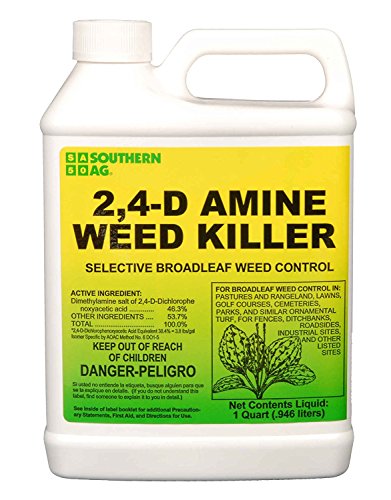
Southern Ag Amine 2,4-D is a liquid weed killer intended to control many broadleaf weeds and woody plants. The listed use sites include turf, pastures, rangeland, ditch banks, and fences, making it more relevant to lawn and property weed management than to routine vegetable-bed care.
The product information gives a use rate of 1 to 4 pints per acre. That range can help users plan applications over larger areas, but the correct rate and method depend on the full product label and the target site. The listing does not identify specific weed species or provide a coverage estimate.
The container is listed as 32 ounces, or 1 quart. No application equipment, mixing instructions, or storage details are provided in the listed specifications, so check the label for those directions rather than assuming a particular sprayer or dilution method.
Potential settings include turf areas, pasture, rangeland, ditch banks, and fence lines. Its stated use rate is expressed per acre, so homeowners treating a small lawn or isolated weeds should verify that the product label covers their site and provides suitable small-area directions.
As with any herbicide, read and follow the complete label, including protective equipment, application limits, and precautions for desirable plants and nearby areas. Avoid off-label use, and check local restrictions where applicable. The listing does not establish suitability for every lawn, crop, or garden setting.
This may suit users managing broadleaf weeds or woody plants in the listed areas who are comfortable following label directions. Gardeners seeking a ready-to-use spot treatment, or needing product-specific guidance for a particular plant or site, should consider a more clearly specified alternative.
Best For / Avoid If
Best for buyers prioritizing
- Product information identifies both broadleaf weeds and woody plants as targets.
- Listed use sites include turf and several larger landscape or property areas.
- A use rate is provided, which can help with application planning when interpreted according to the label.
Consider another option if
- The supplied information does not name specific weed species or explain application equipment, so consult the full label before use.
- Who should skip it: gardeners seeking a ready-to-use spot treatment or a product specifically documented for a particular plant or site should consider another option.
Start with the weeds you need to control
Identify whether the growth is mostly grass, broadleaf weeds, or woody seedlings. Spectracide Weed & Grass Killer with AccuShot is described for weeds and grasses on driveways and walkways. Southern Ag Amine 2,4-D WEED KILLER, 32oz – Quart is described as controlling many broadleaf weeds and woody plants, so it is a more targeted fit when those are the main concern.
These descriptions do not replace the product label. Confirm that the specific gravel area and weed types are covered before buying or applying either product. If you cannot identify a plant, avoid treating it until you have checked what it is and whether the label supports the intended use.
Check that the label covers the gravel area
A product described for driveways or walkways may be relevant to a gravel path, but wording on a retailer page is not a substitute for the full, current label. Read the label for approved sites, application directions, and restrictions. Do not assume that a product labeled for one hardscape surface is automatically appropriate for every gravel bed or adjacent planting area.
Site conditions matter too. Gravel near a vegetable bed, ornamental planting, drain, or water feature calls for particular care. Follow label instructions on where and how to apply, and avoid letting spray drift or run off beyond the intended treatment area.
Choose an application format you can control
Spectracide includes an AccuShot continuous power sprayer with an extendable wand. That format may be convenient for treating scattered growth without carrying a separate sprayer, but precise aiming remains important around plants you want to keep. The manufacturer states that visible results can appear as fast as three hours; this is a manufacturer claim, not a promise of the same timing in every situation.
Southern Ag is a concentrate with a stated use rate of 1 to 4 pints per acre. A concentrate can suit someone treating an appropriate larger area who is comfortable measuring and preparing a spray mix according to the label. Do not estimate dilution or apply a rate based on acreage without following the product’s exact instructions.
Consider selectivity and nearby plants
Herbicide choice is not just about what should die. Southern Ag’s 2,4-D product is described for broadleaf weeds and woody plants, while Spectracide is described for weeds and grasses. Neither description should be read as permission to spray indiscriminately. Drift or contact with desirable plants may cause unwanted damage, so take extra care beside flower beds, shrubs, and trees.
If the gravel borders plants you want to preserve, consider whether hand removal or another nonchemical approach is more manageable for the small area. For either herbicide, follow the label’s precautions and application method, and keep people and pets away as directed by the manufacturer.
Think about area size and effort
For isolated weeds along a short path, ease of aiming and avoiding overspray may matter more than treating a large area quickly. The wand on the Spectracide sprayer may help reach growth at ground level, while its ready-to-use format avoids measuring a concentrate. For larger treatment areas, Southern Ag’s per-acre use-rate information may be relevant, but the label’s mixing and site directions still govern.
Do not compare package size alone as a measure of value. The products have different formulations and use directions, and the amount needed depends on the label rate and area being treated. Estimate the area first, then check the label for coverage and application details.
Avoid common application mistakes
Common errors include treating before confirming the weed, spraying in a way that reaches wanted plants, using an off-label dilution, or assuming a fast visible response means the whole treatment is complete. Spectracide states that it becomes rainfast after 15 minutes, but check the current label for exact directions and conditions rather than relying on a product summary.
Apply only as directed, and do not increase the amount or repeat treatment more often than the label allows. Observe any label instructions about weather, re-entry, protective equipment, cleanup, and disposal. Local rules may impose additional limits on herbicide use.
Store and handle herbicides responsibly
Keep herbicides in their original, labeled containers and follow the manufacturer’s storage and disposal instructions. Store them securely away from children, pets, food, and garden supplies, as directed on the label. Do not transfer leftover product into an unmarked container.
For the Spectracide sprayer, follow the product instructions for handling and storage of the bottle and sprayer. For the Southern Ag concentrate, measure and mix only as directed, and clean equipment as the label specifies. Avoid pouring leftover mixture onto gravel, soil, or drains unless the label explicitly permits that disposal method.
How we evaluate gravel weed killers
We compare herbicides by the weeds they are described to target, the application format, the intended use areas, and how clearly their features fit common gravel-maintenance jobs. For this guide, the key distinction is between a product described for weeds and grasses on driveways and walkways and a concentrate described for many broadleaf weeds and woody plants.
We also assess practical ownership considerations: whether the product is ready to apply or requires measured preparation, how the sprayer may affect aiming, and what buyers need to confirm on the full label. Manufacturer statements about visible results and rainfastness are attributed as claims, not treated as guarantees.
During updates in November 2026, we review the products’ stated features and relevance to gravel paths, driveways, and similar home-garden areas. The most suitable choice depends on the target weeds, the label-approved site, nearby plants, and the gardener’s comfort with application and mixing.
Frequently asked questions
Can I use a driveway weed killer on gravel?
Check the product label for the exact site and surface before use. A product description that mentions driveways or walkways does not by itself confirm that every gravel area is an approved use.
Which type is aimed at grass as well as weeds?
Spectracide Weed & Grass Killer with AccuShot is described for weeds and grasses. Confirm the label covers the plants and treatment site, and take care to avoid spray reaching desirable vegetation.
When might a 2,4-D concentrate make sense?
Southern Ag Amine 2,4-D WEED KILLER, 32oz – Quart is described for many broadleaf weeds and woody plants and has a stated use rate of 1 to 4 pints per acre. It may suit a gardener addressing those targets in a label-approved area who can measure and prepare the product as directed.
Does the Spectracide sprayer need a separate applicator?
The product includes an AccuShot continuous power sprayer with an extendable wand. Follow its instructions for operation and care, and aim carefully to limit contact with plants you want to keep.
How should I protect plants beside a gravel path?
Follow the label’s directions for application and precautions, and avoid drift or direct spray onto desirable plants. If the area is tight or plantings are close, manual removal may offer more control than spraying.
How should I store leftover herbicide?
Keep the product in its original labeled container and follow the manufacturer’s storage and disposal instructions. Store it securely as directed, and do not pour leftover product or mixture onto the ground or into a drain unless the label specifically allows it.