

Every January, thousands of gardeners ask the same practical question: can you plant a christmas tree after christmas in your home landscape? The short answer depends entirely on the type of tree you brought inside for the holidays. While living container-grown or balled-and-burlapped evergreens can successfully establish in the yard with proper acclimation, standard cut trees lack a root system and cannot regenerate roots once severed from the stump. Knowing which category your tree falls into determines whether you should prepare an outdoor planting hole or focus on hydration and post-holiday recycling.
For gardeners managing indoor holiday displays, keeping conifers hydrated is critical to maintaining foliage freshness and reducing messy needle drop. To help homeowners evaluate their options, we examined 2 cut-tree hydration formulas from Miracle-Gro, priced between $5.97 and $13.94. Whether you are caring for a cut evergreen indoors before repurposing it as garden mulch or planning a permanent addition to your landscape, understanding conifer biology and tree care ensures the best outcome for your property. Gardeners exploring permanent evergreen options can also view our selection of outdoor Christmas trees for landscape-ready varieties.
This comprehensive guide breaks down the essential differences between living root-ball specimens and cut trees, outlines the steps required to transition potted evergreens outdoors during winter, and details how indoor moisture additives help sustain cut foliage throughout the festive period.

Pros
- Very easy to integrate, since you simply add a capful each time the stand is refilled
- Purpose-made for cut Christmas trees rather than being a general-purpose plant food
- Clear mixing ratio of one capful per quart reduces guesswork during a busy season
- Small bottle takes up little storage space alongside seasonal items
Cons
- Results still depend on basics like a fresh trunk cut and consistent watering, so the additive may not compensate for a stand left dry
- Intended only for cut Christmas trees, so gardeners wanting a general evergreen or houseplant fertilizer may prefer a different product
- Requires remembering to treat every quart added, which adds a small step to each refill
Miracle-Gro for Christmas Trees is a liquid water additive made specifically for live cut trees displayed indoors during the holiday season. The 8 fl. oz. bottle mixes into the water in your tree stand, and the product information indicates it is designed to help reduce the needle drop that often collects on floors, tree skirts, and wrapped gifts in the weeks between setup and take down. It is aimed at homeowners and first-time tree buyers who want a low-effort way to keep a fresh tree looking its best.
The most important supported benefit is needle drop reduction compared with watering alone. According to the listed features, the formula works with a cut tree's natural ability to absorb water, helping the trunk keep drawing moisture so needles stay attached and branches stay supple longer. Hydration is the biggest single factor in how long a cut tree holds its needles, so an additive that supports uptake fits logically into good tree care.
Using it is straightforward. The instructions call for one capful, about two teaspoons, for every quart of water added to the stand, which means no measuring spoons or complicated math in the middle of a busy season. For best results, the product guidance recommends cutting a half inch off the bottom of the trunk before the tree goes in the stand and keeping the bottom two inches of the trunk submerged at all times. Those two steps matter as much as the additive itself, because a sealed or dried-out trunk base cannot drink.
In a typical living room or family room, this fits naturally into an existing routine: each time you top off the stand, you add a capful along with the fresh water. A newly cut tree can take up a surprising amount of water in the first week, so a household that refills the stand daily will simply repeat the same quick step. The small bottle stores easily with holiday decorations or under the sink, and it makes a practical extra for anyone setting up their first real tree.
There are honest limitations to keep in mind. This product is formulated for cut Christmas trees, not for living potted trees, landscape evergreens, or houseplants, so gardeners needing a general plant food should look at other options. It also works alongside solid tree care rather than replacing it: a fresh cut, a stand that holds enough water, and regular refills are still essential, and an additive may not compensate for a tree that arrived dry or a stand left empty. As with any product used around pets and children, keep the bottle closed and stored out of reach.
Based on the listed specifications, this is a practical seasonal helper for anyone displaying a cut tree and hoping for fewer needles on the floor. It suits busy households, first-time tree owners, and anyone who already trims the trunk and waters diligently but wants to support hydration further. If you display an artificial tree, or you need fertilizer for outdoor evergreens and container plants, a different product will serve you better.
Best For / Avoid If
Best for buyers prioritizing
- Very easy to integrate, since you simply add a capful each time the stand is refilled
- Purpose-made for cut Christmas trees rather than being a general-purpose plant food
- Clear mixing ratio of one capful per quart reduces guesswork during a busy season
Consider another option if
- Results still depend on basics like a fresh trunk cut and consistent watering, so the additive may not compensate for a stand left dry
- Intended only for cut Christmas trees, so gardeners wanting a general evergreen or houseplant fertilizer may prefer a different product
- Requires remembering to treat every quart added, which adds a small step to each refill
Pros
- Very easy to use, with the dose measured right from the bottle cap at one capful per quart
- Targets the most common cut tree complaint, needles across floors and gifts, as an alternative to watering with plain water
- Two bottle pack provides a supply sized for a full holiday season in most households
- Small footprint makes off season storage on a closet or utility shelf simple
Cons
- Designed for fresh cut trees only, so it may not suit households with artificial trees or living potted trees
- Results depend on proper prep and steady watering, including a fresh trunk cut and keeping the base submerged, so it cannot replace good tree stand habits
- Needle drop reduction is stated against water alone, and real world results can vary with tree freshness, species, and indoor heat
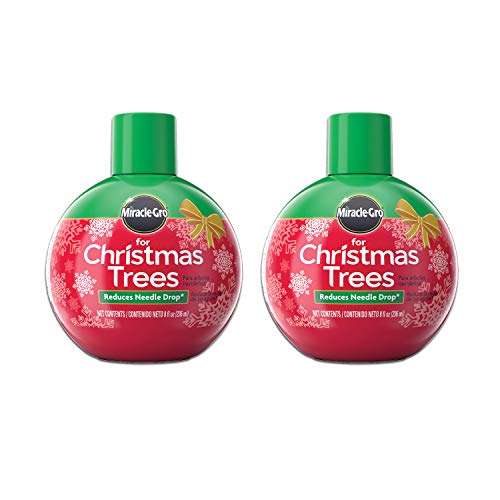
Miracle-Gro for Christmas Trees is a liquid additive made for the water in a cut tree stand, and its stated purpose is simple: help a fresh cut tree take up water and shed fewer needles inside your home. Although it sits in the plant food category, this is really a holiday season product for anyone who brings a live cut tree indoors, from first time tree buyers to households that set up a full size tree every December.
According to the listed features, the formula is designed to reduce needle drop indoors compared with water alone, and it works with a cut tree's natural ability to absorb water. That matters because a hydrated tree holds its needles longer, which means less sweeping under the stand and fewer needles in carpet, gifts, and tree skirts.
Dosing is straightforward. The directions call for one capful, about two teaspoons, mixed into every quart of water added to the stand, so it fits an everyday watering routine rather than a complicated schedule. The two pack includes two 8 fl. oz. bottles, and the whole package weighs about a pound with compact dimensions, so the spare bottle stores easily between seasons.
Use cases center on the holidays. It suits a living room tree in a standard stand, a family room tree near a heat source where needles tend to drop faster, and anyone who travels in December and wants a quick mix-in step before leaving. The product information also reinforces two basics that matter most: cut a fresh half inch off the trunk base before setup, and keep the bottom two inches of the trunk immersed in stand water at all times.
Keep a few limits in mind. This formula is intended for fresh cut trees, not artificial trees, and it supports hydration rather than reviving a tree that has already dried out, so results depend on tree freshness and indoor conditions. As a sensible precaution, follow the label directions and keep the treated stand water and bottles out of reach of children and pets.
Who should buy it: households with a fresh cut tree that want less needle cleanup and an easy watering routine. Who should consider other options: homes with artificial trees, people displaying living potted trees that need planting care rather than stand water, and anyone unlikely to water the stand regularly. Used with a fresh trunk cut and steady watering, this two bottle pack is a low effort way to finish the season with a cleaner, better looking tree.
Best For / Avoid If
Best for buyers prioritizing
- Very easy to use, with the dose measured right from the bottle cap at one capful per quart
- Targets the most common cut tree complaint, needles across floors and gifts, as an alternative to watering with plain water
- Two bottle pack provides a supply sized for a full holiday season in most households
Consider another option if
- Designed for fresh cut trees only, so it may not suit households with artificial trees or living potted trees
- Results depend on proper prep and steady watering, including a fresh trunk cut and keeping the base submerged, so it cannot replace good tree stand habits
- Needle drop reduction is stated against water alone, and real world results can vary with tree freshness, species, and indoor heat
Practical Can You Plant A Christmas Tree After Christmas Buying and Care Guide
Cut Trees vs. Living Potted Trees: Understanding What Can Be Planted
The single most important factor in determining whether an evergreen will survive outdoors is whether the root structure remains intact. Traditional cut Christmas trees are harvested by cutting the trunk flush above the root collar. Once severed, the xylem tissue can continue drawing water for several weeks, but the tree cannot generate adventitious roots to survive in garden soil. Attempting to plant a cut trunk in dirt will inevitably result in desiccation and decay.
In contrast, living Christmas trees are sold either in rigid plastic nursery containers or as balled-and-burlapped root balls. These specimens preserve the fine feeder roots required for water and mineral uptake. If you intend to add a holiday tree to your landscape permanently, you must purchase a containerized or field-dug conifer from the outset rather than a standard cut lot tree.
| Tree Category | Root System Status | Outdoor Replanting Viability | Primary Care Objective |
|---|---|---|---|
| Standard Cut Conifer | Completely severed; trunk only | Not viable for replanting | Hydration in stand, needle retention, composting |
| Container-Grown Conifer | Intact root system in potting medium | High viability with proper care | Short indoor stay, moisture control, acclimation |
| Balled-and-Burlapped Conifer | Field soil root ball wrapped in burlap | High viability in suitable soil | Root moisture protection, gradual hardening off |
Caring for Cut Trees Indoors Before Composting or Mulching
When working with a cut conifer, your goal is to slow down dehydration until the season ends. Freshly harvested conifers seal their vascular channels with sap within hours of being recut. Before setting your cut tree into a stand, manufacturer guidelines recommend making a fresh perpendicular cut across the bottom half-inch of the trunk. This reopens the water-conducting capillaries so the tree can pull moisture freely.
Water absorption is vigorous during the first ten days indoors. Stands must maintain at least two inches of water covering the base of the trunk at all times. Utilizing specialized water treatments such as Miracle-Gro for Christmas Trees, 8 fl. oz. helps reduce needle drop indoors compared to plain water alone. The formula works alongside the tree’s natural capillary uptake, helping the branches stay supple throughout December so you have clean, intact branches to turn into fragrant garden mulch or wood chips once disassembled.
Indoor Duration Limits for Living Conifers
If you have purchased a living evergreen with roots, the biggest mistake homeowners make is keeping the tree inside a heated home for too long. Conifers require a winter dormancy period driven by cool temperatures and shortened day lengths. Warm indoor temperatures fool the tree into breaking dormancy, triggering tender, pale new growth that will freeze and die immediately upon return to winter weather.
Horticultural guidelines suggest limiting a living tree’s indoor stay to a maximum of five to seven days. Place the potted evergreen in the coolest area of the room, far away from forced-air heat vents, wood stoves, and radiant radiators. Keep the root ball evenly moist but never waterlogged, as stagnant water in a decorative saucer can rot fragile evergreen feeder roots within days.
Acclimation and Temperature Transition Stages
Never move a living conifer directly from a 70-degree living room into sub-freezing outdoor temperatures. The drastic thermal shock can rupture plant cell membranes and cause severe foliage dieback. Instead, transition the tree gradually through an unheated shelter such as an attached garage, an enclosed porch, or a garden potting shed.
Keep the tree in this sheltered intermediate zone for three to five days. This buffer window allows the conifer to adjust to declining temperatures while shielding the containerized root system from harsh desiccating winds. Check soil moisture daily during this transition, as dry roots freeze far more rapidly than well-hydrated root balls.
Winter Soil Preparation and Digging Logistics
In northern and continental climate zones, winter soil often freezes solid by late December, making digging a planting hole nearly impossible. Forward-thinking gardeners dig the planting hole in late autumn before the first hard ground freeze. Store the excavated soil in buckets or wheelbarrows inside a garage or shed where it remains pliable and easy to shovel.
Fill the pre-dug hole with straw, bags of dry mulch, or leaves, and place a wooden board over the top to prevent accidental falls. When Christmas concludes and the living tree is acclimated, remove the insulating straw, position the root ball at the appropriate depth, and backfill using the unfrozen soil stored in your sheltered space.
Planting Depth, Siting, and Wind Protection
Evergreen trees such as Colorado blue spruce, Douglas fir, and Fraser fir grow into substantial forest canopies over several decades. Choose a planting site that accommodates the mature spread and height of the species, maintaining a safe distance from house foundations, overhead utility lines, and boundary fences. Conifers demand well-draining soil and full sunlight to thrive.
Set the root ball so the trunk flare sits level with or slightly above the surrounding soil grade. Planting evergreens too deeply invites trunk rot and suffocates the surface roots. After backfilling firmly to eliminate air pockets, apply a three-inch layer of organic bark mulch over the entire root zone, keeping the mulch two inches away from the trunk bark. In exposed sites, erect a simple burlap windbreak to shelter the needles from harsh winter winds until new roots anchor in spring.
Research Methodology and Trust
Our conifer care analysis is based on horticultural research, manufacturer product specifications, and arboricultural planting guidelines. Rather than relying on generic product claims or conducting unverified physical laboratory trials, our review team compared documented product features, dilution ratios, and seasonal care requirements to establish practical solutions for home gardeners.
During our September 2026 review cycle, we evaluated tree hydration additives from Miracle-Gro, examining active user directions, capful measurements, container volumes, and multi-pack values. We assessed how these liquid formulas integrate with household maintenance routines and verified label safety instructions. Our goal is to provide honest, realistic gardening advice so you can make informed decisions when managing holiday greenery.
Frequently Asked Questions
Can you plant a christmas tree after christmas if it has no roots?
No, a cut conifer without roots cannot survive in garden soil. Conifers cannot regenerate a functional root system from a severed trunk once cut. Cut trees should be kept hydrated indoors and then composted, mulched, or recycled through local green waste programs.
How long can a living christmas tree stay indoors before planting?
A living container-grown or balled-and-burlapped conifer should stay indoors for no more than five to seven days. Prolonged warmth causes the tree to break winter dormancy, producing tender shoots that will suffer severe winterkill when returned to freezing outdoor conditions.
What should you do if the ground is frozen when planting?
If frozen ground prevents digging, do not leave the living tree exposed to wind. Keep the container in an unheated garage, shed, or sheltered corner against your house foundation. Insulate the root container with bags of leaves or mulch, and water periodically until soil thaws in late winter or early spring.
How does a water additive help if the tree cannot be planted?
Water additives such as Miracle-Gro for Christmas Trees are formulated to support water absorption in cut trunks, helping the tree remain hydrated and reducing messy needle drop indoors. While it does not regrow roots, it extends indoor aesthetics and needle retention throughout the holidays.
Which evergreen species have the best survival rate when planted outdoors?
Species native or well-adapted to your specific USDA hardiness zone perform best. Colorado blue spruce, Norway spruce, and white pine generally establish well in northern zones, provided they receive full sun, moist well-draining soil, and adequate wind shelter during their first winter.
Do living Christmas trees need fertilizer right after planting?
No, newly planted conifers should not be fertilized in midwinter. Nitrogen fertilizers stimulate vegetative growth when the root system is dormant and incapable of supporting new shoots. Withhold granular or chemical fertilizers until the tree completes a full growing season in the ground.