


Le limacce possono distruggere piantine, lattuga e hosta durante la notte, e molte esche popolari contro le limacce contengono metaldeide o altre sostanze chimiche che rappresentano un rischio reale per cani, gatti e fauna selvatica curiosa del giardino. Questa guida spiega come controllare le limacce senza danneggiare gli animali domestici, una preoccupazione comune per chi desidera un orto produttivo o un’aiuola fiorita senza mettere a rischio i propri animali. È pensata per i giardinieri principianti, per le persone più anziane che desiderano soluzioni semplici e a basso rischio e per chiunque coltivi in un piccolo giardino o su un patio, dove animali e piante condividono spazi ravvicinati.
Per questo articolo, abbiamo cercato di confrontare quattro prodotti per il controllo delle limacce, valutandoli in base a fattori come il principio attivo o il metodo fisico utilizzato, la facilità di posizionamento intorno alle aiuole e la chiarezza con cui ogni prodotto documenta la sicurezza per gli animali domestici sulla propria etichetta. I criteri di selezione per questa categoria includono l’uso di un metodo a barriera o di un’esca dichiarata sicura in presenza di animali domestici, la resistenza in condizioni umide e la necessità di riapplicazione dopo l’irrigazione o la pioggia.
Poiché il controllo delle limacce si trova all’intersezione tra gestione dei parassiti e sicurezza degli animali domestici, vale la pena esaminare anche le pratiche più ampie di controllo della fauna selvatica e dei parassiti. Puoi consultare altri contenuti su questo tema nella nostra categoria Garden Pest & Wildlife, che include ulteriori indicazioni su come gestire i comuni parassiti del giardino in abitazioni con animali domestici e bambini.
Prodotti da valutare per il controllo delle limacce
Queste opzioni includono esche a base di fosfato di ferro e una barriera elettrica fisica. Segui sempre alla lettera l’etichetta aggiornata, conserva le esche in modo sicuro e tieni lontani gli animali domestici durante l’applicazione, anche quando una scheda descrive un prodotto come adatto all’uso in presenza di animali domestici o fauna selvatica.
Monterey Sluggo LG 6500 Snail & Slug Killer for Organic Garden Pest Control Garden Safe HG-4536 Slug & Snail Bait Granules for Lawns, Vegetable Beds, and Greenhouses Bonide Captain Jack's Slug Magic Granules for Vegetable Garden Slug and Snail Control SNAILSHIELD Snail Shield Electric Snail Fence for Raised Bed Protection Prices and availability can change. We may earn a commission from qualifying purchases.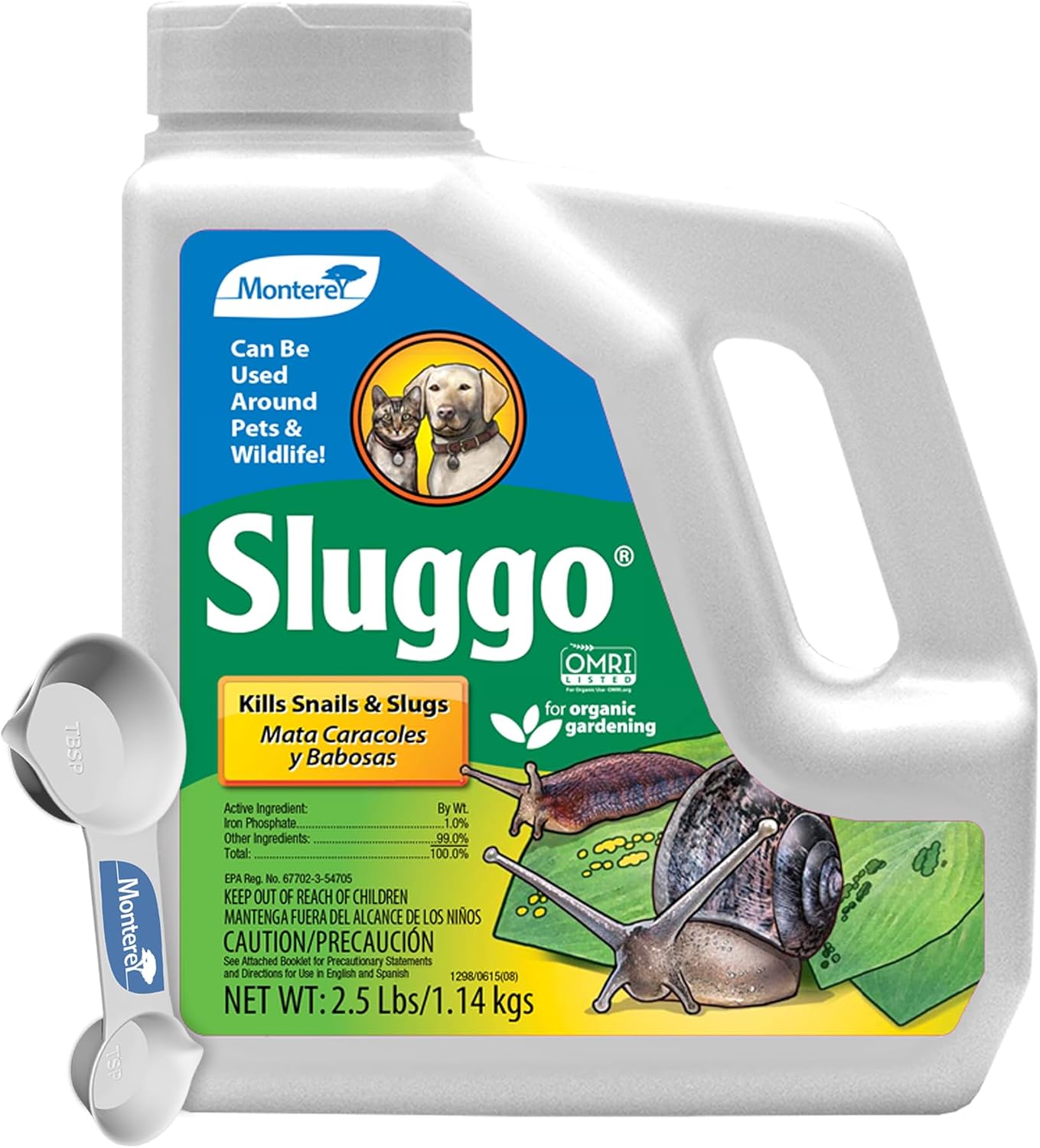


Alcune schede qui sotto sono ancora in inglese; la traduzione è in revisione.
Pros
- Purpose-built for slug and snail control in garden settings.
- Listed in the product title as OMRI Listed for organic gardening.
- Includes a measuring spoon for easier, more deliberate application.
- Several reviewers report good results around plants and areas where slugs or snails appear.
- Pet and wildlife friendly positioning may be reassuring for many home gardeners when used as directed.
Cons
- As with any pest bait, it should be applied only according to the product label and kept out of unintended areas.
- One reviewer noted that the product did not hold up well in wet conditions, so rainy climates may require closer monitoring or reapplication.
- Gardeners needing a physical barrier or non-bait approach may prefer traps, copper barriers, or habitat management instead.
Monterey Sluggo LG 6500 is a snail and slug killer sold in a 2.5 lb jug and bundled with a measuring spoon. It is intended for gardeners dealing with slug and snail activity around edible gardens, ornamental beds, porch edges, and tender new growth. Based on the product title, it is OMRI Listed for organic gardening and described as wildlife and pet friendly.
The main appeal is straightforward pest control for one of the more frustrating backyard garden problems. Slugs and snails often show up around young plants, leafy ornamentals, and damp garden edges, and reviewers commonly mention using this product to protect plants or reduce slug and snail activity in problem areas. Those comments should be read as user experience rather than a guarantee, but they do suggest the product fits routine home-garden pest management.
The included measuring spoon is a practical detail, especially for beginners who want to avoid overapplying a bait product. The package dimensions are listed as 8.23 x 6.93 x 3.78 inches, with a package weight of 2.78 pounds, so it should be manageable for most homeowners to carry, store, and use around beds or containers. The jug format is also convenient for gardeners who expect to make repeat applications during active slug and snail periods.
Good use cases include hosta beds, vegetable starts, flower borders, raised beds, and porch-adjacent areas where slugs or snails are noticed. Small-space gardeners may also find the measured application helpful around containers or compact beds, provided they follow the label directions carefully. For households with pets or visiting wildlife, the product’s pet and wildlife friendly positioning is a notable part of its appeal, but safe placement and label compliance still matter.
The biggest caution is moisture. One reviewer reported that the pellets did not hold up well after getting wet and became costly to use in a wet location, so gardeners in rainy or heavily irrigated areas may need to check treated spots more often. As with all pest-control products, avoid casual scattering, do not apply more than directed, and store the jug where children and animals cannot access it.
Overall, Monterey Sluggo LG 6500 looks best suited to gardeners who want an organic-gardening-listed slug and snail bait with a simple measuring aid. Gardeners who want a non-bait method, need a long-lasting physical barrier, or garden in persistently wet conditions may want to compare it with traps, barriers, or habitat cleanup strategies before choosing.
Best For / Avoid If
Best for buyers prioritizing
- Purpose-built for slug and snail control in garden settings.
- Listed in the product title as OMRI Listed for organic gardening.
- Includes a measuring spoon for easier, more deliberate application.
Consider another option if
- As with any pest bait, it should be applied only according to the product label and kept out of unintended areas.
- One reviewer noted that the product did not hold up well in wet conditions, so rainy climates may require closer monitoring or reapplication.
- Gardeners needing a physical barrier or non-bait approach may prefer traps, copper barriers, or habitat management instead.
Pros
- OMRI-listed formula fits gardeners looking for an organic-gardening slug and snail bait option.
- Useful across a broad range of home garden settings, including lawns, vegetable beds, fruit areas, ornamentals, and greenhouses.
- Granules allow targeted placement around plant bases, bed edges, and rows where slug or snail damage is noticed.
- Product directions include practical timing and weather guidance, such as applying in the evening and avoiding rain or windy conditions.
- Can be used around pets and wildlife when applied according to the full label directions and precautions.
Cons
- It is not an instant knockdown product, since the listed die-off window begins within three to six days after ingestion.
- Reapplication may be needed at least every two weeks, more often after heavy watering, heavy rain, or severe infestations.
- Gardeners dealing with persistent or heavy snail pressure may need additional monitoring or integrated controls if bait alone is not enough.
Garden Safe HG-4536 Slug & Snail Bait Granules are made for controlling slugs and snails in common home growing areas, including lawns, vegetable gardens, ornamentals, fruits, berries, citrus plantings, crop plants, and greenhouses. This is the kind of product a homeowner might reach for when tender leaves, hostas, petunias, vegetable starts, or other susceptible plants show slug or snail feeding damage.
The product uses iron phosphate with slug and snail bait additives. According to the product information, once slugs or snails eat the bait, they stop feeding, become less mobile, and begin to die within three to six days. That makes it better suited to gardeners who want steady control rather than an immediate visible result. It is also OMRI listed for organic gardening, which will matter to many vegetable and backyard gardeners.
Application is straightforward but should not be careless. The granules are intended to be spread evenly, not piled, on moist soil with little or no standing water. For larger areas, the label allows use with a standard broadcast spreader, while row applications can be handled with a standard granular spreader. Around smaller beds or individual plants, the product can be scattered around likely slug and snail travel areas, such as bed edges, between rows, or near the base of affected plants.
For backyard and small-space use, this bait fits many practical situations: a vegetable bed with chewed seedlings, a flower border with snail activity, a greenhouse bench area where slugs are feeding at night, or a lawn and garden edge where pests move in from moist cover. The product directions recommend applying in the evening because slugs and snails feed mostly at night or early in the morning. Reviewers commonly describe using it around vegetable beds, patios, porch areas, hostas, and petunias, with many reporting reduced slug activity after application.
There are important limitations and safety steps. The label should be read in full before use, and all directions and precautions should be followed, especially around pets, wildlife, edible crops, and water runoff. The product should not be allowed to enter storm drains, gutters, drainage ditches, or surface waters, and any granules that land on hard surfaces should be swept back into the treated area. It should also be applied during calm weather when rain is not expected for the next 24 hours.
This is a sensible option for gardeners who want an easy-to-spread granular slug and snail bait that can be used in a wide range of home garden settings and is listed for organic gardening. Gardeners who need instant pest removal, have severe recurring infestations, or cannot reapply after watering or heavy rain may need to combine it with careful monitoring, habitat cleanup, or other label-appropriate slug and snail control methods.
Best For / Avoid If
Best for buyers prioritizing
- OMRI-listed formula fits gardeners looking for an organic-gardening slug and snail bait option.
- Useful across a broad range of home garden settings, including lawns, vegetable beds, fruit areas, ornamentals, and greenhouses.
- Granules allow targeted placement around plant bases, bed edges, and rows where slug or snail damage is noticed.
Consider another option if
- It is not an instant knockdown product, since the listed die-off window begins within three to six days after ingestion.
- Reapplication may be needed at least every two weeks, more often after heavy watering, heavy rain, or severe infestations.
- Gardeners dealing with persistent or heavy snail pressure may need additional monitoring or integrated controls if bait alone is not enough.
Pros
- Targeted for common garden damage from slugs and snails.
- Pelletized application is straightforward and does not require mixing equipment.
- Suitable for use around vegetable, fruit, and berry gardens according to the product information.
- Listed for use around areas where pets and wildlife go, with label directions still important.
- Reviewers commonly mention that it is easy to use and effective for reducing slug and snail activity.
Cons
- It is a pest bait, so careful label reading, placement, and storage are still important around children, pets, and wildlife.
- Gardeners looking for a broad insect spray or a physical barrier may prefer a different type of product.
- Application rates vary by garden or plant type, so it may take a little attention to apply correctly in mixed plantings.
Bonide Captain Jack's Slug Magic Granules are made for controlling snails and slugs in home gardens, including vegetable, fruit, and berry areas. Based on the listed product information, this is a granular bait rather than a liquid spray, so it is aimed at gardeners who want to scatter pellets around problem areas instead of mixing a concentrate.
The key benefit is focused slug and snail control for edible garden spaces where tender seedlings, leafy greens, berries, and low-growing plants can be vulnerable to chewing damage. The product information states that it can be used in fruit and vegetable gardens up to the day of harvest when used as directed, which is a practical feature for active kitchen gardens.
The 3 lb container uses a pelletized formula containing iron phosphate with slug and snail bait additives. One pound is listed as treating up to 1,000 square feet, so the container can cover a meaningful area when applied at the labeled rate. The granule format should be simple for most homeowners to place around beds, rows, borders, and other damp areas where slugs and snails are commonly noticed.
For backyard use, this product fits vegetable beds, berry patches, fruit garden areas, and lawns where slug or snail activity is a recurring issue. It may also be useful around raised beds or small-space plantings, provided the granules are applied carefully and according to the label for that garden type. Reviewers commonly mention good results and easy application, but those comments should be viewed as user experience rather than a guarantee.
As with any pest-control product, the label should guide where, how much, and how often to apply it. Although the product information says it can be used around areas pets and wildlife go, gardeners should still avoid careless broadcasting, store the container securely, and keep granules where they are intended to work. It is best for gardeners dealing specifically with slugs and snails, while those needing control for other pests or a non-bait approach should consider a different solution.
Pros
- Chemical-free approach for protecting edible garden beds from snails
- Self-adhesive tape can be shortened to fit the perimeter of a raised bed or planter setup
- Runs on 2 AA batteries, so placement is not limited by access to household power
- Reviewers commonly mention straightforward installation and a clean-looking setup on raised beds
Cons
- It is a perimeter barrier, so gardeners may still need to remove snails already inside the bed before installation
- May be less practical for multiple separate beds unless each area can be fully enclosed with the available tape
- Adhesive performance may depend on careful surface cleaning and the condition of the mounting surface
The SNAILSHIELD Snail Shield is an electric snail fence set made for raised beds, vegetable beds, and other outdoor garden planting areas where snails are a recurring problem. Rather than using bait or spray, it creates a low-voltage boundary around the bed with self-adhesive fence tape connected to a small battery-powered unit.
According to the product information, the low fence voltage gives snails a mild, unpleasant tingling sensation that encourages them to turn around. The listed design is intended to be safe for humans and animals, while still providing a physical-style deterrent for the target pest. For gardeners growing leafy vegetables or tender young plants, that non-chemical approach may be the main appeal.
The kit includes 11 m of extra-strong self-adhesive fence tape, which the manufacturer says can be cut to length with ordinary scissors. The tape is listed as suitable for wood, metal, plastic, stone, and concrete, so it should fit many common raised bed materials when the surface is prepared properly. The power unit uses 2 AA batteries and includes two control LEDs for checking battery status and power supply.
Installation is described as a short setup with no separate wiring or cables required. The retaining plate can be attached with screws on wooden surfaces, while other surfaces can use adhesive tape according to the product information. This makes the system especially relevant for backyard raised beds, patio planters with solid sides, and small vegetable gardens where running an extension cord would be inconvenient.
There are a few practical limits to keep in mind. This type of barrier is meant to stop new snails from crossing into the protected area, not remove snails or eggs that may already be inside the soil or mulch. Gardeners should inspect the bed before installation, keep vegetation from bridging over the tape, and check the LEDs and batteries periodically so the barrier stays active.
Overall, the Snail Shield is a sensible option for gardeners who want a tidy, battery-powered snail deterrent for a defined raised bed perimeter. Gardeners with many separate beds, irregular surfaces, or heavy existing infestations may need additional cleanup steps or a different protection plan.
Best For / Avoid If
Best for buyers prioritizing
- Chemical-free approach for protecting edible garden beds from snails
- Self-adhesive tape can be shortened to fit the perimeter of a raised bed or planter setup
- Runs on 2 AA batteries, so placement is not limited by access to household power
Consider another option if
- It is a perimeter barrier, so gardeners may still need to remove snails already inside the bed before installation
- May be less practical for multiple separate beds unless each area can be fully enclosed with the available tape
- Adhesive performance may depend on careful surface cleaning and the condition of the mounting surface
Guida all’acquisto: come controllare le limacce senza danneggiare gli animali domestici
Capire il parassita da colpire
Le limacce sono più attive di notte e dopo la pioggia o l’irrigazione, quando la superficie del terreno rimane umida. Tendono a concentrarsi intorno alle verdure a foglia bassa, alle hosta e alle piantine vicino al livello del suolo. Sapere quando e dove si alimentano le limacce aiuta a decidere se, in base alla disposizione del giardino, sia più adatta una barriera, una trappola o un’esca sicura per gli animali domestici.
Barriera fisica o metodo di controllo
Le barriere fisiche, come il nastro di rame, gli anelli di gusci d’uovo tritati o la terra di diatomee, agiscono rendendo la superficie scomoda o impraticabile per le limacce, invece di avvelenarle. Questi metodi possono essere un buon punto di partenza per chi possiede animali domestici, perché evitano del tutto i granuli di esca ingeribili. Lo svantaggio è che le barriere devono solitamente essere riapplicate dopo forti piogge o l’irrigazione, quindi richiedono una manutenzione più regolare rispetto a una singola applicazione di esca.
Leggere attentamente le indicazioni sulla sicurezza per gli animali
Non tutti i prodotti commercializzati come sicuri per gli animali domestici adottano lo stesso standard, quindi è importante leggere l’etichetta effettiva invece di affidarsi soltanto alle indicazioni sulla confezione. Cerca il principio attivo riportato e verifica se il produttore specifica l’uso in presenza di cani, gatti o altri animali domestici. In caso di dubbi, segui esattamente le istruzioni di sicurezza del prodotto e del produttore e consulta un veterinario se un animale entra in contatto con un prodotto per il controllo dei parassiti del giardino.
Copertura e posizionamento intorno alle aiuole
Un controllo efficace delle limacce dipende spesso dal posizionamento tanto quanto dal prodotto stesso. Applicare una barriera o una trappola direttamente intorno alle piante vulnerabili, invece di distribuirla in tutto il giardino, tende a concentrare la protezione dove serve e limita la quantità di prodotto con cui gli animali domestici possono entrare in contatto. Questo è particolarmente importante nei piccoli giardini o negli orti su patio, dove animali e piante si trovano vicini.
Attenzione agli impollinatori e agli insetti utili
I metodi di controllo delle limacce devono essere valutati anche considerando gli insetti utili e gli impollinatori che condividono il giardino. In genere, le barriere fisiche hanno un impatto minore sugli insetti non bersaglio rispetto alle esche distribuite in modo esteso, ma qualsiasi prodotto deve comunque essere utilizzato secondo le indicazioni dell’etichetta per evitare effetti indesiderati sulla vita utile del giardino.
Errori comuni da evitare
Un errore comune consiste nel presumere che qualsiasi esca indicata per il controllo delle limacce sia automaticamente sicura per gli animali domestici senza verificare l’elenco degli ingredienti. Un altro errore è applicare una barriera una sola volta, aspettandosi che duri per tutta la stagione di crescita senza manutenzione. Anche irrigare eccessivamente le aiuole può annullare l’efficacia dei metodi a barriera asciutti, come la terra di diatomee, che deve rimanere asciutta per funzionare.
Manutenzione e normative locali
Alcuni prodotti per il controllo delle limacce sono soggetti a restrizioni locali o regionali, in particolare quelli contenenti metaldeide, quindi è consigliabile verificare le normative locali prima dell’acquisto. La manutenzione ordinaria, come riapplicare le barriere dopo la pioggia e rimuovere i rifugi delle limacce, ad esempio i residui vegetali, è spesso più importante per i risultati a lungo termine rispetto allo specifico prodotto scelto.
Metodologia di ricerca e affidabilità
Il processo alla base di questa guida è iniziato esaminando i potenziali prodotti in relazione al tema specifico di come controllare le limacce senza danneggiare gli animali domestici e alla categoria Garden Pest & Wildlife. Qualsiasi prodotto che non affrontasse chiaramente sia il controllo delle limacce sia la sicurezza per gli animali domestici è stato escluso, anziché essere sostituito con un articolo non pertinente per il controllo dei parassiti.
Per i prodotti che corrispondono a un tema di questo tipo, il nostro approccio normalmente prevede il confronto delle specifiche dichiarate, dei principi attivi e del linguaggio dell’etichetta, oltre all’analisi dei commenti dei proprietari per individuare eventuali ricorrenze relative alla facilità d’uso, alla necessità di riapplicazione e alle esperienze riportate sulla sicurezza per gli animali domestici. Si tratta di un’analisi basata sulla ricerca di dati pubblici sui prodotti e sui commenti dei proprietari, non di test pratici svolti direttamente in giardino.
I fattori di valutazione per questa categoria danno priorità alle informazioni documentate sulla sicurezza per gli animali domestici, alla chiarezza del principio attivo o del metodo di controllo e all’idoneità pratica per piccoli giardini o aiuole vicine agli spazi frequentati dagli animali, anziché alle generiche valutazioni a stelle. Questa guida è stata revisionata e aggiornata durante agosto 2026 per mantenere attuali i consigli per l’acquisto.
Raccomandazioni finali
Dopo aver esaminato i dati dei prodotti forniti rispetto al tema di come controllare le limacce senza danneggiare gli animali domestici, non erano disponibili prodotti che corrispondessero chiaramente a questo argomento e a questa categoria specifici. Invece di consigliare articoli non adatti al controllo delle limacce sicuro per gli animali domestici, questa guida si concentra sui fattori decisionali indicati sopra, così potrai valutare qualsiasi prodotto sicuro per gli animali domestici utilizzando gli stessi criteri.
Quando confronti autonomamente le opzioni, dai priorità ai prodotti con un principio attivo chiaramente indicato, informazioni esplicite sulla sicurezza per gli animali domestici fornite dal produttore e un metodo di controllo, che si tratti di una barriera fisica o di un’esca autorizzata, adatto al grado di vicinanza con cui i tuoi animali interagiscono con le aiuole.
Domande frequenti
Qual è il modo più sicuro per controllare le limacce senza danneggiare gli animali domestici?
Le barriere fisiche, come il nastro di rame o i gusci d’uovo tritati intorno alle piante vulnerabili, sono generalmente considerate un punto di partenza a rischio inferiore rispetto alle esche, poiché non prevedono l’uso di un prodotto ingeribile con cui gli animali domestici potrebbero entrare in contatto. Leggi sempre interamente l’etichetta di qualsiasi prodotto e segui le istruzioni di sicurezza del produttore prima dell’uso.
Come scelgo un prodotto per il controllo delle limacce sicuro per gli animali domestici?
Controlla l’elenco dei principi attivi e cerca indicazioni esplicite sulla sicurezza per gli animali domestici da parte del produttore, invece di affidarti a generiche affermazioni pubblicitarie. Anche confrontare le modalità di posizionamento del prodotto intorno alle aiuole e verificare se deve rimanere asciutto o essere riapplicato dopo la pioggia può aiutarti a capire quanto sia adatto al tuo giardino.
Le barriere contro le limacce devono essere riapplicate spesso?
Molte barriere fisiche, come la terra di diatomee, perdono efficacia quando si bagnano, quindi in genere devono essere riapplicate dopo la pioggia o l’irrigazione. Prevedere questa manutenzione ordinaria fa parte di una gestione realistica e sicura per gli animali domestici.
I prodotti sicuri per gli animali domestici contro le limacce sono efficaci nei piccoli giardini?
I piccoli giardini e gli orti su patio possono trarre vantaggio dal posizionamento mirato intorno a piante specifiche invece che da un’applicazione estesa, limitando anche la quantità di prodotto a cui gli animali domestici sono esposti. Concentrare barriere o trappole direttamente intorno alle piantine vulnerabili e alle hosta è solitamente più pratico che trattare l’intero giardino.
I prodotti per il controllo delle limacce possono danneggiare gli insetti utili?
Alcune esche distribuite in modo esteso possono colpire gli insetti non bersaglio, quindi vale la pena controllare le informazioni sull’etichetta per eventuali effetti indicati sulla fauna utile del giardino. In genere, i metodi a barriera fisica hanno un impatto più limitato, ma seguire le istruzioni dell’etichetta resta importante indipendentemente dal metodo scelto.
Devo verificare le normative locali prima di usare un’esca contro le limacce?
Sì, alcuni ingredienti utilizzati per il controllo delle limacce sono soggetti a restrizioni o regolamentazioni in determinate aree, quindi verificare le normative locali prima dell’acquisto è una precauzione ragionevole. Questo è particolarmente importante se stai considerando un’esca chimica invece di una barriera fisica.
Cosa devo fare se il mio animale domestico entra in contatto con un prodotto per il controllo delle limacce?
Segui le istruzioni del produttore riportate sull’etichetta per gli incidenti di esposizione e contatta tempestivamente un veterinario se temi per la salute del tuo animale. Conservare la confezione originale del prodotto può aiutare il veterinario a identificare gli ingredienti esatti coinvolti.
Continua la tua ricerca sul giardinaggio
Scopri altre guide pratiche in Parassiti e fauna del giardino.
Scopri come Dove Creek Gardens ricerca e confronta i prodotti.