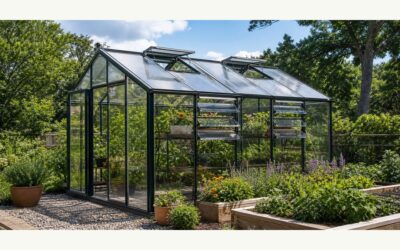



Un bon ventilateur d’aération pour serre aide à évacuer l’air chaud et humide afin que les plantes ne restent pas dans des conditions stagnantes. Ce guide s’adresse aux jardiniers amateurs, aux cultivateurs disposant de peu d’espace et aux propriétaires qui souhaitent améliorer la circulation de l’air dans une serre, un espace de culture de type abri ou une petite structure de jardin. Pour plus de conseils sur les serres et le rangement, consultez notre catégorie Serres et rangements de jardin.
En juillet 2026, nous avons comparé 25 produits proposés entre 25,99 $ et 198,89 $, notamment des modèles SHENVITASO, Ecocalm, VEVOR et d’autres ventilateurs d’aération adaptés aux serres. Nous nous sommes concentrés sur les débits d’air, la source d’alimentation, les fonctions de thermostat ou de contrôleur, les volets ou la protection anti-refoulement, la compatibilité d’installation, les caractéristiques liées aux intempéries lorsqu’elles étaient indiquées, ainsi que l’adéquation claire du produit avec l’usage au jardin.
iLIVING ILG8SF12V-ST 12-Inch Wall-Mounted Exhaust Fan for Greenhouse and Workshop Ventilation Windigaga 8-Inch Shutter Exhaust Fan for Greenhouses, Sheds, and Garden Workspaces Amico 12-Inch Shutter Exhaust Fan with Thermostat for Greenhouses, Garages, and Sheds iLIVING ILG8SF20V-ST 20-Inch Wall-Mounted Shutter Exhaust Fan for Greenhouse and Garage Ventilation Prices and availability can change. We may earn a commission from qualifying purchases.


Certaines fiches ci-dessous restent en anglais ; leur traduction est en cours de révision.
Pros
- Strong listed airflow for greenhouse, garage, workshop, and similar ventilation tasks
- Adjustable airflow and temperature controls offer more flexibility than a basic on-or-off exhaust fan
- UL/cUL Listed design with wire guards and a corrosion-resistant metal construction
Cons
- Wall mounting and 115V electrical installation may require more planning than a portable ventilation solution
- The listed noise level is below 65 dB, so it may be less suitable for gardeners seeking very quiet operation
- Its 12-inch fan size and 15-inch housing may not fit every wall opening or small indoor growing setup
The iLIVING ILG8SF12V-ST is a 12-inch wall-mounted shutter exhaust fan designed to remove air from utility and growing spaces. Its listed applications include greenhouses, garages, workshops, warehouses, and dust extraction areas, making it a practical option for homeowners who need fixed ventilation rather than a portable fan.
Based on the listed specifications, the fan exchanges air at up to 960 cubic feet per minute and is described as covering areas up to 1,400 square feet. In a greenhouse, that airflow can support general air exchange, while in a workshop or garage it can help move warm or stale air out of the space. Actual results will depend on the room layout, wall opening, and installation conditions.
The fan uses a direct-drive motor with 12-inch blades, a galvanized steel frame, aluminum shutters, and aluminum fan blades. Variable speed control allows the airflow to be adjusted, and the included thermal control has a stated range of 32 to 130°F. The automatic shutter design is intended for wall-mounted use, but the supplied information does not specify installation hardware or the exact wall-opening requirements.
For backyard gardeners, the most relevant use is fixed ventilation in a greenhouse or garden workshop. It may also suit a garage used for potting, tool maintenance, or seasonal plant work. The 15 x 15 x 5.75-inch dimensions and 10.15-pound weight should be considered when planning the mounting location, especially where wall space is limited.
This is a 115V electrical appliance, so installation should follow applicable electrical requirements and the product's instructions. The listed noise level is below 65 dB, which is not necessarily quiet for a nearby patio or living area. Overall, it is a reasonable choice for users who need adjustable, wall-mounted ventilation in a greenhouse or utility space, while gardeners seeking a small, silent, or easily movable fan may prefer a different design.
Best For / Avoid If
Best for buyers prioritizing
- Strong listed airflow for greenhouse, garage, workshop, and similar ventilation tasks
- Adjustable airflow and temperature controls offer more flexibility than a basic on-or-off exhaust fan
- UL/cUL Listed design with wire guards and a corrosion-resistant metal construction
Consider another option if
- Wall mounting and 115V electrical installation may require more planning than a portable ventilation solution
- The listed noise level is below 65 dB, so it may be less suitable for gardeners seeking very quiet operation
- Its 12-inch fan size and 15-inch housing may not fit every wall opening or small indoor growing setup
Pros
- Useful temperature-based automation for greenhouses, sheds, and other enclosed growing or work areas.
- Compact 8-inch format with a lightweight 5.07-pound body and remote operation.
- Automatic shutters provide a practical barrier when the fan is not running.
- ETL listing and a grounded cord add useful safety information for a powered ventilation product.
Cons
- Wall-mounted installation requires creating or preparing an appropriately sized opening, so it is not a plug-in solution for every space.
- The 4.9-foot and 2.6-foot cord lengths may limit controller and outlet placement in some installations.
- Gardeners needing ventilation for a large or unusually shaped structure may need to determine whether one 8-inch fan provides enough airflow for that specific space.
The Windigaga 8-inch shutter exhaust fan is a wall-mounted ventilation product for enclosed areas such as greenhouses, sheds, garages, workshops, basements, and chicken coops. For gardeners, its main job is to move warm, damp, smoky, or stale air out of a growing or utility space, making it a practical option for homeowners who need more controlled air circulation.
Its listed 760 CFM airflow, three fan speeds, and thermostat range of 32°F to 140°F provide several ways to manage ventilation. In Auto Mode, the fan can turn on or off around a selected temperature, which may reduce the need for frequent manual adjustments in a greenhouse or shed. The 18-hour timer and remote control add convenience for routine operation.
The fan has a galvanized steel frame, aluminum blades, and automatic louvers that open while operating and close when powered off. The louvers are designed to help block rain, dust, wind, and pests, while built-in sound-absorbing padding is intended to reduce vibration. The listed dimensions are 7.8 by 11 by 10.8 inches, and the unit weighs 5.07 pounds.
In a backyard greenhouse, this fan could help move excess heat and moisture, while a shed or workshop may benefit from removing odors and stagnant air. The compact format may also suit smaller utility spaces, but the product information does not specify a coverage area, so users should match the airflow to the size and layout of their structure rather than assume one fan will serve every space.
Installation still requires a suitable wall cutout and access to power. The included template and prewired 4.9-foot controller-to-plug cord and 2.6-foot fan-to-controller cable may simplify setup, but their lengths can affect placement. The ETL-listed grounded cord is a useful safety feature, and users should follow the installation instructions and confirm that the wall location, opening, and electrical setup are appropriate. This fan is a good fit for gardeners wanting automated ventilation in an enclosed space, while those needing portable airflow or a specified large-area capacity may prefer a different solution.
Best For / Avoid If
Best for buyers prioritizing
- Useful temperature-based automation for greenhouses, sheds, and other enclosed growing or work areas.
- Compact 8-inch format with a lightweight 5.07-pound body and remote operation.
- Automatic shutters provide a practical barrier when the fan is not running.
Consider another option if
- Wall-mounted installation requires creating or preparing an appropriately sized opening, so it is not a plug-in solution for every space.
- The 4.9-foot and 2.6-foot cord lengths may limit controller and outlet placement in some installations.
- Gardeners needing ventilation for a large or unusually shaped structure may need to determine whether one 8-inch fan provides enough airflow for that specific space.
Pros
- Strong airflow for ventilating larger enclosed garden and utility spaces.
- Automatic temperature control plus eight manual speed options.
- Compact 12-inch fan size with a durable metal-and-aluminum construction.
Cons
- Installation still requires a correctly sized wall or window opening, and the listed dimensions should be checked before cutting.
- A 120V outlet must be available because this is a plug-in fan, not a battery-powered unit.
- Gardeners needing quiet, low-volume circulation for a small patio greenhouse may find this type of exhaust fan more capacity than necessary.
The Amico 12-inch shutter exhaust fan is designed to remove warm, humid, or stale air from enclosed spaces such as greenhouses, sheds, workshops, garages, and similar utility areas. Its 1282 CFM airflow makes it more appropriate for larger spaces than for gentle air circulation around a small patio growing area.
For garden use, the main benefit is active ventilation rather than direct plant lighting or watering. The fan can help move heated or moisture-laden air out of a greenhouse or shed, while the thermostat probe is intended to turn the fan on when the selected temperature is reached. Eight speed settings provide more control than a simple single-speed exhaust fan.
The unit measures 14.2 by 14.2 by 6.3 inches and uses a 12-inch fan format. It has a galvanized steel frame, aluminum blades, automatic gravity louvers, and a pre-wired 120V plug with an extra-long power cord. Before installation, confirm that the available wall or window opening can accommodate the fan and that the outlet and mounting location are suitable.
Possible applications include exhausting hot air from a greenhouse during warm weather, reducing stale air in a garden shed, or improving ventilation in a workshop where odors and moisture accumulate. The thermostat and power-off memory may be useful for homeowners who want repeatable settings without readjusting the controls after every power interruption.
The listed design includes louvers intended to close when the fan is off and help block drafts, rain, and insects, but the fan should still be installed according to the manufacturer's instructions and protected from conditions beyond its stated use. This model is a practical choice for larger enclosed spaces needing powered exhaust, while gardeners seeking only gentle circulation, cordless operation, or a compact tabletop fan should consider a different type of product.
Best For / Avoid If
Best for buyers prioritizing
- Strong airflow for ventilating larger enclosed garden and utility spaces.
- Automatic temperature control plus eight manual speed options.
- Compact 12-inch fan size with a durable metal-and-aluminum construction.
Consider another option if
- Installation still requires a correctly sized wall or window opening, and the listed dimensions should be checked before cutting.
- A 120V outlet must be available because this is a plug-in fan, not a battery-powered unit.
- Gardeners needing quiet, low-volume circulation for a small patio greenhouse may find this type of exhaust fan more capacity than necessary.
Pros
- Strong listed airflow capacity for ventilating larger enclosed spaces.
- Adjustable speed and temperature controls provide more control than a basic exhaust fan.
- UL/cUL-listed construction with wire guards and a permanently lubricated motor.
Cons
- At 26 pounds and approximately 23 by 23 inches, it may require a sturdy wall opening and careful installation.
- The listed noise level is below 69 dB, so gardeners seeking especially quiet greenhouse or backyard operation may prefer a quieter model.
- This is a wall-mounted exhaust unit, so it may be less suitable for temporary, portable, or small patio ventilation needs.
The iLIVING ILG8SF20V-ST is a 20-inch wall-mounted shutter exhaust fan intended for moving air through utility spaces such as greenhouses, garages, workshops, warehouses, and areas used for dust extraction. For home gardeners, it is most relevant when a growing space needs active exhaust ventilation rather than a small clip-on or portable fan.
Based on the listed specifications, the fan can exchange air at up to 3,368 cubic feet per minute and is described for coverage up to 5,000 square feet. That airflow capacity may help remove hot, stale, or dusty air from a larger greenhouse or work area, although actual results will depend on the room layout, wall opening, and other ventilation paths.
The unit includes variable-speed control and temperature regulation through the listed Thermospeed controller, with a control range of 32 to 130°F. Its automatic shutters are designed to open with the fan, while the galvanized steel frame, aluminum shutters, and fan blades provide a utility-focused design. The approximately 23 by 23 inch body weighs 26 pounds, so installation should be planned around a suitably strong wall and an appropriate electrical connection.
In a backyard greenhouse, this fan could serve as a primary exhaust point for managing warm air when paired with a suitable air intake. It may also be useful in a garden workshop or garage where tools, soil handling, or other projects create heat and airborne dust. Wall mounting preserves floor and bench space, which is helpful when the available work area is limited.
The listed noise level is below 69 dB, which may be noticeable in a quiet backyard or greenhouse. Users should follow applicable electrical and installation requirements, keep the guarded fan clear of obstructions, and confirm that the wall opening and support structure are appropriate before installation. The fan is a strong candidate for gardeners needing high-volume, adjustable exhaust ventilation, while those with a small patio setup or a need for portable, very quiet airflow may prefer a different design.
Best For / Avoid If
Best for buyers prioritizing
- Strong listed airflow capacity for ventilating larger enclosed spaces.
- Adjustable speed and temperature controls provide more control than a basic exhaust fan.
- UL/cUL-listed construction with wire guards and a permanently lubricated motor.
Consider another option if
- At 26 pounds and approximately 23 by 23 inches, it may require a sturdy wall opening and careful installation.
- The listed noise level is below 69 dB, so gardeners seeking especially quiet greenhouse or backyard operation may prefer a quieter model.
- This is a wall-mounted exhaust unit, so it may be less suitable for temporary, portable, or small patio ventilation needs.

Pros
- Strong listed airflow for clearing warm, humid, or stale air from enclosed garden areas.
- Thermostat, timer, speed settings, and remote offer flexible hands-free control.
- Automatic shutters and corrosion-resistant materials add practical value for utility spaces.
Cons
- An 8-inch fan may be less suitable for large structures or spaces that need broader air exchange.
- Wall installation still requires a correctly sized opening and a suitable location near power, even though the unit uses a plug-and-play design.
The Ehiair 8-inch shutter exhaust fan is designed to move stale air out of enclosed spaces such as greenhouses, sheds, workshops, garages, attics, basements, and chicken coops. For home gardeners, it is most relevant when heat, humidity, odors, smoke, or dust build up in a utility area and passive vents do not provide enough air movement.
Based on the listed specifications, the fan delivers 760 CFM airflow through a three-blade design, which should provide useful ventilation for an appropriately sized space. The thermostat includes Low-Temp and High-Temp modes, a 32°F to 140°F range, three speeds, and an 18-hour timer, allowing gardeners to adjust operation as conditions change rather than running the fan continuously.
The wall-mounted design measures 5 x 10.95 x 10.55 inches and weighs 6.2 pounds. Installation is presented as plug and play, with a cutout template and no wiring required, but the wall opening and placement still need to be planned carefully. The controller-to-plug cord is 4.9 feet, while the fan-to-controller cable is 2.6 feet, so check the layout and nearby outlet before mounting.
In a backyard greenhouse, the thermostat could help manage warm daytime conditions, while a shed or workshop may benefit from scheduled ventilation after dusty or odor-producing tasks. The remote is listed with a 66-foot range, which may be convenient when the fan is mounted high or in a less accessible area. For small-space gardening, the unit is more suitable for ventilating an enclosed structure than for moving air across an open patio or yard.
The galvanized steel frame, aluminum blades, grounded power cord, ETL certification, dual ball bearings, and stated noise level of 40 dB or less are useful design details for regular operation. Gardeners should keep the fan opening and blades clear of accumulated dust, confirm that the installation location is appropriate for the intended environment, and follow electrical and mounting instructions. This is a sensible choice for homeowners who want adjustable ventilation in a small to medium utility space, while those with larger structures or a need for broad-area air circulation may prefer a larger ventilation system.
Best For / Avoid If
Best for buyers prioritizing
- Strong listed airflow for clearing warm, humid, or stale air from enclosed garden areas.
- Thermostat, timer, speed settings, and remote offer flexible hands-free control.
- Automatic shutters and corrosion-resistant materials add practical value for utility spaces.
Consider another option if
- An 8-inch fan may be less suitable for large structures or spaces that need broader air exchange.
- Wall installation still requires a correctly sized opening and a suitable location near power, even though the unit uses a plug-and-play design.

Pros
- Nine speed settings provide more control than a basic single-speed exhaust fan.
- Remote operation, timer control, and power-off memory can make routine ventilation more convenient.
- The compact 10-inch format may fit wall ventilation projects where a larger fan is impractical.
- The stated 42 dB operating level is a useful consideration for spaces near conversations or livestock.
Cons
- A wall opening and secure mounting are still required, so plug-in setup does not eliminate installation work.
- The listed dimensions are 6.3 x 12.3 x 12.3 inches, and gardeners should confirm available wall space and cutout requirements before buying.
- The product data does not specify coverage area, included mounting hardware, or detailed maintenance instructions.
The Amico 10-inch shutter exhaust fan is designed to move air through a wall in spaces where heat, stale air, or odors need to be reduced. For gardeners, it may be useful in a shed, greenhouse-adjacent work area, basement, or chicken coop, although the supplied information does not specify a greenhouse coverage area or plant-growing performance.
Its main performance feature is listed airflow of 1000 CFM, with a stated motor speed of 2100 RPM. Nine speed settings allow the user to choose a lower airflow for routine ventilation or a higher setting when a space needs faster air exchange. The listed 42 dB operation may be preferable where excessive fan noise would be distracting.
The fan measures 6.3 x 12.3 x 12.3 inches and has a silver finish. A remote control provides access to nine speeds and a 1-8 hour timer, while the listed power-off memory function is intended to retain settings after a power outage. The gravity-operated louvers close when the fan is off, helping limit backflow and entry of dust, insects, and rain according to the product information.
Installation is described as plug-in rather than hardwired, and a 1:1 cutting template is included to help mark the wall opening. This can be convenient for a homeowner planning ventilation in a shed or workshop, but the wall must still be suitable for the installation, and the opening, mounting method, outlet location, and local electrical requirements should be confirmed before work begins.
The product information does not provide a coverage area, mounting-hardware list, or detailed cleaning instructions. Keep the fan and plug protected from unsuitable moisture exposure, inspect the louvers and airflow path for accumulated dust, and follow the supplied installation and safety guidance. It is a reasonable option for users wanting adjustable wall ventilation and remote control, while gardeners needing a portable fan, a specified greenhouse ventilation plan, or detailed installation accessories may prefer a product with those details clearly documented.
Best For / Avoid If
Best for buyers prioritizing
- Nine speed settings provide more control than a basic single-speed exhaust fan.
- Remote operation, timer control, and power-off memory can make routine ventilation more convenient.
- The compact 10-inch format may fit wall ventilation projects where a larger fan is impractical.
Consider another option if
- A wall opening and secure mounting are still required, so plug-in setup does not eliminate installation work.
- The listed dimensions are 6.3 x 12.3 x 12.3 inches, and gardeners should confirm available wall space and cutout requirements before buying.
- The product data does not specify coverage area, included mounting hardware, or detailed maintenance instructions.

Pros
- Adjustable fan direction can create targeted circulation without depending on a motorized oscillation function.
- Compact clip-on design is useful where tent or greenhouse space is limited.
- Separate cords and long 8-foot leads allow the two fans to be positioned in different locations.
Cons
- Because the fans do not oscillate, gardeners must manually reposition them when airflow needs change.
- The maximum listed noise level of 53 dBA may be noticeable in quiet indoor areas.
- No coverage area is specified, so larger greenhouses may require additional airflow equipment.
The erifyng dual grow tent fan is designed to circulate air around plants in grow tents, greenhouses, and other compact growing areas. Its two 5-inch fan units use clip-on mounts and manually adjustable joints, making it a practical fit for gardeners who need directed airflow rather than a conventional oscillating fan.
The feature set suggests useful flexibility for managing air movement around different plant areas. Each fan can be aimed as needed, and the three speed settings allow a gentler breeze or stronger circulation. The listed maximum output is up to 330 CFM at 3,700 RPM, while the lower setting is specified at 37 dBA.
Installation is based on a manually tightened clamp that fits poles or edges measuring 0.5 to 2 inches. The listed dimensions are 4 x 5.6 x 5.6 inches, so the fans should occupy relatively little space inside a tent or near greenhouse framing. Two 8-foot cords and an AC-to-DC adapter give the setup more placement flexibility, and the product information indicates it can work with a timer or thermostat.
This design may work well in a small grow tent, a compact greenhouse, or a patio growing area where plants need more consistent air movement. The adjustable heads can be directed toward crowded foliage, corners, or separate plant sections, but the product data does not specify a coverage area for larger structures.
The fans are listed with brushless DC motors rated for a service life of up to 67,000 hours and an IP54 rating for humid environments. Keep the adapter and electrical connections away from direct water, check that each clamp is secure, and allow adequate clearance around the fan openings. Since the system does not oscillate, manual repositioning may be needed as plants grow or the layout changes.
This fan system is a reasonable choice for growers who value compact mounting, adjustable direction, and separate dual-fan placement. Gardeners needing broad coverage, built-in oscillation, or a documented greenhouse coverage rating may prefer a different ventilation setup.
Best For / Avoid If
Best for buyers prioritizing
- Adjustable fan direction can create targeted circulation without depending on a motorized oscillation function.
- Compact clip-on design is useful where tent or greenhouse space is limited.
- Separate cords and long 8-foot leads allow the two fans to be positioned in different locations.
Consider another option if
- Because the fans do not oscillate, gardeners must manually reposition them when airflow needs change.
- The maximum listed noise level of 53 dBA may be noticeable in quiet indoor areas.
- No coverage area is specified, so larger greenhouses may require additional airflow equipment.
Pros
- Useful airflow capacity for greenhouse, shed, garage, attic, workshop, basement, and chicken-coop ventilation.
- Hands-free temperature control with three speeds, a timer, and remote access.
- Closing shutters and corrosion-resistant materials are practical features for enclosed garden spaces.
- Grounded power cord and ETL certification provide documented electrical safety features.
Cons
- A 10-inch wall-mounted fan may be less suitable for large buildings or spaces that need multiple ventilation points.
- Installation still requires a properly sized wall opening and secure mounting, even though the power connection is plug-and-play.
- The supplied cable lengths may limit controller and outlet placement in some layouts.
The Ehiair 10-inch shutter exhaust fan is designed to move air through enclosed spaces such as greenhouses, sheds, workshops, garages, basements, attics, and chicken coops. For gardeners, its main use is helping remove excess heat, humidity, dust, smoke, and odors where natural airflow is not enough. The feature set is most relevant to homeowners managing a dedicated growing or utility area.
Based on the listed specifications, the fan provides 890 CFM airflow from a 36W motor. That combination suggests a practical balance between strong ventilation and modest electrical demand, although the suitable space size will depend on the building layout and other ventilation openings. Three speed settings allow users to adjust airflow, while the thermostat can operate in Low-Temp or High-Temp mode within a 32°F to 140°F range.
The wall-mounted design includes a controller, a 66-foot remote, an 18-hour timer, and automatic shutters. The shutters open while the fan runs and close when it stops, helping reduce the entry of rain, dust, wind, and insects. A galvanized steel frame, aluminum blades, and sound-absorbing padding on the shutter edges are listed design features for humid or dusty areas. The fan measures 5 by 10.8 by 10.8 inches and weighs 6.39 pounds.
In a backyard greenhouse, this fan could help exchange warm, humid air during periods of high temperature. It may also be useful in a garden shed or workshop where odors, dust, or stagnant air build up, and in a chicken coop where automatic temperature-based operation is convenient. The included cutout template can make it easier to mark the opening, while the 4.9-foot controller-to-plug cord and 2.6-foot fan-to-controller cable help define placement options.
Users should confirm that the wall can accommodate the listed dimensions and that the installation location provides a suitable opening, secure mounting, and safe access to grounded power. The product information does not specify a coverage area, so larger structures may need a different ventilation arrangement. Gardeners seeking a compact, adjustable fan for an enclosed greenhouse or outbuilding may find this feature set useful, while those needing whole-building ventilation or a battery-powered option should consider alternatives.
Best For / Avoid If
Best for buyers prioritizing
- Useful airflow capacity for greenhouse, shed, garage, attic, workshop, basement, and chicken-coop ventilation.
- Hands-free temperature control with three speeds, a timer, and remote access.
- Closing shutters and corrosion-resistant materials are practical features for enclosed garden spaces.
Consider another option if
- A 10-inch wall-mounted fan may be less suitable for large buildings or spaces that need multiple ventilation points.
- Installation still requires a properly sized wall opening and secure mounting, even though the power connection is plug-and-play.
- The supplied cable lengths may limit controller and outlet placement in some layouts.
Pros
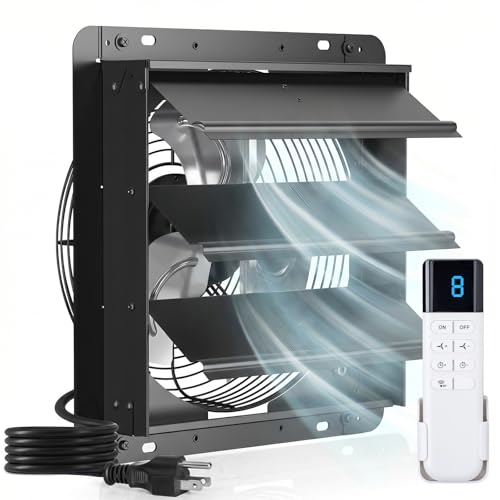
- Eight adjustable speeds provide more control than a single-speed exhaust fan.
- Remote control includes both speed adjustment and a 1-to-8-hour shutoff timer.
- All-metal construction may better resist deformation during handling and installation.
- Suitable for several enclosed garden and home utility spaces, including greenhouses, sheds, and garages.
Cons
- The corded design requires access to a suitable electrical outlet, which may limit placement.
- Installation still requires a properly sized wall opening and secure support, details that are not provided in the listing.
- Gardeners needing weather-resistance information or a battery-powered option will need to consider a different product.
The addlon 12-inch Shutter Exhaust Fan is designed to move air through enclosed spaces rather than provide direct cooling for people or plants. Based on the listed specifications, it is a practical fit for homeowners and gardeners who need wall-mounted ventilation in a greenhouse, shed, garage, workshop, attic, or similar utility area.
The product information lists airflow of 1250 CFPM, a 25W DC motor, and a maximum speed of 1948 rpm. Eight speed settings let users select a gentler or stronger airflow level, which can be useful when conditions change in a greenhouse or when a shed or workshop needs periodic air exchange.
The fan has an all-metal shutter, mesh cover, body, and connecting parts. The listed body dimensions are 12.01 by 12.01 by 5.91 inches, while the grille diameter is 14.97 inches and the louver opening is listed as 12.9 by 12.9 inches. It includes a remote control for power, speed, and a 1-to-8-hour timer, plus a bracket that can hold the remote in a convenient location.
The assembled, plug-and-play design may simplify setup for a suitable wall installation, and the 6.56-foot power cord can help with outlet placement. Potential uses include improving air circulation in a backyard greenhouse, ventilating a potting shed, or clearing stale air from a garage or workshop, provided the space has an appropriate mounting opening and secure support.
This is a corded wall-mounted fan, so it is not a flexible choice for locations without nearby power. The listing does not provide weather-resistance, mounting-hardware, or cleaning details, so the installation area should be selected carefully and the fan should be disconnected from power before maintenance. It is a reasonable option for gardeners who value adjustable ventilation and remote control, while those needing outdoor-rated protection, portable operation, or detailed installation guidance should compare other models.
Best For / Avoid If
Best for buyers prioritizing
- Eight adjustable speeds provide more control than a single-speed exhaust fan.
- Remote control includes both speed adjustment and a 1-to-8-hour shutoff timer.
- All-metal construction may better resist deformation during handling and installation.
Consider another option if
- The corded design requires access to a suitable electrical outlet, which may limit placement.
- Installation still requires a properly sized wall opening and secure support, details that are not provided in the listing.
- Gardeners needing weather-resistance information or a battery-powered option will need to consider a different product.

Pros
- High listed airflow is suitable for ventilating larger enclosed garden-related spaces.
- Variable-speed and thermal controls provide more flexible ventilation management.
- Wall-mounted design preserves usable floor and growing space.
- Corrosion-resistant construction and permanently lubricated motor may simplify routine upkeep.
Cons
- At 18 inches and 16.7 pounds, it may be more fan than needed for a small greenhouse, shed, or patio growing area.
- Wall mounting requires a suitable opening, structure, and electrical installation, none of which are detailed in the supplied information.
- The listed noise level is below 65 dB, so gardeners seeking very quiet operation may prefer a smaller or quieter ventilation option.
The iLIVING ILG8SF18V-ST is a wall-mounted shutter exhaust fan intended to remove warm or stale air from enclosed utility and growing spaces. For home gardeners, it is most relevant to larger greenhouses, workshops, garages, and garden storage areas where a small portable fan may not provide enough exhaust capacity.
Based on the listed specifications, the fan can exchange air at up to 1,736 cubic feet per minute and is identified for coverage up to 2,600 square feet. The variable-speed controller allows airflow to be adjusted, while the thermal control provides temperature-based regulation from 32 to 130°F. These features may help gardeners manage heat buildup more precisely than a basic single-speed exhaust fan.
The unit uses an 18-inch fan assembly in a galvanized steel frame with aluminum shutters and fan blades. It measures 5.75 by 21 by 21 inches and weighs 16.7 pounds, so the wall and opening must be able to accommodate its size and weight. Its automatic shutters and wall-mounted design keep the ventilation equipment organized and leave floor, bench, and growing space available.
Possible uses include exhausting hot air from a greenhouse, clearing air from a garden workshop, or improving ventilation in a garage used for potting and tool maintenance. The product information also identifies it for dust extraction, although the supplied data does not specify filtration or dust-handling procedures, so users should plan the installation and work practices accordingly.
The listed noise level is below 65 dB, which may be noticeable in a quiet backyard or small growing room. Electrical installation should follow applicable requirements, and users should confirm that the wall opening, mounting surface, airflow path, and intended controls are appropriate before installation. The permanently lubricated motor may reduce routine lubrication needs, but the supplied information does not detail cleaning intervals or replacement parts.
This fan is a sensible fit for gardeners who need substantial, controllable exhaust in a greenhouse, garage, or workshop and have a suitable wall location. Those with a compact greenhouse, patio setup, or low ventilation demand may prefer a smaller fan that takes less space and produces less operating noise.
Best For / Avoid If
Best for buyers prioritizing
- High listed airflow is suitable for ventilating larger enclosed garden-related spaces.
- Variable-speed and thermal controls provide more flexible ventilation management.
- Wall-mounted design preserves usable floor and growing space.
Consider another option if
- At 18 inches and 16.7 pounds, it may be more fan than needed for a small greenhouse, shed, or patio growing area.
- Wall mounting requires a suitable opening, structure, and electrical installation, none of which are detailed in the supplied information.
- The listed noise level is below 65 dB, so gardeners seeking very quiet operation may prefer a smaller or quieter ventilation option.
Pros
- Temperature-based operation is useful for enclosed growing and storage areas where heat buildup can be a concern.
- The compact 10-inch design and 5.07-pound weight may fit a range of wall-mounted ventilation projects.
- The listed 36W motor and noise level as low as 40 dB suggest a relatively efficient, quieter option for ongoing airflow.
- Automatic shutters provide a practical barrier when the fan is not running.
Cons
- As a wall-mounted exhaust fan, it requires a suitable opening, power outlet, and installation location, so it is not a portable ventilation solution.
- The product information does not specify a coverage area, so gardeners must determine whether 890 CFM fits the volume and ventilation needs of their space.
- Users needing detailed installation guidance, hardwiring, or specialized ducting compatibility may need information beyond the listed plug-in setup.
The Windigaga 10-inch shutter exhaust fan is designed to remove warm, damp, smoky, or stale air from enclosed utility and growing spaces. Its listed applications include greenhouses, sheds, workshops, garages, attics, basements, and chicken coops, making it most relevant for homeowners and gardeners who need fixed ventilation rather than a portable fan.
Its main performance feature is listed airflow of 890 CFM, which may help improve air movement and reduce heat or moisture buildup when the fan is correctly sized and installed for the space. A thermostat covering 32°F to 140°F can automatically turn the fan on or off at a selected temperature, while three speeds and an 18-hour timer provide additional control.
The fan has a black galvanized steel frame, aluminum blades, and a three-blade design. It measures 7.8 by 10.8 by 10.8 inches and weighs 5.07 pounds. The automatic louvers open during operation and close when powered off, helping limit exposure to rain, dust, wind, and pests. The package information also lists a wall cutout template, a 5.9-foot power cord, and a 2.6-foot fan-to-controller cable.
For backyard use, this fan could be considered for a greenhouse wall, a garden shed, or a workshop where heat and humidity accumulate. The remote control, with a listed range of 66 feet, may be useful when the fan is mounted above normal reach. Its thermostat mode can also reduce the need to enter the space repeatedly to adjust ventilation.
The product information does not provide a recommended room volume, installation depth, or detailed ducting compatibility, so sizing and wall preparation should be checked before purchase. Installation still requires a suitable wall opening and electrical location, and users should follow applicable electrical and building requirements. Based on the listed specifications, it is a practical choice for fixed ventilation in enclosed garden and utility spaces, while those needing portability or a documented coverage area may prefer a different option.
Best For / Avoid If
Best for buyers prioritizing
- Temperature-based operation is useful for enclosed growing and storage areas where heat buildup can be a concern.
- The compact 10-inch design and 5.07-pound weight may fit a range of wall-mounted ventilation projects.
- The listed 36W motor and noise level as low as 40 dB suggest a relatively efficient, quieter option for ongoing airflow.
Consider another option if
- As a wall-mounted exhaust fan, it requires a suitable opening, power outlet, and installation location, so it is not a portable ventilation solution.
- The product information does not specify a coverage area, so gardeners must determine whether 890 CFM fits the volume and ventilation needs of their space.
- Users needing detailed installation guidance, hardwiring, or specialized ducting compatibility may need information beyond the listed plug-in setup.

Pros
- Flexible two-fan configuration for different intake and exhaust layouts.
- Solar operation can avoid adding routine electrical use for daytime ventilation.
- Outdoor-focused construction includes a weatherproofed kit, metal guards, and a stated operating range of -13°F to 140°F.
Cons
- There is no built-in battery, so the fans stop at night and on rainy conditions, while airflow can weaken in limited sunlight.
- The specifications do not provide an airflow rating or recommended coverage area, making sizing for a particular greenhouse or attic difficult.
- Installation may require choosing suitable mounting locations and ensuring the solar panel receives sufficient sunlight.
The FDJTPOIU solar powered fan kit is designed to move air through outdoor and semi-enclosed spaces, including chicken coops, pet houses, attics, sheds, and greenhouses. Its two separate 5-inch fans make it a practical option for homeowners who need daytime ventilation without relying on a standard electrical connection.
A 25W solar panel powers both fans and is intended to help exhaust hot indoor air and bring fresher air into the space. The two fans can be set up as exhaust fans, intake fans, or one of each, giving gardeners more flexibility when planning airflow through a small structure.
The listed kit includes installation guidance, fix plates, and a screw kit. The product information lists dimensions of 18 x 12 x 18 inches and a weight of 1 pound. The weatherproofed design, shockproof and drop-resistant housing, and outer metal mesh are intended for outdoor use, while the guards help keep children and small animals away from the fan blades.
In a backyard setting, the kit could be useful for a sunny greenhouse, shed, chicken coop, or pet shelter that becomes hot during the day. It may also fit small ventilation projects where separate intake and exhaust positions are helpful, although the supplied specifications do not state an airflow rating or coverage area.
The main limitation is its dependence on sunlight. There is no built-in battery, airflow strength varies with sunlight intensity, and the fans stop at night and on rainy days. Position the solar panel where it can receive sufficient sunlight, follow the installation guidance, and keep the guarded fans securely mounted. Based on the listed features, this kit is a reasonable choice for daytime ventilation in small outdoor structures, while gardeners needing continuous overnight or weather-independent operation should consider a system with battery storage or another power source.
Best For / Avoid If
Best for buyers prioritizing
- Flexible two-fan configuration for different intake and exhaust layouts.
- Solar operation can avoid adding routine electrical use for daytime ventilation.
- Outdoor-focused construction includes a weatherproofed kit, metal guards, and a stated operating range of -13°F to 140°F.
Consider another option if
- There is no built-in battery, so the fans stop at night and on rainy conditions, while airflow can weaken in limited sunlight.
- The specifications do not provide an airflow rating or recommended coverage area, making sizing for a particular greenhouse or attic difficult.
- Installation may require choosing suitable mounting locations and ensuring the solar panel receives sufficient sunlight.
Pros
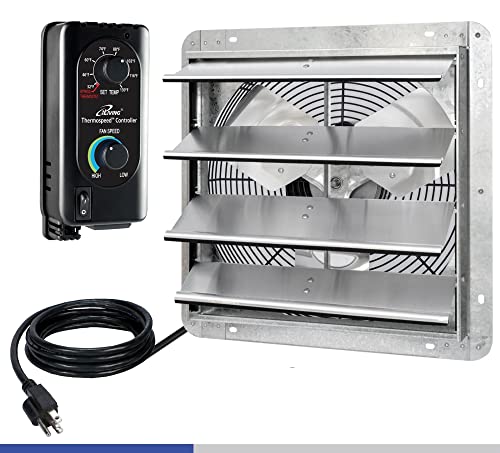
- Combines airflow adjustment with temperature control for more flexible greenhouse or workshop ventilation.
- The 1,200 CFM rating and listed coverage up to 1,800 square feet suit larger enclosed spaces.
- UL/cUL listing, wire guards, and corrosion-resistant construction add useful safety and durability features according to the supplied specifications.
Cons
- At 13.8 pounds and approximately 19 by 19 inches, it may require a sturdy, properly sized wall opening and mounting surface.
- This is a powered wall-mounted ventilator, so gardeners seeking a portable or low-installation solution may prefer a different fan type.
The iLIVING ILG8SF16V-ST is a 16-inch wall-mounted shutter exhaust fan designed to remove warm or stale air from enclosed utility and growing spaces. Its intended uses include greenhouses, garages, workshops, warehouses, and dust-extraction areas, making it most suitable for homeowners or gardeners who need powered ventilation rather than a small portable fan.
Based on the listed specifications, the fan can exchange air at up to 1,200 cubic feet per minute and is described as covering up to 1,800 square feet. The deep-pitch fan blades and 1,550 RPM motor are intended to support strong air movement, while the variable speed controller allows the airflow to be adjusted for changing conditions.
The built-in thermal control has a listed range of 32 to 130°F, which can help users manage ventilation more deliberately in a greenhouse or enclosed work area. The unit measures approximately 5.75 by 19 by 19 inches and weighs 13.8 pounds. Its wall-mount format can preserve floor space, but the mounting location and opening should be checked carefully before installation.
For backyard use, this fan may fit a larger greenhouse where heat buildup needs to be reduced, or a garage and workshop where air exchange is important. The automatic shutters are designed to close when the fan is not running, and the galvanized steel frame with aluminum shutters and blades provides a utility-focused construction for these settings.
The product information lists a noise level below 65 dB, a permanently lubricated direct-drive motor, OSHA-compliant wire guards, and UL/cUL listing. Users should still confirm the 115-volt electrical setup, mounting dimensions, and local installation requirements before use. This fan is a good candidate for fixed ventilation in a larger enclosed space, while gardeners needing quiet, portable, or simple plug-in airflow may want a different option.
Best For / Avoid If
Best for buyers prioritizing
- Combines airflow adjustment with temperature control for more flexible greenhouse or workshop ventilation.
- The 1,200 CFM rating and listed coverage up to 1,800 square feet suit larger enclosed spaces.
- UL/cUL listing, wire guards, and corrosion-resistant construction add useful safety and durability features according to the supplied specifications.
Consider another option if
- At 13.8 pounds and approximately 19 by 19 inches, it may require a sturdy, properly sized wall opening and mounting surface.
- This is a powered wall-mounted ventilator, so gardeners seeking a portable or low-installation solution may prefer a different fan type.

Pros
- Combines temperature and humidity sensing with manual speed control.
- Automatic shutters provide a barrier when the fan is not running.
- Plug-in installation can be more approachable than a fully hardwired fan setup.
- The remote is listed with a range of up to 50 feet, allowing control from a distance.
Cons
- It still requires a suitable window or wall opening, and cutting or mounting work may be needed for permanent installation.
- The supplied information does not specify an outdoor weather-resistance rating, so placement and protection should be considered carefully.
- Gardeners needing a fan with a different voltage, smaller footprint, or documented airflow coverage may prefer another model.
The Amico 10-inch shutter exhaust fan is designed to remove hot or humid air from an enclosed space. For garden-related use, it may suit a chicken coop, garden outbuilding, or another appropriate window or wall opening where controlled ventilation is needed. Its automatic controls make it more suitable for gardeners who do not want to monitor conditions constantly.
Based on the listed specifications, the fan delivers 1068 CFM through a 13W brushless DC motor running at 2035 RPM. The system can respond to selected high and low temperature settings, while its auto mode increases speed as temperature or humidity rises. These controls could help maintain more consistent airflow, but actual results will depend on the room, opening, layout, and outside conditions.
The fan includes eight speed settings, a 24-hour timer, a sensor probe, and a remote listed with up to 50 feet of range. It measures 6.3 by 10 by 10 inches and has a pre-wired 120V plug with an extra-long power cord. The included paper template may help with cutting a wall opening, although permanent installation still requires careful measuring, secure mounting, and suitable electrical placement.
Possible backyard applications include ventilating a chicken coop or helping move stale, warm air from a garden shed or similar enclosed space. The automatic gravity shutters are intended to close when the fan stops, which may help limit drafts, rain, and insects. The product information also lists 45 dB operation, a feature that may be helpful when the fan is located near animals, work areas, or the home.
Before installation, confirm that the opening, power source, and mounting location are appropriate for a 120V plug-in fan. The supplied information does not state an outdoor weather-resistance rating or define a recommended coverage area, so avoid assuming it is suitable for fully exposed locations or every greenhouse setup. The fan should be kept clear of obstructions, and the shutters and sensor should be checked periodically for dirt or blockage.
This model is a reasonable option for gardeners who want adjustable ventilation, automatic temperature and humidity response, and a plug-in setup. Consider a different option if you need documented outdoor weather protection, a hardwired installation, a smaller unit, or published guidance for a specific room size.
Best For / Avoid If
Best for buyers prioritizing
- Combines temperature and humidity sensing with manual speed control.
- Automatic shutters provide a barrier when the fan is not running.
- Plug-in installation can be more approachable than a fully hardwired fan setup.
Consider another option if
- It still requires a suitable window or wall opening, and cutting or mounting work may be needed for permanent installation.
- The supplied information does not specify an outdoor weather-resistance rating, so placement and protection should be considered carefully.
- Gardeners needing a fan with a different voltage, smaller footprint, or documented airflow coverage may prefer another model.
Pros
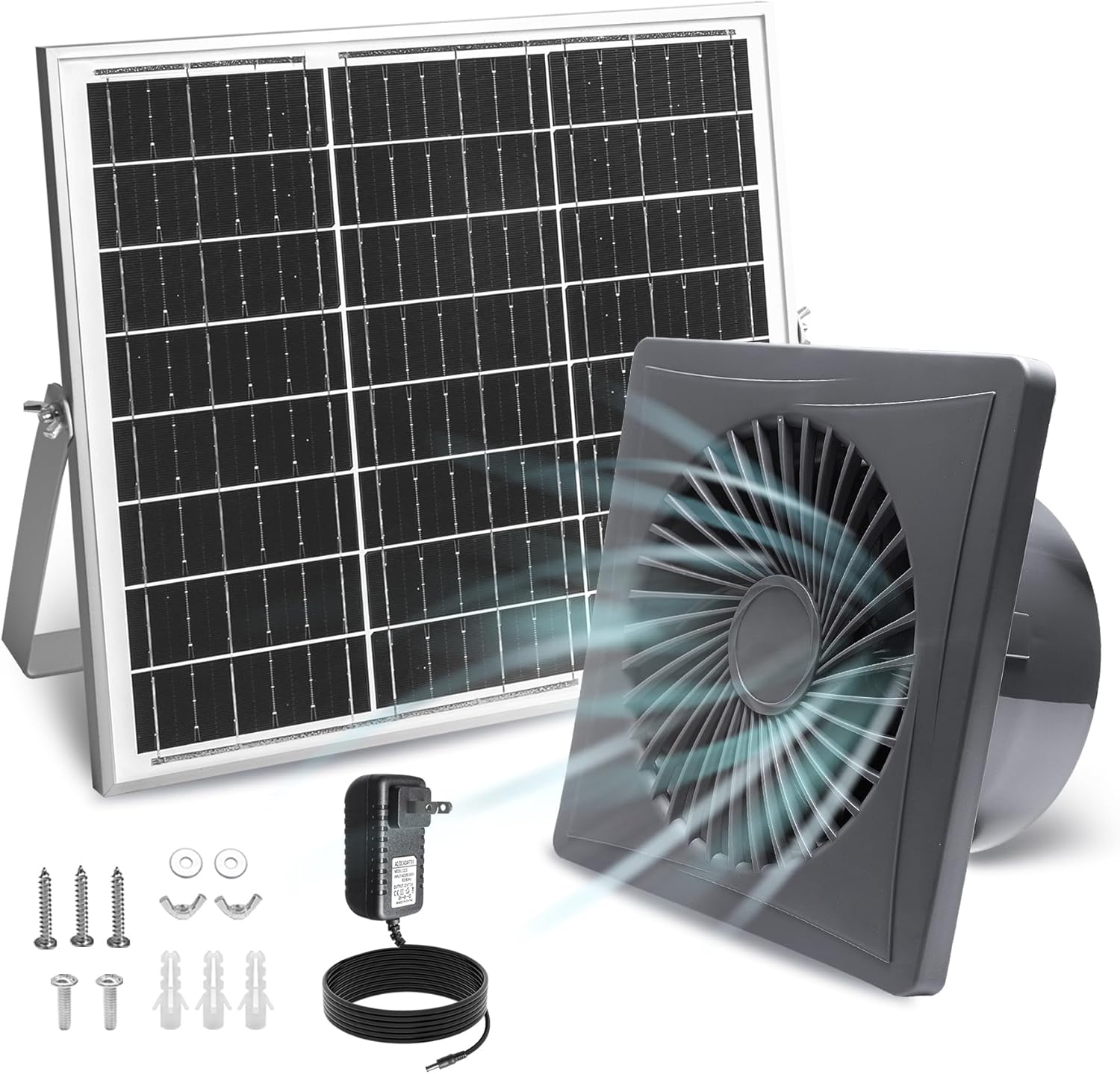
- Solar panel and household power adapter are both included for more flexible operation.
- Listed 36 dB noise level suggests relatively quiet ventilation for coops, sheds, or small greenhouses.
- Comes with bracket, solar panel, power adapter, and long cord needed for a basic installation.
- Wall-mount exhaust design is useful for removing warm, stale, humid, or dusty air from enclosed outdoor structures.
Cons
- Installation requires drilling a 7-inch hole, which may not suit renters or gardeners uncomfortable modifying a wall or shed panel.
- Solar performance will depend on sun exposure, panel placement, and weather, so shaded locations may need the power adapter more often.
- No battery runtime is listed, so gardeners wanting stored solar power overnight may need a different ventilation setup.
The SHENVITASO XJS-G8 is a solar exhaust fan kit made for ventilating small outdoor and utility spaces such as greenhouses, chicken coops, sheds, pet houses, garages, barns, RVs, and similar enclosed areas. For gardeners, its main job is to help move stale air out of a structure where heat, moisture, dust, or odors can build up.
According to the listed specifications, the kit pairs an 8-inch exhaust fan with a 25W monocrystalline solar panel. The fan is rated at 430 CFM, 2300 RPM, and 36 dB, giving it a useful mix of airflow and relatively low listed noise for small-space ventilation. The product information also notes a photovoltaic conversion efficiency of up to 21.5 percent for the panel.
The design includes a wall-mount fan, adjustable solar panel bracket, MC4 connector, push-button control, and a separate ON/OFF switch. A 16.4-foot solar panel cord helps with roof or sunny-wall placement, while the included power adapter with a 4.66-foot cable allows connection to household power when sunlight is not enough. Installation requires drilling a 7-inch hole and making the connection to the panel, so careful measuring and safe tool use are important.
In a backyard greenhouse, this fan may help exhaust hot, humid air during sunny periods. In a chicken coop or garden shed, it can support air exchange where odors, dust, or trapped heat are concerns. The anti-backflow valve is a helpful detail for outdoor structures because it is designed to stay closed when the fan is not running, helping limit outside insects, small animals, and reverse airflow through the opening.
The solar panel is listed with an IP67 waterproof rating, toughened glass surface, and aluminum frame, which supports outdoor use according to the product data. Still, placement matters. The panel should be aimed for the best available sun, wiring should be routed safely, and the fan opening should be positioned where exhaust air can leave freely. Periodic checks for dust, debris, and blocked vents will help keep airflow from being restricted.
This is a sensible option for homeowners and beginner-to-intermediate gardeners who want a ready solar ventilation kit with an AC power backup option. Gardeners who cannot cut a wall opening, need battery-backed overnight solar operation, or are ventilating a larger structure may want to compare other systems before choosing this one.
Best For / Avoid If
Best for buyers prioritizing
- Solar panel and household power adapter are both included for more flexible operation.
- Listed 36 dB noise level suggests relatively quiet ventilation for coops, sheds, or small greenhouses.
- Comes with bracket, solar panel, power adapter, and long cord needed for a basic installation.
Consider another option if
- Installation requires drilling a 7-inch hole, which may not suit renters or gardeners uncomfortable modifying a wall or shed panel.
- Solar performance will depend on sun exposure, panel placement, and weather, so shaded locations may need the power adapter more often.
- No battery runtime is listed, so gardeners wanting stored solar power overnight may need a different ventilation setup.

Pros
- Stepless speed regulation provides more control than a simple fixed-speed fan.
- The compact 4-inch format is practical for smaller ventilation installations.
- The feature set combines strong listed airflow with quiet operation and motor efficiency.
- Multiple safety features are included, including stall protection and a wide-voltage power adapter.
Cons
- A 4-inch inline fan may be less suitable for large greenhouses, workshops, or spaces requiring substantially higher airflow.
- The supplied information does not specify included ducting, mounting hardware, filters, or other installation accessories.
- Gardeners should confirm the required ducting and electrical setup before purchase because compatibility details are not provided.
The VIVOSUN 4-inch Pro is an inline exhaust fan for moving air through compact ventilation setups. It is intended for spaces such as grow tents, greenhouses, basements, bathrooms, kitchens, attics, and workshops, making it most relevant to homeowners and gardeners who need directed airflow rather than a general room fan.
Based on the listed specifications, the fan can deliver up to 130 CFM and uses an upgraded EC motor intended to provide efficient performance. For a small greenhouse or grow tent, that airflow may help exchange stale air and manage ventilation needs, although the right capacity depends on the size and layout of the space.
The stepless speed regulator allows users to adjust airflow instead of operating only at one fixed setting. Its compact dimensions of 6.38 by 3.86 by 3.86 inches and weight of about 1.17 pounds may help it fit into space-limited arrangements, but the supplied information does not identify mounting hardware, ducting, filters, or other included accessories.
Practical uses include ventilating a small greenhouse, improving air movement in a grow tent, or exhausting air from a home workshop or utility area. The listed 26dB(A) noise level may be useful where quieter operation matters, while the speed control can help users choose a gentler setting when full airflow is unnecessary.
The ABS plastic housing and PBT blades are specified for durability and resistance to deformation. Low-voltage safety features, a wide-voltage power adapter, and stall protection provide useful safeguards, but users should still follow appropriate electrical practices and confirm that the planned ducting and power arrangement are compatible. Overall, this fan appears best suited to compact ventilation projects that benefit from adjustable airflow, while larger spaces may require a higher-capacity option.
Best For / Avoid If
Best for buyers prioritizing
- Stepless speed regulation provides more control than a simple fixed-speed fan.
- The compact 4-inch format is practical for smaller ventilation installations.
- The feature set combines strong listed airflow with quiet operation and motor efficiency.
Consider another option if
- A 4-inch inline fan may be less suitable for large greenhouses, workshops, or spaces requiring substantially higher airflow.
- The supplied information does not specify included ducting, mounting hardware, filters, or other installation accessories.
- Gardeners should confirm the required ducting and electrical setup before purchase because compatibility details are not provided.

Pros
- Provides a substantial listed airflow level for a compact 8-inch ventilation fan.
- Automatic louvers help protect the opening from outside debris when the fan is not running.
- ETL-listed construction with grounding protection is a useful safety feature for an electrically powered fan.
- Its plug-and-play design may be convenient for homeowners who want to avoid hardwiring.
Cons
- An 8-inch fan may be less suitable for large barns, whole-house ventilation, or spaces needing multiple air exchanges.
- Installation still requires a properly sized wall opening, secure mounting, and a suitable power connection.
- The product information does not specify a thermostat, timer, speed control, or automatic humidity control.
The Windigaga 8-inch shutter exhaust fan is designed to remove stale, warm, humid, dusty, or odorous air from enclosed spaces. For backyard use, it may be a practical fit for a chicken coop, shed, workshop, attic, or small greenhouse, especially for homeowners who want a straightforward powered ventilation option.
Based on the listed specifications, the fan can provide up to 760 CFM of airflow through a 26W motor. That level of movement may help improve air circulation and reduce heat or humidity buildup, although the right fan size and quantity depend on the room dimensions, layout, and existing intake openings.
The fan uses three aluminum alloy blades, a galvanized steel housing, and coated shutter louvers. Its automatic shutters open when the fan operates and close when it stops, which may help limit incoming rain, insects, and dust. The listed dimensions are 6.5 by 10.8 by 10.8 inches, and the unit weighs 5.07 pounds.
For a small greenhouse or coop, this fan could be installed in a wall or suitable panel to exhaust warm air while allowing replacement air to enter through another opening. The included mounting hardware and 5.9-foot power cord are intended to simplify installation, but users should confirm the opening, mounting surface, airflow path, and electrical setup before installation.
The product information lists noise below 40 dB, corrosion-resistant construction, and ETL listing with grounding protection. Even so, gardeners should keep the fan and power connection appropriately protected from moisture, follow applicable electrical safety practices, and clean dust or debris from the fan and shutters as needed. It is a reasonable choice for small enclosed garden spaces, while larger buildings or users needing thermostatic control may prefer a larger or more feature-rich ventilation system.
Best For / Avoid If
Best for buyers prioritizing
- Provides a substantial listed airflow level for a compact 8-inch ventilation fan.
- Automatic louvers help protect the opening from outside debris when the fan is not running.
- ETL-listed construction with grounding protection is a useful safety feature for an electrically powered fan.
Consider another option if
- An 8-inch fan may be less suitable for large barns, whole-house ventilation, or spaces needing multiple air exchanges.
- Installation still requires a properly sized wall opening, secure mounting, and a suitable power connection.
- The product information does not specify a thermostat, timer, speed control, or automatic humidity control.
Pros
- Works without a conventional power outlet, useful for remote sheds, greenhouses, barns, and chicken coops.
- Thermostat control reduces the need to manually switch the fan on during hot parts of the day.
- Included battery provides backup ventilation after charging, rather than limiting operation only to direct sun.
- Reviewers commonly mention straightforward installation and effective airflow in greenhouse or coop uses.
- Metal build and screw-together style wiring noted in reviews suggest a more substantial setup than many lightweight plastic fan kits.
Cons
- Fan and battery performance may drop in cloudy weather or poorly positioned solar panel locations.
- Control setup may take patience, as at least one reviewer found the settings less intuitive at first.
- Gardeners needing guaranteed all-night ventilation or code-compliant attic ventilation should confirm the system meets their space and safety requirements before relying on it.
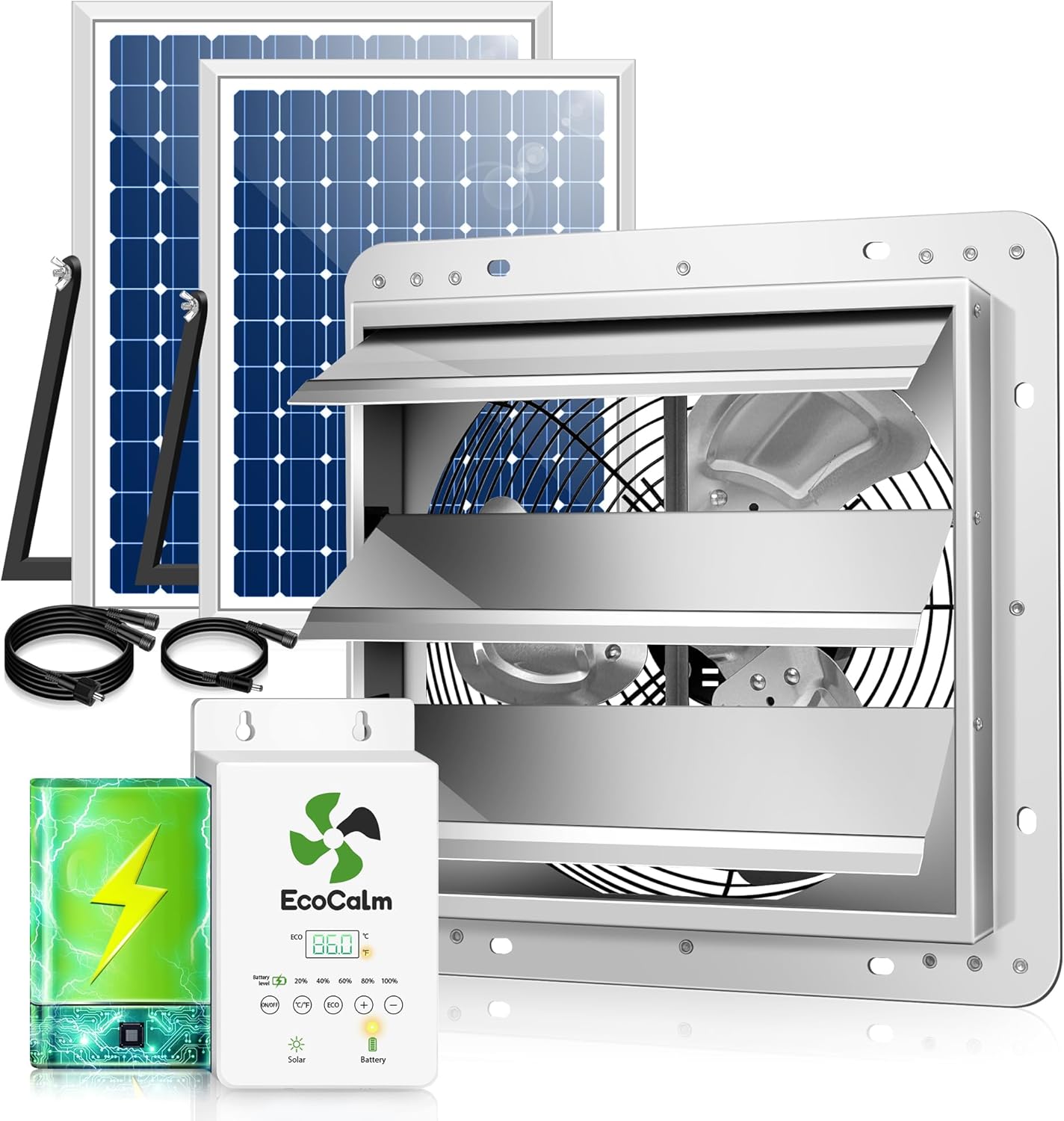
The ecoCalm KP-SEF240812 is a 12-inch solar powered exhaust fan made for moving hot, humid, or stale air out of enclosed spaces such as greenhouses, garden sheds, garages, attics, barns, and chicken coops. For gardeners, its most useful role is greenhouse ventilation, especially in backyard structures that do not have convenient access to a household electrical outlet.
Based on the listed specifications, the fan is rated at 680 CFM and is intended for spaces up to 1600 cubic feet. That puts it in a useful range for many small to midsize hobby greenhouses and outbuildings, provided there is also an intake opening so replacement air can enter. The product information also highlights cooling indoor temperatures, helping reduce mold-friendly conditions, and improving air quality through circulation.
The system includes two 30W bifacial solar panels, a 5000mAh rechargeable battery, and an intelligent power system that switches according to sunlight conditions. The battery is described as providing up to 6 hours of operation after a full charge in sunlight, though the product information clearly notes that fan output and battery charging are affected by cloudy weather. For best results, the panels need to be placed where they receive strong sun for much of the day.
Installation is listed for window or wall mounting, and the 14.8-foot cable gives some flexibility in locating the solar panels away from the fan opening. The fan uses metal construction, a DC motor, touch control, and IP44 waterproof fan blades. Reviewers commonly mention straightforward setup, quiet operation, and good results in small greenhouses and coops, although those comments should be treated as user experiences rather than guaranteed performance.
The adjustable thermostat is one of the more gardener-friendly features because it can cycle the fan on and off according to the temperature setting rather than requiring constant attention. That is helpful for seed starting areas, summer greenhouse use, or animal shelters where heat can build quickly. One practical setup tip is to think through both exhaust and intake placement, since an exhaust fan works best when fresh air can enter from the opposite side or lower part of the structure.
This is a good fit for homeowners who want off-grid ventilation for a greenhouse, shed, or coop and are willing to mount solar panels in a sunny location. It may be less suitable for shaded yards, spaces that need dependable ventilation through long dark periods, or installations where electrical safety and building-code compliance are critical. As with any powered outdoor equipment, keep wiring protected, follow the manufacturer instructions, and inspect the fan and connections periodically for damage, vibration, or moisture issues.
Best For / Avoid If
Best for buyers prioritizing
- Works without a conventional power outlet, useful for remote sheds, greenhouses, barns, and chicken coops.
- Thermostat control reduces the need to manually switch the fan on during hot parts of the day.
- Included battery provides backup ventilation after charging, rather than limiting operation only to direct sun.
Consider another option if
- Fan and battery performance may drop in cloudy weather or poorly positioned solar panel locations.
- Control setup may take patience, as at least one reviewer found the settings less intuitive at first.
- Gardeners needing guaranteed all-night ventilation or code-compliant attic ventilation should confirm the system meets their space and safety requirements before relying on it.

Pros
- Daytime solar operation can simplify ventilation in locations without a convenient power outlet.
- Separate fan placement allows intake and exhaust functions to be arranged for the space.
- Included mounting hardware and switch cables may make installation more straightforward for common outdoor structures.
Cons
- There is no built-in battery, so the fans operate only during the day and airflow may decrease in cloudy conditions, at dusk, or when sunlight is weak.
- The listed coverage is limited to spaces around 9 square meters or smaller, so larger structures may need additional ventilation equipment.
- Solar panel placement and cable routing will require a suitable sunny location and a secure mounting surface.
The pqins 5-inch solar dual fan kit is designed for moving air through small outdoor spaces such as greenhouses, chicken coops, sheds, pet houses, and similar enclosures. Based on the listed specifications, it is most suitable for homeowners and gardeners who need daytime ventilation without running household electrical wiring to the structure.
The kit includes two fans that can be mounted together or separately. They can be arranged as exhaust fans, intake fans, or as one of each to encourage air movement through the enclosure. The product information lists a maximum speed of 3200 RPM and identifies the kit for spaces of about 9 square meters, or 6 by 6 feet, or smaller.
The solar panel is described as monocrystalline and includes a bracket for upright or wall and roof mounting. The fans include metal protective nets, while the package is listed with mounting plates, screws, and nylon ties. A 13-foot cable and individual on/off switches may help with positioning the fans and controlling when ventilation starts.
In a small greenhouse, one fan could help draw warm air out while the other brings outside air in. The same arrangement may be useful in a shed or chicken coop where daytime air movement is needed. For a patio-adjacent growing structure or remote garden building, solar operation can avoid the need for a nearby electrical outlet.
The main limitation is the lack of a built-in battery. The fans work only when powered directly by the solar panel, and the listed airflow decreases in cloudy conditions or as sunlight fades. Installers should place the panel where it receives useful sunlight, secure the fans and cables properly, and confirm that the structure and mounting surface can support the chosen arrangement. Overall, this is a practical option for small, sunny enclosures that need daytime ventilation, while gardeners needing overnight operation, consistent airflow, or larger-area coverage should consider a different system or additional equipment.
Best For / Avoid If
Best for buyers prioritizing
- Daytime solar operation can simplify ventilation in locations without a convenient power outlet.
- Separate fan placement allows intake and exhaust functions to be arranged for the space.
- Included mounting hardware and switch cables may make installation more straightforward for common outdoor structures.
Consider another option if
- There is no built-in battery, so the fans operate only during the day and airflow may decrease in cloudy conditions, at dusk, or when sunlight is weak.
- The listed coverage is limited to spaces around 9 square meters or smaller, so larger structures may need additional ventilation equipment.
- Solar panel placement and cable routing will require a suitable sunny location and a secure mounting surface.

Pros
- Useful combination of manual speed control, automatic temperature and humidity response, and timed operation.
- Suitable for several backyard utility spaces, including greenhouses, chicken coops, garages, attics, barns, and sheds.
- Compact 15-by-15-inch housing and included cutout template may simplify planning for a wall installation.
- Rust-resistant construction and automatic closing shutters are practical features for a ventilation fan.
Cons
- Wall installation requires a correctly sized opening, and the listed dimensions should be checked against the intended location before cutting.
- The fan requires access to a 110V outlet, so it may be less suitable for spaces without nearby electrical service.
- The remote requires two AAA batteries, which are not included.
The VIVOHOME 12-inch shutter exhaust fan is designed to move stale, warm, dusty, or odorous air from utility spaces. For gardeners, its most relevant uses include ventilating a greenhouse, chicken coop, garden shed, barn, or garage where heat and humidity can build up. It is best suited to homeowners and DIY users who have a suitable wall location and access to a 110V outlet.
Based on the listed specifications, the brushless EC motor provides airflow up to 1300 CFM across nine speed settings while operating below 60 dB. That range should make it easier to choose gentler airflow for a smaller space or stronger exhaust for a larger utility area. The product information indicates coverage for spaces up to 1400 square feet, although actual ventilation results will depend on the room layout and available air inlets.
The control system is more advanced than a basic on-off exhaust fan. It monitors temperature from 32 to 120°F and humidity from 30% to 90%, with automatic operation and an alarm when either level becomes too high. The remote shows the selected mode, speed, temperature, and humidity, and it can be mounted with the included adhesive and screws or kept handheld. A 12-hour timer adds another way to manage operation.
Installation is intended for wall mounting, with a 12.4-by-12.4-inch cutout template, a 5-foot plug-in cord, and a housing measuring about 15 by 15 inches. The listed specifications also give a depth of 8.1 inches, so gardeners should measure the wall, confirm clearance, and plan how replacement air will enter the space before installation. A greenhouse or coop may benefit from this type of exhaust when passive vents alone do not move enough air.
The fan has a listed rust-resistant design, and its automatic shutters with foam are intended to reduce noise and help block rain and dust when closed. It is not described as a complete weatherproof system, so placement, electrical connections, and local installation requirements still deserve careful attention. The remote needs two AAA batteries, which are not included.
This fan is a reasonable fit for gardeners who want adjustable, sensor-assisted ventilation in a greenhouse, coop, shed, or garage and are comfortable planning a wall installation. Gardeners seeking a portable fan, a battery-powered option, or a product requiring no permanent opening may prefer a different design.
Best For / Avoid If
Best for buyers prioritizing
- Useful combination of manual speed control, automatic temperature and humidity response, and timed operation.
- Suitable for several backyard utility spaces, including greenhouses, chicken coops, garages, attics, barns, and sheds.
- Compact 15-by-15-inch housing and included cutout template may simplify planning for a wall installation.
Consider another option if
- Wall installation requires a correctly sized opening, and the listed dimensions should be checked against the intended location before cutting.
- The fan requires access to a 110V outlet, so it may be less suitable for spaces without nearby electrical service.
- The remote requires two AAA batteries, which are not included.

Pros
- Strong listed airflow across three settings, from 3,000 to 4,000 CFM.
- Adjustable tilt and wall or ceiling mounting can save floor space while directing air where it is needed.
- Thermally protected motor and dual ball bearings support dependable operation according to the product information.
Cons
- As a corded 115-volt fan, it requires access to a suitable outlet and is not intended for battery-powered use.
- Wall or ceiling installation requires a secure mounting surface and careful positioning before use.
- The 18-inch metal design may be less suitable for very small rooms or gardeners seeking a lightweight portable fan.
The Simple Deluxe 18-inch high-velocity fan is designed for fixed-position air circulation in spaces such as greenhouses, workshops, patios, basements, warehouses, and factories. For home gardeners, it is most relevant when a greenhouse, potting area, or covered work space needs stronger directional airflow than a small tabletop fan typically provides.
Based on the listed specifications, the fan delivers 4,000 CFM on high, 3,500 CFM on medium, and 3,000 CFM on low. That range gives users some control over circulation, whether they need a higher setting for a warm utility space or a lower setting for more moderate airflow around plants and work areas.
The fan has a powder-coated steel construction, a metal frame, rear-mounted speed controls, and a full 360-degree tilt range. Its listed dimensions are 7 by 20 by 20 inches, and it weighs 12.7 pounds. The product information describes bracket-based wall or ceiling installation, so the mounting surface should be suitable for the fan's weight and positioned near a compatible outlet.
In a backyard greenhouse, this fan could be aimed along the growing area to improve general air movement. It may also fit a patio, basement potting station, or workshop where preserving floor space is useful. The six-foot cord adds placement flexibility, while the adjustable head allows airflow to be directed toward benches, shelves, or a work surface.
The fan uses a corded 115-volt, 110-watt motor and should be operated with appropriate electrical safety precautions in the selected location. Keep the grille and motor area clear, inspect the cord periodically, and clean the metal frame as needed. The listed sound levels range from 45 to 60 decibels, so gardeners who need very quiet operation may prefer using the low setting or choosing a smaller fan.
This model is a practical fit for gardeners who need substantial, directed airflow from a wall or ceiling position and have a secure installation point. Those who need portable placement, battery operation, or a compact fan for a small indoor growing area should consider a different format.
Best For / Avoid If
Best for buyers prioritizing
- Strong listed airflow across three settings, from 3,000 to 4,000 CFM.
- Adjustable tilt and wall or ceiling mounting can save floor space while directing air where it is needed.
- Thermally protected motor and dual ball bearings support dependable operation according to the product information.
Consider another option if
- As a corded 115-volt fan, it requires access to a suitable outlet and is not intended for battery-powered use.
- Wall or ceiling installation requires a secure mounting surface and careful positioning before use.
- The 18-inch metal design may be less suitable for very small rooms or gardeners seeking a lightweight portable fan.

Pros
- High listed airflow for ventilating small enclosed work and growing spaces
- Durable all-metal frame, fan, and shutter construction
- Enclosed motor with thermal protection and permanent lubrication
Cons
- The unit does not include a speed control switch or plug, so electrical installation requires additional parts and appropriate wiring.
- Its approximately 12.8-inch square face and 5.9-inch listed depth may not fit every existing wall or window opening.
- Gardeners who need adjustable airflow will need a different model or a compatible control solution, since speed control is not included.
The VEVOR 10-inch shutter exhaust fan is designed to move air through enclosed utility and growing spaces, including greenhouses, sheds, garages, workshops, chicken coops, and attics. It is most suitable for homeowners who need fixed wall or window ventilation rather than a portable fan and who can arrange the required electrical installation.
Based on the listed specifications, the fan provides up to 820 CFM of airflow at 1,650 rpm. That level of stated air movement may help exchange warm, humid, dusty, or stale air in an appropriately sized enclosed area, although actual ventilation results will depend on the room, opening, and installation layout.
The fan has a listed 12.8 by 12.8-inch face and a 5.9-inch depth. Its galvanized steel frame, aluminum alloy fan, and aluminum shutter form an all-metal assembly described as resistant to weather, liquid, and dust. The enclosed AC motor operates at 120V and 45 watts, with thermal protection and permanent lubrication intended to reduce routine maintenance.
In a backyard greenhouse, shed, or workshop, this fan could provide a dedicated exhaust point when mounted in a suitable wall or window opening. The shutter format is useful for a fixed installation, while the compact square face may work well where wall space is limited, provided the opening and surrounding structure can accommodate the listed dimensions.
The basic model does not include a plug or speed control switch. A separate plug must be purchased and wired for operation, so installation should be completed safely by someone qualified to handle the electrical work. Overall, this is a practical choice for fixed ventilation in small enclosed garden-related spaces, while users wanting plug-and-play setup or adjustable fan speed should consider another option.
Best For / Avoid If
Best for buyers prioritizing
- High listed airflow for ventilating small enclosed work and growing spaces
- Durable all-metal frame, fan, and shutter construction
- Enclosed motor with thermal protection and permanent lubrication
Consider another option if
- The unit does not include a speed control switch or plug, so electrical installation requires additional parts and appropriate wiring.
- Its approximately 12.8-inch square face and 5.9-inch listed depth may not fit every existing wall or window opening.
- Gardeners who need adjustable airflow will need a different model or a compatible control solution, since speed control is not included.

Pros
- High listed airflow for exhausting hot, stale, or humid air from enclosed spaces.
- Smart controller includes temperature and humidity triggers plus multiple speed settings.
- Automatic shutter design helps protect the opening when the fan is not running.
- Steel construction is suited to tougher utility and outbuilding environments.
- Wall-mounted format saves floor and bench space.
Cons
- Wall installation may require cutting an opening and planning for safe power access, so it may not be ideal for renters or temporary setups.
- The listed dimensions should be checked carefully against the intended wall space before purchase.
- Gardeners needing gentle airflow around seedlings may prefer a smaller circulation fan rather than a high-airflow exhaust fan.
The VEVOR 14-inch wall-mounted exhaust fan is designed to remove stale air, heat, humidity, odors, and airborne dirt from enclosed spaces. For gardeners, that makes it most relevant for sheds, workshops, garages, attic areas, and similar utility spaces where air can become hot or stuffy. It is not a grow light or greenhouse kit, but it can be part of a ventilation plan for spaces that need active air exchange.
The product information lists 2000 CFM airflow, a 1500 RPM EC motor, and 80W power use. In plain terms, this is intended as a high-airflow exhaust fan rather than a small comfort fan. The variable speed controller, with up to 10 speed settings, gives users a way to reduce or increase airflow depending on conditions instead of running the fan at one fixed level.
A key benefit is the smart programming. The listed controller includes temperature and humidity triggers, multiple modes, a timer, and an alarm. That can be useful in a garden shed where stored tools, soil amendments, or seed-starting supplies are exposed to heat and damp air, or in a garage workspace where ventilation needs change throughout the day.
The fan measures 16.54 inches deep by 7.09 inches wide by 16.54 inches high according to the specifications, and it is made for wall mounting. The automatic shutters open when the fan is powered and close when it is off, helping block rain and small objects from entering through the vent opening. The listed all-metal steel construction is a practical feature for a utility space where durability matters.
Installation deserves careful planning. A wall-mounted exhaust fan typically needs the right wall opening, secure mounting, and safe connection to power, so homeowners should check the dimensions and their installation location before buying. It is also wise to keep the shutter area clear, inspect it periodically, and make sure the fan is not placed where strong exhaust airflow could disturb lightweight materials.
This fan is a good fit for homeowners who want automated ventilation in a shed, workshop, garage, or attic-style space and are comfortable with a fixed wall-mounted setup. Gardeners who only need light air movement around seedlings, a portable fan for a patio, or a plug-and-move solution may want a smaller and simpler fan instead.
Best For / Avoid If
Best for buyers prioritizing
- High listed airflow for exhausting hot, stale, or humid air from enclosed spaces.
- Smart controller includes temperature and humidity triggers plus multiple speed settings.
- Automatic shutter design helps protect the opening when the fan is not running.
Consider another option if
- Wall installation may require cutting an opening and planning for safe power access, so it may not be ideal for renters or temporary setups.
- The listed dimensions should be checked carefully against the intended wall space before purchase.
- Gardeners needing gentle airflow around seedlings may prefer a smaller circulation fan rather than a high-airflow exhaust fan.

Pros
- Separate fan and solar-panel setups allow more flexible intake and exhaust placement.
- No AC connection is required, which can be useful for detached structures or locations without convenient electrical access.
- The two-fan configuration can help create through-flow ventilation instead of relying on a single circulation point.
- The 16.5-foot cables provide useful reach between the panels and fan locations.
Cons
- Because no battery is included, airflow may drop substantially during cloudy weather or when the solar panels are shaded.
- Solar-dependent operation may be less suitable for nighttime ventilation or structures that do not receive consistent sunlight.
- Gardeners will need to plan the fan and panel locations carefully, especially when using one unit for intake and the other for exhaust.
The pqins 7.1-inch solar greenhouse fan 2-pack is designed to improve air circulation and ventilation in outdoor structures. It is a practical fit for homeowners managing a greenhouse, chicken coop, shed, pet house, or similar space without a convenient AC power connection.
Based on the listed specifications, each fan uses a brushless motor and thin blades, with operation up to 3,800 RPM and an air volume of up to 900 CFM. When both fans are used together, the product information indicates coverage for ventilation needs in spaces of approximately 150 to 230 square feet, although actual results will depend on sunlight, structure layout, and airflow openings.
The two fans are separate rather than connected as a single fixed unit. Each has its own solar panel and 16.5-foot extension cable, so you can position one for intake and one for exhaust, or configure both for the same airflow direction. The listed product dimensions are 7.5 by 7.5 by 4 inches, and the outdoor-oriented design is described as waterproof and lightweight.
For backyard use, this setup could help move warm air through a sun-heated greenhouse, improve circulation in a chicken coop, or ventilate a shed where running an electrical cable is inconvenient. The separate panels and long cables may also help when the best fan location and the sunniest panel location are not the same.
The main limitation is the lack of a battery. The product information states that performance is reduced on cloudy days or when a panel is shaded, so it is not intended to provide dependable stored-power ventilation after sunset. Keep the panels as unshaded as practical, and periodically check the outdoor fan and panel areas for dirt or obstructions. This is a sensible option for sunny locations needing daytime ventilation, while gardeners needing overnight or consistently powered airflow may prefer a battery-backed or AC-powered system.
Best For / Avoid If
Best for buyers prioritizing
- Separate fan and solar-panel setups allow more flexible intake and exhaust placement.
- No AC connection is required, which can be useful for detached structures or locations without convenient electrical access.
- The two-fan configuration can help create through-flow ventilation instead of relying on a single circulation point.
Consider another option if
- Because no battery is included, airflow may drop substantially during cloudy weather or when the solar panels are shaded.
- Solar-dependent operation may be less suitable for nighttime ventilation or structures that do not receive consistent sunlight.
- Gardeners will need to plan the fan and panel locations carefully, especially when using one unit for intake and the other for exhaust.

Pros
- High listed airflow is suitable for ventilating larger enclosed spaces.
- Aluminum construction is intended to help resist rust and moisture-related corrosion.
- Automatic shutters reduce the need to open or close the vent manually.
- Supplied power cord simplifies connection compared with a unit requiring hardwiring.
Cons
- It requires a suitable wall opening and secure mounting, so installation may take more planning than a portable fan.
- The 1.65-meter cord may not reach every outlet without an appropriately rated extension solution.
- Gardeners seeking quiet operation, adjustable airflow, or detailed control settings will need to verify those features separately because they are not listed.
The KEN BROWN 20-inch shutter exhaust fan is a wall-mounted ventilation fan for moving air through greenhouses, garages, workshops, barns, attics, warehouses, and similar spaces. For home gardeners, its main use is helping remove built-up heat and moisture from an enclosed greenhouse or work area rather than providing direct airflow to individual plants.
Based on the listed specifications, the fan provides up to 3,500 cubic feet per minute of airflow and operates at 1,309 rotations per minute. That capacity may be useful in larger spaces where heat, dust, moisture, or unpleasant odors accumulate, although actual ventilation results will depend on room size, intake openings, and the installation location.
The fan includes aluminum shutters and blades described as corrosion resistant, along with automatic gravity shutters that open when the fan runs and close when it stops. The product is listed at 6.8 by 15 by 15 inches and about 19.7 pounds, so the mounting surface and wall opening should be checked carefully before installation. A pre-installed 1.65-meter power cord supports plug-in connection after secure mounting.
In a backyard greenhouse, this fan could support air exchange during hot conditions when paired with a suitable fresh-air intake. It may also help ventilate a potting shed, garden workshop, or detached garage where tools, soil, and stored materials contribute to heat, dust, or odors. The wall-mounted design keeps the fan off benches and floor areas, which can be helpful where working space is limited.
This is a high-airflow ventilation unit, not a portable circulation fan, and the supplied information does not list adjustable speed settings, operating noise, weather exposure ratings, or a thermostat. Before use, verify the required wall opening, mounting support, outlet location, and electrical requirements, and keep routine attention on dust buildup and secure mounting. It is a reasonable choice for gardeners needing substantial fixed ventilation, while users wanting portability or fine airflow control may prefer a different fan.
Best For / Avoid If
Best for buyers prioritizing
- High listed airflow is suitable for ventilating larger enclosed spaces.
- Aluminum construction is intended to help resist rust and moisture-related corrosion.
- Automatic shutters reduce the need to open or close the vent manually.
Consider another option if
- It requires a suitable wall opening and secure mounting, so installation may take more planning than a portable fan.
- The 1.65-meter cord may not reach every outlet without an appropriately rated extension solution.
- Gardeners seeking quiet operation, adjustable airflow, or detailed control settings will need to verify those features separately because they are not listed.
Guide d’achat d’un ventilateur d’aération pour serre
Commencez par le débit d’air, pas seulement par la taille du ventilateur
Le débit d’air est généralement indiqué en CFM, soit en pieds cubes par minute. Dans les données produits fournies, les ventilateurs d’aération pour serre adaptés vont de modèles solaires compacts de 430 CFM à des ventilateurs muraux à haut débit affichant 4200 CFM. Une petite serre, une zone de semis ou un espace de culture de type abri n’a pas forcément besoin du même débit d’air qu’une grande structure accessible.
Ne choisissez pas uniquement en fonction du diamètre du ventilateur. Le ventilateur solaire Ecocalm de 12 pouces affiche 720 CFM, tandis que le VEVOR 14 inch Exhaust Fan affiche 2000 CFM. Cette différence compte davantage que les deux pouces d’écart si votre objectif principal est d’évacuer rapidement l’air chaud.
| Débit d’air indiqué | Exemples issus des données fournies | Usage à envisager |
|---|---|---|
| 430 à 820 CFM | Ventilateur solaire SHENVITASO de 8 pouces ; ventilateur à volets VEVOR de 10 pouces | Petite serre, petit abri ou extraction supplémentaire |
| 960 à 2000 CFM | iLIVING de 12 pouces, iLIVING de 16 pouces, VEVOR 14 inch Exhaust Fan | Serre de taille moyenne ou ventilation murale plus puissante |
| 3368 à 4200 CFM | iLIVING de 20 pouces, Simple Deluxe 18 Inch Industrial Wall Mount Fan | Structures plus grandes lorsque le débit d’air élevé est prioritaire |
Choisissez la bonne source d’alimentation
Les ventilateurs solaires sont utiles lorsqu’il est difficile de faire arriver l’électricité domestique jusqu’à la serre. Le ventilateur d’extraction solaire Ecocalm comprend deux panneaux bifaciaux de 30 W et une batterie rechargeable de 5000 mAh, cette dernière permettant, selon les données indiquées, d’assurer 6 heures de ventilation après une charge complète au soleil. Le ventilateur d’extraction solaire SHENVITASO comprend un panneau solaire de 25 W ainsi qu’un adaptateur secteur, ce qui offre une autre possibilité de fonctionnement la nuit ou par temps pluvieux.
Les ventilateurs muraux sur secteur peuvent être plus adaptés si vous recherchez un fonctionnement plus régulier, indépendant de l’ensoleillement. Le VEVOR 14 inch Exhaust Fan indique un moteur EC de 80 W, 1500 tr/min, des déclencheurs de température et d’humidité, ainsi que 10 niveaux de vitesse au maximum. Suivez toujours les instructions électriques du fabricant et appliquez les pratiques adaptées aux installations extérieures ou aux emplacements humides.
Recherchez des commandes adaptées à votre routine
Un thermostat ou un contrôleur peut simplifier l’aération de la serre pour les débutants et les jardiniers âgés qui ne souhaitent pas surveiller constamment le ventilateur. Le modèle Ecocalm indique un réglage de température ajustable qui met automatiquement le ventilateur en marche et l’arrête selon la température ambiante sélectionnée. Plusieurs ventilateurs d’extraction à volets iLIVING figurant dans les données fournies indiquent également la présence d’un thermostat et d’un contrôleur de vitesse variable.
Le VEVOR 14 inch Exhaust Fan ajoute, selon les caractéristiques fournies, des déclencheurs de température et d’humidité, plusieurs modes, une minuterie et une alarme. Ces fonctions peuvent être utiles dans une serre où la chaleur et l’accumulation d’humidité posent problème, mais elles impliquent aussi davantage de réglages à comprendre.
Les volets, clapets et protections anti-refoulement sont importants
De nombreux ventilateurs d’extraction pour serre s’installent dans une ouverture murale ou de fenêtre. Les volets automatiques ou les clapets anti-refoulement aident à fermer l’ouverture lorsque le ventilateur est éteint. Le VEVOR 14 inch Exhaust Fan indique que ses volets s’ouvrent lorsqu’il est alimenté et se ferment à l’arrêt afin d’aider à bloquer la pluie et les petits éléments. Le ventilateur d’extraction solaire SHENVITASO indique un clapet anti-refoulement doté d’un bloc en fer intégré qui reste fermé lorsque le ventilateur s’arrête.
Pour une serre, ces fonctions sont particulièrement pratiques lorsque la météo change. Elles ne remplacent pas une bonne étanchéité de la serre, des protections grillagées ou une inspection saisonnière, mais elles peuvent réduire la nécessité d’ouvrir et de fermer manuellement les aérations au quotidien.
Adaptez le type d’installation à votre serre
La plupart des produits figurant dans les données fournies sont des ventilateurs d’extraction muraux ou à installer dans une fenêtre. Avant l’achat, vérifiez que le mur, le panneau ou l’ouverture d’aération de votre serre peut supporter le ventilateur et déterminez si une découpe est nécessaire. Le modèle SHENVITASO indique une installation simple nécessitant de percer un trou de 7 pouces et d’effectuer un raccordement électrique au panneau solaire, tandis que le modèle Ecocalm précise qu’il peut être installé dans une fenêtre ou un mur.
Si votre serre sert également au rangement des outils, pensez à l’espace libre autour des établis, des étagères et des passages. Notre guide sur l’organisation d’un petit abri de jardin propose des idées utiles pour planifier l’espace, qui s’appliquent également aux petits espaces de rangement d’une serre.
Tenez compte du confort, du bruit et de l’accessibilité
N’utilisez des indications concernant le bruit que lorsque l’annonce les fournit. Le ventilateur solaire SHENVITASO de 8 pouces indique un fonctionnement à 36 décibels à pleine vitesse, tandis que le VEVOR 14 inch Exhaust Fan est décrit comme fonctionnant en douceur et silencieusement, sans chiffre en décibels dans les données fournies. Si le bruit vous préoccupe à proximité d’une terrasse, d’un espace de repos ou d’une fenêtre de chambre, privilégiez les annonces qui donnent des informations plus précises.
Pour l’accessibilité, un contrôleur, un thermostat ou un volet automatique peut réduire les flexions, l’utilisation d’un escabeau et les allers-retours vers la serre. Installez les commandes à une hauteur facile d’accès, gardez les câbles hors des passages et évitez de créer des risques de trébuchement autour des bacs surélevés, des sacs de culture ou des tables de rempotage. Si votre serre fait partie d’un aménagement de culture plus vaste dans un espace réduit, notre guide sur les sacs de culture en tissu pour tomates peut vous aider à organiser les contenants autour des flux d’air.
Évitez les erreurs d’achat courantes
L’erreur la plus courante consiste à acheter un ventilateur trop faible pour l’espace ou trop puissant pour une petite structure où une circulation d’air douce et régulière suffirait. Une autre erreur est de supposer que tous les ventilateurs solaires fonctionnent de la même manière la nuit. Dans les données fournies, Ecocalm comprend une batterie rechargeable, tandis que SHENVITASO comprend un adaptateur secteur : il s’agit de deux solutions différentes au même problème.
Évitez également de confondre un ventilateur d’extraction avec un ventilateur de circulation. Les produits présentés ici sont principalement des ventilateurs d’extraction ou de ventilation murale destinés à évacuer l’air d’une serre, d’un abri, d’un grenier, d’un garage ou d’un espace similaire. Si votre serre a également besoin d’un apport de chaleur en hiver, comparez les besoins de ventilation et de chauffage dans notre guide sur le chauffage de serre avec thermostat.
Entretien, rangement saisonnier et utilisation sûre
Les ventilateurs de serre fonctionnent dans un environnement exposé à la poussière, à l’humidité, au terreau et aux débris végétaux : une inspection régulière est donc importante. Nettoyez les pales, les volets, les clapets et les panneaux solaires conformément aux instructions du fabricant. Vérifiez que les volets automatiques s’ouvrent et se ferment toujours librement et qu’aucune plante grimpante, toile d’ombrage ou outil rangé ne bloque la circulation de l’air.
Pour les modèles électriques, suivez les consignes de sécurité du fabricant ainsi que les règles électriques locales applicables. Pour les modèles solaires, placez le panneau à un endroit bénéficiant d’un ensoleillement approprié et protégez les câbles des arêtes coupantes et du passage des personnes. Si vous rangez des fournitures supplémentaires près de la serre, une solution adaptée aux intempéries comme un coffre de terrasse pour outils de jardin peut aider à garder les abords de l’ouverture du ventilateur dégagés.
Méthodologie de recherche et fiabilité
Nous avons examiné la liste de produits fournie afin d’identifier ceux qui correspondaient à un usage de ventilation de serre dans la catégorie Serres et rangements de jardin. Les produits ont été considérés comme pertinents lorsque leur annonce décrivait clairement un ventilateur d’extraction, à volets, mural, solaire ou industriel adapté à une serre ou à une structure de jardin proche, comme un abri.
Cette analyse repose sur des recherches et non sur des essais physiques. Nous avons comparé les caractéristiques disponibles, notamment le CFM indiqué, la taille du ventilateur, la source d’alimentation, les fonctions du contrôleur, les fonctions de thermostat ou d’humidité, les volets, les clapets anti-refoulement, les indications d’étanchéité ou de résistance à la rouille lorsqu’elles étaient fournies, les évaluations, le nombre d’avis et le prix.
En juillet, nous avons également pris en compte les signaux issus des retours de propriétaires lorsque le nombre d’avis et les évaluations étaient disponibles. Les produits présentant un grand nombre d’avis, une pertinence claire pour les serres et des caractéristiques de ventilation précises étaient plus faciles à évaluer que les annonces offrant peu de détails. Nous n’avons pas inventé les noms de marques manquants, les garanties, les résultats de durabilité ou les affirmations de performance.
Recommandations finales
Meilleur choix global : VEVOR 14 inch Exhaust Fan, Wall Mounted Attic Fan with Variable Speed, Temperature & Humidity Controller, 2000 CFM, Automatic Shutter. D’après les caractéristiques indiquées, il offre un débit d’air élevé de 2000 CFM, des déclencheurs de température et d’humidité, jusqu’à 10 réglages de vitesse, des volets automatiques et une construction entièrement métallique en acier. C’est une option pratique pour les jardiniers qui souhaitent un ventilateur d’extraction mural contrôlé plutôt qu’un modèle exclusivement solaire.
Meilleur choix pour les petits espaces : Solar Exhaust Fan, 25W Solar Panel + 8" Ventilation Vent Fan, with Power Adapter, Anti-backflow Valve, High Speed Solar Powered Exhaust Fan with Bracket for Shed, Chicken Coop, Greenhouse, Dog House. Son débit d’air indiqué de 430 CFM, son panneau solaire de 25 W, son adaptateur secteur, son câble de 16.4FT, son clapet anti-refoulement et son niveau sonore de 36 décibels en font une option intéressante à comparer pour la ventilation d’une petite serre, notamment lorsqu’un système solaire compact est privilégié.
Meilleur choix pour les fonctions solaires : Solar Exhaust Fan 12“ for Greenhouse with Smart Thermostat, Battery | Solar Powered Attic Fans, 2PCS 30W Bifacial Panels, Metal Build, Waterproof, Stable, for Outdoor, Garage, Shed, Chicken coop. L’annonce Ecocalm se distingue par sa batterie rechargeable de 5000 mAh, son contrôle de température réglable, ses deux panneaux solaires bifaciaux de 30 W, son débit d’air de 720 CFM et ses pales de ventilateur étanches IP44. Il coûte plus cher que plusieurs autres options et convient donc surtout aux jardiniers qui accordent de l’importance à l’ensemble panneau solaire et batterie.
FAQ
Quelle taille de ventilateur d’aération pour serre me faut-il ?
Commencez par prendre en compte la taille de la serre et le débit CFM indiqué. Une petite serre peut être ventilée par un modèle affichant un débit plus faible, tandis qu’une structure plus grande peut nécessiter un ventilateur d’extraction mural plus puissant. Comparez le CFM et pas seulement le diamètre du ventilateur.
Un ventilateur d’aération solaire pour serre en vaut-il la peine ?
Un ventilateur solaire peut être intéressant lorsqu’il est difficile d’amener l’électricité domestique jusqu’à la serre. Vérifiez si le modèle comprend une batterie, un adaptateur secteur ou s’il fonctionne uniquement à l’énergie solaire. Les conditions d’ensoleillement influencent la production du panneau solaire : lisez donc attentivement les instructions du fabricant.
Dois-je choisir un ventilateur d’aération pour serre avec thermostat ?
Un thermostat peut simplifier la ventilation, car le ventilateur peut se mettre en marche et s’arrêter selon les réglages de température. Cette fonction est utile si vous ne souhaitez pas surveiller la serre en permanence. Les modèles dotés de déclencheurs d’humidité offrent un autre point de contrôle lorsque l’accumulation d’humidité est préoccupante.
Quelle est la différence entre un ventilateur à volets et un ventilateur d’extraction classique ?
Un ventilateur à volets comprend des lamelles qui s’ouvrent lorsque le ventilateur fonctionne et se ferment lorsqu’il est arrêté. Selon la conception du produit, cela peut contribuer à réduire les retours d’air indésirables et à limiter l’entrée de pluie ou de débris par l’ouverture. Vérifiez toujours les détails concernant les volets dans l’annonce.
Comment entretenir un ventilateur d’aération pour serre ?
Nettoyez les pales, les volets, les grilles d’aération, les clapets et les panneaux solaires conformément aux instructions du fabricant. Inspectez les câbles, les points de fixation et les pièces mobiles pendant la saison de culture. Ne laissez pas les plantes, les toiles d’ombrage ou les fournitures rangées bloquer le trajet d’entrée ou d’évacuation de l’air.
Puis-je utiliser un ventilateur d’extraction de grenier ou d’abri pour ventiler une serre ?
Certains ventilateurs d’extraction de grenier ou d’abri indiquent également un usage en serre et peuvent donc être pertinents lorsque leur taille, leur mode de fixation, leur débit d’air et leur installation électrique conviennent à votre structure. Vérifiez que le produit est adapté à l’emplacement prévu et suivez toutes les consignes de sécurité du fabricant.