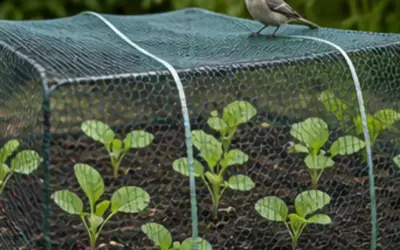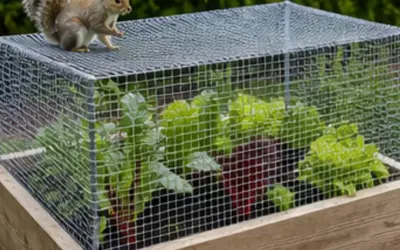



Les pucerons, les piéride du chou, les oiseaux et même les écureuils peuvent réduire à néant des semaines de plantations soigneuses en un seul après-midi. Pour les jardiniers qui souhaitent une barrière physique plutôt que de compter uniquement sur les pulvérisations, un filet anti-insectes pour potager constitue une solution simple pour éloigner les nuisibles des légumes, des fruits et des fleurs tout en laissant passer la lumière du soleil, l’air et la pluie. Ce guide compare 15 filets, des protections prédécoupées adaptées à un seul carré potager surélevé aux grands rouleaux pouvant être découpés pour plusieurs carrés, rangées ou un petit verger.
Ce comparatif s’adresse aux jardiniers débutants qui installent leur premier carré potager surélevé, aux particuliers qui protègent une parcelle potagère existante, aux jardiniers âgés qui recherchent un filet facile à soulever et à fixer sans effort important, ainsi qu’à toute personne cultivant dans un petit jardin ou sur une terrasse. Les critères de sélection comprennent la taille des mailles et les nuisibles qu’elles peuvent réellement bloquer, la durabilité du matériau et sa résistance aux UV, la facilité d’installation et de retrait, ainsi que les dimensions du filet par rapport à un carré potager standard ou la nécessité de le découper.
Pour découvrir d’autres solutions contre les nuisibles et les animaux sauvages, au-delà des filets, consultez notre rubrique Nuisibles et animaux sauvages du jardin, qui présente des approches complémentaires à une barrière physique.
Garden Tailor 4×10 Fine Mesh Garden Netting for Raised Beds and Crop Pest Barriers RIFNY GN-10-33-2 Ultra-Fine Garden Netting for Raised Beds, Fruits, and Vegetable Protection FEEDGARDEN LX-HYW-8.10ft Garden Netting for Raised Beds and Vegetable Protection Sunwinx 2-Pack Fine Mesh Raised Bed Covers for Easy Vegetable and Flower Protection Prices and availability can change. We may earn a commission from qualifying purchases.


Pros
- Breathable mesh allows water and airflow through while keeping the cover lightweight.
- Suitable for direct crop coverage or use with garden hoops and cages.
- Useful for small-space pest exclusion around vegetables, herbs, fruits, flowers, and young plants.
- Reviewers commonly mention that it is easy to handle and works as intended for plant protection.
Cons
- Hoops, pegs, clips, or other anchoring supplies are not included, and windy sites could require careful securing.
- Crops that depend on bee pollination need the net lifted or removed during flowering.
- The 4 by 10 foot size may be too small for larger beds, long rows, or full-size fruit tree coverage.
The Garden Tailor 4 by 10 foot fine mesh garden netting is a physical pest barrier for vegetables, fruits, flowers, herbs, and small plantings. Based on the listed specifications, it is made from high density polyethylene and is intended for use over crops, raised beds, garden hoops, fruit or vegetable cages, and similar protective setups.
The main benefit is simple exclusion. The product information lists protection against pests such as cabbage root fly, carrot fly, cabbage white butterfly, pea moth, leek moth, cutworm, onion fly, leaf miners, aphids, cicadas, rabbits, and other garden visitors. As with any netting, results depend on proper placement, sealed edges, and using it before pests get established.
The mesh size is listed as 0.03 inch, with 90 percent light passage and 95 percent air passage. That means it is designed to let light, airflow, rain, and irrigation pass through while still acting as a fine screen. It is light enough to rest directly on crops, but many gardeners may prefer using hoops to keep the mesh from pressing on tender plants as they grow.
For small gardens, this size is a practical fit for a short raised bed section, a few containers, young seedlings, herbs, brassicas, leafy greens, or a small berry patch. It can also be cut with scissors, which helps when fitting it to planter boxes, frames, or custom covers. Reviewers commonly describe it as lightweight and easy to use, with several using it for potted plants, basil, and planters.
There are a few important limitations. Hoops are not included, so gardeners who want a tunnel will need a separate support system and a way to secure the edges, such as buried edges, pegs, clips, or weights. In windy conditions, loose netting can blow away if it is not anchored well. One reviewer also noted concern about the edges appearing cut rather than sewn, so gardeners planning repeated seasonal reuse may want to handle and store it carefully.
This is a sensible choice for beginner and small-space gardeners who want a breathable, cut-to-fit barrier rather than a spray-based approach. Gardeners covering long rows, larger raised beds, or plants that need frequent bee pollination may want a larger net, a framed cover, or a setup that is easier to open during flowering.
Pros
- Large total coverage area in two separate pieces for flexible garden setups.
- Fine mesh design is useful for gardeners looking for a physical plant barrier around brassicas, berries, seedlings, and similar crops.
- Allows air, rain, and light to pass through based on the listed product features.
- Easy to trim to size for pots, low tunnels, raised beds, or frame-supported covers.
- Lightweight and see-through, which can make routine plant checks more convenient.
Cons
- Because the mesh can exclude beneficial insects as well as pests, flowering crops that need pollination may require temporary uncovering or another setup.
- Edges need to be secured with soil, stones, staples, clips, or a frame, so installation may take extra care in windy areas.
- Some reviewers report stretching, tearing, or animal tangling concerns, so it should be kept taut, checked often, and placed with wildlife safety in mind.
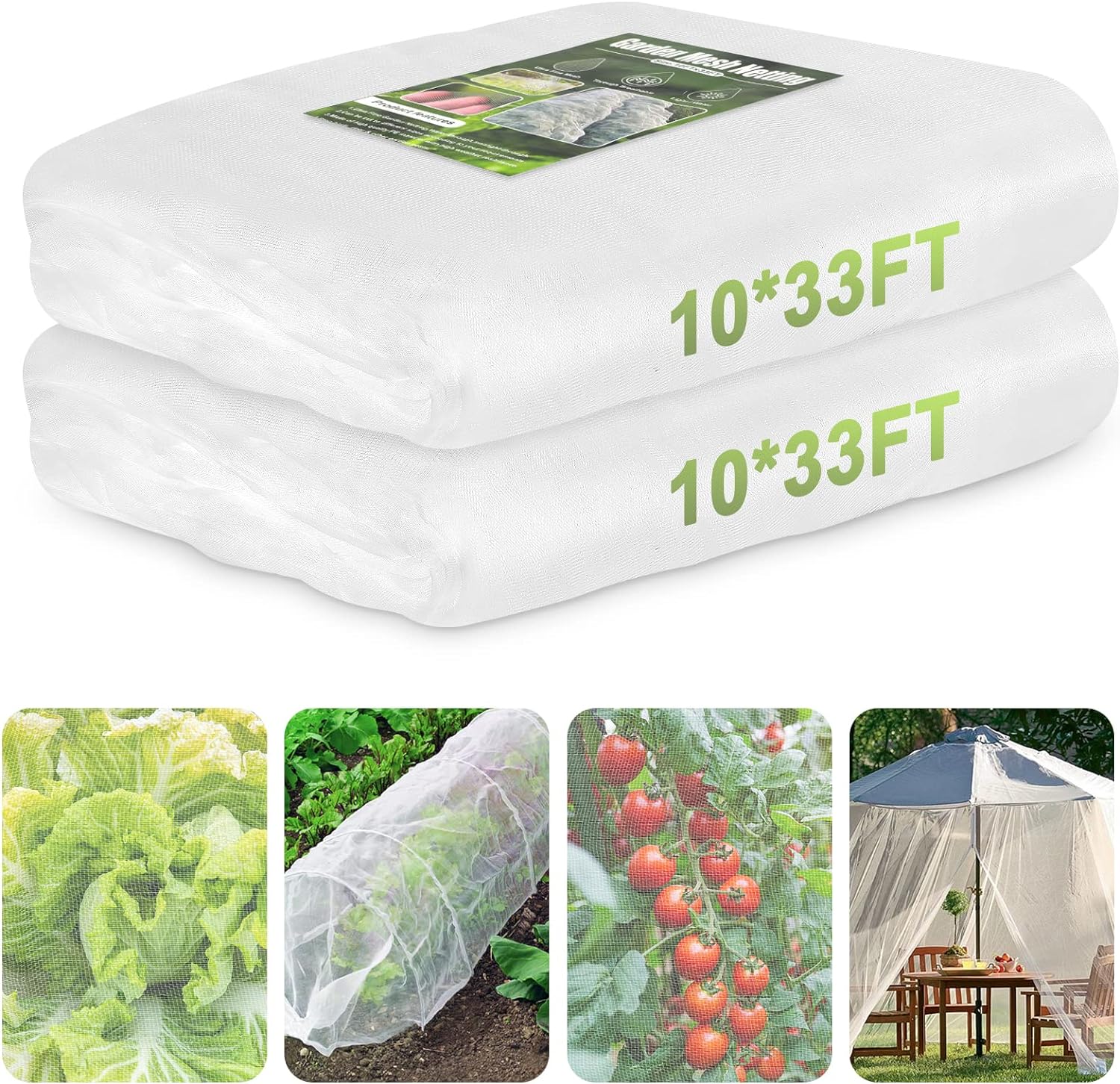
The RIFNY GN-10-33-2 is an ultra-fine garden netting set made for covering plants rather than treating pests chemically. The package contains two 10 by 33 foot net pieces, giving home gardeners a practical option for raised beds, vegetable rows, fruit bushes, flowers, greenhouse crops, and patio plantings where a lightweight physical barrier is useful.
Based on the listed specifications, the mesh measures 0.04 inch and is described as 60 mesh per inch. The product information indicates that it allows sunlight, artificial light, air, and rain to pass through, so it is intended to protect plants while still supporting normal growing conditions. This makes it especially relevant for gardeners growing cabbage, cauliflower, greens, tomatoes, berries, cherries, grapes, strawberries, or other crops commonly bothered by birds, small animals, or insects.
The netting is made from polyethylene and has a rectangular shape with listed dimensions of 396 inches by 120 inches for each 10 by 33 foot piece. It can be cut to size, which is helpful if you need one section for a low row cover and another for pots or a small fruit cage. The product information suggests securing the edges with stones, soil, staples, clips, stakes, or a frame, and the see-through mesh lets you monitor plants without opening the cover every time.
For backyard and small-space gardeners, this netting is most useful when paired with hoops, stakes, PVC, or another support that keeps the fabric off delicate foliage and fruit. It can also be draped over raised beds or used around potted plants, provided the edges are closed well enough to reduce gaps. Reviewers commonly mention that it is easy to cut and that the coverage is generous, though those comments should be viewed as user experiences rather than guaranteed performance.
There are a few important limitations to consider. Fine mesh can also keep pollinators from reaching blossoms, so crops that need bee activity may need timed uncovering, hand pollination, or a cover design that can be opened during bloom. As with any netting, keep it taut and inspect it often, especially around birds, pets, and wildlife. Some reviewers reported tearing or tangling issues, while others found it durable, so careful installation and regular checks are important.
This RIFNY netting is a good fit for gardeners who want a cut-to-fit, lightweight plant cover for vegetables, berries, flowers, and raised beds. Gardeners who need a rigid animal fence, a shade cloth, or a pollinator-friendly open structure may prefer a different type of garden protection.
Pros
- Useful size for small gardens and common raised-bed layouts.
- Allows rain, watering, sunlight, and airflow to reach plants through the mesh.
- Can be cut to fit custom planting areas and containers.
- Made from UV-stabilized polyethylene, according to the listed product information.
- Reviewers commonly mention that it is lightweight and easy to cut once positioned.
Cons
- Light mesh usually needs separate supports, clips, stakes, hoops, or weights to keep it positioned securely.
- May be awkward to manage at first because fine, lightweight netting can snag or fold while being placed.
- Gardeners protecting tall crops or longer rows may need a larger size or multiple pieces.
The FEEDGARDEN LX-HYW-8.10ft Garden Netting is an 8 x 10 ft rectangular PE mesh cover designed for protecting vegetables, fruits, berries, flowers, and other garden plants. It is best suited to homeowners, raised-bed gardeners, patio growers, and beginners who want a simple physical barrier for small planting areas without setting up permanent fencing.
The main practical benefit is the fine 0.7 x 0.8 mm mesh, which the product information describes as a high-density barrier for birds and small animals. Because the mesh allows sunlight, rain, and airflow to pass through, gardeners can keep plants covered during routine watering and changing weather instead of removing the netting every time the bed needs moisture.
Based on the listed specifications, this netting measures 120 inches long by 96 inches wide and is made from white polyethylene. The material is described as UV-stabilized and resistant to tearing and sun damage. It is also lightweight enough to trim, which is helpful when fitting it around a raised bed, container grouping, berry bush, or irregular planting layout.
In a backyard garden, this size makes sense for covering leafy greens, strawberries, peppers, young tomatoes, flowers, or compact berry plantings. It can also be used in greenhouses, around small orchard plants, over ponds, on balconies, or as a patio or window insect mesh where the dimensions fit. Reviewers commonly mention using similar placements to protect vegetable beds, young trees, and fruiting plants, though results will depend on how securely the edges are fastened.
There are a few setup considerations. Fine mesh netting performs best when it is supported and held in place so it does not rest heavily on delicate seedlings or blow loose in wind. The listing does not specify included hoops, clips, stakes, or a frame, so gardeners should plan their own fastening method if the cover needs structure. It is also wise to check the netting regularly for gaps, trapped leaves, or snags and to store it dry and folded between seasons if it will be reused.
This is a good choice for gardeners who need a cut-to-fit, breathable cover for small beds, containers, and seasonal plant protection. Gardeners with long crop rows, very tall plants, or heavy wildlife pressure may want a larger netting size, a framed enclosure, or a more rigid barrier system.
Pros
- Sized specifically for common 6 x 3 ft raised beds.
- Allows sunlight, airflow, and water through the mesh.
- Lightweight HDPE material should be easy for beginners and older gardeners to handle.
- Drawstring closure helps reduce gaps around the bed edges.
Cons
- Only the netting is included, so gardeners will need a raised bed or support setup separately.
- The 1.5 ft height may be less suitable for taller crops unless additional support is used.
- Fine mesh covers can limit easy access to flowers for pollinators, so timing and crop needs should be considered.
The Sunwinx 2-pack raised bed cover is a fine mesh garden netting set made for protecting vegetables, fruits, leafy greens, and flowers in small growing spaces. Based on the listed specifications, each rectangular cover is sized at 79.2 inches by 39.6 inches, with product information describing a 6.6 x 3.3 x 1.5 ft fit for standard 6 x 3 x 1 ft raised beds. It suits home gardeners who want a simple, non-spray physical barrier for raised beds, patios, balconies, greenhouses, or backyard plots.
The main benefit is coverage that still supports normal plant growth needs. The product information indicates a 0.04-inch ultra-fine mesh designed to block birds, insects, and small animals while allowing airflow, light, and water through. For beginner gardeners, that means seedlings and leafy crops can stay covered during vulnerable stages without removing the netting every time the bed needs watering.
The covers are made from high density polyethylene, or HDPE, and are described as UV-resistant, lightweight, breathable, and foldable for storage. A double drawstring closure lets the user tighten the cover around the raised bed, which can help reduce gaps along the bottom edge. No tools are listed as required, and the soft, lightweight fabric should be easier to handle than rigid framed covers.
In a backyard or patio garden, this cover set makes the most sense over low to medium-height crops such as young vegetables, greens, herbs, strawberries, or compact flowers. The two-pack format is useful if you maintain multiple small beds or want one cover available while another is being cleaned or stored. It can also be used in greenhouse or balcony setups where a removable mesh barrier is more convenient than a permanent enclosure.
There are a few practical limits to keep in mind. The raised bed itself is not included, and taller plants may outgrow the listed 1.5 ft cover height unless the gardener uses a compatible support arrangement. Because fine mesh can also keep beneficial insects from reaching blossoms, gardeners growing crops that need pollination should plan when to cover and uncover plants. Overall, this is a straightforward raised-bed netting option for gardeners who want lightweight, reusable coverage and easy drawstring installation.

Pros
- Generous size provides enough material for multiple small beds or custom garden covers
- Fine mesh is more protective against small insects than wide bird netting
- Cuttable design makes it adaptable to different bed shapes, hoops, and partial plant coverage
- Manufacturer-listed breathability allows routine watering and light penetration through the mesh
- Reviewers commonly mention that it is easy to cut, flexible to handle, and useful over raised beds
Cons
- Crops that rely on bee pollination may need the netting removed during flowering
- It requires a frame or careful draping and secure edge anchoring to avoid gaps where pests can enter
- Gardeners who need a wider single sheet than 10 ft may need to overlap pieces or choose another size
The JTSIOV GMN-10X50FT is an ultra-fine garden netting sheet made for covering vegetables, fruiting plants, flowers, shrubs, raised beds, greenhouse rows, and similar home garden spaces. It is best understood as a physical barrier, not a pesticide or trap, and it should appeal to gardeners who want a simple cover for insect, bird, and small wildlife pressure without adding a complicated system.
Based on the listed specifications, the netting measures 10 x 50 ft and uses polyethylene material in a white rectangular sheet. The product information describes a 0.04-inch, 60-mesh-per-inch design, which is intended to block small insects while also helping keep out larger visitors such as birds, rabbits, squirrels, and deer when the cover is properly installed and sealed at the edges.
The mesh is described as breathable, allowing sunlight, air, and moisture to pass through. For everyday garden care, that means gardeners can often water through the cover instead of removing it each time. The manufacturer also notes moderate shading, which may be useful for leafy crops exposed to strong direct sun, though gardeners should still watch plant growth and heat buildup under any cover.
Installation is straightforward in concept. The sheet can be cut to size, placed over hoops or another support frame, and anchored along the edges with soil, stones, stakes, or similar garden weights. Reviewers commonly mention using it over raised beds and cutting it with scissors, which makes it a practical option for beds that do not match a standard cover size.
For small-space gardeners, the 10 ft width and 50 ft length provide flexible coverage for several patio planters, a row of brassicas, strawberry or tomato beds, or temporary protection around fruiting plants. It may also be used as a patio screen, mosquito net, or pond leaf net according to the product description, but garden use will depend on how securely it can be supported and fastened in the specific space.
The main limitation is pollination access. The product information specifically notes that the netting should be removed during flowering if crops depend on bees, so it is not a set-and-forget cover for every plant stage. Gardeners should also inspect for tears, loose edges, and trapped insects, and those needing a rigid enclosure or a wider seamless span may prefer a different type of garden protection.

Pros
- Good fit for compact raised beds and elevated planters based on the listed dimensions.
- Mesh construction supports airflow and watering while creating a physical barrier around young plants.
- Zippered access is more convenient than fully removing the cover for routine checks.
- Reviewers commonly mention easy storage and practical use for protecting vegetables, strawberries, and starter plants.
- Includes 8 ground stakes and a storage strap, so basic anchoring and off-season storage are addressed.
Cons
- The 16-inch height may be limiting once taller vegetables or fast-growing plants mature.
- Assembly may take some patience because the end panels need to be zipped to the side panels rather than simply springing open fully on their own.
- Gardeners with larger beds may prefer a longer cover, since this model is listed at 45 inches by 22 inches.
The ANGAR Netting Covers-01 set is a pair of small rectangular mesh covers made for raised beds, elevated beds, vegetable rows, seedlings, flowers, fruits, and potted plants. Based on the product information, the main job is to create a breathable physical barrier around young or vulnerable plants while still allowing routine watering and airflow.
The feature set is especially useful for gardeners who want protection without sealing plants inside a solid cover. The dark green mesh is described as water and air permeable, and it provides 30% sun shading to reduce direct sunlight. That can be helpful for seedlings and tender starts in exposed beds, though gardeners should still match shade needs to the crops they are growing.
Each cover measures 45 inches long by 22 inches wide by 16 inches high, so this is best viewed as a compact raised-bed cover rather than a full-bed tunnel for large plantings. The covers use zippered end connections and include a zippered roll-up window for checking plants. The set also includes 8 metal ground stakes and a storage strap, and the covers fold down for compact storage when not in use.
In a backyard or patio garden, these covers make sense over strawberries, leafy greens, starter vegetables, low flowers, or small potted groupings. Reviewers commonly mention watering through the mesh, using the covers on elevated beds, and appreciating the zipper access. Several users also describe them as useful for keeping birds, bugs, grasshoppers, or animals away, although results will depend on placement, anchoring, and the specific garden pressure.
There are a few practical limits to consider. The 16-inch height may not work once tomatoes, peppers, taller herbs, or vigorous greens outgrow the enclosure. The product is called a pop-up cover, but the listed setup requires zipping the end panels to the side panels, and at least one reviewer found that part a little frustrating. It is also wise to inspect zippers before the return window ends, since one reviewer reported a zipper issue.
Overall, this ANGAR 2-pack is a sensible option for small-space gardeners, beginners starting seedlings, and homeowners who want a reusable mesh barrier for compact raised beds. Gardeners with long beds, taller crops, or a need for heavy-duty seasonal protection may want a larger or more rigid garden cover instead.

Pros
- Large sheet size is useful for raised beds, vegetable patches, berry bushes, and small fruit trees
- Fine mesh design is suited to insect and bird barrier use while still permitting basic watering and ventilation
- Can be cut to fit custom spaces, which helps in small yards, greenhouses, and irregular garden layouts
- Light weight makes it easier to drape, fold, move, and store than heavier barrier materials
Cons
- Thin netting may need gentle handling, especially around sharp stakes, branches, clips, or rough bed corners
- Gardeners needing a rigid animal fence or heavy-duty long-term perimeter barrier may prefer a sturdier material
- Because it is an insect barrier, it may need to be lifted during flowering crops that require pollinator access
The Fippy ZN-GMN garden netting is a 10 x 50 ft white polyethylene mesh intended for physical pest protection in home gardens. Based on the listed product information, it is designed for raised beds, vegetable rows, fruit trees, blueberry bushes, strawberries, greenhouse use, and similar backyard growing areas. It is a practical option for gardeners who want a simple cover that can be draped, secured, and trimmed to fit different planting spaces.
The key feature is the 0.8 mm mesh, which the product information describes as fine enough to help block many garden pests while still allowing airflow, sunlight, and water penetration. That combination matters for beginners because a barrier cover should protect plants without making daily care overly complicated. Reviewers commonly mention easy handling and use in vegetable gardens, raised beds, flowers, and fruit trees, although individual results will depend on how well the edges are sealed and how the netting is supported.
At 590 inches long by 118 inches wide, this rectangular sheet provides broad coverage for multiple small beds or one longer row. The material is listed as lightweight PE, with a product weight of 0.55 pounds, so it should be easy to move and fold. It can be placed directly over plants according to the product information, but gardeners working with tender seedlings, tall crops, or plants with delicate tips may still prefer hoops, stakes, or a simple frame to keep the mesh from pressing on new growth.
In a typical backyard garden, this netting could be used over brassicas, greens, strawberries, blueberry bushes, fig trees, or other crops where a breathable barrier is helpful. It may also fit small-space gardeners who need to cover a patio planter, a compact raised bed, or a greenhouse opening. Since it can be cut to shape, it is useful when one full sheet is too large or when separate covers are needed for different crops.
There are a few limitations to keep in mind. Thin, lightweight mesh can snag or puncture if pulled across rough wood, wire, thorns, or sharp plant supports, so careful installation and storage are important. One reviewer reported concerns about thinness and sizing, while others described the netting as easy to use and effective for their garden needs, so buyers should inspect the sheet on arrival and handle it gently. For insect-pollinated crops, remember that a fine barrier can also block beneficial pollinators, so covers may need to be opened during bloom or used after pollination.
Overall, the Fippy ZN-GMN is best suited to gardeners who want an adaptable, lightweight mesh cover for seasonal plant protection rather than a rigid wildlife fence. It is a sensible choice for raised beds, berries, vegetable rows, and small fruit plantings when you can secure the edges well. Gardeners facing heavy animal pressure, rough weather exposure, or frequent contact with sharp supports may want to consider a heavier-duty barrier material.

Pros
- Large two-pack format provides adaptable coverage for several garden areas or one longer planting row.
- Fine mesh design is intended to create a physical barrier while maintaining light, airflow, and water penetration.
- Suitable for common home garden uses such as raised beds, berries, vegetables, flowers, and fruit tree protection.
- Several reviewers mention easy installation and good results keeping birds and small animals away from plants.
- Can be trimmed to size for custom coverage around beds, bushes, or patio plantings.
Cons
- Some reviewers report that the material can snag, tear, or run if cut or handled roughly.
- It does not include hoops or clips in this listed 2-pack version, so gardeners may need separate supports or fasteners.
- Because it is a lightweight mesh barrier, it may require careful edge weighting or burying to reduce access underneath.
The YNERHAI 10x30FT 2-Pack Garden Netting Mesh is a lightweight physical barrier for gardeners who want to protect vegetables, berries, flowers, shrubs, and small fruit trees without fully blocking the growing environment. Based on the listed specifications, each sheet measures 360 inches long by 120 inches wide, giving a 10 by 30 foot rectangular format that can be used over raised beds, blueberry bushes, patio plants, or garden rows.
The product information highlights an ultra-fine mesh design that allows sunlight, air, and water to pass through. That matters for beginners and busy homeowners because plants can stay covered while still receiving basic exposure from natural light and rainfall. The netting is positioned as a barrier for birds, rabbits, squirrels, deer, and insects, although results will depend on how completely the edges are secured and how the netting is supported around the plants.
The listed material is high density polyethylene, and the netting is described as stable, lightweight, reusable, and easy to cut. In practice, that feature set is most useful when you need to shape coverage around a berry patch, cabbage row, strawberry bed, or young tree. The product information suggests securing the edges with stones, soil, or nails, and it also notes that burying or weighting the edges can help prevent animals from getting underneath.
For raised-bed gardeners, this mesh can be draped directly over plants or supported with separate hoops or a frame if extra clearance is needed. For blueberry bushes and fruiting plants, the large sheet size gives more flexibility than small pre-shaped covers. It may also be useful on patios as a mosquito-style mesh barrier for outdoor spaces, as described by the manufacturer, but gardeners should still measure carefully before cutting because the product does not list included poles, clips, or a dedicated frame.
There are a few practical limitations to keep in mind. Some reviewers say the material works well and is easy to handle, while others mention that it can snag, tear, or develop runs when cut or handled roughly. Use sharp scissors, avoid dragging it across rough surfaces, and store it indoors in a dry place when not in use, as the product information recommends. Gardeners who need a heavier, rigid wildlife barrier or a complete hoop-and-clip kit may prefer a different setup, but for flexible seasonal plant coverage, this YNERHAI netting is a practical option for many home gardens.

Pros
- Complete kit format is convenient for creating a covered grow tunnel over raised beds or vegetable rows
- PE netting with fine mesh supports pest exclusion without fully enclosing plants from light, rain, or airflow
- Adjustable DIY sizing makes it useful for more than one garden layout when the netting is cut or arranged carefully
- Reviewers commonly mention straightforward assembly and useful crop protection in smaller garden setups
Cons
- The wide, long netting may be awkward for one person to unfold, measure, and position neatly
- May need extra anchoring or closer hoop spacing in windy areas, based on reviewer feedback about collapse in strong wind
- Gardeners covering long rows or taller crops may find the netting needs frequent adjustment to prevent sagging
The Fippy ZN-GMN04 Garden Netting Kit is designed for gardeners who want to build a simple pest barrier over vegetables, fruits, flowers, or raised beds. The kit includes a 10 x 50 ft garden netting pest barrier, 10 sets of garden hoops, and 20 fixing clips, making it a practical starter option for creating a covered row or small grow tunnel.
The main benefit is physical protection. According to the product information, the 0.8 mm mesh is intended to block many common garden pests while still allowing sunlight, water, and airflow to reach plants. That makes it useful for crops that benefit from coverage without being sealed off, such as young vegetable seedlings, strawberries, blueberries, and other small garden plantings.
The hoops are listed as having an inner steel tube with an outer plastic coating, which gives the structure more support than netting alone and helps reduce rust or corrosion concerns. Assembly is described as a basic process: connect the hoops, insert them into the soil, drape the netting over the frame, secure it with clips, and weigh down the edges with soil or stones.
For backyard and raised-bed use, this kit fits gardeners who want one package for seasonal crop protection rather than buying mesh, hoops, and clips separately. The long netting roll can be cut or arranged for different bed sizes, though careful measuring before cutting is a good idea. Reviewers commonly note that the system is easy to assemble, but some also say the netting can be hard to manage by one person because of its size.
There are a few practical limitations to consider. Lightweight garden netting can sag if it is stretched over too large a span, and windy sites may require additional anchoring beyond the included clips and soil weighting. Some reviewer feedback also suggests the setup may be better for smaller beds than for a full 50 ft row if you want a tidy, low-maintenance tunnel.
Overall, this Fippy kit is a useful choice for beginner and home gardeners who need a flexible insect and wildlife barrier for raised beds, vegetable patches, or compact fruit plantings. Gardeners in very windy locations, or those who need a sturdier long-row structure, may prefer a heavier-duty frame and netting system.

Pros
- Generous sheet size is useful for multiple garden layouts or for trimming to fit raised beds and rows.
- Fine mesh design supports plant protection while still allowing moisture and airflow through.
- Lightweight material is easy to drape over plants, hoops, shrubs, or small trees.
- Reviewers commonly mention that it works well as a raised-bed or vegetable cover when secured carefully.
- Can be secured with stones, soil, stakes, or similar garden supports according to the product information.
Cons
- Several reviewers describe the fabric as delicate or easy to damage, so it may not suit gardeners who need a heavy-duty barrier.
- Cut edges may require careful handling because reviewer feedback notes that trimmed areas can shred or rip.
- The large sheet can be unwieldy for small beds unless it is measured and cut before installation.
The FARAER 10x33 ft Ultra-Fine Garden Netting is a lightweight polyethylene mesh cover made for protecting vegetable plants, fruits, flowers, crops, shrubs, and raised beds with a physical barrier. Based on the listed specifications, it is most useful for home gardeners who want a broad, cut-to-fit cover for garden rows, berry plants, brassicas, tomatoes, greenhouse use, or simple hoop tunnels.
The key feature is the ultra-fine 0.8 mm by 1 mm oblong mesh. The product information indicates that this mesh allows air, moisture, rain, liquid feed, and light to pass through, so gardeners do not need to remove the cover every time they water. It is also described as offering partial shade, which may be helpful for reducing some sun intensity while still allowing light transmission.
At 10 feet wide by 33 feet long, this is a large sheet rather than a fitted cover. That gives it flexibility, but it also means most gardeners will need to measure, cut, fold, or secure it for their specific setup. It can be placed directly over plants, wrapped around small trees or shrubs, or stretched over hoops, posts, or a grow tunnel frame. The product information suggests securing it with stones, soil, or stakes.
For backyard and small-space gardens, this netting is a practical option for raised beds, berry patches, vegetable rows, and greenhouse openings where a see-through barrier is preferred. Reviewers commonly mention using it over raised beds, squash and zucchini, brassicas, raspberries, marionberries, and young plants. Because it is lightweight, it may be easier for beginners or older gardeners to position than a heavier net, especially when working over low beds.
The main tradeoff is durability. While the product description calls the PE material stabilized and reusable, several reviewers describe the mesh as thin, delicate, or prone to tearing, especially around cut edges. For best results, handle it gently, avoid pulling it hard over sharp stakes or rough frames, and secure it so wind does not whip the fabric against edges. Gardeners who need a rugged, long-term cover for rough conditions may prefer a heavier garden netting material.
Overall, this FARAER netting is a sensible choice for gardeners who want a large, breathable, fine-mesh plant cover that can be trimmed for raised beds, rows, and fruiting plants. It is best for careful seasonal use where light weight and broad coverage matter more than maximum tear resistance.

Pros
- Generous 10 x 50 ft size is useful for raised beds, garden plots, and shrub coverage.
- Fine mesh design supports plant protection without fully blocking light, airflow, or watering.
- Can be cut to fit different garden layouts and plant sizes.
- Simple drape-and-secure setup does not require a permanent frame, based on the listed installation method.
Cons
- Fine mesh may be damaged by sharp objects, so careful handling and storage are important.
- Gardeners who need a rigid cage or heavy-duty wildlife barrier may prefer a sturdier framed solution.
- Pollination may require temporary access for flowering crops that depend on insect pollinators.
The GonLei 10 x 50 ft garden netting is a flexible physical barrier for gardeners who want to cover raised beds, vegetable rows, fruiting shrubs, flowers, or young crops. Based on the product information, it is intended for simple garden protection by draping the mesh over plants and securing the edges. It is a practical option for homeowners, beginner gardeners, and small-space growers who want a cut-to-fit cover rather than a permanent enclosure.
The key benefit is the ultra-fine mesh, listed as 0.04 inch with 60 mesh per inch. This dense mesh format is designed to help separate plants from unwanted garden visitors while still allowing air, water, and light to pass through. That matters in everyday use because gardeners can water or apply liquid feeding through the netting without fully uncovering the bed each time.
The rectangular 10 x 50 ft size provides a broad sheet of coverage that can be trimmed for different layouts. The product information says it can be draped over plants in raised beds or regular garden plots, then secured with stones, soil, or the included clips. Because the specifications list a nylon material and a 1.79 kilogram item weight, it appears to be a lightweight, flexible cover rather than a rigid barrier.
In a backyard vegetable garden, this netting could be used over cabbage, cauliflower, tomatoes, or seedling areas, as listed in the product description. In a fruit garden, it may be shaped around blueberry shrubs, peaches, or cherries where a fine cover is preferred. It may also be useful in small spaces because the sheet can be cut down for individual planters, compact raised beds, or temporary outdoor mosquito-net style coverage as described by the manufacturer.
There are a few practical limits to keep in mind. The manufacturer notes that sharp objects can damage the fine mesh, so avoid pulling it over rough stakes, thorny branches, or jagged bed edges. For crops that need insect pollination, gardeners may need to uncover plants at the right time or hand-pollinate as appropriate. It is also not the same as a rigid animal fence, so gardeners dealing with determined larger wildlife may want a stronger framed barrier.
Overall, the GonLei garden netting is best for gardeners who want a simple, adaptable mesh cover for raised beds, vegetables, fruit shrubs, and flowers. It is a good fit if you value easy cutting, broad coverage, and the ability to water through the mesh. Consider another option if you need a heavy-duty cage, a permanent structural enclosure, or a barrier specifically built for high-pressure wildlife problems.

Pros
- Generous sheet size and two-piece pack provide adaptable coverage for common home garden layouts.
- PE mesh material is listed as durable and resistant to easy deformation or breakage.
- Reviewers commonly mention that it is lightweight, easy to cut, and simple to position over garden areas.
- A physical barrier approach can reduce reliance on direct pest contact methods when used properly.
- Works for both temporary seasonal coverage and DIY fitted covers when cut and secured carefully.
Cons
- Pollination can be limited if the netting is left over flowering crops that need insect access.
- Edges need to be secured with soil, stones, clips, or another method, especially in windy conditions.
- Gardeners wanting detailed crop timing instructions may need to look beyond the basic product information.
The Unves YY-039-1 garden netting is a two-pack of white rectangular mesh intended for protecting garden plants from birds and insects. Based on the listed specifications, each piece measures 10 x 33 ft and is made from polyethylene, giving home gardeners a flexible cover for raised beds, vegetable rows, berries, seedlings, small fruit trees, or other vulnerable plantings.
The main value of this netting is its role as a physical barrier. The product information describes an ultra-fine, breathable mesh that allows sunlight and air to reach plants while helping separate crops from pests. That makes it a practical option for gardeners who prefer a non-spray layer of protection around tender growth or ripening fruit, as long as the crop still receives the access it needs for pollination.
Installation is straightforward. The netting can be placed directly over plants and weighted at the edges with soil, stones, or similar heavy objects, or it can be set over a simple support frame. Because the sheets can be cut to size, they are useful for custom covers around raised beds, berry rows, nursery starts, and irregular garden spaces where a fixed-size cover may not fit cleanly.
For small-space gardeners, the two separate sheets are convenient because one can be used over a raised bed while the other is cut for containers, fruiting shrubs, or seasonal row protection. Reviewers commonly mention that the netting is lightweight and easy to cut, and some report using clips or other simple fasteners to hold it in place. Those comments are useful for planning, but the exact hold in wind will depend on how well the edges are secured and what support structure is used.
The biggest caution is pollination. A fine mesh barrier can also block helpful insects, so gardeners growing flowering vegetables or fruits should remove or open the cover at the right stage if pollinator access is needed. It is also wise to avoid letting the mesh press heavily on delicate seedlings and to check underneath regularly for trapped pests, plant stress, or growth that needs more room.
Overall, this Unves garden netting is a sensible choice for homeowners and beginner gardeners who want a large, cuttable plant cover for seasonal pest and bird protection. Gardeners who need crop-specific instructions, built-in supports, or a cover designed to stay permanently over pollinator-dependent plants may want a more specialized system.
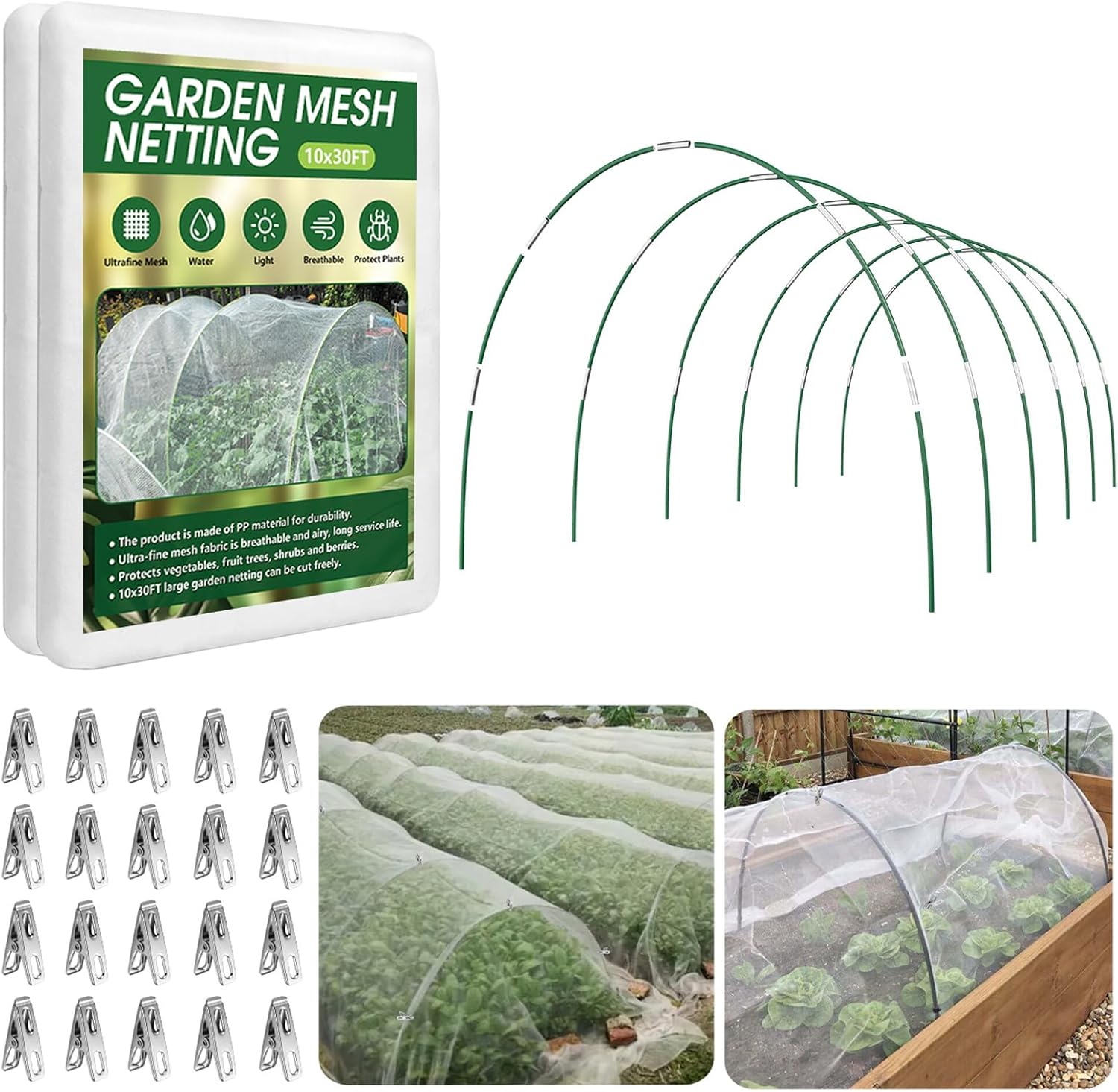
Pros
- Complete kit format reduces the need to source hoops, connectors, netting, and clips separately.
- Fine polyethylene mesh provides a lightweight barrier approach for raised beds and garden rows.
- Water, light, and air can pass through the mesh, which helps simplify everyday care compared with solid covers.
- User feedback commonly mentions easy setup, useful clips, and good results for protecting brassicas and other garden plants.
Cons
- Some reviewers report that the fine netting can fray, pull, or develop holes, so careful handling and edge checks are important.
- This is a mesh barrier, not a rigid cage, so gardeners dealing with chewing wildlife may need a stronger or reinforced protection method.
- The listed crop examples are mainly shorter plants and row crops, so tall or sprawling plants may require a different support setup.
The MONIRSEN Garden Netting Kit is a raised-bed and row-cover setup built around a 10 x 30 ft polyethylene mesh sheet and six sets of 8 ft fiberglass garden hoops. It is intended for gardeners who want a simple physical barrier over vegetables, fruiting plants, flowers, potted plants, and other shorter crops without building a permanent frame.
The key benefit is the ultra-fine 0.8 mm x 1 mm mesh, which the product information describes as allowing air, light, and water through while helping keep insects, birds, and small animals away from plants. That makes it useful for crops such as cabbage, broccoli, lettuce, strawberries, blueberries, grapes, tomatoes, root vegetables, and flowers where a lightweight cover can reduce direct pest access without blocking routine watering.
The kit includes one netting panel, 36 fiberglass hoop sections, 30 connecting pipes, and 20 clips. Assembly is described as joining the fiberglass hoops with connectors, bending them into arches, inserting them into soil, and securing the cover with clips. The fiberglass hoop material is listed as rust-free and flexible, which is helpful for outdoor garden beds where metal corrosion can be a concern.
For a typical home garden, this kit fits raised beds, short crop rows, and small-space vegetable plots where a temporary tunnel is easier than a fixed enclosure. The generous netting dimensions give room to cover a longer planting area or to adapt the layout to different bed sizes, as long as the grower accounts for the height and width created by the hoops.
There are a few practical cautions. Fine mesh should be handled gently, especially around clips and edges, because some reviewers mention fraying, pulling, and holes. It is also wise to inspect the cover for loose strands and damage so wildlife does not become tangled and pests do not find openings. For chipmunks or other chewing animals, a heavier barrier may be more appropriate.
Overall, this MONIRSEN kit is a sensible choice for beginner and intermediate gardeners who want a ready-to-assemble mesh tunnel for raised beds and short crops. Gardeners who need a rigid animal-proof cage, a tall trellis-style cover, or a long-term heavy-duty enclosure should consider a sturdier system designed for that level of protection.

Pros
- Complete kit format reduces the need to source hoops and netting separately.
- Large netting sheet offers flexibility for DIY layouts and multiple small covers.
- Mesh allows watering and sunlight through according to the product information.
- Fiberglass hoops are bendable and rust-free, based on the listed materials.
- Several reviewers report that it was helpful for keeping birds or animals away from garden plants.
Cons
- Some gardeners may need extra clips, binder clips, clothespins, or side brackets to secure the cover more firmly in certain beds.
- Because it is a barrier mesh, it may also block pollinators such as bees and butterflies, so flowering crops may need timed access for pollination.
- At least one reviewer reported difficulty fitting poles into connectors, so assembly quality may vary.
The WYRJXYB XWTZ-US Garden Mesh Netting Kit is a physical plant-cover system for raised beds, vegetable rows, berry patches, and small garden spaces. It includes a 10 x 30 ft sheet of ultra-fine polyethylene mesh, 6 sets of fiberglass garden hoops, 36 connectors, and 24 clips. Based on the supplied product information, it is intended for gardeners who want a lightweight barrier against insects, birds, chickens, deer, and other animals without building a permanent enclosure.
The main gardening value is the combination of fine mesh and hoop support. The listed 0.8 mm x 1 mm mesh is designed to exclude many common garden pests while allowing water and light to pass through. That makes it useful for leafy greens, brassicas, strawberries, blueberries, young tomato plants, peppers, and other crops that need protection from chewing or pecking damage. As with any barrier cover, results depend on how tightly the edges are secured and whether pests are already inside before the cover goes on.
The hoop system is built from bendable fiberglass rods that connect into arched supports. The product information lists the combined hoop size as about 2.8 ft wide by 3.8 ft high when assembled with 6 pieces, making it a practical fit for narrow raised beds or row-cover tunnels. The netting can also be cut to different sizes, which is helpful if you are covering containers, short rows, or individual plantings rather than one long bed.
For backyard and small-space gardeners, this kit is most useful where a flexible seasonal cover is better than a fixed cage. It can be set over a raised bed during early growth, draped over berry plants as fruit develops, or adjusted over container rows where birds and animals are a problem. Reviewers commonly mention use around raised beds, strawberries, tomatoes, peppers, and vegetable plants, with several noting that water and light still reach the plants.
There are a few practical limitations to plan for. The clips may not be enough for every bed shape or windy location, and some reviewers mention using binder clips, clothespins, or other fasteners for a more secure hold. Because the mesh is fine enough to block insects, it can also keep pollinators away, so crops that need bee or butterfly access may require the cover to be opened during bloom or removed at the right stage. Check the cover regularly so leaves are not crowded against the mesh and so trapped insects are not sealed inside.
This is a sensible option for gardeners who want an affordable, adjustable row-cover kit for raised beds and small garden areas. It is especially appealing if you value cut-to-fit netting and a lightweight hoop structure. Gardeners needing a rigid animal cage, a heavily anchored system, or a cover for very wide beds may want to consider a sturdier enclosure or additional mounting hardware.

Pros
- Fine 0.8 mm by 1 mm mesh is suitable for gardeners who need a tighter barrier than standard bird netting.
- Generous 50 foot length can cover multiple small beds or be trimmed into custom sections.
- Lightweight enough to drape, clip, stake, or use with support structures.
- Product information states that the mesh can be cut without unraveling.
- White mesh is easy to see in the garden, which can help during setup, harvesting, and removal.
Cons
- As with most fine mesh plant covers, it may need secure anchoring at the edges to reduce gaps where insects or animals can enter.
- Gardeners growing crops that need insect pollination may need to uncover plants at the right time or hand-pollinate as appropriate.
- One reviewer noted that stretching the mesh on a frame may enlarge the openings, so a relaxed drape may be better when the smallest mesh size matters.
The Hyxanons GN-W-315 is an ultra-fine garden mesh netting intended for physical plant protection in outdoor gardens, raised beds, patios, greenhouses, nurseries, orchards, and similar growing spaces. Based on the listed specifications, it measures 10 feet by 50 feet and is designed for vegetables, fruit, flowers, and other garden crops that benefit from a breathable cover.
The key feature is the 0.8 mm by 1 mm mesh, which is much finer than many basic bird nets. The product information indicates that the mesh allows air, water, and light to pass through, so gardeners can generally keep plants covered while still watering and maintaining airflow. It is best viewed as a physical barrier rather than a guaranteed pest-control solution.
The netting is made from PE material that is described as thick, UV-resistant, durable, and reusable. It can be draped over plants and held with rocks, soil, wooden stakes, or similar supports, or paired with hoops, frames, tunnels, arches, wooden rods, or steel rods to keep the fabric off delicate foliage. The manufacturer also states that it can be trimmed to size without unraveling.
For backyard use, this size works well for creating temporary covers over raised beds, rows of seedlings, berry plantings, vegetable patches, or patio containers. It may also be useful for wrapping small fruiting plants or making custom panels for greenhouse openings, garden windows, doors, ponds, or other areas where a fine breathable screen is helpful.
There are a few practical considerations. Fine mesh can also limit access for beneficial insects, so gardeners growing crops that rely on pollinators should plan when to cover, uncover, or hand-pollinate. Edges should be secured carefully because gaps reduce the value of any barrier cover. A reviewer also noted that stretching the material on a frame may enlarge the openings, so avoid pulling it overly tight when insect exclusion is the priority.
Overall, this is a sensible choice for homeowners and beginner-to-intermediate gardeners who want a large, cuttable mesh cover for seasonal crop protection. Gardeners who need a rigid enclosure, built-in frame, or a heavier-duty wildlife fence may want a different style of product, but for flexible row-cover and raised-bed use, the listed features are practical and easy to adapt.
Guide pratique pour choisir un filet anti-insectes pour potager
Un filet anti-insectes paraît simple, mais de petites différences de taille de maille, de matériau et de forme influencent considérablement son efficacité pour protéger un carré potager et sa durée de vie. Les sections ci-dessous présentent les points à vérifier avant l’achat.
Taille des mailles et nuisibles réellement bloqués
Plusieurs produits de ce comparatif utilisent une maille ultrafine avec des ouvertures d’environ 0.04 inches, souvent décrite comme une maille de 60 mesh par inch, notamment les modèles de JTSIOV, Sunwinx, RIFNY et GonLei. D’après les caractéristiques indiquées, cette maille serrée vise à empêcher les petits nuisibles comme les pucerons et les cigales, tout en bloquant les oiseaux, les lapins, les écureuils et les cerfs. Le filet GardenTailor indique pour sa part une maille de 40 mesh, dont la description associe l’efficacité au blocage des cigales, de la mouche de la carotte et de certaines espèces de pucerons, tout en permettant la circulation de l’air.
Hyxanons et FARAER décrivent tous deux une construction à mailles oblongues de 0.8mm x 1mm, plutôt qu’un simple nombre de mailles par inch. Selon leurs listes de caractéristiques, cette forme vise à équilibrer l’exclusion des petits nuisibles avec une bonne circulation de l’air et une transmission suffisante de la lumière. Si votre principale préoccupation concerne les animaux plus grands plutôt que les minuscules insectes, une maille légèrement plus lâche peut rester adaptée et offrir une meilleure ventilation dans les climats chauds.
Matériau et résistance aux UV
La plupart des filets comparés ici sont fabriqués en polyéthylène (PE) ou en HDPE et décrits comme stabilisés aux UV ou résistants aux UV. Selon les fiches produits, cela permet de réutiliser le filet pendant plusieurs saisons plutôt que de le remplacer chaque année. JTSIOV décrit précisément un procédé épaissi et densifié destiné à améliorer la résistance aux déchirures par rapport aux filets plus fins, un point d’usure fréquemment signalé par les retours de propriétaires de produits à mailles similaires.
Comme le filet reste dehors, exposé directement au soleil pendant plusieurs mois, le traitement anti-UV est plus important qu’il n’y paraît. D’après les caractéristiques indiquées, les produits mentionnant une stabilisation aux UV sont conçus pour une utilisation saisonnière répétée, tandis que les filets qui ne donnent pas cette précision peuvent être mieux adaptés aux projets de courte durée ou à une seule saison.
Dimensions et adaptation à vos carrés potagers
Les dimensions couvertes varient fortement dans cette sélection. Le panneau FEEDGARDEN de 8x10ft et le modèle GardenTailor de 4x10ft conviennent à un petit carré unique, tandis que FARAER et RIFNY proposent une couverture de 10x33ft, et que JTSIOV, Hyxanons et GonLei fournissent chacun des rouleaux de 10x50ft pour plusieurs carrés ou des rangées plus longues. Le lot de 2 filets YNERHAI de 10x30ft s’adresse aux jardiniers qui souhaitent protéger deux zones distinctes à la fois.
Sunwinx adopte une approche différente avec un lot de 2 protections de 6.6 x 3.3 x 1.5 feet, présenté comme parfaitement adapté à un carré potager surélevé standard de 6x3x1 foot. Cette solution évite de devoir découper un grand rouleau. Si vous possédez un ou deux carrés potagers standard, une protection prédécoupée de ce type peut considérablement simplifier l’installation par rapport à la mesure et à la découpe d’un rouleau volumineux.
Méthode d’installation : à poser, avec cordon ou escamotable
La plupart des filets en rouleau, notamment les modèles de FARAER, RIFNY, GonLei et Hyxanons, sont conçus pour être posés sur une structure de support ou des arceaux, puis fixés sur les bords avec des pierres, de la terre ou des piquets. Cette méthode est flexible et fonctionne avec des arceaux de jardin existants, mais elle demande un certain temps de préparation ainsi que du matériel pour maintenir les bords au sol.
Sunwinx utilise une fermeture à double cordon destinée à se resserrer autour d’un carré potager surélevé, ce qui, selon la fiche produit, aide la protection à rester en place par temps venteux. ANGAR propose une approche plus structurée avec une conception escamotable en maille, des piquets métalliques et une fenêtre enroulable zippée pour surveiller les plantes. La description indique qu’elle se replie jusqu’à environ 13 x 13 x 1.2 inches pour le rangement. Les jardiniers qui recherchent une installation plus rapide et moins contraignante peuvent trouver les modèles à cordon ou escamotables intéressants malgré leur prix plus élevé par rapport à un rouleau à découper et à fixer.
Circulation de l’air, lumière et arrosage à travers le filet
Une caractéristique récurrente de presque tous les produits de ce comparatif est que l’eau, l’air et la lumière du soleil sont décrits comme pouvant traverser la maille. Vous n’aurez donc généralement pas besoin de retirer le filet pour arroser vos plantes. La fiche de JTSIOV précise également que sa maille fine offre un ombrage modéré, ce qui, selon sa description, réduit le stress subi par les légumes à feuilles sous un soleil direct intense.
ANGAR est le seul produit présenté ici principalement pour son ombrage plutôt que pour l’exclusion des nuisibles. Il indique un effet d’ombrage de 30 % grâce à sa maille vert foncé haute résistance. C’est donc une option raisonnable si vous cherchez aussi à protéger les semis du soleil intense de l’après-midi, même si elle peut réduire davantage la lumière qu’une maille légère et transparente.
Erreurs fréquentes lors de l’utilisation d’un filet de jardin
Une erreur courante consiste à laisser le filet complètement fermé pendant la floraison, ce qui peut empêcher les abeilles et autres pollinisateurs d’atteindre les fleurs. La fiche de JTSIOV recommande expressément de retirer le filet pendant la floraison lorsque les cultures dépendent de la pollinisation. Une autre erreur consiste à ne pas fixer tous les bords : les espaces au niveau du sol permettent aux lapins, aux écureuils ou aux insectes rampants de passer dessous, même lorsque la maille est suffisamment fine pour les bloquer.
Découper un filet sans prévoir la finition des bords peut également entraîner un effilochage prématuré. Plusieurs fiches produits, notamment celles de FARAER, RIFNY et Hyxanons, indiquent que leur matériau peut être découpé aux dimensions voulues sans se défaire. C’est un point à vérifier si vous prévoyez de réduire un grand rouleau pour l’adapter à une forme de carré irrégulière.
Rangement et réutilisation saisonnière
Un filet qui se replie à plat est plus facile à ranger entre deux saisons, ce qui est important pour les jardiniers disposant de peu d’espace dans une remise ou un garage. La conception escamotable d’ANGAR se replie jusqu’à une taille compacte de 13 x 13 x 1.2 inches et sa fiche inclut une sangle de rangement à cet effet. Les filets en rouleau de marques comme FARAER ou GonLei peuvent généralement être pliés ou roulés sans serrer, puis rangés à l’abri du soleil et de l’humidité lorsqu’ils ne sont pas utilisés. Plusieurs fiches indiquent que cela contribue à préserver le matériau pour les saisons suivantes.
Pollinisateurs et animaux sauvages
Comme le filet anti-insectes constitue une barrière physique, il ne fait pas la distinction entre les insectes nuisibles et les pollinisateurs s’il n’est pas retiré au bon moment. Si vous cultivez des plantes qui dépendent de la pollinisation par les abeilles, prévoyez de soulever ou de retirer le filet pendant la floraison, puis de le remettre une fois les fruits formés. Suivez toujours les recommandations propres au produit fournies avec votre filet et consultez la réglementation locale concernant la faune si vous utilisez un filet à proximité de zones fréquentées par des oiseaux ou d’autres espèces protégées.
Méthodologie de recherche et fiabilité
Ce guide repose sur une analyse fondée sur la recherche et non sur des essais physiques au jardin. Chaque produit a d’abord été sélectionné pour sa pertinence par rapport au meilleur filet anti-insectes pour potagers, en vérifiant qu’il était conçu comme une barrière en maille pour carrés potagers surélevés, rangées ou installations de jardin similaires, plutôt que comme un accessoire sans rapport avec la lutte contre les nuisibles.
Nous avons ensuite comparé les caractéristiques indiquées côte à côte, notamment la taille des mailles ou des ouvertures, le type de matériau, les revendications concernant le traitement anti-UV, les dimensions couvertes et la méthode d’installation. Les avis de propriétaires et les notes en étoiles ont été examinés afin d’identifier des tendances, comme la fréquence à laquelle un produit est mentionné pour les carrés potagers surélevés plutôt que pour les grandes exploitations ou les vergers, ainsi que la manière dont les acheteurs évaluent les dimensions et l’ajustement.
Le classement de cette catégorie privilégie les critères pratiques utiles au jardin : l’adéquation entre la taille des mailles et les nuisibles courants des carrés potagers, la facilité d’installation et de fixation sans outils spéciaux, ainsi que la compatibilité des dimensions avec un potager domestique standard plutôt qu’avec un champ commercial. Ce guide reflète les données produits disponibles en August 2026 et sera révisé lorsque les fiches évolueront.
Recommandations finales
Pour la plupart des particuliers qui souhaitent couvrir un carré potager standard, le filet FARAER de 10x33ft se distingue comme Meilleur choix global. Sa maille ultrafine de 0.8mm x 1mm est décrite comme efficace contre un éventail de nuisibles, il peut être découpé aux dimensions voulues et il affiche le plus grand volume d’avis de ce comparatif, avec 5,903 évaluations et une moyenne de 4.3 étoiles, ce qui suggère une utilisation étendue dans différentes configurations de jardin.
Les jardiniers qui recherchent une protection prédécoupée spécifiquement adaptée à un carré potager standard peuvent choisir le lot de 2 Sunwinx, désigné comme Meilleur choix pour les petits espaces. Ses dimensions de 6.6 x 3.3 x 1.5 feet correspondent à un carré courant de 6x3x1 foot sans nécessiter de découpe. Ceux qui souhaitent l’installation la plus simple possible, notamment les jardiniers âgés qui préfèrent éviter de planter des piquets et de lester un filet souple, peuvent se tourner vers les protections escamotables ANGAR, retenues comme Meilleur choix pour une installation facile grâce à leurs panneaux zippés, leurs piquets de sol et leur fenêtre d’observation enroulable. Les acheteurs attentifs à leur budget qui aménagent leur premier carré peuvent considérer le filet GardenTailor de 4x10ft comme Meilleur choix pour débuter : à $7.99, il offre un prix d’accès abordable et dispose déjà d’une importante base d’avis avec 1,443 évaluations.
Aucun produit ne convient à toutes les configurations. Le meilleur choix dépend du nombre de carrés à couvrir, de votre préférence pour une protection prédécoupée ou un rouleau à découper, ainsi que du temps que vous souhaitez consacrer à l’installation à chaque saison.
Foire aux questions
Quelle taille de maille choisir pour un filet anti-insectes de potager ?
Plusieurs produits de ce comparatif utilisent une maille ultrafine de 0.04-inch ou 60 mesh, que leurs fiches associent au blocage des petits nuisibles comme les pucerons ainsi que des animaux plus grands. Si vous cherchez principalement à éloigner les oiseaux ou les lapins plutôt que les minuscules insectes, une maille légèrement plus lâche, comme celle de 40 mesh du modèle GardenTailor, peut néanmoins offrir une protection suffisante.
Puis-je arroser mes plantes sans retirer le filet ?
La plupart des filets comparés ici, notamment ceux de FEEDGARDEN, FARAER et RIFNY, sont décrits comme suffisamment perméables pour laisser passer l’eau, l’air et la lumière du soleil sans être retirés. Il s’agit de l’une des caractéristiques les plus régulièrement mentionnées dans les fiches produits et elle mérite d’être vérifiée si vous prévoyez un arrosage manuel ou l’utilisation d’un arroseur par aspersion.
Comment choisir les dimensions d’un filet pour mon carré potager surélevé ?
Mesurez la longueur et la largeur de votre carré, puis ajoutez suffisamment de matériau pour le faire retomber sur une structure de support et fixer les bords au sol. Les modèles prédécoupés comme le lot de 2 Sunwinx sont adaptés aux dimensions standard, tandis que les grands rouleaux de FARAER, GonLei ou Hyxanons peuvent être découpés pour des configurations personnalisées ou plusieurs carrés.
Dois-je retirer le filet pendant la floraison ?
Si votre culture dépend de la pollinisation par les abeilles, oui. La fiche produit de JTSIOV recommande expressément de retirer le filet pendant la floraison des cultures qui ont besoin d’accéder aux pollinisateurs. Cette recommandation mérite d’être suivie avec tout produit à maille similaire afin d’éviter de bloquer les pollinisateurs.
Combien de temps un filet anti-insectes de jardin dure-t-il généralement ?
Les produits décrits comme stabilisés aux UV ou résistants aux UV, notamment ceux de JTSIOV, Sunwinx et Hyxanons, sont présentés dans leurs fiches comme réutilisables pendant plusieurs saisons de jardinage plutôt que pour un usage unique. La durée de vie réelle dépend de l’exposition au soleil, des conditions de rangement entre les saisons et du soin apporté à la fixation des bords pour éviter les déchirures.
Comment ranger un filet lorsqu’il n’est pas utilisé ?
Plier le filet et le conserver à l’abri de la lumière directe du soleil et de l’humidité constitue une recommandation courante dans plusieurs fiches de ce comparatif. Les modèles escamotables comme ANGAR comprennent une sangle de rangement dédiée et se replient dans un format compact, ce qui peut simplifier le rangement hors saison par rapport à la gestion d’un rouleau souple.
Les filets anti-insectes sont-ils sûrs autour des animaux domestiques et des enfants ?
Un filet anti-insectes est une barrière physique passive et non un produit chimique, mais les piquets, attaches et ancrages utilisés pour le fixer doivent être installés avec précaution afin d’éviter les risques de trébuchement ou de blessure par perforation dans les jardins où jouent des enfants ou des animaux domestiques. Suivez toujours les instructions d’installation du fabricant fournies avec votre filet.