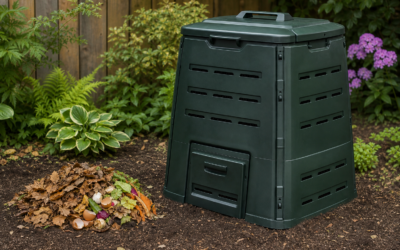


De pH-waarde van de grond beïnvloedt hoe goed planten voedingsstoffen opnemen. Gissen kan leiden tot gele bladeren, achterblijvende groei of meststoffen die niet werken zoals verwacht. Deze gids is geschreven voor beginnende tuiniers, huiseigenaren die hun tuin onderhouden, oudere tuiniers die een hulpmiddel willen dat gemakkelijk af te lezen en te gebruiken is, en kwekers met weinig ruimte die potten en verhoogde kweekbakken compact willen controleren. We vergeleken 15 digitale pH-meters voor grond in de prijsklasse van $8.99 – $47.99 van merken zoals LusterLeaf, SONKIR, Kensizer and more. Daarbij keken we naar de manier waarop elk apparaat de pH meet, hoe het wordt gevoed, hoe de sonde is gebouwd en hoe comfortabel het is voor dagelijks gebruik in de tuin.
De selectiecriteria voor deze vergelijking omvatten het meetbereik en de resolutie, de benodigde batterijen, het ontwerp en de duurzaamheid van de sonde, het gemak waarmee resultaten kunnen worden afgelezen en de vraag of een meter uitsluitend de pH meet of pH combineert met vochtigheids-, licht- of vruchtbaarheidsmetingen. Als je ook bezig bent met het verbeteren of uitgebreider testen van tuingrond, bevat onze categorie Compost, Soil & Mulch aanvullende gidsen die je naast deze gids kunt bekijken.
YAMRON CTY 4-in-1 Digital Soil Meter for Moisture, pH, Temperature, and Light Checks HSLGOVE 001 7-in-1 Soil Test Kit for Easier Watering, pH, Fertility, Light, and Temperature Checks LUVCOSY GSph-B-LCy Digital Soil pH Meter for Garden and Lawn Soil Checks Buladeke 7-in-1 Digital Soil Tester for Easier Plant Moisture, pH, Light, and Fertility Checks Prices and availability can change. We may earn a commission from qualifying purchases.


Pros
- Combines moisture, pH, temperature, and light readings in one compact garden tool.
- Large backlit screen and visual display design are beginner-friendly compared with small analog gauges.
- Lightweight listed weight of 120 grams should make it easy to carry between pots, beds, and outdoor planting areas.
- Suitable for both indoor and outdoor plant checks according to the product information.
Cons
- Requires four AAA batteries, and they are not included.
- Cannot be used directly in liquid, and forcing the probe into very dry, hard soil may damage the tester according to the instructions.
- For pH and moisture checks, the product instructions call for readings from at least five soil locations, so careful testing takes more time than a single probe reading.
The YAMRON CTY 4-in-1 Digital Soil Meter is made for gardeners who want a quick way to check basic growing conditions before watering, moving plants, or evaluating soil. It measures soil moisture, pH, temperature, and sunlight intensity, which makes it useful for houseplants, patio containers, raised beds, outdoor garden rows, succulents, and general backyard planting.
Based on the listed features, the main benefit is convenience. Instead of relying only on touch or guesswork, gardeners can use the probe and display to compare moisture levels, soil temperature, pH readings, and available light. This can be especially helpful for newer growers who are learning that different plants dry out at different rates and may respond differently to light exposure.
The design includes a large LCD screen with a white backlight, plus a 45-degree rotating head for easier viewing. The unit is listed at 2.36 inches wide by 12.6 inches high and weighs 120 grams, so it should be simple to carry between containers or garden beds. It uses four AAA 1.5V batteries, which are not included, and the product information notes a low-battery alert.
For use, the instructions say to insert the probe about 4 inches, or 10 cm, into soil and wait about 10 seconds for a reading. For soil pH and moisture, the manufacturer recommends checking at least five locations and averaging the results, which is a sensible approach because moisture and pH can vary across a bed or pot. The listed temperature range is 32 to 122 degrees Fahrenheit, with a stated temperature accuracy of 1.8 degrees Fahrenheit.
There are a few important cautions. This tester should not be used directly in liquids, and the product information warns not to insert it into very dry, hard soil. If the soil is too dry, the instructions recommend watering the test area and waiting 10 minutes before testing to avoid damaging the machine. As with any home soil meter, it is best used as a practical garden guide rather than a substitute for a professional laboratory soil test when exact nutrient or pH analysis is required.
This YAMRON meter is a good fit for homeowners, container gardeners, and beginners who want readable digital feedback for everyday plant care decisions. Gardeners who need lab-level soil analysis, battery-free operation, or a tool designed for direct liquid testing should consider a different type of testing method.
Pros
- Measures a broad set of growing conditions, including moisture, pH, fertility, light, soil temperature, air temperature, and humidity.
- Designed for both indoor and outdoor gardening uses, from houseplants to lawns and garden beds.
- LCD screen helps display temperature and humidity information clearly.
- Reviewers commonly mention that the readings are easy to understand and helpful for reducing guesswork around watering.
- Compact and lightweight enough for routine checks around pots, beds, and small growing spaces.
Cons
- Requires three batteries, and the product instructions indicate replacing or installing all three at the same time.
- It is not designed for testing liquid, so gardeners should only use it in soil as directed.
- The probe should not be forced into hard or very dry soil, since probe-style meters can be vulnerable to damage if pushed too aggressively.
The HSLGOVE 001 7-in-1 Soil Test Kit is a multipurpose soil meter made for everyday plant-care checks in home gardens, lawns, containers, and indoor growing spaces. Based on the product information, it measures soil moisture, pH, fertility, light, soil temperature, air temperature, and humidity, making it a practical choice for beginners who want a clearer picture of plant conditions before watering or fertilizing.
Its main benefit is convenience. Instead of relying only on finger tests or guessing from plant appearance, gardeners can insert the probe into soil and switch modes to check several key conditions. Moisture readings are especially useful for houseplants and containers, where overwatering is a common problem. The pH and fertility functions can also help guide general soil-care decisions, though gardeners making major amendments may still want a lab or dedicated soil test for confirmation.
The design combines a dial-style soil meter with an LCD display for temperature and humidity information. The listed probe length is about 6.8 inches, which should be useful for medium to large potted plants and many garden-bed checks. The product measures 11.5 x 2.9 x 1.5 inches and weighs 4.8 ounces, so it should be easy to store in a drawer, potting bench, greenhouse shelf, or small garden tote.
For everyday use, this meter fits a wide range of small-space and backyard tasks. A patio gardener could compare moisture levels between containers, a raised-bed gardener could check whether different areas are drying unevenly, and an indoor plant grower could use the light meter to evaluate plant placement. The air temperature and humidity readings may also be useful around seedlings, houseplants, or protected growing areas where conditions change quickly.
There are a few important cautions. The product information says this is not a water moisture meter, so it should not be used to test liquid. It also requires three batteries, and the instructions note that all three should be replaced or installed each time. As with any probe-style soil meter, it is wise to loosen very hard or dry soil first and insert the probe gently rather than forcing it, which can help reduce the chance of damaging the shaft or disturbing roots.
This is a sensible pick for gardeners who want an easy, all-in-one reference tool for routine plant care rather than a professional soil analysis device. Gardeners who need highly detailed nutrient reporting, laboratory-grade pH confirmation, or rugged field equipment for compacted farm soil may prefer a more specialized testing method.
Pros
- Designed specifically for soil pH testing in gardens, lawns, and plant beds.
- Digital LCD display and 0.1 pH resolution make readings easier to interpret than simple needle-style testers.
- Portable size and listed 160 gram weight support convenient use around multiple planting areas.
- Includes three AA batteries according to the product information.
- Backed by a listed one-year warranty from the manufacturer.
Cons
- It is soil-only and should not be used to measure liquids.
- Gardeners who want a multi-function meter for moisture, light, or temperature may prefer a different tool.
- IP54 protection is not the same as being fully waterproof, so it should not be submerged or left exposed in wet conditions.
The LUVCOSY GSph-B-LCy Digital Soil pH Meter is made for checking the acidity or alkalinity of soil in gardens, lawns, planted beds, and similar growing areas. Soil pH matters because nutrients can become less available when soil is too acidic or too alkaline, so a pH reading can help guide whether further soil testing or amendments may be needed.
Based on the listed specifications, this meter measures from 3.0 to 9.0 pH with 0.1 pH resolution. The product information also notes FDR (Frequency Domain Reflectometry) and AC detection techniques, along with double stainless-steel probes described as sensitive and anticorrosive. For home gardeners, the practical value is a dedicated soil pH tool that provides a numeric reading instead of relying only on visual estimates.
The unit is handheld and portable, with listed dimensions of 10 x 2 x 2.7 inches and a stated weight of 160 grams in the feature information. It uses an LCD display and is described as calibration-free, which may appeal to beginners who want fewer setup steps. The listed IP54 waterproof level suggests protection against dust and splashing, but it should still be treated as an electronic tool and stored dry after use.
In a backyard garden, this meter could be used to compare pH in vegetable beds, ornamental borders, lawn trouble spots, or container plantings. It may also be useful in raised beds where imported soil or compost blends can differ from native ground soil. Small-space gardeners can use its compact design to check multiple pots or planters without carrying a bulky kit.
The main limitation is that this LUVCOSY meter is for soil pH only. The manufacturer specifically notes that it should not be used to measure liquid, and it does not list additional functions such as soil moisture, light, or temperature. As with any probe-style soil tool, gardeners should avoid forcing the probes into rocks, roots, or compacted ground, and should clean and store the meter carefully after use.
This is a sensible option for gardeners who want a dedicated digital pH checker for routine soil monitoring rather than a full laboratory test or a multi-sensor garden meter. Gardeners needing broader soil analysis, nutrient testing, or liquid pH measurement should consider a different product designed for those tasks.
Pros
- Measures multiple soil and growing-condition indicators in one digital device.
- Backlit display with large numbers may be easier to read than basic needle-style meters, a point several reviewers commonly mention.
- Works for indoor and outdoor plant care, including gardens, beds, potted plants, and succulents according to the product information.
- Fast listed reading process, with the manufacturer describing about 10 seconds after inserting the probe.
- Lightweight design should be easy to carry between rooms, containers, and garden beds.
Cons
- AAA batteries are required but not included.
- The probe should not be forced into very dry or hard soil, so compacted beds may need light moistening and a wait before measuring.
- Gardeners who need laboratory-grade pH, nutrient, EC, or TDS results may prefer dedicated testing equipment.
The Buladeke 7-in-1 Digital Soil Tester is a probe-style meter made for routine plant checks around the home garden. Based on the listed features, it measures soil moisture, pH, temperature, light intensity, and fertility, with EC and TDS functions also included. It is a practical fit for beginners, houseplant collectors, patio gardeners, and homeowners who want a quick snapshot of growing conditions before watering or adjusting plant placement.
The main value is convenience. Instead of using separate tools for moisture, light, and basic soil-condition checks, this meter puts several readings on one digital display. For everyday gardening, moisture is likely the most useful function, especially for containers, succulents, and indoor plants where the soil surface can look dry while the root zone is still damp. The pH, fertility, temperature, and light readings can also help flag when a plant may need closer attention.
The product information highlights a large LCD screen with a white backlight, clear numbers, intuitive symbols, and a low-battery warning. It runs on 4 x 1.5V AAA batteries, which are not included. The listed package dimensions are 11.61 x 2.68 x 1.85 inches, and the item weight is 5.6 ounces, so it should store easily with small garden tools or on a potting bench.
For use, the manufacturer says to insert the probe about 10 cm into the soil and wait about 10 seconds for a reading. That makes it useful for checking several pots, raised-bed sections, or garden rows during a watering round. It can also help compare light levels in different areas, such as a windowsill, patio corner, greenhouse bench, or outdoor bed, when deciding where to place plants with different light needs.
There are a few important cautions. The product notes that the tester must not be used directly to measure liquids, and if soil is too dry or hard, the probe should not be forced in. The recommended approach is to moisten the test area slightly and wait 10 minutes before measuring to avoid damaging the device. As with most home soil meters, gardeners needing highly precise nutrient, pH, EC, or TDS data should consider follow-up testing with dedicated equipment.
Overall, this Buladeke meter looks most useful as a quick decision aid for everyday plant care rather than a professional lab instrument. It is a good match for growers who want easier watering judgment, clearer digital readings, and multiple plant-condition checks in one lightweight tool. Gardeners working in very compacted soil or those requiring calibrated scientific measurements may be better served by more specialized testing methods.
Pros
- Measures three common plant-care factors: soil moisture, soil pH, and sunlight level.
- Does not require batteries, charging, or digital setup.
- Compact and lightweight for use around indoor plants, outdoor containers, raised beds, gardens, and lawns.
- Simple switch-based operation makes it approachable for beginner gardeners.
- Product instructions clearly outline cleaning and soil-use precautions.
Cons
- Not intended for testing water or other liquids, including liquid pH readings.
- Very dry or very hard soil may prevent movement of the indicator or risk damaging the probes if forced.
- Gardeners needing laboratory-level pH accuracy may prefer a dedicated soil test kit or professional soil analysis.
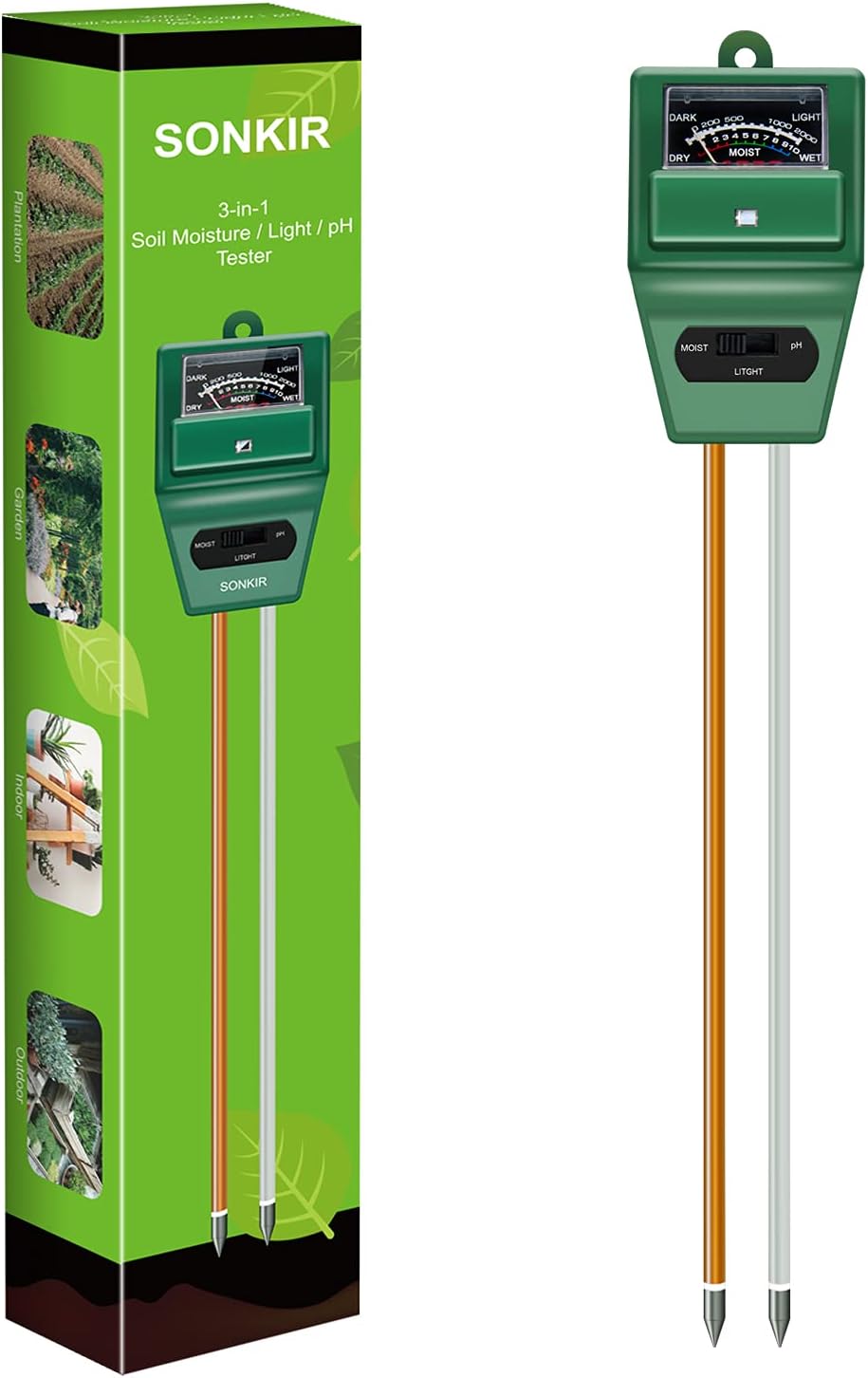
The SONKIR MS02 is a 3-in-1 soil meter made for checking soil moisture, soil pH, and sunlight level with a single analog dial. It is intended for practical plant care rather than lab-grade testing, making it a useful fit for homeowners, houseplant keepers, patio gardeners, and beginners who want a quick reference before watering or moving plants.
Its most useful everyday role is helping reduce guesswork around watering. The moisture scale runs from dry to wet, so gardeners can check below the surface instead of judging only by the top layer of soil. The pH function covers a listed range of 3.5 to 8, and the light setting can help compare growing spots for indoor plants, containers, vegetable beds, or lawn areas.
Based on the listed specifications, the meter measures 11.5 x 2 x 1.5 inches and weighs 2.89 ounces, so it should be easy to store with small garden tools or keep near a potting bench. The probe length is listed at 7.9 inches, and the instructions recommend inserting the probes about 6 to 7 inches into soil, then waiting about 10 minutes before reading the dial.
For small-space gardeners, this tool can be helpful when checking container soil that dries unevenly, comparing light levels on a windowsill, or monitoring raised-bed moisture after watering. In larger yards, it can serve as a quick reference for garden beds, lawns, and general soil checks, especially when plants show signs that water, light, or soil conditions may need attention.
There are important use limits to keep in mind. The product information says it is for soil only and should not be used to test pure water or other liquids. It also should not be forced into very hard soil or left in soil for long periods, and the probes should be wiped clean after each use. If the soil is extremely dry, the indicator may not move until the soil is watered before testing.
This is a sensible choice for gardeners who want a simple, battery-free way to gather basic soil-condition clues. Gardeners who need highly precise pH data for major soil amendments, crop planning, or diagnostic work may want to pair it with a more formal soil test, but for routine home plant care the MS02 offers a convenient starting point.

Pros
- Combines multiple plant-care measurements in one soil meter.
- App connectivity may make readings easier to track than a basic analog probe.
- Works for a wide range of indoor and outdoor growing situations listed by the manufacturer.
- Rechargeable Type-C interface is convenient for routine garden use.
- Care instructions are straightforward, including wiping the probe and storing it dry after use.
Cons
- Requires Bluetooth, app use, and phone permissions, which may not appeal to gardeners who prefer a simple no-app meter.
- Readings require inserting the probe for 1 to 2 minutes and syncing in the app, so it is not an instant glance tool.
- The product information does not list measurement ranges, calibration details, waterproof rating, or battery runtime.
The KGLLIFE 6-in-1 Soil Test Kit is a digital soil meter made for checking several common growing conditions in one device. According to the product information, it measures soil pH, soil moisture, soil temperature, conductivity, light intensity, and relative humidity of the surrounding environment. That makes it a practical option for houseplant owners, balcony gardeners, vegetable growers, greenhouse users, and homeowners trying to make more informed care decisions.
The main benefit is the broader view it gives compared with a basic moisture-only meter. Moisture can tell you whether the root zone is dry or wet, but pH, conductivity, temperature, light, and humidity can also affect plant performance. The listed feature set suggests it can help gardeners compare readings with a plant’s preferred range before changing watering, fertilizer, or lighting routines.
This meter connects to the SoilX app through Bluetooth. The listed setup instructions say to press and hold the power button for 3 seconds, enable Bluetooth and location permissions, connect in the app, insert the probe into soil for 1 to 2 minutes, and then press Sync for more stable readings. An LED indicator shows power, pairing, and connection status, which should help users understand what the device is doing during setup.
For small-space gardening, this type of tool can be useful when checking potted herbs, succulents, flowers, balcony containers, or indoor foliage plants that dry unevenly. Outdoors, the product information lists use in vegetable gardens, lawns, greenhouses, and small farms, including crops and plants such as tomatoes, corn, strawberries, flowers, and succulents. It may be especially helpful when comparing conditions across several beds or containers rather than guessing by surface appearance alone.
There are a few practical cautions. The metal probe should be inserted vertically and should not be forced into hard rocks or compacted hard soil. After use, the probe should be wiped clean and the device stored dry to help preserve it. Gardeners should also note that the supplied information does not provide measurement ranges, calibration instructions, waterproof rating, or battery runtime, so those details should be checked before relying on it for more technical growing decisions.
Overall, this KGLLIFE soil meter is a sensible fit for gardeners who want a rechargeable, app-connected tool for routine plant checks and basic decision support. Gardeners who dislike phone apps, need lab-level soil analysis, or want a meter with clearly published calibration and range specifications may prefer a different option.

Pros
- Easy-to-read digital output supports quick pH checks for home garden soil.
- Includes a printed plant list and instructions to help connect readings with plant preferences.
- The listed 3.5 to 9.0 pH range is useful for many common gardening situations.
- Compact, lightweight product information suggests easy storage with other small garden tools.
Cons
- It is listed as designed only for soil, so it may be less suitable for testing liquids, compost tea, or other materials.
- Gardeners who need lab-level nutrient analysis or detailed soil reports may prefer a full soil test kit or laboratory test.
- The supplied product data does not list calibration details, so careful reading of the instructions is important.
The Luster Leaf Rapitest 1845 Digital Soil pH Meter is a compact soil meter for checking whether garden soil is acidic or alkaline. Based on the listed specifications, it is intended for adult home gardeners who want a simple pH reading for beds, planters, lawns, and other soil-based growing areas.
Its main practical benefit is the digital output, which can be easier for beginners to read than visual color matching. The product information indicates that it measures pH from 3.5 to 9.0, a range that helps gardeners compare their soil conditions with the included plant pH preference list.
The meter is specifically designed to be used only in soil, so it is best treated as a focused garden soil tool rather than a general liquid testing device. The listed item weight is 0.1 pounds, which suggests it should be easy to move around the yard or keep with seed packets, labels, and other small planting supplies.
In a backyard garden, this type of meter can be useful before choosing a planting location for vegetables, flowers, shrubs, or acid-loving plants. In raised beds and patio containers, it gives gardeners a quick way to check soil pH when refreshing potting mix, comparing beds, or trying to understand why a plant may not match its preferred growing conditions.
There are limits to keep in mind. A soil pH meter does not replace a full soil test for nutrients, organic matter, or broader soil health, and the supplied data does not describe calibration features. For best results, gardeners should follow the included instructions, use it only as directed in soil, and keep the probe or meter clean and stored safely after use.
This is a practical choice for gardeners who want a straightforward digital pH check and a plant preference reference in one package. Gardeners who need professional soil recommendations, fertilizer analysis, or multi-parameter testing may want to consider a more comprehensive soil testing option.

Pros
- Measures several common growing conditions with one compact soil meter.
- LCD screen supports quick reading of temperature and humidity information.
- Single-probe design may be easier to insert around established roots than wider multi-probe testers.
- Works across a broad range of gardening situations, from houseplants to lawns and raised beds.
Cons
- Requires 3 batteries before use, so gardeners should check power needs before relying on it for seasonal testing.
- It is not intended for testing liquids, which limits use to soil and air readings only.
- Gardeners needing laboratory-grade soil analysis may prefer a dedicated soil test service or more specialized kit.
The HCZMOPTP 7-in-1 Digital Soil Tester is designed for gardeners who want a quick way to check several growing conditions without juggling multiple tools. Based on the listed product information, it measures soil moisture, pH, fertility, soil temperature, air temperature, air humidity, and light intensity. That makes it a practical option for houseplant owners, vegetable gardeners, lawn caretakers, greenhouse users, and beginners learning how soil and site conditions affect plant care.
The main benefit is convenience. Moisture readings can help guide watering decisions, while pH and fertility readings provide general reference points for soil condition. Temperature, humidity, and light readings add more context, especially when comparing indoor plant locations, checking a greenhouse environment, or deciding whether a raised bed is warming up enough for seasonal planting. These readings should be treated as helpful garden guidance rather than a replacement for professional soil analysis when exact nutrient data is needed.
The tester uses a single alloy probe listed at about 6.8 inches long. The product information recommends inserting the probe more than 3 inches into the soil for best results. A single-probe design can be useful around potted plants and established garden beds because it creates less disturbance than tools with multiple prongs. The LCD screen displays temperature and humidity information, and the unit switches between modes with a slide button.
In everyday use, this type of meter fits well into routine plant checks. A homeowner could compare moisture levels between containers on a patio, check whether a lawn area is staying too dry, or compare light intensity in different indoor plant spots. Raised-bed gardeners may find it useful for quick checks before watering vegetables or flowers, while greenhouse growers can use the air temperature and humidity readings as extra reference points for daily observation.
There are a few practical limitations to keep in mind. The product information states that 3 batteries must be installed before use, and it should not be used to test liquids. As with most consumer soil meters, readings can vary with soil contact, depth, and soil texture, so it is wise to test in more than one spot and wipe the probe clean after use. Avoid forcing the probe into hard or rocky soil, since that could bend or damage the sensor area.
This soil tester is a good fit for gardeners who want fast, broad feedback on common plant care conditions in pots, beds, lawns, or greenhouses. Gardeners who need precise nutrient levels, detailed soil chemistry, or official amendment recommendations should consider a dedicated soil lab test or a more specialized testing method.
Pros
- Combines several basic garden checks in one soil analyzer
- Digital display and corded probe support more convenient reading and handling
- Includes pH guidance for a wide range of plants
- Compact listed dimensions make it practical to store with small garden tools
Cons
- It measures basic conditions only, so gardeners needing nutrient analysis or lab-level soil testing may need a separate test
- Probe-style meters can require careful placement and clean contact with soil for useful readings
- The listed information does not specify battery details or weather-resistant construction
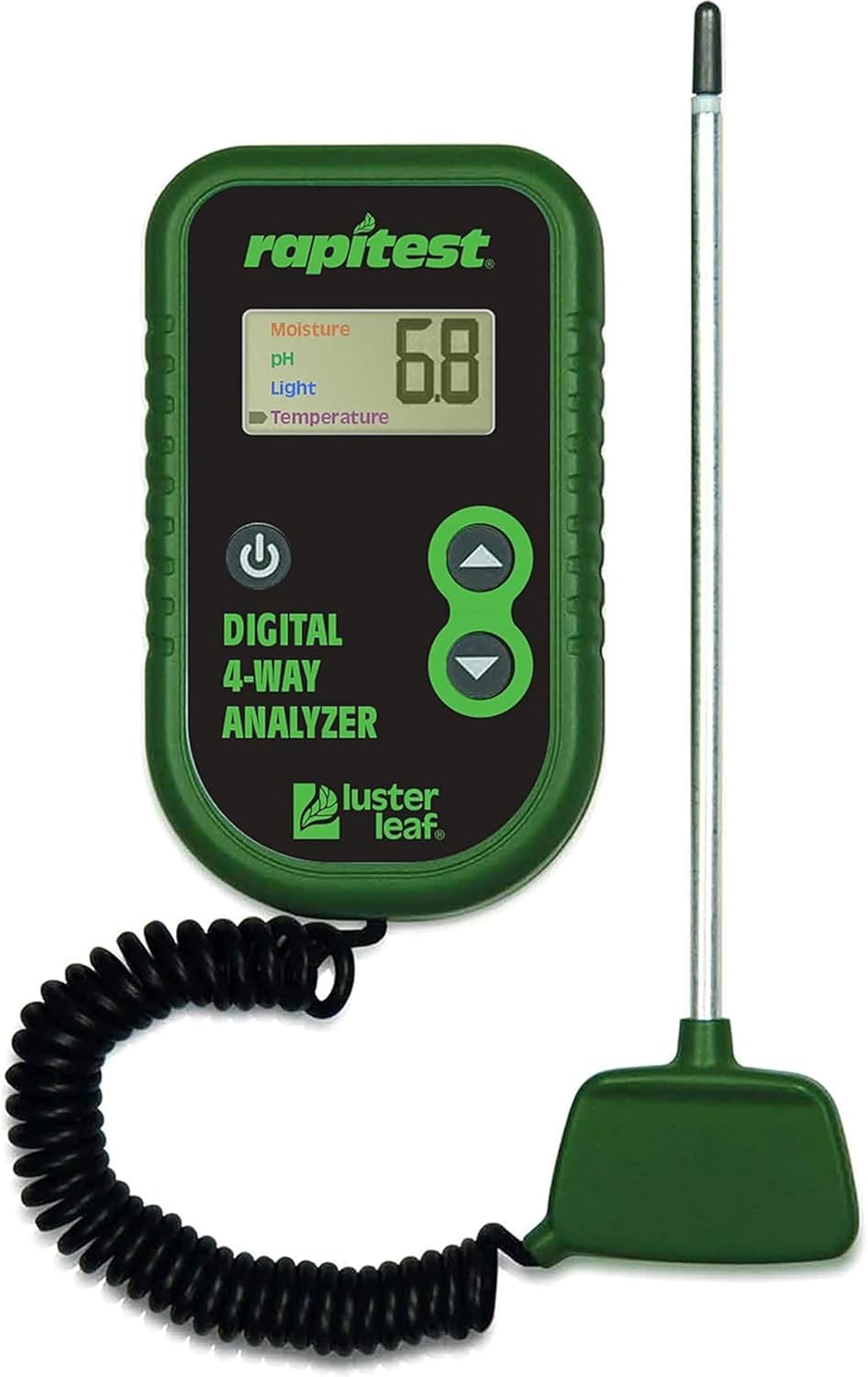
The Luster Leaf Rapitest 1885 4-Way Digital Soil Analyzer is a home garden soil meter designed to check pH, moisture, temperature, and light. It is a practical option for beginners, container gardeners, raised-bed growers, and homeowners who want a quick way to compare growing conditions before watering, planting, or moving plants to a brighter spot.
Its strongest value is the combination of four common garden checks in one compact tool. Soil pH can help gardeners understand whether a plant is in a more acidic or alkaline root zone, moisture readings can support better watering decisions, soil temperature can be useful around planting time, and light readings can help compare different growing locations.
The product information lists a modern digital output and a corded probe, which should make it easier to position the probe in soil while keeping the readout visible. At 12 x 7 x 2 inches and 7 ounces, it is small enough to store on a potting bench, in a garden tote, or near indoor plant supplies without taking much room.
In everyday use, this type of meter is most helpful for spot-checking vegetable beds, patio planters, flower borders, and potted herbs. The included instructions, gardening tips, and pH list for 450+ plants are especially useful for gardeners who are still learning how different plants respond to soil conditions.
There are some reasonable limits to keep in mind. This is not listed as a nutrient test and should not replace a full laboratory soil analysis when you need detailed fertility recommendations. As with most probe-style tools, gardeners should use it carefully, avoid forcing the probe into hard soil, and keep the probe clean so readings remain as useful as possible.
Overall, the Rapitest 1885 is a sensible choice for gardeners who want one easy-reference tool for several basic growing conditions. Gardeners who need professional-grade soil diagnostics, fertilizer analysis, or detailed calibration information may prefer a more specialized testing method.

Pros
- Measures more than soil, including water, solutions, plants, and food-related samples as listed by the manufacturer.
- Three-point calibration is a useful feature for gardeners who want more control than a basic color strip or simple analog probe.
- Backlit display, data hold, temperature readout, and alarm function add practical usability for routine garden checks.
- Compact 1.6-inch by 10-inch form factor is easy to store with seed-starting, greenhouse, or soil amendment supplies.
- Several reviewers describe accurate readings after calibration, while noting that proper setup matters.
Cons
- Requires calibration before first use and electrode care afterward, so it may be more involved than beginners expect.
- The product information says potassium chloride solution should be added to the protective cover after measurement, which adds a maintenance step.
- A small number of reviewer comments mention defective display or calibration prompt issues, so checking the unit promptly after arrival is sensible.
The Tadeto TE027 is a digital pH tester intended for measuring pH in soil, garden water, solutions, plants, and food-related samples. For home gardeners, its most relevant job is helping you understand whether a bed, container mix, or irrigation water is trending acidic, neutral, or alkaline before you make soil amendment decisions.
The key feature is its three-point calibration method using pH 4.01, 7.0, and 10.01 buffer solutions. That matters because garden soils and water can fall across a wide range, and calibration helps the meter interpret readings more reliably than an uncalibrated probe. The product information also lists a real-time temperature display, which can be useful context when checking solutions.
The meter has a backlit LCD screen for easier reading in lower light, plus a data hold function for recording values without rushing. A red backlight alarm is listed for very strong acid or alkaline readings below pH 3.5 or above pH 12. The included zinc alloy cap and hard conical protective tip are designed to shield the electrode, especially when working with firmer materials.
In a backyard garden, this type of meter can be helpful for comparing raised beds, checking container mixes, monitoring greenhouse inputs, or evaluating water used for sensitive crops. It may also appeal to gardeners managing potting media for acid-loving or pH-sensitive plants, provided they understand that pH readings should guide decisions rather than replace a full soil test for nutrients.
This is not a no-maintenance garden gadget. The manufacturer states that it should be calibrated before first measurement and that potassium chloride solution should be placed in the protective cover after measurement to keep the electrode active. Reviewers often respond well to the meter when it is calibrated carefully, but at least one reported display or calibration prompt problems, so new owners should verify operation early and follow the manual closely.
Overall, the Tadeto TE027 is a practical fit for gardeners who want a digital pH meter with calibration, temperature display, and probe protection. Gardeners who only need an occasional rough soil check, or who do not want to maintain an electrode and calibration solutions, may be happier with a simpler testing method or a lab soil test through a local extension service.
Pros
- Useful for quick soil moisture checks in pots, vegetable beds, lawns, and outdoor planting areas.
- Battery-free operation keeps the tool simple and low maintenance.
- Compact and lightweight enough to store with small gardening tools.
- Product information provides clear use steps, including insertion depth, wait time, and cleaning guidance.
- Reviewers commonly mention the moisture meter as easy to use for watering decisions.
Cons
- The pH reading is described as relative, with a stated margin of error around 1 to 2, so gardeners needing precise soil chemistry data may prefer a lab test or dedicated pH method.
- The probe should not be forced into hard or very dry soil, which may require watering or loosening the soil before testing.
- It should not be left in soil for long periods or used in liquids, so it is a spot-check tool rather than a permanent monitor.
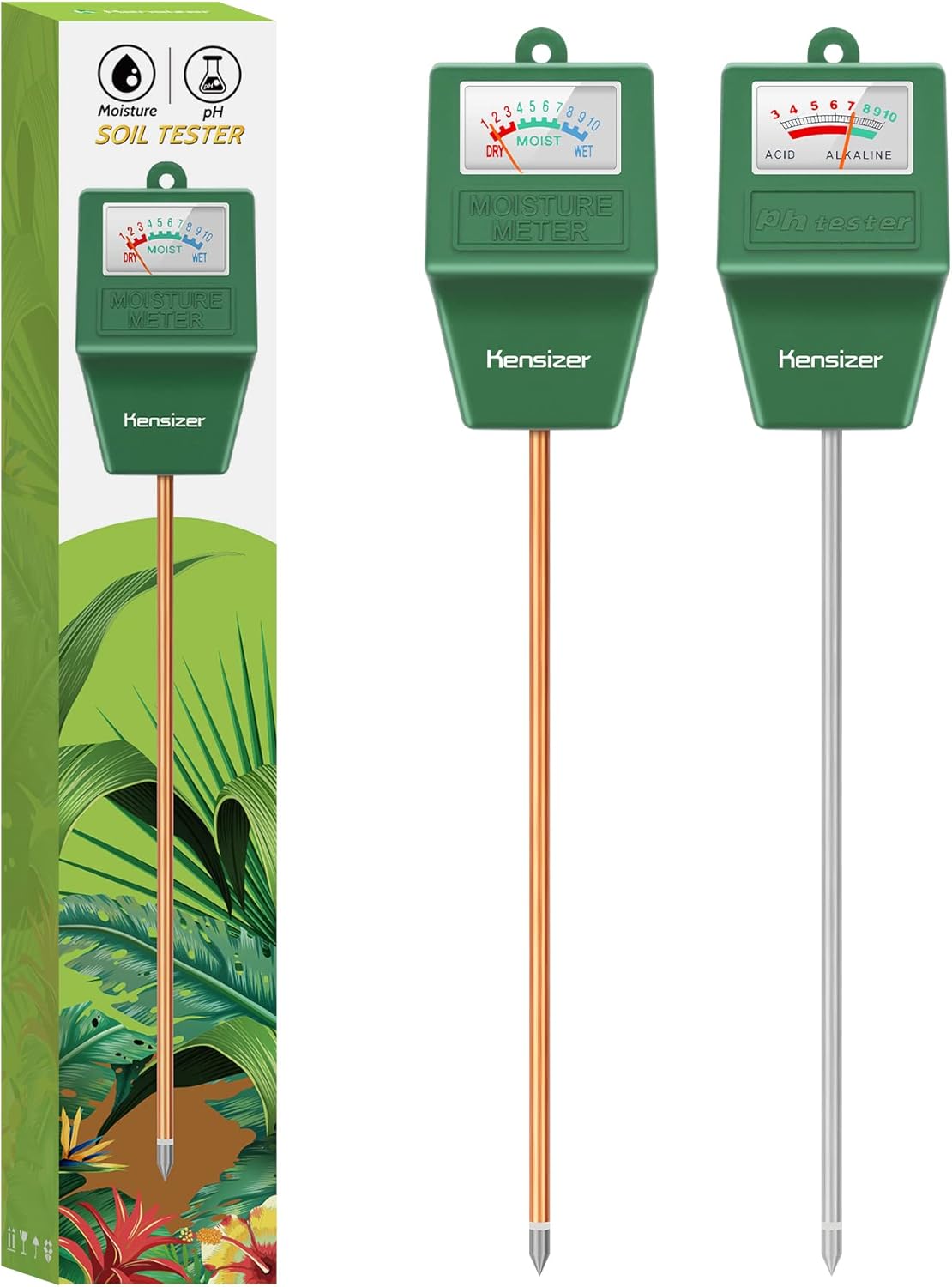
The Kensizer Soil Tester-2 is a compact soil meter set made for two common garden checks: soil moisture and soil pH. According to the product information, the package includes one moisture tester and one pH tester, giving homeowners, container gardeners, and beginner growers a simple way to check soil conditions before watering or making basic soil decisions.
Its most practical use is moisture checking. The listed instructions recommend inserting the probe 2 to 4 inches into the soil, waiting about one minute for the value to stabilize, then reading the dial. This can be especially helpful in containers, raised beds, and vegetable gardens where the surface may look dry while deeper soil still holds moisture.
The design is intentionally simple. The meters use a single-probe detection style, a clear dashboard with an arrow pointer, and no batteries. At 2.2 x 1.89 x 11.22 inches and 4.5 ounces, the set is small enough to move between houseplants, patio planters, lawn trouble spots, and outdoor beds without taking up much storage space.
For everyday gardening, this set is best viewed as a quick reference tool rather than a laboratory instrument. The product information notes that pH readings are for soil only, not liquids, and that soil moisture should be within a suitable range when checking pH. It also states that the difference between relative and absolute pH may be around 1 to 2, so major soil amendment decisions should be made carefully.
Maintenance and proper handling matter with this type of probe meter. The manufacturer advises not forcing the probe into hard soil, not testing pure water or other liquids, not leaving the meter in soil for a long time, and wiping the probe clean after use. If the soil is too dry and the indicator does not move, the instructions recommend watering before testing.
This is a sensible choice for gardeners who want a low-maintenance way to check whether soil is dry, moist, or wet before watering. Gardeners who need highly precise pH data for specialty crops, detailed soil correction, or formal soil management should consider a more exact testing method.

Pros
- Measures both soil and water pH, giving it broader use than soil-only garden meters.
- Included tapered plastic dibbers are intended to help protect the pH electrode when inserting into soil.
- Automatic app data storage can help gardeners track pH changes over time or compare multiple planting areas.
- Compact listed size and light weight make it easier to store with other seed-starting, greenhouse, or potting bench supplies.
Cons
- Digital pH meters require calibration and probe cleaning, so it may take more care than a basic analog tester.
- The app-based data features may be unnecessary for gardeners who only want an occasional quick pH check.
- Product information does not list waterproofing or long-term outdoor exposure protection, so storage and careful handling are important.
The YINMIK YK-S01P is a digital pH meter made for gardeners who want to check the acidity or alkalinity of soil and water. It is positioned for potted plants, gardens, lawns, greenhouses, farms, yards, hydroponic nutrient solutions, and other plant-related water sources. For beginners, pH testing can be useful because soil pH affects how available nutrients are to plant roots, especially for crops with specific pH preferences such as blueberries.
Its main practical advantage is that it provides a digital pH reading rather than a pointer-style dial. According to the product information, the probe can be inserted directly into soil without mixing a soil solution, which may make routine checks easier for containers, raised beds, and planting rows. The listed suitable media include coco coir, potting mixes, sandy soil, and loam, so it fits a range of common home gardening situations.
The meter is also listed for water pH testing, including hydroponic nutrient solution, well water, rain water, tap water, aquariums, and pools. That broader use may appeal to gardeners who grow both in soil and in water-based systems. The YINMIK app adds automatic data storage for up to 1000 readings and allows notes about where samples were taken, which can help keep records for different beds, pots, or greenhouse zones.
Based on the listed specifications, the meter measures about 1.5 x 1.49 x 11.42 inches and weighs 10.6 ounces, making it small enough for a potting bench drawer or garden tool caddy. The package includes the soil pH detector, two tapered plastic dibbers, a cleaning brush, three 1.5V LR44 batteries, six calibration buffer powders, a dropper, an English instruction manual, and a plant pH card. The dibbers are a useful inclusion because the product information describes them as a way to help protect the pH electrode during soil insertion.
For everyday backyard use, this meter is most relevant when checking vegetable beds before adjusting soil amendments, monitoring potted plants that seem stressed, comparing raised-bed mixes, or keeping records in a greenhouse. It may also be useful for hydroponic growers who want a single tool listed for both soil and water pH checks. Gardeners growing acid-loving or pH-sensitive plants may appreciate having a more specific digital reading instead of relying only on plant symptoms.
The tradeoff is that a digital pH meter needs more care than a simple probe tester. Calibration, cleaning, and careful probe handling are part of responsible use, and the supplied calibration powders and brush suggest those steps should not be skipped. Gardeners who only need a very occasional rough soil check may prefer a simpler kit, while those who want digital readings, record keeping, and soil plus water use will find the YINMIK YK-S01P feature set well matched to regular garden monitoring.

Pros
- Combines multiple common soil and growing-environment readings in a single digital meter.
- Large split display may be easier to read than compact probe-only meters.
- Suitable for both indoor and outdoor plant care according to the listed product information.
- Product guidance clearly explains that moist soil, settling time, and multiple test spots can improve pH trend readings.
- Reviewers commonly mention that it is most useful when treated as a trend-checking tool rather than a laboratory-grade soil test.
Cons
- Gardeners needing precise nutrient analysis or formal soil recommendations may still prefer a professional soil test.
- Readings can vary in dry or uneven soil, so it may require moistening the soil, waiting, and checking several spots.
- It is designed for spot testing, so leaving the probe buried continuously may not be the best routine for long-term lifespan.
The ISyncPlug TH-02 is a digital 7-in-1 soil meter made for routine plant and soil checks around the home garden. It is intended to measure pH, sunlight, fertility, soil and air temperature, and humidity, giving gardeners a broader look at growing conditions than a basic moisture-only probe. It is best suited to beginners and intermediate gardeners who want help deciding when to water, when to investigate soil conditions, or when to compare different areas of a bed or container.
The main benefit is convenience. Instead of using separate tools for moisture, pH, temperature, and light checks, this meter brings several readings onto one display. The product information describes a five-probe system and a calibration algorithm designed for faster and more detailed readings than simpler probe meters. For practical gardening, that means it can help identify patterns, such as a pot drying out faster than expected or a bed showing different moisture or fertility readings from one end to the other.
The split large LCD display is one of the more useful design details, especially for gardeners who do not want to crouch low to read a small dial at soil level. The listed dimensions are compact, and the unit uses 3 AAA batteries. The product information also notes that the air temperature and humidity readings come through rear ventilation openings, so the display should be allowed to stabilize in the target area before those values are checked.
In everyday use, this type of meter fits houseplants, patio containers, raised beds, vegetable beds, flower borders, greenhouse benches, and lawn areas where conditions can vary from spot to spot. The product guidance recommends using evenly moist soil for pH checks, allowing the reading to settle, and comparing several spots to understand the trend. That is especially important because soil is not uniform, and a single reading may not represent an entire pot, bed, or lawn patch.
There are a few realistic limitations. The product information explains that very dry soil can cause readings to lag, and reviewers commonly note that pH readings may vary unless the soil is slightly moist and the probe is left in place long enough to settle. Fertility readings should be treated as relative indicators rather than a full nutrient breakdown. For outdoor beds where exact nutrient levels matter, a professional or lab soil test is still the better choice.
Overall, the ISyncPlug TH-02 is a useful monitoring tool for gardeners who want a quick way to compare growing conditions and make more informed routine care decisions. It is a good fit for houseplant owners, container growers, raised-bed gardeners, and homeowners checking lawn or garden moisture trends. Gardeners who need highly precise pH or nutrient analysis should consider it a supplemental tool rather than a replacement for formal soil testing.
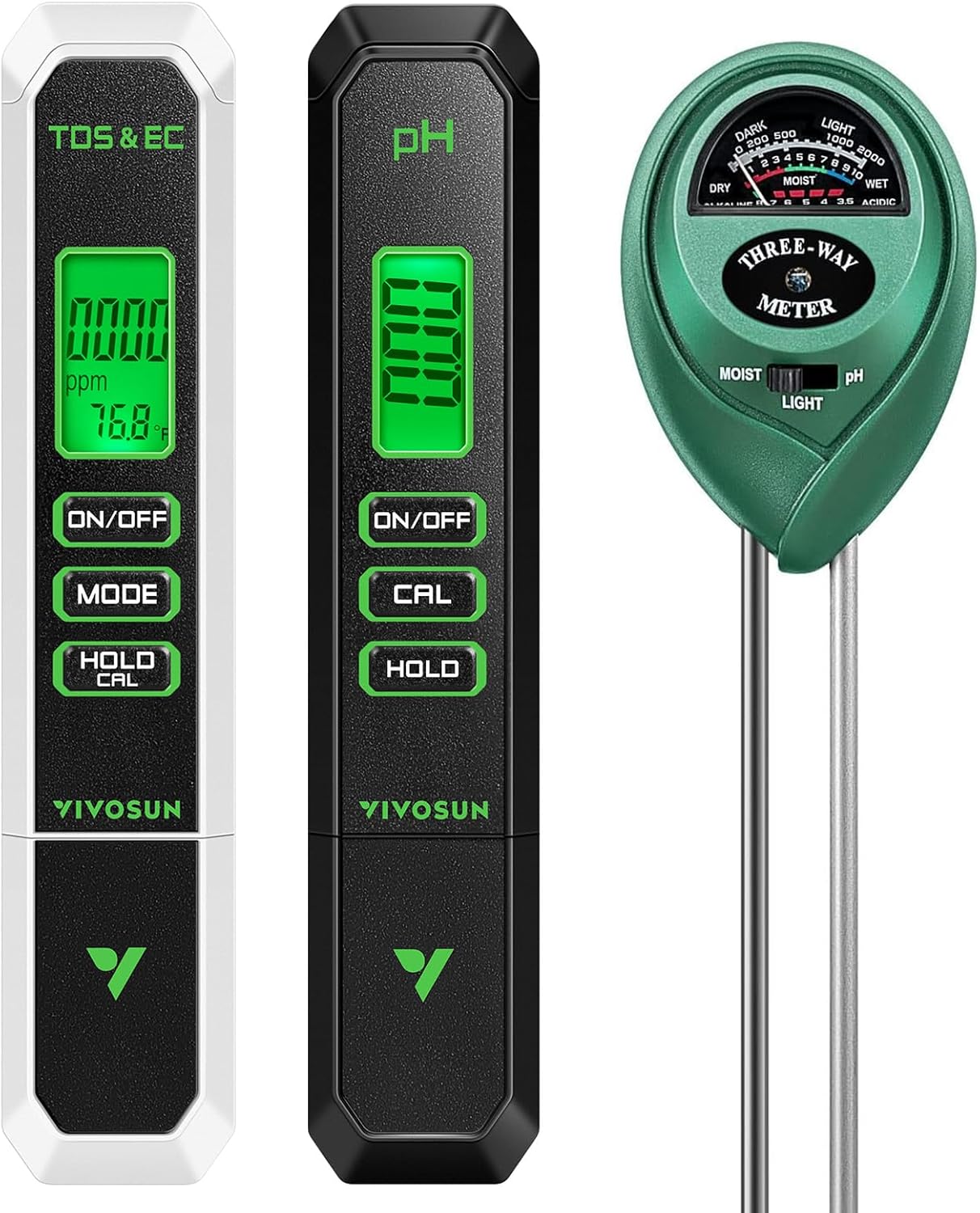
Pros
- Combines three different testers for a wider range of garden and water measurements.
- Includes calibration buffer powder packs for the digital pH meter.
- Compact tools are suited to home, garden, pool, aquarium, and hydroponic use according to the listed applications.
- Soil tester does not require batteries, which simplifies quick outdoor checks.
Cons
- The product information does not list a waterproof rating, so the digital meters should be handled carefully around liquids and used according to the instructions.
- Gardeners needing professional lab-grade precision may prefer a more specialized meter.
- Some reviewers report needing extra pH calibration or finding readings less consistent for advanced use.
The VIVOSUN COMBO-02J is a multi-meter testing kit for gardeners who want to check both liquid and soil conditions without buying separate single-purpose tools. The set includes a digital pH meter, a digital TDS/EC/temperature meter, and a 3-in-1 soil tester for moisture, pH, and light. Based on the listed features, it fits beginners, container gardeners, small greenhouse growers, and hydroponic users who want practical measurements for routine plant care.
The main value of this kit is its broad coverage. The liquid pH meter measures from 0.00 to 14.00 pH with listed ±0.1 pH accuracy, while the TDS meter reads TDS, EC, and temperature with a switchable Celsius or Fahrenheit display. For soil, the included tester offers a moisture scale from dry to moist, a light range from low to bright, and a pH range from 3.5 to 8.0, giving gardeners quick reference points before watering or adjusting growing conditions.
The digital meters include backlit LCD displays, hold functions, and Automatic Temperature Compensation, all of which are useful when taking readings in a grow room, near a sink, or outdoors in changing light. The pH meter also uses one-touch automatic calibration with included buffer powder packs, which is important because pH meters need calibration to stay useful. The soil tester is described as compact and battery-free, making it easy to carry between pots, raised beds, and planting areas.
In a backyard or patio garden, this kit can help with everyday decisions such as checking whether a container is drying out, comparing light levels between plant locations, or reviewing water quality before using it in a hydroponic setup. It may also be useful for homeowners who maintain aquariums, pools, or spas, since the listed applications include those liquid-testing uses. For raised beds and houseplants, the soil tester gives a quick snapshot rather than requiring a more involved lab soil test.
There are some important limitations to keep in mind. The product information does not list a waterproof rating, so the digital meters should not be treated as fully waterproof instruments, and only the probe area should be used as directed by the manual. pH meters also require calibration and careful rinsing between samples, and reviewer feedback is mixed on consistency for more demanding use. The soil pH function is best viewed as a convenient garden reference, not a substitute for a professional soil analysis when exact amendment planning is needed.
Overall, the VIVOSUN COMBO-02J is a practical choice for gardeners who want a compact, multi-reading kit for general plant, water, and hydroponic monitoring. It is a better fit for home troubleshooting and beginner-to-intermediate growing than for professional greenhouse management or laboratory-level measurement.

Pros
- Checks both soil moisture and pH with one handheld meter.
- Does not require batteries, charging, or an on/off switch.
- Dual-screen style display makes it easy to view both measurements during a soil check.
- Probe length is practical for many container plants and general garden use.
Cons
- Not intended for testing liquids, so it should only be used in soil as directed.
- May be less suitable for very hard or very loose soil, since the product instructions warn not to force the probe.
- Gardeners needing lab-level soil analysis may prefer a dedicated soil test kit or professional test.
The HSLGOVE Purple Sage soil test kit is a 2-in-1 soil meter designed to measure moisture and pH for plant care. It is aimed at gardeners who want a quick way to check whether soil is dry, moist, or overly wet, while also getting a basic soil pH reading for routine growing decisions.
The main benefit is simplicity. Based on the listed product information, the meter uses a plug-and-read design with no batteries and no switch. The dual-dial layout shows moisture and pH at the same time, which can be especially helpful for beginners who want to avoid guessing when to water.
The probe is listed as 7 inches long and should be inserted at least 3 inches into the soil. The product information indicates that moisture readings appear in seconds, while pH readings take about 3 minutes. Its single-probe format with steel sensing probes is intended to be sturdy and to reduce disturbance around plant roots compared with larger probe arrangements.
This soil meter fits common home gardening situations, including houseplants, patio containers, raised-bed plantings, lawns, yards, farms, and greenhouse use. For small-space gardeners, it can be a practical tool for checking several pots without needing batteries or a separate moisture-only meter.
There are a few important use limits. The manufacturer advises not to test liquids, not to force the probe into hard or overly loose soil, and to wipe the probe after each use. For best routine care, gardeners should treat it as a helpful guide rather than a substitute for detailed laboratory soil testing, especially when diagnosing serious nutrient or pH problems.
Overall, this is a straightforward choice for gardeners who want a simple moisture and pH checker for everyday plant care. It is most appealing for beginners, houseplant owners, and backyard growers who value easy operation, while gardeners needing advanced soil analysis may want a more specialized testing method.
Een praktische koopgids voor de beste digitale pH-meter voor tuinen
Digitale pH-meters voor grond en meters met een wijzerplaat verschillen meer van elkaar dan op het eerste gezicht lijkt. In de onderstaande onderdelen bespreken we de belangrijkste factoren bij het kiezen van een meter voor je tuin, evenals fouten die je moet vermijden en onderhoudstips die helpen om deze hulpmiddelen langer mee te laten gaan.
Meetbereik en resolutie
Op basis van de vermelde specificaties verschillen het pH-meetbereik en de resolutie per model. De LUVCOSY-meter vermeldt bijvoorbeeld een pH-bereik van 3.0 tot 9.0 met een resolutie van 0.1 pH. Dat dekt het zuurbereik waarin de meeste grond in particuliere tuinen valt, van zuurminnende planten zoals bosbessen tot meer neutrale groentebedden. Een meter met een kleiner gepubliceerd bereik en een hogere resolutie geeft doorgaans een nauwkeurigere meting. Dat is belangrijk als je de grond precies wilt afstemmen op een specifiek gewas in plaats van alleen te controleren of de grond ongeveer zuur, neutraal of alkalisch is.
Eenvoudigere testers met een wijzerplaat, zoals de modellen van SONKIR en Kensizer, gebruiken een wijzer en een brede schaal in plaats van een numerieke weergave. Ze zijn in één oogopslag gemakkelijk af te lezen, maar bieden minder precisie dan een digitaal scherm met een specifieke resolutiewaarde. Voor de meeste thuiskwekers die regelmatig controleren, is een aflezing op de wijzerplaat vaak voldoende. Kwekers die subtiele veranderingen gedurende een seizoen willen volgen, geven mogelijk de voorkeur aan een numeriek scherm.
Meters zonder batterij versus meters op batterijen
Verschillende testers in deze vergelijking, waaronder de Kensizer, SONKIR MS02 en HSLGOVE 2-in-1, worden beschreven als modellen waarvoor geen batterijen nodig zijn. Je steekt de sonde eenvoudig in de grond en leest de wijzerplaat af. Dat is handig voor tuiniers die een direct inzetbaar hulpmiddel willen zonder zich midden in het seizoen zorgen te maken over lege batterijen.
Andere modellen, zoals de LUVCOSY, HCZMOPTP 7-in-1 en Buladeke 7-in-1, werken op AA- of AAA-batterijen en voegen doorgaans metingen toe zoals temperatuur, luchtvochtigheid of lichtintensiteit, die een batterijloze meter met wijzerplaat niet kan leveren. Volgens de vermelde functies zouden de drie AA-batterijen van de LUVCOSY het apparaat bij normaal gebruik ongeveer vijf jaar kunnen ondersteunen. Als je meer gegevens uit één hulpmiddel wilt halen, is een multifunctionele meter op batterijen het compromis waard. Als je liever minder onderdelen onderhoudt, is een batterijloze meter met één of twee functies eenvoudiger.
pH-testers met één functie versus multifunctionele bodemtestsets
Sommige producten in dit overzicht zijn speciale pH-testers, zoals de LUVCOSY- en YINMIK-meters. Andere combineren pH met metingen van vochtigheid, vruchtbaarheid, temperatuur, luchtvochtigheid of licht, zoals de KGLLIFE 6-in-1- en HCZMOPTP 7-in-1-sets. Een gecombineerde tester kan het aantal hulpmiddelen dat je door de tuin moet meenemen verminderen, maar het betekent ook dat de pH-meting sensoren deelt met andere functies. Lees nauwkeurigheidsclaims daarom zorgvuldig in relatie tot de specifieke productvermelding.
In gebruikersfeedback wordt vaak vermeld dat eenvoudige testers met één of twee functies gemakkelijker te begrijpen zijn voor beginners, omdat er minder functies zijn om tussen te schakelen. Als je vooral de pH wilt controleren voordat je plant of de grond verbetert, is een speciaal apparaat of een 2-in-1-model waarschijnlijk de meest overzichtelijke keuze. Als je ook het moment van water geven of de blootstelling aan licht wilt volgen, biedt een 6-in-1- of 7-in-1-set die extra functies in één apparaat.
Sondeontwerp en bodemdiepte
De lengte en het materiaal van de sonde beïnvloeden hoe gemakkelijk een meter een representatief grondmonster bereikt. De HCZMOPTP- en HSLGOVE 7-in-1-sets vermelden een sonde van een legering of meerdere metalen van ongeveer 6.8 inches lang, terwijl de HSLGOVE 2-in-1 een sonde van 7 inches vermeldt. Instructies van fabrikanten bij verschillende producten adviseren om de sonde ten minste 3 inches in de grond te steken. De SONKIR-vermelding adviseert voor zijn metingen een diepte van ongeveer 6 tot 7 inches.
Ontwerpen met één sonde, zoals bij de meters van Kensizer, SONKIR en HSLGOVE, worden beschreven als minder verstorend voor wortels dan testers met meerdere sondes. Dat is relevant wanneer je in de buurt van een gevestigde plant meet in plaats van in kale grond. Verschillende productvermeldingen waarschuwen ook om de sonde niet in droge, harde of verdichte grond te forceren, omdat dit de sensor kan verbuigen of beschadigen. Het testgebied licht bevochtigen voordat je de sonde inbrengt, is een veelvoorkomende instructie bij meerdere productvermeldingen.
Meetsnelheid en wachttijden
De wachttijd voor een stabiele meting verschilt per product. De HSLGOVE 2-in-1 vermeldt een pH-resultaat binnen ongeveer 3 minuten, terwijl het 7-in-1-model resultaten na 3 tot 5 minuten vermeldt. De SONKIR-vermelding adviseert om de wijzerplaat na ongeveer 10 minuten te controleren voor een stabiele meting. De modellen van Buladeke en YAMRON adviseren ongeveer 10 seconden te wachten voor een snelle aflezing, waarbij voor de meest betrouwbare resultaten een zorgvuldiger meting op meerdere locaties wordt aanbevolen.
Als je verschillende plekken in een bed of gazon controleert, bespaart een meter met een snelle meting tijd. Toch moet je de door de fabrikant vermelde wachttijd respecteren en de wijzerplaat niet te vroeg aflezen. De YAMRON-vermelding adviseert specifiek om metingen van ten minste vijf locaties in de grond te middelen voor een betrouwbaardere uiteindelijke pH- en vochtigheidswaarde.
Geschiktheid voor binnen, buiten en de kas
De meeste testers in deze vergelijking worden vermeld voor zowel binnen- als buitengebruik. Ze zijn geschikt voor kamerplanten in potten, verhoogde kweekbakken, gazons, boerderijen en kassen. De LUVCOSY vermeldt een waterdichtheidsclassificatie van IP54 en een bedrijfstemperatuurbereik van -20 tot 60 graden Celsius. Op basis van de functies lijkt dit model bedoeld voor veeleisender buitengebruik of industrieel gebruik. Andere vermeldingen publiceren geen specifieke weerbestendigheidsclassificatie. Controleer daarom rechtstreeks de productpagina als je een meter regelmatig buiten wilt laten liggen in plaats van hem na elk gebruik op te bergen.
Voor kwekers met weinig ruimte die potgrond op een balkon of terras testen, is een compacte meter met één sonde, zoals de Kensizer of SONKIR, gemakkelijk op te bergen in een lade of kleine gereedschapsbak. Voor iedereen die een grotere tuin, een stuk grond of meerdere bedden beheert, kan een meter met een langere sonde en een bijbehorende app, zoals de KGLLIFE 6-in-1 met Bluetooth-connectiviteit, helpen om meerdere metingen in de loop van de tijd bij te houden.
Veelgemaakte meetfouten die je moet vermijden
- Rechtstreeks vloeistoffen testen: meerdere vermeldingen, waaronder SONKIR, Kensizer, LUVCOSY en YAMRON, geven aan dat de sonde is ontworpen voor grond en niet mag worden gebruikt om vloeistofmonsters te testen, tenzij het product dit specifiek vermeldt, zoals bij de YINMIK-vermelding voor watertesten.
- De sonde in droge of verdichte grond forceren: verschillende productvermeldingen waarschuwen dat dit de sonde kan beschadigen. Het wordt aanbevolen om het testgebied vooraf licht te bevochtigen.
- Te vroeg aflezen: wachten gedurende de door de fabrikant aangegeven tijd, of dat nu 10 seconden of enkele minuten is, levert een stabieler resultaat op dan onmiddellijk na het inbrengen meten.
- Slechts één plek testen: de pH-waarde kan binnen een bed of tuin verschillen. Meerdere locaties testen en de resultaten middelen, zoals in de YAMRON-vermelding wordt voorgesteld, geeft een representatiever beeld.
Onderhoud, opslag en toegankelijkheid
De sonde na elk gebruik schoonvegen is een aanbeveling die in verschillende productvermeldingen terugkomt, waaronder die van HSLGOVE, KGLLIFE en Kensizer. Achtergebleven grond of vocht op de sensor kan toekomstige metingen beïnvloeden en bij batterijloze meters met wijzerplaat na verloop van tijd bijdragen aan corrosie als je de sonde te lang in de grond laat zitten. De meter droog opbergen, in plaats van hem in een vochtige schuur of rechtstreeks in een plantenbak te laten liggen, helpt de sonde en het mechanisme van de wijzerplaat tussen de groeiseizoenen te beschermen.
Voor oudere tuiniers of iedereen die liever minder bukt, vermeldt het YAMRON-model een draaibare kop die 0 tot 45 graden kan kantelen, zodat het scherm kan worden afgelezen zonder helemaal naar het niveau van de grond te hoeven hurken. Ontwerpen met een grote wijzerplaat of een groot scherm, genoemd in de vermeldingen van SONKIR, Kensizer en Buladeke, maken de metingen ook gemakkelijker zichtbaar zonder dicht bij de grond te hoeven knielen.
Veiligheidsopmerkingen bij grondtesten
Deze meters zijn meetinstrumenten, geen behandelingsapparaten. Ze passen de pH-waarde van je grond dus niet zelf aan. Als een meting aangeeft dat de grond te zuur of te alkalisch is voor wat je kweekt, volg dan de productetiketten en instructies van de fabrikant voor kalk-, zwavel- of andere bodemverbeteringsproducten die je gebruikt. Raadpleeg waar mogelijk ook de aanbevelingen van lokale voorlichtingsdiensten in plaats van op basis van één meting grote veranderingen aan te brengen in tuinbedden of gazons.
Onderzoeksmethode en betrouwbaarheid
Ons proces voor deze gids begon met het controleren van elke productvermelding om te bevestigen dat het product daadwerkelijk was ontworpen voor pH-metingen van grond en niet voor een ander tuinaccessoire. Vervolgens vergeleken we gepubliceerde specificaties, waaronder pH-bereik, resolutie, sonde-lengte, voedingsbron en wachttijden, voor de 15 producten in de prijsklasse van $8.99 – $47.99 van merken zoals LusterLeaf, SONKIR, Kensizer and more.
We beoordeelden ook gebruikersfeedback en sterbeoordelingen waar deze beschikbaar waren om te begrijpen hoe elke meter in het dagelijks gebruik presteert. Daarbij letten we op terugkerende opmerkingen, zoals het advies om sondes niet in droge grond te forceren of sondes na elke test schoon te vegen. Dit is een op onderzoek gebaseerde analyse die is gebaseerd op fabrikantvermeldingen en feedback van klanten, en niet op een praktijktest in de tuin door ons team. We hebben dat onderscheid in deze gids duidelijk aangegeven.
De beoordelingsfactoren voor deze categorie richten zich op duidelijkheid van de meting, gebruiksgemak bij kalibratie of eenvoudig aansluiten en aflezen, duurzaamheid van de sonde en geschiktheid voor veelvoorkomende tuintaken, zoals het controleren van grond vóór het planten of het volgen van de toestand van potplanten binnenshuis. Deze gids is beoordeeld en bijgewerkt in August 2026 om actuele productvermeldingen en prijzen weer te geven.
Eindaanbevelingen
Voor de meeste thuiskwekers is de SONKIR Soil pH Meter MS02 de beste algemene keuze. Het model combineert metingen van bodemvocht, pH en licht in één batterijloze wijzerplaat, heeft veel gebruikersreviews en bevindt zich aan de onderkant van de prijsklasse. Daarmee is het een gemakkelijke eerste aankoop voor het controleren van tuinbedden en potten.
De Kensizer Soil Tester is een sterke keuze voor beginners dankzij het duidelijke afleesvenster, het ontwerp met één sonde en de werking zonder batterij, waardoor de leercurve beperkt blijft. Voor tuiniers die meer precisie willen, is de LUVCOSY Digital Soil pH Meter de nauwkeurige keuze, met een gepubliceerd pH-bereik en een gepubliceerde resolutie, een IP54-waterdichtheidsclassificatie en roestvrijstalen sondes met twee naalden die geschikt zijn voor zorgvuldiger monitoren. De HSLGOVE 2-in-1 Soil Test Kit is het overwegen waard als toegankelijke keuze voor oudere tuiniers of iedereen die een eenvoudig ontwerp met twee wijzerplaten wil dat je direct kunt insteken en aflezen zonder tussen meerdere modi te schakelen.
Welke meter je ook kiest, stem hem af op de manier waarop je daadwerkelijk tuiniert: een eenvoudige tester met wijzerplaat is geschikt voor de meeste routinemetingen, terwijl een multifunctionele set met app-connectiviteit of extra sensoren beter past bij tuiniers die naast de pH ook vochtigheid, licht of vruchtbaarheid met één apparaat willen volgen.
Veelgestelde vragen
Hoe kies ik de beste digitale pH-meter voor tuinen?
Bepaal eerst of je een speciale pH-tester wilt of een gecombineerde set die ook vochtigheid, vruchtbaarheid of licht meet. Vergelijk daarna de lengte van de sonde, de voedingsbron en de tijd die de fabrikant aangeeft voor een stabiele meting. Deze verschillen hebben in het dagelijks gebruik vaak meer invloed dan één afzonderlijke specificatie.
Hebben digitale pH-meters voor grond batterijen nodig?
Sommige wel en sommige niet. Modellen zoals de Kensizer en SONKIR worden beschreven als batterijloos, terwijl andere modellen, zoals de LUVCOSY- en HCZMOPTP-sets, op AA- of AAA-batterijen werken om een digitaal scherm en extra sensoren van stroom te voorzien.
Hoe nauwkeurig zijn digitale pH-meters voor grond?
De nauwkeurigheid verschilt per product en wordt doorgaans beschreven aan de hand van het door de fabrikant gepubliceerde bereik en de resolutie, niet aan de hand van één universele norm. Door de instructies nauwkeurig te volgen, waaronder de sonde-diepte en wachttijd, en meerdere plekken in een bed te testen, krijg je doorgaans consistentere resultaten dan met één snelle meting.
Hoe diep moet ik de sonde inbrengen voor een nauwkeurige meting?
De meeste vermeldingen in deze vergelijking adviseren om de sonde ten minste 3 inches in de grond te steken. Sommige modellen, zoals de SONKIR, adviseren 6 tot 7 inches. Volg altijd de specifieke diepte-instructies voor jouw model, omdat de lengte van de sonde per product verschilt.
Kan ik een pH-meter voor grond gebruiken om water of vloeistof te testen?
De meeste testers die uitsluitend voor grond bedoeld zijn, waaronder SONKIR, Kensizer, LUVCOSY en YAMRON, waarschuwen specifiek tegen het rechtstreeks testen van vloeistoffen. Enkele producten, zoals de YINMIK-meter, worden vermeld als geschikt voor zowel grond- als watertesten. Controleer daarom de instructies van jouw specifieke product voordat je het voor iets anders dan grond gebruikt.
Hoe onderhoud en bewaar ik een pH-meter voor grond?
Veeg de sonde na elk gebruik schoon en laat batterijloze meters met wijzerplaat niet langere tijd in de grond zitten, omdat verschillende vermeldingen aangeven dat dit corrosie kan veroorzaken. Bewaar het apparaat tussen gebruiksmomenten op een droge plek, niet in een vochtige schuur of rechtstreeks in een plantenbak.
Hoe lang gaan digitale pH-meters voor grond mee?
De levensduur hangt af van het onderhoud en de constructie. In de LUVCOSY-vermelding staat dat de meegeleverde batterijen bij normaal gebruik ongeveer vijf jaar kunnen meegaan. Batterijloze meters met wijzerplaat kunnen lang meegaan als je ze regelmatig schoonmaakt en langdurige blootstelling aan grond voorkomt, omdat dit de sonde kan laten corroderen.