


Ein Rasen an einem Hang kann das regelmäßige Mähen zu einer anstrengenden, umständlichen und manchmal unsicheren Aufgabe machen. Ein Mähroboter für Hanglagen kann diese wöchentliche Arbeit reduzieren – allerdings nur, wenn Traktion, Steigungsgrenze, Navigationssystem und Schnitthöhe zur Form Ihres Gartens passen.
Für diesen Leitfaden vom Juli 2026 hat Dove Creek Gardens 16 Produkte aus dem verfügbaren Produktsatz verglichen und die Kaufberatung anschließend auf Modelle konzentriert, die eindeutig für das Mähen mit Robotern und die Rasenpflege an Hängen geeignet sind. Wenn Sie noch überlegen, ob sich die Automatisierung grundsätzlich lohnt, hilft Ihnen unser Leitfaden dazu, ob sich Mähroboter lohnen, die allgemeinen Vor- und Nachteile abzuwägen.
Die wichtigsten Kriterien sind eine dokumentierte Steigungsfähigkeit, die Abdeckung der Rasenfläche, das Design der Räder oder Ketten, die Kartierungsmethode, die Hinderniserkennung, der Schnitthöhenbereich, die Komplexität der Einrichtung und der Umfang des Nachschneidens an Kanten, Beeten, Zäunen und engen Durchgängen.
MOVA LiDAX Ultra 1000 Robot Lawn Mower for Wire-Free, Precise Yard Care NAVIMOW X430 Wire-Free Robot Lawn Mower for Sloped, Complex Lawns DREAME A3 AWD Robot Lawn Mower for Wire-Free Hillside and Multi-Zone Lawn Care Mammotion LUBA 3 AWD 1500H Robot Lawn Mower for Sloped, Multi-Zone Yards Prices and availability can change. We may earn a commission from qualifying purchases.


Einige Produktangaben unten sind noch auf Englisch; ihre Übersetzung wird überprüft.
Pros
- Wire-free mapping can be useful for complex lawns and separate mowing areas.
- The combination of edge-focused cutting, obstacle avoidance, and slope handling suits varied residential yards.
- A listed 3-year warranty and 24/7 after-sales service provide useful support for a technical lawn-care product.
Cons
- The listed 0.25-acre capacity may be less suitable for larger properties or lawns that require substantial unmapped space.
- Homeowners should still keep the lawn clear of unexpected items and monitor initial mapping, obstacle recognition, and boundary behavior.
- At 34 x 20 x 16 inches and 30 pounds, it requires dedicated storage and a suitable location for the charging tower.
The MOVA LiDAX Ultra 1000 is a wireless robotic lawn mower intended to handle routine grass cutting on lawns listed for up to 0.25 acre. Its feature set is aimed at homeowners who want automated mowing without installing boundary wire, especially those with complex layouts, separate lawn areas, slopes, or regular obstacles.
Its main operating advantage is the combination of 360° 3D LiDAR, AI vision, and automatic 3D mapping. The mower is designed to plan U-shaped mowing paths, return to its charging tower when needed, and resume where it stopped. The movable disc is also designed to cut within 2 inches of walls, hedges, and raised edges, which can reduce the amount of trimming required after mowing.
Based on the listed specifications, the mower measures 34 x 20 x 16 inches and weighs 30 pounds. Cutting height can be adjusted through the MOVAhome App from 1.2 to 3.9 inches. The package information lists a charging tower, power supply, screws, cleaning brush, and one set of nine blades. The charging tower will need a suitable, accessible installation location, although specific placement requirements are not provided.
For a residential backyard, the dual-map feature can be useful when the front and back lawns are separate or when a property includes multiple mapped lawn areas. Up to 150 managed zones may help organize mowing schedules and exclusions. Rear-wheel drive, off-road wheels, and the listed ability to handle slopes up to 45% may also suit yards with uneven ground, narrow paths, and modest raised obstacles.
As with any autonomous mower, the initial map should be checked carefully, and the lawn should be cleared of items that could interfere with movement or cutting. The product information describes obstacle recognition for more than 300 types of objects, but it does not provide independent testing details or guarantee detection in every situation. Routine blade care, cleaning with the included brush, and attention to anti-theft alerts are sensible maintenance steps. This mower is a strong match for homeowners seeking wire-free automation and app control, while gardeners with larger lawns or a preference for manual oversight may want a different solution.
Best For / Avoid If
Best for buyers prioritizing
- Wire-free mapping can be useful for complex lawns and separate mowing areas.
- The combination of edge-focused cutting, obstacle avoidance, and slope handling suits varied residential yards.
- A listed 3-year warranty and 24/7 after-sales service provide useful support for a technical lawn-care product.
Consider another option if
- The listed 0.25-acre capacity may be less suitable for larger properties or lawns that require substantial unmapped space.
- Homeowners should still keep the lawn clear of unexpected items and monitor initial mapping, obstacle recognition, and boundary behavior.
- At 34 x 20 x 16 inches and 30 pounds, it requires dedicated storage and a suitable location for the charging tower.
Pros
- Designed for lawns up to 1 acre, making it suitable for many larger residential yards.
- Wire-free mapping reduces installation complexity compared with traditional perimeter-wire robot mowers.
- All-wheel drive, smart traction control, and slope capability are useful for challenging terrain.
- 17-inch cutting width and dual cutting discs should help cover ground more efficiently than smaller robotic mower decks.
- Smart home compatibility and GPS-based alerts add convenience for users who prefer app-connected yard equipment.
Cons
- At 63.7 pounds, it may be awkward for some users to lift or reposition when needed.
- Battery runtime and charging time are not listed, so buyers cannot easily estimate exact mowing cycles from the supplied specifications.
- Automatic operation still requires safe setup, map review, blade maintenance, and keeping the lawn clear of small objects that could interfere with mowing.
The NAVIMOW X430 is a battery-powered robotic lawn mower for homeowners who want automated lawn care without installing a physical boundary wire. Based on the listed specifications, it is intended for lawns up to 1 acre and is especially relevant for yards with slopes, uneven areas, trees, fences, or more complex mowing zones.
The main strength of this mower is its terrain-focused feature set. The product information lists all-wheel drive, an ORV-tuned dual suspension system, smart traction control, and the ability to climb slopes up to 84% or 40 degrees. It is also described as crossing obstacles up to 2.8 inches, which may help on bumpy residential lawns where a flatter-yard robotic mower could struggle.
For cutting performance, the X430 uses dual 180W motors, dual cutting discs, 12 blades, and a 17-inch cutting width. The cutting height range of 0.75 to 4 inches gives homeowners room to adjust mowing height for different lawn looks and growing conditions. EdgeSense is listed to reduce trimming margins to under 2 inches, although some hand trimming may still be needed around walls, garden edging, raised beds, and tight corners.
Setup and control are centered around wire-free mapping. The product information lists one-tap Auto Mapping, GeoSketch map editing, GPS tracking, GeoFence and lift alerts, and voice control through Alexa or Google Home. It also lists EFLS tri-frequency Network RTK, 360-degree vision, VIO, and AI-powered VisionFence obstacle recognition, which together are meant to help the mower navigate accurately and avoid common yard obstacles.
The mower measures 33.5 inches deep by 24 inches wide by 13.8 inches high and weighs 63.7 pounds, so storage space and lifting ability are worth considering before purchase. Like any robotic mower, it should be set up carefully, monitored during early runs, and kept away from children, pets, loose toys, hoses, and debris while operating. Blade condition and the mowing area should be checked regularly for safe, consistent results.
This model is best suited to homeowners with a larger lawn who want a smart, wire-free mower with strong listed slope and terrain capabilities. Gardeners with very small, simple lawns, limited storage space, or a preference for manual control may be better served by a lighter mower or a simpler lawn-care setup.
Best For / Avoid If
Best for buyers prioritizing
- Designed for lawns up to 1 acre, making it suitable for many larger residential yards.
- Wire-free mapping reduces installation complexity compared with traditional perimeter-wire robot mowers.
- All-wheel drive, smart traction control, and slope capability are useful for challenging terrain.
Consider another option if
- At 63.7 pounds, it may be awkward for some users to lift or reposition when needed.
- Battery runtime and charging time are not listed, so buyers cannot easily estimate exact mowing cycles from the supplied specifications.
- Automatic operation still requires safe setup, map review, blade maintenance, and keeping the lawn clear of small objects that could interfere with mowing.
Pros
- Wire-free mapping can simplify setup compared with systems that require buried boundary cable.
- AWD traction and slope capability make it a stronger fit for hills, wrap-around lawns, and multiple lawn zones.
- App control, 4G connectivity, and an HDR camera add remote monitoring and theft-protection features.
- The listed fast-charge time may help the mower resume scheduled lawn care sooner.
Cons
- The product information gives a coverage range of 0.25 to 0.5 acre, so homeowners should confirm the mower's capacity for their specific lawn layout.
- An optional trimmer module is required for the closest listed edge performance and is sold separately.
- Although obstacle avoidance is included, the lawn still needs routine inspection and removal of items the mower could miss or that may create a safety concern.
The DREAME A3 AWD is a robotic lawn mower intended to handle routine grass cutting with less manual mowing. Its wire-free mapping approach, all-wheel drive, and app controls make it most relevant for homeowners with sloped, irregular, L-shaped, wrap-around, or multi-zone lawns who want scheduled lawn maintenance.
Its main performance advantage is traction. The listed system is designed for slopes up to 80 percent, or 38.7 degrees, and obstacles up to 2.17 inches. A 360° 3D LiDAR system and binocular AI vision are used for mapping and navigation, while the product information says it can recognize more than 300 objects, including pets, toys, and hoses.
Setup does not require burying boundary wire, but the mower still needs initial mapping and an appropriate place for charging and storage. The Dreamehome App provides scheduling and control, while the built-in 4G module and HDR camera support remote monitoring and theft-protection functions. The listed dimensions are 25 x 17.05 x 11.57 inches, and the mower weighs 26.4 pounds.
In a backyard, this mower may be useful for maintaining a lawn with hills, tree cover, tall walls, or several connected areas. The listed 45-minute recharge time can help it return to its mowing routine more quickly. EdgeMaster 2.0 is specified to work within 1.97 inches of edges, while the optional trimmer module is listed as reducing the gap to under 1.18 inches.
Homeowners should verify that their lawn falls within the stated 0.25 to 0.5-acre coverage range and that its layout is suitable for autonomous mowing. Even with obstacle detection, inspect the lawn regularly, remove loose objects, and follow the manufacturer's safety and maintenance instructions. Weather-resistance details, storage requirements, and service information are not provided in the supplied data.
This mower is a reasonable option for gardeners who value wire-free setup, remote control, and all-wheel-drive navigation on challenging terrain. Those with very small, highly segmented, or frequently changing lawns may prefer a simpler mower or a manually operated option.
Best For / Avoid If
Best for buyers prioritizing
- Wire-free mapping can simplify setup compared with systems that require buried boundary cable.
- AWD traction and slope capability make it a stronger fit for hills, wrap-around lawns, and multiple lawn zones.
- App control, 4G connectivity, and an HDR camera add remote monitoring and theft-protection features.
Consider another option if
- The product information gives a coverage range of 0.25 to 0.5 acre, so homeowners should confirm the mower's capacity for their specific lawn layout.
- An optional trimmer module is required for the closest listed edge performance and is sold separately.
- Although obstacle avoidance is included, the lawn still needs routine inspection and removal of items the mower could miss or that may create a safety concern.
Pros
- Wire-free navigation is well suited to yards where buried boundary wire would be inconvenient or vulnerable to damage.
- Wide 15.7-inch cutting width and dual cutting discs are practical for maintaining a medium residential lawn on a routine schedule.
- The 26 cutting height positions offer more adjustment than a simple low, medium, high setting.
- Reviewers commonly mention quiet operation, straightforward setup, and consistent mowing, though individual yard conditions can affect results.
Cons
- It may still require periodic string trimming along edges, tight corners, gates, and landscape borders.
- The mapping and app-based setup could take patience, especially on divided yards or properties with narrow transitions.
- Gardeners with larger lawns than the listed 0.37-acre capacity may need to consider a higher-capacity model.
The Mammotion LUBA 3 AWD 1500H is an automatic robotic lawn mower intended for homeowners who want regular lawn maintenance with less push mowing. It is listed for lawns up to 0.37 acre and is especially relevant for yards with slopes, multiple lawn sections, trees, landscape beds, or areas where a buried perimeter wire would be inconvenient.
Its main strengths come from the combination of all-wheel drive, 360-degree LiDAR, dual-camera AI vision, and obstacle detection. In plain terms, the mower is designed to build a map of the yard, recognize many common obstacles, and plan mowing paths with less overlap and fewer missed areas. The listed slope capability of 80% is notable for hilly residential lawns, though safe performance will still depend on surface conditions and the way the yard is mapped.
The mower has a 15.7-inch cutting width, two cutting discs, and an adjustable cutting height from 2.2 to 4.0 inches with 26 positions. That height range fits homeowners who prefer a taller lawn cut rather than a very close trim. The product information also lists a 9.4Ah lithium battery, automatic operation, a charging station, an extra set of blades, other accessories, a product guide, and a garage that ships separately.
For everyday yard care, the 15-zone management is one of the more practical features. A homeowner could create separate areas for the front yard, back yard, side strip, or fenced sections, then define no-go zones around pools, flowerbeds, pet spaces, or delicate landscape features. Available path options include perimeter-only, zigzag, checkerboard, and adaptive zigzag, giving some control over both coverage and the visible mowing pattern.
There are a few realistic limitations to keep in mind. Robotic mowers generally do not replace detail trimming, and reviewer comments specifically note that edging or string trimming may still be needed along borders and tight spaces. Setup and map editing may also require patience, particularly around gates or divided lawns. The vision system and sensors should be kept clean, and users should follow the product guide for safe operation around children, pets, roads, water features, and obstacles.
This model is a strong fit for homeowners who want a wire-free robotic mower for a medium-size lawn with varied terrain and app-based control. Gardeners who have a very small, simple lawn may not need this level of navigation technology, while those with more than the listed lawn capacity should compare larger LUBA 3 AWD versions before choosing.
Best For / Avoid If
Best for buyers prioritizing
- Wire-free navigation is well suited to yards where buried boundary wire would be inconvenient or vulnerable to damage.
- Wide 15.7-inch cutting width and dual cutting discs are practical for maintaining a medium residential lawn on a routine schedule.
- The 26 cutting height positions offer more adjustment than a simple low, medium, high setting.
Consider another option if
- It may still require periodic string trimming along edges, tight corners, gates, and landscape borders.
- The mapping and app-based setup could take patience, especially on divided yards or properties with narrow transitions.
- Gardeners with larger lawns than the listed 0.37-acre capacity may need to consider a higher-capacity model.

Pros
- No perimeter wire is required according to the product information, which can simplify installation compared with traditional robotic mowers.
- Supports app-based mapping, mowing paths, no-go zones, and multi-zone control for more customized lawn care.
- Includes the mower, charging base station, RTK reference station, and a blade set with five blades.
- Compact 7.9-inch cutting width and 21.6-pound listed weight may suit small to medium residential lawns where large equipment feels cumbersome.
Cons
- The listed maximum mowing size is 0.3 acre, so gardeners with larger lawns may need a different model or a more traditional mower.
- The 7.9-inch cutting width may require more passes than wider walk-behind equipment on open lawn areas.
- Because it depends on app control, RTK positioning, and vision technology, setup and routine use may require comfort with connected lawn equipment.
The ANTHBOT M9 is a robotic lawn mower built for homeowners who want to automate routine lawn trimming on small to medium yards. Based on the listed specifications, it is a battery-powered mower with app control, a charging base station, an RTK reference station, and a no-perimeter-wire setup. It is best matched to users who want less time behind a mower and are comfortable managing lawn zones through a mobile app.
The main appeal is its navigation package. The product information describes dual AI vision with full-band RTK positioning, adaptive cruise control, and centimeter-level positioning. In practical terms, these features are intended to help the mower map the lawn, follow planned mowing paths, avoid common objects, and manage complex yard layouts without a buried or staked boundary wire.
For cutting, the M9 lists a 7.9-inch cutting width, five free-rotating blades, and an adjustable cutting height from 1.2 to 2.7 inches. It is also listed for slopes up to a 45% gradient, which may be useful for many residential yards that are not perfectly flat. The app can manage up to 30 work zones, create paths between areas, and set no-go zones, giving homeowners more control around beds, patios, trees, or other landscape features.
The mower measures 19.61 inches deep by 15.43 inches wide by 9.88 inches high and has a listed weight of 21.6 pounds. Assembly is listed as not required, and the package includes the robotic mower, charging base station, blade set, and RTK reference station, though the product information notes that items may ship in separate packages. The self-charging function allows the mower to return to its base and resume work automatically, which is one of the major conveniences of this style of lawn care equipment.
In a typical backyard, the M9 makes the most sense for homeowners with a defined lawn area up to the listed 0.3-acre maximum, especially where quiet operation and frequent light trimming are preferred. The listed 58 dB or lower operating noise may be helpful in neighborhoods where early or frequent mowing with louder equipment would be disruptive. It may also appeal to older gardeners or busy homeowners who want to reduce the physical effort of regular mowing.
There are still practical considerations. Robotic mowers are not a complete substitute for all lawn tools, and edges, tight corners, heavy debris, or areas outside the mapped zones may still need attention. Users should keep children, pets, hoses, toys, and loose garden items clear during mowing and follow the manufacturer’s safety guidance, especially because the mower uses blades. Gardeners with larger properties, very simple open lawns where speed matters most, or those who prefer non-app equipment may be better served by a different mower type.
Best For / Avoid If
Best for buyers prioritizing
- No perimeter wire is required according to the product information, which can simplify installation compared with traditional robotic mowers.
- Supports app-based mapping, mowing paths, no-go zones, and multi-zone control for more customized lawn care.
- Includes the mower, charging base station, RTK reference station, and a blade set with five blades.
Consider another option if
- The listed maximum mowing size is 0.3 acre, so gardeners with larger lawns may need a different model or a more traditional mower.
- The 7.9-inch cutting width may require more passes than wider walk-behind equipment on open lawn areas.
- Because it depends on app control, RTK positioning, and vision technology, setup and routine use may require comfort with connected lawn equipment.

Pros
- AWD and stability control are useful for homeowners managing sloped or uneven lawns.
- Wire-free mapping can reduce installation work and make lawn boundaries easier to adjust.
- The zero-turn design and adjustable cutting height support cleaner, more controlled mowing patterns.
Cons
- The listed 2,690-square-foot per-charge figure may require multiple charging cycles for larger lawns, so buyers should compare it with their actual mowing area.
- Network RTK, Vision mapping, and app-based controls may require more setup and connectivity planning than a basic boundary-wire mower.
- Gardeners with very small, highly fragmented areas may not need the mower's multi-zone and slope-focused capabilities.
The NAVIMOW i210 AWD is a robotic lawn mower for homeowners who want routine grass cutting with less manual pushing or riding. It is designed for lawns up to the listed 0.25-acre size and is especially relevant where uneven ground, slopes, or multiple mowing zones make conventional mowing less convenient.
Its all-wheel-drive system and automotive-grade electronic stability control are intended to help the mower stay controlled on slopes up to 45 percent, or 24 degrees. Zero-turn steering uses a concentric third-wheel design to help the mower turn without scraping the lawn, while the 2 to 3.6-inch cutting-height range provides useful control over the finished grass height.
The product information describes wire-free setup through EFLS Network RTK, one-tap auto mapping, tri-frequency Network RTK, and Vision. These systems are intended to support accurate boundary definition and navigation without installing physical perimeter wire. The mower measures 33.5 by 24 by 13.8 inches, and its app-based controls support up to 20 mowing zones, automatic charging, and mowing resumption.
This feature set could suit a suburban backyard with sloped sections, uneven lawn areas, or separate grass zones that need different mowing boundaries. It may also be useful for homeowners who prefer scheduled robotic maintenance and want GPS notifications if the mower is lifted or exits its designated area.
Buyers should plan around the listed coverage of up to 2,690 square feet per charge and confirm how that figure fits their total lawn area and expected charging cycles. Setup may also require careful mapping and reliable operation of the mower's positioning and app features. Based on the supplied specifications, it is a strong match for homeowners prioritizing wire-free control and slope handling, while those with simple, compact lawns may prefer a less feature-focused mower.
Best For / Avoid If
Best for buyers prioritizing
- AWD and stability control are useful for homeowners managing sloped or uneven lawns.
- Wire-free mapping can reduce installation work and make lawn boundaries easier to adjust.
- The zero-turn design and adjustable cutting height support cleaner, more controlled mowing patterns.
Consider another option if
- The listed 2,690-square-foot per-charge figure may require multiple charging cycles for larger lawns, so buyers should compare it with their actual mowing area.
- Network RTK, Vision mapping, and app-based controls may require more setup and connectivity planning than a basic boundary-wire mower.
- Gardeners with very small, highly fragmented areas may not need the mower's multi-zone and slope-focused capabilities.

Pros
- Suitable for steep slopes, rough terrain, tall grass, hillsides, orchards, and other difficult mowing areas.
- Wide cutting-height range gives homeowners more control over how closely different areas are cut.
- Tracked construction and remote operation may reduce the need to walk over challenging ground while mowing.
- The listed 384-pound weight and 38.98 by 36.61 by 22.05-inch dimensions indicate a substantial, stable machine for demanding work.
Cons
- Its 384-pound weight and large footprint may make transport, storage, and repositioning more demanding than with a conventional mower.
- The product information does not list remote-control range, runtime, fuel capacity, or detailed maintenance intervals, so buyers should confirm those specifications before purchase.
- Gardeners with small, flat lawns may find this type of tracked, remote-controlled equipment more substantial than necessary.
The INFRONT remote control lawn mower is a heavy-duty tracked mower intended for steep slopes, tall grass, large lawns, hillsides, orchards, gardens, and rough terrain. It is best suited to homeowners or property managers who need to maintain areas that can be difficult or unsafe to cross with a standard walk-behind mower.
Its most notable capability is the listed 55-degree slope-climbing performance, along with traction designed for wet grass, muddy slopes, and uneven ground. The 20-inch cutting width offers useful coverage, while the adjustable cutting height from 0.79 to 5.9 inches allows the mowing height to be matched to different grass conditions and maintenance preferences.
The mower uses a tracked design and remote control operation, which can help the operator manage challenging areas from a safer position away from the machine. The product information also lists warning lights and a fully enclosed cabin. Its brushless motor includes a downward cooling duct intended to improve heat dissipation, and the engine is described as providing strong torque for demanding mowing work.
For backyard use, this mower may fit larger properties with sloped lawns, overgrown edges, orchard rows, hillside grass, or rough areas that are difficult to reach with ordinary lawn equipment. It is less naturally suited to compact patios, small flat yards, or spaces where frequent turning and easy manual repositioning are priorities.
The listed dimensions of 38.98 by 36.61 by 22.05 inches and weight of 384 pounds point to substantial storage and transport needs. Buyers should also confirm the remote-control range, runtime, fuel details, and maintenance schedule, since those specifications are not provided. Operators should follow the manufacturer's safety instructions, keep people clear of the mowing area, and use extra caution on slopes and wet ground.
This mower is worth considering for property owners who need remote-controlled slope and rough-terrain mowing support. Gardeners seeking a lighter, simpler machine for routine flat-lawn maintenance may prefer a conventional mower with less demanding storage and handling requirements.
Best For / Avoid If
Best for buyers prioritizing
- Suitable for steep slopes, rough terrain, tall grass, hillsides, orchards, and other difficult mowing areas.
- Wide cutting-height range gives homeowners more control over how closely different areas are cut.
- Tracked construction and remote operation may reduce the need to walk over challenging ground while mowing.
Consider another option if
- Its 384-pound weight and large footprint may make transport, storage, and repositioning more demanding than with a conventional mower.
- The product information does not list remote-control range, runtime, fuel capacity, or detailed maintenance intervals, so buyers should confirm those specifications before purchase.
- Gardeners with small, flat lawns may find this type of tracked, remote-controlled equipment more substantial than necessary.

Pros
- Avoids the need for complicated boundary-wire installation by using visual navigation and magnetic no-go strips.
- Offers flexible cutting-height adjustment and obstacle response for varied small-lawn layouts.
- Includes several automatic safety responses, including blade stopping when lifted and pausing when rain is detected.
Cons
- The 32-foot magnetic strip may be limiting for gardeners who need to protect many separate areas or larger boundaries.
- Its listed small-lawn size and 6.3-inch cutting width may be less suitable for larger properties or faster mowing coverage.
- Gardeners should still inspect the lawn and follow operating and blade-handling precautions, since obstacle detection may not eliminate every collision risk.
The YARDCARE V100 is a battery-powered robotic lawn mower intended for routine grass cutting on small lawns up to 1,600 square feet. It is most relevant for homeowners who want to reduce manual mowing, especially where a compact mower can work around ordinary garden features.
Its camera-based visual navigation is designed to distinguish grass from non-grass areas and detect up to 150 different obstacles. The bumper and visual sensors help it adjust its route, while collision detection is intended to redirect the mower if an object reaches a blind spot.
Setup is designed to avoid digging or installing conventional boundary wires. The included 32-foot magnetic strip and 20 pegs can mark no-go areas around flower beds, pools, paths, or play spaces. The mower measures 21 by 16 by 11 inches, uses an 18V 4000mAh battery, and includes a charger plus replacement blade-and-screw sets.
For a compact backyard lawn, the 6.3-inch cutting width and adjustable 0.8 to 2.4-inch cutting height provide a practical range for regular grass maintenance. The listed slope suitability of up to 20 degrees may also help in yards with moderate inclines, though the exact layout and surface conditions will affect how well any robotic mower moves.
Safety features include a tilt sensor that stops the blades when the mower is lifted, an emergency stop switch, and a rain sensor that pauses operation during rain. Gardeners should keep the mowing area arranged for safe navigation, check the no-go strip placement, and handle blade replacement carefully. Based on the listed specifications, this is a reasonable option for small-lawn owners who value simpler installation, while larger properties or more complex boundaries may require a different mower design.
Best For / Avoid If
Best for buyers prioritizing
- Avoids the need for complicated boundary-wire installation by using visual navigation and magnetic no-go strips.
- Offers flexible cutting-height adjustment and obstacle response for varied small-lawn layouts.
- Includes several automatic safety responses, including blade stopping when lifted and pausing when rain is detected.
Consider another option if
- The 32-foot magnetic strip may be limiting for gardeners who need to protect many separate areas or larger boundaries.
- Its listed small-lawn size and 6.3-inch cutting width may be less suitable for larger properties or faster mowing coverage.
- Gardeners should still inspect the lawn and follow operating and blade-handling precautions, since obstacle detection may not eliminate every collision risk.
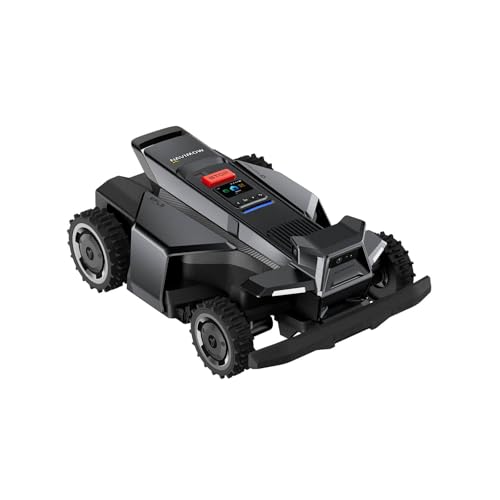
Pros
- Strong fit for large or challenging lawns because the listed design addresses slopes, uneven terrain, and narrow passages.
- Wide cutting path and dual 180W motors may reduce the number of mowing passes needed compared with a narrower robotic mower.
- Wire-free mapping and app-based controls can simplify setup and routine scheduling.
- The 33.5 by 24 by 13.8-inch body and 63.71-pound weight provide a substantial platform for outdoor lawn work.
Cons
- Its 63.71-pound weight may make manual repositioning or storage more demanding when lifting is required.
- The advanced positioning and mapping features could be more equipment than needed for small, simple lawns.
- The supplied information does not specify battery runtime, charging details, maintenance intervals, or weather-resistance information.
The NAVIMOW X450 is a robotic lawn mower intended to automate routine grass cutting on residential lawns up to the listed 1.5-acre size. Its feature set is aimed at homeowners with larger, uneven, sloped, or complicated yards who want less manual mowing and more control over where the machine travels.
Its all-wheel-drive system, ORV-tuned dual suspension, and listed ability to climb slopes up to 84 percent are the main reasons to consider it for demanding terrain. The mower is also specified to cross obstacles up to 2.8 inches, while zero-turn steering and traction control are designed to improve tight maneuvering and help limit turf scuffing.
For cutting, the X450 uses dual 180W motors, dual cutting discs, 12 blades, and a 17-inch cutting width. The cutting height adjusts from 0.75 to 4 inches, giving homeowners room to choose a shorter or taller lawn finish. EdgeSense is designed to reduce the uncut margin near edges to under 2 inches, although some lawn borders may still need occasional attention.
Setup is described as wire-free and antenna-free, with one-tap Auto Mapping for creating a lawn map and GeoSketch for editing it. GPS tracking, GeoFence and lift alerts, voice control through Alexa or Google Home, and 360-degree vision with VIO are intended to make operation easier around fences, trees, narrow passages, and other lawn features.
The mower measures 33.5 by 24 by 13.8 inches and weighs 63.71 pounds, so gardeners should plan a suitable place for storage and avoid assuming it will be easy to carry by hand. The supplied information does not list battery runtime, charging requirements, maintenance intervals, or weather resistance, so those details should be confirmed before purchase. Overall, it appears best suited to homeowners with larger or challenging lawns who will use its mapping and terrain capabilities, while owners of small, flat yards may prefer a simpler robotic mower.
Best For / Avoid If
Best for buyers prioritizing
- Strong fit for large or challenging lawns because the listed design addresses slopes, uneven terrain, and narrow passages.
- Wide cutting path and dual 180W motors may reduce the number of mowing passes needed compared with a narrower robotic mower.
- Wire-free mapping and app-based controls can simplify setup and routine scheduling.
Consider another option if
- Its 63.71-pound weight may make manual repositioning or storage more demanding when lifting is required.
- The advanced positioning and mapping features could be more equipment than needed for small, simple lawns.
- The supplied information does not specify battery runtime, charging details, maintenance intervals, or weather-resistance information.

Pros
- Wire-free navigation may simplify setup for yards with clearly defined grass boundaries.
- Magnetic-strip no-go zoning offers a flexible way to restrict access to selected lawn areas.
- App scheduling and automatic charging can reduce the need for frequent manual mowing.
- The 28.7-pound design and compact 23 x 15.8 x 9.5-inch dimensions may be practical for homeowners managing limited storage space.
Cons
- It may be less suitable for lawns without clear visual boundaries, since the vision-navigation system is designed around defined grass and non-grass areas.
- Grass taller than 2.6 inches should be manually trimmed before initial use, which adds preparation work.
- Routine blade replacement is recommended, and gardeners with complex obstacles or changing lawn layouts may need to manage no-go zones carefully.
The YARDCARE M800Plus is a robotic lawn mower designed for routine grass cutting on residential lawns up to 8611 square feet. Its cordless GPS and 3D vision navigation is intended for yards with clear visual boundaries, making it a potential fit for homeowners who want scheduled mowing without installing traditional boundary wires.
The feature set focuses on reducing routine lawn-care effort. Vision-based navigation identifies grass and non-grass areas, while obstacle detection is designed to recognize common lawn objects and adjust movement. The mower also supports slopes up to 35 percent, or 20 degrees, which may help it manage many typical residential lawn sections.
Homeowners can use the YARDCARE App to set schedules, adjust mowing patterns, and access firmware updates. The included 32.8-foot magnetic strip provides a no-go zone option without digging or using an external power source. The mower measures 23 by 15.8 by 9.5 inches and weighs 28.7 pounds, so storage planning is still worthwhile even though the listed dimensions are relatively compact for a lawn machine.
The adjustable cutting height spans 0.8 to 2.4 inches, and the three-blade cutting disc has a 7-inch cutting width. Spiral spot mowing is intended for thicker or faster-growing patches, while automatic charging supports unattended mowing sessions. These functions may be useful for homeowners who prefer regular lawn maintenance rather than occasional heavy cutting.
Before initial use, grass taller than 2.6 inches should be manually trimmed according to the product information. Routine blade replacement is also recommended to maintain consistent cutting performance. Because navigation depends on clear visual boundaries, gardeners with highly irregular edges, complex obstacles, or frequently changing lawn layouts may prefer a mower with another boundary-management approach.
This model is a reasonable option for homeowners who want app-controlled, wire-free mowing and have a clearly defined lawn with manageable slopes. It may be less suitable for overgrown lawns at startup or properties where grass boundaries are difficult for a vision-based system to distinguish.
Best For / Avoid If
Best for buyers prioritizing
- Wire-free navigation may simplify setup for yards with clearly defined grass boundaries.
- Magnetic-strip no-go zoning offers a flexible way to restrict access to selected lawn areas.
- App scheduling and automatic charging can reduce the need for frequent manual mowing.
Consider another option if
- It may be less suitable for lawns without clear visual boundaries, since the vision-navigation system is designed around defined grass and non-grass areas.
- Grass taller than 2.6 inches should be manually trimmed before initial use, which adds preparation work.
- Routine blade replacement is recommended, and gardeners with complex obstacles or changing lawn layouts may need to manage no-go zones carefully.

Pros
- No perimeter wire or RTK antenna required for setup.
- Built-in edge trimming adds functionality many robotic mowers do not include.
- Custom zones, schedules, and no-go areas support more tailored mowing plans.
- Designed for tight paths and shaded yards where navigation can be challenging.
- Reviewers commonly mention easy setup, quiet operation, and even routine cutting.
Cons
- Initial mapping and fine-tuning may take several adjustments, especially in complex yards.
- Edge trimming may still require manual follow-up around sharp corners, raised edges, narrow gaps, fences, or obstacles.
- May be less suitable for lawns with exposed sand, mulch transitions, or very uneven borders based on mixed reviewer feedback.
The ECOVACS GOAT O1000 LiDAR PRO is an automatic, battery-powered robotic lawn mower for homeowners who want frequent mowing support on lawns up to 1/4 acre. It is best understood as a routine maintenance mower rather than a full replacement for every lawn-care task, especially where borders, fences, mulch beds, and tight corners are involved.
The main advantage is its wire-free mapping system. The product information states that its HoloScope 360 degree Dual-LiDAR navigation does not require buried perimeter wire or an RTK antenna, and is designed to work under trees, near fences, and in shaded areas. For gardeners with established beds or hardscaping, avoiding perimeter wire can make installation less disruptive.
This model also includes the TruEdge trimming feature, which is meant to cut closer along driveways, sidewalks, flower beds, and irregular borders than a standard robot mower. That can reduce the amount of string trimming after mowing, but the product information and user feedback both suggest that highly complex corners, narrow gaps, raised edges, and fence lines may still need occasional manual trimming.
Control is handled through the ECOVACS app, where users can create mowing zones, schedule tasks, and set no-go areas. The mower uses AI Vision and 3D ToF LiDAR obstacle detection to navigate around common yard objects, and the narrow body is designed to pass through corridors as slim as 0.8 m. Assembly is required, and the trimmer module installation calls for the included screws and a PH2 Phillips screwdriver.
For small lawns, side yards, compact backyards, and layouts with trees or play equipment, the feature set is well matched to homeowners who prefer frequent light mowing over occasional heavy cutting. The listed cutting width is 8.66 inches, and the cutting height range is 1.2 to 3.6 inches, so gardeners who maintain taller cool-season turf should confirm that this height range fits their grass-care goals.
The balanced verdict is that the GOAT O1000 LiDAR PRO is a strong candidate for tech-comfortable homeowners who want wire-free robotic mowing with more edge help than many basic models provide. Consider a different mower if your lawn has exposed sand, frequent mulch transitions, very rough edges, or if you expect completely hands-off trimming along every fence and corner.
Best For / Avoid If
Best for buyers prioritizing
- No perimeter wire or RTK antenna required for setup.
- Built-in edge trimming adds functionality many robotic mowers do not include.
- Custom zones, schedules, and no-go areas support more tailored mowing plans.
Consider another option if
- Initial mapping and fine-tuning may take several adjustments, especially in complex yards.
- Edge trimming may still require manual follow-up around sharp corners, raised edges, narrow gaps, fences, or obstacles.
- May be less suitable for lawns with exposed sand, mulch transitions, or very uneven borders based on mixed reviewer feedback.

Pros
- No boundary wires or antennas are required, which may make initial setup less disruptive.
- The combination of LiDAR, vision sensing, obstacle detection, and zone editing offers detailed navigation control.
- A 7.1-inch cutting width, six-blade disc, and 2 to 4-inch height range support routine lawn maintenance across varied grass conditions.
- Its listed 59 dB(A) operating noise may be more neighbor-friendly than louder conventional mowing equipment.
Cons
- At 32.41 pounds and 25 x 17.6 x 11.3 inches, it needs a suitable location for docking and storage when not in use.
- Gardeners with lawns larger than the listed 0.37-acre coverage or highly complex boundaries may need a different mower or additional planning.
- The supplied information does not specify battery runtime, maintenance intervals, or included accessories, so those details should be confirmed before purchase.
The Segway Navimow i215 is a wire-free robotic lawn mower for maintaining residential lawns up to the listed 0.37-acre coverage area. Its automatic mapping and app controls make it a good match for homeowners, older gardeners, and busy households seeking a more automated approach to routine mowing.
Its main performance advantage is the combination of solid-state LiDAR and vision sensors. The feature set suggests stable, satellite-free navigation with three-dimensional awareness during both daytime and nighttime operation. AI VisionFence is listed as detecting more than 200 obstacle types, while GeoSketch allows up to 20 mowing zones to be edited on an interactive map.
The mower uses off-road wheels and electronic stability control for slopes up to 45%, which may help on yards that are difficult to manage with a standard push mower. A 100-watt motor, six-blade cutting disc, 7.1-inch cutting width, and adjustable 2 to 4-inch cutting height provide useful control for regular lawn maintenance. The listed 59 dB(A) noise level may also be helpful where quieter operation matters.
Wire-free installation, one-tap auto mapping, and Alexa and Google Home support can reduce the amount of routine interaction needed after setup. EdgeSense ride-on mode is intended to help the mower work closer to fences and pathways. Measuring 25 by 17.6 by 11.3 inches and weighing 32.41 pounds, the gray mower should have a planned docking and storage location with enough clearance for its dimensions.
Homeowners should still inspect the lawn for objects, loose material, and areas that could interfere with safe operation, even with automated obstacle detection. The supplied information does not state battery runtime, maintenance requirements, weather-resistance details, or included accessories, so those factors should be checked before buying. Overall, this model is most suitable for homeowners wanting wire-free, app-managed mowing on lawns within its stated coverage area, while those with larger properties or a need for detailed runtime information may prefer an option with more fully documented specifications.
Best For / Avoid If
Best for buyers prioritizing
- No boundary wires or antennas are required, which may make initial setup less disruptive.
- The combination of LiDAR, vision sensing, obstacle detection, and zone editing offers detailed navigation control.
- A 7.1-inch cutting width, six-blade disc, and 2 to 4-inch height range support routine lawn maintenance across varied grass conditions.
Consider another option if
- At 32.41 pounds and 25 x 17.6 x 11.3 inches, it needs a suitable location for docking and storage when not in use.
- Gardeners with lawns larger than the listed 0.37-acre coverage or highly complex boundaries may need a different mower or additional planning.
- The supplied information does not specify battery runtime, maintenance intervals, or included accessories, so those details should be confirmed before purchase.

Pros
- Designed for steep and uneven lawns with all-wheel drive, adaptive suspension, and a listed slope capability of up to 80 percent.
- Detailed navigation system uses LiDAR, NetRTK, and AI vision rather than relying on a single positioning method.
- Supports complex lawn layouts with up to 30 mowing zones, no-go areas, and several coverage patterns.
- Listed runtime of up to 175 minutes per charge and mowing coverage of up to 500 square meters per hour may suit larger residential lawns.
Cons
- The garage ships separately, so the complete setup may arrive in more than one delivery.
- Its 27.2 by 21 by 12.8 inch dimensions may require dedicated storage and a suitable charging location.
- Gardeners with simple, flat lawns may not need the advanced navigation and off-road features of this model.
The Mammotion LUBA 3 AWD 3000H is a robotic lawn mower for homeowners who want automated grass cutting across larger, sloped, uneven, or divided residential lawns. Its feature set is especially relevant to yards where conventional robotic mowers may need more help navigating changes in terrain or multiple mowing areas.
Its main advantage is the combination of 360° LiDAR, NetRTK, and dual-camera AI vision. Based on the listed specifications, these systems work together to map the yard, recognize objects, and switch sensing methods as conditions change. The mower can also identify more than 300 obstacle types and plan paths around them.
For lawn access and maneuverability, the mower uses four independently powered motors, all-wheel drive, omni-wheel pivoting, and adaptive suspension. The product information states that it can handle slopes up to 80 percent, or 38.6 degrees, and step over curbs, roots, and thresholds up to 50 mm high. Its listed dimensions are 27.2 by 21 by 12.8 inches, so owners should plan a clear charging and storage area.
The mower supports up to 30 mowing zones and lets users define no-go areas, which can be useful for lawns separated by paths or surrounding garden features. Perimeter-only, zigzag, checkerboard, and adaptive zigzag patterns provide options for different coverage preferences. The listed battery can run for up to 175 minutes per charge, with coverage of up to 500 square meters per hour.
Routine attention may include keeping the cutting system and sensors clear, checking the blades, and following the product guide for setup and safe operation. The included extra blade set, charging station, and garage add practical value, but the garage ships separately. Because installation details, operating conditions, and maintenance schedules are not provided, buyers should review the guide before relying on the mower in a complex yard.
This model is best suited to homeowners with challenging terrain, multiple lawn zones, or a preference for highly automated mowing. Gardeners with a small, flat, uncomplicated lawn may prefer a simpler robotic mower with fewer navigation features and less equipment to configure.
Best For / Avoid If
Best for buyers prioritizing
- Designed for steep and uneven lawns with all-wheel drive, adaptive suspension, and a listed slope capability of up to 80 percent.
- Detailed navigation system uses LiDAR, NetRTK, and AI vision rather than relying on a single positioning method.
- Supports complex lawn layouts with up to 30 mowing zones, no-go areas, and several coverage patterns.
Consider another option if
- The garage ships separately, so the complete setup may arrive in more than one delivery.
- Its 27.2 by 21 by 12.8 inch dimensions may require dedicated storage and a suitable charging location.
- Gardeners with simple, flat lawns may not need the advanced navigation and off-road features of this model.

Pros
- No perimeter wires are required according to the product information, which may simplify planning for suitable yards.
- Supports lawns up to 3/4 acre and can handle listed slopes up to 24 degrees.
- Adjustable cutting height and multi-zone controls offer useful flexibility for varied lawn sections.
Cons
- Battery runtime, charging details, and installation requirements are not provided, so planning the setup may require additional information.
- A robotic mower may be less suitable for lawns with frequently moved objects, complex boundaries, or areas that need frequent manual intervention.
- The listed 4-inch edge-mowing distance means some border trimming may still be necessary.
The Greenworks C30Z is a wire-free robotic lawn mower intended to automate routine grass cutting across lawns up to 3/4 acre. It is a practical fit for homeowners who want scheduled mowing and app control, particularly those managing larger, sloped, uneven, or multi-zone yards.
Its RTKVision navigation combines RTK and vision guidance for systematic mowing with listed accuracy within 1 inch. The mower is also rated to climb slopes up to 24 degrees, while its two-wheel-drive design is intended to help it reach pathways, gravel, and uneven lawn sections.
Electronic height adjustment ranges from 0.75 to 3.5 inches and can be controlled through the app or onboard LCD screen. Zone-specific height settings and schedules may be useful when different parts of the yard have varying grass conditions or mowing preferences. The product dimensions are 25.39 by 11.81 by 16.54 inches, and the listed weight is 27.56 pounds.
For backyard use, the mower may suit homeowners with open lawns that include slopes, narrow pathways, or multiple mowing zones. Its virtual mapping and multi-zone management features are designed to help organize mowing across separate areas, while edge mowing within 4 inches can help maintain a finished appearance around lawn boundaries.
The ToF camera and AI system is listed as detecting and avoiding more than 200 objects, with pet protection stated up to 16 feet away. Gardeners should still clear loose hazards, supervise pets and children around operating equipment, and follow the manufacturer's installation and maintenance guidance. Battery runtime, charging information, and weather-resistance details are not included in the supplied data.
This mower is best for homeowners who value wire-free navigation, automated scheduling, slope capability, and adjustable cutting height. Those with highly complicated lawn boundaries, frequently changing obstacles, or a need for clearly documented runtime and installation details should review those requirements before choosing it.

Pros
- Well suited to sloped, uneven, or unusually shaped lawns where traction and maneuverability are important.
- Wire-free LiDAR and AI vision navigation may simplify setup compared with traditional boundary-wire systems.
- Adjustable cutting height and multi-zone app controls provide flexibility for different lawn sections and seasonal conditions.
- The gray mower weighs 26.4 pounds, which is relatively manageable for repositioning when needed.
Cons
- Its large 29.13 by 20.94 by 12.8-inch footprint may require deliberate planning for storage and access around the charging area.
- App-based mapping, virtual boundaries, and multi-zone controls could require more setup and learning than a conventional push mower.
- Gardeners who need confirmed battery runtime, weather-resistance details, or included accessory information will need to verify those specifications separately.
The DREAME A3 AWD Pro 5000 is a wire-free robotic lawn mower for maintaining large residential lawns, including yards with slopes, separate grass areas, narrow passages, and irregular boundaries. Its feature set is aimed at homeowners who want scheduled mowing with less pushing, lifting, and weekend lawn work.
Based on the listed specifications, the mower uses 4WD hub motors, heavy-duty wheels, and suspension to improve traction across steep or uneven terrain. The product information indicates support for slopes up to 80 percent and for obstacles such as roots, curbs, thresholds, and small potholes up to 2.2 inches. A 15.8-inch cutting width is intended to cover lawn areas efficiently, while the EdgeMaster 2.0 system is designed to cut close to borders.
Navigation combines 360-degree 3D LiDAR with binocular AI vision rather than relying on perimeter wires. The system is listed as capable of detecting more than 300 obstacles, with long-range detection up to 240 feet. Through the Dreamehome app, users can create virtual boundaries, schedule mowing, manage up to 100 zones and 100 no-go areas, and define up to 50 paths. The listing does not provide assembly, charging, battery-runtime, or included-accessory details.
This mower could be useful for a homeowner with a large front and backyard, sloped sections, mature landscaping, or several connected and separate lawn zones. Its 1-to-4-inch cutting-height adjustment can accommodate different grass types and lawn conditions, and the listing indicates it can address dense grass up to 8 inches tall. The 26.4-pound weight and nearly 29-inch length should be considered when planning storage or moving it between areas.
Obstacle detection and GPS security features can add convenience, but they do not replace careful mapping and routine inspection of the mowing area. Users should verify the product's installation requirements, operating limits, maintenance instructions, weather guidance, and safety procedures before relying on autonomous scheduling. This is a promising option for homeowners prioritizing wire-free navigation and terrain handling, while those wanting a simpler mower or fully documented runtime and accessory specifications may prefer to compare alternatives.
Best For / Avoid If
Best for buyers prioritizing
- Well suited to sloped, uneven, or unusually shaped lawns where traction and maneuverability are important.
- Wire-free LiDAR and AI vision navigation may simplify setup compared with traditional boundary-wire systems.
- Adjustable cutting height and multi-zone app controls provide flexibility for different lawn sections and seasonal conditions.
Consider another option if
- Its large 29.13 by 20.94 by 12.8-inch footprint may require deliberate planning for storage and access around the charging area.
- App-based mapping, virtual boundaries, and multi-zone controls could require more setup and learning than a conventional push mower.
- Gardeners who need confirmed battery runtime, weather-resistance details, or included accessory information will need to verify those specifications separately.

Pros
- Designed for very large lawns, with listed coverage up to 6 acres.
- Does not require perimeter wire, using RTK, vision, and sensor-based navigation instead.
- Wide 20-inch cutting width helps cover more ground per pass than smaller robotic mowers.
- Tracks, skid shoes, and a 70 percent listed climbing ability make it suitable for more complex terrain.
- Includes both razor blades and straight blades for different grass conditions, according to the product information.
Cons
- At about 215 pounds and shipped in 4 boxes, assembly and placement could be challenging without two adults.
- The Data Center Set needs a 120-degree unobstructed sky view, so heavily treed or obstructed properties may require careful planning.
- Remote control is listed as sold separately, which may matter to users who want manual control capability.
The YARBO Lawn Mower Pro is a robotic lawn mower aimed at homeowners and property managers with large, demanding turf areas. Based on the listed specifications, it is designed for lawns up to 6 acres and uses perimeter wire free navigation, making it a fit for users who want automated mowing without installing a traditional boundary wire system.
Its strongest lawn-care benefits are its large-area capacity, 20-inch cutting width, and adjustable 0.8 to 4.0 inch cutting height. The product information also lists a 300W dual-motor cutting system, straight blades plus razor blades, and a grass ejection design intended to reduce clogging in thick, damp, or overgrown grass.
Navigation is a major part of this mower’s design. YARBO lists RTK-GPS, NetRTK support, binocular vision, and multi-sensor PPVS for positioning and obstacle avoidance. In plain terms, the mower is built to map and move through the lawn using satellite positioning, camera vision, and onboard sensors rather than relying on buried wire.
The mower is large and heavy, measuring 50 inches deep, 27 inches wide, and 20 inches high, with an item weight listed at 215 pounds. It requires assembly, ships in 4 separate boxes, and the manufacturer recommends two adults for assembly. Setup also depends on placing the Data Center Set where it has a 120-degree unobstructed view of the sky, so site planning matters before purchase.
For real backyard use, this model makes the most sense on large residential lawns, estate properties, turf areas, and yards with slopes or uneven ground. The listed multi-terrain tracks, all-steel skid shoes, and 70 percent maximum climbing ability suggest it is built for more challenging terrain than a lightweight mower, though users should still follow the installation guidance and keep children, pets, and loose objects away during operation.
The main tradeoffs are size, setup complexity, and the need for a suitable open-sky location for the navigation equipment. Gardeners with small lawns, narrow passages, heavy tree cover, or limited help for assembly may prefer a smaller robotic mower. For large-property owners who want an autonomous, app-controlled mower with strong terrain capability, the YARBO Lawn Mower Pro is a feature-rich option to consider.
Best For / Avoid If
Best for buyers prioritizing
- Designed for very large lawns, with listed coverage up to 6 acres.
- Does not require perimeter wire, using RTK, vision, and sensor-based navigation instead.
- Wide 20-inch cutting width helps cover more ground per pass than smaller robotic mowers.
Consider another option if
- At about 215 pounds and shipped in 4 boxes, assembly and placement could be challenging without two adults.
- The Data Center Set needs a 120-degree unobstructed sky view, so heavily treed or obstructed properties may require careful planning.
- Remote control is listed as sold separately, which may matter to users who want manual control capability.
Kaufberatung für Mähroboter an Hanglagen
Beginnen Sie mit der Steigungsgrenze, nicht mit dem Preis
Die Steigungsgrenze ist die erste technische Angabe, die Sie prüfen sollten, denn sie zeigt, ob der Mäher für die steilsten Bereiche Ihres Rasens ausgelegt ist. In den bereitgestellten Produktdaten geben der Segway Navimow X430 und der Segway Navimow X450 eine Steigungsfähigkeit von 84 % an, der Mammotion LUBA 3 AWD 1500H ist für Steigungen bis 80 % ausgelegt, der DREAME A3 AWD 1000 ebenfalls für 80 %, der YARBO Robot Lawn Mower Pro für eine Steigfähigkeit von 70 % und der ANTHBOT M9 sowie der Segway Navimow i215 für Steigungen bis 45 %.
Kaufen Sie nicht auf Grundlage einer durchschnittlichen Hangneigung, wenn eine Ecke, eine Grabenkante oder ein Übergang an einer Einfahrt deutlich steiler ist. Ein Mäher, der an sanften Hängen problemlos arbeitet, kann an kurzen, aber scharfen Steigungen Schwierigkeiten haben – besonders bei dichtem, feuchtem oder unebenem Gras. Wählen Sie im Zweifel ein Modell mit zusätzlicher Steigungsreserve statt eines Geräts, das Ihre Schätzung gerade so erfüllt.
Passen Sie die Flächenleistung an Ihre tatsächliche Rasenfläche an
Die Flächenleistung ist ebenso wichtig wie die Steigfähigkeit. Der YARBO Robot Lawn Mower Pro ist laut Angaben für große Grundstücke bis zu 6 Acres geeignet, der Segway Navimow X450 für bis zu 1,5 Acres, der Segway Navimow X430 für bis zu 1 Acre, der DREAME LiDAR 5000 A3 AWD Pro für 1,25 Acres und der Mammotion LUBA 3 AWD 1500H für 0,37 Acres. Zu den kleineren angegebenen Kapazitäten gehören der ANTHBOT M9 mit 0,3 Acres, der Segway Navimow i215 mit 0,37 Acres und der DREAME A3 AWD 1000 mit 0,25 Acres.
Wenn Ihre Rasenfläche nahe an der Obergrenze liegt, sollten Sie berücksichtigen, wie viele Zonen, Hindernisse, Durchgänge und steile Bereiche der Mäher bewältigen muss. Ein einfaches, rechteckiges Grundstück mit 0,25 Acres ist leichter zu bearbeiten als eine unterteilte Fläche derselben Größe mit Seitenrasen, Hängen, Bäumen und Beeten. Für sehr große Grundstücke können Sie diese Übersicht mit unserer Kaufberatung zu Mährobotern für 2 Acres vergleichen.
Wählen Sie das passende Traktionssystem für Hänge
Rasenflächen an Hängen profitieren meist von Allradantrieb, Vierradantrieb oder kettenbasierten Konstruktionen. Der Mammotion LUBA 3 AWD 1500H verfügt laut Angaben über vier unabhängige Motoren, Allradantrieb, ein Omni-Rad und eine adaptive Federung. Der Segway Navimow X430 und der X450 bieten 4WD, eine ORV-abgestimmte Doppelaufhängung und eine Nullwendekreis-Lenkung, die Beschädigungen des Rasens vermeiden soll. Der YARBO Robot Lawn Mower Pro verwendet patentierte Ketten für unterschiedliches Gelände und Gleitkufen aus Stahl für komplexes Terrain.
Das Raddesign ist besonders wichtig, wenn Ihr Hang uneben statt gleichmäßig ist. Wurzeln, kleine Bordsteine, schlammige Stellen und Vertiefungen können ebenso entscheidend sein wie der Winkel selbst. Nach den aufgeführten technischen Daten eignen sich Ketten- und AWD-Systeme besser für raue oder komplexe Rasenflächen als einfache Mähroboter für kleine Gärten ohne dokumentierte Hangfunktion.
Verstehen Sie die Navigation: LiDAR, RTK, Vision und kabellose Kartierung
Moderne Mähroboter verwenden unterschiedliche Navigationssysteme. LiDAR nutzt Laserscans, um Objekte und Räume zu kartieren. RTK verwendet satellitengestützte Positionsbestimmung mit einer Referenzstation oder eine verwandte Positionierungstechnologie. Vision-Systeme nutzen Kameras und Software, um Grenzen, Hindernisse und Mähwege zu erkennen.
Der Mammotion LUBA 3 AWD 1500H kombiniert 360°-LiDAR mit einer KI-Bilderkennung über zwei Kameras. Der Segway Navimow X430 bietet laut Angaben EFLS-Tri-Frequency-Network-RTK, 360° Vision und VIO. Der YARBO Robot Lawn Mower Pro verwendet RTK-GPS, binokulare Bildverarbeitung und das multisensorische PPVS. Der ANTHBOT M9 nutzt zwei Kameras sowie Full-Band-RTK, während mehrere DREAME- und Segway-Modelle LiDAR- und KI-Vision-Funktionen bereits in ihren Produktnamen aufführen.
Für Gartenanfänger oder Hausbesitzer, die keinen Begrenzungsdraht vergraben möchten, kann eine kabellose Kartierung attraktiv sein. Dennoch kann die Einrichtung eine freie Sicht zum Himmel, eine Kartierung per App, Sperrzonen und spätere Anpassungen erfordern. Einen umfassenderen Überblick über die Funktionsweise dieser Geräte bietet unser Leitfaden dazu, ob Mähroboter funktionieren.
Vergleichen Sie Schnitthöhe und Rasenbedingungen
Der Schnitthöhenbereich beeinflusst, wie gut ein Mäher zu Ihrer Grasart und dem gewünschten Erscheinungsbild des Rasens passt. Der Mammotion LUBA 3 AWD 1500H bietet laut Angaben eine Schnitthöhe von 2,2 bis 4,0 Zoll. Der Segway Navimow X430 und der X450 bieten eine Schnitthöhe von 0,75 bis 4 Zoll. Der YARBO Robot Lawn Mower Pro ist mit einer Schnitthöhe von 0,8 bis 4,0 Zoll angegeben, während der ANTHBOT M9 eine Schnitthöhe von 1,2 bis 2,7 Zoll bietet.
Wenn Sie das Gras in Hitze- oder Trockenperioden höher halten, sollte der Mäher Ihre bevorzugte Höhe erreichen können. Wenn Ihr Rasen häufig überwuchert, achten Sie auf die angegebene Schnittleistung und Funktionen gegen Verstopfungen. Beim YARBO-Modell werden ausdrücklich ein 300-W-Doppelmotor, ein Grasauswurfsystem und die Fähigkeit genannt, dichtes, nasses und überwuchertes Gras zu schneiden. Der Segway Navimow X430 verfügt laut Angaben über zwei 180-W-Motoren und eine Schnittbreite von 17 Zoll.
Planen Sie Zonen, Kanten und Sperrbereiche vor der Einrichtung
Rasenflächen an Hängen haben häufig kompliziertere Grenzen als ebene Rasen. Blumenbeete, Stützmauern, Terrassenkanten, Wege und Entwässerungsmulden sollten vor der Einrichtung berücksichtigt werden. Modelle mit App-Steuerung und Verwaltung mehrerer Zonen können hilfreich sein, wenn Vorder-, Hinter- und Seitenrasen unterschiedliche Zeitpläne oder Fahrwege benötigen.
Der Mammotion LUBA 3 AWD 1500H unterstützt laut Angaben 15 Mähzonen und Sperrbereiche. Der ANTHBOT M9 bietet bis zu 30 Arbeitszonen, nahtlose Wege zwischen Bereichen und anpassbare Sperrzonen. Der ECOVACS Goat O1000 LiDAR PRO hat zwar keine angegebene Steigungsgrenze, bietet laut Angaben jedoch kabellose Kartierung, App-Einrichtung, benutzerdefinierte Zonen und ein schmales Gehäuse für enge Wege mit einer Breite von nur 0,8 m. Daher kann er für kompakte, komplexe Rasenflächen relevant sein, bei denen die Leistung an steilen Hängen nicht die wichtigste Anforderung ist.
Berücksichtigen Sie Komfort, Zugänglichkeit und kleine Flächen
Das Mähen mit einem Roboter kann besonders für ältere Gärtner, Hausbesitzer mit Knie- oder Rückenbeschwerden und alle hilfreich sein, die das Mähen mit einem handgeführten Rasenmäher an Hängen als anstrengend empfinden. Die beste Wahl ist nicht immer das größte oder teuerste Modell. Ein kleiner, gut kartierter Rasen kann mit einem kompakten Mäher und zuverlässiger Hinderniserkennung besser bedient sein als mit einem schweren Gerät für große Flächen.
Achten Sie bei kleinen Gärten besonders auf enge Durchgänge, den benötigten Stauraum an der Ladestation und darauf, wie viel manuelles Nachschneiden an den Kanten verbleibt. Unsere Anleitung zu Mährobotern für kleine Gärten kann hilfreicher sein, wenn Ihre Hauptherausforderung begrenzter Platz und nicht schwieriges Gelände ist.
Wartung, Lagerung und sicherheitsbewusste Nutzung
Auch Mähroboter benötigen regelmäßige Pflege. Rechnen Sie damit, die Messer zu kontrollieren, Sensoren und Räder von Schmutz freizuhalten, den Bereich der Ladestation zu prüfen und die App-Einstellungen anzupassen, wenn sich die Gestaltung Ihres Rasens ändert. Im Lieferumfang des Mammotion LUBA 3 AWD 1500H ist laut Angaben ein zusätzlicher Messersatz enthalten, während das Paket des ANTHBOT M9 ein Messerset mit insgesamt 5 Messern umfasst.
Prüfen Sie vor jeder Mähsaison die Herstellerangaben zu Messerwechsel, Reinigung, Lagerung, Aufladung und sicherem Betrieb. Entfernen Sie nach Möglichkeit Spielzeug, Schläuche, Gartengeräte und Gegenstände für Haustiere vom Rasen, auch wenn ein Mäher über Hindernisvermeidung verfügt. Befolgen Sie alle Sicherheitshinweise des Herstellers, insbesondere in der Nähe von Kindern, Haustieren, steilen Abbruchkanten, Teichen, Pools und öffentlichen Gehwegen.
| Anforderung | Zu priorisierende Spezifikationen |
|---|---|
| Steile Hänge | Dokumentierte Steigungsgrenze von 70 % bis 84 %, AWD, 4WD oder Ketten |
| Große Rasenflächen | Angegebene Flächenkapazität, Zonensteuerung, effiziente Navigation |
| Kleine oder komplexe Rasenflächen | Kabellose Kartierung, Bewältigung enger Durchgänge, Sperrzonen |
| Weniger Nachschneiden | Kantenorientierte Funktionen wie EdgeSense oder integriertes Kantenschneiden, sofern angegeben |
| Einfache Einrichtung | Automatische Kartierung, App-Steuerung, klare Einrichtungsvoraussetzungen, automatisches Aufladen |
Recherchemethode und Vertrauen
Dieser Leitfaden basiert auf den bereitgestellten Produktspezifikationen, Preisen, Bewertungen, der Anzahl der Rezensionen und den während des Juli 2026 verfügbaren Funktionsbeschreibungen. Es handelt sich um eine recherchierte Analyse, nicht um einen Praxistest. Wir haben diese Mäher weder installiert noch auf einer Testfläche von Dove Creek Gardens betrieben.
Zuerst wurde die Produktrelevanz geprüft. Wir priorisierten Mähroboter, die eindeutig der Kategorie Lawn Care & Power Equipment zugeordnet waren und dokumentierte Funktionen für Hänge, AWD, 4WD, Ketten oder unterschiedliches Gelände aufwiesen. Produkte ohne ausreichende Hinweise zur Eignung für Hänge wurden vorsichtig bewertet und nicht als primäre Empfehlungen für steile Rasenflächen verwendet.
Zu den Ranking-Faktoren gehörten die angegebene Steigungsfähigkeit, das Traktionsdesign, die Flächenabdeckung, das Navigationssystem, die Hindernisvermeidung, der Schnitthöhenbereich, App- und Zonensteuerung, die Einrichtungsanforderungen sowie die praktische Eignung für Hausbesitzer. Rückmeldungen von Besitzern wurden anhand der bereitgestellten Bewertungen und der Anzahl der Rezensionen berücksichtigt, jedoch nicht als Beweis für die Leistung in jedem Garten behandelt.
Die Technologie von Mährobotern entwickelt sich schnell weiter, insbesondere bei LiDAR, RTK, Kamerabildverarbeitung und kabelloser Einrichtung. Wir empfehlen, vor dem Kauf die aktuellen Produktseiten und Herstelleranleitungen zu vergleichen – insbesondere, wenn Ihr Grundstück steile Abbruchkanten, starke Verschattung, schlechten Satellitenempfang oder ungewöhnlich komplexe Grenzen aufweist. Einen umfassenderen Überblick über die Kategorie finden Sie auf unserer Seite Lawn Care & Power Equipment.
Abschließende Empfehlungen
Beste Gesamtwahl: Der Mammotion LUBA 3 AWD 1500H Robot Lawn Mower with Garage (Ship Separately), 0.37 Acre, All-Wheel-Drive for 80% Slopes, 360° LiDAR+Dual-Camera AI Vision, 15 Multi-Zone Management, 2.2"-4.0" Cut Height ist in den bereitgestellten Daten für viele private Rasenflächen an Hängen die ausgewogenste Wahl. Seine dokumentierte Steigungsgrenze von 80 %, der Allradantrieb, 360°-LiDAR, die KI-Bilderkennung über zwei Kameras, 15 Zonen und die Schnitthöhe von 2,2 bis 4,0 Zoll ergeben ein überzeugendes, auf Hanglagen ausgerichtetes Ausstattungspaket für eine Fläche bis zu 0,37 Acres.
Schwereinsatz-Wahl: Der Segway Navimow X430 Robot Lawn Mower Wire Free, for up to 1 Acre, 4WD for 84% Slopes, Zero-Turn for Damage-Free Mowing, ORV-Tuned Lawnmower, MowMentum with 2 × 180W Motors, 0.75–4 in Cutting Height ist eine starke Option, wenn sowohl eine steile Neigung als auch eine größere Flächenabdeckung wichtig sind. Seine angegebene Steigungsfähigkeit von 84 %, 4WD, die Nullwendekreis-Lenkung, zwei 180-W-Motoren, die Schnittbreite von 17 Zoll und die Kapazität für bis zu 1 Acre machen ihn für größere Hanglagen geeigneter als kleinere Modelle für 1/4 Acre.
Wahl für große Grundstücke: Der YARBO Robot Lawn Mower Pro with Modular Design for Large Yard up to 6 Acres, Perimeter Wire Free APP Control Robotic Lawnmower with 0.8"-4.0" Cutting Height, AI Vision & RTK for Navigation hebt sich bei sehr großen Grundstücken hervor, da er laut Angaben für bis zu 6 Acres geeignet ist und Ketten für unterschiedliches Gelände verwendet. Außerdem ist er die teuerste Option im bereitgestellten Sortiment. Die meisten Hausbesitzer mit mittelgroßen Rasenflächen an Hängen dürften daher ein kleineres AWD- oder 4WD-Modell bevorzugen.
FAQ
Welche Steigungsgrenze sollte ein Mähroboter für Hanglagen haben?
Wählen Sie einen Mäher mit einer dokumentierten Steigungsgrenze, die über dem steilsten Bereich Ihres Rasens liegt. In den bereitgestellten Daten reichen die Steigungsgrenzen der speziell für Hänge ausgewiesenen Modelle von 45 % bis 84 %. Eine zusätzliche Reserve ist sinnvoll, da echte Rasenflächen Unebenheiten, feuchtes Gras, Wurzeln und Übergänge aufweisen können.
Sind AWD oder 4WD bei einem Mähroboter für Hanglagen wichtig?
Bei steilen oder unebenen Rasenflächen sollten AWD, 4WD oder Ketten priorisiert werden. Der Mammotion LUBA 3 AWD 1500H bietet laut Angaben Allradantrieb, der Segway Navimow X430 und X450 4WD und der YARBO Robot Lawn Mower Pro Ketten für unterschiedliches Gelände. Diese traktionsorientierten Konstruktionen sind für Hänge relevanter als grundlegende Mähroboterfunktionen allein.
Kann ein Mähroboter für Hanglagen das gesamte Nachschneiden ersetzen?
In der Regel nicht vollständig. Einige Modelle verfügen laut Angaben über kantenorientierte Funktionen, beispielsweise EdgeSense beim Segway Navimow X430 oder integriertes TruEdge-Kantenschneiden beim ECOVACS Goat O1000 LiDAR PRO. Trotzdem können komplexe Ecken, erhöhte Kanten, Zäune und Beete gelegentliches manuelles Nachschneiden erfordern.
Wie dimensioniere ich einen Mähroboter für einen Rasen an einem Hang?
Passen Sie den Mäher sowohl an die Fläche als auch an die Komplexität des Grundstücks an. Ein für 0,25 Acres ausgelegter Mäher kann für einen kompakten Garten geeignet sein, während Modelle wie der Segway Navimow X430, der Segway Navimow X450, der DREAME LiDAR 5000 A3 AWD Pro und der YARBO Robot Lawn Mower Pro für größere Flächen angegeben sind. Wenn Ihr Rasen in Zonen aufgeteilt ist, sollten Sie außerdem die App- und Multi-Zonen-Funktionen prüfen.
Sind kabellose Mähroboter für Hanglagen besser geeignet?
Kabellose Kartierung kann die Einrichtung übersichtlicher machen, ist an Hängen aber nicht automatisch besser. Bei Steigungen stehen Traktion und eine dokumentierte Steigungsfähigkeit weiterhin an erster Stelle. Navigationsfunktionen wie LiDAR, RTK, KI-Bilderkennung und Sperrzonen helfen dem Mäher, den Garten zu verstehen, ersetzen jedoch nicht die erforderliche Eignung für die jeweilige Steigung.
Welche Wartung benötigt ein Mähroboter für Hanglagen?
Planen Sie regelmäßige Kontrollen der Messer, Räder oder Ketten, Sensoren und des Bereichs der Ladestation ein. Entfernen Sie Stöcke, Spielzeug, Schläuche und Gartengeräte vom Rasen, um einen sicheren Betrieb und die Hinderniserkennung zu unterstützen. Befolgen Sie die Herstellerangaben zum Messerwechsel, zur Reinigung, zum Aufladen, zur Lagerung und zu Softwareupdates.
Ist ein Mähroboter für Hanglagen in der Nähe von Haustieren und Kindern sicher?
Viele Modelle verfügen laut Angaben über Hindernisvermeidung, Hebealarme, eine Notbremsung oder KI-Objekterkennung. Diese Funktionen sollten jedoch nicht als Ersatz für Aufsicht und eine sichere Einrichtung betrachtet werden. Halten Sie Kinder und Haustiere während des Betriebs vom Mäher fern, insbesondere an Hängen oder in der Nähe von Abbruchkanten. Befolgen Sie stets die Sicherheitshinweise des Herstellers für Ihr konkretes Modell.