


Une serre chaude peut rapidement stresser les plantes, surtout au cœur de l’été lorsque l’air stagnant emprisonne la chaleur et l’humidité. Le bon ventilateur aide à évacuer l’air vicié, à faire entrer de l’air plus frais et à faciliter la gestion d’un petit espace de culture sans dépendre constamment d’une prise électrique à proximité.
Ce guide consacré au meilleur ventilateur de serre solaire s’adresse aux jardiniers amateurs, aux cultivateurs disposant de peu d’espace et aux particuliers qui souhaitent ajouter une ventilation dans une serre, une remise ou une dépendance de jardin. Nous avons comparé 15 produits fournis, dans une fourchette de 18,99 $ à 198,89 $, puis vérifié la présence d’une alimentation solaire claire, l’adaptation à une serre, les informations sur le débit d’air, la batterie, les commandes, la souplesse d’installation et les avis des propriétaires lorsqu’ils étaient disponibles.
Pour découvrir d’autres idées concernant les serres et le rangement, consultez notre section Serres et rangement de jardin. Dans cet article, nous nous concentrons uniquement sur les produits issus des données fournies qui correspondent clairement à un usage de ventilateur de serre solaire.
ecoCalm KP-SEF240812 12-Inch Solar Exhaust Fan for Greenhouse and Shed Ventilation DCHOUSE SF-B-1 Solar Exhaust Fan Kit for Greenhouse, Coop, and Shed Ventilation VIVOSUN AeroWave E6 Gen2 6-Inch Grow Tent Clip Fan for Adjustable Air Circulation VEVOR 16-Inch Shutter Exhaust Fan for Greenhouse, Shed, Garage, and Attic Ventilation Prices and availability can change. We may earn a commission from qualifying purchases.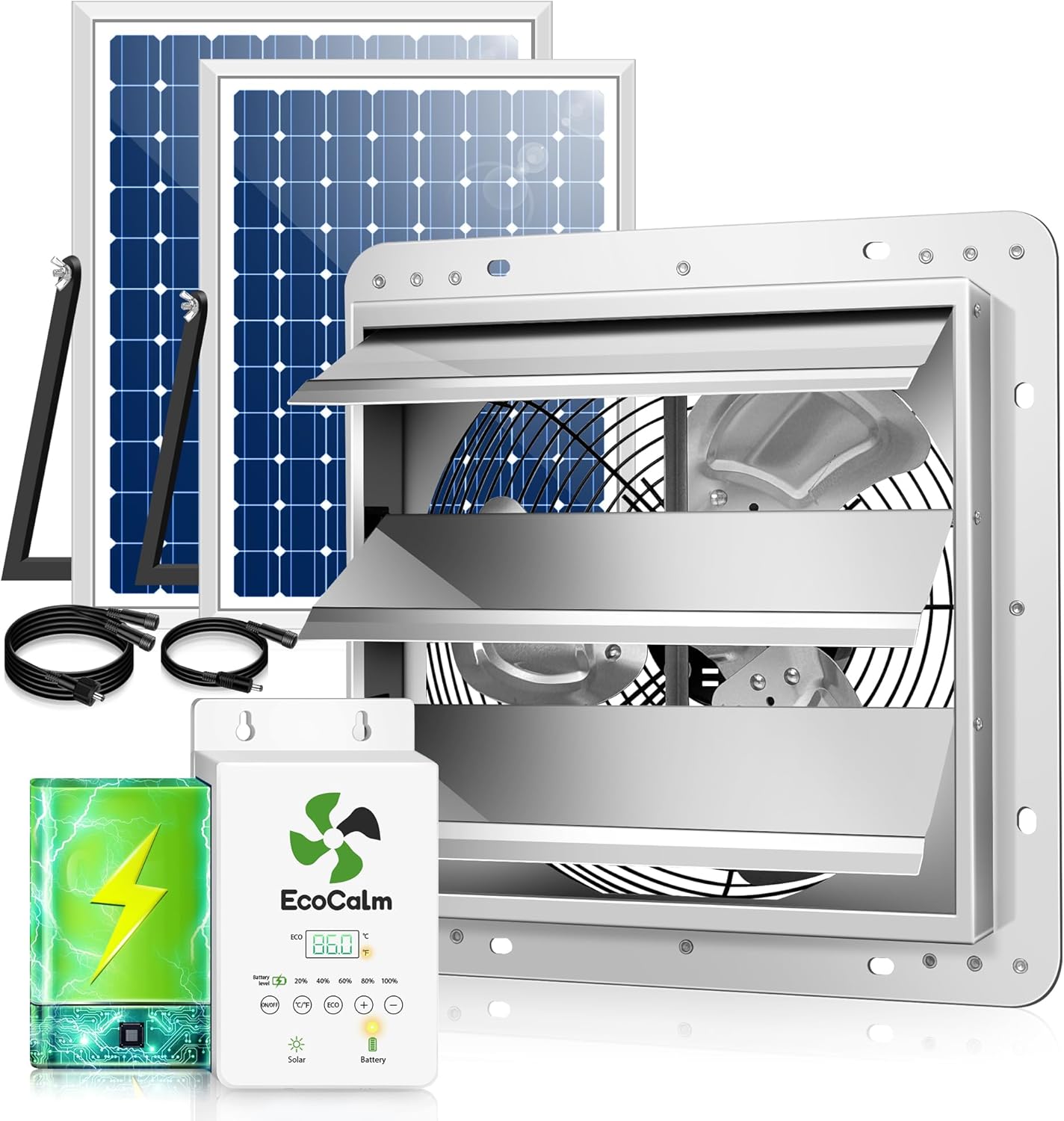


Certaines fiches ci-dessous restent en anglais ; leur traduction est en cours de révision.
Pros
- Works without a conventional power outlet, useful for remote sheds, greenhouses, barns, and chicken coops.
- Thermostat control reduces the need to manually switch the fan on during hot parts of the day.
- Included battery provides backup ventilation after charging, rather than limiting operation only to direct sun.
- Reviewers commonly mention straightforward installation and effective airflow in greenhouse or coop uses.
- Metal build and screw-together style wiring noted in reviews suggest a more substantial setup than many lightweight plastic fan kits.
Cons
- Fan and battery performance may drop in cloudy weather or poorly positioned solar panel locations.
- Control setup may take patience, as at least one reviewer found the settings less intuitive at first.
- Gardeners needing guaranteed all-night ventilation or code-compliant attic ventilation should confirm the system meets their space and safety requirements before relying on it.
The ecoCalm KP-SEF240812 is a 12-inch solar powered exhaust fan made for moving hot, humid, or stale air out of enclosed spaces such as greenhouses, garden sheds, garages, attics, barns, and chicken coops. For gardeners, its most useful role is greenhouse ventilation, especially in backyard structures that do not have convenient access to a household electrical outlet.
Based on the listed specifications, the fan is rated at 680 CFM and is intended for spaces up to 1600 cubic feet. That puts it in a useful range for many small to midsize hobby greenhouses and outbuildings, provided there is also an intake opening so replacement air can enter. The product information also highlights cooling indoor temperatures, helping reduce mold-friendly conditions, and improving air quality through circulation.
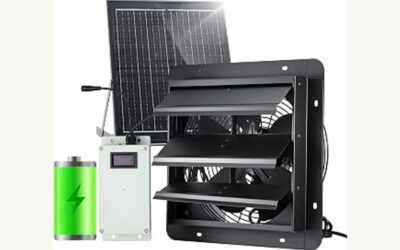
The system includes two 30W bifacial solar panels, a 5000mAh rechargeable battery, and an intelligent power system that switches according to sunlight conditions. The battery is described as providing up to 6 hours of operation after a full charge in sunlight, though the product information clearly notes that fan output and battery charging are affected by cloudy weather. For best results, the panels need to be placed where they receive strong sun for much of the day.
Installation is listed for window or wall mounting, and the 14.8-foot cable gives some flexibility in locating the solar panels away from the fan opening. The fan uses metal construction, a DC motor, touch control, and IP44 waterproof fan blades. Reviewers commonly mention straightforward setup, quiet operation, and good results in small greenhouses and coops, although those comments should be treated as user experiences rather than guaranteed performance.
The adjustable thermostat is one of the more gardener-friendly features because it can cycle the fan on and off according to the temperature setting rather than requiring constant attention. That is helpful for seed starting areas, summer greenhouse use, or animal shelters where heat can build quickly. One practical setup tip is to think through both exhaust and intake placement, since an exhaust fan works best when fresh air can enter from the opposite side or lower part of the structure.
This is a good fit for homeowners who want off-grid ventilation for a greenhouse, shed, or coop and are willing to mount solar panels in a sunny location. It may be less suitable for shaded yards, spaces that need dependable ventilation through long dark periods, or installations where electrical safety and building-code compliance are critical. As with any powered outdoor equipment, keep wiring protected, follow the manufacturer instructions, and inspect the fan and connections periodically for damage, vibration, or moisture issues.
Best For / Avoid If
Best for buyers prioritizing
- Works without a conventional power outlet, useful for remote sheds, greenhouses, barns, and chicken coops.
- Thermostat control reduces the need to manually switch the fan on during hot parts of the day.
- Included battery provides backup ventilation after charging, rather than limiting operation only to direct sun.
Consider another option if
- Fan and battery performance may drop in cloudy weather or poorly positioned solar panel locations.
- Control setup may take patience, as at least one reviewer found the settings less intuitive at first.
- Gardeners needing guaranteed all-night ventilation or code-compliant attic ventilation should confirm the system meets their space and safety requirements before relying on it.
Pros
- Includes the core solar fan setup with panel, battery, fan, and mounting bracket listed in the product information.
- Automatic intermittent operation is useful for set-and-go ventilation in coops, sheds, and greenhouses.
- Reviewers commonly mention straightforward installation and useful airflow in smaller coop or shed applications.
- MC4 connector type and waterproof plug are practical details for an outdoor solar ventilation setup.
Cons
- May be less suitable for large animal shelters or long coops where stronger exhaust airflow is needed.
- Product information contains mixed waterproof and cord-length details, so buyers should verify the current listing before installation.
- Solar performance and battery runtime can depend on panel placement, shade, weather, and ventilation demand.
The DCHOUSE SF-B-1 is a solar powered exhaust fan kit intended for ventilation in spaces such as chicken coops, greenhouses, sheds, dog houses, and attics. For gardeners, its most relevant use is moving hot, stale air out of a small greenhouse or garden shed without needing to run an extension cord or add a wired electrical circuit.
Based on the listed specifications, the kit uses a 25W monocrystalline solar panel and a 12,000mAh rechargeable lithium battery. The product information states that, after a full charge, it can provide up to 12 hours of ventilation, and that the fan can reach up to 2,600 RPM with airflow up to 180 CFM. That makes it a practical light-duty ventilation choice for small enclosed garden and backyard structures.
The fan includes automatic operating modes tied to light conditions. During the day, the listed cycle is 30 minutes on and 10 minutes off, while at night it runs 20 minutes on and 20 minutes off. This intermittent pattern is useful for conserving stored battery power, though it also means the fan is not described as running at full output continuously in normal automatic operation.
Installation is designed around a roof or wall mounting bracket, with a waterproof plug and MC4 connector type listed. The product dimensions are 15 inches long by 15 inches wide by 5 inches high, and the material is listed as metal. For best results, homeowners should plan the fan location as an exhaust point and place the solar panel where it receives strong sun rather than shade from trees, rooflines, or greenhouse framing.
In everyday backyard use, this type of fan can help reduce stagnant air in a small greenhouse, improve airflow in a potting shed, or add ventilation to a coop window or wall opening. Reviewers commonly mention easy setup and useful airflow in smaller sheds and coops, while some also report that it may feel gentle or underpowered for larger animal housing. That feedback is worth considering if the space is long, heavily enclosed, or already prone to heat buildup.
The main buying decision is sizing expectations. This kit is a good fit for homeowners who want a self-contained solar ventilation aid for a modest space, especially where wiring is inconvenient. Gardeners or livestock keepers needing high-volume exhaust, precise climate control, or dependable performance through extended low-sun periods may want to compare larger or wired ventilation options before choosing this model.
Best For / Avoid If
Best for buyers prioritizing
- Includes the core solar fan setup with panel, battery, fan, and mounting bracket listed in the product information.
- Automatic intermittent operation is useful for set-and-go ventilation in coops, sheds, and greenhouses.
- Reviewers commonly mention straightforward installation and useful airflow in smaller coop or shed applications.
Consider another option if
- May be less suitable for large animal shelters or long coops where stronger exhaust airflow is needed.
- Product information contains mixed waterproof and cord-length details, so buyers should verify the current listing before installation.
- Solar performance and battery runtime can depend on panel placement, shade, weather, and ventilation demand.
Pros
- Strong listed airflow for a compact 6-inch grow tent fan.
- Oscillation, speed control, and timer settings allow more tailored air movement.
- Compatible with VIVOSUN GrowHub E42, E42A, and E25 for remote app control.
- Corded electric power avoids battery management during regular indoor growing use.
Cons
- Full 10-speed control depends on app or GrowHub connection, while standalone use is more limited.
- Best suited to grow tents and pole-mounted setups, so it may be less convenient for areas without a compatible place to clip it.
- As a corded fan, placement depends on access to an outlet and safe cable routing in the grow area.
The VIVOSUN AeroWave E6 Gen2 is a 6-inch clip-on circulation fan made for grow tents, hydroponic setups, and other controlled indoor growing spaces. Based on the listed specifications, it is aimed at gardeners who need directed airflow around plants without taking up floor or shelf space.
The main practical benefit is adjustable air movement. The product information lists 320 CFM airflow, a 33 dB(A) noise level, 5-level auto oscillation, and multiple speed settings, giving indoor growers several ways to match air circulation to plant size, tent layout, and daily growing conditions.
Controls are more flexible when the fan is connected to compatible VIVOSUN GrowHub models, including E42, E42A, and E25. Without app connection, the fan still provides five speed levels, while app-connected use expands control to ten speed levels. The local timer with three cycle settings can also help simplify routine circulation scheduling.
The clip-on design is useful for small-space growing because it mounts to round or square tent poles rather than sitting on the floor. Its listed dimensions are 5.58 inches deep by 9.15 inches wide by 9.88 inches high, and the rubber-padded clamp is intended to help reduce slipping and surface damage where it attaches.
For backyard gardeners who start seedlings indoors, grow herbs in a tent, or manage a compact hydroponic area, this fan offers more control than a basic fixed-speed clip fan. The natural wind mode may appeal to growers who prefer variable airflow rather than one constant stream, while oscillation helps avoid concentrating air on a single point for too long.
There are a few practical limits to consider. Full smart control requires compatible VIVOSUN equipment, and corded placement should be planned carefully to keep cables secure and away from water exposure. Overall, the AeroWave E6 Gen2 looks best suited to indoor growers who want a compact, adjustable, pole-mounted fan for regular grow tent circulation.
Best For / Avoid If
Best for buyers prioritizing
- Strong listed airflow for a compact 6-inch grow tent fan.
- Oscillation, speed control, and timer settings allow more tailored air movement.
- Compatible with VIVOSUN GrowHub E42, E42A, and E25 for remote app control.
Consider another option if
- Full 10-speed control depends on app or GrowHub connection, while standalone use is more limited.
- Best suited to grow tents and pole-mounted setups, so it may be less convenient for areas without a compatible place to clip it.
- As a corded fan, placement depends on access to an outlet and safe cable routing in the grow area.
Pros
- High listed airflow capacity for a 16-inch wall-mounted exhaust fan.
- Shutter-style design helps reduce open-wall exposure when the fan is off.
- Suitable for several common backyard and home utility spaces, including greenhouses, sheds, garages, and attics.
- Fully enclosed motor includes thermal protection and permanent lubrication according to the product information.
- All-metal housing components provide a sturdier feel than lightweight portable fans.
Cons
- Does not include a plug, power switch, speed control switch, or thermostat, so installation may require extra parts and electrical work.
- Requires an approximately 18.9 x 18.9 inch opening, which may be more involved than using a portable fan.
- Listed noise level is up to 65 dB, so it may not be the quietest choice for areas where low sound is a priority.
The VEVOR 16-inch Shutter Exhaust Fan is a wall-mounted ventilation fan intended for moving hot, humid, dusty, or stale air out of enclosed spaces. For gardeners, its most relevant use is greenhouse ventilation, but the product information also lists garages, workshops, chicken coops, sheds, barns, and attics as suitable locations. It is a better fit for homeowners planning a fixed installation than for someone wanting a plug-in portable fan.
Based on the listed specifications, the key benefit is airflow. The fan is rated at 2000 CFM with a 1450 RPM AC motor, which gives it the capacity to exchange air in small enclosed work and growing areas. In a greenhouse, that kind of exhaust setup can help support more active air movement when roof vents or open doors are not enough, especially during still, hot weather.
The housing measures 18.9 x 18.9 inches with a 16-inch fan, and the manufacturer notes that an 18.9 x 18.9 inch cutout is needed for installation. It can be added to wall or window openings, and reviewers commonly describe adapting it to greenhouse, attic, shed, and window-frame projects. The frame is listed as galvanized steel with an aluminum shutter, and the motor is described as fully enclosed with thermal protection and permanent lubrication.
The shutter design is useful in garden outbuildings because it helps close the opening when the fan is off. That can reduce unwanted exposure compared with a permanently open vent. Several reviewers mention pairing the fan with a thermostat or fan controller, which makes sense for greenhouse and attic use, but those controls are not included with this basic fan-only model.
The main limitation is installation. The product information states that it does not include a speed control switch or plug, and users need to purchase and wire separate power accessories for use. Anyone uncomfortable with electrical work should plan for qualified help. The fan is also listed at 65 dB, so it may produce a noticeable hum in quiet areas.
Overall, this VEVOR fan is a practical option for gardeners and homeowners who need a fixed exhaust fan for a greenhouse, shed, garage, coop, or attic and who are prepared for a cutout and proper wiring. If you need a ready-to-plug-in fan, built-in thermostat, or included programmable controller, a different model with those controls already supplied may be more convenient.

Pros
- Compact footprint is well suited to grow tents, plant cabinets, and other small indoor growing spaces.
- Three-speed touch control is simple to operate and gives more flexibility than a single-speed fan.
- Adjustable hook and airflow angle make it easier to direct circulation where plants need it.
- Listed 35 dBA maximum noise level suggests relatively quiet operation for indoor gardening areas.
Cons
- It is USB powered and not cordless, so it must remain connected to a suitable power source.
- A separate iron plate is required for magnetic mounting to tent walls and is not included.
- Gardeners who want very fine speed control may prefer a fan with a dial or more speed settings.
The VIVOSUN AeroWave D4 is a 4-inch indoor grow tent clip fan made for moving air in compact growing spaces. Based on the listed specifications, it is best suited to gardeners using small grow tents, plant cabinets, hydroponic setups, or similar indoor areas where a full-size fan would be awkward.
Its key gardening value is targeted air circulation. The fan offers three speed settings up to 3500 RPM, with an airflow capacity listed at 85 CFM. For indoor growers, that can help reduce stagnant pockets of air around foliage and improve general air movement, especially in tight corners or enclosed plant areas.
The design is intentionally compact, measuring 1.57 inches deep by 4.92 inches wide by 5.51 inches high and weighing 0.23 kilograms. It uses touch control, runs on USB power, and is not cordless. The product information also notes a memory function, so the selected speed is retained if power is interrupted.
Mounting flexibility is one of the stronger features. The fan can sit on a flat surface, clip to poles, hang from above, or attach magnetically to a tent wall when a separate iron plate is placed on the outside. The detachable angle-adjustable hook and adjustable airflow angle help aim the breeze without taking up much growing space.
There are a few practical limits to keep in mind. Because it is USB powered, gardeners need a suitable power source nearby, and cord placement should be kept tidy and away from water. Magnetic mounting also requires an iron plate that is not included, so buyers planning that setup should account for the extra part.
Overall, the AeroWave D4 makes sense for indoor gardeners who want a small, low-wattage fan with simple controls and flexible placement. Those needing battery operation, outdoor-rated equipment, or more granular speed adjustment may want to compare other ventilation options before choosing this model.
Best For / Avoid If
Best for buyers prioritizing
- Compact footprint is well suited to grow tents, plant cabinets, and other small indoor growing spaces.
- Three-speed touch control is simple to operate and gives more flexibility than a single-speed fan.
- Adjustable hook and airflow angle make it easier to direct circulation where plants need it.
Consider another option if
- It is USB powered and not cordless, so it must remain connected to a suitable power source.
- A separate iron plate is required for magnetic mounting to tent walls and is not included.
- Gardeners who want very fine speed control may prefer a fan with a dial or more speed settings.

Pros
- High listed airflow for exhausting hot, stale, or humid air from enclosed spaces.
- Smart controller includes temperature and humidity triggers plus multiple speed settings.
- Automatic shutter design helps protect the opening when the fan is not running.
- Steel construction is suited to tougher utility and outbuilding environments.
- Wall-mounted format saves floor and bench space.
Cons
- Wall installation may require cutting an opening and planning for safe power access, so it may not be ideal for renters or temporary setups.
- The listed dimensions should be checked carefully against the intended wall space before purchase.
- Gardeners needing gentle airflow around seedlings may prefer a smaller circulation fan rather than a high-airflow exhaust fan.
The VEVOR 14-inch wall-mounted exhaust fan is designed to remove stale air, heat, humidity, odors, and airborne dirt from enclosed spaces. For gardeners, that makes it most relevant for sheds, workshops, garages, attic areas, and similar utility spaces where air can become hot or stuffy. It is not a grow light or greenhouse kit, but it can be part of a ventilation plan for spaces that need active air exchange.
The product information lists 2000 CFM airflow, a 1500 RPM EC motor, and 80W power use. In plain terms, this is intended as a high-airflow exhaust fan rather than a small comfort fan. The variable speed controller, with up to 10 speed settings, gives users a way to reduce or increase airflow depending on conditions instead of running the fan at one fixed level.
A key benefit is the smart programming. The listed controller includes temperature and humidity triggers, multiple modes, a timer, and an alarm. That can be useful in a garden shed where stored tools, soil amendments, or seed-starting supplies are exposed to heat and damp air, or in a garage workspace where ventilation needs change throughout the day.
The fan measures 16.54 inches deep by 7.09 inches wide by 16.54 inches high according to the specifications, and it is made for wall mounting. The automatic shutters open when the fan is powered and close when it is off, helping block rain and small objects from entering through the vent opening. The listed all-metal steel construction is a practical feature for a utility space where durability matters.
Installation deserves careful planning. A wall-mounted exhaust fan typically needs the right wall opening, secure mounting, and safe connection to power, so homeowners should check the dimensions and their installation location before buying. It is also wise to keep the shutter area clear, inspect it periodically, and make sure the fan is not placed where strong exhaust airflow could disturb lightweight materials.
This fan is a good fit for homeowners who want automated ventilation in a shed, workshop, garage, or attic-style space and are comfortable with a fixed wall-mounted setup. Gardeners who only need light air movement around seedlings, a portable fan for a patio, or a plug-and-move solution may want a smaller and simpler fan instead.
Best For / Avoid If
Best for buyers prioritizing
- High listed airflow for exhausting hot, stale, or humid air from enclosed spaces.
- Smart controller includes temperature and humidity triggers plus multiple speed settings.
- Automatic shutter design helps protect the opening when the fan is not running.
Consider another option if
- Wall installation may require cutting an opening and planning for safe power access, so it may not be ideal for renters or temporary setups.
- The listed dimensions should be checked carefully against the intended wall space before purchase.
- Gardeners needing gentle airflow around seedlings may prefer a smaller circulation fan rather than a high-airflow exhaust fan.

Pros
- Strong listed airflow for a 12-inch wall-mounted exhaust fan.
- Variable speed controller provides more control than a single-speed fan.
- Metal construction and shutter design are well suited to utility spaces.
- Suitable for several garden-adjacent spaces, including greenhouses, sheds, garages, barns, and workshops.
- Several reviewers report that it is easy to install and moves a useful amount of air.
Cons
- Indoor usage is listed in the specifications, so outdoor exposure and placement should be planned carefully.
- Gardeners ventilating a larger building may need to calculate required air changes and may prefer a larger fan.
- One reviewer noted the speed controller starts on high, and another wished the controller cord were longer.
The VEVOR AMX-FAGAC12 is a 12-inch wall-mounted shutter exhaust fan designed to remove heat, humidity, odors, and stale air from enclosed spaces. For gardeners, its most relevant uses are greenhouse ventilation, shed cooling, barn airflow, and workshop exhaust where passive vents are not enough.
Based on the listed specifications, this fan delivers 1100 CFM of airflow from a 120V AC motor running at 1600 RPM. That level of airflow can help exchange warm air more quickly in a small greenhouse or utility building, especially when the fan is mounted high where hot air collects. The variable speed controller is useful because greenhouse ventilation needs can change between cool mornings and hot afternoons.
The fan measures 14.96 inches by 14.96 inches by 7.09 inches and weighs 7.83 pounds. Its alloy steel body and powder-coated finish give it a heavy-duty utility design, while the three-blade exhaust fan layout and automatic shutters are meant for wall-mounted use. The shutters open when powered and close when off, helping reduce rain entry and small debris intrusion according to the product information.
In a backyard growing setup, this fan makes the most sense for a greenhouse, potting shed, garage grow area, or metal outbuilding where heat can build up quickly. Reviewers commonly mention easy installation and good airflow, with examples including an 8 by 8 greenhouse, a larger metal shed, and high-wall mounting in a greenhouse. Some users also pair it with a separate thermostat or outlet controller, though those accessories are not listed as included.
Installation still deserves careful planning. The package includes the fan, user manual, and four M8.0 by 50 expansion bolts, but the wall opening, framing, power access, and weather exposure should be evaluated before cutting into a greenhouse panel or shed wall. Because this is a corded 120V AC unit, follow the manual, protect electrical connections from moisture, and consult a qualified electrician if the outlet location or wiring is uncertain.
This is a good choice for gardeners who want a sturdy plug-in exhaust fan with adjustable airflow rather than a basic vent or fixed-speed fan. Gardeners working with a very large greenhouse, a building that needs a specific number of air changes per hour, or a fully outdoor installation may want to compare larger models and installation requirements before choosing this 12-inch version.
Best For / Avoid If
Best for buyers prioritizing
- Strong listed airflow for a 12-inch wall-mounted exhaust fan.
- Variable speed controller provides more control than a single-speed fan.
- Metal construction and shutter design are well suited to utility spaces.
Consider another option if
- Indoor usage is listed in the specifications, so outdoor exposure and placement should be planned carefully.
- Gardeners ventilating a larger building may need to calculate required air changes and may prefer a larger fan.
- One reviewer noted the speed controller starts on high, and another wished the controller cord were longer.

Pros
- Cordless solar setup is useful for sheds, small greenhouses, chicken coops, and other outbuildings away from household power.
- Thermostat control adds convenience compared with a basic always-on solar fan.
- Battery backup provides a supported option for continued ventilation beyond direct sunlight, depending on charge and conditions.
- Wall or window mounting gives homeowners flexibility for exhaust placement.
- Anti-backflow exhaust fan design is appropriate for moving air out of an enclosed space.
Cons
- Solar charging and fan output can be reduced in cloudy weather, shaded locations, or poor panel placement.
- The listed 220 CFM capacity may be too small for larger greenhouses, sheds, or animal shelters that need stronger air exchange.
- Some users may need to plan controller placement carefully because installation height and cable routing can affect everyday access.
The ecoCalm KP-SEF23124 is an 8-inch solar exhaust fan intended for outdoor ventilation in small greenhouses, sheds, chicken coops, animal houses, garages, barns, and similar enclosed spaces. It is designed to pull air out rather than blow fresh air in, so it works best when paired with an appropriate intake opening or existing vent on the opposite side of the space.
The main practical benefit is cord-free air movement. The product information lists 220 CFM airflow and suitability for spaces up to 380 cubic feet, which makes it most relevant for compact structures rather than large greenhouses. The included 4400mAh rechargeable battery is listed to provide up to 8 hours of operation after a full sunlight charge, although the manufacturer notes that charging and fan performance are affected by sunlight conditions.
The fan uses a bifacial solar panel that can generate power from both sides when light conditions allow. It also includes an adjustable temperature control system in the battery box, allowing the fan to turn on and off automatically according to the selected ambient temperature. For gardeners who do not want to manually manage ventilation throughout the day, that thermostat feature is a meaningful upgrade over a simple direct-solar fan.
Installation is listed as wall or window mount, with a permanent installation type, DC connectors, a waterproof plug, and a 14.8-foot cable. The fan body measures 3.74 inches deep by 9.06 inches wide by 9.06 inches high. The IP44 waterproof fan blades and outdoor-focused design are useful for garden structures, but the solar panel should still be positioned for strong sun exposure and mounted securely against wind or weather.
In a backyard setup, this fan makes the most sense for a small greenhouse that overheats in afternoon sun, a potting shed that holds warm air, or a coop where air exchange is needed without running electrical wiring. Reviewers commonly mention use in chicken coops and sheds, with several noting easy setup and quiet operation, while others report that airflow or battery performance did not meet their needs in larger or less ideal conditions.
Gardeners should size ventilation carefully before buying. A single 8-inch, 220 CFM exhaust fan may not be enough for a larger greenhouse, a very humid shed, or an animal shelter that needs substantial air exchange. This is a practical choice for small-space solar ventilation, but anyone needing dependable all-weather airflow, more capacity, or powered ventilation independent of sunlight may want to consider a larger or hardwired system.
Best For / Avoid If
Best for buyers prioritizing
- Cordless solar setup is useful for sheds, small greenhouses, chicken coops, and other outbuildings away from household power.
- Thermostat control adds convenience compared with a basic always-on solar fan.
- Battery backup provides a supported option for continued ventilation beyond direct sunlight, depending on charge and conditions.
Consider another option if
- Solar charging and fan output can be reduced in cloudy weather, shaded locations, or poor panel placement.
- The listed 220 CFM capacity may be too small for larger greenhouses, sheds, or animal shelters that need stronger air exchange.
- Some users may need to plan controller placement carefully because installation height and cable routing can affect everyday access.

Pros
- Solar-powered design can reduce the need to run an electrical line to a greenhouse or coop.
- Adjustable thermostat control is useful for gardeners who want ventilation to respond to heat changes automatically.
- Three-fan layout supports cross ventilation when mounted on opposite sides as described in the product information.
- Reviewers commonly mention straightforward installation, although directions were described as limited by some users.
- Weather-focused features include IP44 fan blades and waterproof plugs for outdoor use.
Cons
- Air movement may be too modest for users expecting a large exhaust fan, and one reviewer felt it barely moved air in a chicken coop.
- Battery performance can vary with sunlight, placement, and unit condition, and reviewers reported mixed experiences with after-sunset runtime.
- Installation may require careful planning and cutting or mounting in the structure, especially on greenhouse panels or sloped coop roofs.
The ecoCalm KP-SEFPC3 is a solar exhaust fan kit designed for small garden and backyard structures that need extra airflow. Based on the listed specifications, it includes three 5.5-inch fans, a rechargeable 6600mAh battery box, two bifacial solar panels, and a mounting bracket. It is aimed at greenhouse owners, backyard chicken keepers, and homeowners ventilating sheds, garages, or similar outdoor spaces.
The main gardening value is automatic, off-grid ventilation. The adjustable temperature control allows the fan system to turn on and off according to the ambient setting, which can be helpful in a greenhouse where heat can build quickly on sunny days. The product information lists 254 CFM airflow and suitability for spaces up to 1900 cubic feet, so it is best viewed as a compact ventilation aid rather than a heavy-duty exhaust solution.
The three-fan layout gives users some flexibility in airflow direction. The manufacturer describes mounting fans on opposite sides so one side draws air in while the others exhaust air, creating cross ventilation. The battery system is designed to switch power modes according to sunlight conditions, and the product information states operation for up to 10 hours after a full charge in sunlight. Actual runtime will depend on sun exposure, panel placement, temperature setting, and installation conditions.
For small greenhouse use, this setup can help move warm air out without adding a standard electrical outlet nearby. In a chicken coop, it may be useful for helping vent hot air, provided the fan openings are safely placed where birds cannot interfere with wiring or blades. For sheds or garages, it can provide supplemental airflow in sunny locations where the solar panels can be positioned well.
Installation deserves careful attention. Reviewers commonly mention that setup is manageable, but some also note that the directions may be incomplete or not especially clear. If cutting into corrugated polycarbonate, wood, or coop siding, measure carefully, protect the work surface, and keep wiring secured away from sharp edges, moving parts, animals, and standing water. The IP44 fan blades and waterproof plugs support outdoor use, but the system should still be mounted thoughtfully rather than left exposed to avoidable damage.
This is a sensible choice for gardeners who want a compact solar ventilation kit with thermostat control for a modest enclosed space. It may be less suitable for large greenhouses, very hot structures, or users who need strong, continuous airflow through the entire night regardless of weather and sunlight. For those cases, a larger powered exhaust fan or a system with greater battery capacity may be a better fit.
Best For / Avoid If
Best for buyers prioritizing
- Solar-powered design can reduce the need to run an electrical line to a greenhouse or coop.
- Adjustable thermostat control is useful for gardeners who want ventilation to respond to heat changes automatically.
- Three-fan layout supports cross ventilation when mounted on opposite sides as described in the product information.
Consider another option if
- Air movement may be too modest for users expecting a large exhaust fan, and one reviewer felt it barely moved air in a chicken coop.
- Battery performance can vary with sunlight, placement, and unit condition, and reviewers reported mixed experiences with after-sunset runtime.
- Installation may require careful planning and cutting or mounting in the structure, especially on greenhouse panels or sloped coop roofs.

Pros
- Solar power can reduce the need for extension cords or hardwiring in remote backyard structures.
- Battery backup and timer controls offer more flexibility than a simple sun-only solar fan.
- Compact listed dimensions can work well on smaller coop, shed, dog house, or greenhouse wall openings.
- Quiet listed sound level is a practical advantage for animal shelters and shared backyard spaces.
Cons
- Ventilation performance will depend on sun exposure, installation placement, and the size of the space being ventilated.
- The product information does not list an airflow rating, so it is harder to compare directly with powered exhaust fans.
- Installation may require cutting or fitting a suitable opening in the wall, roof, or panel of the structure.
The Ropelux solar dual exhaust fan is designed for ventilating small backyard and utility spaces, including chicken coops, dog houses, rabbit hutches, greenhouses, sheds, attics, and cabins. Based on the listed specifications, it is a solar-powered fan system with a separate solar panel, dual exhaust fans, an 18000mAh battery, timer controls, mounting hardware, and a user manual. It is a practical option for gardeners, small flock keepers, and homeowners who need air movement in a place where running electrical wiring is inconvenient.
The main benefit is supported off-grid ventilation. The dual-fan design is intended to help remove stale air, dust, odors, and excess humidity while drawing in fresher air. For a chicken coop or small greenhouse, that kind of airflow can help make enclosed spaces feel less stuffy, especially during warm weather. The built-in battery is listed to run up to 10 hours without sunlight, which gives it more usefulness than a solar fan that only operates in direct sun.
Controls are simple but helpful. The fan includes two timer modes, Day plus 3 Hours and Day plus 6 Hours after sunset, so users can extend airflow into the evening without necessarily running the battery as long as possible. The listed noise range of 36 to 40 decibels is relatively quiet, which matters around poultry, pets, and backyard structures near patios or windows. The ABS material and compact listed dimensions of 16.3 inches long by 1.18 inches wide by 7.09 inches high suggest a slim fan assembly, though buyers should still measure their intended mounting location carefully.
In a home garden setting, this fan makes the most sense for small enclosed structures that trap heat, moisture, or odors. A gardener might use it in a greenhouse to improve basic air exchange, in a potting shed to reduce stale air, or in a coop where summer ventilation is a concern. Because it is solar powered, placement of the panel is important. The panel needs good sun exposure for best charging, and shaded locations may reduce runtime.
There are a few limitations to consider. The product information does not provide a specific airflow rating, coverage area, or weather-resistance rating, so it should not be selected solely by guessing how much space it can ventilate. Installation may also require cutting or adapting an opening and securing the fan and panel properly. As with any fan used around animals, cords, hardware, and fan openings should be placed where pets or poultry cannot peck, chew, or disturb them.
Overall, this Ropelux solar exhaust fan is a useful fit for homeowners who want quiet, low-maintenance ventilation in a small off-grid structure and appreciate battery backup with timer options. Gardeners needing a fan for a large greenhouse, a high-heat attic, or a precisely engineered ventilation system may prefer a model with published airflow specifications and more detailed installation requirements.
Best For / Avoid If
Best for buyers prioritizing
- Solar power can reduce the need for extension cords or hardwiring in remote backyard structures.
- Battery backup and timer controls offer more flexibility than a simple sun-only solar fan.
- Compact listed dimensions can work well on smaller coop, shed, dog house, or greenhouse wall openings.
Consider another option if
- Ventilation performance will depend on sun exposure, installation placement, and the size of the space being ventilated.
- The product information does not list an airflow rating, so it is harder to compare directly with powered exhaust fans.
- Installation may require cutting or fitting a suitable opening in the wall, roof, or panel of the structure.
Pros
- Runs from solar power, so it is useful for sheds, coops, and small greenhouses that do not have convenient outlet access.
- Fan and solar panel can be mounted separately, which helps when the best sun exposure is not directly beside the vent opening.
- Designed for both exhaust and intake use, giving gardeners flexibility when planning airflow through a small structure.
- Product information lists quiet operation at 45 decibels, which may be helpful around pets, poultry, or backyard work areas.
- No built-in battery to maintain or replace, which keeps the system simpler for daytime-only ventilation.
Cons
- Because there is no built-in battery, the fan only operates when the solar panel receives enough daylight, with reduced airflow in cloudy conditions or near dusk.
- One power level limits fine control, so gardeners needing adjustable speeds may prefer a fan with multiple settings.
- Installation may require cutting or preparing a vent opening, and some reviewers mention that the included instructions could be clearer.
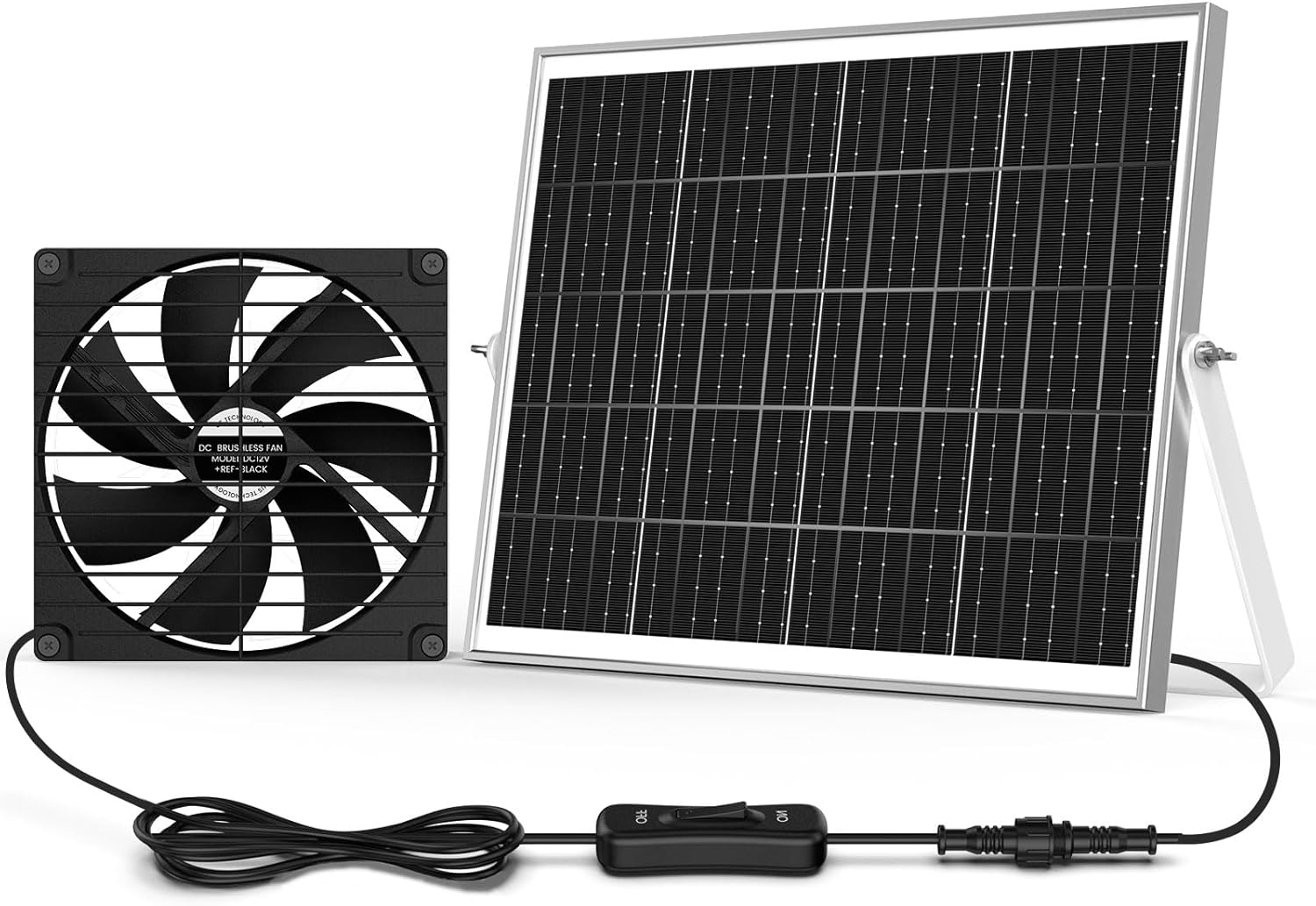
The PQINS 18-1P-B is a 7.1-inch solar-powered ventilation fan kit made for moving air through small outdoor and semi-outdoor spaces. Based on the listed uses, it fits small greenhouses, chicken coops, sheds, pet houses, garages, attics, and similar structures where stagnant heat or trapped air can build up during the day. It is best suited to homeowners and backyard growers who want a simple daytime airflow solution without running household power to the structure.
The product information lists a 25-watt solar power source, 3800 RPM maximum speed, and 720 CFM airflow capacity, with a recommended space range of 80 to 120 sq. ft. In plain terms, this is intended to help exchange air in smaller enclosures rather than cool a large building like an air conditioner. Reviewers commonly mention stronger airflow in direct sun and reduced or no operation when sunlight is weak, which matches the manufacturer note that the fan is powered directly by the solar panel and has no built-in battery.
The separate fan and solar panel are useful design choices for garden structures. You can place the panel where it gets better exposure while mounting the fan at the vent opening for exhaust or intake. The 16.5 ft cord helps with routing, and the push-button on/off switch gives basic manual control. The kit is listed as wall mounted and includes a bracket, DC fan, solar panel, and installation accessories such as mounting plates, screws, and nylon ties.
For a hobby greenhouse, this fan can help move hot, stale air out during sunny parts of the day, especially when paired with an opposite vent or opening for make-up air. In a chicken coop or doghouse, it may help improve air circulation during daylight hours, provided the installation keeps cords, blades, and hardware safely away from animals. For a shed, cabin, or small garage space, it can serve as a low-maintenance exhaust fan when heat builds up under direct sun.
The main limitation is also the reason it is simple: it has no battery backup. Gardeners who need overnight ventilation, cloudy-day performance, thermostat control, or continuous 24-hour airflow should consider a powered fan with battery storage or a wired option. Installation should be planned carefully, including weather exposure, secure mounting, protected cord routing, and a clear intake or exhaust path. Based on the specifications, this PQINS kit is a practical pick for sunny daytime ventilation in small backyard structures, but it is not the right choice for gardeners who need guaranteed airflow after dark or during extended cloudy weather.
Best For / Avoid If
Best for buyers prioritizing
- Runs from solar power, so it is useful for sheds, coops, and small greenhouses that do not have convenient outlet access.
- Fan and solar panel can be mounted separately, which helps when the best sun exposure is not directly beside the vent opening.
- Designed for both exhaust and intake use, giving gardeners flexibility when planning airflow through a small structure.
Consider another option if
- Because there is no built-in battery, the fan only operates when the solar panel receives enough daylight, with reduced airflow in cloudy conditions or near dusk.
- One power level limits fine control, so gardeners needing adjustable speeds may prefer a fan with multiple settings.
- Installation may require cutting or preparing a vent opening, and some reviewers mention that the included instructions could be clearer.
Pros
- Solar panel and household power adapter are both included for more flexible operation.
- Listed 36 dB noise level suggests relatively quiet ventilation for coops, sheds, or small greenhouses.
- Comes with bracket, solar panel, power adapter, and long cord needed for a basic installation.
- Wall-mount exhaust design is useful for removing warm, stale, humid, or dusty air from enclosed outdoor structures.
Cons
- Installation requires drilling a 7-inch hole, which may not suit renters or gardeners uncomfortable modifying a wall or shed panel.
- Solar performance will depend on sun exposure, panel placement, and weather, so shaded locations may need the power adapter more often.
- No battery runtime is listed, so gardeners wanting stored solar power overnight may need a different ventilation setup.
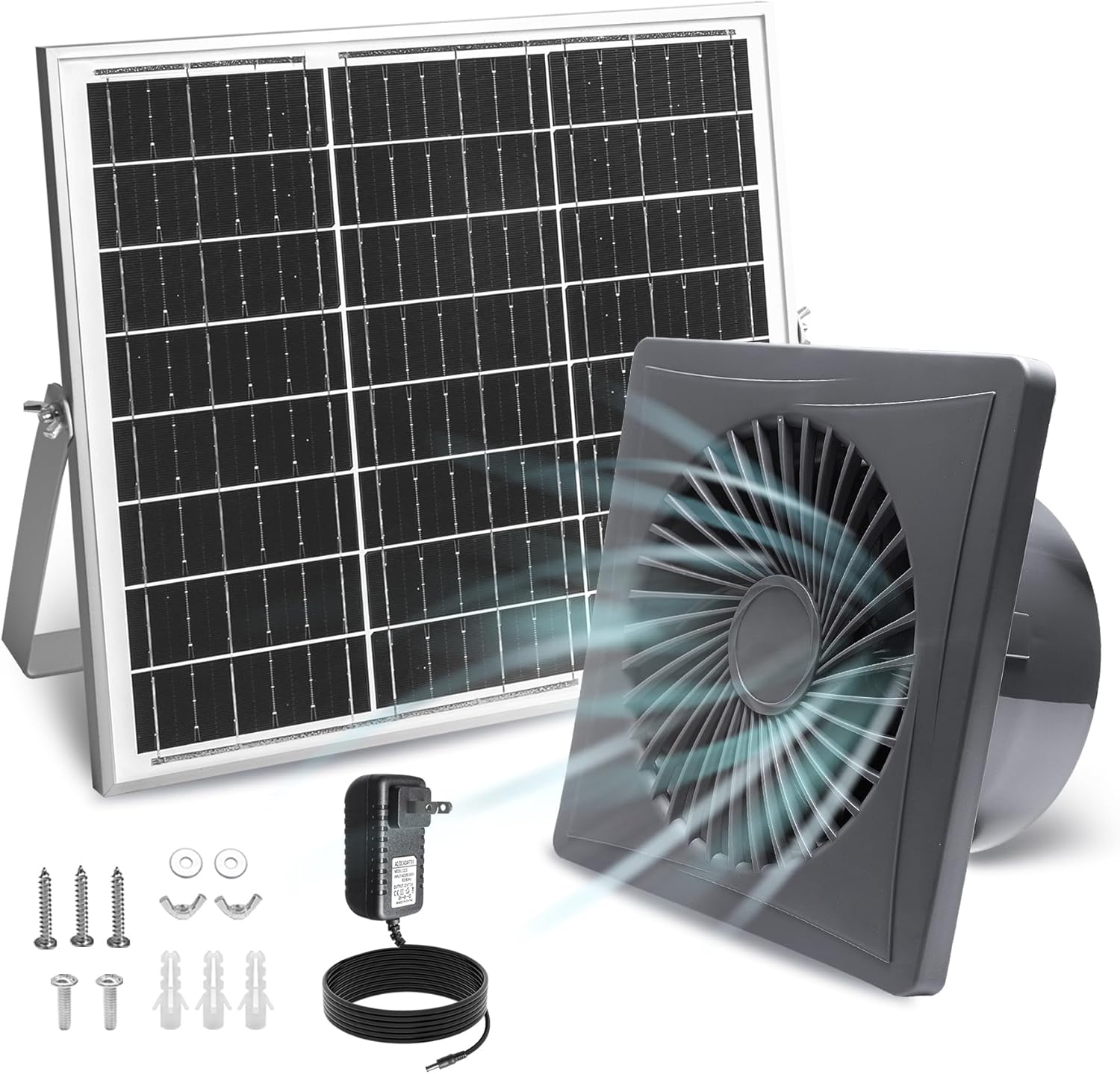
The SHENVITASO XJS-G8 is a solar exhaust fan kit made for ventilating small outdoor and utility spaces such as greenhouses, chicken coops, sheds, pet houses, garages, barns, RVs, and similar enclosed areas. For gardeners, its main job is to help move stale air out of a structure where heat, moisture, dust, or odors can build up.
According to the listed specifications, the kit pairs an 8-inch exhaust fan with a 25W monocrystalline solar panel. The fan is rated at 430 CFM, 2300 RPM, and 36 dB, giving it a useful mix of airflow and relatively low listed noise for small-space ventilation. The product information also notes a photovoltaic conversion efficiency of up to 21.5 percent for the panel.
The design includes a wall-mount fan, adjustable solar panel bracket, MC4 connector, push-button control, and a separate ON/OFF switch. A 16.4-foot solar panel cord helps with roof or sunny-wall placement, while the included power adapter with a 4.66-foot cable allows connection to household power when sunlight is not enough. Installation requires drilling a 7-inch hole and making the connection to the panel, so careful measuring and safe tool use are important.
In a backyard greenhouse, this fan may help exhaust hot, humid air during sunny periods. In a chicken coop or garden shed, it can support air exchange where odors, dust, or trapped heat are concerns. The anti-backflow valve is a helpful detail for outdoor structures because it is designed to stay closed when the fan is not running, helping limit outside insects, small animals, and reverse airflow through the opening.
The solar panel is listed with an IP67 waterproof rating, toughened glass surface, and aluminum frame, which supports outdoor use according to the product data. Still, placement matters. The panel should be aimed for the best available sun, wiring should be routed safely, and the fan opening should be positioned where exhaust air can leave freely. Periodic checks for dust, debris, and blocked vents will help keep airflow from being restricted.
This is a sensible option for homeowners and beginner-to-intermediate gardeners who want a ready solar ventilation kit with an AC power backup option. Gardeners who cannot cut a wall opening, need battery-backed overnight solar operation, or are ventilating a larger structure may want to compare other systems before choosing this one.
Best For / Avoid If
Best for buyers prioritizing
- Solar panel and household power adapter are both included for more flexible operation.
- Listed 36 dB noise level suggests relatively quiet ventilation for coops, sheds, or small greenhouses.
- Comes with bracket, solar panel, power adapter, and long cord needed for a basic installation.
Consider another option if
- Installation requires drilling a 7-inch hole, which may not suit renters or gardeners uncomfortable modifying a wall or shed panel.
- Solar performance will depend on sun exposure, panel placement, and weather, so shaded locations may need the power adapter more often.
- No battery runtime is listed, so gardeners wanting stored solar power overnight may need a different ventilation setup.

Pros
- Runs from a rechargeable battery, solar panel, or included AC adapter for flexible garden and outdoor use.
- Listed high airflow capacity makes it a practical option for general air circulation in greenhouses, sheds, gazebos, and coops.
- Lithium iron phosphate battery is listed for over 1,500 charge cycles and is described as durable in varied temperature conditions.
- Reviewers commonly mention quiet operation and easy portability, though individual airflow expectations vary.
- USB output adds limited emergency charging usefulness for small mobile devices.
Cons
- Some users may find the airflow less forceful than expected, especially if they want a strong personal cooling fan at close range.
- Solar charging depends on available sunlight and may require planning around weather, placement, and season.
- The listed USB output is 5V/1A, so it is better viewed as backup charging rather than fast device charging.
The ZIZIWIN Solar Fan-14'' is a rechargeable cordless ventilation fan designed for spaces such as greenhouses, sheds, chicken coops, gazebos, patios, barns, garages, workshops, tents, and camping setups. For gardeners, its main appeal is simple movable airflow without needing a permanent wired exhaust fan or a nearby outlet.
Based on the listed specifications, the fan provides up to 2,180 CFM at 1,500 RPM and uses a 38,600 mAh lithium iron phosphate battery. The product information states 8 to 12 hours of runtime on high and 30 to 60 hours on low, which can be useful for daytime air circulation in a small greenhouse, a shaded potting area, or a coop during warm weather.
The charging setup is a key feature. The fan can be charged with the included AC adapter, with the listing stating about 3 hours for a full AC charge, or with the 25W monocrystalline solar panel, with a stated 4 to 6 hour solar charging range. The MPPT solar feature is intended to improve charging efficiency, though real charging time will still depend on sun exposure and panel placement.
The design includes a 360-degree tilt adjustment, metal frame construction, ultra-thin metal blades, a pure copper brushless motor, and a 0.2-inch metal mesh guard. Listed product dimensions are 7.5 x 16.9 x 14.8 inches, so it is sized for floor or tabletop-style placement rather than built-in wall ventilation. Reviewers commonly describe it as quiet and portable, but a few also note that the airflow may not feel strong enough for every use.
In backyard use, this fan makes the most sense as a flexible helper for moving air around a potting bench, seed-starting area, greenhouse corner, patio seating area, animal shelter, or shed workspace. It can also serve as a portable fan for camping, fishing, RV use, or power-outage comfort, and the USB-A 5V/1A port can charge small devices in a pinch.
This is not a substitute for a properly sized greenhouse exhaust system if you need automatic temperature control or continuous whole-structure ventilation. Keep the fan guard clear, avoid blocking airflow, protect charging connections as directed by the manufacturer, and plan solar charging around direct sunlight. Gardeners who want portable cordless airflow with solar backup should consider it, while those needing very forceful air movement may prefer a larger or higher-speed fan.
Best For / Avoid If
Best for buyers prioritizing
- Runs from a rechargeable battery, solar panel, or included AC adapter for flexible garden and outdoor use.
- Listed high airflow capacity makes it a practical option for general air circulation in greenhouses, sheds, gazebos, and coops.
- Lithium iron phosphate battery is listed for over 1,500 charge cycles and is described as durable in varied temperature conditions.
Consider another option if
- Some users may find the airflow less forceful than expected, especially if they want a strong personal cooling fan at close range.
- Solar charging depends on available sunlight and may require planning around weather, placement, and season.
- The listed USB output is 5V/1A, so it is better viewed as backup charging rather than fast device charging.

Pros
- Includes the main components needed for setup, including the fan, solar panel kit, battery box, zip ties, screw kit, and user manual.
- Rechargeable solar design is useful for small outdoor structures where electrical access is limited.
- Compact listed dimensions make it easier to fit in tight greenhouse, coop, shed, or pet house spaces.
- Adjustable tilt and a long cord support more flexible placement than a fixed short-cord fan.
Cons
- Performance will depend on available sunlight and battery charge, so it may be less suitable as the only ventilation source in consistently cloudy or shaded locations.
- The product information does not list airflow rating, coverage area, or weatherproof rating, so sizing and placement should be planned cautiously.
- Gardeners needing whole-greenhouse ventilation for a larger structure may prefer a larger fan or a dedicated exhaust system.
The blessny BL-8Y-B is an 8-inch solar rechargeable fan kit made for outdoor air circulation and cooling support in spaces such as small greenhouses, chicken coops, sheds, dog houses, and pet houses. Based on the listed specifications, it is best suited to gardeners and homeowners who need a simple fan where running a standard 110V power cord is inconvenient.
The key benefit is its solar-powered design with a 25W monocrystalline solar panel and a 66.6Wh battery backup. The product information indicates the battery can power the fan for around 9 hours when fully charged, which can help keep air moving after direct sunlight is reduced. The 8-inch fan and listed 2010 RPM speed suggest stronger airflow potential than smaller 4-inch or 6-inch solar fan kits, though no airflow rating is provided.
For setup, the kit includes the 8-inch fan, 25W solar panel kit, battery box, zip ties, installation screw kit, and user manual. A 19.5-foot cord gives useful flexibility, allowing the solar panel to be placed in a sunnier location while the fan is positioned inside or near the structure that needs circulation. The adjustable tilt helps aim the airflow, and the on/off button keeps operation straightforward.
In a backyard setting, this fan may be useful for moving warm, stagnant air in a small greenhouse, adding circulation in a coop, or improving comfort in a pet shelter during hot weather. Its compact listed dimensions, 9.6 inches by 4.1 inches by 9.8 inches, make it easier to place in tight spaces than a larger floor fan. Because it uses 12V DC power from the solar kit, it is aimed at off-grid outdoor use rather than indoor household outlet use.
There are a few practical limits to consider. Solar fan performance depends on sun exposure and battery charge, so shaded locations or long cloudy stretches may reduce usefulness. The supplied data does not list a CFM airflow rating, coverage area, waterproof rating, or mounting environment limits, so it should not be treated as a guaranteed replacement for a properly sized greenhouse exhaust system. Keep wiring and the battery box positioned safely, follow the user manual, and check the fan regularly for dust, debris, or obstruction.
Overall, the blessny BL-8Y-B is a sensible choice for small-space gardeners, poultry keepers, and homeowners who want a solar rechargeable fan for supplemental air movement. Those managing a large greenhouse, heat-sensitive plants, or a structure that requires dependable ventilation in all weather should consider a larger or more fully specified ventilation system.
Best For / Avoid If
Best for buyers prioritizing
- Includes the main components needed for setup, including the fan, solar panel kit, battery box, zip ties, screw kit, and user manual.
- Rechargeable solar design is useful for small outdoor structures where electrical access is limited.
- Compact listed dimensions make it easier to fit in tight greenhouse, coop, shed, or pet house spaces.
Consider another option if
- Performance will depend on available sunlight and battery charge, so it may be less suitable as the only ventilation source in consistently cloudy or shaded locations.
- The product information does not list airflow rating, coverage area, or weatherproof rating, so sizing and placement should be planned cautiously.
- Gardeners needing whole-greenhouse ventilation for a larger structure may prefer a larger fan or a dedicated exhaust system.
Pros
- No wiring is required, which can simplify installation for coops, sheds, and small greenhouse setups.
- Solar panel, battery backup, and timer controls provide more flexibility than a sun-only fan.
- Low listed noise level may be helpful around chickens, pets, or quiet backyard spaces.
- Reviewers commonly mention easy installation and useful airflow in chicken coop applications.
Cons
- Airflow may be less suitable for larger coops, sheds, or greenhouses, as some reviewers felt it was not as strong as expected.
- Timer use has a specific limitation, it can only be activated at night and must be pressed when it is dark.
- Solar performance will depend on direct sun exposure, panel placement, and weather conditions.
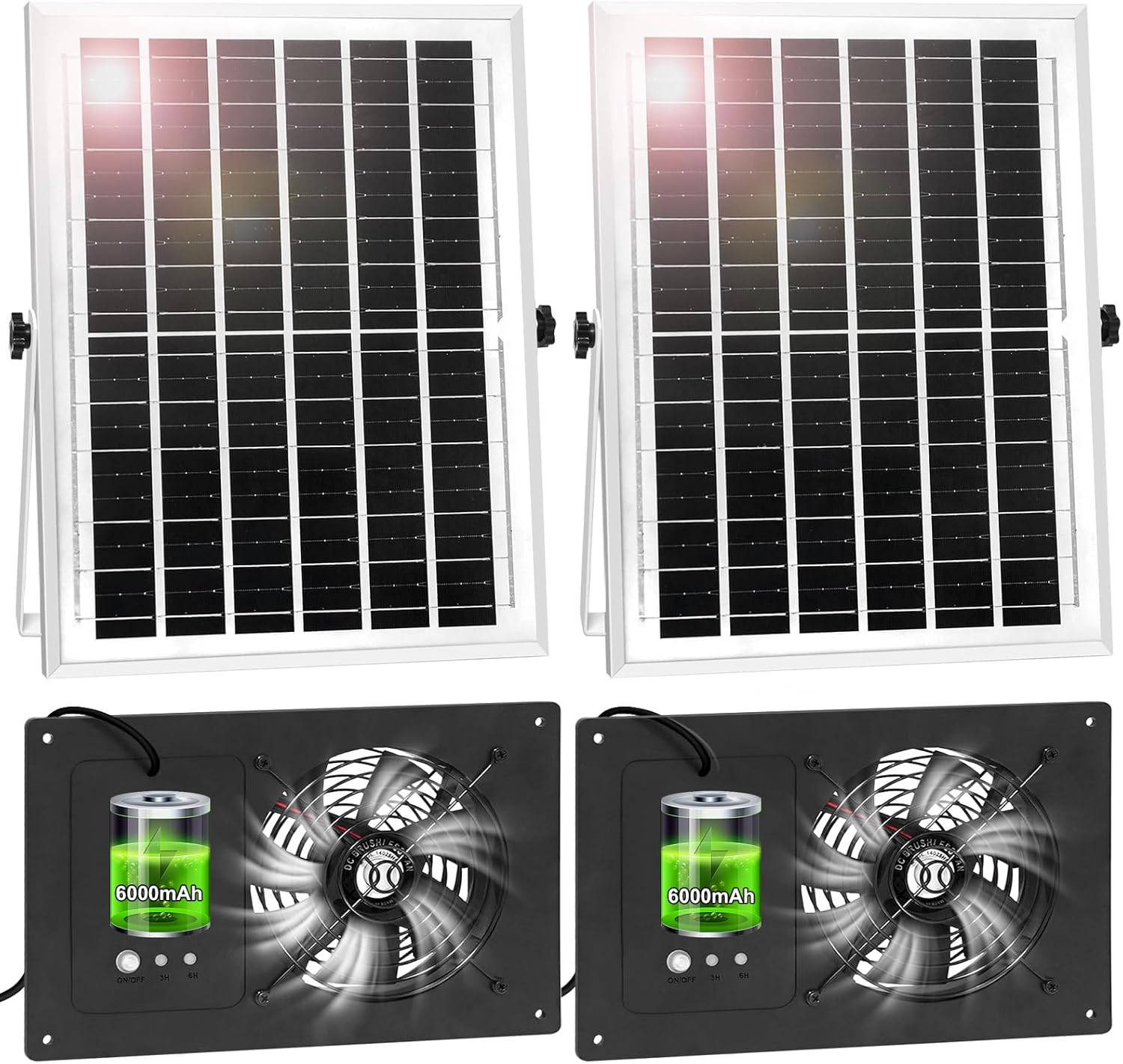
The AEQ AE002 is a compact solar-powered ventilation fan designed for chicken coops, pet houses, sheds, and greenhouse spaces that need supplemental airflow. Based on the listed specifications, it pairs a 15W solar panel with a built-in 6000mAh battery so the fan is not limited only to bright daytime conditions.
For backyard growers and poultry keepers, the main appeal is simple off-grid ventilation. Moving air can help reduce stagnant, stuffy conditions in enclosed garden structures, and the product information indicates day and night operation with battery support. Reviewers commonly mention using it in chicken coops, with several noting that it was quiet and easy to install.
The fan uses plastic plus metal construction and has an IP65 waterproof rating, which makes it appropriate for outdoor garden structures when installed as directed. The front and back metal mesh guards are a useful safety detail because they help separate hands, feathers, and debris from the fan blades. The 16.4 ft cable can also make placement easier, since the solar panel can be positioned for direct sunlight while the fan is mounted where airflow is needed.
Controls are straightforward, with 3 and 6 hour timer options for nighttime use. One important detail is that the timer function can only be used at night and must be pressed when it is dark, so gardeners expecting a fully automatic daytime schedule should note that limitation. Installation is described as no-wiring, with the fan mounted to a wall and the solar panel placed in direct sun.
This fan makes the most sense for small coops, modest sheds, pet enclosures, or a compact greenhouse where supplemental air movement is needed without adding an electrical circuit. It may not be the right choice for a large greenhouse or a heavily enclosed building that requires known high-volume ventilation, especially because one reviewer reported lower airflow than expected. As with any fan around animals or damp garden spaces, mount it securely, keep the guards clear of debris, and check operation periodically.
Overall, the AEQ AE002 is a practical option for gardeners and chicken keepers who want a solar ventilation fan with battery backup and basic timer control. Buyers who need stronger airflow specifications, confirmed coverage for a large structure, or a more automated ventilation system may want to compare it with larger powered exhaust fans before choosing.
Best For / Avoid If
Best for buyers prioritizing
- No wiring is required, which can simplify installation for coops, sheds, and small greenhouse setups.
- Solar panel, battery backup, and timer controls provide more flexibility than a sun-only fan.
- Low listed noise level may be helpful around chickens, pets, or quiet backyard spaces.
Consider another option if
- Airflow may be less suitable for larger coops, sheds, or greenhouses, as some reviewers felt it was not as strong as expected.
- Timer use has a specific limitation, it can only be activated at night and must be pressed when it is dark.
- Solar performance will depend on direct sun exposure, panel placement, and weather conditions.
Guide d’achat du meilleur ventilateur de serre solaire
Commencez par déterminer le type de circulation d’air nécessaire
Les ventilateurs solaires pour serre de cet ensemble de données se répartissent en deux catégories utiles : les extracteurs d’air et les ventilateurs portables de circulation. Les extracteurs, comme l’extracteur solaire Ecocalm de 12 pouces et l’extracteur double Ropelux, servent à évacuer l’air vicié d’un espace fermé. Les ventilateurs portables ou sur pied, comme le ventilateur solaire rechargeable blessny de 8 pouces et le ventilateur solaire ZIZIWIN de 14 pouces, conviennent davantage à la circulation de l’air à l’intérieur d’une serre, d’une remise, d’un gazebo ou d’un autre espace extérieur.
Si votre serre devient étouffante à cause de la chaleur et de l’humidité emprisonnées, une installation avec extracteur constitue généralement la solution la plus directe. Si votre principal problème est l’air stagnant autour des plantes ou si vous souhaitez déplacer le ventilateur entre une serre, une terrasse et un poulailler, un ventilateur portable rechargeable peut être plus pratique.
Vérifiez la puissance du panneau solaire et l’autonomie de la batterie
Les ventilateurs solaires dépendent de la lumière du soleil : la puissance du panneau et la présence d’une batterie sont donc importantes. L’extracteur solaire Ecocalm de 12 pouces utilise deux panneaux bifaciaux de 30 W et une batterie rechargeable de 5000 mAh annoncée pour 6 heures après une charge complète au soleil. Le système Ecocalm à trois ventilateurs de 5,5 pouces indique une batterie de 6600 mAh et deux panneaux solaires bifaciaux, avec une autonomie pouvant atteindre 10 heures après une charge complète.
Le ventilateur solaire double Ropelux comprend une batterie de 18000 mAh et annonce jusqu’à 10 heures d’autonomie sans soleil, tandis que le ventilateur blessny de 8 pouces indique une batterie de 66,6 Wh pouvant alimenter séparément le ventilateur pendant environ 9 heures lorsqu’elle est complètement chargée. Le ventilateur ZIZIWIN de 14 pouces possède la plus grande batterie indiquée dans le groupe solaire retenu, avec 38600 mAh et une autonomie de 8 à 12 heures à puissance élevée ou de 30 à 60 heures à faible puissance, selon les spécifications fournies.
Adaptez le débit d’air à la taille de la serre
Le débit d’air est généralement indiqué en CFM, c’est-à-dire en pieds cubes par minute. Un CFM plus élevé correspond généralement à un déplacement d’air plus important, mais le débit adapté dépend du volume de votre serre, de l’emplacement des ouvertures et du fait que le ventilateur évacue l’air ou le fait circuler à l’intérieur.
| Produit | Détail du débit d’air ou de la surface couverte | Usage le plus adapté d’après les données fournies |
|---|---|---|
| Extracteur solaire de 12“ pour serre avec thermostat intelligent et batterie | Ventilateurs de grenier alimentés par l’énergie solaire, 2 panneaux bifaciaux de 30 W, construction métallique, étanche, stable, pour extérieur, garage, remise, poulailler | 720 CFM, adapté aux espaces jusqu’à 1600 ft³ | Ventilation par extraction pour serres, remises, garages et espaces similaires |
| Extracteur solaire pour serre avec thermostat intelligent et batterie | Trois ventilateurs solaires de 5,5″, contrôle réglable de la température, 2 panneaux bifaciaux de 25 W, pour poulailler, extérieur, garage, remise | 254 CFM, adapté aux espaces jusqu’à 1900 ft³ | Ventilation transversale flexible à plusieurs ventilateurs |
| Ventilateur solaire de 14″, ventilateur de serre sans fil alimenté par panneau solaire de 25 W, batterie rechargeable, portable, inclinaison à 360°, autonomie de 8 à 60 h, pour camping extérieur, gazebo, poulailler, terrasse, voyage, remise, grange | Débit d’air maximal de 2180 CFM | Circulation portable à débit d’air élevé |
| Ventilateur solaire rechargeable blessny de 8″ pour serre, poulailler, maison pour animaux | Ventilateur de sol solaire de 25 W avec batterie de secours de 66,6 Wh pour rafraîchir et faire circuler l’air extérieur | Ventilateur de 8 pouces, 2010 tr/min indiquées | Circulation de l’air dans une petite serre, une maison pour animaux, une remise ou un poulailler |
Ne choisissez pas uniquement en fonction du CFM. Un ventilateur à fort débit d’air, mais mal positionné, peut ne pas évacuer efficacement l’air chaud. Pour les modèles extracteurs, prévoyez un passage permettant à l’air frais d’entrer, par exemple une ouverture d’aération ou un panneau ouvert du côté opposé.
Choisissez des commandes adaptées à vos habitudes
Les jardiniers débutants se débrouillent souvent mieux avec des commandes simples, tandis que les utilisateurs réguliers d’une serre peuvent apprécier l’automatisation. Les extracteurs solaires Ecocalm comprennent un réglage ajustable de la température, permettant au ventilateur de s’allumer et de s’éteindre automatiquement selon les paramètres décrits dans les données produit fournies. Cette fonction peut être utile si vous ne pouvez pas vérifier la serre plusieurs fois par jour.
Le ventilateur solaire Ropelux comprend deux modes de minuterie, indiqués comme Day + 3 Hours et Day + 6 Hours après le coucher du soleil. Le ventilateur blessny possède un bouton marche/arrêt et un câble de 19,5 ft pour faciliter l’installation. Pour un ventilateur portable, le modèle ZIZIWIN ajoute une inclinaison à 360°, ce qui peut aider à orienter le flux d’air sans devoir déplacer le support.
Tenez compte de l’installation et de l’emplacement
Les extracteurs muraux ou de fenêtre demandent davantage de travail que les ventilateurs au sol, mais ils peuvent être plus efficaces pour évacuer l’air chaud d’une serre fermée. L’extracteur solaire Ecocalm de 12 pouces est décrit comme facile à installer et peut être monté dans une fenêtre ou un mur. Le système Ecocalm à trois ventilateurs comprend des câbles de différentes longueurs pour une installation flexible, et les données produit indiquent spécifiquement qu’un montage opposé peut augmenter le débit d’air.
Les ventilateurs solaires portables réduisent les travaux d’installation. Le ventilateur blessny de 8 pouces possède un câble de 19,5 ft, tandis que le ventilateur ZIZIWIN de 14 pouces est sans fil et rechargeable. Ces modèles peuvent convenir aux locataires, aux utilisateurs saisonniers d’une serre ou aux jardiniers âgés qui préfèrent éviter de découper une ouverture dans un mur.
Soyez attentif à la résistance aux intempéries et aux détails de fabrication
Les serres sont des environnements humides, et les structures de jardin extérieures peuvent être exposées à la poussière, à l’humidité et aux variations météorologiques. L’extracteur Ecocalm de 12 pouces indique des pales étanches IP44 et un câble de 14,8 ft. Le système Ecocalm à trois ventilateurs indique des pales étanches IP44 et des prises étanches.
Le ventilateur ZIZIWIN de 14 pouces est décrit comme doté d’une structure solide entièrement métallique, étanche, résistante à la poussière et à la rouille. Le modèle Ropelux est destiné à une utilisation hors réseau dans les remises, poulaillers, serres, greniers et cabanes. Suivez toujours les instructions d’installation et de sécurité du fabricant, notamment lors de la fixation des panneaux, du passage des câbles ou de l’utilisation d’un ventilateur dans un environnement humide.
Évitez les erreurs d’achat courantes
L’erreur la plus courante consiste à acheter un ventilateur présenté comme un modèle de ventilation sans vérifier qu’il est réellement alimenté par l’énergie solaire. Plusieurs produits fournis sont utiles pour les serres ou les espaces de culture, mais ne correspondent pas clairement à l’exigence d’un ventilateur de serre solaire ; ils n’ont donc pas été retenus ici comme recommandations.
Une autre erreur consiste à attendre les mêmes performances par temps nuageux qu’en plein soleil. Les données de l’extracteur Ecocalm de 12 pouces précisent que l’efficacité du ventilateur et la recharge de la batterie dépendent de l’ensoleillement et diminuent lorsque le temps est nuageux. Une batterie de secours est utile, mais elle ne dispense pas d’une bonne conception des ouvertures ni d’attentes réalistes.
Entretien, rangement et accessibilité
Les ventilateurs solaires pour serre doivent être protégés contre l’accumulation de poussière, de feuilles et de débris végétaux afin de ne pas bloquer la circulation de l’air. Vérifiez régulièrement l’emplacement du panneau solaire pendant la saison, car les plantes voisines, une toile d’ombrage ou l’évolution de l’angle du soleil peuvent réduire la recharge.
Pour les jardiniers qui privilégient le confort et l’accessibilité, les ventilateurs portables peuvent être plus faciles à nettoyer, à déplacer et à ranger. Les extracteurs muraux peuvent réduire les manipulations quotidiennes une fois installés, mais ils nécessitent davantage de planification au départ. En fin de saison, rangez les ventilateurs portables rechargeables dans un endroit sec et protégé, en suivant les recommandations du fabricant concernant la batterie.
Méthodologie de recherche et fiabilité
Ce guide repose sur l’étude et la comparaison des spécifications, descriptions, prix, notes et nombres d’avis des produits fournis. Il ne s’appuie pas sur des tests physiques, une installation ou un essai pratique dans un jardin.
Nous avons d’abord évalué les 15 produits fournis selon leur pertinence pour le sujet du meilleur ventilateur de serre solaire. Les produits qui étaient des ventilateurs de serre sans être clairement alimentés par l’énergie solaire, ainsi que les extracteurs nécessitant une alimentation secteur standard, ont été exclus des recommandations finales, même s’ils peuvent être utiles pour d’autres projets de ventilation.
Pour les produits solaires retenus, nous avons comparé les détails des panneaux solaires, la capacité et l’autonomie indiquées de la batterie, les informations sur le débit d’air, les commandes de température ou de minuterie, les caractéristiques de résistance aux intempéries, les options de fixation et l’adaptation aux espaces de jardin. Les retours des propriétaires ont été pris en compte lorsque le nombre d’avis était disponible, mais les produits ayant peu ou pas d’avis ont été évalués avec davantage de prudence.
Cet article a été préparé et mis à jour en juillet 2026. Les prix, la disponibilité et les notes peuvent changer ; consultez donc les informations actuelles de la page produit et les instructions du fabricant avant d’acheter ou d’installer un équipement électrique ou solaire pour serre.
Recommandations finales
Meilleur choix global : Extracteur solaire de 12“ pour serre avec thermostat intelligent et batterie | Ventilateurs de grenier alimentés par l’énergie solaire, 2 panneaux bifaciaux de 30 W, construction métallique, étanche, stable, pour extérieur, garage, remise, poulailler. D’après les spécifications indiquées, il offre une combinaison intéressante de 720 CFM de débit d’air, deux panneaux bifaciaux de 30 W, une batterie de 5000 mAh, un réglage ajustable de la température, des pales étanches IP44 et une fixation à la fenêtre ou au mur pour la ventilation par extraction d’une serre.
Meilleur choix pour les petits espaces : Ventilateur solaire rechargeable blessny de 8″ pour serre, poulailler, maison pour animaux | Ventilateur de sol solaire de 25 W avec batterie de secours de 66,6 Wh pour rafraîchir et faire circuler l’air extérieur. Il constitue une option pratique pour une petite serre ou un espace de type maison pour animaux, car il utilise un panneau solaire de 25 W, possède une batterie de 66,6 Wh, comprend un câble de 19,5 ft et est conçu pour la circulation de l’air extérieur sans alimentation secteur de 110 V CA.
Meilleur choix pour une installation facile : Ventilateur solaire de 14″, ventilateur de serre sans fil alimenté par panneau solaire de 25 W, batterie rechargeable, portable, inclinaison à 360°, autonomie de 8 à 60 h, pour camping extérieur, gazebo, poulailler, terrasse, voyage, remise, grange. Les jardiniers qui souhaitent une option portable rechargeable peuvent apprécier son panneau solaire de 25 W, sa batterie de 38600 mAh, son inclinaison à 360° et son autonomie indiquée de 8 à 12 heures à puissance élevée ou de 30 à 60 heures à faible puissance.
FAQ
Quel est le meilleur ventilateur de serre solaire pour la plupart des jardiniers amateurs ?
Pour de nombreuses serres domestiques, un ventilateur solaire extracteur avec batterie de secours et contrôle de la température est le plus utile. Dans les données fournies, l’extracteur solaire Ecocalm de 12 pouces se distingue grâce à son débit d’air indiqué de 720 CFM, ses deux panneaux solaires bifaciaux, sa batterie et son réglage ajustable de la température.
Comment dimensionner un ventilateur de serre solaire ?
Commencez par examiner le débit d’air indiqué et la taille d’espace recommandée lorsque le fabricant la fournit. Par exemple, l’extracteur Ecocalm de 12 pouces indique 720 CFM pour des espaces jusqu’à 1600 ft³, tandis que le système Ecocalm à trois ventilateurs de 5,5 pouces indique 254 CFM pour des espaces jusqu’à 1900 ft³.
Les ventilateurs de serre solaires fonctionnent-ils la nuit ?
Seuls les modèles équipés d’une batterie de secours sont conçus pour fonctionner sans lumière directe du soleil. Les options solaires fournies indiquent différentes capacités de batterie et autonomies : environ 9 heures pour le ventilateur blessny lorsqu’il est complètement chargé, jusqu’à 10 heures pour le ventilateur Ropelux et 6 heures pour l’extracteur Ecocalm de 12 pouces après une charge complète au soleil.
Un extracteur ou un ventilateur portable est-il préférable pour une serre ?
Un extracteur est généralement préférable lorsqu’il faut évacuer l’air chaud, humide ou vicié d’une serre fermée. Un ventilateur portable convient mieux si vous recherchez une circulation d’air flexible, un rangement facile et la possibilité de l’utiliser dans plusieurs endroits comme une serre, une terrasse, une remise ou un poulailler.
Quel entretien nécessite un ventilateur de serre solaire ?
Gardez les pales, grilles, ouvertures d’aération et panneaux solaires exempts de poussière et de débris végétaux. Vérifiez régulièrement le passage des câbles et les points de fixation, puis suivez les instructions du fabricant concernant la batterie et le nettoyage, en particulier dans les conditions humides d’une serre.
Les ventilateurs solaires pour serre sont-ils sûrs près de l’eau et de l’humidité ?
Certains modèles fournis indiquent des caractéristiques d’étanchéité ou IP44, mais cela ne signifie pas que chaque élément peut être exposé sans précaution. Suivez les consignes de sécurité du fabricant, évitez toute installation électrique dangereuse et fixez les panneaux, prises et boîtiers de batterie conformément aux instructions.
Puis-je utiliser un ventilateur de serre solaire dans une remise ou un poulailler ?
Plusieurs produits solaires retenus dans ce guide indiquent une utilisation dans les remises, poulaillers, maisons pour animaux, garages ou cabanes, en plus des serres. Adaptez le type de ventilateur à l’espace, prévoyez un passage d’air dégagé et assurez-vous que le panneau solaire reçoit suffisamment de lumière.
Poursuivez vos recherches de jardinage
Découvrez d’autres guides pratiques dans Serres et rangement de jardin.
Découvrez comment Dove Creek Gardens étudie et compare les produits.