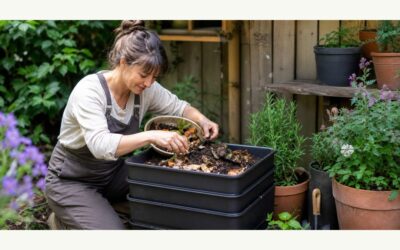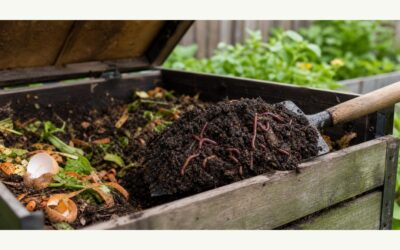



Ein Feuchtigkeitsmesser für Hochbeete hilft dabei, beim Gießen von Gemüse, Kräutern, Blumen und Pflanzen in Gefäßen weniger raten zu müssen. Hochbeete können ungleichmäßig austrocknen, besonders an den Rändern, bei flacher Erde oder heißem Wetter. Daher kann ein einfaches Messgerät mit Sonde für Gartenanfänger und Hausbesitzer hilfreich sein, die sich nicht nur auf das Erscheinungsbild der Bodenoberfläche verlassen möchten.
Für diesen Leitfaden vom Juli 2026 haben wir die Herstellerangaben zu 24 Produkten verglichen und daraufhin geprüft, ob sie tatsächlich für die Messung der Bodenfeuchtigkeit in Gärten, Hochbeeten, Rasenflächen, auf Bauernhöfen, in Topfpflanzen sowie bei der Innen- oder Außenpflege von Pflanzen eingesetzt werden können. Wenn Sie Ihre Anbauanlage noch planen, finden Sie bei Dove Creek Gardens auch praktische Informationen zu Beet- und Behälteroptionen in unserem Bereich Hochbeete und Pflanzgefäße.
Unser Schwerpunkt lag auf Produkttyp, Sondennutzung, Funktionen zur Feuchtigkeitsmessung, zusätzlichen pH- oder Lichtmessungen, sofern aufgeführt, Ablesbarkeit, Batterien, Bedienkomfort und der Frage, ob die Produktinformationen den Einsatz als Feuchtigkeitsmesser für Hochbeete eindeutig unterstützen. Feuchtigkeitsmesser für Baumaterialien wurden nicht als Empfehlungen für den Garten berücksichtigt, da ihr aufgeführter Verwendungszweck Trockenbau, Holz, Mauerwerk, Beton oder die Erkennung von Wasserlecks ist und nicht die Bodenmessung.
Bodenfeuchtemesser: XLUX Long Probe Bodenfeuchtemesser: YAMRON 4-in-1 Antonki 2-Pack Soil Moisture Meter for Plants, Battery-Free Watering Checks Bodenfeuchtemesser: XLUX Preise und Verfügbarkeit können sich ändern. Für qualifizierte Käufe erhalten wir möglicherweise eine Provision.


Einige Produktangaben unten sind noch auf Englisch; ihre Übersetzung wird überprüft.
Bodenfeuchtemesser: XLUX Long Probe
Produktübersicht: Modell zur Kontrolle der Feuchtigkeit von Pflanzsubstrat. Vergleichen Sie Sonde und Anzeige passend zum Beet.
Vor dem Kauf prüfen: Beachten Sie die Anleitung und prüfen Sie den Zustand des Substrats zusätzlich. Weitere Messfunktionen ersetzen keine Laboranalyse.
Zusammenfassung von Produktangaben, kein Praxistest.
Bodenfeuchtemesser: YAMRON 4-in-1
Produktübersicht: Modell zur Kontrolle der Feuchtigkeit von Pflanzsubstrat. Vergleichen Sie Sonde und Anzeige passend zum Beet.
Vor dem Kauf prüfen: Beachten Sie die Anleitung und prüfen Sie den Zustand des Substrats zusätzlich. Weitere Messfunktionen ersetzen keine Laboranalyse.
Zusammenfassung von Produktangaben, kein Praxistest.
Pros
- Simple dial operation is accessible for beginners and gardeners who prefer no digital controls.
- Useful for checking moisture in indoor pots, outdoor containers, and garden soil.
- Compact, lightweight design and battery-free operation make it easy to keep available.
- Two meters provide convenient coverage for separate plants or growing areas.
Cons
- It is intended for soil use only and should not be used to test water or other liquids.
- A manual probe reading checks the spot where it is inserted, so gardeners may need multiple readings in uneven soil.
- Gardeners who need recorded readings, automatic alerts, or broader moisture mapping may prefer a more advanced sensor.
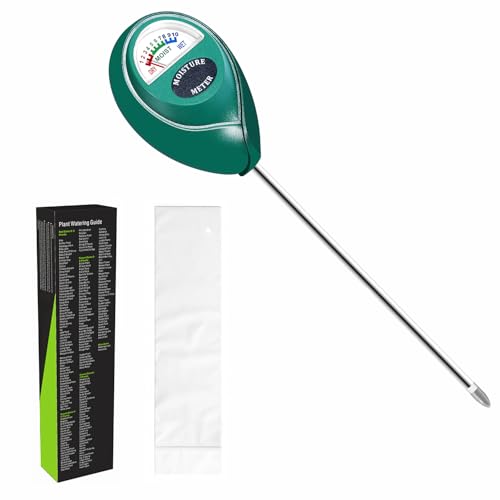
The Antonki 2-pack is a manual soil moisture meter for checking whether garden or potting soil is dry, moist, or wet before watering. It is a practical fit for beginners, indoor plant owners, patio gardeners, and homeowners who want a straightforward alternative to judging moisture by appearance alone.
Its main benefit is the quick, readable dial. The color-coded zones identify dry, moist, and wet conditions, while the 10-scale display provides more detail than a simple yes-or-no indicator. The product information indicates that the pointer responds once the probe has full contact with the soil, helping users make watering decisions with less guesswork.
Using it requires three basic steps: remove the probe protector, insert the probe near the roots with full soil contact, and read the dial after the pointer settles. The listed 7.6-inch probe is intended to reach deeper root areas, and the single-probe design may disturb less soil than a bulkier double-probe style. No batteries, settings, or assembly are required.
For container plants, the meter can help identify whether the upper soil is dry while lower areas remain wet. In raised beds or outdoor planting areas, checking more than one location may reveal uneven watering. The two-pack also allows separate meters to remain in different rooms, containers, or garden sections for convenient spot checks.
This is a soil-only tool, not a liquid or water tester. Because it measures the spot where it is inserted, gardeners may need to check several locations when moisture is uneven. Wipe the probe clean after each reading and use it carefully near roots. Overall, it is a simple option for routine moisture checks, while gardeners seeking automatic monitoring, alerts, or stored data should consider a different type of sensor.
Best For / Avoid If
Best for buyers prioritizing
- Simple dial operation is accessible for beginners and gardeners who prefer no digital controls.
- Useful for checking moisture in indoor pots, outdoor containers, and garden soil.
- Compact, lightweight design and battery-free operation make it easy to keep available.
Consider another option if
- It is intended for soil use only and should not be used to test water or other liquids.
- A manual probe reading checks the spot where it is inserted, so gardeners may need multiple readings in uneven soil.
- Gardeners who need recorded readings, automatic alerts, or broader moisture mapping may prefer a more advanced sensor.
Bodenfeuchtemesser: XLUX
Produktübersicht: Modell zur Kontrolle der Feuchtigkeit von Pflanzsubstrat. Vergleichen Sie Sonde und Anzeige passend zum Beet.
Vor dem Kauf prüfen: Beachten Sie die Anleitung und prüfen Sie den Zustand des Substrats zusätzlich. Weitere Messfunktionen ersetzen keine Laboranalyse.
Zusammenfassung von Produktangaben, kein Praxistest.
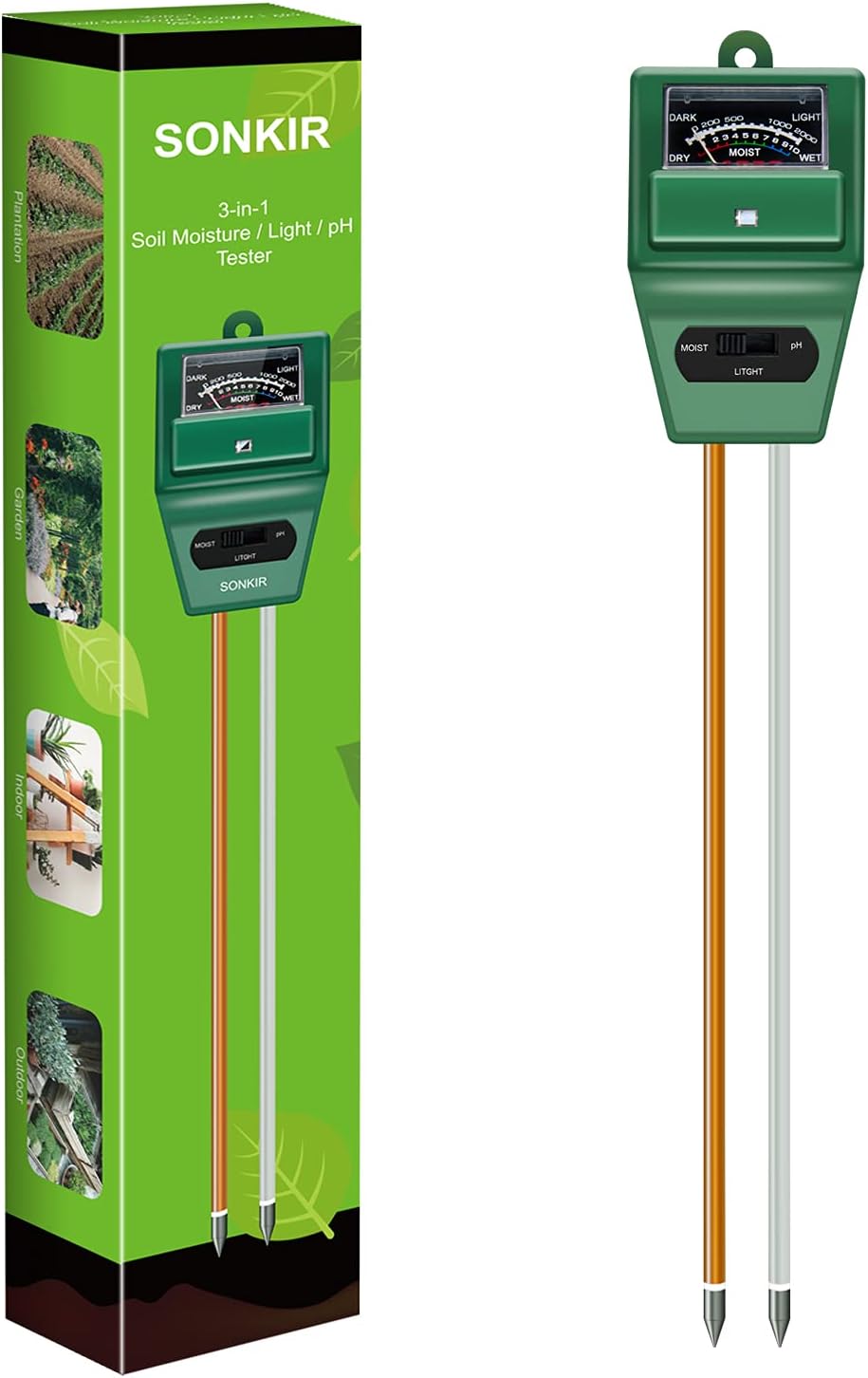
Bodenfeuchtemesser: SONKIR MS02
Produktübersicht: Modell zur Kontrolle der Feuchtigkeit von Pflanzsubstrat. Vergleichen Sie Sonde und Anzeige passend zum Beet.
Vor dem Kauf prüfen: Beachten Sie die Anleitung und prüfen Sie den Zustand des Substrats zusätzlich. Weitere Messfunktionen ersetzen keine Laboranalyse.
Zusammenfassung von Produktangaben, kein Praxistest.

Pros
- Measures multiple soil and growing-condition indicators in one digital device.
- Backlit display with large numbers may be easier to read than basic needle-style meters, a point several reviewers commonly mention.
- Works for indoor and outdoor plant care, including gardens, beds, potted plants, and succulents according to the product information.
- Fast listed reading process, with the manufacturer describing about 10 seconds after inserting the probe.
- Lightweight design should be easy to carry between rooms, containers, and garden beds.
Cons
- AAA batteries are required but not included.
- The probe should not be forced into very dry or hard soil, so compacted beds may need light moistening and a wait before measuring.
- Gardeners who need laboratory-grade pH, nutrient, EC, or TDS results may prefer dedicated testing equipment.
The Buladeke 7-in-1 Digital Soil Tester is a probe-style meter made for routine plant checks around the home garden. Based on the listed features, it measures soil moisture, pH, temperature, light intensity, and fertility, with EC and TDS functions also included. It is a practical fit for beginners, houseplant collectors, patio gardeners, and homeowners who want a quick snapshot of growing conditions before watering or adjusting plant placement.
The main value is convenience. Instead of using separate tools for moisture, light, and basic soil-condition checks, this meter puts several readings on one digital display. For everyday gardening, moisture is likely the most useful function, especially for containers, succulents, and indoor plants where the soil surface can look dry while the root zone is still damp. The pH, fertility, temperature, and light readings can also help flag when a plant may need closer attention.
The product information highlights a large LCD screen with a white backlight, clear numbers, intuitive symbols, and a low-battery warning. It runs on 4 x 1.5V AAA batteries, which are not included. The listed package dimensions are 11.61 x 2.68 x 1.85 inches, and the item weight is 5.6 ounces, so it should store easily with small garden tools or on a potting bench.
For use, the manufacturer says to insert the probe about 10 cm into the soil and wait about 10 seconds for a reading. That makes it useful for checking several pots, raised-bed sections, or garden rows during a watering round. It can also help compare light levels in different areas, such as a windowsill, patio corner, greenhouse bench, or outdoor bed, when deciding where to place plants with different light needs.
There are a few important cautions. The product notes that the tester must not be used directly to measure liquids, and if soil is too dry or hard, the probe should not be forced in. The recommended approach is to moisten the test area slightly and wait 10 minutes before measuring to avoid damaging the device. As with most home soil meters, gardeners needing highly precise nutrient, pH, EC, or TDS data should consider follow-up testing with dedicated equipment.
Overall, this Buladeke meter looks most useful as a quick decision aid for everyday plant care rather than a professional lab instrument. It is a good match for growers who want easier watering judgment, clearer digital readings, and multiple plant-condition checks in one lightweight tool. Gardeners working in very compacted soil or those requiring calibrated scientific measurements may be better served by more specialized testing methods.
Best For / Avoid If
Best for buyers prioritizing
- Measures multiple soil and growing-condition indicators in one digital device.
- Backlit display with large numbers may be easier to read than basic needle-style meters, a point several reviewers commonly mention.
- Works for indoor and outdoor plant care, including gardens, beds, potted plants, and succulents according to the product information.
Consider another option if
- AAA batteries are required but not included.
- The probe should not be forced into very dry or hard soil, so compacted beds may need light moistening and a wait before measuring.
- Gardeners who need laboratory-grade pH, nutrient, EC, or TDS results may prefer dedicated testing equipment.

Pros
- Long probe reaches deeper soil in larger pots and garden areas.
- Large, simple dial is accessible for beginner gardeners.
- No batteries or assembly are listed, and readings appear immediately after insertion.
Cons
- It should not be left in soil for more than five minutes because the metal tip may gradually corrode.
- Very hard soil may be unsuitable for this probe and could make insertion difficult.
- The meter is intended for soil, so it should not be used to test water or other liquids.
The XLUX Long Probe Soil Moisture Meter is a manual soil-checking tool for indoor plants, outdoor containers, garden soil, and larger flower pots. It is especially suited to beginners and homeowners who need a clearer indication of moisture below the surface, where a finger check may not reach.
Its main benefit is deeper moisture detection. The product information lists a 40 cm size and describes the probe as 14 cm longer than regular styles, allowing it to reach toward the bottom of deeper pots. This can help gardeners compare the moisture in lower soil with what is visible at the surface before deciding whether to water.
The large dial is designed for quick reading, with three moisture zones and ten scales. Insert the single probe into suitable soil, read the dial immediately, and remove it after checking. The single-probe format may cause less root disturbance and bring out less soil than meters with multiple probes.
In practical use, this meter may fit houseplant containers, patio pots, large flower pots, and garden areas where soil moisture varies by depth. Having two meters can also make it easier to check separate containers, although the published information does not specify additional accessories or storage features.
Use care with the probe. Do not force it into very hard soil, do not place it in water or other liquids, and wipe the probe clean after each test. The metal tip should not remain in soil for more than five minutes because it may gradually corrode. This is a sensible choice for straightforward soil checks, while gardeners wanting automated monitoring or additional soil measurements should consider a different type of instrument.
Best For / Avoid If
Best for buyers prioritizing
- Long probe reaches deeper soil in larger pots and garden areas.
- Large, simple dial is accessible for beginner gardeners.
- No batteries or assembly are listed, and readings appear immediately after insertion.
Consider another option if
- It should not be left in soil for more than five minutes because the metal tip may gradually corrode.
- Very hard soil may be unsuitable for this probe and could make insertion difficult.
- The meter is intended for soil, so it should not be used to test water or other liquids.

Pros
- Provides four types of soil and growing-condition information in one handheld tool.
- Rotating dial may be more comfortable for older gardeners or users with limited mobility.
- Suitable for garden and mixed soils, with a single probe intended to reduce root disturbance.
Cons
- The product information notes that it may not work effectively in loose soils.
- The probe is intended for insertion deeper than 4 inches, which may be less convenient in shallow containers or around dense root systems.
- Specific measurement ranges, calibration instructions, and nutrient-testing details are not provided.
The Raintrip 4-in-1 soil tester is designed for routine plant-care checks in garden and mixed soils. It combines moisture, pH, nutrient, and light monitoring in one handheld device, making it a useful option for beginners, homeowners, and gardeners who want more information before watering or adjusting plant conditions.
Moisture readings can help users identify whether soil may be too wet or too dry, while the pH, nutrient, and light functions offer additional points of reference when a plant is not growing as expected. The product information indicates that readings appear within seconds after inserting the probe deeper than 4 inches, although the published data does not specify measurement ranges or calibration details.
The 90-degree rotating dial can hover at different angles, which may reduce the need to bend or squat while reading the display. Its single-probe design is intended to minimize disturbance around roots, and the reinforced probe is described as resistant to rust and breakage. The tester measures 2.6 by 2.6 by 10.4 inches and weighs 0.25 pounds, so it should be easy to carry between planting areas.
In a backyard bed, lawn area, or mixed-soil planting space, the tester can be used for spot checks before watering or making soil-care decisions. It may also help gardeners compare conditions in different parts of a garden. The battery-free design keeps operation simple, and the listed gift box, plant growing guide, and sandpaper add practical value for new plant owners.
Users should insert the probe carefully, especially near established roots, and wipe it clean after use. The product information notes that it may not work effectively in loose soils, and gardeners working mainly in shallow containers or very soft potting mixes may need a different type of meter. Overall, it appears best suited to gardeners wanting quick, convenient readings in structured garden soil, provided they understand that detailed specifications for accuracy and calibration are not supplied.
Best For / Avoid If
Best for buyers prioritizing
- Provides four types of soil and growing-condition information in one handheld tool.
- Rotating dial may be more comfortable for older gardeners or users with limited mobility.
- Suitable for garden and mixed soils, with a single probe intended to reduce root disturbance.
Consider another option if
- The product information notes that it may not work effectively in loose soils.
- The probe is intended for insertion deeper than 4 inches, which may be less convenient in shallow containers or around dense root systems.
- Specific measurement ranges, calibration instructions, and nutrient-testing details are not provided.

Pros
- Measures a broad set of growing conditions, including moisture, pH, fertility, light, soil temperature, air temperature, and humidity.
- Designed for both indoor and outdoor gardening uses, from houseplants to lawns and garden beds.
- LCD screen helps display temperature and humidity information clearly.
- Reviewers commonly mention that the readings are easy to understand and helpful for reducing guesswork around watering.
- Compact and lightweight enough for routine checks around pots, beds, and small growing spaces.
Cons
- Requires three batteries, and the product instructions indicate replacing or installing all three at the same time.
- It is not designed for testing liquid, so gardeners should only use it in soil as directed.
- The probe should not be forced into hard or very dry soil, since probe-style meters can be vulnerable to damage if pushed too aggressively.
The HSLGOVE 001 7-in-1 Soil Test Kit is a multipurpose soil meter made for everyday plant-care checks in home gardens, lawns, containers, and indoor growing spaces. Based on the product information, it measures soil moisture, pH, fertility, light, soil temperature, air temperature, and humidity, making it a practical choice for beginners who want a clearer picture of plant conditions before watering or fertilizing.
Its main benefit is convenience. Instead of relying only on finger tests or guessing from plant appearance, gardeners can insert the probe into soil and switch modes to check several key conditions. Moisture readings are especially useful for houseplants and containers, where overwatering is a common problem. The pH and fertility functions can also help guide general soil-care decisions, though gardeners making major amendments may still want a lab or dedicated soil test for confirmation.
The design combines a dial-style soil meter with an LCD display for temperature and humidity information. The listed probe length is about 6.8 inches, which should be useful for medium to large potted plants and many garden-bed checks. The product measures 11.5 x 2.9 x 1.5 inches and weighs 4.8 ounces, so it should be easy to store in a drawer, potting bench, greenhouse shelf, or small garden tote.
For everyday use, this meter fits a wide range of small-space and backyard tasks. A patio gardener could compare moisture levels between containers, a raised-bed gardener could check whether different areas are drying unevenly, and an indoor plant grower could use the light meter to evaluate plant placement. The air temperature and humidity readings may also be useful around seedlings, houseplants, or protected growing areas where conditions change quickly.
There are a few important cautions. The product information says this is not a water moisture meter, so it should not be used to test liquid. It also requires three batteries, and the instructions note that all three should be replaced or installed each time. As with any probe-style soil meter, it is wise to loosen very hard or dry soil first and insert the probe gently rather than forcing it, which can help reduce the chance of damaging the shaft or disturbing roots.
This is a sensible pick for gardeners who want an easy, all-in-one reference tool for routine plant care rather than a professional soil analysis device. Gardeners who need highly detailed nutrient reporting, laboratory-grade pH confirmation, or rugged field equipment for compacted farm soil may prefer a more specialized testing method.
Best For / Avoid If
Best for buyers prioritizing
- Measures a broad set of growing conditions, including moisture, pH, fertility, light, soil temperature, air temperature, and humidity.
- Designed for both indoor and outdoor gardening uses, from houseplants to lawns and garden beds.
- LCD screen helps display temperature and humidity information clearly.
Consider another option if
- Requires three batteries, and the product instructions indicate replacing or installing all three at the same time.
- It is not designed for testing liquid, so gardeners should only use it in soil as directed.
- The probe should not be forced into hard or very dry soil, since probe-style meters can be vulnerable to damage if pushed too aggressively.

Pros
- Useful for homeowners checking wood, drywall, subflooring, and other building materials for moisture concerns.
- Specific pin contact can help narrow down damp spots more precisely than a broad surface scan.
- Compact one-hand design and backlit screen support quick checks around the house, garage, or garden storage area.
- Replaceable pins are practical because pin tips can bend or wear when used on tougher materials.
- Auto power off helps reduce unnecessary battery drain.
Cons
- Because it uses pins, it can leave two small holes in the material being measured.
- Gardeners who want non-invasive scans over finished surfaces may prefer a pinless meter.
- It is not a smart home device, so readings must be checked manually at the meter.
The General Tools MMD4E is a handheld pin-type moisture meter made for checking moisture levels in wood, drywall, concrete, and subflooring. For gardeners and homeowners, its most practical role is not testing soil, but evaluating materials around the home and garden, such as shed framing, greenhouse wood, deck boards, stored lumber, potting-bench surfaces, and firewood.
Based on the listed specifications, the meter reads 5 to 50 percent moisture in wood and 1.5 to 33 percent in building materials. That range makes it useful for comparing dry and suspiciously damp areas after a leak, before painting or finishing wood, or when deciding whether stored boards or firewood are ready for use. The low, medium, and high alerts also give beginners a quick visual and audible cue.
The design is straightforward: press the stainless steel pins into the material, then read the result on the backlit LCD. The product information notes large 0.3-inch digits, a reading hold button, auto power off, extra 8mm pins, a protective cap that doubles as a calibration checker, and a 9V battery. Its one-hand size should suit quick checks in tight utility spaces, sheds, garages, and storage corners.
In a backyard setting, this tool can help when tracking dampness around a leaky hose bib, checking whether a garden shed wall has stayed wet, evaluating lumber for raised-bed or potting-bench projects, or confirming that firewood is not being judged only by weight or sound. Reviewers commonly mention that it is easy to use and helpful for checking walls, floors, studs, and firewood, though those comments should be treated as user experiences rather than formal testing.
The main tradeoff is that this is a pin meter, so it must pierce the surface and can leave two small holes. That is usually acceptable for rough lumber, framing, firewood, or hidden areas, but it may not be ideal on finished trim, furniture, or visible wall surfaces. The pins should also be handled carefully, and replacement pins may be needed over time if they bend or wear.
This is a practical choice for homeowners, DIY gardeners, and small-space growers who maintain sheds, greenhouse structures, decks, or wood storage and want a simple moisture-checking tool. If you need non-marking scans over finished surfaces, continuous remote monitoring, or a device specifically designed for soil moisture, a different type of meter would be a better fit.
Best For / Avoid If
Best for buyers prioritizing
- Useful for homeowners checking wood, drywall, subflooring, and other building materials for moisture concerns.
- Specific pin contact can help narrow down damp spots more precisely than a broad surface scan.
- Compact one-hand design and backlit screen support quick checks around the house, garage, or garden storage area.
Consider another option if
- Because it uses pins, it can leave two small holes in the material being measured.
- Gardeners who want non-invasive scans over finished surfaces may prefer a pinless meter.
- It is not a smart home device, so readings must be checked manually at the meter.
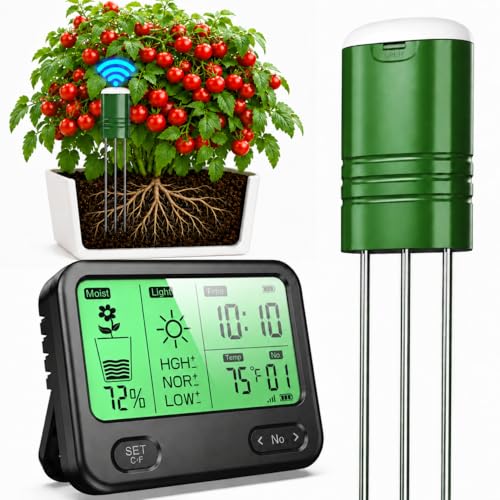
Pros
- Combines four useful readings in one monitoring system.
- Wireless range and multi-sensor support can simplify care across several growing areas.
- The listed probe design is waterproof and corrosion-resistant for use in real soil.
Cons
- The published information does not specify battery life, charging method, or replacement requirements.
- Calibration instructions and measurement ranges are not provided, so gardeners seeking detailed setup guidance may need to confirm those details before purchase.
- A connected sensor system may be more equipment than needed for someone who only checks one or two plants occasionally.
The EDGEVEIL is a wireless soil monitoring system for houseplants, containers, garden beds, lawns, and other planted areas. It measures soil moisture, temperature, light, and time, making it best suited to gardeners who want more information than a simple moisture-only probe provides.
Its main growing-use benefit is helping gardeners base watering decisions on a soil reading rather than relying only on surface appearance. The listed low-moisture flashing reminder can draw attention to plants that need checking, while the four-in-one display provides additional context about the growing environment.
The feature set is designed for low-interruption monitoring. The probe can remain inserted in the soil, and the wireless display can receive readings from up to 328 feet according to the product information. A large screen is intended to make the readings easier to view, and one display can connect with up to 12 sensors.
This setup could be useful for a home with plants spread across rooms, a balcony, patio containers, raised beds, or a small garden. Remote monitoring may be especially convenient when the display is kept indoors while sensors are placed outside, although the listing does not explain how walls or other obstacles affect the stated wireless range.
The probe is described as waterproof and corrosion-resistant, but the published information does not provide battery details, calibration instructions, measurement ranges, or specific cleaning guidance. Avoid forcing any probe into hard, rocky, or compacted soil, and follow the manufacturer’s instructions for installation and care.
This meter is a sensible choice for gardeners who want centralized readings across multiple plants and prefer a visible reminder when moisture is low. Someone caring for only a few plants, or anyone needing documented calibration procedures and detailed technical specifications, may prefer to compare other options before deciding.
Best For / Avoid If
Best for buyers prioritizing
- Combines four useful readings in one monitoring system.
- Wireless range and multi-sensor support can simplify care across several growing areas.
- The listed probe design is waterproof and corrosion-resistant for use in real soil.
Consider another option if
- The published information does not specify battery life, charging method, or replacement requirements.
- Calibration instructions and measurement ranges are not provided, so gardeners seeking detailed setup guidance may need to confirm those details before purchase.
- A connected sensor system may be more equipment than needed for someone who only checks one or two plants occasionally.
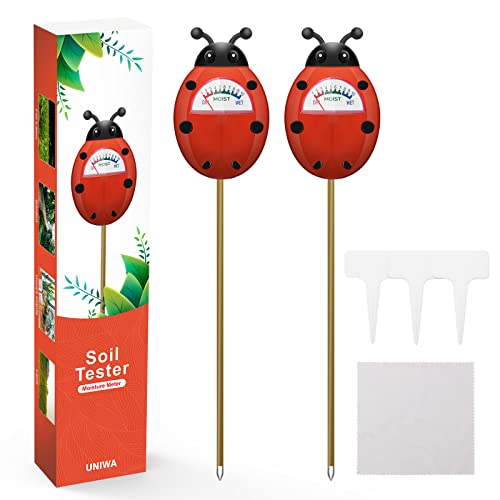
Pros
- No batteries are required, reducing routine upkeep and the risk of depleted power.
- Clear dashboard with a wide scale and large numbers may be easier for beginners and older gardeners to read.
- Compact, lightweight design suits houseplants and container gardening.
Cons
- The listed feature set focuses on soil moisture readings, and no pH measurement range or scale is provided.
- The probe should not be used in water, liquids, stone, or hard soil, which limits where it can be used.
- Users need to wipe the probe after use and avoid leaving it in soil for extended periods.
The UNIWA Ladybug Soil Moisture Meter is designed to help gardeners check whether soil needs water before reaching for a watering can. It is especially suited to houseplants, container plants, patio gardens, and beginners who want a simple visual aid for routine plant care.
Its moisture-focused design uses a probe and a pointer-style dashboard with large numbers and a wide scale. The product information indicates that the detection design is intended to improve reading speed and accuracy, which may make quick checks easier when several plants need attention.
The meter is described as battery-free and compact, with listed dimensions of 2.95 by 2.95 by 11.62 inches and a listed weight of about 0.28 pounds. There are no batteries, charging steps, or assembly requirements described, so the basic routine is to place the probe in appropriate soil and read the dashboard.
In a home garden, it can be moved from one container to another to compare moisture levels in houseplants, balcony pots, or small outdoor planters. The ladybug design may also make routine moisture checks more approachable for children participating in supervised gardening activities.
Care is important for continued use. The instructions say not to test stone, hard objects, water, or other liquids, and recommend wiping the probe clean after use and not leaving it inserted in soil for a long time. Gardeners seeking a dedicated, portable moisture check may find it useful, while those needing confirmed pH measurements or broader soil analysis should consider a tool with those specifications clearly provided.
Best For / Avoid If
Best for buyers prioritizing
- No batteries are required, reducing routine upkeep and the risk of depleted power.
- Clear dashboard with a wide scale and large numbers may be easier for beginners and older gardeners to read.
- Compact, lightweight design suits houseplants and container gardening.
Consider another option if
- The listed feature set focuses on soil moisture readings, and no pH measurement range or scale is provided.
- The probe should not be used in water, liquids, stone, or hard soil, which limits where it can be used.
- Users need to wipe the probe after use and avoid leaving it in soil for extended periods.

Pros
- Combines four soil and light checks in one handheld meter.
- Rotating head supports easier reading from different positions.
- Does not require batteries, charging, or electrical setup.
Cons
- The probe should not be forced into hard soil, so compacted ground may need to be loosened first.
- It is not designed for testing water or other liquids.
- The meter should be wiped clean after use and should not be left inserted in soil for extended periods.
The Buladeke 4-in-1 soil meter is designed for gardeners who want a simple way to check growing conditions around the home. Its four modes cover soil moisture, pH, fertility, and light intensity, making it relevant for indoor containers, lawns, garden areas, farms, and greenhouses.
The main benefit is convenience. A slide switch lets you select the type of reading you want, and the dial displays data after the probe is inserted into the soil. These checks can help gardeners make more informed decisions about routine plant care, although the published information does not provide measurement ranges or calibration details.
The 45-degree rotating head is a useful ergonomic feature for reading the scale from a more comfortable position. The battery-free design also simplifies storage and portability, since the meter does not require charging or battery replacement before use.
For backyard and patio gardening, the meter can be moved between potted plants, lawn areas, greenhouse soil, and other planting locations. It may be especially useful for beginners or gardeners managing several types of growing spaces who prefer one handheld tool for multiple basic checks.
Use care when operating the probe. Do not force it into hard soil, use it to test water or other liquids, or leave it in soil for long periods. Wipe the probe clean before and after use. Based on the listed features, it is a practical choice for convenient spot checks, while gardeners needing detailed laboratory-style soil analysis or documented measurement specifications may prefer a more specialized instrument.
Best For / Avoid If
Best for buyers prioritizing
- Combines four soil and light checks in one handheld meter.
- Rotating head supports easier reading from different positions.
- Does not require batteries, charging, or electrical setup.
Consider another option if
- The probe should not be forced into hard soil, so compacted ground may need to be loosened first.
- It is not designed for testing water or other liquids.
- The meter should be wiped clean after use and should not be left inserted in soil for extended periods.

Pros
- Works without batteries or electricity.
- Top-facing dial can improve readability for standing users.
- Suitable for indoor plants, gardens, lawns, farms, greenhouses, and large pots.
Cons
- It is designed for soil testing only and should not be used in water or other liquids.
- The probe may be less suitable for very hard, rocky, or compacted soil.
- Gardeners who need additional measurements such as pH, light, or nutrient levels will need a different type of testing tool.
The Jxikatx soil moisture meter is a simple probe-style tool for checking how much moisture is present in soil around a plant's roots. It is intended for houseplants, garden beds, lawns, farms, greenhouses, and larger containers, making it suitable for beginners and homeowners who want a clearer watering routine.
The product information indicates that the meter provides an immediate moisture reading after the probe is inserted. This can help gardeners decide whether a plant needs water instead of relying only on the appearance of the soil surface, which may dry at a different rate than the root area.
Its top-facing display is designed for easier viewing while standing, so users may not need to bend as far when checking pots, beds, or lawn areas. The single probe is also intended to reduce root disturbance compared with meters that use multiple probes, although careful placement is still important.
For practical use, gardeners can check individual houseplant pots, larger planters, garden soil, greenhouse containers, or selected lawn areas before watering. Because the meter does not require batteries or electricity, it can be used as needed in indoor and outdoor growing spaces without preparation beyond inserting the probe.
The meter should be used in soil only, not in water or other liquids. Avoid forcing the probe into very hard soil or stones, and wipe it clean after testing to support long-term performance. The listed dimensions are 1 x 1 x 1 inches, but the published information does not provide additional details about measurement ranges, calibration, or storage features.
This is a sensible option for gardeners who want a straightforward moisture check with minimal setup and a display that is easier to see from above. Those who need soil pH, nutrient, light, or other measurements should consider a more comprehensive testing tool instead.
Best For / Avoid If
Best for buyers prioritizing
- Works without batteries or electricity.
- Top-facing dial can improve readability for standing users.
- Suitable for indoor plants, gardens, lawns, farms, greenhouses, and large pots.
Consider another option if
- It is designed for soil testing only and should not be used in water or other liquids.
- The probe may be less suitable for very hard, rocky, or compacted soil.
- Gardeners who need additional measurements such as pH, light, or nutrient levels will need a different type of testing tool.

Pros
- No batteries or power setup are required.
- Large dial markings should be easy for many gardeners to read.
- Suitable for indoor and outdoor soil checks in a compact format.
- Portable design makes it convenient to move between plants.
Cons
- It is intended for soil moisture checks, so it may be less suitable for gardeners who need soil pH, nutrient, or liquid testing.
- The probe requires careful handling and should not be used in stone, hard objects, water, or other liquids.
- The probe should be wiped clean after use and should not remain inserted in soil for extended periods.
The UNIWA Soil Moisture Meter is a single-probe tool for checking moisture in garden soil and helping determine whether a plant may need watering. It is suited to homeowners, houseplant owners, container gardeners, and beginners who want a simple reading rather than relying only on the surface appearance of the soil.
The feature set focuses on quick moisture checks. The product information describes a clear dashboard with an arrow pointer, wide scale intervals, and large numbers, while the listed double-needle detection technology is intended to support faster readings. These features may make routine watering decisions easier, especially when several plants have different moisture needs.
Its compact design measures 11 x 2.48 x 2.48 inches and requires no batteries, so there is no charging or battery replacement involved. The red ladybug-style appearance also makes the tool approachable for children's gardening activities. No assembly, installation, or storage system is specified in the published information.
For practical use, gardeners can carry it between indoor pots, outdoor containers, lawn areas, and garden beds to check soil moisture in different locations. Its small format may be especially convenient in tight spaces, such as windowsills, patios, and houseplant collections, where a larger garden tool would be unnecessary.
Use the meter only in suitable soil, not in stone, hard objects, water, or other liquids, because those uses may damage the probe or affect readings. After each use, wipe the probe clean and avoid leaving it inserted in soil for a long time. Based on the listed specifications, it is a useful basic moisture-checking tool, but gardeners who need pH, nutrient, or liquid measurements should consider a different type of tester.
Best For / Avoid If
Best for buyers prioritizing
- No batteries or power setup are required.
- Large dial markings should be easy for many gardeners to read.
- Suitable for indoor and outdoor soil checks in a compact format.
Consider another option if
- It is intended for soil moisture checks, so it may be less suitable for gardeners who need soil pH, nutrient, or liquid testing.
- The probe requires careful handling and should not be used in stone, hard objects, water, or other liquids.
- The probe should be wiped clean after use and should not remain inserted in soil for extended periods.

Pros
- Simple dial design is accessible for beginner gardeners.
- No batteries are required for operation.
- Single-probe construction may disturb fewer roots during routine checks.
- Useful across indoor and outdoor soil-checking situations.
Cons
- May be less suitable for hard or rocky soil, where inserting the probe could be difficult.
- It is designed for soil only and should not be used to test water or other liquids.
- The probe should be wiped clean after use to support durability and accurate readings.
The Zoiydals Soil Moisture Meter is a manual soil-checking tool for determining whether the soil beneath the surface is dry, moist, or wet. It is suited to homeowners, beginning gardeners, indoor plant owners, and anyone who wants a quick moisture reading before watering potted plants, garden beds, lawns, or farm areas.
Its main benefit is helping gardeners look beyond the surface of the soil. The listed feature set indicates that the probe provides an immediate reading on a dial with three moisture zones and ten scales, which can make routine watering decisions more consistent than relying only on visual inspection or touching the top layer.
The meter uses a single probe and does not require batteries, charging, or assembly based on the published information. Its stated dimensions are 9.84 by 2.47 by 1.81 inches, and the large dial is intended to be easy to read while checking plants. The battery-free design also keeps operation simple for occasional use in different parts of the garden.
For practical use, gardeners can insert the probe into soil around potted plants, garden beds, lawn areas, or other planting spaces and read the dial immediately. It may be particularly useful when the surface looks dry but moisture deeper in the root area is uncertain, although the product information does not specify a measurement depth or calibration process.
The probe is not suitable for hard or rocky soil, and it should not be placed in water or other liquids. After each use, the probe should be wiped clean to help maintain durability and reading accuracy. Overall, this is a straightforward option for gardeners who want a basic, battery-free soil moisture check, while users needing advanced electronic readings or additional soil measurements may prefer a different type of meter.
Best For / Avoid If
Best for buyers prioritizing
- Simple dial design is accessible for beginner gardeners.
- No batteries are required for operation.
- Single-probe construction may disturb fewer roots during routine checks.
Consider another option if
- May be less suitable for hard or rocky soil, where inserting the probe could be difficult.
- It is designed for soil only and should not be used to test water or other liquids.
- The probe should be wiped clean after use to support durability and accurate readings.

Pros
- Non-destructive design is well suited to checking finished surfaces before cutting into walls or wood panels.
- Material selection covers several common building surfaces used around homes, sheds, and garden structures.
- Bright display and LED bar graph make readings easier to interpret at a glance.
- Lightweight listed weight of 7 ounces should be manageable for most homeowners.
- Reviewers commonly mention that it is straightforward to use for isolating damp areas and monitoring drying after water issues.
Cons
- It is calibrated for drywall, masonry, hardwood, and softwood only, so it should not be treated as a soil moisture meter for plants.
- As a pinless relative moisture meter, it may be less suitable for users who need invasive pin-style measurements or detailed material-specific moisture percentages.
- The listed operating humidity range is 30 to 70 percent relative humidity, so very damp or unusual environments may require extra care when interpreting readings.
The Klein Tools ET140 is a pinless moisture meter designed to detect relative moisture in building materials, including drywall, masonry, hardwood, and softwood. For gardeners, its most relevant use is not measuring potting mix or garden soil, but checking structures that support a home growing setup, such as a shed wall, greenhouse base, basement grow area, garage storage corner, or wood framing near a hose bib or utility sink.
The main benefit is non-destructive moisture detection. Because it uses electromagnetic field technology rather than pins, the product information indicates it can scan up to 3/4 inch below the surface without puncturing finished materials. That can be helpful when you want to investigate a suspicious damp smell, a wet spot after flooding, or moisture near stored tools, seed-starting shelves, or lumber before deciding whether a repair is needed.
The controls are kept simple, with a mode button for selecting drywall, masonry, hardwood, or softwood. The reverse-contrast display and nine LED bars give both a reading and a quick moisture-range reference, which is useful for homeowners who do not work with moisture meters every day. It also includes hold, low-battery, and auto-power-off functions, and the listed kit includes the meter, a 9V battery, and an instruction manual.
In a backyard or small-space gardening setup, this meter could be used to check wood shelving in a potting shed, masonry near a greenhouse wall, drywall around an indoor seed-starting area, or flooring after a water heater or plumbing event. Reviewers commonly mention using it to isolate damp areas and monitor whether materials appear to be drying after repairs, which fits the kind of preventive maintenance many homeowners appreciate.
There are important limits to keep in mind. The ET140 measures relative moisture in the materials it is calibrated for, so it should not be used as a plant-care soil moisture probe. It also does not replace professional leak diagnosis, mold assessment, or structural repair advice when water damage is significant. For routine checks around garden storage and home growing spaces, however, its pinless design, clear display, and supported material modes make it a practical maintenance tool for cautious homeowners.
Best For / Avoid If
Best for buyers prioritizing
- Non-destructive design is well suited to checking finished surfaces before cutting into walls or wood panels.
- Material selection covers several common building surfaces used around homes, sheds, and garden structures.
- Bright display and LED bar graph make readings easier to interpret at a glance.
Consider another option if
- It is calibrated for drywall, masonry, hardwood, and softwood only, so it should not be treated as a soil moisture meter for plants.
- As a pinless relative moisture meter, it may be less suitable for users who need invasive pin-style measurements or detailed material-specific moisture percentages.
- The listed operating humidity range is 30 to 70 percent relative humidity, so very damp or unusual environments may require extra care when interpreting readings.

Pros
- Simple, battery-free style of moisture checking based on the listed design.
- Large dial and clear dry, moist, and wet zones are accessible for quick garden decisions.
- Two meters can be useful for checking more than one pot or growing area.
Cons
- The probe should not remain in soil for more than five minutes because the metal tip may corrode.
- It is not intended for very hard soil, water, or other liquids.
- Gardeners needing stored readings, automated alerts, or more detailed soil measurements may prefer a different type of meter.
The XLUX Green 2 Pack is a pair of analog soil moisture meters designed to check whether soil deeper inside a pot or garden area is dry, moist, or wet. It is a practical fit for beginners, houseplant owners, patio gardeners, and homeowners who want more information than a surface inspection can provide.
Its main benefit is a quick reading after the probe is inserted into the soil. The large dial uses three moisture zones and ten scales, giving gardeners a straightforward reference when deciding whether a plant may need watering. The feature set supports routine checks in containers, garden beds, and lawn soil where surface appearance may not reflect conditions farther down.
Each meter uses a single probe, which the product information indicates may cause less root disturbance than a multiple-probe design. The listed 26 cm size can help reach into deeper containers or soil, while the lightweight construction should be manageable for ordinary spot checks. No assembly or batteries are listed.
For backyard use, one meter could be kept with indoor plants while the second is used in patio containers, raised beds, or another garden area. Using two meters may also make it easier to compare moisture conditions in separate pots, although readings should still be interpreted according to the needs of each plant and soil mix.
Use the meter only in soil that is not very hard, and do not test water or other liquids. Remove it after checking, keep it out of the soil for no more than five minutes, and wipe the probe clean afterward to help limit corrosion. This is a simple choice for manual moisture checks, but gardeners wanting automated notifications, saved readings, or broader soil analysis should consider a different tool.
Best For / Avoid If
Best for buyers prioritizing
- Simple, battery-free style of moisture checking based on the listed design.
- Large dial and clear dry, moist, and wet zones are accessible for quick garden decisions.
- Two meters can be useful for checking more than one pot or growing area.
Consider another option if
- The probe should not remain in soil for more than five minutes because the metal tip may corrode.
- It is not intended for very hard soil, water, or other liquids.
- Gardeners needing stored readings, automated alerts, or more detailed soil measurements may prefer a different type of meter.

Pros
- Non-invasive design is suitable for finished wood, walls, and other surfaces where pin marks would be undesirable.
- Offers a deep reading capability with clearly listed softwood and hardwood ranges.
- Visual and audible indicators can make it easier to identify potentially damp areas quickly.
Cons
- The listed features focus on wood and building materials, so gardeners seeking a dedicated soil moisture meter may prefer a different tool.
- Readings for wallboard, drywall, and masonry are relative rather than presented as direct moisture percentages.
- The product information does not specify included accessories, storage protection, or battery runtime.
The General Tools MMD7NP is a pinless digital moisture meter designed to check wood and detect damp areas in wallboard, drywall, and masonry. For homeowners and gardeners, its most relevant uses include inspecting sheds, greenhouse framing, wooden storage areas, and other garden structures where hidden moisture may lead to deterioration or require further investigation.
The meter reads up to 3/4 inch, or 19 mm, into a surface. It provides a listed range of 0 to 53 percent for softwood and 0 to 35 percent for hardwood, while wallboard, drywall, and masonry receive relative readings. This combination can help users compare suspicious areas and investigate water stains without relying only on what is visible.
Its pinless design avoids making probe holes in walls or finished wood. The unit measures 1.13 by 3 by 6.5 inches and weighs 0.25 pounds, according to the published specifications. An auto-calibrating function, hold button, backlit 2-inch diagonal LCD, three-color LED bar graph, audible alert, out-of-range alarm, and low 9V battery alert are intended to make routine checks easier to read and manage.
In a backyard setting, this tool could be useful when checking a damp-looking shed wall, wooden garden storage area, greenhouse components, or masonry near a suspected leak. It may also help compare a stained area with a nearby dry-looking section, although the product information does not establish that it is intended for measuring soil or guiding plant watering.
The meter should be treated as an investigation aid rather than a complete diagnosis of a leak, mold concern, or structural problem. Users should follow appropriate safety practices around suspected water damage and seek qualified help when conditions appear serious. Gardeners who want non-invasive checks of wood and building surfaces should find the feature set practical, while those needing direct soil moisture measurements or more detailed material-specific documentation may prefer another meter.
Best For / Avoid If
Best for buyers prioritizing
- Non-invasive design is suitable for finished wood, walls, and other surfaces where pin marks would be undesirable.
- Offers a deep reading capability with clearly listed softwood and hardwood ranges.
- Visual and audible indicators can make it easier to identify potentially damp areas quickly.
Consider another option if
- The listed features focus on wood and building materials, so gardeners seeking a dedicated soil moisture meter may prefer a different tool.
- Readings for wallboard, drywall, and masonry are relative rather than presented as direct moisture percentages.
- The product information does not specify included accessories, storage protection, or battery runtime.

Pros
- Provides both automatic three-minute readings and on-demand manual checks.
- Capacitive sensing may offer a longer-lasting alternative to rust-prone resistive probes.
- Suitable for indoor and outdoor moisture monitoring, with a compact listed footprint.
Cons
- Remote app monitoring requires a compatible RAINPOINT WiFi hub, which is sold separately.
- The published information does not specify battery life, calibration guidance, or the moisture measurement range.
- Gardeners wanting a complete multi-zone monitoring setup may need additional sensors or equipment.
The RAINPOINT Smart Digital Wireless Plant Moisture Meter is a leave-in soil sensor for checking moisture around houseplants, container plants, raised beds, and other garden growing areas. Its intended task is to make routine watering decisions easier for homeowners and beginner gardeners who prefer a visible reading instead of relying only on the appearance of the soil or plant.
Based on the listed feature set, the meter automatically checks moisture every three minutes and shows the reading on an LCD display. A short button press provides a manual reading within seconds, giving users a quick way to check conditions after watering or before deciding whether a plant needs more water.
The product uses a capacitive probe rather than a traditional resistive probe, which the product information describes as reducing rust-related accuracy concerns. Its listed dimensions are 2 by 1 by 8 inches, and the sensor is supplied with a Phillips screwdriver. The box also includes pH test strips, although the published information does not explain a pH measurement range or calibration process.
For indoor use, it may help monitor moisture in houseplant containers without repeatedly removing the sensor. Outdoors, the listed IPX5 waterproof protection supports use around watering and rainy conditions in patios, raised beds, and garden areas. Remote monitoring through the RAINPOINT Home app is available only when paired with a compatible 2.4 GHz WiFi hub, including the listed HWG023, HWG023WBRF, or HWG040 models, sold separately.
This meter may be a practical choice for gardeners who want recurring local readings and a leave-in sensor. Limitations include the separate hub requirement for app access and missing information about battery life, calibration, and measurement range. Gardeners who need several monitored zones, detailed soil analysis, or a complete connected system should review those requirements before choosing this sensor.
Best For / Avoid If
Best for buyers prioritizing
- Provides both automatic three-minute readings and on-demand manual checks.
- Capacitive sensing may offer a longer-lasting alternative to rust-prone resistive probes.
- Suitable for indoor and outdoor moisture monitoring, with a compact listed footprint.
Consider another option if
- Remote app monitoring requires a compatible RAINPOINT WiFi hub, which is sold separately.
- The published information does not specify battery life, calibration guidance, or the moisture measurement range.
- Gardeners wanting a complete multi-zone monitoring setup may need additional sensors or equipment.

Pros
- Covers a wide range of common soil and environmental checks in one unit.
- LCD display includes air and soil temperature and air humidity information.
- Metal probes are intended to support responsive moisture and pH detection.
- Suitable for many home gardening and small-scale growing situations.
Cons
- The published information does not specify measurement ranges, calibration procedures, dimensions, or power details.
- It is not intended for testing water or other liquids and may be less suitable for rocky, sandy, or very loose soil.
- The probe requires careful handling, cleaning, and drying, and should not be left in soil for extended periods.
The Auduto 7-in-1 soil test kit is a multi-function soil meter for gardeners who want a broader view of growing conditions without using several separate basic tools. It is designed to check soil moisture, pH, fertility, sunlight intensity, soil temperature, air temperature, and air humidity, making it a practical match for beginners, houseplant owners, lawn-care users, and small garden growers.
Its main benefit is the combination of soil and air information in one unit. Moisture and pH readings can help guide watering and soil-adjustment decisions, while sunlight intensity, soil temperature, air temperature, and humidity provide additional context when plants are struggling or conditions are changing. The listed feature set suggests a convenient way to compare growing areas and monitor seedlings or established plants.
The unit uses metal probes and an LCD display. Based on the product information, the metal construction is intended to improve conductivity, sensitivity, and corrosion resistance during moisture and pH detection. No dimensions, calibration instructions, assembly requirements, battery details, or specific measurement ranges are provided, so gardeners should review the included instructions for operating and maintaining those functions.
This tester can be used in potted plants, vegetable gardens, flower beds, lawns, rice planting, greenhouse soil, and other soil-based growing settings. It may be especially useful when checking several locations, such as comparing a sunny patio container with a shaded bed, or reviewing moisture conditions in different parts of a lawn or garden.
Use it only in soil, not in water or other liquids. The supplied guidance recommends avoiding rocks and excessively hard soil, using caution in sandy or loose soil, inserting the probe about two-thirds of its length, and avoiding force. Keep the probe clean and dry before and after use, do not leave it in soil for a long time, and do not repeatedly measure the same spot. It is a reasonable choice for beginners wanting multiple basic indicators in one device, while gardeners needing documented measurement ranges or advanced calibration controls may prefer a more specialized meter.
Best For / Avoid If
Best for buyers prioritizing
- Covers a wide range of common soil and environmental checks in one unit.
- LCD display includes air and soil temperature and air humidity information.
- Metal probes are intended to support responsive moisture and pH detection.
Consider another option if
- The published information does not specify measurement ranges, calibration procedures, dimensions, or power details.
- It is not intended for testing water or other liquids and may be less suitable for rocky, sandy, or very loose soil.
- The probe requires careful handling, cleaning, and drying, and should not be left in soil for extended periods.

Pros
- Battery-free operation keeps the tool simple and convenient.
- Large gauge may be easier to read than smaller moisture indicators.
- Lightweight, 7-inch design is practical for houseplants and small garden areas.
- Can help gardeners make more informed watering decisions.
Cons
- It should not be left in the soil, so moisture checks require removing the meter after each use.
- The probe is described as suitable for mildly firm soil and may be less suitable for very compacted ground.
- Gardeners needing automated watering, data logging, or readings beyond basic moisture checks will need a different type of tool.
The Tennedriv Green is a simple soil moisture meter for checking the moisture around houseplants and outdoor plants. It is intended for gardeners who want an easier way to decide when a plant may need water, particularly beginners, indoor plant owners, and people managing a small collection of containers.
The main benefit is reduced guesswork during routine watering. The product information indicates that the probe senses moisture in the surrounding soil, while the large gauge is designed to make the result easy to read. Because it requires no batteries, it can be used without charging, replacing cells, or managing electronic controls.
At 7 inches long and 0.02 pounds, the meter is lightweight and easy to move between pots or planting areas. Its listed construction is described as sturdy enough to penetrate mildly firm soil, but the available information does not establish a specific probe material, measurement scale, calibration method, or reading range.
For backyard and patio use, a gardener could insert the meter into a container, check the gauge, and then remove it before checking another plant. It may also be useful in small raised-bed sections or around outdoor plants where a quick spot check is more convenient than relying only on the surface appearance of the soil.
The meter should not be left in the soil or placed in a cup of water, as doing so may ruin it. After use, wipe the probe with a paper towel or rag. This is a basic manual checking tool rather than an automated irrigation device, so it will not water plants or monitor them continuously.
It is a reasonable fit for gardeners seeking a straightforward, battery-free moisture check for common containers and mildly firm soil. Those who need automated scheduling, advanced measurements, or a tool intended for very compacted ground should consider a different option.
Best For / Avoid If
Best for buyers prioritizing
- Battery-free operation keeps the tool simple and convenient.
- Large gauge may be easier to read than smaller moisture indicators.
- Lightweight, 7-inch design is practical for houseplants and small garden areas.
Consider another option if
- It should not be left in the soil, so moisture checks require removing the meter after each use.
- The probe is described as suitable for mildly firm soil and may be less suitable for very compacted ground.
- Gardeners needing automated watering, data logging, or readings beyond basic moisture checks will need a different type of tool.
Kaufberatung für Feuchtigkeitsmesser in Hochbeeten
Wählen Sie ein Bodenmessgerät und kein Feuchtigkeitsmessgerät für Gebäude
Der wichtigste Prüfschritt besteht darin, sicherzustellen, dass das Messgerät für Erde vorgesehen ist. Mehrere Feuchtigkeitsmesser sind für die Erkennung von Feuchtigkeit in Holz, Trockenbau, Beton, Mauerwerk und Unterböden entwickelt. Diese Geräte können im Haushalt nützlich sein, aber die verglichenen Produktinformationen unterstützen sie nicht als geeignete Feuchtigkeitsmesser für Hochbeete.
Zu den geeigneten Gartenoptionen in den Herstellerangaben gehören Bodenfeuchtigkeitsmesser und Bodentest-Sets von HSLGOVE, Buladeke, YAMRON, SONKIR sowie mehrere nicht gekennzeichnete Angebote, die ausdrücklich Pflanzen, Garten, Rasen, Bauernhöfe, Topfpflanzen oder die Wasserprüfung bei Pflanzen im Innen- und Außenbereich erwähnen. Achten Sie beim Kauf auf Begriffe wie Bodenfeuchtigkeit, Pflanzenfeuchtigkeit, Bodentester, Sonde, Garten, Rasen, Landwirtschaft, Zimmerpflanzen oder Außenpflanzen.
Entscheiden Sie, ob Sie nur Feuchtigkeit oder mehrere Messwerte benötigen
Ein einfacher Feuchtigkeitsmesser für Hochbeete ist am unkompliziertesten, wenn es hauptsächlich darum geht, zu entscheiden, ob gegossen werden muss. Produkt 8, Soil Moisture Meter, Soil Test Kit, Soil Meter, Soil Tester, Moisture Meter for House Plants, Garden, Lawn, Farm, Indoor & Outdoor Use(ICY White), wird als Bodenfeuchtigkeitsmesser für Zimmerpflanzen, Garten, Rasen und Landwirtschaft aufgeführt. Die Herstellerangaben enthalten jedoch über den Titel hinaus keine zusätzlichen Funktionen.
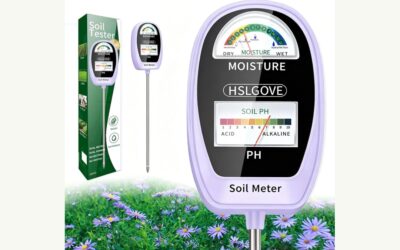
Multifunktionsmessgeräte liefern weitere Informationen. Das HSLGOVE 2-in-1-Bodentest-Set kombiniert Bodenfeuchtigkeit und Boden-pH-Wert mit einer Doppelskala. Das SONKIR Soil pH Meter, MS02 ergänzt Feuchtigkeit, pH-Wert und Sonnenlichtmessung. Das 4-in-1-Modell von YAMRON misst außerdem Bodenfeuchtigkeit, pH-Wert, Temperatur und Sonnenlicht. Die Modelle HSLGOVE 7-in-One und Buladeke 7-in-1 bieten je nach Angebot weitere Messwerte wie pH-Wert, Nährstoffgehalt, Temperatur, Licht, EC, TDS oder Luftfeuchtigkeit.
| Messgerätetyp | Geeignet laut Herstellerangaben | Kompromiss |
|---|---|---|
| Bodenmessgerät mit Schwerpunkt Feuchtigkeit | Einfache Gießkontrollen in Hochbeeten, Töpfen, Rasenflächen und Gärten | Weniger zusätzliche Messwerte aufgeführt |
| Analoges Bodentestgerät 2-in-1 oder 3-in-1 | Gärtner, die neben der Feuchtigkeit auch pH-Wert oder Sonnenlicht messen möchten, ohne ein komplexes Display | Für manche Messwerte kann eine Wartezeit von mehreren Minuten erforderlich sein |
| Digitales Messgerät 4-in-1 oder 7-in-1 | Gärtner, die neben der Feuchtigkeit auch Temperatur-, Licht-, Nährstoff-, EC-, TDS- oder Luftfeuchtigkeitsdaten wünschen | Kann Batterien und häufigeres Umschalten zwischen Messmodi erfordern |
| Funk- oder Smart-Pflanzenfeuchtigkeitsmesser | Gärtner, die sich für eine Echtzeitüberwachung interessieren, sofern das Angebot diese Funktion unterstützt | Einige Modelle benötigen laut Produkttitel möglicherweise eine Basisstation |
Sondentiefe und Zugang zur Erde im Hochbeet
Hochbeete haben oft lockerere Erde als ebenerdige Beete, dennoch kann die Feuchtigkeit je nach Tiefe variieren. Das Angebot zum HSLGOVE 2-in-1 besagt, dass das Bodenmessgerät mehr als 3 Zoll tief eingeführt werden soll, und nennt eine Sondenlänge von 7 Zoll. Auch das Angebot zum HSLGOVE 7-in-One empfiehlt, den Pflanzenfeuchtigkeitsmesser mehr als 3 Zoll tief in die Erde einzuführen, und nennt eine Sondenlänge von etwa 6,8 Zoll.
Die Anleitung von SONKIR empfiehlt, die Sonde etwa 15 bis 18 cm tief einzuführen und nach 10 Minuten die Skala abzulesen. YAMRON und Buladeke nennen beide eine Einstecktiefe von etwa 4 Zoll beziehungsweise 10 cm sowie eine kurze Wartezeit für die Messung. Nehmen Sie in einem Hochbeet an mehreren Stellen Messungen vor, anstatt davon auszugehen, dass die gesamte Fläche gleich feucht ist.
Ablesbarkeit von analogen, digitalen und kabellosen Messgeräten
Analoge Messgeräte mit Skala können attraktiv sein, weil sie einfach zu bedienen sind und oft ohne Batterien auskommen. Das HSLGOVE 2-in-1-Modell wird als batteriefrei beschrieben und verfügt über eine Doppelskala, die Bodenfeuchtigkeit und pH-Wert gleichzeitig anzeigt. Auch SONKIR wird als batterielos aufgeführt; Feuchtigkeit, pH-Wert und Sonnenlicht werden über einen Funktionsschalter ausgewählt.
Digitale Messgeräte können für Gärtner leichter abzulesen sein, die Zahlen, eine Hintergrundbeleuchtung oder größere Displays bevorzugen. Das HSLGOVE 7-in-One verfügt über ein Doppel-Display mit LCD-Anzeigen für Bodentemperatur sowie Lufttemperatur und Luftfeuchtigkeit. Buladeke nennt ein großes LCD-Display mit Hintergrundbeleuchtung, während YAMRON ein großes, hintergrundbeleuchtetes LCD-Display und einen um 45 Grad drehbaren Kopf aufführt, der das Ablesen erleichtern kann, ohne dass man sich so stark bücken muss.
Batterieloser Komfort oder digitale Funktionen
Batterielose Bodenmessgeräte sind praktisch für Gärtner, die ein Gerät in der Nähe der Pflanzbank aufbewahren und verwenden möchten, ohne vorher die Stromversorgung zu prüfen. Beim HSLGOVE 2-in-1 und SONKIR MS02 wird angegeben, dass keine Batterie erforderlich ist. Das kann für Anfänger, ältere Gärtner oder alle geeignet sein, die möglichst wenige Einzelteile verwalten möchten.
Digitale Messgeräte können hintergrundbeleuchtete Displays, Temperaturmessungen, Warnungen bei niedrigem Batteriestand oder mehrere Messmodi bieten. YAMRON und Buladeke geben die Verwendung von 4 AAA-Batterien an, die nicht im Lieferumfang enthalten sind. Beim HSLGOVE 7-in-One werden Hinweise zum Einsetzen und Austauschen der Batterien genannt. Wählen Sie ein digitales Modell, wenn diese zusätzlichen Messwerte wichtiger sind als ein batterieloser Betrieb.
Häufige Fehler bei Feuchtigkeitsmessern für Hochbeete
Drücken Sie eine Sonde nicht mit Gewalt in harten, trockenen, verdichteten oder steinigen Boden. Mehrere der verglichenen Angebote warnen davor, die Sonde gewaltsam einzuführen, und weisen darauf hin, dass der Tester nicht für Flüssigkeiten geeignet ist. Wenn die Erde sehr trocken ist, merkt SONKIR an, dass sich der Zeiger möglicherweise nicht bewegt, und empfiehlt, vor der Messung zu gießen. YAMRON und Buladeke warnen ebenfalls davor, die Sonde in trockenen, harten Boden zu drücken, und raten dazu, den Messbereich vor der Messung anzufeuchten.
Ein weiterer häufiger Fehler besteht darin, nur eine Stelle zu messen. Hochbeete können in der Nähe von Tropfern feuchter und an den Rändern trockener sein. YAMRON empfiehlt ausdrücklich, bei der Prüfung von Boden-pH-Wert und Feuchtigkeit Daten von mindestens 5 Stellen abzulesen und den Durchschnittswert als endgültigen Boden-pH-Wert und Feuchtigkeitswert zu verwenden. Für größere Hochbeete und Mischkulturen ist dieser Ansatz sinnvoll.
Pflege und Aufbewahrung
Die Pflege der Sonde ist wichtig, da Erdreste die nächste Messung beeinflussen und das Einführen des Geräts erschweren können. Im Angebot zum HSLGOVE 2-in-1 wird ausdrücklich daran erinnert, die Bodensonde nach jedem Gebrauch abzuwischen. Auch die SONKIR-Anleitung empfiehlt, die Sonde nach jeder Verwendung aus der Erde zu nehmen und sauberzuwischen.
Bewahren Sie das Messgerät so auf, dass es leicht zur Hand ist, aber vor grober Behandlung geschützt bleibt. Eine kleine Kiste, eine Schublade an der Pflanzbank oder eine Gartenbox eignen sich gut. Wenn Sie Werkzeuge für einen kleinen Garten organisieren, kann unser Ratgeber zu einer Gartenbox für Gartengeräte bei der Planung einer gut zugänglichen Aufbewahrung im Außenbereich helfen.
Aspekte für kleine Flächen, Anzuchtbeutel und Barrierefreiheit
Wählen Sie für kleine Terrassen, Balkone und erhöhte Pflanzgefäße ein Messgerät, das auch auf engem Raum gut abzulesen ist. Für einige wenige Gefäße kann ein einfaches batterieloses Modell ausreichen, während ein digitales Display leichter zu erkennen sein kann, wenn das Ablesen kleiner Skalen schwierig ist. Der bei YAMRON aufgeführte um 45 Grad drehbare Kopf ist ein nützliches Merkmal, wenn das Bücken unangenehm ist.
Wenn Sie sowohl in Gefäßen als auch in Beeten anbauen, achten Sie auf Angebote, die Topfpflanzen, Zimmerpflanzen, Sukkulenten oder den Einsatz im Innen- und Außenbereich erwähnen. HSLGOVE, Buladeke, YAMRON, SONKIR, Produkt 8, Produkt 9 und Produkt 10 enthalten in ihren Titeln oder Beschreibungen entsprechende Begriffe zu Pflanzen oder Garten. Für Tomatenanbauer, die weiche Pflanzgefäße verwenden, passt unser Ratgeber zu Pflanzsäcken aus Stoff für Tomaten gut zur Nutzung eines Feuchtigkeitsmessers, da die Erde in Gefäßen schnell austrocknen kann.
Recherchemethode und Vertrauen
Dieser Leitfaden basiert auf den verglichenen Produkttiteln, Beschreibungen, aufgeführten Funktionen, Preisen, Bewertungen und Anzahl der Rezensionen, die im Juli 2026 verfügbar waren. Es handelt sich um eine recherchierte Analyse. Wir haben diese Messgeräte nicht in einem Gartenbeet installiert, kalibriert oder verwendet und Aussagen vermieden, die nicht durch die Herstellerangaben belegt waren.
Zunächst haben wir die Relevanz für den Einsatz als Feuchtigkeitsmesser für Hochbeete geprüft. Bodentester und Pflanzenfeuchtigkeitsmesser wurden als geeignet angesehen, wenn das Angebot eindeutig Bodenfeuchtigkeit, Pflanzen, Garten, Rasen, Landwirtschaft, Zimmerpflanzen, Topfpflanzen oder den Einsatz im Außenbereich erwähnte. GeneralTools MMD4E und Klein Tools ET140 wurden von den Gartenempfehlungen ausgeschlossen, da die Herstellerangaben die Feuchtigkeitserkennung in Holz, Trockenbau, Beton, Mauerwerk, Unterböden oder Baumaterialien und nicht in Erde beschreiben.
Bei den verbleibenden geeigneten Produkten verglichen wir praktische Faktoren für Hochbeete: Funktion zur Feuchtigkeitsmessung, Hinweise zum Einführen der Sonde, batterieloser oder batteriebetriebener Betrieb, Displaytyp, zusätzliche Messwerte wie pH-Wert, Licht, Nährstoffgehalt, Temperatur, EC, TDS oder Luftfeuchtigkeit sowie Warnungen vor Flüssigkeiten oder hartem Boden. Hinweise aus Nutzererfahrungen wurden nur auf hoher Ebene anhand der veröffentlichten Bewertungen und Anzahl der Rezensionen berücksichtigt.
Da Feuchtigkeitsmesser eine gute Beobachtung des Gartens nicht ersetzen, haben wir sie als Entscheidungshilfen betrachtet. Die beste Wahl hängt davon ab, ob Sie eine schnelle Gießkontrolle, einen multifunktionalen Bodentester, ein digitales Display oder eine kabellose Überwachungsoption wünschen. Gärtner in der Nähe von Bestäuberpflanzen möchten ihre Bewässerungsgewohnheiten möglicherweise auch mit einer umfassenderen Gartenplanung abstimmen, etwa mit den Ideen in unserem Ratgeber zum Anlocken von Bestäubern in den Gemüsegarten.
Abschließende Empfehlungen
Beste Gesamtwahl: Das HSLGOVE Soil Test Kit, 2-in-1 Soil Moisture Meter/Soil PH Meter, Dual Screen Soil Tester, Soil Moisture Meter for Plants Watering/Gardening for Lawn,Farm Indoor&Outdoor Use-Purple Sage eignet sich gut für Gärtner, die einfache Messungen von Bodenfeuchtigkeit und pH-Wert ohne Batterien wünschen. Das aufgeführte Doppelskalen-, Einsteck- und Ablesedesign, die Empfehlung zum Einführen von mehr als 3 Zoll und die 7-Zoll-Sonde machen es zu einer praktischen Option für Hochbeete, Rasenflächen, Gärten, Bauernhöfe, Gewächshäuser sowie die Pflanzenpflege im Innen- und Außenbereich.
Beste Wahl für Anfänger: Das SONKIR Soil pH Meter, MS02 3-in-1 Soil Moisture/Light/pH Tester Gardening Tool Kits for Plant Care, Great for Garden, Lawn, Farm, Indoor & Outdoor Use (Green) passt gut zu Gärtnern, die Feuchtigkeit, pH-Wert und Sonnenlicht mit einem batterielosen Gerät messen möchten. Unter den geeigneten Boden- und Gartenoptionen weist es die höchste angegebene Anzahl an Rezensionen auf. Nutzer sollten jedoch die aufgeführten Anweisungen befolgen, einige Minuten warten.
Barrierearme digitale Wahl: Das YAMRON 4-in-1 Soil Moisture Meter Digital Plant Temperature/Soil Moisture/pH Meter/Sunlight Intensity Backlight LCD Display Soil Test Meter for Gardening, Farming and Outdoor Plants fällt durch das aufgeführte hintergrundbeleuchtete LCD-Display, die visuelle Anzeige und den um 45 Grad drehbaren Kopf auf. Gärtner, die umfangreichere digitale Daten wünschen, können auch die Modelle HSLGOVE 7-in-One oder Buladeke 7-in-1 in Betracht ziehen. Wer sich für Überwachung interessiert, sollte das Angebot RAINPOINT Smart Digital Wireless Plant Moisture Meter Houseplant Indoor,WiFi Hub Needed,Capacitive Probe,Leave-in Soil Hygrometer Sensor,Real-time Monitor Humidity Tester Outdoor Gardening sorgfältig prüfen, da im Titel eine erforderliche WiFi-Basisstation genannt wird.
FAQ
Welcher Feuchtigkeitsmesser für Hochbeete eignet sich am besten für Anfänger?
Ein batterieloses Bodenmessgerät ist für Anfänger oft am einfachsten, da weniger Einstellungen verwaltet werden müssen. Auf Grundlage der Herstellerangaben sind das HSLGOVE 2-in-1 und das SONKIR MS02 einfache Optionen, die beide die Bodenfeuchtigkeit und zusätzlich den pH-Wert messen. SONKIR führt außerdem eine Sonnenlichtmessung auf.
Wie tief sollte ich einen Feuchtigkeitsmesser für Hochbeete einführen?
Befolgen Sie die Anweisungen des jeweiligen Produkts. In den verglichenen Angeboten wird bei den HSLGOVE-Modellen eine Einstecktiefe von mehr als 3 Zoll genannt, während YAMRON und Buladeke etwa 4 Zoll oder 10 cm angeben. Bei SONKIR werden etwa 15 bis 18 cm sowie eine Wartezeit vor dem Ablesen der Skala aufgeführt.
Kann ich einen Feuchtigkeitsmesser für Hochbeete in Pflanzsäcken und Töpfen verwenden?
Ja, sofern das Angebot Topfpflanzen, Zimmerpflanzen, Pflanzen im Innenbereich, Pflanzen im Außenbereich oder eine Verwendung in Gefäßen unterstützt. Mehrere der verglichenen Bodenmessgeräte erwähnen Topfpflanzen, Sukkulenten, Zimmerpflanzen oder Gärten im Innen- und Außenbereich. Damit kommen sie neben Hochbeeten auch für Gefäße infrage.
Sollte ich ein reines Feuchtigkeitsmessgerät oder einen Bodentester für pH-Wert und Licht kaufen?
Wählen Sie ein Gerät zur reinen Feuchtigkeitsmessung, wenn es Ihnen hauptsächlich um den richtigen Zeitpunkt zum Gießen geht. Entscheiden Sie sich für einen 2-in-1-, 3-in-1-, 4-in-1- oder 7-in-1-Bodentester, wenn Sie zusätzlich Messwerte wie pH-Wert, Sonnenlicht, Temperatur, Nährstoffgehalt, EC, TDS oder Luftfeuchtigkeit wünschen. Zusätzliche Funktionen sind nur dann nützlich, wenn Sie sie tatsächlich ablesen und verwenden.
Kann ich mit einem Feuchtigkeitsmesser für Hochbeete Wasser testen?
Testen Sie keine Flüssigkeiten, sofern die spezifische Produktanleitung diese Verwendung nicht ausdrücklich erlaubt. Mehrere der verglichenen Angebote für Bodenmessgeräte warnen ausdrücklich vor Flüssigkeitstests. Befolgen Sie die Herstelleranweisungen, um eine Beschädigung der Sonde oder des Messgeräts zu vermeiden.
Wie pflege ich einen Feuchtigkeitsmesser für Hochbeete?
Nehmen Sie die Sonde nach jeder Messung heraus und wischen Sie die Erde ab, bevor Sie das Gerät verstauen. Vermeiden Sie es, die Sonde in harten oder sehr trockenen Boden zu drücken, und bewahren Sie batteriebetriebene Modelle so auf, dass Display und Sonde vor grober Behandlung geschützt sind.
Sind alle Feuchtigkeitsmesser für Gartenerde geeignet?
Nein. Einige Feuchtigkeitsmesser sind für Holz, Trockenbau, Beton, Mauerwerk oder die Erkennung von Wasserlecks vorgesehen. Wählen Sie für Hochbeete ein Produkt, das im Angebot eindeutig Bodenfeuchtigkeitsmesser, Bodentester, Pflanzenfeuchtigkeitsmesser oder die Verwendung im Garten nennt.