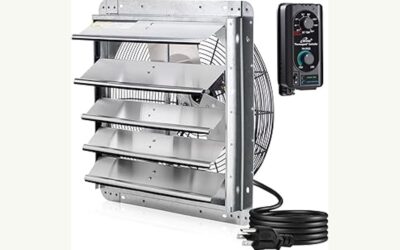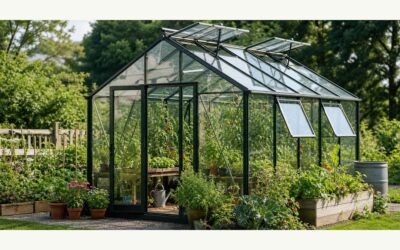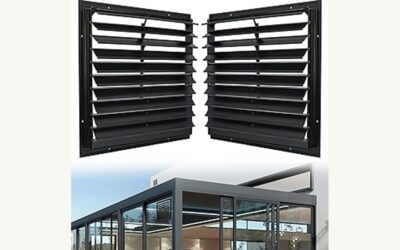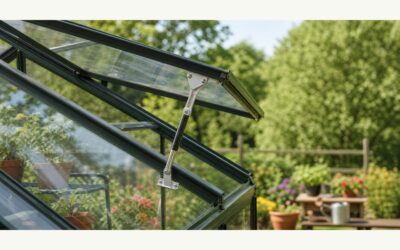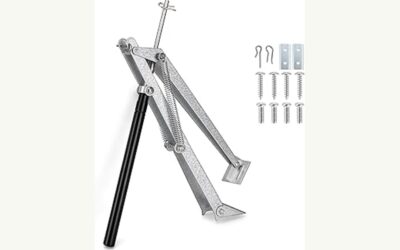



Un ventilador solar de ventilación para invernadero puede ayudar a expulsar el aire caliente, estancado y húmedo de un invernadero sin añadir una toma eléctrica convencional. Para los jardineros domésticos, esto resulta especialmente útil en pequeños túneles, invernaderos de afición, cobertizos de macetas y estructuras de jardín cerradas donde el calor puede acumularse rápidamente durante los días soleados.
Para esta guía de julio de 2026, Dove Creek Gardens comparó 25 productos incluidos en un rango de $25.99 – $199.99, con opciones de Ecocalm, SHENVITASO, PQINS y otras marcas. Analizamos los productos proporcionados según su relevancia para la ventilación de invernaderos y nos centramos en detalles disponibles como el tamaño del ventilador, la potencia del panel solar, la disponibilidad de batería, el control mediante termostato, la longitud del cable, las clasificaciones de impermeabilidad cuando se indicaban, las afirmaciones sobre el flujo de aire y la facilidad de instalación. Para obtener más información sobre la planificación de invernaderos y almacenamiento, consulta nuestra sección Invernaderos y almacenamiento de jardín.
Esta guía está pensada para jardineros principiantes, propietarios con invernaderos en el jardín, personas mayores que prefieren controles sencillos y cultivadores con poco espacio que necesitan una ventilación práctica sin complicar la instalación. No todos los ventiladores solares funcionan igual: algunos solo funcionan con sol directo, mientras que otros incluyen baterías, termostatos inteligentes, temporizadores, adaptadores de corriente o válvulas antirretorno.
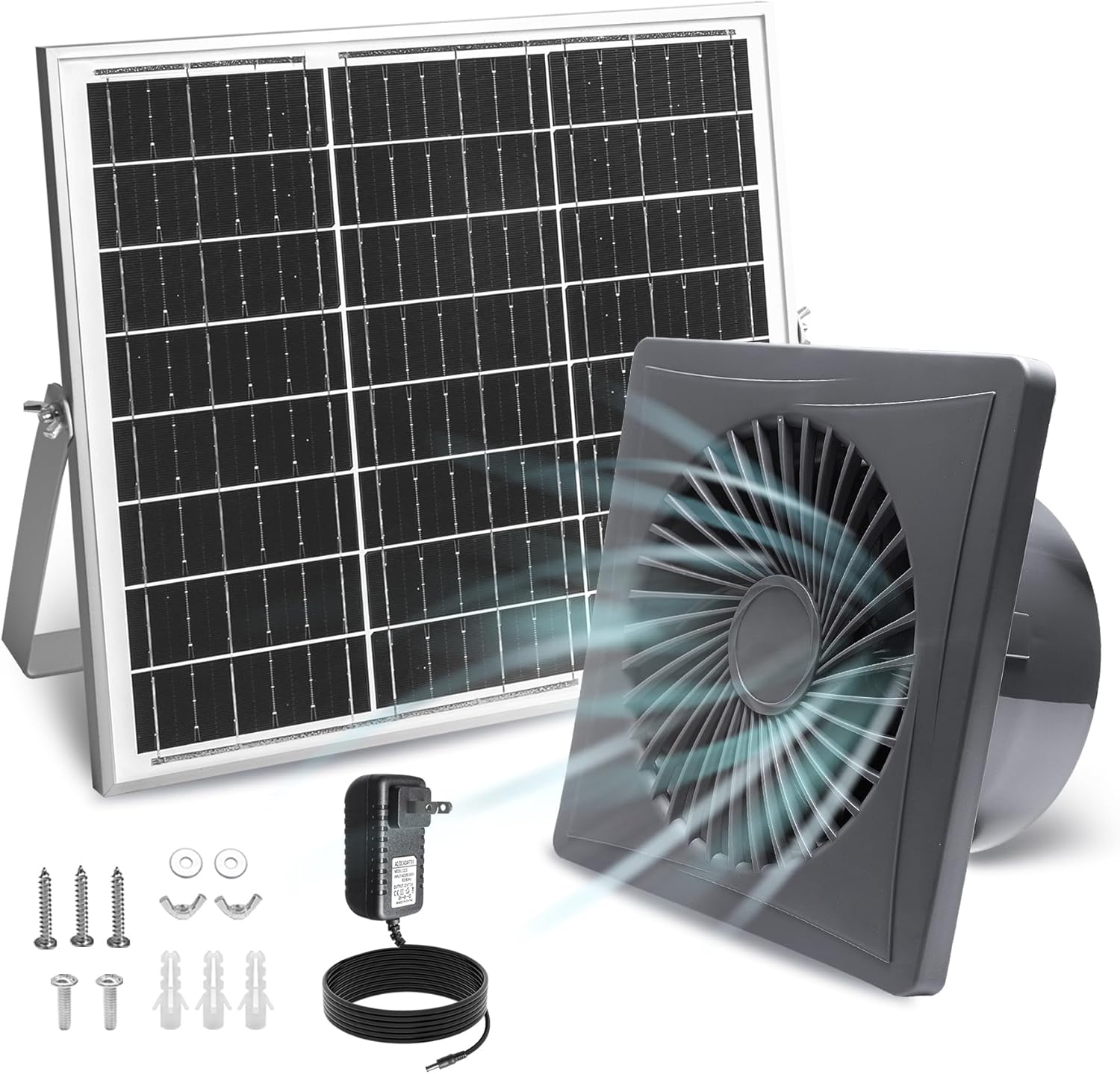
ecoCalm KP-SEF240812 12-Inch Solar Exhaust Fan for Greenhouse and Shed Ventilation SHENVITASO XJS-G8 Solar Exhaust Fan for Shed, Coop, and Greenhouse Ventilation pqins 5-Inch Solar Dual Fan Kit for Daytime Greenhouse and Shed Ventilation Solar Powered Shed Fan Kit with Dual 5-Inch IPX7 Fans, 13 Ft Switch Cable, and Exhaust or Intake Mounting for Coops and Greenhouses Prices and availability can change. We may earn a commission from qualifying purchases.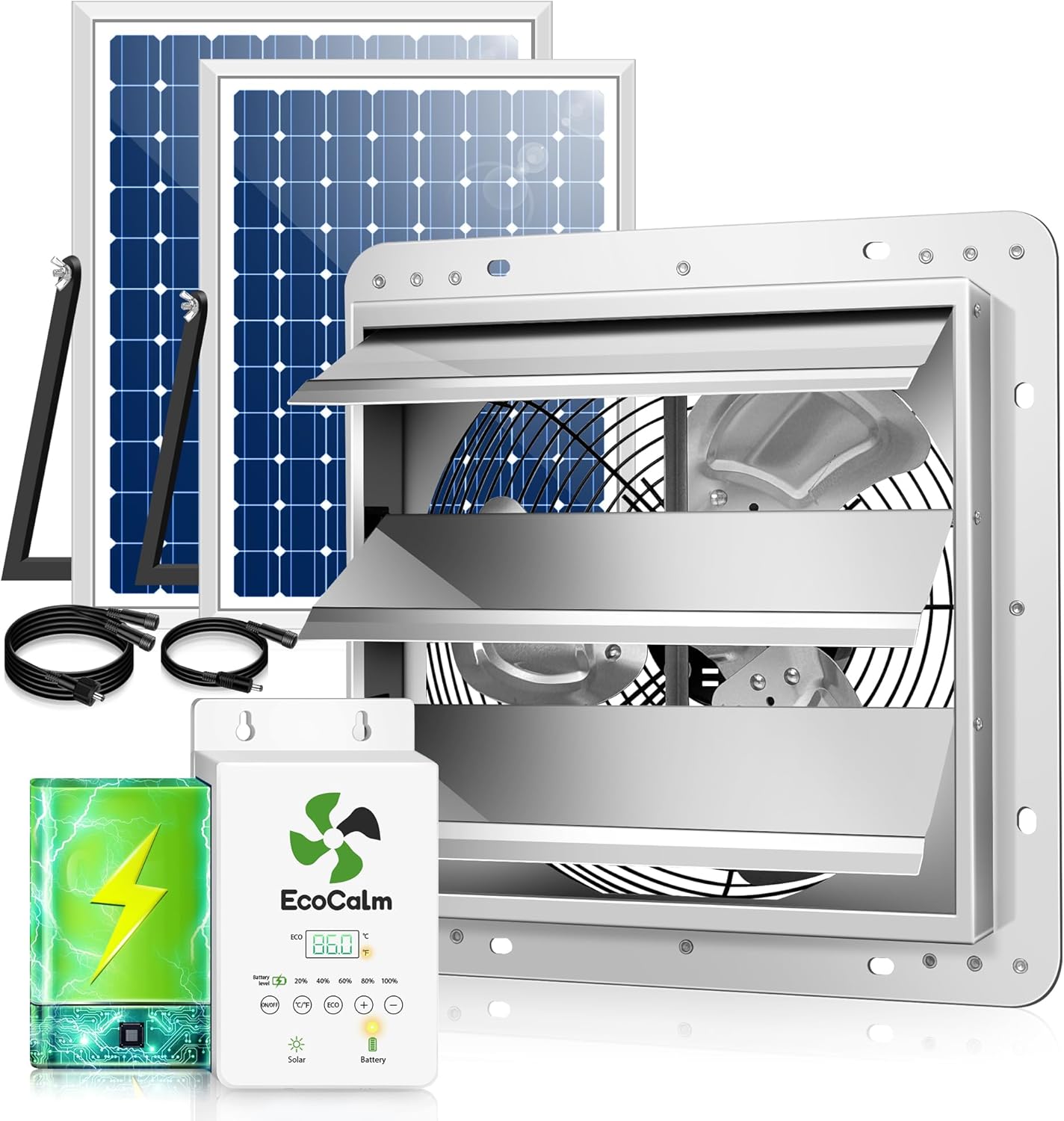


Algunas fichas siguen en inglés; su traducción está pendiente de revisión.
Pros
- Works without a conventional power outlet, useful for remote sheds, greenhouses, barns, and chicken coops.
- Thermostat control reduces the need to manually switch the fan on during hot parts of the day.
- Included battery provides backup ventilation after charging, rather than limiting operation only to direct sun.
- Reviewers commonly mention straightforward installation and effective airflow in greenhouse or coop uses.
- Metal build and screw-together style wiring noted in reviews suggest a more substantial setup than many lightweight plastic fan kits.
Cons
- Fan and battery performance may drop in cloudy weather or poorly positioned solar panel locations.
- Control setup may take patience, as at least one reviewer found the settings less intuitive at first.
- Gardeners needing guaranteed all-night ventilation or code-compliant attic ventilation should confirm the system meets their space and safety requirements before relying on it.
The ecoCalm KP-SEF240812 is a 12-inch solar powered exhaust fan made for moving hot, humid, or stale air out of enclosed spaces such as greenhouses, garden sheds, garages, attics, barns, and chicken coops. For gardeners, its most useful role is greenhouse ventilation, especially in backyard structures that do not have convenient access to a household electrical outlet.
Based on the listed specifications, the fan is rated at 680 CFM and is intended for spaces up to 1600 cubic feet. That puts it in a useful range for many small to midsize hobby greenhouses and outbuildings, provided there is also an intake opening so replacement air can enter. The product information also highlights cooling indoor temperatures, helping reduce mold-friendly conditions, and improving air quality through circulation.
The system includes two 30W bifacial solar panels, a 5000mAh rechargeable battery, and an intelligent power system that switches according to sunlight conditions. The battery is described as providing up to 6 hours of operation after a full charge in sunlight, though the product information clearly notes that fan output and battery charging are affected by cloudy weather. For best results, the panels need to be placed where they receive strong sun for much of the day.
Installation is listed for window or wall mounting, and the 14.8-foot cable gives some flexibility in locating the solar panels away from the fan opening. The fan uses metal construction, a DC motor, touch control, and IP44 waterproof fan blades. Reviewers commonly mention straightforward setup, quiet operation, and good results in small greenhouses and coops, although those comments should be treated as user experiences rather than guaranteed performance.
The adjustable thermostat is one of the more gardener-friendly features because it can cycle the fan on and off according to the temperature setting rather than requiring constant attention. That is helpful for seed starting areas, summer greenhouse use, or animal shelters where heat can build quickly. One practical setup tip is to think through both exhaust and intake placement, since an exhaust fan works best when fresh air can enter from the opposite side or lower part of the structure.
This is a good fit for homeowners who want off-grid ventilation for a greenhouse, shed, or coop and are willing to mount solar panels in a sunny location. It may be less suitable for shaded yards, spaces that need dependable ventilation through long dark periods, or installations where electrical safety and building-code compliance are critical. As with any powered outdoor equipment, keep wiring protected, follow the manufacturer instructions, and inspect the fan and connections periodically for damage, vibration, or moisture issues.
Best For / Avoid If
Best for buyers prioritizing
- Works without a conventional power outlet, useful for remote sheds, greenhouses, barns, and chicken coops.
- Thermostat control reduces the need to manually switch the fan on during hot parts of the day.
- Included battery provides backup ventilation after charging, rather than limiting operation only to direct sun.
Consider another option if
- Fan and battery performance may drop in cloudy weather or poorly positioned solar panel locations.
- Control setup may take patience, as at least one reviewer found the settings less intuitive at first.
- Gardeners needing guaranteed all-night ventilation or code-compliant attic ventilation should confirm the system meets their space and safety requirements before relying on it.
Pros
- Solar panel and household power adapter are both included for more flexible operation.
- Listed 36 dB noise level suggests relatively quiet ventilation for coops, sheds, or small greenhouses.
- Comes with bracket, solar panel, power adapter, and long cord needed for a basic installation.
- Wall-mount exhaust design is useful for removing warm, stale, humid, or dusty air from enclosed outdoor structures.
Cons
- Installation requires drilling a 7-inch hole, which may not suit renters or gardeners uncomfortable modifying a wall or shed panel.
- Solar performance will depend on sun exposure, panel placement, and weather, so shaded locations may need the power adapter more often.
- No battery runtime is listed, so gardeners wanting stored solar power overnight may need a different ventilation setup.
The SHENVITASO XJS-G8 is a solar exhaust fan kit made for ventilating small outdoor and utility spaces such as greenhouses, chicken coops, sheds, pet houses, garages, barns, RVs, and similar enclosed areas. For gardeners, its main job is to help move stale air out of a structure where heat, moisture, dust, or odors can build up.
According to the listed specifications, the kit pairs an 8-inch exhaust fan with a 25W monocrystalline solar panel. The fan is rated at 430 CFM, 2300 RPM, and 36 dB, giving it a useful mix of airflow and relatively low listed noise for small-space ventilation. The product information also notes a photovoltaic conversion efficiency of up to 21.5 percent for the panel.
The design includes a wall-mount fan, adjustable solar panel bracket, MC4 connector, push-button control, and a separate ON/OFF switch. A 16.4-foot solar panel cord helps with roof or sunny-wall placement, while the included power adapter with a 4.66-foot cable allows connection to household power when sunlight is not enough. Installation requires drilling a 7-inch hole and making the connection to the panel, so careful measuring and safe tool use are important.
In a backyard greenhouse, this fan may help exhaust hot, humid air during sunny periods. In a chicken coop or garden shed, it can support air exchange where odors, dust, or trapped heat are concerns. The anti-backflow valve is a helpful detail for outdoor structures because it is designed to stay closed when the fan is not running, helping limit outside insects, small animals, and reverse airflow through the opening.
The solar panel is listed with an IP67 waterproof rating, toughened glass surface, and aluminum frame, which supports outdoor use according to the product data. Still, placement matters. The panel should be aimed for the best available sun, wiring should be routed safely, and the fan opening should be positioned where exhaust air can leave freely. Periodic checks for dust, debris, and blocked vents will help keep airflow from being restricted.
This is a sensible option for homeowners and beginner-to-intermediate gardeners who want a ready solar ventilation kit with an AC power backup option. Gardeners who cannot cut a wall opening, need battery-backed overnight solar operation, or are ventilating a larger structure may want to compare other systems before choosing this one.
Best For / Avoid If
Best for buyers prioritizing
- Solar panel and household power adapter are both included for more flexible operation.
- Listed 36 dB noise level suggests relatively quiet ventilation for coops, sheds, or small greenhouses.
- Comes with bracket, solar panel, power adapter, and long cord needed for a basic installation.
Consider another option if
- Installation requires drilling a 7-inch hole, which may not suit renters or gardeners uncomfortable modifying a wall or shed panel.
- Solar performance will depend on sun exposure, panel placement, and weather, so shaded locations may need the power adapter more often.
- No battery runtime is listed, so gardeners wanting stored solar power overnight may need a different ventilation setup.
Pros
- Daytime solar operation can simplify ventilation in locations without a convenient power outlet.
- Separate fan placement allows intake and exhaust functions to be arranged for the space.
- Included mounting hardware and switch cables may make installation more straightforward for common outdoor structures.
Cons
- There is no built-in battery, so the fans operate only during the day and airflow may decrease in cloudy conditions, at dusk, or when sunlight is weak.
- The listed coverage is limited to spaces around 9 square meters or smaller, so larger structures may need additional ventilation equipment.
- Solar panel placement and cable routing will require a suitable sunny location and a secure mounting surface.
The pqins 5-inch solar dual fan kit is designed for moving air through small outdoor spaces such as greenhouses, chicken coops, sheds, pet houses, and similar enclosures. Based on the listed specifications, it is most suitable for homeowners and gardeners who need daytime ventilation without running household electrical wiring to the structure.
The kit includes two fans that can be mounted together or separately. They can be arranged as exhaust fans, intake fans, or as one of each to encourage air movement through the enclosure. The product information lists a maximum speed of 3200 RPM and identifies the kit for spaces of about 9 square meters, or 6 by 6 feet, or smaller.
The solar panel is described as monocrystalline and includes a bracket for upright or wall and roof mounting. The fans include metal protective nets, while the package is listed with mounting plates, screws, and nylon ties. A 13-foot cable and individual on/off switches may help with positioning the fans and controlling when ventilation starts.
In a small greenhouse, one fan could help draw warm air out while the other brings outside air in. The same arrangement may be useful in a shed or chicken coop where daytime air movement is needed. For a patio-adjacent growing structure or remote garden building, solar operation can avoid the need for a nearby electrical outlet.
The main limitation is the lack of a built-in battery. The fans work only when powered directly by the solar panel, and the listed airflow decreases in cloudy conditions or as sunlight fades. Installers should place the panel where it receives useful sunlight, secure the fans and cables properly, and confirm that the structure and mounting surface can support the chosen arrangement. Overall, this is a practical option for small, sunny enclosures that need daytime ventilation, while gardeners needing overnight operation, consistent airflow, or larger-area coverage should consider a different system or additional equipment.
Best For / Avoid If
Best for buyers prioritizing
- Daytime solar operation can simplify ventilation in locations without a convenient power outlet.
- Separate fan placement allows intake and exhaust functions to be arranged for the space.
- Included mounting hardware and switch cables may make installation more straightforward for common outdoor structures.
Consider another option if
- There is no built-in battery, so the fans operate only during the day and airflow may decrease in cloudy conditions, at dusk, or when sunlight is weak.
- The listed coverage is limited to spaces around 9 square meters or smaller, so larger structures may need additional ventilation equipment.
- Solar panel placement and cable routing will require a suitable sunny location and a secure mounting surface.
Pros
- Solar operation means no outlet access or wiring work, which is handy for far corners of the yard
- Dual-fan setup supports cross-ventilation with separate exhaust and intake placement
- IPX7 waterproof rating adds confidence for year-round outdoor exposure
- The long 13-foot switch cable gives flexible spacing between the panel and the fans
Cons
- Because no battery backup is listed, airflow will likely slow or stop in heavy overcast and after dark, which may matter for overnight ventilation
- Five-inch fans may be modest for larger sheds or greenhouses, so gardeners with bigger spaces could need more than one kit
- Mounting may require cutting openings and basic DIY skills, and fan output will depend on how much direct sun the panel receives
This solar powered fan kit is built around a simple goal: keeping air moving in small outdoor structures without needing household electricity. The package includes two 5-inch fans with an IPX7 waterproof rating, a 13-foot cable with an on/off switch, and installation kits for mounting. The product information lists sheds, chicken coops, greenhouses, and general outdoor use as the intended applications, which makes it a practical match for backyard chicken keepers, greenhouse gardeners, and homeowners with storage sheds that tend to get stuffy.
The dual-fan design is the most interesting feature here. Because each fan can be mounted as either an exhaust or an intake, you can place one to push warm, stale air out and the other to pull fresher air in. That cross-flow approach is the same principle gardeners rely on to manage heat and humidity in greenhouses and to keep coop air fresher for birds, and having both fans in one kit simplifies planning the setup.
Installation flexibility is another strong point based on the listed specifications. The 13-foot cable leaves room to position the solar panel where sunlight is strongest while mounting the fans where airflow is needed most, and the inline on/off switch lets you stop the fans without climbing a ladder to disconnect anything. The included installation kits are meant to cover basic mounting, though plan on supplying common tools and cutting openings in walls or panels where the fans will sit.
In everyday use, this type of kit fits many backyard scenarios. It can help vent a chicken coop on warm afternoons, reduce heat buildup inside a small greenhouse, keep a garden shed from turning musty through a humid summer, or circulate air in other small outdoor structures. Because it runs on solar power, it is especially useful for buildings that sit far from the house and have no convenient outlet nearby.
There are realistic limits to keep in mind. Solar fans deliver their best output in direct sun, and since no battery is mentioned in the product information, the fans will likely slow or stop during heavy overcast and after dark. Five-inch fans are also best suited to small and medium spaces, so a large barn or long greenhouse may call for multiple kits or a powered ventilation system. Occasional cleaning of the fan blades and the panel surface will help maintain performance through the season.
Overall, this is a sensible pick for DIY-minded gardeners and small-homestead keepers who want simple, cord-free airflow where wiring is impractical. If you need overnight ventilation, thermostat control, or high-volume air movement for a large structure, a wired fan or a battery-backed model may serve you better. For a coop, shed, or compact greenhouse with decent sun exposure, the feature set suggests an easy way to add fresh-air circulation.
Best For / Avoid If
Best for buyers prioritizing
- Solar operation means no outlet access or wiring work, which is handy for far corners of the yard
- Dual-fan setup supports cross-ventilation with separate exhaust and intake placement
- IPX7 waterproof rating adds confidence for year-round outdoor exposure
Consider another option if
- Because no battery backup is listed, airflow will likely slow or stop in heavy overcast and after dark, which may matter for overnight ventilation
- Five-inch fans may be modest for larger sheds or greenhouses, so gardeners with bigger spaces could need more than one kit
- Mounting may require cutting openings and basic DIY skills, and fan output will depend on how much direct sun the panel receives

Pros
- Cordless solar setup is useful for sheds, small greenhouses, chicken coops, and other outbuildings away from household power.
- Thermostat control adds convenience compared with a basic always-on solar fan.
- Battery backup provides a supported option for continued ventilation beyond direct sunlight, depending on charge and conditions.
- Wall or window mounting gives homeowners flexibility for exhaust placement.
- Anti-backflow exhaust fan design is appropriate for moving air out of an enclosed space.
Cons
- Solar charging and fan output can be reduced in cloudy weather, shaded locations, or poor panel placement.
- The listed 220 CFM capacity may be too small for larger greenhouses, sheds, or animal shelters that need stronger air exchange.
- Some users may need to plan controller placement carefully because installation height and cable routing can affect everyday access.
The ecoCalm KP-SEF23124 is an 8-inch solar exhaust fan intended for outdoor ventilation in small greenhouses, sheds, chicken coops, animal houses, garages, barns, and similar enclosed spaces. It is designed to pull air out rather than blow fresh air in, so it works best when paired with an appropriate intake opening or existing vent on the opposite side of the space.
The main practical benefit is cord-free air movement. The product information lists 220 CFM airflow and suitability for spaces up to 380 cubic feet, which makes it most relevant for compact structures rather than large greenhouses. The included 4400mAh rechargeable battery is listed to provide up to 8 hours of operation after a full sunlight charge, although the manufacturer notes that charging and fan performance are affected by sunlight conditions.
The fan uses a bifacial solar panel that can generate power from both sides when light conditions allow. It also includes an adjustable temperature control system in the battery box, allowing the fan to turn on and off automatically according to the selected ambient temperature. For gardeners who do not want to manually manage ventilation throughout the day, that thermostat feature is a meaningful upgrade over a simple direct-solar fan.
Installation is listed as wall or window mount, with a permanent installation type, DC connectors, a waterproof plug, and a 14.8-foot cable. The fan body measures 3.74 inches deep by 9.06 inches wide by 9.06 inches high. The IP44 waterproof fan blades and outdoor-focused design are useful for garden structures, but the solar panel should still be positioned for strong sun exposure and mounted securely against wind or weather.
In a backyard setup, this fan makes the most sense for a small greenhouse that overheats in afternoon sun, a potting shed that holds warm air, or a coop where air exchange is needed without running electrical wiring. Reviewers commonly mention use in chicken coops and sheds, with several noting easy setup and quiet operation, while others report that airflow or battery performance did not meet their needs in larger or less ideal conditions.
Gardeners should size ventilation carefully before buying. A single 8-inch, 220 CFM exhaust fan may not be enough for a larger greenhouse, a very humid shed, or an animal shelter that needs substantial air exchange. This is a practical choice for small-space solar ventilation, but anyone needing dependable all-weather airflow, more capacity, or powered ventilation independent of sunlight may want to consider a larger or hardwired system.
Best For / Avoid If
Best for buyers prioritizing
- Cordless solar setup is useful for sheds, small greenhouses, chicken coops, and other outbuildings away from household power.
- Thermostat control adds convenience compared with a basic always-on solar fan.
- Battery backup provides a supported option for continued ventilation beyond direct sunlight, depending on charge and conditions.
Consider another option if
- Solar charging and fan output can be reduced in cloudy weather, shaded locations, or poor panel placement.
- The listed 220 CFM capacity may be too small for larger greenhouses, sheds, or animal shelters that need stronger air exchange.
- Some users may need to plan controller placement carefully because installation height and cable routing can affect everyday access.
Pros
- Battery backup is designed to continue operation during cloudy conditions, at night, and in low light.
- Useful for several garden-related spaces, including greenhouses, hothouses, sunrooms, sheds, and chicken coops.
- Multiple fan speeds provide more control than a single-speed ventilation unit.
- Automatic louvers help reduce exposure to dust and outside air when the fan is not running.
Cons
- The product information does not specify how long the 3200mAh battery will run at each speed, so overnight or low-light performance may vary.
- Installation requires creating and mounting into a suitable opening, which may be less convenient for gardeners seeking a plug-in or portable fan.
- Users without consistent access to direct sunlight may prefer a ventilation system with a more clearly documented conventional power or runtime setup.
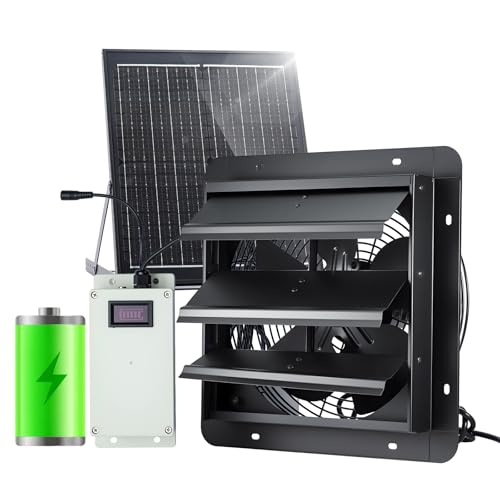
The GROWNEER Solar Powered Exhaust Fan is intended to remove hot, stale, or odorous air from enclosed spaces used around the home and garden. It is a suitable option for homeowners managing greenhouse heat, shed ventilation, attic air circulation, chicken coop odors, or airflow in a pet house, especially when reducing dependence on conventional electricity is a priority.
Based on the listed specifications, the fan provides up to 1200 CFM of airflow at a listed 1200 RPM and is intended for spaces up to 1400 square feet. Three speed settings allow the user to select lower airflow for routine circulation or higher airflow when a space needs faster heat dissipation. The product information specifically positions it for greenhouses, hothouses, sunrooms, attics, garages, work sheds, warehouses, chicken coops, and pet houses.
The fan uses solar-priority operation, running from the panel and charging its built-in 3200mAh battery when sunlight is available. It is described as switching to battery power during cloudy weather, nighttime, or low-light conditions, although the supplied information does not provide runtime figures for each speed. The included installation kit and template are intended to help with placement, while the solar panel bracket adjusts from 25 to 75 degrees for positioning toward available sunlight.
For backyard use, this design could be useful on a greenhouse wall, shed, or other suitable enclosure where heat and stale air build up. The listed dimensions are 6 x 10.83 x 10.83 inches, so users should compare those measurements with the intended mounting area before cutting an opening. The automatic louver closes when the fan stops, which can help limit dust entry and backdraft when ventilation is not active.
The metal louvered body is listed as rust resistant and corrosion protected, and the operating noise is specified at 40 to 60 dBA. Installation should follow the supplied instructions, and the mounting surface, opening, panel position, and wiring arrangement should be checked carefully before use. Because battery runtime, exact installation requirements, and long-term performance details are not provided, this fan is best for users comfortable planning a fixed ventilation installation, while gardeners wanting portable operation or fully documented backup runtime may prefer another option.
Pros
- Runs from solar power, so it is useful for sheds, coops, and small greenhouses that do not have convenient outlet access.
- Fan and solar panel can be mounted separately, which helps when the best sun exposure is not directly beside the vent opening.
- Designed for both exhaust and intake use, giving gardeners flexibility when planning airflow through a small structure.
- Product information lists quiet operation at 45 decibels, which may be helpful around pets, poultry, or backyard work areas.
- No built-in battery to maintain or replace, which keeps the system simpler for daytime-only ventilation.
Cons
- Because there is no built-in battery, the fan only operates when the solar panel receives enough daylight, with reduced airflow in cloudy conditions or near dusk.
- One power level limits fine control, so gardeners needing adjustable speeds may prefer a fan with multiple settings.
- Installation may require cutting or preparing a vent opening, and some reviewers mention that the included instructions could be clearer.
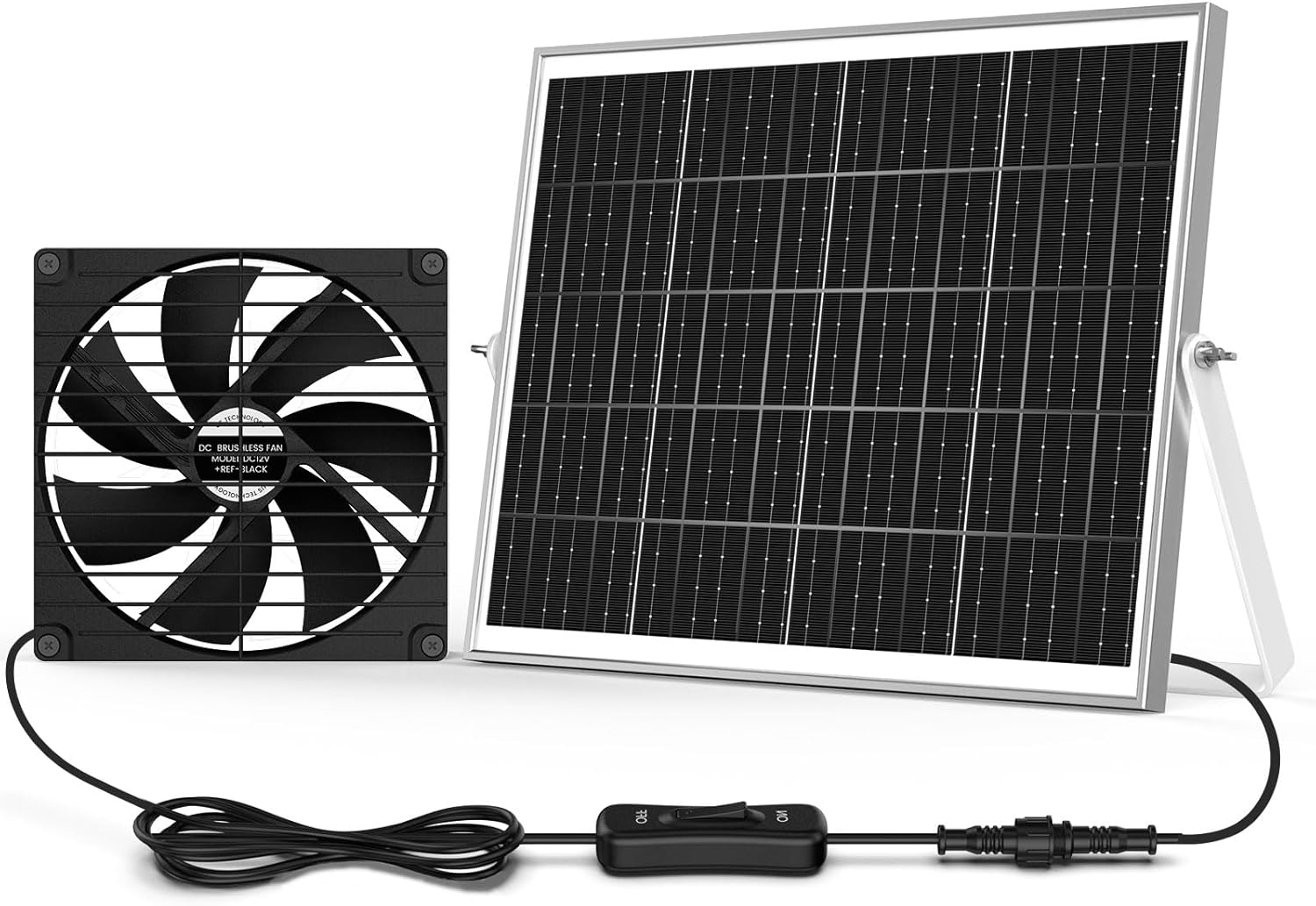
The PQINS 18-1P-B is a 7.1-inch solar-powered ventilation fan kit made for moving air through small outdoor and semi-outdoor spaces. Based on the listed uses, it fits small greenhouses, chicken coops, sheds, pet houses, garages, attics, and similar structures where stagnant heat or trapped air can build up during the day. It is best suited to homeowners and backyard growers who want a simple daytime airflow solution without running household power to the structure.
The product information lists a 25-watt solar power source, 3800 RPM maximum speed, and 720 CFM airflow capacity, with a recommended space range of 80 to 120 sq. ft. In plain terms, this is intended to help exchange air in smaller enclosures rather than cool a large building like an air conditioner. Reviewers commonly mention stronger airflow in direct sun and reduced or no operation when sunlight is weak, which matches the manufacturer note that the fan is powered directly by the solar panel and has no built-in battery.
The separate fan and solar panel are useful design choices for garden structures. You can place the panel where it gets better exposure while mounting the fan at the vent opening for exhaust or intake. The 16.5 ft cord helps with routing, and the push-button on/off switch gives basic manual control. The kit is listed as wall mounted and includes a bracket, DC fan, solar panel, and installation accessories such as mounting plates, screws, and nylon ties.
For a hobby greenhouse, this fan can help move hot, stale air out during sunny parts of the day, especially when paired with an opposite vent or opening for make-up air. In a chicken coop or doghouse, it may help improve air circulation during daylight hours, provided the installation keeps cords, blades, and hardware safely away from animals. For a shed, cabin, or small garage space, it can serve as a low-maintenance exhaust fan when heat builds up under direct sun.
The main limitation is also the reason it is simple: it has no battery backup. Gardeners who need overnight ventilation, cloudy-day performance, thermostat control, or continuous 24-hour airflow should consider a powered fan with battery storage or a wired option. Installation should be planned carefully, including weather exposure, secure mounting, protected cord routing, and a clear intake or exhaust path. Based on the specifications, this PQINS kit is a practical pick for sunny daytime ventilation in small backyard structures, but it is not the right choice for gardeners who need guaranteed airflow after dark or during extended cloudy weather.
Best For / Avoid If
Best for buyers prioritizing
- Runs from solar power, so it is useful for sheds, coops, and small greenhouses that do not have convenient outlet access.
- Fan and solar panel can be mounted separately, which helps when the best sun exposure is not directly beside the vent opening.
- Designed for both exhaust and intake use, giving gardeners flexibility when planning airflow through a small structure.
Consider another option if
- Because there is no built-in battery, the fan only operates when the solar panel receives enough daylight, with reduced airflow in cloudy conditions or near dusk.
- One power level limits fine control, so gardeners needing adjustable speeds may prefer a fan with multiple settings.
- Installation may require cutting or preparing a vent opening, and some reviewers mention that the included instructions could be clearer.

Pros
- Supports both air removal and fresh-air intake in one ventilation system.
- Battery storage can extend operation into nighttime and low-light periods.
- Remote and automatic control options are useful for hard-to-reach sheds or greenhouse walls.
- No household electrical wiring is required for installation.
Cons
- Actual runtime will vary with speed selection and available solar charging, so maximum runtime should not be expected in every setup.
- The 10-inch fan and listed six-speed controls may be less suitable for gardeners needing ventilation for a very large structure.
- Installation still requires a suitable wall or vent opening, secure mounting, and a location where the solar panel can receive useful sunlight.
The Tephrotrak 10-inch solar ventilation fan is designed for chicken coops, greenhouses, and sheds where air circulation, heat removal, or humidity management is important. It suits homeowners and beginner gardeners who want an off-grid ventilation option without running household electrical wiring to an outdoor structure.
Its dual-direction motor allows the fan to work as either an exhaust fan or an intake fan. Exhaust mode can help move hot or stale air out of a coop or shed, while intake mode can bring in outside air for more balanced circulation. The feature set also includes six manual speed levels and automatic modes that use built-in sensors to adjust airflow.
The system measures 10 by 3.5 by 10 inches and includes a solar panel, fan, battery control box, remote, mounting brackets, and screws. The combined cable length is listed as 17 feet, with a 12-foot panel-to-fan cable and a 5-foot fan-to-control-box cable. This layout may make it easier to place the panel in a sunny location while keeping the control box accessible.
For backyard use, the fan could be useful on a greenhouse wall, a coop vent opening, or a shed that becomes hot and stuffy during summer. The remote control range is listed at up to 164 feet, which may be convenient when the structure is away from the house. Battery storage is specified to provide up to 19 hours in smart eco modes, although operating time depends on speed and charging conditions.
The IP65 rating and coated metal housing are intended for humid outdoor environments, but the fan should still be mounted securely and used according to the product instructions rather than treated as a submersible device. Keep the solar panel positioned for useful sunlight, check cable connections during routine maintenance, and make sure the installation opening and mounting surface are appropriate for the 10-inch unit.
This fan is a reasonable choice for small to medium backyard structures needing flexible, solar-powered ventilation and remote control. Gardeners ventilating a much larger building, working with limited sunlight, or needing a precisely documented airflow capacity may prefer a different system with more detailed sizing information.
Best For / Avoid If
Best for buyers prioritizing
- Supports both air removal and fresh-air intake in one ventilation system.
- Battery storage can extend operation into nighttime and low-light periods.
- Remote and automatic control options are useful for hard-to-reach sheds or greenhouse walls.
Consider another option if
- Actual runtime will vary with speed selection and available solar charging, so maximum runtime should not be expected in every setup.
- The 10-inch fan and listed six-speed controls may be less suitable for gardeners needing ventilation for a very large structure.
- Installation still requires a suitable wall or vent opening, secure mounting, and a location where the solar panel can receive useful sunlight.

Pros
- Flexible two-fan configuration for separate intake and exhaust arrangements
- Long 15-foot cords allow more adaptable installation positioning
- Outdoor-oriented design with listed IP67 waterproofing and a broad working temperature range
- Installation accessories and a user manual are included
Cons
- Performance is dramatically reduced by cloudy conditions or shade, and the fans stop working during rain or at night because there is no built-in battery backup
- The solar panel needs a suitable location with strong direct sunlight for useful daytime operation
- The kit may be less suitable for gardeners who need continuous ventilation or dependable airflow after sunset
The blessny 5.5-inch Solar 2 Fan Kit is an outdoor ventilation setup for moving air through spaces such as greenhouses, sheds, chicken coops, and dog houses. It includes two separate fans that can be arranged for intake, exhaust, or a combination of both, making it a practical option for homeowners managing airflow in small backyard structures.
Each fan uses a listed 5.5-inch size and can reach a maximum speed of 3500 RPM according to the product information. The larger fan size is intended to provide more air volume than the 4.7-inch fans referenced in the listing, which may help with general air circulation or cooling efforts when the solar panel receives direct sunlight.
The two fans have 15-foot cords, giving you room to position them separately during installation. The kit includes fix plates, screws, zip-ties, and an installation guide. The listed dimensions are 15.4 by 12.6 by 1 inches, and the product information identifies the kit components as IP67 waterproofed for outdoor use, with a stated working range from -13°F to 140°F.
For backyard use, one fan could be positioned to draw warmer air out of a greenhouse or shed while the other brings in outside air. Using both fans for intake or both for exhaust may suit a different layout. The flexible arrangement can also be useful in a chicken coop or dog house where air circulation is needed during sunny summer conditions.
The most important limitation is the lack of a built-in battery backup. The fans work well during sunny days, but their performance is dramatically reduced when the day is cloudy or the solar panel is shaded. They stop working during rainy weather or at night, so installation should prioritize unobstructed sunlight and this kit should not be treated as continuous ventilation. Gardeners needing dependable airflow at all hours may prefer a different power source or a system with battery support.
Best For / Avoid If
Best for buyers prioritizing
- Flexible two-fan configuration for separate intake and exhaust arrangements
- Long 15-foot cords allow more adaptable installation positioning
- Outdoor-oriented design with listed IP67 waterproofing and a broad working temperature range
Consider another option if
- Performance is dramatically reduced by cloudy conditions or shade, and the fans stop working during rain or at night because there is no built-in battery backup
- The solar panel needs a suitable location with strong direct sunlight for useful daytime operation
- The kit may be less suitable for gardeners who need continuous ventilation or dependable airflow after sunset

Pros
- Separate fan and solar-panel setups allow more flexible intake and exhaust placement.
- No AC connection is required, which can be useful for detached structures or locations without convenient electrical access.
- The two-fan configuration can help create through-flow ventilation instead of relying on a single circulation point.
- The 16.5-foot cables provide useful reach between the panels and fan locations.
Cons
- Because no battery is included, airflow may drop substantially during cloudy weather or when the solar panels are shaded.
- Solar-dependent operation may be less suitable for nighttime ventilation or structures that do not receive consistent sunlight.
- Gardeners will need to plan the fan and panel locations carefully, especially when using one unit for intake and the other for exhaust.
The pqins 7.1-inch solar greenhouse fan 2-pack is designed to improve air circulation and ventilation in outdoor structures. It is a practical fit for homeowners managing a greenhouse, chicken coop, shed, pet house, or similar space without a convenient AC power connection.
Based on the listed specifications, each fan uses a brushless motor and thin blades, with operation up to 3,800 RPM and an air volume of up to 900 CFM. When both fans are used together, the product information indicates coverage for ventilation needs in spaces of approximately 150 to 230 square feet, although actual results will depend on sunlight, structure layout, and airflow openings.
The two fans are separate rather than connected as a single fixed unit. Each has its own solar panel and 16.5-foot extension cable, so you can position one for intake and one for exhaust, or configure both for the same airflow direction. The listed product dimensions are 7.5 by 7.5 by 4 inches, and the outdoor-oriented design is described as waterproof and lightweight.
For backyard use, this setup could help move warm air through a sun-heated greenhouse, improve circulation in a chicken coop, or ventilate a shed where running an electrical cable is inconvenient. The separate panels and long cables may also help when the best fan location and the sunniest panel location are not the same.
The main limitation is the lack of a battery. The product information states that performance is reduced on cloudy days or when a panel is shaded, so it is not intended to provide dependable stored-power ventilation after sunset. Keep the panels as unshaded as practical, and periodically check the outdoor fan and panel areas for dirt or obstructions. This is a sensible option for sunny locations needing daytime ventilation, while gardeners needing overnight or consistently powered airflow may prefer a battery-backed or AC-powered system.
Best For / Avoid If
Best for buyers prioritizing
- Separate fan and solar-panel setups allow more flexible intake and exhaust placement.
- No AC connection is required, which can be useful for detached structures or locations without convenient electrical access.
- The two-fan configuration can help create through-flow ventilation instead of relying on a single circulation point.
Consider another option if
- Because no battery is included, airflow may drop substantially during cloudy weather or when the solar panels are shaded.
- Solar-dependent operation may be less suitable for nighttime ventilation or structures that do not receive consistent sunlight.
- Gardeners will need to plan the fan and panel locations carefully, especially when using one unit for intake and the other for exhaust.

Pros
- Solar power can reduce the need for extension cords or hardwiring in remote backyard structures.
- Battery backup and timer controls offer more flexibility than a simple sun-only solar fan.
- Compact listed dimensions can work well on smaller coop, shed, dog house, or greenhouse wall openings.
- Quiet listed sound level is a practical advantage for animal shelters and shared backyard spaces.
Cons
- Ventilation performance will depend on sun exposure, installation placement, and the size of the space being ventilated.
- The product information does not list an airflow rating, so it is harder to compare directly with powered exhaust fans.
- Installation may require cutting or fitting a suitable opening in the wall, roof, or panel of the structure.
The Ropelux solar dual exhaust fan is designed for ventilating small backyard and utility spaces, including chicken coops, dog houses, rabbit hutches, greenhouses, sheds, attics, and cabins. Based on the listed specifications, it is a solar-powered fan system with a separate solar panel, dual exhaust fans, an 18000mAh battery, timer controls, mounting hardware, and a user manual. It is a practical option for gardeners, small flock keepers, and homeowners who need air movement in a place where running electrical wiring is inconvenient.
The main benefit is supported off-grid ventilation. The dual-fan design is intended to help remove stale air, dust, odors, and excess humidity while drawing in fresher air. For a chicken coop or small greenhouse, that kind of airflow can help make enclosed spaces feel less stuffy, especially during warm weather. The built-in battery is listed to run up to 10 hours without sunlight, which gives it more usefulness than a solar fan that only operates in direct sun.
Controls are simple but helpful. The fan includes two timer modes, Day plus 3 Hours and Day plus 6 Hours after sunset, so users can extend airflow into the evening without necessarily running the battery as long as possible. The listed noise range of 36 to 40 decibels is relatively quiet, which matters around poultry, pets, and backyard structures near patios or windows. The ABS material and compact listed dimensions of 16.3 inches long by 1.18 inches wide by 7.09 inches high suggest a slim fan assembly, though buyers should still measure their intended mounting location carefully.
In a home garden setting, this fan makes the most sense for small enclosed structures that trap heat, moisture, or odors. A gardener might use it in a greenhouse to improve basic air exchange, in a potting shed to reduce stale air, or in a coop where summer ventilation is a concern. Because it is solar powered, placement of the panel is important. The panel needs good sun exposure for best charging, and shaded locations may reduce runtime.
There are a few limitations to consider. The product information does not provide a specific airflow rating, coverage area, or weather-resistance rating, so it should not be selected solely by guessing how much space it can ventilate. Installation may also require cutting or adapting an opening and securing the fan and panel properly. As with any fan used around animals, cords, hardware, and fan openings should be placed where pets or poultry cannot peck, chew, or disturb them.
Overall, this Ropelux solar exhaust fan is a useful fit for homeowners who want quiet, low-maintenance ventilation in a small off-grid structure and appreciate battery backup with timer options. Gardeners needing a fan for a large greenhouse, a high-heat attic, or a precisely engineered ventilation system may prefer a model with published airflow specifications and more detailed installation requirements.
Best For / Avoid If
Best for buyers prioritizing
- Solar power can reduce the need for extension cords or hardwiring in remote backyard structures.
- Battery backup and timer controls offer more flexibility than a simple sun-only solar fan.
- Compact listed dimensions can work well on smaller coop, shed, dog house, or greenhouse wall openings.
Consider another option if
- Ventilation performance will depend on sun exposure, installation placement, and the size of the space being ventilated.
- The product information does not list an airflow rating, so it is harder to compare directly with powered exhaust fans.
- Installation may require cutting or fitting a suitable opening in the wall, roof, or panel of the structure.

Pros
- Solar operation avoids the need for a 110V AC power connection.
- The 16-foot cord and panel bracket provide useful installation flexibility.
- Manual on/off control offers more direct control over fan operation.
Cons
- Because there is no built-in battery backup, the fan may slow in cloudy conditions or shade and stop at night or during rainy weather.
- The listed 420 CFM airflow may be less suitable for larger or heavily enclosed spaces without confirming the required ventilation rate.
- Installation requires selecting a location with adequate sunlight and placing the fan and panel appropriately.
The blessny 10-inch solar exhaust fan is designed to improve air movement in outdoor spaces such as greenhouses, chicken coops, sheds, pet houses, and some window ventilation setups. Based on the listed specifications, it is best suited to homeowners and gardeners who need ventilation where running 110V AC power would be inconvenient.
The fan uses a 25W solar panel and is listed with airflow of up to 420 CFM. That combination may help reduce stagnant air in a suitable enclosure, supporting more comfortable conditions for plants or pets, although the appropriate airflow will depend on the space and its existing openings.
The kit measures 11.4 by 11.4 by 5.6 inches and includes a 16-foot cord, a solar panel bracket, and an on/off button. The cord can make it easier to position the panel for sunlight, while the manual control provides a straightforward way to turn the fan on or off. An anti-backflow valve is also listed to help limit air, gas, and dust moving back through the fan.
For backyard use, this fan may fit a sunny greenhouse, small shed, chicken coop, or pet shelter where daytime ventilation is needed. The solar setup can be useful in detached areas without a convenient electrical outlet, but the installation location should allow the panel to receive adequate direct sunlight.
The main limitation is the lack of built-in battery backup. The product information states that performance can be reduced by clouds or shade and that the fan stops at night or during rainy weather. Users should also follow appropriate installation and electrical safety practices, keep the panel positioned as directed, and confirm that the fan size and listed airflow suit the enclosure.
This fan is a reasonable option for gardeners and homeowners seeking daytime solar ventilation in a small outdoor structure. Those needing continuous nighttime operation, dependable airflow in cloudy conditions, or power independent of sunlight should consider a different ventilation setup with an alternative power source or battery system.
Best For / Avoid If
Best for buyers prioritizing
- Solar operation avoids the need for a 110V AC power connection.
- The 16-foot cord and panel bracket provide useful installation flexibility.
- Manual on/off control offers more direct control over fan operation.
Consider another option if
- Because there is no built-in battery backup, the fan may slow in cloudy conditions or shade and stop at night or during rainy weather.
- The listed 420 CFM airflow may be less suitable for larger or heavily enclosed spaces without confirming the required ventilation rate.
- Installation requires selecting a location with adequate sunlight and placing the fan and panel appropriately.

Pros
- Useful for adding airflow to small outdoor structures where running power may be inconvenient.
- Separate or combined installation provides more placement flexibility than a fixed single-unit layout.
- Compact and relatively lightweight design should be manageable for many basic installation locations.
- The listed outdoor-oriented solar panel design supports use in backyard and garden settings.
Cons
- Fan output, airflow rate, noise level, battery storage, and runtime are not provided, so suitability for larger structures is difficult to judge.
- Because it is solar powered, ventilation may vary with available sunlight and weather conditions.
- The weatherproof description specifically refers to the solar panel surface, so the complete installation should be placed and maintained according to the product instructions.
The HASDSAGY 15W Solar Powered Fan is a two-fan ventilation kit for improving air circulation in small outdoor spaces. It is aimed at homeowners and gardeners who need intake or exhaust airflow in a greenhouse, chicken coop, shed, doghouse, pet house, or similar area without relying on a listed household power connection.
The main supported benefit is flexible solar-powered ventilation. The product information describes the fan as suitable for cooling and fresh-air circulation, while the 15W monocrystalline solar panel is intended to supply power outdoors. The listing also indicates that the fan may continue working during dusk, dawn, or cloudy conditions, although actual airflow will depend on available light and the installation environment.
Installation can be arranged separately or as a combined setup, which may help when the solar panel and fans need different positions. The listed product dimensions are 12 x 9.4 x 1 inches, and the weight is 2.09 pounds. No fan controls, airflow rating, mounting hardware details, or cable length are provided, so buyers should confirm those points before planning a more complex installation.
For backyard use, this kit may fit small chicken coops, compact greenhouses, garden sheds, and pet shelters where added air movement is helpful. The intake or exhaust configuration can be selected based on the structure, but the available data does not specify a coverage area or recommend it for large buildings. Its portable size may also be useful for temporary outdoor setups such as camping areas.
The solar panel has a TPE surface described as weatherproof and durable, but the available information does not establish weather protection for every part of the complete fan assembly. Keep the installation secure, check the components periodically, and follow the included instructions for placement and connections. This is a practical option for small-space solar ventilation, while gardeners needing measured airflow, nighttime operation, battery backup, or ventilation for a larger structure should consider a model that lists those specifications.
Best For / Avoid If
Best for buyers prioritizing
- Useful for adding airflow to small outdoor structures where running power may be inconvenient.
- Separate or combined installation provides more placement flexibility than a fixed single-unit layout.
- Compact and relatively lightweight design should be manageable for many basic installation locations.
Consider another option if
- Fan output, airflow rate, noise level, battery storage, and runtime are not provided, so suitability for larger structures is difficult to judge.
- Because it is solar powered, ventilation may vary with available sunlight and weather conditions.
- The weatherproof description specifically refers to the solar panel surface, so the complete installation should be placed and maintained according to the product instructions.

Pros
- Does not require mains electricity or extra wiring work.
- Solar-powered operation automatically starts when sunlight is available.
- Suitable for several small-space applications, including greenhouses, coops, sheds, pet houses, and windows.
- The included waterproof connector and pre-drilled panel holes can make installation more straightforward.
Cons
- It has no battery, so it will not continue operating when sunlight is unavailable.
- There is no on/off switch, and fan speed varies with the intensity of available sunlight.
- Gardeners needing consistent ventilation in shaded locations or after sunset may prefer a powered fan with battery storage or mains operation.
The DC HOUSE 20W solar exhaust fan is designed to ventilate small enclosed spaces such as greenhouses, chicken coops, sheds, pet houses, and windows. It is a practical fit for homeowners and gardeners who need basic air exchange in an outbuilding without running mains wiring.
The listed dual-fan design is intended to exhaust warm air and encourage fresher air movement, which can help reduce stagnant conditions and indoor humidity in suitable small spaces. The product information lists a maximum applicable space of 880 cubic feet, or 25 cubic meters, so it should be considered for compact structures rather than large rooms or buildings.
The panel and fan connect through a plug-and-play waterproof connector, and the solar panel has pre-drilled mounting holes. Installation requires self-tapping screws and tools. The fan measures 12 x 6 x 2 inches and weighs about 2.82 pounds, while the metal protective case helps shield the blades during normal operation.
For backyard use, the kit may suit a small greenhouse roof, a shed wall, a chicken-coop ventilation opening, or a pet-house project where direct sunlight is available. The panel should be positioned where it receives full, direct sun, and the fan's operation will naturally change as sunlight becomes stronger or weaker.
The main limitation is that this is real-time solar ventilation. It has no battery and no on/off switch, so it will not provide stored-energy operation after dark or in low sunlight. The accessories are treated with a waterproof layer for outdoor use, but installation should still be planned carefully to protect connections and ensure the fan is securely mounted.
This product makes the most sense for small, sunny structures where simple, cord-free daytime ventilation is the priority. Choose a different option if you need scheduled control, nighttime operation, or steady airflow in a shaded location.
Best For / Avoid If
Best for buyers prioritizing
- Does not require mains electricity or extra wiring work.
- Solar-powered operation automatically starts when sunlight is available.
- Suitable for several small-space applications, including greenhouses, coops, sheds, pet houses, and windows.
Consider another option if
- It has no battery, so it will not continue operating when sunlight is unavailable.
- There is no on/off switch, and fan speed varies with the intensity of available sunlight.
- Gardeners needing consistent ventilation in shaded locations or after sunset may prefer a powered fan with battery storage or mains operation.
Pros
- No extra electrical wiring is required for operation.
- Suitable for several small-space ventilation applications, including greenhouses and chicken coops.
- Automatic operation keeps the fan running when sunlight is available.
- The solar panel includes mounting holes and connects through a waterproof plug.
- A blade cover adds a practical safety feature during operation.
Cons
- It has no battery, so it will not operate at night or indoors.
- Airflow depends on sunlight and may be lower in shaded or cloudy conditions.
- There are no switches or speed settings for manual control.
The DC HOUSE 20W Solar Powered Exhaust Fan is intended to remove hot air from small backyard spaces such as greenhouses, chicken coops, sheds, pet houses, and windows. Its listed maximum applicable space is 880 cubic feet, so it is better suited to modest structures than large barns, workshops, or whole-home ventilation. Gardeners who want to avoid adding electrical wiring may find the solar-powered design especially useful.
The main benefit is automatic daytime ventilation. The product information indicates that the fan runs when the sun is out, with airflow increasing in brighter light. This can help move warm air through a small growing or animal-care space during sunny periods, although the actual airflow will vary with available sunlight and installation conditions.
The fan and solar panel connect through a waterproof plug, and the panel has mounting holes for screw attachment to a wall or roof. The listed fan dimensions are 12 inches in diameter, 6 inches wide, and 2 inches high, with a weight of about 2.82 pounds. There are no switches or speed settings, so operation is automatic rather than manually adjustable.
In a backyard greenhouse, the fan could be positioned to exhaust warm air during sunny weather, while a coop or shed may benefit from daytime air movement where a nearby electrical outlet is not convenient. The compact listed size may also work for suitable window or small-structure installations, but the panel needs direct sunlight for the best results.
The fan does not include a battery, so it will not run at night or indoors, and its performance may be limited when sunlight is weak or blocked. The product information states that all parts are treated to be waterproof, while a metal cover protects the blades during operation. Confirm the mounting surface is secure, keep the solar panel unobstructed, and inspect the connection and mounting hardware periodically. This is a reasonable option for simple, daytime ventilation in small outdoor spaces, while gardeners needing nighttime operation, indoor use, or precise speed control should consider a different fan.
Best For / Avoid If
Best for buyers prioritizing
- No extra electrical wiring is required for operation.
- Suitable for several small-space ventilation applications, including greenhouses and chicken coops.
- Automatic operation keeps the fan running when sunlight is available.
Consider another option if
- It has no battery, so it will not operate at night or indoors.
- Airflow depends on sunlight and may be lower in shaded or cloudy conditions.
- There are no switches or speed settings for manual control.
Pros
- Solar operation can provide daytime ventilation without connecting the fan to household electricity.
- High listed airflow gives it more potential for larger or hotter enclosed spaces than a small circulation fan.
- Battery-free construction reduces maintenance associated with battery storage, leaks, and replacement.
Cons
- Because it relies on direct sunlight and has no listed battery, airflow may be limited or unavailable at night and during overcast conditions.
- Roof or gable installation may require careful sizing, sealing, and mounting work even though the product is described as easy to install.
- The supplied information does not specify included mounting hardware, noise level, or a recommended coverage area.
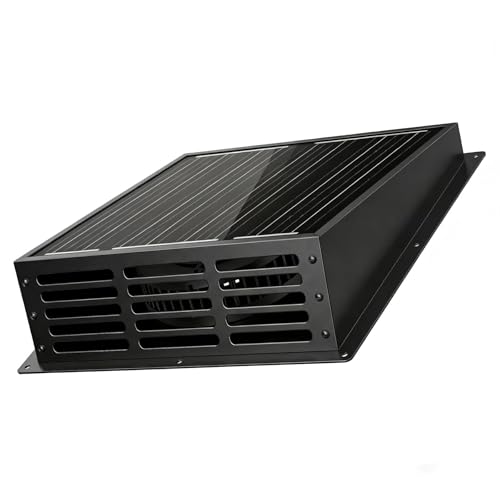
The PEAKROCK 25W Solar Powered Exhaust Fan is a compact ventilation unit for moving hot, damp, or stale air out of enclosed spaces. It is aimed at homeowners and gardeners managing greenhouses, chicken coops, sheds, detached garages, workshops, attics, RVs, and similar structures, especially where running electrical wiring is inconvenient.
Based on the listed specifications, the 2500 RPM motor can move up to 430 CFM of air during suitable sunlight. That airflow may help flush out heat and moisture during the day, while the product information states that it can reduce indoor temperatures by up to 15°F in the intended conditions. Actual results will depend on sunlight, structure size, intake openings, and how well the space allows air to circulate.
The fan measures 13.6 x 13 x 3 inches and includes a 12V monocrystalline solar panel. It starts automatically when sunlight reaches the panel, so there are no listed controls, battery connections, or complex electrical wiring to manage. Before installation, confirm that the roof or gable opening and mounting surface can accommodate the unit, and plan for a properly sealed installation to limit unwanted water entry.
For backyard use, this fan could suit a greenhouse that becomes excessively warm, a coop that needs daytime air exchange, or a shed and workshop with limited ventilation. Its battery-free design is also useful for remote garden buildings and other off-grid locations. The dual-layer safety mesh is intended to help prevent birds and small animals from contacting the blades.
The product information lists a UV-stabilized ABS housing, corrosion-resistant protective grill, and IP65 rating for outdoor use. Even so, the fan only operates in real time under direct sunlight, and the supplied details do not state its noise level, coverage area, included mounting hardware, or performance in low-light conditions. It is a practical option for daytime solar ventilation, while users needing quiet operation, nighttime airflow, or dependable performance during cloudy weather may prefer a model with additional power or battery support.
Best For / Avoid If
Best for buyers prioritizing
- Solar operation can provide daytime ventilation without connecting the fan to household electricity.
- High listed airflow gives it more potential for larger or hotter enclosed spaces than a small circulation fan.
- Battery-free construction reduces maintenance associated with battery storage, leaks, and replacement.
Consider another option if
- Because it relies on direct sunlight and has no listed battery, airflow may be limited or unavailable at night and during overcast conditions.
- Roof or gable installation may require careful sizing, sealing, and mounting work even though the product is described as easy to install.
- The supplied information does not specify included mounting hardware, noise level, or a recommended coverage area.

Pros
- Solar operation avoids routine electricity use and eliminates the need to run wiring to the installation site.
- 430 CFM airflow is a useful listed capacity for moving warm air in appropriately sized coops, sheds, or greenhouse spaces.
- Weather-resistant construction and an IP67 rating support outdoor placement according to the supplied specifications.
- Protective netting adds a safety feature for areas where poultry or small animals are nearby.
Cons
- Because there is no battery, ventilation may be limited or unavailable when direct sunlight is weak or absent.
- Installation requires creating a correctly sized 4.5-inch inner-diameter opening and securing the unit with screws.
- Gardeners needing adjustable airflow, stored power, or operation after dark may prefer a different ventilation setup.
The Chtoocy 25W Solar Fan is a solar-powered exhaust fan for ventilation in chicken coops, sheds, and greenhouses. It is most suitable for homeowners, poultry keepers, and gardeners who want to move warm air without connecting the structure to household electricity.
Based on the listed specifications, the brushless motor and optimized blades produce 430 CFM at 2500 RPM. That airflow can help remove hot, stagnant air from a suitably sized outdoor structure, although actual ventilation results will depend on the space, opening layout, and available sunlight.
The fan measures 13.6 x 13 x 3 inches and weighs 4.2 pounds. Installation requires a matching 4.5-inch inner-diameter hole, screws, and the supplied hardware. The product information describes the setup as wire-free, with no battery or extra solar panel rack, so placement should be planned around direct sunlight and secure mounting.
For backyard use, this fan may fit a coop wall, a garden shed, or a greenhouse where daytime heat buildup is a concern. The 25W monocrystalline solar panel is intended to power the fan automatically in sunlight, and tilting the panel toward direct sun is listed as a way to improve output and fan speed.
The listed IP67 rating, weather-resistant ABS plastic, metal grill, and double plastic protection net support outdoor use and help keep small animals away from the blades. However, the lack of a battery means it is not designed to store power for cloudy periods or nighttime operation. It is a sensible option for daytime, solar-dependent ventilation, while gardeners needing continuous or controllable airflow should consider another setup.
Best For / Avoid If
Best for buyers prioritizing
- Solar operation avoids routine electricity use and eliminates the need to run wiring to the installation site.
- 430 CFM airflow is a useful listed capacity for moving warm air in appropriately sized coops, sheds, or greenhouse spaces.
- Weather-resistant construction and an IP67 rating support outdoor placement according to the supplied specifications.
Consider another option if
- Because there is no battery, ventilation may be limited or unavailable when direct sunlight is weak or absent.
- Installation requires creating a correctly sized 4.5-inch inner-diameter opening and securing the unit with screws.
- Gardeners needing adjustable airflow, stored power, or operation after dark may prefer a different ventilation setup.
Pros
- Solar operation can reduce reliance on a nearby electrical outlet.
- Temperature-based switching provides more convenient ventilation management.
- Battery backup supports airflow beyond periods of direct sunlight.
- Compact dual-fan format fits a range of small ventilation projects.
Cons
- Solar output, fan performance, and battery charging may decrease in cloudy weather.
- The listed airflow is intended for spaces up to 850 cubic feet, so larger buildings may need a different ventilation solution.
- Installation requires choosing a suitable window or wall location and positioning the solar panel where it can receive useful sunlight.
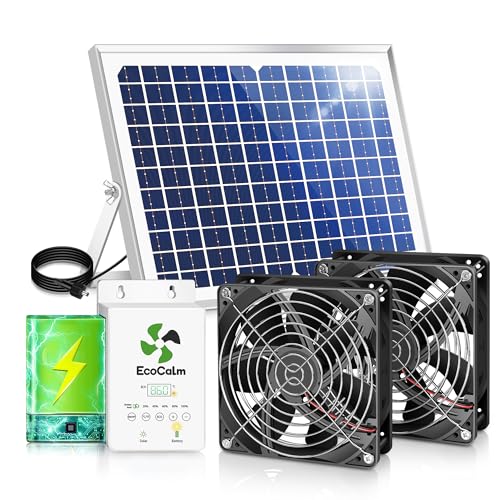
The ecoCalm Solar Exhaust Fan is a supplemental ventilation system for small outdoor structures such as chicken coops, greenhouses, garden sheds, garages, and animal houses. It uses two 5.5-inch fans, a solar panel, a rechargeable battery, and a temperature control system, making it a practical fit for homeowners who want automated airflow without depending entirely on a wired power source.
Based on the listed specifications, the fans deliver 169 CFM and are suggested for spaces up to 850 cubic feet. That airflow can help move stale or warm air out of a compact enclosure, while the adjustable thermostat allows the fan to switch on and off according to the temperature setting. This is useful where regular manual checks are inconvenient, such as a backyard coop or small greenhouse.
The unit is designed for window or wall mounting and measures 5.5 by 2 by 5.5 inches according to the supplied specifications. The cable listing includes 11.8 inches and 43.4 inches, which may help with placement between the fan and solar panel. Because mounting details and included hardware are not specified, confirm the opening size, mounting surface, cable route, and panel position before installation.
For backyard use, the fan could suit a small chicken coop that needs supplemental air movement, a greenhouse where extra exhaust is helpful during sunny periods, or a garden shed that becomes warm during the day. The battery is listed to provide up to 8 hours after a full charge in sunlight, but actual operation and charging will depend on available sunlight and weather conditions.
The fan blades are listed as IP44 waterproof, and the product includes a waterproof plug, but the specifications do not establish that every component is fully weatherproof. Position the solar panel and electrical connections carefully, follow the installation instructions, and keep the setup clear of animals, loose bedding, and obstructions. Gardeners with a small structure and good solar exposure may find this a convenient ventilation option, while those needing dependable airflow in larger spaces or consistently cloudy conditions may prefer a more powerful or mains-powered system.
Best For / Avoid If
Best for buyers prioritizing
- Solar operation can reduce reliance on a nearby electrical outlet.
- Temperature-based switching provides more convenient ventilation management.
- Battery backup supports airflow beyond periods of direct sunlight.
Consider another option if
- Solar output, fan performance, and battery charging may decrease in cloudy weather.
- The listed airflow is intended for spaces up to 850 cubic feet, so larger buildings may need a different ventilation solution.
- Installation requires choosing a suitable window or wall location and positioning the solar panel where it can receive useful sunlight.
Pros
- Useful off-grid design for locations without convenient electrical access
- Battery backup and multiple operating modes improve flexibility across changing conditions
- Dual fans can support either concentrated exhaust or cross-ventilation
- Protective guards and listed IP65 construction are practical features for outdoor animal housing
Cons
- The listed capacity is aimed at smaller spaces, and larger coops or structures may require additional units.
- Actual battery runtime and charging performance may vary with sunlight, weather, temperature, and operating mode.
- The controller may need sheltered placement in extremely low temperatures to help avoid battery performance issues.
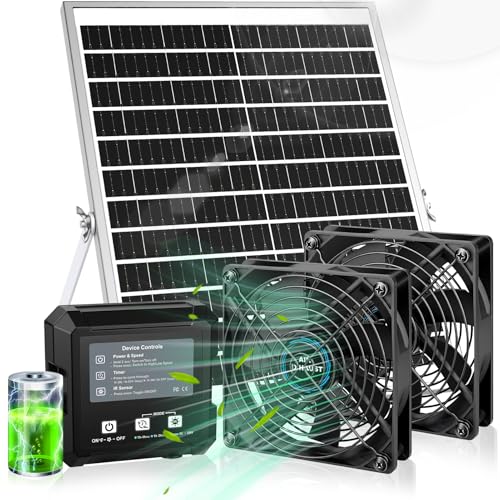
The TARKARI Solar-Powered Chicken Coop Exhaust Fan is a compact ventilation system for small animal shelters and other outdoor spaces. It includes a 25W solar panel, two 4.7-inch fans, a controller, and a built-in battery, making it a practical fit for chicken coops, dog houses, sheds, tents, RVs, or compact greenhouses without a nearby outlet.
Based on the listed specifications, each fan provides 120 CFM, for a combined listed airflow of 240 CFM when both are operating. The fans can be mounted on the same side for direct exhaust or arranged for cross-ventilation, which may help move stale air and odors through a small enclosure. Ventilation can improve air movement, but the product should not be treated as a substitute for a properly sized housing design.
The system offers high and low settings, timer options, and an infrared sensor mode. In sensor mode, the fan runs for 10 minutes after detecting an animal and then stops automatically. The controller memory feature retains the previous setting after a restart, while the included 3-meter fan-to-controller and 3-meter controller-to-panel cables allow more flexible positioning during installation.
For backyard use, this setup could suit a detached chicken coop or pet house where running electrical wiring would be inconvenient. In a small greenhouse or shed, the two fans may be arranged to create a simple intake-and-exhaust pattern, although the available airflow and enclosure layout should be considered before relying on it for temperature control.
The panel and housing are listed as IP65 rated, and the fans include protective guards, but careful placement is still important around animals and outdoor structures. The controller should be installed inside a shelter in extremely low temperatures, and users should account for reduced charging or runtime during extended cloudy weather. The product information does not specify maintenance requirements, mounting dimensions, or noise level.
This fan kit is a reasonable option for gardeners and poultry keepers who need solar-powered ventilation for a small off-grid space and value automatic operating modes. Those ventilating a larger coop, greenhouse, or shed may prefer a higher-capacity system or multiple units after evaluating the structure's airflow needs.
Best For / Avoid If
Best for buyers prioritizing
- Useful off-grid design for locations without convenient electrical access
- Battery backup and multiple operating modes improve flexibility across changing conditions
- Dual fans can support either concentrated exhaust or cross-ventilation
Consider another option if
- The listed capacity is aimed at smaller spaces, and larger coops or structures may require additional units.
- Actual battery runtime and charging performance may vary with sunlight, weather, temperature, and operating mode.
- The controller may need sheltered placement in extremely low temperatures to help avoid battery performance issues.
Pros
- Works without grid electricity when adequate sunlight is available.
- Weather-oriented construction and a waterproof motor rating support outdoor ventilation applications.
- Useful across several backyard and small-farm spaces, not just residential attics.
- Listed low operating noise may be more comfortable near living or working areas.
Cons
- Ventilation output depends on available sunlight, and the supplied information does not mention battery storage or nighttime operation.
- Roof installation may require careful weatherproofing and safe work practices, even though the system is described as DIY-friendly.
- The product information does not specify adjustable controls, thermostat operation, or a backup power option.
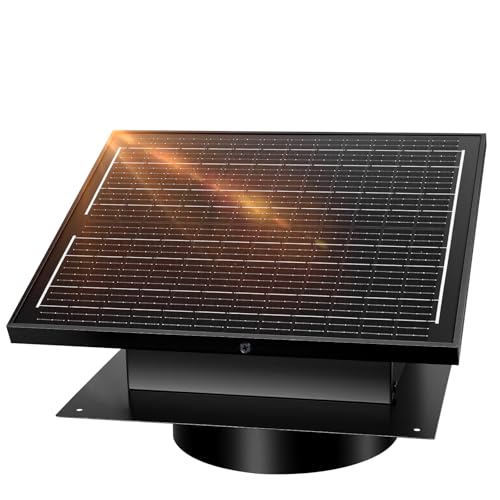
The HNRLOY solar attic exhaust fan is a roof-mounted ventilation unit for moving heated, damp, or stale air from enclosed spaces. For gardeners, its most relevant uses are ventilating a greenhouse, farm shed, storage room, or other outbuilding where air circulation matters and grid power may not be convenient. It may suit homeowners and small-scale growers who want a solar-powered ventilation approach rather than running a dedicated electrical line.
Based on the listed specifications, the fan is designed to provide up to 2,500 CFM of airflow and is described for areas up to 3,000 square feet. In a greenhouse or garden shed, moving hot air outward may help reduce stuffy conditions and remove moist air, although actual results will depend on the building layout, intake openings, sunlight, and weather. The solar panel supplies power during suitable daylight conditions, so it is best viewed as a daytime ventilation solution unless another power arrangement is provided.
The unit measures 16.9 by 14.5 by 10 inches and is listed in a 10-inch size. Its galvanized steel casing, corrosion-resistant coating, aluminum mesh, and IP68 waterproof motor rating are intended for outdoor exposure. The listed 43 dB operating level suggests a relatively quiet fan for placement near a home, greenhouse workspace, or backyard storage area. No thermostat, speed control, battery, or automatic scheduling feature is identified in the supplied information.
Potential applications include exhausting heat from a sunny greenhouse, improving air movement in a garden tool shed, or helping remove damp air from a barn or storage building. The fan can also be considered for garages and attics, especially where sunlight reaches the solar panel and the structure has a suitable opening for exhausting air. Proper intake ventilation is important because an exhaust fan cannot move air effectively if replacement air has nowhere to enter.
Installation includes hardware and a detailed manual, but roof work still requires careful measuring, sealing, and safe access to help prevent leaks. Check the mounting location, panel exposure, and local building requirements before installation, and consider professional help if the roof structure or working height presents a safety concern. Overall, this fan is a reasonable option for gardeners needing daytime, off-grid ventilation in a greenhouse or outbuilding, while users who need nighttime operation, automatic temperature control, or guaranteed moisture management should consider a system with those features clearly specified.
Best For / Avoid If
Best for buyers prioritizing
- Works without grid electricity when adequate sunlight is available.
- Weather-oriented construction and a waterproof motor rating support outdoor ventilation applications.
- Useful across several backyard and small-farm spaces, not just residential attics.
Consider another option if
- Ventilation output depends on available sunlight, and the supplied information does not mention battery storage or nighttime operation.
- Roof installation may require careful weatherproofing and safe work practices, even though the system is described as DIY-friendly.
- The product information does not specify adjustable controls, thermostat operation, or a backup power option.

Pros
- Flexible two-fan configuration for different intake and exhaust layouts.
- Solar operation can avoid adding routine electrical use for daytime ventilation.
- Outdoor-focused construction includes a weatherproofed kit, metal guards, and a stated operating range of -13°F to 140°F.
Cons
- There is no built-in battery, so the fans stop at night and on rainy conditions, while airflow can weaken in limited sunlight.
- The specifications do not provide an airflow rating or recommended coverage area, making sizing for a particular greenhouse or attic difficult.
- Installation may require choosing suitable mounting locations and ensuring the solar panel receives sufficient sunlight.
The FDJTPOIU solar powered fan kit is designed to move air through outdoor and semi-enclosed spaces, including chicken coops, pet houses, attics, sheds, and greenhouses. Its two separate 5-inch fans make it a practical option for homeowners who need daytime ventilation without relying on a standard electrical connection.
A 25W solar panel powers both fans and is intended to help exhaust hot indoor air and bring fresher air into the space. The two fans can be set up as exhaust fans, intake fans, or one of each, giving gardeners more flexibility when planning airflow through a small structure.
The listed kit includes installation guidance, fix plates, and a screw kit. The product information lists dimensions of 18 x 12 x 18 inches and a weight of 1 pound. The weatherproofed design, shockproof and drop-resistant housing, and outer metal mesh are intended for outdoor use, while the guards help keep children and small animals away from the fan blades.
In a backyard setting, the kit could be useful for a sunny greenhouse, shed, chicken coop, or pet shelter that becomes hot during the day. It may also fit small ventilation projects where separate intake and exhaust positions are helpful, although the supplied specifications do not state an airflow rating or coverage area.
The main limitation is its dependence on sunlight. There is no built-in battery, airflow strength varies with sunlight intensity, and the fans stop at night and on rainy days. Position the solar panel where it can receive sufficient sunlight, follow the installation guidance, and keep the guarded fans securely mounted. Based on the listed features, this kit is a reasonable choice for daytime ventilation in small outdoor structures, while gardeners needing continuous overnight or weather-independent operation should consider a system with battery storage or another power source.
Best For / Avoid If
Best for buyers prioritizing
- Flexible two-fan configuration for different intake and exhaust layouts.
- Solar operation can avoid adding routine electrical use for daytime ventilation.
- Outdoor-focused construction includes a weatherproofed kit, metal guards, and a stated operating range of -13°F to 140°F.
Consider another option if
- There is no built-in battery, so the fans stop at night and on rainy conditions, while airflow can weaken in limited sunlight.
- The specifications do not provide an airflow rating or recommended coverage area, making sizing for a particular greenhouse or attic difficult.
- Installation may require choosing suitable mounting locations and ensuring the solar panel receives sufficient sunlight.

Pros
- Operates off-grid using solar charging and a built-in battery.
- Flexible panel placement can help accommodate shaded installation areas.
- Two speed settings and a listed 35dB maximum noise level support adaptable, quieter ventilation.
Cons
- The listed dimensions are shown as 1 x 1 x 1 inches, so buyers should confirm the actual fan and panel measurements before planning a cutout or mounting location.
- Performance depends on available sunlight, and the stated runtime assumes a fully charged battery.
- A 7.1-inch fan may be less suitable for ventilating large buildings or spaces that need high-volume air exchange.
The ladate solar exhaust fan is a compact off-grid ventilation option for sheds, greenhouses, chicken coops, dog kennels, workshops, storage rooms, and similar backyard spaces. Its solar panel and built-in battery make it relevant for homeowners who do not have convenient electrical power at the installation site.
Based on the listed specifications, the 25W solar panel charges the 24000mAh battery in approximately 6 to 8 hours of direct sunlight, while a full charge is claimed to support 8 to 12 hours of operation. That makes the fan useful for continuing air exchange after daylight, although actual results can vary with sunlight, speed setting, and operating conditions.
The fan has high and low speed controls, so users can choose stronger airflow when a space feels hot or more moderate circulation when quieter operation is preferred. The product information lists a maximum noise level of 35dB. The 16.4-foot waterproof cable also provides flexibility when the fan needs to be installed in shade but the solar panel can be positioned in a sunnier location.
For backyard use, this fan could suit a shed that becomes warm during the day, a small greenhouse needing additional air movement, or a chicken coop where gentle ventilation is desirable. The included brackets, screws, nuts, and installation guide are intended to support setup, but buyers should confirm the actual mounting dimensions before cutting openings or selecting a mounting surface.
The product information describes the fan as IP65 weatherproof and made with corrosion-resistant materials, but installation should still follow the supplied instructions and place the components where the solar panel can receive direct sunlight. The listed product dimensions of 1 x 1 x 1 inches appear incomplete or inconsistent with a 7.1-inch fan, so measurement verification is important. This is a practical choice for small off-grid ventilation projects, while gardeners needing ventilation for a large structure or higher air volume may prefer a larger system.
Best For / Avoid If
Best for buyers prioritizing
- Operates off-grid using solar charging and a built-in battery.
- Flexible panel placement can help accommodate shaded installation areas.
- Two speed settings and a listed 35dB maximum noise level support adaptable, quieter ventilation.
Consider another option if
- The listed dimensions are shown as 1 x 1 x 1 inches, so buyers should confirm the actual fan and panel measurements before planning a cutout or mounting location.
- Performance depends on available sunlight, and the stated runtime assumes a fully charged battery.
- A 7.1-inch fan may be less suitable for ventilating large buildings or spaces that need high-volume air exchange.

Pros
- Runs on solar power alone, so it can ventilate structures located far from any electrical outlet.
- Flexible enough for greenhouses, coops, sheds, and pet houses, which adds value if you maintain more than one outbuilding.
- Compact 8-inch size fits small enclosures and tight mounting spots.
- With no controls indicated in the available information, operation is essentially automatic whenever sunlight is strong enough.
Cons
- Airflow depends entirely on available sunlight, so output may drop on overcast days, in shaded mounting spots, or after dark.
- Because no battery backup is listed, the fan will not provide overnight ventilation, which may matter for coops or pet houses in warm climates.
- Detailed specifications such as airflow rating, housing material, and included mounting hardware are not provided, so gardeners with large structures may want to confirm fit before buying.
The Blessny 8-inch solar exhaust fan is a small, self-contained ventilation unit built around a 25W solar panel and designed for outdoor air circulation in enclosed backyard structures. The product information lists four intended settings: greenhouses, chicken coops, sheds, and pet houses. That combination makes it a practical option for gardeners and small-homestead keepers who want to move stale air out of a closed space without running electrical service to a detached building.
The main appeal is the solar-powered design. Because the fan draws its power from sunlight rather than a wall outlet, there is no wiring trench, no extension cord stretched across the yard, and no added cost on an electric bill. The 25W rating suggests output appropriate for a compact fan, and daylight operation lines up naturally with the hours when a closed greenhouse or coop traps the most warm, stale air. An exhaust-style fan works by pushing inside air out, which encourages fresher air to be drawn in through vents, cracks, or openings elsewhere in the structure.
In terms of design, the 8-inch fan is a compact size that suits small structures. It can mount in a shed wall, a coop gable, or a greenhouse vent opening without dominating the space. The available information does not include detailed specifications such as airflow rating, housing material, or mounting hardware, so plan for a straightforward do-it-yourself installation and confirm the opening dimensions on your structure before ordering. Placement matters with any solar fan: the panel needs direct sun for most of the day, and the fan should sit high in the structure, since warm air rises and exhausts most effectively near the roofline.
Realistic backyard uses are easy to picture. In a greenhouse, daytime ventilation helps moderate the hot, humid air that builds up under glazing on sunny days. In a chicken coop, steady air exchange helps limit the stale, damp conditions that can settle into bedding areas. A closed shed benefits from airflow in place of stagnant air, and a pet house gains circulation on warm afternoons. In each case the fan is best understood as a helper for air exchange rather than a cooling system; it moves air, it does not refrigerate the space.
Limitations are worth weighing. A solar fan without a listed battery will only run while sunlight is strong, so output can drop on cloudy days and stops at night. If overnight ventilation is a priority for a coop or pet house in a hot climate, a battery-backed or plug-in model may serve better. Maintenance is simple but not zero: keep the panel surface clear of dust, pollen, and leaves so it can perform efficiently, and in a coop or pet house, mount the fan and any wiring where curious animals cannot reach the blades.
As a verdict, this fan fits gardeners who want simple, off-grid ventilation for a small greenhouse, coop, shed, or pet house and who are comfortable with a basic mounting job. It is a sensible pick for detached structures where an outlet is not an option. Gardeners managing a large greenhouse, needing reliable overnight airflow, or wanting fully documented performance specifications may prefer a larger or mains-powered ventilation fan.
Best For / Avoid If
Best for buyers prioritizing
- Runs on solar power alone, so it can ventilate structures located far from any electrical outlet.
- Flexible enough for greenhouses, coops, sheds, and pet houses, which adds value if you maintain more than one outbuilding.
- Compact 8-inch size fits small enclosures and tight mounting spots.
Consider another option if
- Airflow depends entirely on available sunlight, so output may drop on overcast days, in shaded mounting spots, or after dark.
- Because no battery backup is listed, the fan will not provide overnight ventilation, which may matter for coops or pet houses in warm climates.
- Detailed specifications such as airflow rating, housing material, and included mounting hardware are not provided, so gardeners with large structures may want to confirm fit before buying.
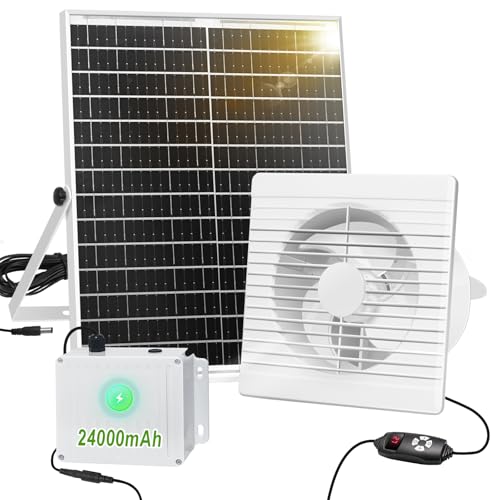
Pros
- Solar charging with a 24000mAh battery supports ventilation when sunlight is no longer available.
- Separate controls for speed and timed operation make routine use more flexible.
- The long cable allows more freedom when placing the solar panel for sun exposure.
- Suitable for several small-space applications, including greenhouses, sheds, chicken coops, garages, and pet houses.
Cons
- Installation requires drilling a hole approximately 7.28 to 7.48 inches wide, so it may not suit renters or users seeking a no-tools setup.
- Performance depends on available sunlight and the panel's placement, particularly when extended battery operation is needed.
- Gardeners needing ventilation for a large building or broad growing area may prefer a higher-capacity system designed for larger spaces.
The HelpLand solar exhaust fan is designed to move air through small enclosed spaces such as greenhouses, chicken coops, sheds, pet houses, garages, barns, and similar outdoor areas. Its solar power design makes it a practical option for homeowners who want ventilation without relying on a nearby electrical outlet.
Based on the listed specifications, the 25W solar panel charges a 24000mAh battery that can support operation after sunset. The product information indicates up to 8 to 10 hours of continuous running after a full charge, which may help maintain airflow during evening and nighttime periods when direct solar power is unavailable.
The fan provides two speed settings, along with separate on, off, and 1 to 8-hour cyclic timer controls. Installation requires drilling a hole approximately 7.28 to 7.48 inches wide and connecting the fan to the solar panel. The panel can be repositioned, and its 14.7-foot cable may help place it on a roof or another sunny location while keeping the fan at the ventilation opening.
For backyard use, this fan could help circulate air in a compact greenhouse, garden shed, chicken coop, or pet shelter. It may also be useful in a small garage, attic, basement, RV, or outdoor camping setup where solar-powered air movement is preferred. The two speeds allow users to adjust airflow for different spaces and conditions.
The product information lists IP65-rated fan blades and a waterproof plug for outdoor use, but installation should still keep electrical connections properly positioned and protected according to the instructions. Sun exposure will affect charging, so shaded locations or prolonged cloudy weather may reduce available runtime. Overall, it is a reasonable fit for small structures needing supplemental ventilation, while larger buildings may require a more powerful or dedicated ventilation system.
Best For / Avoid If
Best for buyers prioritizing
- Solar charging with a 24000mAh battery supports ventilation when sunlight is no longer available.
- Separate controls for speed and timed operation make routine use more flexible.
- The long cable allows more freedom when placing the solar panel for sun exposure.
Consider another option if
- Installation requires drilling a hole approximately 7.28 to 7.48 inches wide, so it may not suit renters or users seeking a no-tools setup.
- Performance depends on available sunlight and the panel's placement, particularly when extended battery operation is needed.
- Gardeners needing ventilation for a large building or broad growing area may prefer a higher-capacity system designed for larger spaces.
Guía de compra de ventiladores solares de ventilación para invernaderos
Adapta el tamaño y el flujo de aire del ventilador a tu invernadero
El punto de partida más útil es el tamaño del espacio que necesitas ventilar. Ecocalm indica que su ventilador de extracción solar de 12 pulgadas Solar Exhaust Fan 12“ for Greenhouse with Smart Thermostat, Battery ofrece 720 CFM y es adecuado para espacios de hasta 1600 ft³, mientras que el modelo Ecocalm Solar Fan 8″ with Adjustable Thermostat and Battery ofrece 220 CFM para espacios de hasta 380 ft³. SHENVITASO indica 430 CFM para su ventilador de 8 pulgadas, y PQINS señala que su ventilador de 7.1 pulgadas es adecuado para entre 80 y 120 sq. ft.
Para un pequeño invernadero de afición, un ventilador compacto de 7.1 o 8 pulgadas puede ser suficiente si la estructura ya cuenta con respiraderos o una puerta que permita la entrada de aire. Para un invernadero más grande o una estructura de jardín tipo cobertizo, un ventilador de 10 o 12 pulgadas de la lista proporcionada puede ser una opción más adecuada. Compara siempre el flujo de aire o la cobertura indicados por el producto con el espacio cerrado real antes de comprar.
Decide si necesitas una batería de respaldo
Algunos ventiladores solares solo funcionan cuando el panel recibe suficiente luz solar. PQINS señala claramente que su 7.1″ Large Solar Greenhouse Fan no tiene batería integrada y recibe la alimentación directamente del panel solar, por lo que el flujo de aire disminuye en días nublados o al anochecer. Aun así, puede funcionar para jardineros que principalmente necesitan aliviar el calor del mediodía.
Si quieres ventilación después de la puesta de sol o durante periodos nublados, busca una batería indicada en las especificaciones. Ropelux incluye una batería de 18000mAh con hasta 10 horas de funcionamiento sin luz solar, según los datos proporcionados. El modelo de 12 pulgadas de Ecocalm indica una batería de 5000mAh con 6 horas después de una carga completa, mientras que el modelo de 8 pulgadas de Ecocalm indica una batería de 4400mAh con hasta 8 horas después de una carga completa. El rendimiento de la batería también depende de las condiciones de luz solar y de la ubicación del panel.
Ten en cuenta los termostatos, temporizadores y controles manuales
Los controles pueden facilitar el uso diario de un ventilador solar de ventilación para invernadero, especialmente para los jardineros que no quieren ajustar el ventilador varias veces al día. Los modelos de 12 y 8 pulgadas de Ecocalm indican un control de temperatura ajustable que puede encender y apagar automáticamente el ventilador según la temperatura ambiente seleccionada.
Ropelux utiliza un enfoque diferente, con dos modos de temporizador: Day + 3 Hours y Day + 6 Hours después de la puesta de sol. SHENVITASO incluye un interruptor ON/OFF independiente para el control manual. Para las personas mayores o cualquiera que valore la comodidad, puede ser prioritario elegir un termostato o un interruptor sencillo en lugar de un ventilador solar básico que solo funcione con luz solar.
Comprueba el tipo, la potencia y la ubicación del panel solar
La ventilación solar depende en gran medida de la exposición del panel. SHENVITASO indica un panel solar de alta eficiencia de 25W con soportes ajustables y una eficiencia de conversión fotovoltaica de hasta el 21.5%. PQINS indica paneles solares monocristalinos de mayor tamaño, mientras que el producto 25W Solar Powered Exhaust Fan, 430 CFM High Airflow Attic Fan incluye un panel monocristalino de 12V en el título.
Los paneles bifaciales pueden captar luz por ambos lados cuando se instalan en una ubicación adecuada. El modelo de 12 pulgadas de Ecocalm incluye dos paneles bifaciales de 30W y especifica una generación de hasta 48W, mientras que el modelo Ecocalm de 8 pulgadas indica un panel trasero transparente de 16W con hasta 41W. Evita colocar los paneles donde la sombra de los árboles, la estructura del invernadero o el tejado de un cobertizo cercano bloquee el sol del mediodía.
Revisa las clasificaciones meteorológicas y los detalles de uso exterior
Los equipos para invernaderos suelen estar expuestos a humedad, salpicaduras, condensación y cambios meteorológicos. Los datos proporcionados indican un diseño impermeable IP67 para el ventilador PQINS y una clasificación de impermeabilidad IP67 para el panel solar SHENVITASO. Ecocalm indica aspas de ventilador impermeables IP44 en su modelo de 12 pulgadas y aspas impermeables IP44 con un enchufe resistente al agua en su modelo de 8 pulgadas. El producto 25W Solar Exhausted Fan with Battery incluye IP65 waterproof en su título, y el 32W Solar Powered Attic Exhaust Fan with 10″ Roof Vent incluye IP68 waterproof en su título.
Las clasificaciones de impermeabilidad son útiles, pero no sustituyen una instalación cuidadosa. Sigue las instrucciones de montaje del fabricante, protege las conexiones eléctricas según se indique y coloca el ventilador de modo que el agua no se acumule alrededor de la carcasa o el cableado. Si utilizas tu invernadero durante todo el año, también puedes comparar las necesidades de ventilación y calefacción en nuestra guía de calefactores para invernadero con termostato.
Planifica la instalación antes de comprar
Los detalles de instalación varían. SHENVITASO indica que la instalación requiere perforar un orificio de 7 pulgadas y realizar una conexión eléctrica al panel solar, e incluye tornillos y soporte. El ventilador de 12 pulgadas de Ecocalm puede montarse en una ventana o pared e incluye un cable de 14.8 ft. PQINS incluye materiales de instalación, un soporte, placas de hierro, tornillos, bridas de nailon y un cable plug-and-play que puede pasarse por orificios pequeños.
Antes de hacer el pedido, decide si el ventilador expulsará el aire caliente, introducirá aire más fresco o funcionará junto con otra abertura de ventilación. PQINS indica que el ventilador y el panel solar están separados y que el ventilador puede utilizarse para extracción o entrada de aire. En invernaderos y cobertizos pequeños, también conviene mantener las herramientas y los suministros almacenados fuera del recorrido del aire; nuestra guía sobre cómo organizar un cobertizo de jardín pequeño puede ayudarte si tu estructura de jardín también sirve como almacén.
Compara el ruido y la comodidad cuando se indiquen
No todos los productos incluyen datos sobre el ruido, por lo que solo deben utilizarse cuando se proporcionen. Ropelux indica entre 36 y 40 decibelios para un funcionamiento silencioso, y SHENVITASO indica 36 decibelios a velocidad máxima. Estos detalles pueden ser importantes si el ventilador está cerca de un patio, banco de trabajo, gallinero, caseta para perros o un invernadero donde pasas tiempo cuidando las plantas.
Para mejorar la comodidad y la accesibilidad, piensa también en dónde estarán el interruptor, la caja de la batería o el termostato. Una ubicación accesible para los controles resulta más sencilla para las personas mayores y para cualquiera que quiera evitar subir, estirarse o entrar en el invernadero durante las horas de máximo calor.
Evita los errores de compra más habituales
El error más importante es suponer que todos los ventiladores solares funcionan de noche. Algunos productos necesitan luz solar directa salvo que incluyan una batería u otra opción de alimentación. Otro error frecuente es comprar un ventilador sin comprobar si el invernadero tiene suficiente entrada de aire; un ventilador de extracción necesita aire de sustitución para mover el aire de forma eficiente por el espacio.
Evita también basarte únicamente en el diámetro del ventilador. Un ventilador más pequeño con batería, termostato o adaptador puede adaptarse mejor a un jardinero que una unidad más grande que solo funcione durante el día. Si tus herramientas de jardín están amontonadas en la misma zona, una solución de almacenamiento resistente a la intemperie, como un arcón de terraza para herramientas de jardín, puede ayudarte a mantener los cables, paneles y accesorios más organizados.
Metodología de investigación y confianza
Esta es una guía de compra basada en investigación, no una prueba física y práctica. Revisamos los datos de productos proporcionados según su relevancia para las necesidades de los ventiladores solares de ventilación para invernaderos y excluimos de nuestro análisis las afirmaciones no respaldadas. Consideramos relevantes los productos cuyos nombres, descripciones o características indicadas coincidían claramente con la ventilación alimentada por energía solar para invernaderos, cobertizos, gallineros o estructuras de jardín similares.
Nuestra comparación hizo hincapié en factores específicos de la categoría Invernaderos y almacenamiento de jardín: capacidad de ventilación cuando se indicaba, tamaño del ventilador, potencia y tipo del panel solar, presencia de batería, controles de termostato o temporizador, longitud del cable, clasificación de impermeabilidad cuando se proporcionaba, detalles de instalación y adaptación a espacios de jardín pequeños. También anotamos señales de opinión de propietarios, como la valoración y el número de reseñas cuando estaban disponibles, pero no tratamos las valoraciones como sustituto de las especificaciones.
Durante las actualizaciones de julio, comprobamos la lista de productos proporcionada frente al tema solicitado y utilizamos únicamente los nombres, marcas, precios, valoraciones, descripciones y características disponibles. Cuando no se proporcionaron marcas o detalles de características para algunos artículos, limitamos la discusión a la información presente en el título, el precio, la valoración y el número de reseñas.
Recomendaciones finales
Mejor opción general: Solar Exhaust Fan 12“ for Greenhouse with Smart Thermostat, Battery | Solar Powered Attic Fans, 2PCS 30W Bifacial Panels, Metal Build, Waterproof, Stable, for Outdoor, Garage, Shed, Chicken coop. Según las especificaciones indicadas, destaca por su ventilador de 12 pulgadas, flujo de aire de 720 CFM, dos paneles bifaciales de 30W, batería de respaldo, control de temperatura ajustable y adecuación para espacios de hasta 1600 ft³.
Mejor opción para espacios pequeños: 7.1″ Large Solar Greenhouse Fan, 25W Solar Powered Vent Exhaust and Intake Chicken Coop Fan Outdoor Waterproof, 16.5 ft Cord, Strong Airflow for Shed Doghouse Cabin Ventilation Air Circulation. Está claramente orientado a pequeños invernaderos, indica una adecuación de entre 80 y 120 sq. ft., incluye materiales de instalación y puede utilizarse para extracción o entrada de aire, pero no incluye una batería integrada.
Mejor opción para principiantes: Solar Exhaust Fan, 25W Solar Panel + 8″ Ventilation Vent Fan, with Power Adapter, Anti-backflow Valve, High Speed Solar Powered Exhaust Fan with Bracket for Shed, Chicken Coop, Greenhouse, Dog House. El modelo de SHENVITASO indica un panel de 25W, un flujo de aire de 430 CFM, un adaptador de corriente para uso diurno y nocturno, una válvula antirretorno, un interruptor ON/OFF independiente y un proceso de instalación descrito, por lo que puede ser una opción práctica para jardineros que quieren detalles claros de montaje.
Preguntas frecuentes
¿Qué tamaño de ventilador solar de ventilación para invernadero necesito?
Empieza por el tamaño del espacio cerrado y compáralo con los CFM o la cobertura indicados por el producto. Por ejemplo, Ecocalm indica 720 CFM para espacios de hasta 1600 ft³ en su modelo de 12 pulgadas, mientras que PQINS indica una adecuación de entre 80 y 120 sq. ft. para su ventilador de 7.1 pulgadas.
¿Funcionará de noche un ventilador solar de ventilación para invernadero?
Solo algunos modelos están diseñados para funcionar de noche o durante días nublados. Busca una batería, un temporizador o un adaptador de corriente indicado en las especificaciones, como la batería de 18000mAh de Ropelux, los modelos con batería de Ecocalm o el modelo de SHENVITASO con adaptador de corriente.
¿Merece la pena tener un termostato en un ventilador solar de ventilación para invernadero?
Un termostato puede ser útil si quieres que el ventilador se encienda y apague automáticamente según la temperatura. Los modelos de 12 y 8 pulgadas de Ecocalm incluidos en los datos indican un control de temperatura ajustable, lo que puede ayudar a los jardineros que prefieren reducir los ajustes manuales.
¿Puedo usar un ventilador solar de ventilación también en un cobertizo o gallinero?
Muchos de los productos proporcionados indican que pueden utilizarse en cobertizos, gallineros, garajes, casetas para perros o áticos, además de invernaderos. Comprueba los usos previstos, el flujo de aire, los requisitos de instalación y las instrucciones de seguridad indicados por el producto antes de utilizarlo fuera de un invernadero.
¿Cómo debo mantener un ventilador solar de ventilación para invernadero?
Mantén el panel solar libre de suciedad, hojas y sombra, e inspecciona periódicamente las rejillas del ventilador, los cables y los elementos de montaje. Sigue las instrucciones de seguridad y limpieza del fabricante, especialmente en lo relativo a las cajas de batería, los enchufes y las conexiones eléctricas exteriores.
¿Dónde debo colocar un ventilador solar de ventilación para invernadero?
Coloca el ventilador donde pueda expulsar el aire caliente o favorecer la entrada de aire sin quedar bloqueado por estanterías, herramientas almacenadas o el follaje de las plantas. El panel solar debe orientarse para recibir una buena exposición al sol, utilizando el soporte o los elementos de montaje incluidos cuando se proporcionen.