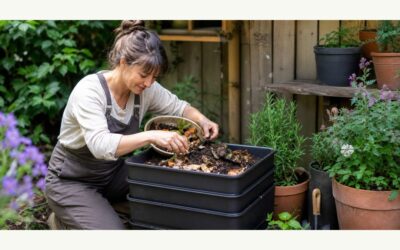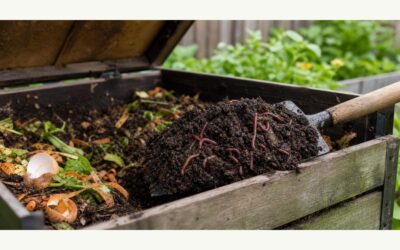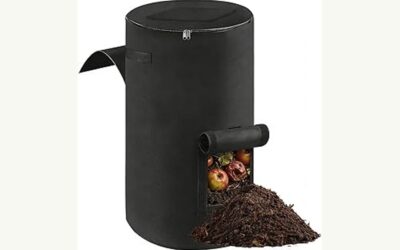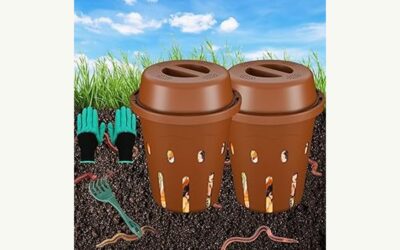


Commencer le compostage peut sembler compliqué si vous imaginez un tas ouvert qu’il faut creuser, soulever et retourner constamment. Un composteur rotatif offre aux débutants une méthode plus propre pour mélanger les déchets de cuisine et du jardin, car le tambour tourne au lieu de nécessiter un retournement manuel.
Ce guide du meilleur composteur rotatif pour débutants compare l’ensemble fourni de 15 produits, puis concentre ses recommandations sur les modèles qui correspondent clairement au compostage rotatif extérieur. Nous avons recherché une capacité adaptée aux débutants, une conception à double compartiment, une bonne aération, un accès par porte coulissante, un effort de rotation raisonnable, des informations sur l’assemblage, des éléments de stabilité et une installation adaptée aux terrasses, aux coins de potagers surélevés et aux petits jardins. Pour découvrir d’autres outils et amendements destinés à améliorer le sol, consultez notre catégorie Compost, Soil & Mulch.
La fourchette de prix fournie va de $14.40 à $179.95 et comprend FCMPOutdoor, F2C, HealthyPonds et d’autres marques. Tous les articles listés ne sont pas des composteurs rotatifs : les bacs à déchets de cuisine à poser sur le plan de travail et les additifs pour compost sont donc considérés comme des articles complémentaires plutôt que comme des recommandations finales de composteurs.
FCMP Outdoor IM4000 Dual-Chamber Tumbling Composter for Continuous Kitchen and Yard Waste Composting VIVOSUN 43 Gallon Dual-Chamber Tumbling Composter for Easier Backyard Compost Mixing Nazhura 43-Gallon Dual Chamber Compost Tumbler for Continuous Backyard Composting Miracle-Gro Dual Chamber Compost Tumbler for Steady Backyard Composting Prices and availability can change. We may earn a commission from qualifying purchases.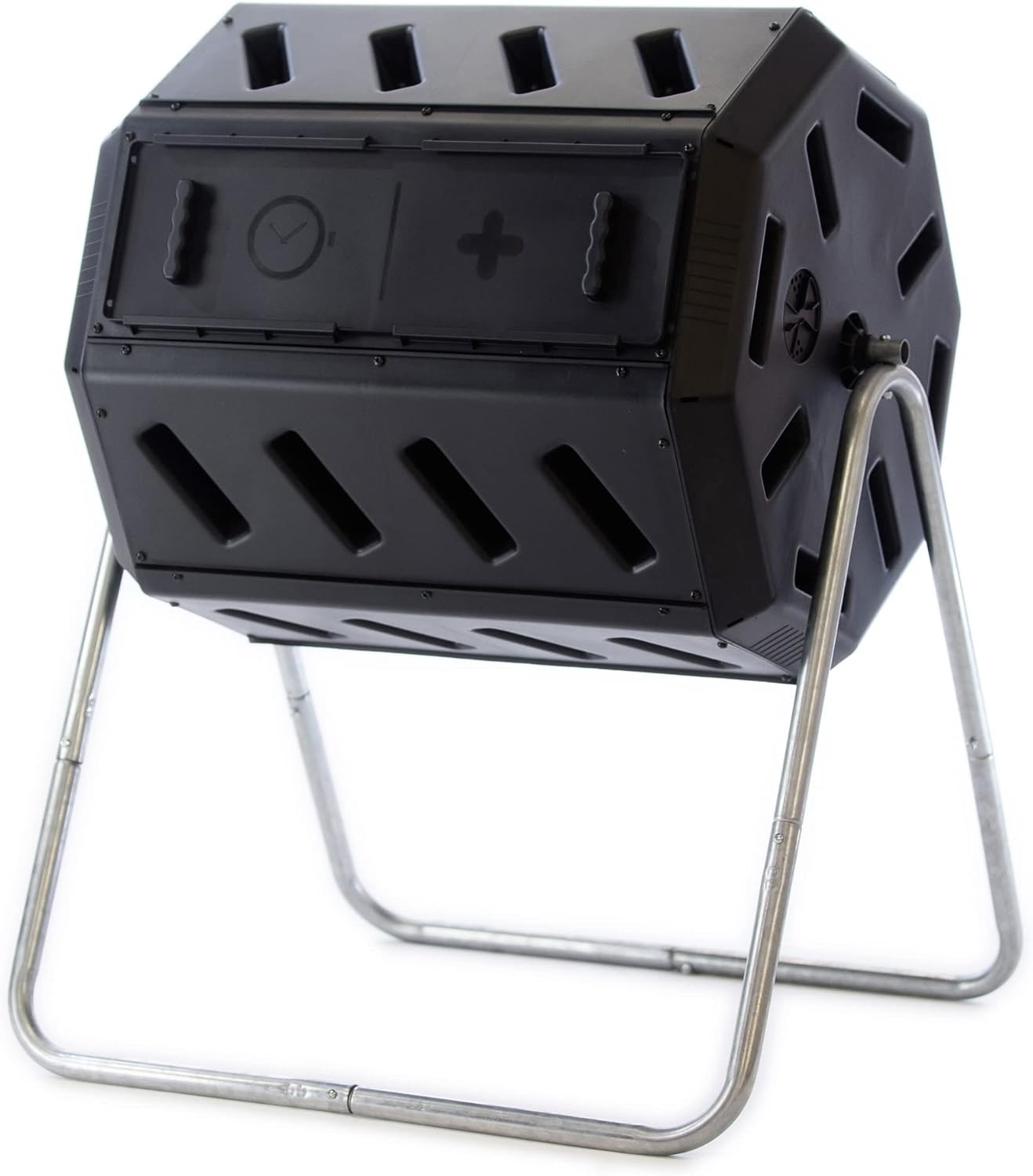


Certaines fiches ci-dessous restent en anglais ; leur traduction est en cours de révision.
Pros
- Two-chamber layout supports batch composting instead of mixing fresh waste into nearly finished compost.
- Elevated rotating design helps reduce direct ground contact and makes routine turning simpler than managing an open pile.
- BPA-free, UV-inhibited polypropylene is listed as contact safe and intended to resist fading and damage from direct sunlight.
- Octagonal shape and built-in hand holds are designed to make rotation easier during regular maintenance.
- Made in Canada from 100% post-consumer recycled resin, according to the product information.
Cons
- Compost timing depends on warm conditions and balanced ingredients, so the listed two-week result should not be expected in every climate or season.
- At 30 inches long by 28 inches wide by 36 inches high, it may need more dedicated space than very compact countertop or worm composting options.
- Gardeners who produce large volumes of leaves, grass clippings, or livestock bedding may prefer a larger composting system.
The FCMP Outdoor IM4000 is a 37-gallon tumbling composter built for turning kitchen scraps and yard waste into garden compost without maintaining an open pile. Its dual-chamber layout is especially useful for homeowners, beginner composters, and small-space gardeners who want a more organized way to manage compost in batches.
The main advantage is the two-sided system. One chamber can be filled with fresh material while the other side cures, which helps avoid the common problem of continually adding scraps to compost that is almost finished. The product information recommends rotating the bin 5 to 6 times every 2 to 3 days for best results, and notes that compost can be ready in as little as two weeks in warm, sunny conditions with balanced ingredients.
Based on the listed specifications, the IM4000 measures 30 inches long by 28 inches wide by 36 inches high and weighs 28 pounds. The 8-sided polypropylene body includes deep fins for gripping and mixing, aeration holes for airflow, wide openings, and a removable door for loading and unloading. The frame is galvanized steel, and the plastic is described as BPA-free, UV-inhibited, and made from 100% post-consumer recycled resin.
For backyard gardens, raised-bed growers, and patio-adjacent composting areas, this style of elevated tumbler can be easier to manage than a ground pile. It keeps the compost contained, rotates instead of requiring fork turning, and provides enough listed capacity for regular household vegetable scraps, plant trimmings, and moderate yard debris. Its black color and compact upright footprint may also fit neatly beside a shed, fence line, or garden work area.
There are a few practical limits to keep in mind. Like any composting system, results depend on moisture, airflow, temperature, and the balance of green and brown materials, so it is not a set-and-forget bin. The 37-gallon capacity is useful for many home gardeners, but people with heavy seasonal leaf loads or large lawns may need additional composting space. Gardeners should also place the unit on a stable surface and avoid overfilling, since extra weight can make turning more difficult.
Overall, the FCMP Outdoor IM4000 is a sensible choice for gardeners who want a contained, rotating, dual-batch composting setup made with recycled plastic. It is best suited to routine kitchen and garden waste rather than high-volume yard cleanup, and it will be most rewarding for users willing to turn it regularly and manage the ingredient balance.
Best For / Avoid If
Best for buyers prioritizing
- Two-chamber layout supports batch composting instead of mixing fresh waste into nearly finished compost.
- Elevated rotating design helps reduce direct ground contact and makes routine turning simpler than managing an open pile.
- BPA-free, UV-inhibited polypropylene is listed as contact safe and intended to resist fading and damage from direct sunlight.
Consider another option if
- Compost timing depends on warm conditions and balanced ingredients, so the listed two-week result should not be expected in every climate or season.
- At 30 inches long by 28 inches wide by 36 inches high, it may need more dedicated space than very compact countertop or worm composting options.
- Gardeners who produce large volumes of leaves, grass clippings, or livestock bedding may prefer a larger composting system.
Pros
- Two-bin setup supports batch composting instead of continuously mixing new scraps into one unfinished pile.
- Tumbling action can be easier for older gardeners or anyone who wants to avoid manual stirring.
- Listed dimensions give it a relatively compact footprint for a raised outdoor composter.
- Reviewers commonly mention that it feels sturdy once assembled and turns easily.
- Included gloves are a useful extra for routine garden cleanup and compost loading.
Cons
- Assembly may take time, and several reviewers say a second person makes panel alignment easier.
- The door opening may feel small for gardeners dumping larger bowls or countertop compost bags.
- Gardeners who generate a very large volume of yard waste may prefer a larger stationary bin or multi-bin system.
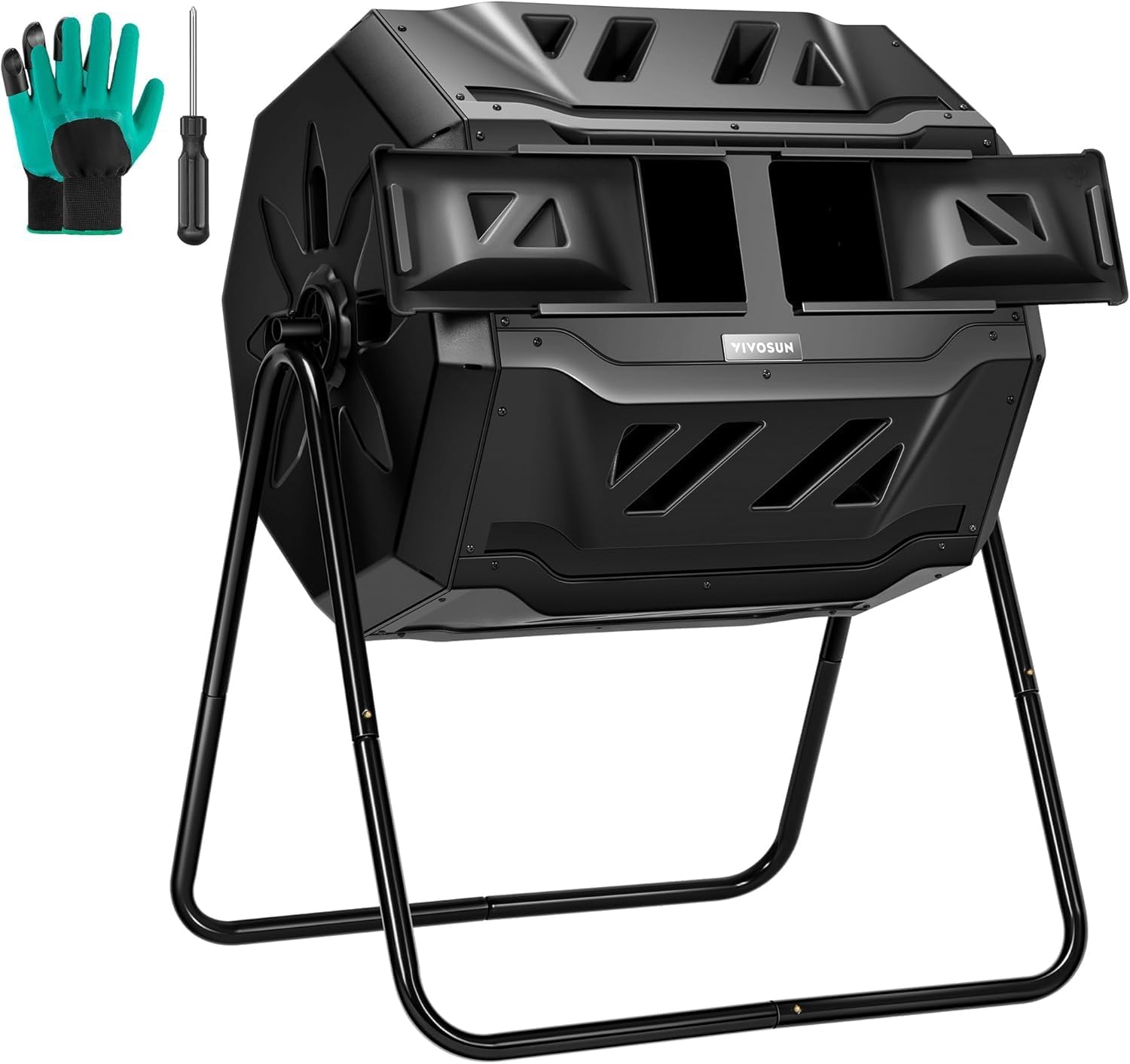
The VIVOSUN Outdoor Tumbling Composter is a 43 gallon compost bin for turning kitchen scraps and garden waste into compost in a contained outdoor setup. Based on the listed specifications, it is best suited to homeowners, raised-bed gardeners, and small-yard growers who want a cleaner alternative to an open compost pile and do not want to stir material by hand.
The main practical advantage is the dual-chamber layout. One side can hold material that is already composting while the other side stays available for fresh additions. For gardeners who add fruit and vegetable scraps, coffee grounds, leaves, or other compostable garden materials on a regular schedule, that batch-style setup can make it easier to let one side finish without constantly resetting the process.
The barrel rotates 360 degrees, and the product information lists air vents plus deep fins inside the panels. In plain terms, the tumbler is designed to mix the contents and introduce airflow as it turns, both of which are important for active composting. The octagonal shape, black body, and raised frame also keep the material off the ground, which can make turning and access more comfortable than working at soil level.
Its listed dimensions are 26.25 inches long by 23.6 inches wide by 36.5 inches high, with a listed capacity of 43 gallons and item weight of 21.67 pounds. The product description indicates a metal frame and PP plastic body, while the specifications also list galvanized steel. Reviewers commonly note that assembly involves many panels, screws, and a center divider, so beginners should plan time, organize parts first, and consider having a helper hold pieces in place.
In everyday backyard use, this composter fits gardeners who want to process a moderate stream of household scraps and light garden waste near a vegetable bed, patio edge, or utility area. The included garden gloves are a helpful extra for loading material or doing nearby planting work, though they do not replace careful hygiene. Always wash hands after handling compost materials, avoid adding unsuitable waste, and keep the unit on stable ground before rotating it.
The tradeoff is access size and assembly effort. Review feedback suggests the sliding doors may be less convenient when dumping larger containers, and gardeners with heavy compost output may want a larger bin. For many home gardeners, however, the VIVOSUN 43 gallon dual tumbler offers a useful balance of contained composting, easier mixing, and batch management in a compact outdoor footprint.
Best For / Avoid If
Best for buyers prioritizing
- Two-bin setup supports batch composting instead of continuously mixing new scraps into one unfinished pile.
- Tumbling action can be easier for older gardeners or anyone who wants to avoid manual stirring.
- Listed dimensions give it a relatively compact footprint for a raised outdoor composter.
Consider another option if
- Assembly may take time, and several reviewers say a second person makes panel alignment easier.
- The door opening may feel small for gardeners dumping larger bowls or countertop compost bags.
- Gardeners who generate a very large volume of yard waste may prefer a larger stationary bin or multi-bin system.
Pros
- Two-bin design supports a more continuous composting routine than a single-chamber tumbler.
- Raised rotating design reduces the need to fork or shovel a traditional compost pile.
- Listed dimensions make it compact enough for many home garden spaces.
- Reviewers commonly mention that it is lightweight and generally easy to rotate when not overfilled.
Cons
- Assembly may take patience, as several reviewers note many small fasteners and limited instructions.
- The tumbler does not list a side crank or handle, and some users report it can become harder to turn as it fills.
- Small sliding doors may be less convenient for gardeners emptying larger kitchen scrap containers or removing finished compost.
The Nazhura 43-gallon dual chamber compost tumbler is an outdoor composting bin for gardeners who want a cleaner, more contained alternative to an open compost pile. Based on the listed product information, it is intended for kitchen throw-outs, grass clippings, leaves, and other organic yard waste, making it suitable for homeowners, beginner composters, and small-yard gardeners who want to recycle everyday organic material.
The main benefit is the dual-bin design. One chamber can be used for new scraps while the other chamber continues breaking down, which helps avoid constantly disturbing a batch that is already composting. The rotating barrel is designed to mix materials and bring oxygen into the compost, a key part of keeping the process active without using a pitchfork.
The product specifications list a 43-gallon capacity, plastic and galvanized steel materials, and dimensions of 26.25 inches long by 23.6 inches wide by 36.5 inches high. At 21 pounds, the unit itself is not especially heavy before filling, though compost materials can add substantial weight. The sliding doors provide access for adding scraps and removing finished material, and the included garden gloves are a useful extra for routine garden handling.
In a typical backyard, this tumbler could sit near raised beds, a vegetable garden, or a side-yard utility area where kitchen scraps and dried leaves are easy to add. Its compact footprint may also work for gardeners who do not have space for a large three-bin compost system. For best results with any tumbler-style composter, gardeners should pay attention to the balance of wet green materials and dry brown materials so the contents do not become overly soggy.
The most common caution from reviewers is assembly. Several users describe the setup as doable but tedious, with many small nuts and bolts and instructions that may require careful interpretation. Some reviewers also mention that the unit can be harder to rotate as it gets fuller, and a few note leakage when the contents are too wet, so it is sensible to avoid overfilling and to add dry leaves or similar brown material when needed.
This is a sensible choice for gardeners who want an affordable-style, contained, dual-chamber composting system and do not mind a time-consuming assembly process. Gardeners who need a larger composting capacity, very large loading doors, or a built-in crank handle may want to compare other compost bin designs before choosing this one.
Best For / Avoid If
Best for buyers prioritizing
- Two-bin design supports a more continuous composting routine than a single-chamber tumbler.
- Raised rotating design reduces the need to fork or shovel a traditional compost pile.
- Listed dimensions make it compact enough for many home garden spaces.
Consider another option if
- Assembly may take patience, as several reviewers note many small fasteners and limited instructions.
- The tumbler does not list a side crank or handle, and some users report it can become harder to turn as it fills.
- Small sliding doors may be less convenient for gardeners emptying larger kitchen scrap containers or removing finished compost.
Pros
- Two-chamber layout supports a more continuous composting routine than a single batch bin.
- Tumbler format is helpful for gardeners who do not want to turn a pile with a fork or shovel.
- Moderate 37-gallon total capacity is practical for many household food scraps and garden trimmings.
- Reviewers commonly mention that the finished unit feels useful and space-conscious once assembled.
Cons
- Several reviewers report that assembly can be tricky, especially aligning and snapping parts together.
- The 18.5-gallon chamber size may fill quickly for larger households or gardeners with heavy seasonal yard waste.
- As with most compost tumblers, it still requires regular turning and a balanced mix of greens and browns for good results.
The Miracle-Gro Dual Chamber Compost Tumbler is an outdoor compost bin built for gardeners who want a cleaner, more contained way to process kitchen scraps and garden waste. Based on the listed specifications, it provides 37 gallons of total capacity split into two 18.5-gallon chambers, making it especially appealing for beginners, homeowners with small to medium yards, and gardeners who prefer not to manage an open compost pile.
The key benefit is the two-chamber design. One side can be used for fresh material while the other side is left to cure, which helps keep composting moving in batches instead of requiring the whole bin to be emptied before starting again. The product information also describes a rotating system intended to reduce the need for hand-turning with a fork or shovel, a practical advantage for older gardeners or anyone who wants a less physically demanding compost routine.
The tumbler measures 25 inches long, 23.5 inches wide, and 29.5 inches high, so it is compact enough for many backyard corners, side yards, or patio-adjacent areas where an open pile would be messy or impractical. The feature list notes two sliding doors, side-locking mechanisms, tight seals, UV-protected plastic, and a galvanized steel base. The specifications also list an 8 kilogram item weight and a hexagonal black shape.
In everyday use, this style of composter is best suited to households that can add a steady mix of food scraps and dry brown materials, then rotate the drum every few days as directed by the product information. It can be a good fit near raised beds, vegetable gardens, or flower beds where finished compost will be used seasonally. Reviewers commonly appreciate the dual chambers, although some note that the individual sides can fill quickly depending on household waste volume.
The main caution is assembly. Multiple reviewers mention that the snap-together parts and alignment can take patience, and some found the instructions or connectors frustrating. It is worth setting aside enough time, checking all parts before assembly, and avoiding excessive force if pieces are not lining up. Like any compost tumbler, it also needs routine turning and a reasonable balance of green and brown materials to avoid odor, excess moisture, or slow decomposition.
Overall, this Miracle-Gro tumbler is a practical choice for gardeners who want a contained, batch-style composting setup with easier turning than a ground pile. Gardeners with very large yards, high volumes of leaves, or frequent bulky garden debris may prefer a larger composting system, but for many home gardens this dual chamber design offers a manageable way to turn waste into useful compost material.
Best For / Avoid If
Best for buyers prioritizing
- Two-chamber layout supports a more continuous composting routine than a single batch bin.
- Tumbler format is helpful for gardeners who do not want to turn a pile with a fork or shovel.
- Moderate 37-gallon total capacity is practical for many household food scraps and garden trimmings.
Consider another option if
- Several reviewers report that assembly can be tricky, especially aligning and snapping parts together.
- The 18.5-gallon chamber size may fill quickly for larger households or gardeners with heavy seasonal yard waste.
- As with most compost tumblers, it still requires regular turning and a balanced mix of greens and browns for good results.

Pros
- Two composting chambers support batch composting instead of mixing fresh scraps into nearly finished material.
- Moderate 45-gallon capacity is useful for home gardeners without taking up the space of a very large bin.
- Tumbler format can make routine mixing easier than turning a ground pile by hand.
- Enclosed design may be more acceptable in small yards, patio areas, or communities where open piles are discouraged.
Cons
- Assembly may require extra time, careful attention to the illustrated instructions, and possibly a second person based on recurring reviewer feedback.
- Several reviewers mention the doors are small, so adding bulky material or emptying finished compost may be less convenient.
- As with many enclosed tumblers, gardeners may need to monitor moisture carefully and add enough dry browns to avoid a wet, gummy mix.
The PatioZen 180A is a 45-gallon dual chamber tumbling composter designed for outdoor batch composting. It is intended for gardeners who want to turn kitchen scraps and garden waste into compost without maintaining an open pile on the ground. Its enclosed format makes it especially relevant for homeowners with small yards, patio areas, or community settings where a loose compost heap may not be welcome.
The main advantage is the two-chamber design. One side can hold newer material while the other side continues breaking down, which helps prevent finished or nearly finished compost from being mixed with fresh scraps. For beginner gardeners, that batch system is easier to understand than a single large pile that is constantly being added to.
Based on the listed specifications, the composter measures 28.23 inches long, 25.59 inches wide, and 36.02 inches high, with a cylindrical black body and a listed weight of 25 pounds. The material is specified as ABS and metal, and the product information describes the construction as rust-resistant. The tumbling design is meant to make mixing easier, and reviewers commonly note that it rotates easily once assembled.
In practical use, this composter fits gardeners who collect fruit and vegetable scraps, coffee grounds, small garden clippings, and dry carbon materials such as leaves or shredded paper. It can serve a raised-bed gardener who wants homemade compost for seasonal soil improvement, or a patio gardener who needs a contained system that looks neater than a pile.
The main tradeoff is setup and access. Multiple reviewers describe assembly as somewhat challenging, with some saying a second person helps hold parts in place. Reviewers also commonly mention small doors, which may make it slower to load larger scraps or remove finished compost. Like other enclosed tumblers, it also requires moisture balance, so adding enough dry brown material is important if the contents become too wet.
Overall, the PatioZen 180A is a sensible option for home gardeners who want a compact, enclosed, batch-style tumbler and are willing to spend time on assembly. Gardeners who process large volumes of yard waste, want wide access doors, or prefer a no-assembly composting setup may be better served by a larger stationary bin or a different tumbler design.
Best For / Avoid If
Best for buyers prioritizing
- Two composting chambers support batch composting instead of mixing fresh scraps into nearly finished material.
- Moderate 45-gallon capacity is useful for home gardeners without taking up the space of a very large bin.
- Tumbler format can make routine mixing easier than turning a ground pile by hand.
Consider another option if
- Assembly may require extra time, careful attention to the illustrated instructions, and possibly a second person based on recurring reviewer feedback.
- Several reviewers mention the doors are small, so adding bulky material or emptying finished compost may be less convenient.
- As with many enclosed tumblers, gardeners may need to monitor moisture carefully and add enough dry browns to avoid a wet, gummy mix.
Pros
- Compact countertop-friendly dimensions with enough capacity for routine kitchen scrap collection
- Smooth plastic interior and removable parts support easier cleaning than bins with more crevices
- Handle folds down when not in use and helps with transporting scraps to the main compost area
- Lid can stay open during food prep and comes off for emptying
- Reviewers frequently praise the neat bag fit and odor control
Cons
- Larger households or very active cooks may need to empty it more often than a bigger kitchen compost pail
- Plastic construction may not appeal to gardeners who prefer stainless steel or ceramic countertop bins
- One long-term reviewer reported staining and water getting into the liner after extended use, so periodic inspection and cleaning are sensible
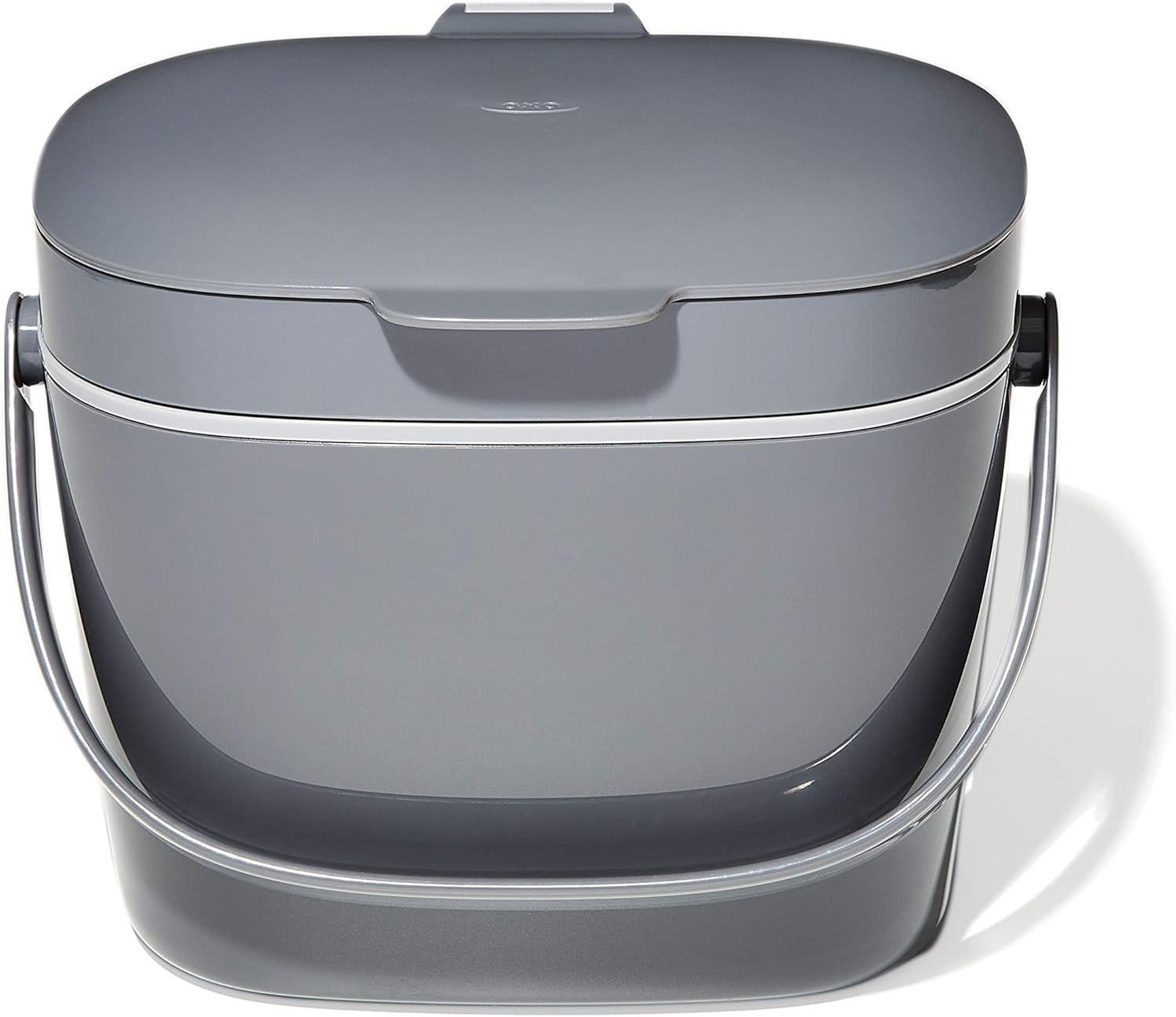
The OXO Good Grips Easy-Clean Compost Bin is an in-home composting bin made for collecting kitchen scraps before they move to an outdoor compost pile, backyard bin, or local compost collection container. Based on the listed specifications, it holds 1.75 gallons, or 6.62 liters, which makes it useful for everyday vegetable peels, fruit scraps, coffee grounds, and other kitchen compostables allowed by your composting system.
Its strongest practical benefit is convenience during food prep. The stay-open lid lets you toss scraps in as you cook, while the design keeps bags tucked inside for a cleaner look on the counter. The product information also notes an odor-containing, pest-reducing lid design, and several reviewers commonly mention that it helps keep smells down when closed.
The bin measures 8.3 inches long, 10.15 inches wide, and 12 inches high, with an oval charcoal plastic body. It weighs 1.5 pounds, includes a removable lid, and has a handle that folds down when not in use. The smooth interior is intended to make cleaning easier, and the removable internal bucket is listed as dishwasher safe for more thorough washing.
For small-space gardeners, this bin is a simple bridge between the kitchen and the garden. It can sit near a sink for daily scraps, tuck under a sink for a cleaner counter, or be carried out to a backyard compost bin when full. It is especially well suited to beginners who want composting to feel like a normal kitchen habit rather than a messy extra chore.
There are a few limitations to keep in mind. A 1.75-gallon bin may fill quickly in larger households, during canning season, or for gardeners who cook heavily with fresh produce. Since it is plastic, it may stain over time depending on what is stored in it, and one reviewer noted staining after extended use. Emptying it regularly, using compatible composting bags if desired, and washing it often will help keep it more pleasant indoors.
Overall, the feature set suggests a well-designed kitchen compost collector for homeowners, apartment gardeners, and anyone trying to keep food scraps organized before composting. Gardeners who want a countertop bin with simple handling and easy cleaning should find it a good match, while those needing a larger-volume pail or a non-plastic material may want to compare other options.
Best For / Avoid If
Best for buyers prioritizing
- Compact countertop-friendly dimensions with enough capacity for routine kitchen scrap collection
- Smooth plastic interior and removable parts support easier cleaning than bins with more crevices
- Handle folds down when not in use and helps with transporting scraps to the main compost area
Consider another option if
- Larger households or very active cooks may need to empty it more often than a bigger kitchen compost pail
- Plastic construction may not appeal to gardeners who prefer stainless steel or ceramic countertop bins
- One long-term reviewer reported staining and water getting into the liner after extended use, so periodic inspection and cleaning are sensible

Pros
- Attractive ceramic design can stay visible on a kitchen counter without looking like a basic waste container.
- Dishwasher-safe body simplifies cleaning after removing the rope handle.
- Compact footprint helps preserve counter space while still offering a 4.25-quart listed capacity.
- Wide spout and handled design support easier emptying and carrying.
- Ceramic material is listed as resistant to staining, oxidation, and decomposition.
Cons
- At 5.5 pounds before adding scraps, it may feel heavier than plastic or stainless countertop compost bins.
- The lid is not airtight by design, so users who want a sealed bin may prefer a different style.
- Ceramic can require more careful handling than lightweight bins, especially around sinks, hard floors, or outdoor compost areas.
The Emile Henry EH718638 Compost Bin is an in-home kitchen compost container for collecting food scraps, peels, coffee grounds, and similar organic waste before moving them to a larger composting system. Based on the listed specifications, it is best suited to homeowners, apartment gardeners, and small-space growers who want a countertop bin that looks more like kitchenware than a utility pail.
Its main practical benefit is making daily scrap collection more convenient. The 4.25-quart capacity gives many households room for several days of kitchen scraps, depending on cooking habits and household size, while the ceramic body is listed as resistant to staining, oxidizing, and decomposing. That matters for a bin that may regularly hold moist vegetable trimmings and coffee grounds.
The bin measures 9.8 inches long, 8 inches wide, and 9.5 inches high, so it is compact enough for many counters but still large enough to be useful between emptying trips. The deep lid is designed to contain odors without creating an airtight seal, which the product information notes can help avoid moisture buildup and mold growth. A wide spout helps with pouring out scraps and liquids, and the removable washable rope handle makes carrying and dishwasher cleaning more practical.
For backyard gardeners, this bin can serve as the indoor collection point before scraps are taken to an outdoor compost pile, tumbler, or community compost container. Patio and small-space gardeners may also appreciate that it keeps compostable kitchen material organized without needing a large indoor setup. The truffle color and ceramic square shape are especially relevant for people who plan to keep the bin visible rather than tucked under the sink.
There are a few limitations to consider. At a listed 5.5 pounds, the ceramic bin is heavier than many plastic alternatives before it is filled. It is also not an airtight container, so gardeners who strongly prefer a sealed pail may want another design. As with any ceramic kitchen item, careful handling is wise when carrying it to a compost area or washing it near hard surfaces.
Overall, the Emile Henry EH718638 is a good fit for gardeners who want a durable, decorative countertop scrap bin with easy cleaning and a modest footprint. Those needing a very lightweight bin, a fully sealed lid, or a larger capacity for high-volume cooking may be better served by a different compost collection container.
Best For / Avoid If
Best for buyers prioritizing
- Attractive ceramic design can stay visible on a kitchen counter without looking like a basic waste container.
- Dishwasher-safe body simplifies cleaning after removing the rope handle.
- Compact footprint helps preserve counter space while still offering a 4.25-quart listed capacity.
Consider another option if
- At 5.5 pounds before adding scraps, it may feel heavier than plastic or stainless countertop compost bins.
- The lid is not airtight by design, so users who want a sealed bin may prefer a different style.
- Ceramic can require more careful handling than lightweight bins, especially around sinks, hard floors, or outdoor compost areas.

Pros
- 53-gallon capacity is useful for households that generate regular kitchen scraps and garden cleanup material.
- Two-chamber layout supports staggered batches instead of waiting for one full tumbler load to finish.
- Rotating design reduces the need for manual pile turning, which may help gardeners who prefer less lifting and digging.
- Product information lists adjustable vents, sliding doors, brake locks, and a gear-assisted handle for more convenient routine use.
Cons
- Assembly may take patience, and reviewers mention that the center divider and some instruction steps can be unclear.
- As with most tumblers, compost quality and speed still depend on the right mix of greens, browns, moisture, and airflow.
- Gardeners who want a no-assembly compost solution may prefer a simpler stationary bin.
The Maygrove MGN-CBG53X1-US is a 53-gallon outdoor compost tumbler designed for turning kitchen scraps and garden waste into usable compost for backyard beds, vegetable gardens, and container plantings. Its main appeal is the dual chamber setup, which lets one side receive new material while the other side continues decomposing.
Based on the listed features, the 360-degree rotating drum and built-in mixing bars are intended to reduce the work of turning compost by hand. The product information also lists adjustable air vents, which are helpful because compost needs oxygen and moisture balance to break down properly and reduce odor problems.
The design includes extra-wide sliding doors for loading and unloading, a gear-assisted handle for rotation, and dual-direction brake locks to help hold the drum steady during use. The listed construction combines polypropylene plastic with a solid steel frame, reinforced leg supports, and UV-resistant material for outdoor placement.
This tumbler is a practical fit for homeowners who want a contained composting system near a garden, raised beds, or a backyard growing area. It may also suit gardeners who do not want an open compost pile, since the rotating barrel keeps materials enclosed while still allowing mixing and airflow.
Assembly is the main point to approach carefully. Several reviewers describe setup as manageable, but some mention tricky steps, especially around the barrel panels, center divider, or instruction wording. Having a level work surface, reading the instructions before starting, and sorting hardware first may make the process easier.
For best results, users should follow the product guidance on what not to add and keep a balanced mix of moist green materials and dry brown materials. Gardeners who want continuous composting in a contained tumbler are a good match, while those who need the simplest possible setup or very large-volume composting may want to compare stationary bins or larger systems.
Best For / Avoid If
Best for buyers prioritizing
- 53-gallon capacity is useful for households that generate regular kitchen scraps and garden cleanup material.
- Two-chamber layout supports staggered batches instead of waiting for one full tumbler load to finish.
- Rotating design reduces the need for manual pile turning, which may help gardeners who prefer less lifting and digging.
Consider another option if
- Assembly may take patience, and reviewers mention that the center divider and some instruction steps can be unclear.
- As with most tumblers, compost quality and speed still depend on the right mix of greens, browns, moisture, and airflow.
- Gardeners who want a no-assembly compost solution may prefer a simpler stationary bin.

Pros
- Large dual-chamber layout supports continuous composting instead of waiting for one full bin to finish.
- Tumbler format makes routine mixing simpler than manually turning a ground pile.
- Listed weatherproof, UV-stabilized plastic construction is intended for outdoor use.
- Locking pins add useful stability when loading or positioning the drum.
- Compact rectangular footprint works well for many suburban yards and patio edges.
Cons
- Assembly involves multiple panels and small screws, and reviewers report mixed experiences with how easy it is to put together.
- Each chamber is 26.5 gallons, so gardeners processing very large volumes of yard debris may still need a secondary compost area.
- Ventilation openings and wet scraps mean it is intended for outdoor use, not indoor or garage composting.
The THEGROWING GWDUALOR is a 53-gallon outdoor compost tumbler built for homeowners who want a contained way to process kitchen scraps, leaves, grass clippings, and routine garden cleanup. Its two 26.5-gallon rotating sections make it especially useful for gardeners who want one side actively filling while the other side rests and continues breaking down.
The main gardening benefit is batch management. With a single open pile, fresh scraps often get mixed into material that is nearly finished. This dual-chamber layout helps keep new and curing compost separate, while the tumbler format reduces the need to turn material with a fork or shovel. The listed agitating fins and cross-ventilation slots are intended to lift, split, and aerate dense compost materials during rotation.
Based on the listed specifications, the unit measures 28.7 inches long, 23.6 inches wide, and 36.6 inches high, with an octagonal plastic drum on a reinforced frame. The product information describes pre-embedded metal nuts for bolt assembly without loose washers, plus dual position locking pins that hold the barrel in place while loading. Reviewers commonly mention that assembly can range from straightforward to tedious, so it is wise to sort hardware first, avoid overtightening screws, and make sure panels are fully seated before fastening.
In a backyard setting, this composter fits well near a vegetable garden, along a patio edge, or beside raised beds where finished compost can be used as a soil amendment once fully matured. The orange color is noticeable, so it may be a good choice for gardeners who do not mind a bright utility piece in the yard. Its size is generous for regular household scraps and small-to-moderate yard cleanup, but it is still more contained than a traditional open compost heap.
There are a few practical cautions. Compost tumblers work best when the contents are balanced with moist green materials and dry brown materials, and wet scraps may drip through ventilation areas, so the unit should stay outdoors on a level, washable, or soil-covered surface. Gardeners in wildlife-prone areas should also position and monitor any compost bin carefully, since no tumbler should be treated as a guaranteed animal-proof container.
Overall, this is a sensible option for beginner-to-intermediate composters who want larger capacity, separated batches, and easier mixing than a static pile. Gardeners with very heavy seasonal debris, limited patience for multi-piece assembly, or a need for indoor composting may prefer a different setup.
Best For / Avoid If
Best for buyers prioritizing
- Large dual-chamber layout supports continuous composting instead of waiting for one full bin to finish.
- Tumbler format makes routine mixing simpler than manually turning a ground pile.
- Listed weatherproof, UV-stabilized plastic construction is intended for outdoor use.
Consider another option if
- Assembly involves multiple panels and small screws, and reviewers report mixed experiences with how easy it is to put together.
- Each chamber is 26.5 gallons, so gardeners processing very large volumes of yard debris may still need a secondary compost area.
- Ventilation openings and wet scraps mean it is intended for outdoor use, not indoor or garage composting.

Pros
- Continuous two-bin workflow in one compact tumbler.
- Rotating drum simplifies mixing compared with turning a pile by hand.
- Vented design supports oxygen flow for composting materials.
- Raised frame helps keep the composter tidy and off the soil.
- Includes assembly hardware, gloves, screwdriver, and instruction manual.
Cons
- Assembly may take patience because the package includes many screws and nuts, and reviewers commonly mention that setup can be time-consuming.
- There is no listed crank handle, so turning a heavy, loaded drum may require more effort for some gardeners.
- The sliding door openings may feel limiting for bulky leaves, grass clippings, or unloading larger amounts of finished compost.
The VEVOR XDB-436B2 is a dual chamber outdoor compost tumbler built for gardeners who want to turn kitchen scraps and suitable yard waste into compost without maintaining an open ground pile. With a listed 43-gallon capacity and two internal compartments, it is aimed at homeowners, vegetable gardeners, and small-space growers who want a more contained composting setup.
The main benefit is the two-chamber workflow. One side can be left to decompose while the other side receives fresh organic material, which is helpful if your household produces a regular stream of fruit and vegetable scraps. The product information also describes a 360-degree tumbling design, vents, and internal grooves, all intended to mix materials and provide oxygen, two basics of successful aerobic composting.
Based on the listed specifications, the tumbler measures 29 by 24.6 by 37.6 inches and weighs about 21.9 pounds before filling. The body is made from PP plastic, with Q235B steel frame components, and the listed maximum loading capacity is 110 pounds. The octagonal drum uses two sliding doors for access, and the package includes hardware, gloves, a screwdriver, and an instruction manual.
In a typical backyard or side-yard setup, this composter can sit near a garden bed, shed, or kitchen door where scraps are easy to carry out. It is also a reasonable option for gardeners who want a cleaner-looking alternative to an open pile. Because it is elevated, users do not have to dig into a ground bin, although the drum still needs to be rotated regularly and balanced with appropriate green and brown materials.
There are a few practical limitations to consider. Reviewers commonly mention that assembly involves many small fasteners, so setting aside time and working on a flat surface is wise. The product does not list a crank handle, and some users note that turning can feel more cumbersome when the drum is heavier. The manufacturer also advises against adding meat, fish, dairy, oils, diseased plant material, pet droppings, plastics, metals, glass, chemicals, toxic plants, and large wood pieces.
This tumbler is a good match for gardeners who want a contained, dual chamber composting system for moderate household and garden waste. Gardeners who need to process very bulky seasonal leaf loads, want extra-large access doors, or prefer a no-assembly compost setup may want to compare larger stationary bins or different tumbler designs before choosing.
Best For / Avoid If
Best for buyers prioritizing
- Continuous two-bin workflow in one compact tumbler.
- Rotating drum simplifies mixing compared with turning a pile by hand.
- Vented design supports oxygen flow for composting materials.
Consider another option if
- Assembly may take patience because the package includes many screws and nuts, and reviewers commonly mention that setup can be time-consuming.
- There is no listed crank handle, so turning a heavy, loaded drum may require more effort for some gardeners.
- The sliding door openings may feel limiting for bulky leaves, grass clippings, or unloading larger amounts of finished compost.

Pros
- Dual-bin layout is useful for batch composting and ongoing household food scrap collection.
- Tumbling action can be easier than manually stirring a compost pile, especially for smaller yards.
- Enclosed design may appeal to gardeners who want a tidier composting setup than loose piles or open cans.
- Reviewers commonly mention that the composter feels sturdy once assembled.
Cons
- Several reviewers mention that assembly takes time and that the instructions could be clearer.
- The product information does not list a turning handle, and some reviewers wished it had one.
- Sliding door openings may feel small for gardeners adding bulky clippings or removing larger amounts of compost.
The Hourleey 43 gallon dual chamber tumbling composter is made for outdoor composting of kitchen scraps, garden clippings, and other fermentable compost materials. Based on the listed features, it is best suited to homeowners, beginner composters, and small to medium backyard gardeners who want a contained bin rather than a traditional open compost pile.
The main benefit is the two-chamber design. One side can hold a batch that is actively breaking down while the other side remains available for new material. For gardeners who regularly bring out vegetable scraps or yard trimmings, that layout is more convenient than stopping a single batch every time fresh waste is added.
The tumbler design is intended to rotate 360 degrees, helping mix the compost without digging into it with a garden fork. Aeration holes and deep fins are included to move air through the material and help break up clumps during rotation. As with any composter, results still depend on the right mix of greens, browns, moisture, and regular turning.
Product information lists the composter at 43 gallons with stated assembled dimensions of 27.6 by 25.8 by 36 inches. The body is plastic with a metal frame, and the listing describes it as weather resistant and corrosion resistant. Sliding and removable doors provide access for adding scraps and removing finished compost, although some reviewers note that the openings can feel a bit small.
For backyard use, this style works well near a vegetable garden, raised-bed area, or patio edge where you can conveniently add kitchen scraps and later carry compost to beds or containers. Reviewers commonly mention that it is sturdy once assembled and easy to spin, but assembly is a recurring caution. Several users report unclear instructions or a time-consuming setup, so it is sensible to sort the hardware first and allow extra time.
This is a practical choice for gardeners who want a compact, enclosed, dual-batch composting system and do not mind assembling a panel-style tumbler. Gardeners who need very large compost volume, extra-wide access doors, or a built-in crank handle may want to compare larger or more feature-heavy composters before choosing this model.
Best For / Avoid If
Best for buyers prioritizing
- Dual-bin layout is useful for batch composting and ongoing household food scrap collection.
- Tumbling action can be easier than manually stirring a compost pile, especially for smaller yards.
- Enclosed design may appeal to gardeners who want a tidier composting setup than loose piles or open cans.
Consider another option if
- Several reviewers mention that assembly takes time and that the instructions could be clearer.
- The product information does not list a turning handle, and some reviewers wished it had one.
- Sliding door openings may feel small for gardeners adding bulky clippings or removing larger amounts of compost.

Pros
- Suitable for multiple composting setups, including bins, tumblers, and open piles.
- Highly concentrated formula may be convenient for gardeners who want a compact compost additive.
- Made with beneficial bacteria, a relevant material for supporting compost decomposition.
- Odor-control positioning is useful for composters handling kitchen scraps.
Cons
- The product information does not specify exact application rates, coverage, or how long one package lasts.
- Gardeners who prefer composting without added starters may not need a separate accelerator.
- Results can still depend on basic compost conditions such as moisture, airflow, and a good mix of green and brown materials.
Bioverse Dr. Connie’s Compost Plus is a compost starter and accelerator made with beneficial bacteria. The product information positions it for compost bins, tumblers, and piles, so it is aimed at home gardeners who want help turning kitchen scraps and garden waste into compost for soil-building use.
The main supported benefit is faster decomposition of organic waste. A compost starter like this is intended to boost microbial activity, which is one of the key parts of a working compost system. The listing also highlights odor reduction, which can be especially useful when food scraps are added to a covered bin or indoor collection setup.
The formula is described as 100x concentrated compared with leading compost starters, and the listed item weight is 0.24 kilograms. Exact measuring directions, coverage, and package yield are not included in the supplied data, so gardeners should follow the label instructions carefully rather than guessing application amounts.
In a backyard setting, this product fits gardeners maintaining a standard compost pile or a rotating tumbler. In a smaller space, it may be useful for a compact compost bin where odor control matters more because the bin sits near a patio, garage, mudroom, or kitchen scrap area. It is also listed for both indoor and outdoor use.
Compost accelerators are not a substitute for good compost management. For best results, gardeners still need to balance moist green materials with dry brown materials, avoid waterlogging, and keep the pile aerated when appropriate. Because no guaranteed timeline is provided in the product data, it is best viewed as a support product rather than a complete composting solution.
This is a sensible choice for beginners who want a simple compost additive and for experienced gardeners trying to keep bins or tumblers active. Gardeners who already maintain hot, balanced piles successfully without additives, or those who need clearly stated coverage and dosing details before buying, may prefer a product with more complete application specifications.
Best For / Avoid If
Best for buyers prioritizing
- Suitable for multiple composting setups, including bins, tumblers, and open piles.
- Highly concentrated formula may be convenient for gardeners who want a compact compost additive.
- Made with beneficial bacteria, a relevant material for supporting compost decomposition.
Consider another option if
- The product information does not specify exact application rates, coverage, or how long one package lasts.
- Gardeners who prefer composting without added starters may not need a separate accelerator.
- Results can still depend on basic compost conditions such as moisture, airflow, and a good mix of green and brown materials.
Pros
- Large 53-gallon total capacity works well for regular household scraps and garden trimmings.
- Two-chamber design supports a more continuous composting routine.
- Hand-crank turning system may be easier for many gardeners than lifting and turning compost with a fork.
- Built-in vents and deep fins address two key composting needs: airflow and mixing.
- Several reviewers mention sturdy construction, wide doors, and easy tumbling once assembled.
Cons
- Assembly may take patience, as multiple reviewers report unclear or confusing instructions.
- At 41.3 inches high and 30.64 pounds before filling, placement and moving are worth planning before use.
- Like most tumblers, it could become harder to rotate if overloaded or packed with materials that are too wet or dense.
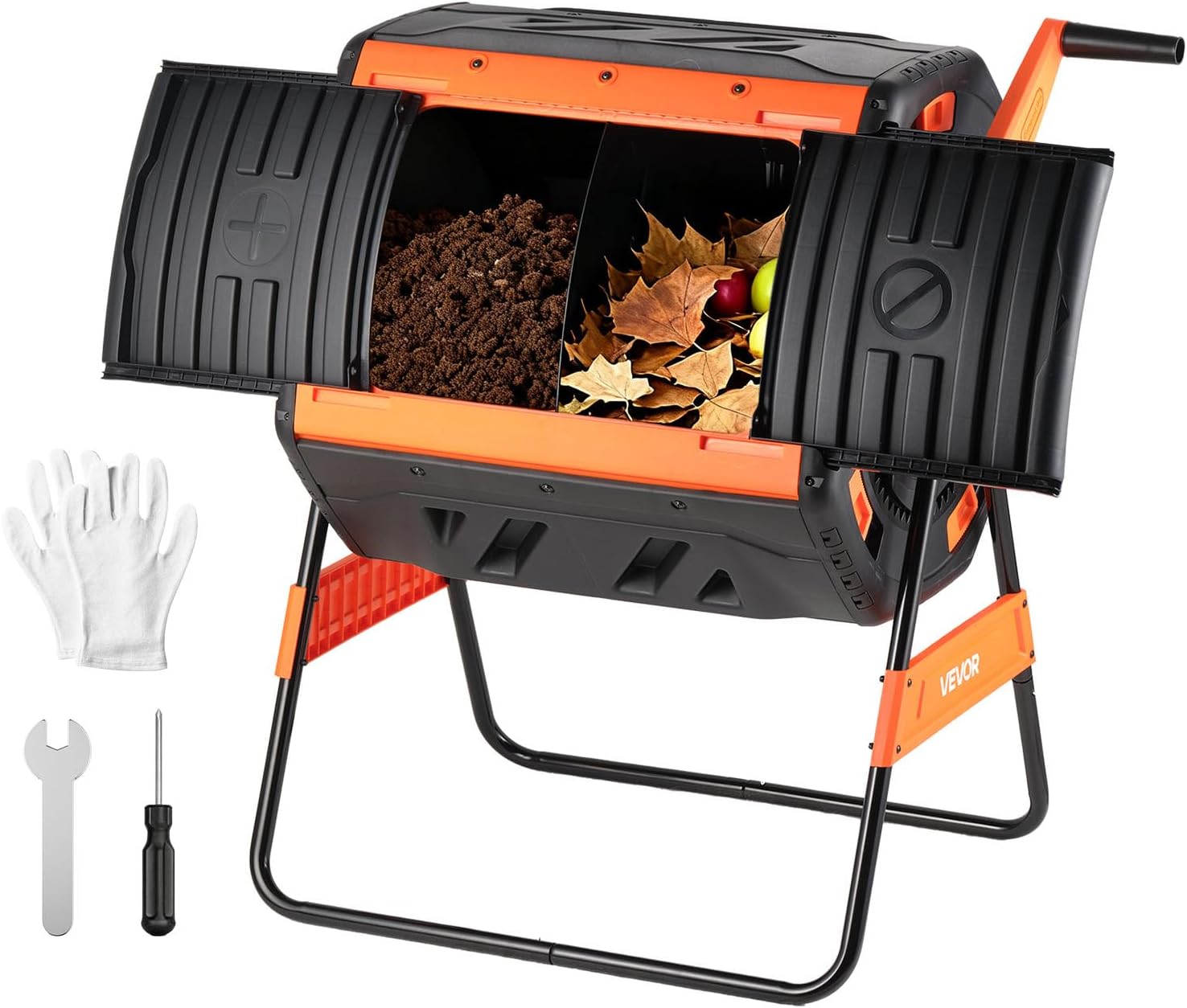
The VEVOR XDB-436C is a 53-gallon dual-chamber compost tumbler built for turning kitchen scraps and garden waste into compost in a contained outdoor bin. Based on the listed specifications, it is a practical fit for homeowners, small farms, community garden plots, patios, and backyard gardeners who want composting capacity without maintaining an open pile on the ground.
The main advantage is the two-chamber layout. One side can hold material that is curing while the other side remains available for new scraps, which helps keep the composting routine moving. The product information also describes a hand-crank shaft, deep fins, and adjustable vents, all intended to improve mixing and airflow, two important factors for faster and more even decomposition.
The tumbler measures 37.6 inches long, 26.4 inches wide, and 41.3 inches high, with a listed weight of 30.64 pounds before filling. It has two sliding doors for loading and unloading, a cylindrical black polypropylene barrel, and a powder-coated carbon steel frame. The raised base helps keep the bin off the ground, which can make the composting area look tidier and may make access more comfortable than a low ground bin.
For everyday use, this composter makes the most sense near a back door, patio edge, shed, or garden bed where food scraps and plant trimmings can be added regularly. The manufacturer recommends cutting food scraps before adding them and avoiding citrus, meat, dairy, and oily foods. A container can also be placed below the composter to collect liquid fertilizer, which should be diluted before use on plants.
The biggest caution is assembly. Reviewers are mixed, with some saying setup was straightforward and others reporting unclear instructions, long assembly time, or hardware challenges. It is wise to lay out parts first, avoid tightening everything until alignment is checked, and consider having a second person available even if you usually assemble garden equipment alone.
Overall, the VEVOR XDB-436C is a useful choice for gardeners who want a large, enclosed tumbler with continuous-batch capability and crank-assisted turning. Gardeners who want a no-assembly composting solution, or those who generate very large volumes of leaves and bulky yard debris, may prefer a simpler stationary bin or a larger open compost system.
Best For / Avoid If
Best for buyers prioritizing
- Large 53-gallon total capacity works well for regular household scraps and garden trimmings.
- Two-chamber design supports a more continuous composting routine.
- Hand-crank turning system may be easier for many gardeners than lifting and turning compost with a fork.
Consider another option if
- Assembly may take patience, as multiple reviewers report unclear or confusing instructions.
- At 41.3 inches high and 30.64 pounds before filling, placement and moving are worth planning before use.
- Like most tumblers, it could become harder to rotate if overloaded or packed with materials that are too wet or dense.

Pros
- Two-compartment design is more flexible than a single chamber bin for ongoing compost additions.
- Tumbler format reduces the need to bend over and turn a traditional ground pile by hand.
- Listed dimensions of 28.5 by 25 by 37 inches make it manageable for many patios, side yards, and garden corners.
- Black exterior may help absorb sunlight, which can support warmer composting conditions when the bin is placed in a sunny area.
- BPA-free PP construction and a powder-coated steel frame are clearly listed in the product specifications.
Cons
- The 43 gallon size may be too limited for gardeners handling large amounts of leaves, grass clippings, or seasonal yard cleanup.
- Assembly requires fitting panels, tabs, divider edges, screws, and self-locking nuts, so careful setup is important.
- Like most compost tumblers, it still requires the right balance of green and brown materials to avoid wet or unpleasant compost.
The F2C 43 gallon dual chamber compost tumbler is built for outdoor composting of kitchen scraps and garden waste in a cleaner, more contained format than an open pile. Based on the listed specifications, it is best suited to homeowners, beginner composters, patio gardeners, and small-yard growers who want a rotating bin rather than a stationary compost heap.
The key benefit is the dual chamber layout. One side can continue decomposing while the other side receives newer material, which helps avoid the common problem of constantly adding fresh scraps to a nearly finished batch. The rotating barrel, aeration holes, and internal fins are designed to mix oxygen into the material and help break up clumps, both of which are important for active composting.
The bin has a listed capacity of 43 gallons and assembled dimensions of 28.5 inches long by 25 inches wide by 37 inches high. Materials are listed as PP and powder-coated steel, with interlocking panels and a steel frame supporting the cylindrical tumbler. Sliding doors give access to the chambers, and the package information indicates that gloves and a screwdriver are included for added setup convenience.
For everyday use, this composter makes the most sense near a vegetable garden, raised bed area, patio, or side yard where kitchen scraps can be added regularly. Its compact footprint is helpful for urban spaces, while the elevated tumbler style keeps the compost contained and easier to turn than a ground pile. Gardeners who produce moderate amounts of food scraps and plant trimmings are the strongest match.
There are a few practical considerations. The product information notes specific assembly details, including aligning tabs, panel seams, and the center divider correctly, so rushing setup could make the bin harder to use. Compost quality will still depend on balancing nitrogen-rich greens with carbon-rich browns, keeping the mix from becoming too wet, and turning it regularly. Gardeners with heavy leaf loads or large lawn cleanup needs may prefer a larger composting system, but for routine home composting in a limited space, this F2C tumbler offers a useful combination of capacity, separation, and easy turning.
Best For / Avoid If
Best for buyers prioritizing
- Two-compartment design is more flexible than a single chamber bin for ongoing compost additions.
- Tumbler format reduces the need to bend over and turn a traditional ground pile by hand.
- Listed dimensions of 28.5 by 25 by 37 inches make it manageable for many patios, side yards, and garden corners.
Consider another option if
- The 43 gallon size may be too limited for gardeners handling large amounts of leaves, grass clippings, or seasonal yard cleanup.
- Assembly requires fitting panels, tabs, divider edges, screws, and self-locking nuts, so careful setup is important.
- Like most compost tumblers, it still requires the right balance of green and brown materials to avoid wet or unpleasant compost.

Pros
- Dual chamber layout is useful for batch composting without stopping your regular scrap collection.
- 360 degree rotation makes routine mixing cleaner than turning a pile by hand.
- Adjustable aeration supports better airflow control inside the tumbler.
- Reviewers commonly mention that assembly is straightforward, though setup experience may vary.
- Wider openings and an ergonomic height are listed to make loading, turning, and harvesting easier.
Cons
- The chamber panels are made from multiple snap-together pieces, so gardeners who prioritize maximum long-term rigidity may prefer a unibody tumbler design.
- Some users reported receiving defective or fragile connector parts, so it is wise to inspect all pieces before completing assembly.
- A mostly empty tumbler could need careful placement in windy areas, based on one reviewer’s caution about adding weight near the legs.
The Cozurra 45 gallon compost tumbler is an outdoor dual chamber compost bin for turning kitchen scraps, grass clippings, leaves, and other yard waste into compostable material. It is aimed at homeowners, beginner composters, and gardeners who want a tidier alternative to an open pile, especially where hand turning is inconvenient.
The main benefit is the two-chamber layout. Each side holds 22.5 gallons, so one chamber can continue decomposing while the other accepts fresh material. That separation matters because constantly adding new scraps to one single bin can make it harder to finish a batch. The product information also describes a 360 degree tumbling system with internal ribs and fins to help mix materials as you rotate the barrel.
Airflow is handled through multiple adjustable vents, which can help gardeners manage common composting issues such as soggy material, clumping, and odors. The listed guidance recommends rotating the tumbler several turns every few days and keeping moisture similar to a wrung-out sponge. As with any composter, results will depend on the mix of greens and browns, particle size, moisture, temperature, and how consistently it is turned.
The bin measures 29.5 inches long, 26 inches wide, and 37.5 inches high, with a cylindrical orange body on a reinforced steel frame. The listed material is BPA-free polypropylene, and the product information describes it as weather-resistant for outdoor use. Assembly is described as snap-together, and reviewers commonly say it is easy to put together, although one older gardener noted the tabs may be challenging for arthritic hands.
For backyard and small-space use, this tumbler is a good match for gardeners who generate regular kitchen scraps but do not want a ground-level heap. The raised frame may also be helpful where open piles are impractical around wildlife, though it should still be placed on a level, stable surface. It can fit near raised beds, along a fence line, or in a utility area where you can access the doors and rotate the chambers comfortably.
The main caution is durability. One critical reviewer liked the design and door size but questioned the long-term strength of the multi-piece plastic chamber construction, and another reported a defective metal tube. Before loading the bin, inspect the connectors, frame pieces, and drilled holes, and contact the seller if anything is damaged or missing. Overall, based on the listed features, this is a practical dual chamber tumbler for routine home composting, while gardeners wanting the most rugged possible construction may want to compare it with heavier one-piece tumbler designs.
Best For / Avoid If
Best for buyers prioritizing
- Dual chamber layout is useful for batch composting without stopping your regular scrap collection.
- 360 degree rotation makes routine mixing cleaner than turning a pile by hand.
- Adjustable aeration supports better airflow control inside the tumbler.
Consider another option if
- The chamber panels are made from multiple snap-together pieces, so gardeners who prioritize maximum long-term rigidity may prefer a unibody tumbler design.
- Some users reported receiving defective or fragile connector parts, so it is wise to inspect all pieces before completing assembly.
- A mostly empty tumbler could need careful placement in windy areas, based on one reviewer’s caution about adding weight near the legs.
Guide d’achat du meilleur composteur rotatif pour débutants
Choisissez une capacité adaptée à vos déchets de cuisine et de jardin
Pour la plupart des jardiniers débutants, la capacité est le premier critère pratique. Un modèle de 37 gallons, comme le FCMP Outdoor Heavy Duty 37 Gallon 8 Sided Steel Portable Plastic Dual Chamber Tumbling Composter Outdoor Elevated Rotating Garden Compost Bin, Black, offre une taille facile à gérer pour les déchets de cuisine et l’entretien courant du jardin. Les modèles d’environ 43 gallons, notamment le VEVOR Compost Bin, 43-Gal Dual Chamber Composting Tumbler et le Hourleey Compost Bin Outdoor, 43 Gallon Dual Chamber Tumbling Composting Bin, offrent davantage d’espace sans devenir trop encombrants pour de nombreux jardins particuliers.
Si votre foyer produit beaucoup de matières selon les saisons, comme des feuilles mortes, des tontes de gazon denses et plusieurs semaines de déchets alimentaires, le THE Growing 53 Gallon Large Outdoor Compost Bin Tumbler Barrel offre la plus grande capacité documentée parmi les composteurs rotatifs valides examinés ici, avec deux compartiments rotatifs de 26.5 gallons. En contrepartie, les charges plus importantes peuvent être plus lourdes à faire tourner et nécessiter un emplacement stable.
| Plage de capacité | Usage recommandé | Exemples issus des données fournies |
|---|---|---|
| 37 gallons | Débutants recherchant un composteur rotatif extérieur facile à gérer | FCMP Outdoor Heavy Duty 37 Gallon 8 Sided Steel Portable Plastic Dual Chamber Tumbling Composter |
| 43 à 45 gallons | Déchets de cuisine réguliers et tontes de jardin | F2C Compost Bin Outdoor 43 Gallon, VIVOSUN Outdoor Tumbling Composter, Hourleey Compost Bin Outdoor, VEVOR Compost Bin, Cozurra 45 Gallon Large Compost Tumbler Outdoor |
| 53 gallons | Foyers plus importants et grandes quantités de déchets de jardin | THE Growing 53 Gallon Large Outdoor Compost Bin Tumbler Barrel |
Les doubles compartiments facilitent le compostage pour les débutants
Un composteur rotatif à double compartiment est généralement la conception la plus facile à utiliser pour un débutant, car un côté peut se décomposer tandis que l’autre reçoit les déchets frais. Cela permet d’éviter l’erreur courante qui consiste à ajouter continuellement de nouvelles matières à un lot presque terminé.
Les composteurs rotatifs FCMPOutdoor, F2C, VIVOSUN, Hourleey, VEVOR, NazhuraGoodCompanionAtHome, THEGROWING et Cozurra indiquent tous une conception à double compartiment ou à deux chambres. Pour un nouveau jardinier, cette caractéristique est plus utile que la recherche du plus grand format, car elle permet de suivre une routine simple : remplir un côté, le faire tourner régulièrement, puis commencer l’autre côté pendant que le premier mûrit.
Recherchez des trous d’aération, des ailettes, des nervures ou des rainures
Le compostage a besoin d’oxygène. Dans un composteur rotatif, les trous d’aération, les évents, les ailettes, les nervures et les rainures internes favorisent la circulation de l’air et aident à défaire les amas. Ces éléments ne suppriment pas la nécessité d’un bon équilibre entre matières vertes et brunes, mais ils rendent le processus moins contraignant qu’avec un tas statique.
Le modèle FCMPOutdoor indique des ailettes profondes et des trous d’aération. VIVOSUN décrit des évents et des ailettes profondes. VEVOR mentionne des évents placés stratégiquement et des rainures internes. THEGROWING utilise des ailettes de brassage et une ventilation transversale, tandis que Cozurra indique des évents réglables ainsi que des nervures de mélange intégrées et des ailettes profondes. Ces détails sont plus importants qu’un style décoratif, car ils influencent directement la facilité avec laquelle le contenu se mélange lorsque vous faites tourner le tambour.
Vérifiez l’accès pour le remplissage et la récupération du compost
Les débutants sous-estiment souvent la fréquence à laquelle ils ouvriront le composteur. Les larges ouvertures, les portes coulissantes et les portes amovibles facilitent l’ajout des déchets, le chargement de matières brunes sèches et le retrait du compost mûr sans en répandre autour de la structure.
Le composteur FCMPOutdoor indique de larges ouvertures et une porte amovible. VEVOR mentionne une porte coulissante amovible avec une grande ouverture. Hourleey décrit de grandes ouvertures et une porte amovible, tandis que F2C et NazhuraGoodCompanionAtHome mentionnent un accès par porte coulissante. Si vous avez des difficultés à vous pencher ou à utiliser votre force manuelle, privilégiez un modèle facilement accessible plutôt qu’un modèle qui met uniquement en avant sa grande capacité.
Tenez compte de l’assemblage avant l’achat
La plupart des composteurs rotatifs extérieurs sont livrés en panneaux et nécessitent un assemblage. Cette étape peut être la plus difficile pour un débutant, notamment lorsqu’il faut utiliser de nombreuses vis et écrous ou aligner correctement des panneaux incurvés.
Cozurra met en avant un assemblage par emboîtement et fait référence à des vidéos d’installation. THEGROWING indique la présence d’écrous préinstallés conçus pour un montage en solo sans rondelles séparées. F2C précise que l’assemblage peut être relativement facile et inclut un manuel, des gants et un tournevis, tout en signalant certains détails concernant les pattes d’ajustement, les jonctions et la cloison centrale. Si vous souhaitez une première installation aussi simple que possible, examinez attentivement les informations sur l’assemblage, et pas seulement la capacité finale.
Adaptez la stabilité et l’emplacement à votre espace de jardin
Un composteur rotatif doit être installé sur une surface plane et stable, à un endroit où vous pouvez atteindre la porte et faire tourner le tambour en toute sécurité. Une terrasse, une cour latérale ou un coin de potager surélevé peuvent convenir si l’espace disponible permet de se tenir debout et de faire tourner le tambour.
THEGROWING indique des goupilles de verrouillage à double position pour aider à stabiliser les charges importantes lors du dépôt des déchets. Cozurra mentionne une structure en acier renforcée et une base robuste. F2C décrit une construction en acier avec revêtement thermolaqué et précise que la stabilité est assurée lorsque le composteur contient du compost. VEVOR indique des composants métalliques robustes et une capacité de charge de 110 lb. Ces éléments sont utiles pour les particuliers qui souhaitent que le composteur reste bien en place lors de son utilisation courante.
Évitez les erreurs courantes des débutants en compostage
La principale erreur des débutants consiste à traiter un composteur rotatif comme une poubelle. Un tambour fonctionne mieux lorsque les déchets de cuisine sont équilibrés avec une matière carbonée sèche, comme des feuilles ou d’autres matières brunes adaptées. F2C précise qu’il faut mélanger les matières avec une source sèche pour éviter d’obtenir un compost trop humide, et plusieurs fiches produits indiquent l’importance de mélanger les matières vertes et brunes.
Ne remplissez pas trop le tambour, car un composteur surchargé est plus difficile à faire tourner et contient moins d’espace pour l’air. Évitez également d’installer l’appareil à un endroit difficile d’accès par mauvais temps. Plus il est facile d’ajouter les déchets et de faire tourner le tambour tous les quelques jours, plus vous aurez de chances de maintenir cette habitude.
Entretien, rangement et utilisation en toute sécurité
L’entretien courant est simple, mais important. Vérifiez que les portes coulissantes sont correctement positionnées, assurez-vous que les évents ne sont pas obstrués, faites tourner le tambour conformément aux indications du fabricant et respectez les instructions d’assemblage et de sécurité fournies avec le produit. Si un composteur devient très lourd, faites-le tourner lentement et évitez de forcer le tambour.
Pour un rangement saisonnier ou pendant les périodes de faible utilisation, retirez si possible le compost mûr et placez l’appareil à un endroit où il ne bloquera pas les passages. Plusieurs modèles indiquent des matériaux résistants aux intempéries et aux UV, mais les conditions extérieures varient toujours : inspectez donc régulièrement la structure, les fixations et les panneaux.
Méthodologie de recherche et confiance
Ce guide repose sur l’analyse des données produits fournies et non sur des tests physiques. Nous avons examiné chaque article pour vérifier sa pertinence par rapport à l’expression « meilleur composteur rotatif pour débutants » et à la catégorie Compost, Soil & Mulch. Les bacs à compost extérieurs rotatifs présentant des informations documentées sur la rotation, le double compartiment, l’aération et l’accès ont été considérés comme des recommandations valides.
Les produits qui ne correspondaient pas clairement au type demandé n’ont pas été recommandés comme composteurs rotatifs. Le OXO Good Grips EASY-CLEAN COMPOST BIN est un bac à déchets de cuisine à poser sur le plan de travail, et non un composteur rotatif extérieur. Dr. Connie’s Compost Plus est un activateur et accélérateur de compost, et non un tambour. Ces deux produits peuvent être utiles dans une routine de compostage, mais ils ne remplacent pas le composteur rotatif lui-même.
Pour les composteurs rotatifs valides, nous avons comparé la capacité documentée, la configuration des compartiments, le système d’aération, le type d’accès, les informations sur l’assemblage, les descriptions de la structure et des matériaux lorsqu’elles étaient fournies, ainsi que l’adéquation aux jardiniers débutants. Les indications issues des propriétaires ont été prises en compte à travers les notes et le nombre d’avis fournis lorsqu’ils étaient disponibles, mais nous n’avons pas inventé d’expérience au-delà de ces chiffres.
Cet article a été mis à jour en juillet 2026 à partir des spécifications et informations produits disponibles. Les performances du compostage dépendent des matières utilisées, de l’humidité, de la circulation de l’air, de la température et des habitudes de l’utilisateur. Aucun composteur rotatif ne doit donc être considéré comme une solution garantie sans une utilisation appropriée.
Recommandations finales
Meilleur choix global : FCMP Outdoor Heavy Duty 37 Gallon 8 Sided Steel Portable Plastic Dual Chamber Tumbling Composter Outdoor Elevated Rotating Garden Compost Bin, Black. Sa conception à double compartiment de 37 gallons, ses ailettes profondes, ses trous d’aération, ses larges ouvertures, sa porte amovible, son polypropylène sans BPA traité contre les UV et sa structure en acier galvanisé en font un premier composteur rotatif pertinent pour les particuliers qui recherchent une installation extérieure facile à gérer.
Meilleur choix pour un assemblage facile : 45 Gallon Large Compost Tumbler Outdoor, Dual Chamber Compost Bin | 360° Tumbling, Snap-Together Assembly, Heavy Duty Design, BPA-Free Material, Efficient Composting for Kitchen & Yard Waste. Le modèle Cozurra se distingue pour les débutants grâce à son assemblage par emboîtement, ses deux compartiments de 22.5 gallons, ses évents réglables, ses ouvertures plus larges, sa hauteur ergonomique, sa rotation fluide, son matériau PP sans BPA résistant aux intempéries et sa structure en acier renforcée.
Meilleur choix grande capacité : THE Growing 53 Gallon Large Outdoor Compost Bin Tumbler Barrel, Orange | Heavy duty dual 26.5gal sections for bulk yard waste. Reinforced frame adds stability. Easy bolt assembly without washers. Choisissez ce modèle si votre principal besoin concerne les grandes quantités de déchets de jardin, car il offre la plus grande capacité documentée parmi les composteurs rotatifs valides et comprend deux compartiments, des goupilles de verrouillage, des ailettes de brassage, une ventilation transversale, une résine résistante aux intempéries et des écrous préinstallés pour l’assemblage.
FAQ
Quelle taille choisir pour un composteur rotatif destiné aux débutants ?
De nombreux débutants trouvent leur compte avec un composteur rotatif à double compartiment de 37 à 45 gallons, car il offre suffisamment de place pour les déchets de cuisine et l’entretien courant du jardin sans devenir trop lourd. Si vous produisez régulièrement des tontes, des feuilles ou si votre foyer est plus grand, un modèle de 53 gallons peut être plus pratique.
Un composteur rotatif à double compartiment est-il préférable pour les débutants ?
Oui, dans la plupart des jardins particuliers, un composteur rotatif à double compartiment est plus facile à gérer. Un compartiment peut continuer à se décomposer tandis que l’autre reçoit les déchets frais, ce qui favorise une routine de compostage plus régulière.
À quelle fréquence dois-je faire tourner un composteur rotatif pour débutants ?
Suivez les instructions du fabricant correspondant à votre modèle. Les données du produit FCMPOutdoor suggèrent de le faire tourner 5 à 6 fois tous les 2 à 3 jours pour des résultats optimaux, mais d’autres modèles peuvent fournir des recommandations différentes.
Où installer un composteur rotatif dans un petit jardin ?
Installez-le sur une surface plane et stable, à un endroit où vous pouvez atteindre la porte et faire tourner le tambour confortablement. Le bord d’une terrasse, une cour latérale ou un coin de potager surélevé peuvent convenir si le composteur ne bloque pas les passages et ne rend pas son remplissage ou sa vidange difficiles.
Puis-je utiliser un bac à compost de cuisine à la place d’un composteur rotatif ?
Un bac de cuisine est utile pour recueillir les déchets alimentaires, mais il ne s’agit pas du même produit qu’un composteur rotatif extérieur. Le OXO Good Grips EASY-CLEAN COMPOST BIN est conçu pour recueillir les déchets sur un plan de travail, tandis que les composteurs rotatifs valides de ce guide sont conçus pour tourner et traiter les matières à l’extérieur.
Les activateurs de compost remplacent-ils un bon entretien du composteur rotatif ?
Non. Un activateur de compost comme Dr. Connie’s Compost Plus peut être utilisé dans des bacs, des composteurs rotatifs ou des tas conformément à son étiquette, mais il ne remplace ni la circulation de l’air, ni le brassage, ni un bon équilibre d’humidité, ni un mélange adapté de matières. Suivez toujours l’étiquette du produit et les instructions du fabricant du composteur.
Quelles caractéristiques rendent le meilleur composteur rotatif pour débutants plus facile à utiliser ?
Recherchez un double compartiment, un accès clair par porte coulissante, des trous d’aération ou des évents, des ailettes ou nervures internes, une structure stable et des instructions d’assemblage qui semblent faciles à suivre. Ces éléments réduisent le besoin de mélanger à la main, facilitent le chargement et aident les débutants à instaurer une routine de compostage régulière.
Poursuivez vos recherches pour le jardin
Découvrez d’autres guides pratiques dans la catégorie Compost, Soil & Mulch.
Découvrez comment Dove Creek Gardens étudie et compare les produits.