

Ein Komposthaufen kann außen unauffällig wirken, während das Innere zu kühl oder zu trocken ist oder bereits umgesetzt werden sollte. Das beste Kompostthermometer mit langem Fühler hilft Ihnen, die Kerntemperatur zu prüfen, ohne den Haufen umzugraben. Das ist besonders für Kompostbehälter im Garten, größere Haufen und Gärtner nützlich, die eine einfache Möglichkeit zur Steuerung der Zersetzung suchen.
Für diesen Ratgeber hat Dove Creek Gardens 15 bereitgestellte Produktangebote in der Kategorie Kompost, Erde & Mulch verglichen und sich anschließend auf Kompostthermometer konzentriert, die eindeutig für die Messung mit einem langen Fühler geeignet sind. Berücksichtigt wurden Fühlerlänge, Temperaturbereich, Ablesbarkeit des Zifferblatts, sofern angegeben die Konstruktionsmaterialien, dokumentierte Eigenschaften wie Beschlag- oder Wasserbeständigkeit, die Preisspanne von $9.99 – $308.00 sowie Hinweise aus Besitzerbewertungen, sofern Bewertungszahlen verfügbar waren.
Wenn Sie zu Hause gesünderen Boden aufbauen möchten, ist ein Thermometer nur ein Teil des Systems. Weitere Informationen zu verwandten Gartenentscheidungen finden Sie auch in unseren umfassenderen Ressourcen zu Kompost, Erde & Mulch.
REOTEMP FG20P 20-Inch Compost Thermometer for Easier Backyard Pile Monitoring STOWBERRY IN-357 20-Inch Compost Thermometer for Reading Pile and Soil Temperature REOTEMP BP-F43 Compost Thermometer with Long Stainless Probe for Backyard Pile Monitoring GardenWeasel 36-Inch Soil & Compost Thermometer for Deep Pile Temperature Checks Prices and availability can change. We may earn a commission from qualifying purchases.


Pros
- Long probe length is well suited to backyard compost piles, bins, and tumblers
- Clearly marked compost activity ranges make readings easier for new composters to understand
- No batteries or app connection are required because it uses an analog display
- Listed stainless steel outer material and reinforced construction support routine garden use
Cons
- Analog readings may not appeal to gardeners who prefer a digital display or connected tracking
- The 20-inch stem may be more length than needed for very small countertop-style compost containers
- Requires wiping clean after use, especially when inserted into damp or finished compost
The REOTEMP FG20P is a backyard compost thermometer made for checking the internal temperature of a compost pile, bin, or tumbler. For gardeners who are new to composting, temperature is one of the simplest clues for understanding whether a pile is steady, actively breaking down, or running hot.
Based on the listed specifications, the 20-inch immersion depth is the key practical feature. It helps reach toward the center of a pile, where composting activity is usually most informative. The dial is marked with three activity zones, Steady, Active, and Hot, so users do not need to interpret every reading from scratch.
The thermometer uses an analog display and does not require batteries, apps, or smart-home compatibility. The product information lists a stainless steel outer material, a 1/4-inch diameter stem, and a hermetically sealed dial intended to help prevent fogging. It is also described as reusable and easy to maintain by wiping clean after use.
In a home garden setting, this tool fits well beside a compost bin, open backyard pile, or tumbler. It can help a gardener decide when a pile may need turning, watering, or added material, using the included basic instructions and PDF digital compost guide as a starting point. The compostable packaging is a small but useful detail for gardeners who want to minimize waste.
There are a few limitations to keep in mind. This is a Fahrenheit analog thermometer, so gardeners who want digital logging, remote alerts, or Celsius readings may prefer a different style. It should also be handled with care when inserting it into dense material to avoid unnecessary bending force, and it should be wiped clean before storage. Overall, the FG20P is a straightforward, beginner-friendly compost monitoring tool for gardeners who want a clearer picture of pile activity.
Pros
- Long 20-inch immersion depth is useful for checking the center of a compost pile rather than only the surface.
- No batteries are required, so it can be kept with composting tools without charging or power concerns.
- Color-coded compost activity zones make readings easier to understand for new composters.
- Reviewers commonly mention that the dial is easy to read and helpful for knowing when compost conditions need adjustment.
Cons
- Analog readings require inserting the probe and waiting for the dial to settle, so it is not as instant as some digital tools.
- The product information lists Fahrenheit readings only, which may be less convenient for gardeners who prefer Celsius.
- The 20-inch length may be more probe than needed for very shallow containers or small countertop compost systems.
The STOWBERRY IN-357 is a 20-inch compost thermometer designed for checking temperature inside compost piles, garden bins, tumblers, and soil. Its main job is to help home gardeners understand whether compost is heating properly or whether planting soil has warmed enough for a crop. It is especially useful for beginners who want a simple visual reading rather than relying on guesswork.
Based on the listed specifications, the key benefit is the long stainless steel probe, which can reach farther into a pile where compost activity is usually more meaningful than at the surface. The dial includes Fahrenheit readings along with Steady, Active, and Hot compost zones, so gardeners can quickly interpret the condition of the pile and decide whether to turn, moisten, or adjust materials as part of normal compost management.
The tool uses an analog display with a 2-inch dial and a bimetal design, so it does not require batteries. The product information describes it as weather resistant and intended for outdoor use, while the stainless steel outer material is a sensible choice for contact with damp compost and soil. As with any long probe thermometer, it should be inserted carefully to avoid bending it against stones, compacted clumps, or hard debris.
For backyard gardeners, this thermometer fits common composting routines such as checking a leaf and kitchen-scrap pile, monitoring a bin after adding green material, or comparing temperatures in different sections of a heap. Several reviewers also describe using it for soil temperature checks, including raised beds, which can be helpful when deciding whether conditions are ready for warm-season planting.
There are a few practical limitations to keep in mind. Because it is analog, the reading may take a little time to stabilize after insertion. The listed dial is in Fahrenheit, so Celsius users may need to convert readings. The long probe is an advantage for larger piles, but gardeners with very small containers may prefer a shorter thermometer.
Overall, the STOWBERRY IN-357 is a straightforward compost and soil temperature gauge for gardeners who want a reusable, battery-free tool with an easy activity-zone dial. It is a good match for outdoor composters and raised-bed growers, while those needing digital readouts, Celsius markings, or very compact storage may want to compare other options.
Pros
- Useful probe length for larger bins, backyard piles, and deeper organic material.
- Large, color-zoned analog dial is simple to read at a glance.
- Reusable stainless steel design fits routine compost monitoring.
- Does not require batteries, apps, or smart-home setup.
Cons
- Analog display may be less convenient for gardeners who prefer digital readouts or remote monitoring.
- Gardeners using small countertop bins or shallow compost containers may not need a probe this long.
- Care is needed when inserting or removing the thermometer, as reviewers commonly advise handling it by the stem rather than pushing on the dial.
The REOTEMP BP-F43 Backyard Pro is a compost thermometer for gardeners who want to understand what is happening inside a pile instead of guessing from the outside. Based on the listed specifications, it is built for outdoor compost monitoring, with an analog Fahrenheit dial and a long probe depth suited to larger backyard piles, deep bins, and bulky organic material.
Its main value is helping you track compost activity through temperature. The dial marks Steady, Active, and Hot zones, which gives beginners a plain-language way to judge whether a pile is warming, working, or running hot. For gardeners learning when to turn, moisten, or leave a pile alone, that simple visual layout can be easier than relying only on exact numbers.
The product information lists rugged stainless steel construction, a 5/16-inch heavy-duty stem, and a 2.5-inch hermetically sealed dial designed not to fog. The listed immersion depth is 24 inches, while the item length is listed as 36 inches, so shoppers should note that the usable probe depth and overall product length are not the same measurement. It also includes an adjustable calibration screw and a digital composting guide.
In practical backyard use, this type of thermometer is most helpful for gardeners managing larger compost piles, horse manure compost, leaf piles, or deep bins where the center temperature matters. It is not a smart thermometer, so it works best for people who are willing to walk out, insert the probe, and read the dial directly.
Maintenance appears straightforward, with wipe-clean care instructions. Because the dial is the most visible and delicate part of the tool, it is wise to insert and remove the thermometer carefully and avoid using the head as a handle. Reviewers commonly mention accuracy and readability, but those comments should be treated as user feedback rather than verified testing.
Overall, the REOTEMP BP-F43 is a sensible choice for homeowners and beginner-to-intermediate composters who want a durable, easy-read tool for monitoring pile heat. Gardeners with very small bins, those wanting digital logging, or anyone needing app-based alerts may prefer a different style of thermometer.
Pros
- Long probe is well matched to deep compost temperature checks
- Battery-free operation avoids digital display or battery maintenance
- Wide temperature range is useful for both planting decisions and compost management
- Large dial and glass lens support easier reading in routine garden tasks
- Backed by the brand's stated lifetime guarantee
Cons
- The long probe may be more tool than needed for shallow seed trays or small containers
- Optional handle is not included, so some gardeners may prefer a model with an integrated handle
- As an analog dial thermometer, it does not offer digital logging or alerts
The GardenWeasel 98001-A is a 36-inch analog dial thermometer made for checking soil and compost temperatures. Its main purpose is to help gardeners judge when soil is warm enough for planting, when compost piles may need attention, and how conditions are changing below the surface. It is a practical fit for home composters, raised-bed gardeners, and anyone managing planting timing without relying only on calendar dates.
The key benefit is reach. A compost pile can be much warmer in the center than at the outside edge, and the listed 36-inch probe is designed to get deeper into that core area. The thermometer reads from 0 to 220 degrees Fahrenheit, which gives it enough range for typical soil temperature monitoring as well as active compost management.
The design is straightforward and low maintenance. The product information lists a stainless steel probe, stainless steel dial housing, and a fade-resistant glass lens. The 3-inch dial face is intended to be readable at a glance, and because it is analog, there are no batteries to replace before spring planting or during compost season.
In everyday use, this type of thermometer is most useful for checking raised beds before direct sowing, monitoring garden soil before transplanting, and tracking the internal temperature of compost or worm compost. The pointed 0.25-inch probe should be easier to insert into loose compost or prepared soil than a blunt end, though compacted ground may still require care.
There are a few practical limits to consider. The 36-inch length is helpful for larger piles, but it may feel oversized for small planters, seed-starting trays, or shallow containers. The dial is threaded to the probe with a 0.5-inch NPT connection for an optional handle, but the handle is sold separately, so buyers wanting a built-in grip should note that detail.
Overall, the GardenWeasel 36-inch Soil & Composting Thermometer is a sensible choice for gardeners who want a durable, battery-free tool for deeper temperature checks. Gardeners who only need quick readings in small pots or who want digital records and alerts may prefer a shorter or digital thermometer instead.
Pros
- Simple analog display with compost-specific activity ranges.
- Long stainless steel stem is useful for checking pile or bin interiors.
- No batteries or electronic setup required.
- Included guide supports gardeners who are new to compost temperature monitoring.
Cons
- The 16-inch length may be short for very large or deep compost piles, and some gardeners may prefer a longer probe.
- Analog readings require manual checking and do not provide alerts, logging, or smart-home connectivity.
- Best results depend on the compost pile itself, so a low reading may reflect pile conditions rather than a thermometer problem.
The REOTEMP FG16P is a backyard compost thermometer made for gardeners who want a clearer picture of what is happening inside a compost pile, bin, or tumbler. Instead of guessing whether the pile is active, cooling, too dry, or ready for turning, this tool gives a direct Fahrenheit temperature reading from inside the compost mass. It is especially approachable for beginner composters because the product includes a digital compost guide and a dial marked with compost activity zones.
Based on the listed specifications, the main benefit is practical decision-making. Compost temperature can help indicate when a pile is actively breaking down material, when it may need turning, when moisture or fresh material may be needed, and when activity is slowing. The dial highlights Steady, Active, and Hot zones, so users do not have to interpret every number from scratch. Several reviewers also commonly mention that it is easy to read and helpful for monitoring compost piles.
The design is straightforward and garden-focused. The thermometer has a 16-inch stainless steel stem, a 1/4-inch diameter probe, and an analog dial with an upper range of 200 degrees Fahrenheit. The manufacturer describes the dial as hermetically sealed to help prevent fogging, and the unit is listed as reusable and wipe-clean. Because it is analog and not smart-home compatible, there are no batteries, apps, or wireless connections to manage.
For everyday backyard use, this thermometer fits gardeners managing a small to medium compost pile, a stationary bin, or a compost tumbler where the 16-inch probe can reach into the active interior. It can also be useful for homeowners learning how green materials, brown materials, moisture, and turning affect compost activity. One reviewer noted using it for soil temperature as well as compost, but the listed product purpose is clearly centered on compost monitoring.
There are a few limitations to consider. A 16-inch probe may not reach the true center of a very large pile, so gardeners with deep windrows or oversized compost systems may want a longer thermometer. Analog readings also require the user to insert or check the probe manually, and the tool cannot make the compost heat up on its own. If the dial does not rise much, the cause may be the pile’s mix, moisture, size, or aeration rather than the thermometer.
Overall, the REOTEMP FG16P is a sensible choice for home composters who want a durable, easy-to-understand temperature tool without electronics. It is best for gardeners who are actively learning to manage a pile and want a simple way to know when conditions are changing. Gardeners with very large compost systems or those who want digital logging and remote monitoring may be better served by a different style of thermometer.

Pros
- Long 20-inch stainless steel stem is well suited to checking compost pile temperatures below the surface.
- Analog color-coded dial offers straightforward reading without relying on a complicated control panel.
- Temperature range of 40 to 180 degrees Fahrenheit covers the typical monitoring range gardeners use for active compost.
- IP55 water-resistant rating and sealed lens are useful features for a tool used around damp organic material.
Cons
- The 20-inch stem may be more length than needed for very small bins, shallow planters, or indoor seed-starting trays.
- Analog readings require the user to insert the stem and read the dial manually, so gardeners wanting remote tracking may prefer another type of thermometer.
- The listed product data does not describe calibration adjustment, so users needing lab-style precision may want to compare options carefully.
The Greenco Compost Soil Thermometer is a straightforward dial thermometer made for monitoring the internal temperature of compost piles, compost bins, and garden soil. Based on the listed specifications, it is best suited to home gardeners who want a simple visual reading while learning how their compost is heating, cooling, and breaking down.
The main practical advantage is reach. The 20-inch stem allows the thermometer to be pushed into the center of a pile, where compost activity is usually more meaningful than at the surface. The dial covers 40 to 180 degrees Fahrenheit and also shows Celsius, giving gardeners a useful range for routine compost observation.
The design is simple and garden-friendly. The product information lists a stainless steel outer material, a solid 0.2-inch diameter stem, and a reinforced welded bolt between the dial and stem. The two-inch dial is color coded, which can make it easier for beginners to interpret temperature zones without stopping to calculate every reading.
For backyard composters, this thermometer can help guide basic decisions such as when to turn a pile, whether the pile is staying active, or whether more attention may be needed to moisture and material balance. It can also be useful around raised-bed soil or larger outdoor containers when a gardener wants a basic temperature check before planting or managing organic matter.
There are a few reasonable limitations to keep in mind. The long stem is helpful for compost but may feel oversized for compact indoor trays or very shallow containers. It is an analog tool, so it does not provide alerts, saved readings, or remote monitoring. The care instruction is simple wipe-clean maintenance, and gardeners should insert and remove the stem carefully to avoid bending or stressing the dial connection.
Overall, this Greenco thermometer is a practical choice for beginners and home composters who want a durable-looking, easy-to-read tool for routine pile checks. Gardeners who need digital logging, probe calibration details, or a shorter thermometer for small containers may want to compare other thermometer styles before choosing.

Pros
- Long probe is well matched to deeper compost piles and bins
- Probe guard adds practical protection for a tool that is repeatedly pushed into dense material
- Analog dual-scale dial is simple to read without navigating settings
- Made in the USA, according to the listed product information
Cons
- May be more tool than gardeners need for very small countertop composters or shallow bins
- Analog readout does not provide digital logging, alarms, or app-based tracking
- The guarded probe has a roughly 1/2-inch sheath, so insertion may require care in compacted material
The REOTEMP Heavy Duty Compost Thermometer with Probe Guard Bundle is designed for monitoring the internal temperature of outdoor compost piles. Based on the listed specifications, it combines a 36-inch compost thermometer with a matching probe guard, making it most useful for gardeners who manage deeper piles, larger bins, or active compost systems where temperature tells you whether the pile is heating properly.
The main practical benefit is reach. A 36-inch stem lets you check the interior of a pile rather than only the outer edges, where temperatures can be misleading. The large 3-inch analog dial uses both Fahrenheit and Celsius scales, with a listed range of 0 to 200°F and -10 to 90°C, which fits the kind of temperature tracking gardeners commonly do when turning, aerating, or balancing compost materials.
The included probe guard is the distinguishing feature of this bundle. The product information describes a stainless steel sheath with a painted steel handle that protects the heavy duty thermometer stem from bending and helps keep the dial from being damaged during insertion. The thermometer screws into the handle, while the final two inches extend beyond the guard tip to maintain response time.
For backyard composting, this tool is especially relevant if you are managing a larger pile made from leaves, grass clippings, kitchen scraps, and garden debris. It can also be helpful for homeowners using outdoor bins where a short thermometer would not reach the center. Small-space gardeners with compact bins may still use it, but the long stem and guarded design are clearly oriented toward outdoor compost monitoring rather than casual indoor temperature checks.
Maintenance appears straightforward, with wipe-clean care instructions and stainless steel listed as the outer material. Because the probe is long and the guard is substantial, it should be inserted steadily rather than forced into packed material. Gardeners should also store it where the dial and probe tip will not be knocked around, even though the guard is intended to add protection.
Overall, this REOTEMP bundle is a strong fit for gardeners who want a long analog compost thermometer with added stem protection. Gardeners who only need occasional shallow readings, digital features, or compact storage may prefer a simpler thermometer, but for routine outdoor compost pile monitoring, the listed design is practical and purpose-built.

Pros
- Long probe is useful for checking deeper layers rather than only the outside of a compost pile.
- Dual Fahrenheit and Celsius markings make it convenient for gardeners using either scale.
- Analog dial design does not require batteries or electronic setup.
- Reviewers commonly mention that it is easy to read and useful for compost or bale temperature checks.
Cons
- The long, narrow stem may need careful insertion, especially in dense wood chips or compacted material.
- Some reviewers reported bending or receiving a bent stem, so gardeners wanting a very heavy-duty probe may prefer a thicker option.
- The 2-inch dial is readable, but users who need remote or digital tracking will need a different style of thermometer.
The Tellegloww 39.4-inch Compost Thermometer is an analog dial thermometer made for checking temperatures inside compost piles, soil, and similar organic materials. For home composters, that long reach is the main appeal, since the center of the pile is usually where the most useful temperature information comes from.
Based on the listed specifications, the thermometer measures from 0°F to 220°F and -10°C to 100°C, which gives gardeners enough range for routine compost monitoring and general soil temperature checks. The product information indicates readings in approximately 30 seconds, so it should fit well into a regular compost routine before turning, moistening, or assessing whether the pile is actively heating.
The design is straightforward: a stainless steel stem, a 2-inch dial, and Fahrenheit and Celsius markings. The product listing describes a sealed glass dial surface intended to keep out fog and moisture, and it notes that the thermometer can be left in the compost pile overnight. The overall dimensions are listed at about 39.76 x 1.89 x 1.89 inches, with a 13.4-ounce weight.
In a backyard setting, this thermometer is most useful for larger compost heaps, bins, or windrows where a shorter soil thermometer would only read the outer layer. It can also suit gardeners who want to check soil temperature before sowing or transplanting, though the long stem is more than most small raised beds or seed trays require. Reviewers also mention using it for round bales, but gardeners should still treat that as user feedback rather than a formal product certification for agricultural storage safety.
The main caution is the stem. While the listing describes a 0.16-inch thick stainless steel probe, several reviewers note that long compost thermometers can bend if forced through dense material, and a couple of users specifically reported bending issues. For best care, insert it slowly, avoid prying with the stem, and make a pilot opening if the pile contains chunky wood chips or compacted debris.
Overall, this is a practical choice for composters who want a simple, battery-free way to monitor deeper pile temperatures with an easy-to-read dial. It is less ideal for gardeners who need a very rugged probe for compacted woody material or those who want digital logging, alerts, or remote readings.

Pros
- Long probe is well matched to deep compost bins, larger piles, farm compost, and deep garden beds.
- Simple analog display requires no batteries and keeps operation straightforward for beginner composters.
- Waterproof, fog-resistant dial supports outdoor placement and easier reading in changing weather.
- Includes a protective case for storage when the thermometer is not in use.
Cons
- The 16-inch probe may be less suitable for small compost tumblers, shallow containers, or indoor gardening setups.
- Analog thermometers require the user to insert the probe and wait for the reading rather than providing remote or continuous monitoring.
- Gardeners who want digital alerts, data logging, or app connectivity may prefer a different compost monitoring tool.
The Yogyro 16-inch compost thermometer is a straightforward outdoor measuring tool for gardeners who want to understand what is happening inside a compost pile. Based on the listed specifications, it is designed for adult use in backyard compost bins, larger compost piles, farm compost, and deep garden beds where a longer probe can reach the warmer center of the material.
The main gardening value is practical temperature feedback. By checking the core temperature of a compost pile, a gardener can better judge whether the pile is actively decomposing, cooling down, or ready for a management step such as turning, watering, or adjusting the mix of greens and browns. The listed 0 to 180 degree Fahrenheit range, with Celsius markings, also makes it useful for checking soil warmth before seeding, transplanting, or lawn-related timing.
The design is intentionally simple. It uses an analog display rather than batteries or digital controls, and the product information describes a large waterproof, fog-resistant dial with blue, green, and red color zones. Those color zones are helpful for beginners because they turn temperature numbers into a quick visual cue, while the stainless steel probe and outer material are suited to routine contact with compost and soil.
In a typical backyard, this thermometer fits best in a full-size compost bin, a deep pile behind a shed, or a larger garden bed where surface temperature is not enough information. It can also be useful for homeowners who are learning hot composting and want a more reliable way to decide when a pile needs attention rather than guessing by smell, moisture, or appearance alone.
There are a few boundaries to keep in mind. The product information specifically notes that the 16-inch probe is not recommended for small compost tumblers, shallow containers, or indoor gardening, so compact-space gardeners may want a shorter thermometer. As with any probe used in compost, it should be inserted carefully, wiped clean after use, and stored in the included protective case to help keep the dial and probe in good condition.
Overall, this is a practical choice for gardeners managing deeper outdoor compost systems who want clear, low-maintenance temperature checks. It is less ideal for anyone looking for digital tracking or a compact tool for small bins, but for basic compost and soil temperature monitoring, the listed feature set is well aligned with everyday home garden use.

Pros
- Long probe length is well matched to larger compost piles and deep soil checks.
- Large analog face supports quick visual readings in the garden.
- Listed accuracy and 2 degree F markings are useful for gardeners who want more than a basic temperature estimate.
- Reusable, wipe-clean design keeps maintenance straightforward.
- Reviewers commonly mention that the stem is useful for reaching into the center of compost piles.
Cons
- The long, narrow stem may require careful insertion into dense or woody compost to reduce the chance of bending.
- Glass face should be handled and stored with care, especially during shipping, transport, or tool-shed storage.
- Gardeners with small countertop composters or shallow bins may not need a 48-inch probe.
The VeeGee 82200-48 is a long-stem analog dial thermometer intended for compost testing, soil temperature checks, and other temperature monitoring tasks listed by the manufacturer. For home gardeners, its most obvious role is measuring the internal temperature of a compost pile so you can better understand whether the pile is heating, cooling, or ready for turning or adjustment.
The key garden benefit is reach. With a 48-inch stem, this thermometer is designed to get beyond the surface layer and closer to the center of a larger pile, where compost temperatures are more meaningful. The 0 to 200 degree F range and 2 degree F subdivisions give gardeners a practical way to track temperature changes over time rather than guessing by feel.
The 3-inch dial is a helpful design choice for outdoor use because it is easier to read than a small pocket thermometer face. The product information also notes a hermetically sealed case to help prevent lens fogging, a glass face, a 0.3-inch stem probe diameter, and an adjustment screw for field calibration. Because it is analog, it does not require batteries, which is convenient for seasonal or occasional use.
In a backyard setting, this thermometer makes the most sense for larger compost bins, open piles, manure composting, or gardeners who want to compare temperatures at different depths. It may also be useful for checking soil temperature before planting, especially when the long stem makes it easier to reach planting depth without leaning as far over.
There are a few practical cautions. The stem is long and relatively narrow, so it should be pushed into dense compost with care, especially if the pile contains sticks, cardboard, or compacted material. The glass face also deserves careful handling and protected storage. Several reviewers mention good usefulness in compost piles, while some feedback raises concern about packaging or bent stems on arrival, so it is wise to inspect the thermometer when it arrives.
This is a good fit for serious home composters, gardeners managing large piles, and anyone who prefers a battery-free analog gauge with a long reach. If you only maintain a small tumbler, shallow bin, or indoor compost container, a shorter and simpler compost thermometer may be easier to store and handle.

Pros
- Good size for small compost piles, backyard bins, tumblers, and soil temperature checks
- Listed waterproof and dust-proof construction is helpful for routine outdoor garden use
- Glass lens and stainless steel case give it a more durable feel than many lightweight plastic garden meters
- Included composting guide adds value for gardeners who are new to compost management
Cons
- The 12-inch stem may be less suitable for large or deep compost piles where a longer probe is easier to read from the center
- Gardeners wanting moisture, pH, or light readings will need a separate soil meter because this product is focused on temperature
- The listed specifications contain mixed wording around digital features, so buyers should review the product page carefully if display type is important
The REOTEMP K83B1 is designed for gardeners who want a straightforward way to check compost and soil temperature. With a 12-inch, 30-centimeter stem, it is aimed at smaller compost piles, compost tumblers, backyard bins, and planting beds rather than large-scale composting setups. It is especially relevant for beginners because the product information includes a free PDF composting guide.
For composting, temperature is one of the easiest clues to whether a pile is actively breaking down material. This thermometer lets a home gardener insert the probe into the pile or tumbler and monitor changes over time. It can also be used in garden soil, which is helpful when deciding when to plant crops that prefer warmer ground.
The listed construction includes a corrosion-resistant 304 stainless steel case and bezel, a glass lens, and waterproof and dust-proof protection. The product description also notes that the thermometer is hermetically sealed, which helps prevent fogging if it is rinsed with water. Care is simple, with wipe-clean maintenance listed in the specifications.
In a typical backyard setup, this thermometer fits gardeners managing a small compost bin near a patio, a tumbler beside a shed, or a raised bed where soil temperature matters before spring planting. The 12-inch length should be manageable for routine checks without feeling excessive in compact spaces.
Its main limitation is probe length. Gardeners with a large, deep compost heap may prefer a longer compost thermometer to reach the hotter center of the pile more easily. It also measures temperature only, so it will not replace a pH meter, moisture meter, or full soil test.
Overall, the REOTEMP K83B1 is a practical choice for beginner composters and home gardeners who want a simple temperature-checking tool for small compost and soil tasks. Those managing bigger piles or wanting multiple soil readings in one device should consider a different style of garden meter.

Pros
- Long probe is well suited to checking the center area of compost or mulch piles.
- Simple analog display is easy to read without digital settings or pairing.
- Stainless steel construction is appropriate for repeated contact with soil and compost materials.
- Includes Fahrenheit and Celsius scales for flexible garden use.
Cons
- Product information says it should not be left outside day and night, so it needs to be stored after use.
- The listed power details are inconsistent, with analog operation and no-battery wording alongside a battery-powered specification.
- Gardeners needing digital readouts, alarms, or data logging may prefer a more advanced compost thermometer.
The Terpovery Long Stem Compost Soil Thermometer is a direct-insertion measuring probe designed for checking the temperature of compost soil. It is most relevant for home composters, gardeners managing mulch or food-waste piles, and beginners who want a simple way to see whether material is warming up inside the pile.
Based on the listed specifications, the thermometer has a stainless steel stem, an analog dial, and a temperature range of 0 to 220 degrees Fahrenheit, with Celsius markings also noted in the product description. That range is useful for routine compost monitoring, where knowing the internal temperature can help you decide when to turn, moisten, or let the pile continue working.
The probe length is listed at 19.69 inches, or 500 millimeters, which gives it more reach than many short soil probes. The product information also notes a reinforced welded bolt between the dial and stem, plus a hermetically sealed design intended to help reduce fogging and moisture. Operation is straightforward: insert the probe into the material, wait for the reading, then remove it by handling the shaft as directed.
In a backyard setting, this thermometer is a practical fit for checking the center of a compost bin, a food-waste and grounds pile, or a deeper mulch layer. It can also be useful around raised-bed gardens when you want a basic temperature reading from soil or compost before planting or turning material. Reviewer comments specifically mention the length as helpful for reaching the center of mulch, though those comments should be treated as user impressions rather than verified test results.
There are a few limitations to keep in mind. The manufacturer notes that it is not suggested to leave the tool outside day and night, so it should be wiped clean and stored after use. The product data also contains mixed power information, with an analog display and no-battery wording alongside a battery-powered specification, so shoppers who specifically need a battery-free or digital instrument may want to confirm details before buying.
Overall, this is best for gardeners who want a basic, long-stem compost and soil thermometer with simple readings and minimal setup. If you need digital precision features, remote monitoring, calibration details, or weatherproof outdoor storage, a more specialized thermometer may be a better match.
Pros
- Long 36-inch stem is well matched to deep backyard compost heaps.
- Large dual-scale dial can be read in Fahrenheit or Celsius.
- Stainless steel construction and reusable design suit regular garden use.
- Comes with a probe guard already included.
Cons
- Analog design does not offer app tracking, alerts, or smart-home compatibility.
- The long 40.55-inch overall length may require more storage space than shorter compost thermometers.
- Gardeners with small bins or shallow compost systems may not need a 36-inch probe.
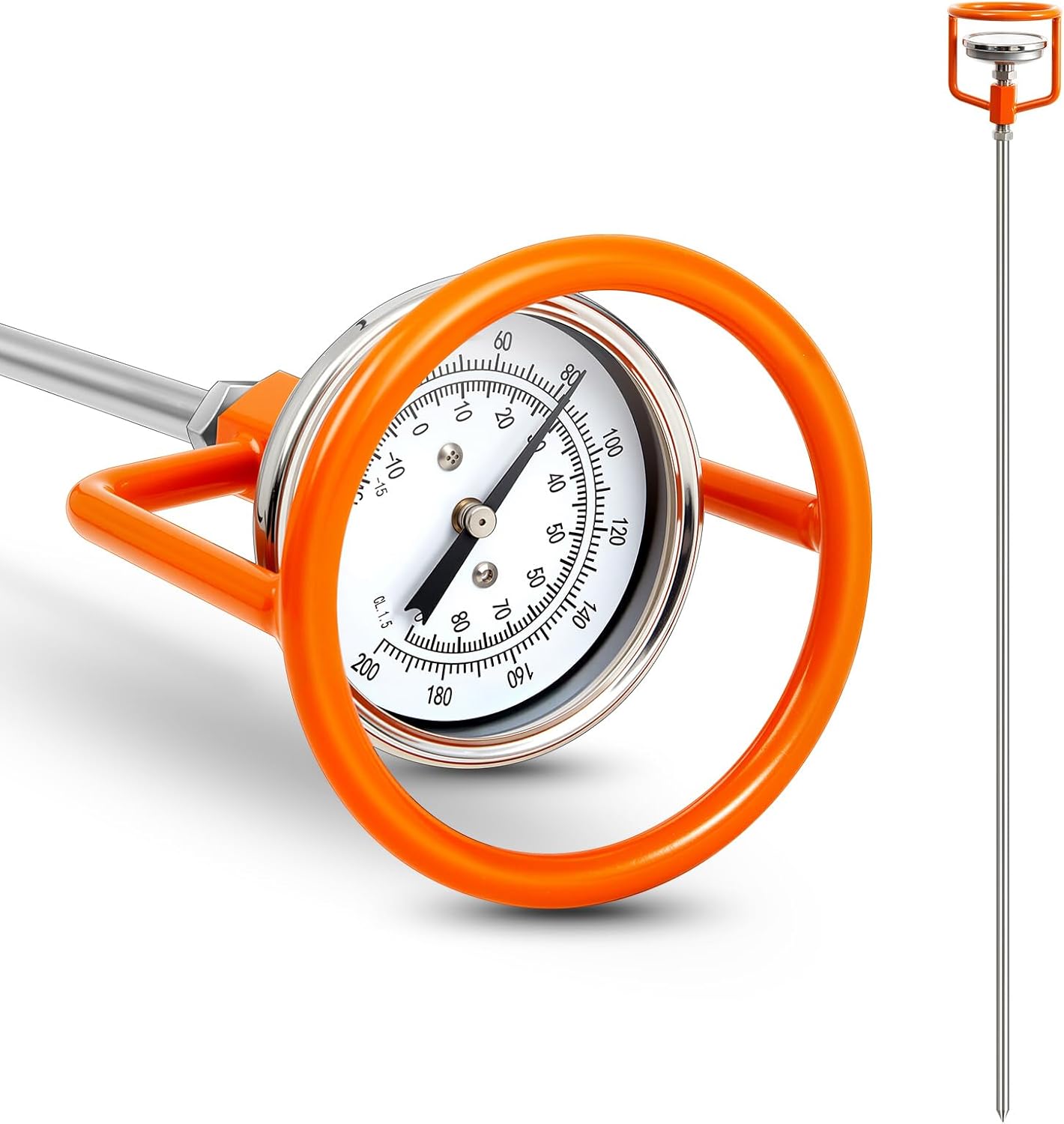
The Tellegloww QMF1759 is a heavy-duty outdoor compost thermometer made for checking the internal temperature of a compost pile. Based on the listed specifications, it is aimed at adult gardeners who want a simple way to monitor active composting in backyard piles, larger bins, or other deeper organic material stacks.
The key practical benefit is its 36-inch stem, which allows the probe to reach well into a compost heap rather than stopping at the cooler outer layer. The 3-inch analog dial displays both Fahrenheit and Celsius, with a listed range of 0 to 200°F and -10 to 90°C, giving gardeners a clear reference point when watching how a pile warms, cools, or changes after turning and watering.
The product information lists a stainless steel outer material, a 5/16-inch stem diameter, and an included probe guard with an orange painted steel handle. It arrives as one assembled compost thermometer with probe guard, so there is no complex setup, pairing, or battery management. The analog display also makes it a straightforward choice for gardeners who prefer a no-screen, no-app tool.
In practical garden use, this type of thermometer fits homeowners managing leaves, grass clippings, kitchen scraps, and other compostable materials in a larger pile. It can also be useful near raised-bed gardens or vegetable beds where homemade compost is part of the soil routine, since it helps the gardener check pile activity before deciding whether to turn, add moisture, or let the material continue breaking down.
There are a few limitations to consider. This model is not smart-home compatible, so it will not record temperature history or send alerts. Its long overall length may also be more than a small patio composter or shallow bin needs, and the pointed probe should be handled and stored carefully with the guard in place when not in use. For gardeners with deeper compost piles who want a durable analog thermometer with an included guard, the Tellegloww QMF1759 is a practical option. For very compact compost systems or gardeners who want digital logging, a shorter or connected thermometer may be a better fit.

Pros
- Long probe is well suited to larger compost piles rather than shallow bins alone
- Rugged stainless steel design gives it a more substantial build than light-duty garden thermometers
- Large dual-scale dial makes temperature readings straightforward without batteries
- Made in the USA and backed by a listed 1-year limited warranty
Cons
- The 36-inch length may be more than needed for small countertop composters or compact patio bins
- Analog dial requires manual reading and does not provide digital logging or alerts
- Gardeners who want extra dial protection may need to consider the compatible probe guard separately
The REOTEMP A36PF-D43 is a heavy-duty compost thermometer made for monitoring heat inside larger compost piles. Based on the listed specifications, it is best suited to gardeners, homesteaders, and composting operations that need to reach well below the surface rather than taking a shallow reading near the top of the pile.
The key advantage is its 36-inch immersion depth, which helps place the sensing stem closer to the active center of a deep compost pile. The dial reads from 0 to 200°F and -10 to 90°C, giving composters a practical range for routine pile monitoring, whether they prefer Fahrenheit or Celsius.
Its 5/16-inch diameter stem and all stainless steel construction give it a rugged, industrial-style design. The large 3-inch analog dial is intended to be easy to read, and the hermetically sealed face is listed as resistant to fogging, which is useful around moist organic material.
For backyard use, this thermometer makes the most sense for larger outdoor compost heaps, multi-bin compost systems, or gardeners who manage hot composting more deliberately. It can also be useful for community gardens or small-scale growing spaces where compost temperature is checked as part of regular pile maintenance.
Because this is a long analog probe, it may be more tool than a small-space gardener needs for a compact tumbler or a shallow bin. Wipe the stainless steel stem clean after use, insert it carefully to avoid bending pressure, and store it where the dial is protected from accidental impact. Gardeners wanting digital tracking, alarms, or a shorter probe may prefer a different style, but for deep manual temperature checks, the listed design is practical and purpose-built.

Pros
- Long probe is useful for checking the warmer center of a compost pile or bin
- Easy-to-read temperature zones simplify routine compost management
- Waterproof feature and stainless steel construction are appropriate for outdoor garden use
- Single Fahrenheit scale keeps readings straightforward for US home gardeners
Cons
- Gardeners managing very large or deep compost piles may prefer an even longer probe
- Analog dial must be read manually and does not log temperature history
- Polycarbonate window may benefit from being stored out of prolonged direct sun when not in use
The GOATACURA GB015 Compost Soil Thermometer is designed for gardeners who want to monitor compost temperature as part of routine pile management. It uses a 20-inch stem and an analog dial to help check conditions inside a compost bin, heap, or farm composting setup. For beginners, the color zones are especially useful because they give a quick visual cue instead of requiring constant interpretation of raw temperature numbers.
The listed 0 to 200°F range is well matched to composting, where gardeners often want to know whether a pile is cool, warming, actively decomposing, or running hot. The dial includes blue, green, and orange zones marked at 80 to 100°F, 100 to 130°F, and 130 to 160°F, which can help guide decisions such as turning, moistening, or adding more carbon-rich or nitrogen-rich material. The product information also lists +/-1% accuracy and ASME B40.3 Grade A compliance.
Its construction is straightforward and garden-friendly. The case and probe are listed as 304 stainless steel, with an aluminum dial, black aluminum pointer, and polycarbonate window. The 1.75-inch dial is compact but still intended for quick visual reading, while the center back mount and long stem make it suitable for inserting into a pile rather than skimming only the surface temperature.
In a typical backyard compost bin, this thermometer can be inserted toward the center of the pile to compare readings over several days. It may also be useful for gardeners managing leaf mold, mixed kitchen-and-yard-waste compost, or small farm composting projects where temperature changes help indicate microbial activity. Because it is analog, it is simple to keep near a compost area and use without batteries or electronic setup.
There are a few practical limitations to consider. A 20-inch stem is useful for many home compost piles, but gardeners with very large windrows or extra-deep bins may want a longer thermometer to reach the core more easily. Reviewers mention the dial is easy to read and the scale is well suited to composting, but one reviewer also wished for a longer probe and cautioned against leaving a thermometer lens in direct sun for extended periods. As with any long metal probe, insert and remove it carefully to avoid bending the stem or puncturing hands, liners, or nearby materials.
Overall, the GOATACURA GB015 is a sensible choice for home gardeners who want a simple, durable-looking compost temperature tool with clear visual zones and no electronics. It is best for routine compost monitoring in backyard bins and medium piles. Gardeners who need remote readings, data logging, or extra-long reach for large compost systems should consider a different style.
Kaufratgeber für das beste Kompostthermometer mit langem Fühler
Wählen Sie die Fühlerlänge passend zu Ihrer Kompostanlage
Die Fühlerlänge ist die erste Entscheidung. Ein 20-Zoll-Schaft, wie beim Reotemp 20 Inch Fahrenheit Backyard Compost Thermometer with Digital Composting Guide, beim GOATACURA Compost Soil Thermometer, beim STOWBERRY Compost Thermometer 20 Inch und beim Terpovery Long Stem Compost Soil Thermometer, ist für viele Kompostbehälter im Garten und mittelgroße Haufen eine praktische Größe. Er reicht tiefer als kurze Bodenthermometer, ohne unhandlich zu werden.
Für größere Komposthaufen sollten Sie die längsten dokumentierten Schäfte in Betracht ziehen. Das REOTEMP Heavy Duty Compost Thermometer with Probe Guard Bundle wird mit einem 36-Zoll-Schaft angegeben, während das Garden Weasel Analog Soil & Composting Dial Thermometer einen 36-Zoll-Fühler besitzt. Beim Reotemp 36 Inch Fahrenheit Backyard Pro Compost Thermometer wird in den wichtigsten Produktmerkmalen ein 24-Zoll-Schaft genannt. Vergleichen Sie daher die aufgeführten Spezifikationen sorgfältig, bevor Sie es für einen sehr tiefen Haufen auswählen.
Achten Sie auf einen Temperaturbereich für aktive Kompostierung
Die meisten kompostorientierten Modelle in den bereitgestellten Daten decken den üblichen Kompostierungsbereich ab. Das REOTEMP Heavy Duty Bundle wird mit 0 bis 200°F und -10 bis 90°C angegeben, das GOATACURA-Modell mit 0 bis 200°F und das Garden-Weasel-Modell mit 0 bis 220°F. Das Yogyro Backyard Compost Thermometer nennt 0 bis 180 Fahrenheit und Celsius bereits im Produktnamen.
Anfänger können von einem Zifferblatt profitieren, das den Messwert visuell einordnet. Mehrere Reotemp-Modelle nennen drei Temperaturzonen wie Steady, Active und Hot, während das GOATACURA-Angebot blaue, grüne und orangefarbene Zonen zur Echtzeitverfolgung der Kompostaktivität beschreibt. Diese Zonen können die Entscheidung erleichtern, ob der Haufen umgesetzt, die Feuchtigkeit angepasst oder ihm mehr Zeit gegeben werden sollte.
Größe und Ablesbarkeit des Zifferblatts sind wichtiger als erwartet
Ein großes Zifferblatt lässt sich leichter ablesen, wenn Sie über einem Behälter stehen. Das kann älteren Gärtnern und allen helfen, die unnötiges Bücken vermeiden möchten. Das REOTEMP Heavy Duty Bundle wird mit einem großen 3-Zoll-Zifferblatt mit Doppelskala angegeben, das Reotemp Backyard Pro mit einem hermetisch abgedichteten 2,5-Zoll-Zifferblatt. STOWBERRY nennt ein gut ablesbares 2-Zoll-Zifferblatt mit Fahrenheit-Anzeige und Kompostaktivitätszonen.
Kleinere Zifferblätter können ebenfalls funktionieren, erfordern aber möglicherweise einen genaueren Blick. Das GOATACURA-Modell wird mit einem 1,75-Zoll-Zifferblatt angegeben. Wenn Sehvermögen, Gleichgewicht oder Rückenkomfort eine Rolle spielen, sollten Sie das größte gut ablesbare Zifferblatt und eine Fühlerlänge bevorzugen, mit der Sie messen können, ohne sich zu weit über den Haufen zu beugen.
Vergleichen Sie Konstruktion und wetterbezogene Eigenschaften
Kompost ist feucht, schwer und manchmal schwierig zu durchstechen, daher spielt die Konstruktion eine Rolle. Das REOTEMP Heavy Duty Compost Thermometer with Probe Guard Bundle wird mit einer robusten Konstruktion vollständig aus Edelstahl, einem Stahl-Fühlerschutz, einem hermetisch abgedichteten Zifferblatt und einer Herstellung in den USA angegeben. Beim Reotemp Backyard Pro werden eine robuste Konstruktion vollständig aus Edelstahl und ein strapazierfähiger Schaft mit 5/16 Zoll Durchmesser genannt.
Auch mehrere andere Angebote betonen Edelstahl. GOATACURA nennt ein Gehäuse und einen Fühler aus Edelstahl 304, STOWBERRY einen korrosionsbeständigen Edelstahlfühler, Terpovery Edelstahl und Yogyro eine robuste Konstruktion aus Edelstahl der Güteklasse 304. Verlassen Sie sich nur auf Angaben zu Wetter- oder Wasserbeständigkeit, wenn sie im Angebot genannt werden, etwa Yogyros Angabe eines wasserdichten und beschlagbeständigen Zifferblatts oder Reotemps Beschreibung eines hermetisch abgedichteten, beschlagfreien Zifferblatts.
Passen Sie das Thermometer an Anfänger, kleine Flächen oder große Haufen an
Für Anfänger ist ein unkompliziertes analoges Zifferblatt mit Kompostaktivitätszonen meist leichter verständlich als eine reine Zahlenanzeige. Das Reotemp 16 Inch Fahrenheit Backyard Compost Thermometer und das Reotemp 20 Inch Fahrenheit Backyard Compost Thermometer werden im Angebot beide mit einem digitalen Kompostierungsleitfaden aufgeführt und verwenden drei Temperaturzonen, um die Kompostaktivität zu erklären.
Für kleine Flächen sollten Sie nicht mehr Fühlerlänge kaufen, als Ihr Behälter bequem nutzen kann. Eine 16-Zoll-Option kann für kleinere Kompostbehälter im Garten besser geeignet sein als ein 36-Zoll-Fühler im Stil eines kommerziellen Modells. Das Yogyro-Angebot weist ausdrücklich darauf hin, dass sein 16-Zoll-Fühler nicht für kleine Komposttrommeln, flache Behälter oder den Indoor-Gartenbau empfohlen wird. Bei großen Haufen erreichen 20-, 24- und 36-Zoll-Fühler den wärmeren Kern eher.
Verstehen Sie die Abwägung zwischen Preis und Bewertungen
Die bereitgestellte Preisspanne reicht von $9.99 – $308.00. Die richtige Wahl hängt daher davon ab, wie oft Sie kompostieren und wie anspruchsvoll Ihr Haufen ist. Das Terpovery Long Stem Compost Soil Thermometer ist mit $9.99 die günstigste aufgeführte Option und verfügt über einen 20-Zoll-Schaft, keinen Batteriebetrieb sowie Fahrenheit und Celsius im Produktnamen.
Am oberen Ende liegt das REOTEMP Heavy Duty Compost Thermometer with Probe Guard Bundle mit einem Preis von $308.00. Es wird als strapazierfähiges Bundle mit 36-Zoll-Schaft und Stahl-Fühlerschutz positioniert. Auch die Zahl der Rückmeldungen von Besitzern variiert stark: Beim Reotemp-16-Inch-Modell werden 1047 Bewertungen genannt, beim Reotemp Backyard Pro 323 Bewertungen, bei STOWBERRY 64 Bewertungen und bei GOATACURA 11 Bewertungen. Einige Angebote weisen trotz hoher Bewertungen 0 Rezensionen auf.
Tipps zu Verwendung, Pflege und Aufbewahrung
Führen Sie ein Kompostthermometer vorsichtig ein, anstatt es mit Gewalt durch verdichtetes Material zu drücken. Wenn der Haufen dicht ist, lockern Sie zunächst einen Weg, indem Sie das Material umsetzen oder öffnen, und schieben Sie den Fühler anschließend in Richtung Mitte, wo sich üblicherweise der aussagekräftigste Temperaturwert befindet. Vermeiden Sie es, den Schaft zu verbiegen, insbesondere bei dünneren Fühlern.
Wischen Sie den Fühler nach der Verwendung sauber und bewahren Sie ihn so auf, dass das Zifferblatt vor Stößen geschützt ist. Auch wenn ein Angebot eine wasserdichte, beschlagbeständige oder hermetisch abgedichtete Konstruktion nennt, hält ein Thermometer in der Regel länger, wenn es nicht dort liegen bleibt, wo man darauf treten, es vergraben oder mit Gartengeräten treffen kann. Befolgen Sie die Pflegehinweise des Herstellers für das von Ihnen gewählte Modell.
Schneller Spezifikationsvergleich
| Produkt | Angegebene Fühler- oder Schaftlänge | Hervorgehobene unterstützte Eigenschaft |
|---|---|---|
| REOTEMP Heavy Duty Compost Thermometer with Probe Guard Bundle – Fahrenheit and Celsius, Made in The USA (36 Inch Stem) | 36-Zoll-Schaft | Stahl-Fühlerschutz, 3-Zoll-Zifferblatt mit Doppelskala, 0 bis 200°F und -10 bis 90°C |
| Reotemp 36 Inch Fahrenheit Backyard Pro Compost Thermometer with Digital Composting Guide | 24-Zoll-Schaft in den aufgeführten Merkmalen | Hermetisch abgedichtetes 2,5-Zoll-Zifferblatt und drei Kompostaktivitätszonen |
| Reotemp 20 Inch Fahrenheit Backyard Compost Thermometer with Digital Composting Guide | 20-Zoll-Schaft | Edelstahlkonstruktion und drei Temperaturzonen |
| Compost Soil Thermometer, 304 Stainless Steel Case and Probe,1.75 inch Dial Size, 20 inch Stem Length, 0-200 Deg F, 3 Temperature Zones | 20-Zoll-Schaft | Gehäuse und Fühler aus Edelstahl 304, Bereich von 0 bis 200°F, drei Farbzonen |
| Garden Weasel Analog Soil & Composting Dial Thermometer – 36-Inch Probe | Measures 0 to 220 Degrees Fahrenheit | Soil Temperature, Worm Compost | 98001-A | 36-Zoll-Fühler | Bereich von 0 bis 220°F für Boden- und Kompostanwendungen |
Recherche-Methodik und Vertrauen
Dieser Ratgeber basiert auf Recherche und einem Vergleich der Spezifikationen, nicht auf praktischen Produkttests. Wir prüften die bereitgestellten Angebote auf ihre Eignung für das beste Kompostthermometer mit langem Fühler und bevorzugten Produkte, die eindeutig als Kompostthermometer ausgewiesen sind und eine Fühler- oder Schaftlänge für Messungen im Komposthaufen nennen.
Zu den Bewertungskriterien gehörten die dokumentierte Fühlerlänge, der Temperaturbereich, die Ablesbarkeit des Zifferblatts, aufgeführte Materialien, sofern angegeben die Beschlag- oder Wasserbeständigkeit sowie Kompostaktivitätszonen oder ein Leitfaden für Anfänger. Außerdem berücksichtigten wir Hinweise von Besitzern wie Bewertung und Anzahl der Rezensionen. Angebote mit 0 Rezensionen behandelten wir jedoch vorsichtig, selbst wenn die angezeigte Bewertung hoch war.
Im Juli 2026 prüften wir die bereitgestellten Produktdaten zu Marken wie REOTEMP, VeeGee, Greenco und weiteren Marken. Für konkrete Empfehlungen wurden jedoch ausschließlich die hier genannten Produktdetails verwendet. Wenn ein Angebot unvollständige oder widersprüchliche Informationen enthielt, ergänzten wir die Lücken nicht durch Annahmen.
Abschließende Empfehlungen
Beste Gesamtwahl: Das Reotemp 20 Inch Fahrenheit Backyard Compost Thermometer with Digital Composting Guide ist auf Grundlage der bereitgestellten Daten die ausgewogenste Wahl. Es wird mit einem 20-Zoll-Schaft aus Edelstahl, einem hermetisch abgedichteten Zifferblatt, drei Kompostaktivitätszonen, einem anfängerfreundlichen digitalen Kompostierungsleitfaden und einem moderaten angegebenen Preis von $22.99 aufgeführt.
Beste strapazierfähige Option: Das REOTEMP Heavy Duty Compost Thermometer with Probe Guard Bundle – Fahrenheit and Celsius, Made in The USA (36 Inch Stem) eignet sich am besten für anspruchsvolle oder größere Komposthaufen. Sein angegebener 36-Zoll-Schaft, die vollständig aus Edelstahl gefertigte Konstruktion, der Stahl-Fühlerschutz, das 3-Zoll-Zifferblatt mit Doppelskala und der Bereich von 0 bis 200°F machen es zur robustesten Option in den bereitgestellten Daten. Der Preis von $308.00 liegt allerdings deutlich über dem typischer Modelle für den Garten.
Beste Budgetwahl: Das Long Stem Compost Soil Thermometer – Fast Response Stainless Steel 20 Inch – Measuring Probe – Fahrenheit and Celsius von Terpovery ist mit $9.99 die günstigste gültige Option mit langem Fühler. Für Gärtner, die ein einfaches, batterieloses Kompost- und Bodenthermometer aus Edelstahl suchen, kann es ausreichen. Käufer, die ein größeres Zifferblatt, klar ausgewiesene Aktivitätszonen oder mehr Bewertungshistorie wünschen, bevorzugen möglicherweise ein Modell von Reotemp, GOATACURA oder STOWBERRY.
FAQ
Welche Fühlerlänge ist für ein Kompostthermometer mit langem Fühler am besten?
Für viele Kompostbehälter im Garten sind 20 Zoll ein praktischer Mittelweg, da der Fühler in den Haufen reicht, ohne unhandlich zu sein. Größere Haufen können von einem 24- oder 36-Zoll-Fühler profitieren, insbesondere wenn Sie die Mitte statt des äußeren Materials messen möchten.
Gilt ein 16-Zoll-Kompostthermometer als langer Fühler?
Ein 16-Zoll-Kompostthermometer ist länger als viele einfache Bodenthermometer und kann für einige Behälter geeignet sein. Den Kern eines großen Haufens erreicht es jedoch möglicherweise nicht. Wenn Ihr Kompost tief oder breit ist, vergleichen Sie es vor dem Kauf mit 20-, 24- und 36-Zoll-Optionen.
Brauche ich Fahrenheit und Celsius auf dem Zifferblatt?
Sie benötigen nur die Skala, die Sie bequem ablesen können. Eine Anzeige mit Doppelskala kann jedoch nützlich sein, wenn Sie Kompostierungstipps aus verschiedenen Quellen befolgen. Das REOTEMP Heavy Duty Bundle wird auf seinem großen Zifferblatt mit Doppelskala mit 0 bis 200°F und -10 bis 90°C angegeben.
Wie sollte ich das beste Kompostthermometer mit langem Fühler aufbewahren?
Wischen Sie den Fühler nach der Verwendung ab und bewahren Sie das Thermometer so auf, dass das Zifferblatt nicht zerdrückt oder herumgestoßen wird. Auch wenn ein Modell wasserdichte, beschlagbeständige oder hermetisch abgedichtete Eigenschaften nennt, ist es sinnvoll, das Zifferblatt zu schützen und ein Verbiegen des Schafts zu vermeiden.
Sind farbcodierte Zonen bei Kompostthermometern sinnvoll?
Farblich gekennzeichnete oder beschriftete Zonen können für Anfänger hilfreich sein, weil sie einen Temperaturwert in einen leichter verständlichen Hinweis zur Kompostaktivität übersetzen. Reotemp-Modelle nennen Zonen wie Steady, Active und Hot, während GOATACURA blaue, grüne und orangefarbene Temperaturzonen aufführt.
Kann ich ein Kompostthermometer mit langem Fühler in einer kleinen Komposttrommel verwenden?
Manchmal, aber vergleichen Sie vor dem Kauf die Fühlerlänge mit der Größe der Trommel. Ein sehr langer 36-Zoll-Fühler kann in einem kleinen Behälter unhandlich sein. Außerdem weist das Yogyro-Angebot ausdrücklich darauf hin, dass sein 16-Zoll-Fühler nicht für kleine Komposttrommeln, flache Behälter oder den Indoor-Gartenbau empfohlen wird.