

Gesunde Pflanzen beginnen mit einem Boden, den Sie verstehen. Das beste Bodentest-Set für den Hausgarten kann Ihnen helfen zu entscheiden, ob Ihr Boden eine pH-Anpassung, mehr Aufmerksamkeit für Nährstoffe, bessere Bewässerungsgewohnheiten oder vor dem Kauf von Bodenverbesserern eine umfassendere Laboranalyse benötigt.
Dieser Ratgeber richtet sich an Gartenanfänger, Hausbesitzer mit Rasen und Beeten, Gärtner mit Pflanzen in Töpfen sowie ältere Gärtner, die klare Ergebnisse ohne unnötigen Aufwand wünschen. Wir haben 15 Produkte aus der bereitgestellten Liste verglichen und unsere Empfehlungen auf Bodentest-Sets und Bodenmessgeräte mit eindeutigem Bezug zum Hausgarten konzentriert, darunter Optionen mit pH-Teststreifen, NPK-Sets für zu Hause, digitalen Messgeräten und Analysen per Post.
Weitere Hilfsmittel für den Bodenaufbau und Ratgeber zur Bodenverbesserung finden Sie in unserem Bereich Kompost, Erde & Mulch. In diesem Vergleich waren vor allem entscheidend, was jedes Set misst, wie leicht die Ergebnisse abzulesen sind, ob es für Rasen, Gemüse, Blumen, Töpfe oder Zimmerpflanzen geeignet ist und wie viel Hilfe bei der Interpretation enthalten ist.
MySoil Soil Test Kit for Lab Nutrient and pH Analysis with Garden Recommendations Luster Leaf Rapitest 1602 Soil Test Kit for Checking pH and NPK in Garden Beds Luster Leaf Rapitest 1601 Soil Test Kit for pH and NPK Garden Checks DewildeTradingCo 140-Test Liquid Soil Test Kit for pH and Key Nutrient Checks Prices and availability can change. We may earn a commission from qualifying purchases.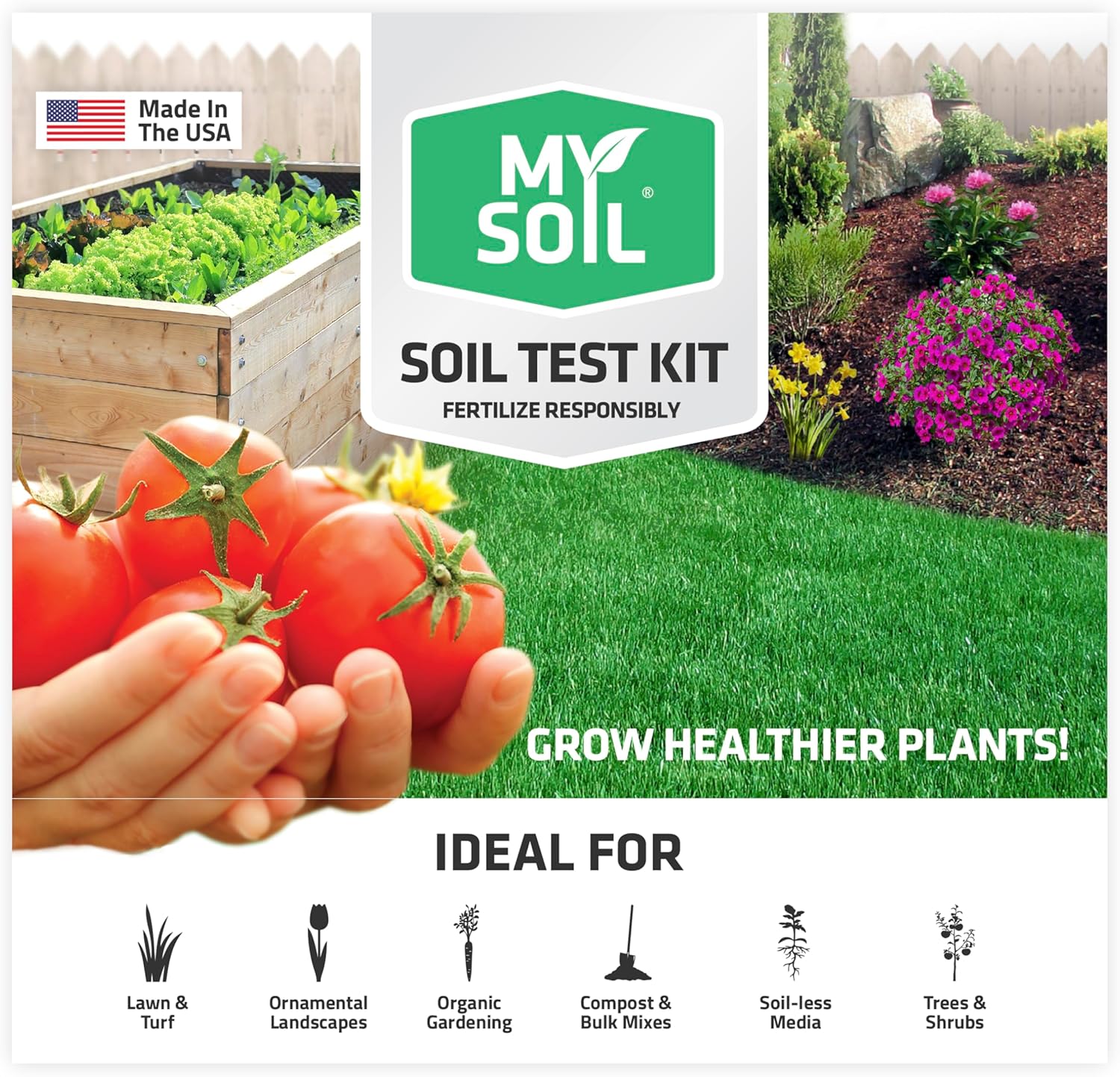


Einige Produktangaben unten sind noch auf Englisch; ihre Übersetzung wird überprüft.
Pros
- Provides lab-based nutrient and pH analysis rather than relying on quick color charts or probe-style readings.
- Covers a wide range of lawn, garden, container, and specialty growing scenarios.
- Prepaid return postage and included instructions make it approachable for beginners.
- Recommendations are tailored to the soil and plant needs entered for the sample.
- Reviewers commonly mention that the kit is easy to use and that the report is detailed.
Cons
- Each kit covers only one soil test, so separate lawn zones, raised beds, or problem areas may require additional kits.
- Because it is a mail-in lab test, gardeners who need immediate same-day readings may prefer an at-home option.
- It is focused on soil nutrients and pH, so it should not be treated as a complete diagnosis for pests, diseases, drainage problems, or watering issues.
The MySoil Soil Test Kit is a single-use mail-in kit designed to help homeowners understand the nutrient and pH condition of a specific lawn, garden bed, container area, compost sample, or other growing setup. It is a practical fit for beginners who are unsure what their soil needs, as well as more experienced lawn and garden caretakers who want a clearer basis for fertilizer and amendment decisions.
According to the product information, the lab analysis measures 13 plant-available nutrient levels, including nitrogen and pH. That is the main advantage over simple at-home pH meters or test strips, which typically provide a narrower picture. The included recommendations are meant to show what to apply, how much to apply, and when to apply it, with both organic and non-organic fertilizer options listed.
The kit includes the soil sample materials, easy-to-follow instructions, and a prepaid mailing envelope addressed to the testing lab. Results are provided through an online dashboard, and the listed turnaround time is 6 to 8 days after the sample is processed through the mail-in system. Reviewers commonly describe the process as simple, with clear instructions and detailed reports, although individual timing can depend on mailing and processing.
For backyard use, this kit makes sense before renovating a tired lawn, starting a vegetable garden, correcting uneven growth in a flower bed, or deciding whether a raised bed needs more than routine compost. It can also be useful for annual spring or fall checks, mid-season troubleshooting, or comparing a poor-performing section with the rest of the yard, provided each distinct area is tested with its own kit.
The main limitation is that one kit equals one test, so gardeners managing several beds, lawn zones, or container mixes should plan accordingly. It also is not a substitute for diagnosing insects, fungal disease, compaction, poor drainage, or irrigation problems. For gardeners who want lab-based nutrient and pH guidance before buying fertilizer, the MySoil kit offers a convenient and beginner-friendly path to more informed soil care.
Best For / Avoid If
Best for buyers prioritizing
- Provides lab-based nutrient and pH analysis rather than relying on quick color charts or probe-style readings.
- Covers a wide range of lawn, garden, container, and specialty growing scenarios.
- Prepaid return postage and included instructions make it approachable for beginners.
Consider another option if
- Each kit covers only one soil test, so separate lawn zones, raised beds, or problem areas may require additional kits.
- Because it is a mail-in lab test, gardeners who need immediate same-day readings may prefer an at-home option.
- It is focused on soil nutrients and pH, so it should not be treated as a complete diagnosis for pests, diseases, drainage problems, or watering issues.
Pros
- Covers pH plus the main NPK nutrient indicators in one home kit.
- Clear instructions are included, and reviewers commonly mention that the process is understandable once prepared.
- Plant pH reference list for over 450 plants helps connect test results to real garden decisions.
- Works for a range of common growing areas, including vegetables, flowers, lawns, and garden beds.
Cons
- The 20-test count means 5 tests for each category, not 20 full sets of pH, nitrogen, phosphorus, and potash checks.
- NPK testing may require preparing a soil-and-water solution and allowing it to settle, so it is not always an instant process.
- Some reviewers report that the small capsules can be awkward to open and pour without spilling.
The Luster Leaf Rapitest 1602 Soil Test Kit is designed for home gardeners who want a basic read on soil pH, nitrogen, phosphorus, and potash before adding fertilizer or soil amendments. It fits vegetable gardens, flower beds, lawns, and general backyard growing areas where guessing at soil needs can lead to overfeeding, underfeeding, or choosing the wrong amendment.
Based on the listed product information, the kit includes components for 20 total tests, with 5 each for pH, nitrogen, phosphorus, and potash. That makes it most useful for spot-checking several areas, comparing beds, or testing before and after a soil improvement plan, provided you budget the capsules carefully.
The kit uses a capsule system and patented color comparators to help gardeners interpret results at home. The included instructions and pH preference list for over 450 plants are especially helpful for beginners because pH is not just a number, it affects how well many plants can use nutrients already present in the soil.
In practical use, this type of kit is well suited to raised beds that have stopped producing well, a new vegetable plot, a lawn area that is not responding as expected, or compost and garden soil that you want to evaluate before planting. Reviewers commonly mention that the directions are understandable, though several note that preparing the soil solution for nutrient testing can take time.
There are a few limitations to keep in mind. The product description’s 20-test total can be misunderstood, since it is not 20 complete four-part soil profiles. The small capsules may also require careful handling, and gardeners who need formal nutrient recommendations, high-volume testing, or documented lab precision may still prefer a professional extension office or laboratory soil analysis.
Overall, the Rapitest 1602 is a sensible starter soil test kit for homeowners who want more information before amending garden beds, lawns, or containers. It is best for occasional at-home checks and learning soil basics, while larger gardens or repeated testing programs may need a more refill-friendly or professional testing option.
Pros
- Covers pH plus the primary NPK nutrients commonly used to guide fertilizing decisions.
- Comes with clear instructions and fertilization guidelines according to the product information.
- Useful for checking different areas of a yard or garden bed rather than treating all soil as identical.
- Does not require batteries or an electronic meter.
Cons
- Gardeners needing laboratory-level analysis, micronutrient data, or professional soil recommendations may prefer a university extension or lab test.
- Some tests require mixing soil with water and waiting for the sample to settle, so it is not as instant as a probe-style meter.
- The kit includes a fixed number of capsules, so repeated testing across many beds may require another kit.
The Luster Leaf Rapitest 1601 Soil Test Kit is designed for home gardeners who want to check basic soil conditions before planting, fertilizing, or adjusting pH. It measures four common soil factors: pH, nitrogen, phosphorus, and potash. That makes it relevant for vegetable gardens, flower beds, lawns, and general backyard soil troubleshooting.
The main benefit is that it gives gardeners a more informed starting point than guessing from plant appearance alone. Soil pH affects how well plants can use nutrients, while nitrogen, phosphorus, and potash relate to leafy growth, root and fruit development, and general plant strength. The kit includes 10 tests for each category, which allows for checking more than one bed, lawn area, or planting zone.
The product information describes a capsule system with color-coded components and patented color comparators. Instead of relying only on a printed chart, the comparators are intended to make color matching easier. The kit also includes an eye dropper, instructions, fertilization guidelines, and a pH preference list for more than 450 plants. Listed dimensions are compact at 5 inches wide by 5.91 inches high, and the kit weighs 4 ounces, so it should be easy to store between seasonal uses.
In practical use, this type of kit is most helpful when preparing a new raised bed, checking a vegetable plot before spring planting, comparing different parts of a lawn, or evaluating soil before adding fertilizer. Reviewers commonly mention that the instructions are understandable and that the kit can help identify differences between planting areas. For small-space gardeners, it may also be useful for checking garden beds or container soil before deciding whether to amend or replace the mix.
There are a few realistic limitations. This is an at-home color comparison kit, not a full laboratory soil analysis, so gardeners managing major soil problems, large landscapes, or high-value plantings may still want a professional or extension-service test. The nutrient tests can require soil and water preparation with settling time, and careful timing and clean handling matter for consistent results. As with any chemical-style garden test kit, keep capsules and test materials away from children and pets, and follow the included directions closely.
Overall, the Rapitest 1601 is a sensible choice for beginner and intermediate gardeners who want a low-tech way to check pH and basic NPK levels before making fertilizer decisions. It is less suited to gardeners who need detailed lab numbers, micronutrient reporting, or ongoing high-volume testing across many separate sites.
Best For / Avoid If
Best for buyers prioritizing
- Covers pH plus the primary NPK nutrients commonly used to guide fertilizing decisions.
- Comes with clear instructions and fertilization guidelines according to the product information.
- Useful for checking different areas of a yard or garden bed rather than treating all soil as identical.
Consider another option if
- Gardeners needing laboratory-level analysis, micronutrient data, or professional soil recommendations may prefer a university extension or lab test.
- Some tests require mixing soil with water and waiting for the sample to settle, so it is not as instant as a probe-style meter.
- The kit includes a fixed number of capsules, so repeated testing across many beds may require another kit.
Pros
- Covers pH plus major fertility indicators in a single home kit.
- Useful for routine monitoring in multiple growing areas.
- May help reduce guesswork before adding fertilizer or soil amendments.
- Updated instructions are listed for the 2026 version.
Cons
- As with most home liquid soil tests, careful sampling, measuring, and color reading may be required for useful results.
- Gardeners needing certified soil analysis, micronutrient data, or detailed amendment calculations may prefer a laboratory soil test.
- The product data does not list storage case details, reagent shelf life, or exact step-by-step procedure.
The DewildeTradingCo 140-test liquid soil test kit is an at-home soil fertility kit for checking pH, ammonia, nitrogen, phosphorus, and potassium. It is intended for gardeners who want a practical read on basic soil conditions before making fertilizer or amendment decisions. Based on the listed uses, it can fit vegetable gardens, lawns, flower beds, turf, ornamental landscapes, houseplants, compost, trees, vines, and hydroponic growing.
The main value of this kit is that it looks at several soil factors instead of focusing only on pH. pH affects how plants access nutrients, while nitrogen, phosphorus, potassium, and ammonia readings can help gardeners think more carefully about feeding. For beginners, that can be especially useful because poor growth is often blamed on one issue when soil fertility may involve several factors.
The product information describes this as a liquid soil test kit with about 140 total tests, including approximately 40 tests for each listed parameter and about 20 for nitrogen. That makes it better suited to repeated checks than a single-use kit, especially if you manage multiple raised beds, lawn sections, containers, or planting areas. No dimensions, storage case details, or exact procedure are provided, so buyers should expect to follow the included instructions closely.
In a backyard garden, this kit could be used before planting a vegetable bed, when comparing different lawn areas, or when checking container soil that has been reused across seasons. It may also be helpful for gardeners managing compost or ornamental beds who want a quick reference point before adding fertilizer. For small-space growers, the ability to run several tests may be useful when containers have different potting mixes or plant histories.
There are some practical limits to keep in mind. Home liquid soil tests generally depend on careful sample collection, clean handling, correct timing, and accurate color comparison, so rushing the process can reduce usefulness. This type of kit is helpful for routine guidance, but gardeners needing certified results, micronutrient testing, heavy metal screening, or precise amendment prescriptions should consider a professional lab soil test.
Overall, this DewildeTradingCo kit is a sensible choice for homeowners and beginner-to-intermediate gardeners who want a broad, at-home look at common soil fertility markers. It is best for routine monitoring and fertilizer planning, not for replacing a full laboratory analysis when a high-stakes planting, persistent soil problem, or detailed nutrient plan is involved.

Pros
- Wide pH 3.5 to 9 measurement range for common home garden soil checks.
- Large 100-count supply supports repeated testing or sampling from several locations.
- No meter, batteries, or probe setup is listed, which keeps the testing method straightforward.
- Product information provides clear timing steps for mixing, dipping, waiting, and comparing results.
- Reviewers often describe the strips as easy to use, although careful sample preparation matters.
Cons
- Color chart readings may be hard to judge for some users, especially when color bands look similar.
- Muddy or unclear soil-water mixtures could make the result harder to read.
- Gardeners needing lab-style precision or nutrient testing beyond pH may prefer a more comprehensive soil test.
The Dewilde Trading Co DTC-00024 Soil pH Test Strip Kit is made for gardeners who want a basic way to check soil acidity or alkalinity at home. Based on the listed specifications, the strips measure from pH 3.5 to 9 and are intended for soil testing in garden beds, lawns, indoor plants, fruit trees, flowers, vegetables, and shrubs.
The main value of this kit is helping you understand whether pH may be a factor in plant performance. Soil pH affects how available nutrients are to plants, so a quick pH check can be a useful first step before adding lime, sulfur, fertilizer, compost, or other amendments. The included 100 strips also make it practical to test more than one area instead of assuming the whole yard has the same soil condition.
The testing procedure listed by the manufacturer is straightforward: mix the soil sample with water, let the solution sit for 30 minutes, dip one strip for 3 seconds, hold it horizontally for 60 seconds, and compare it with the color chart on the bottle. Because this is a color-comparison strip test, consistent sampling is important. Taking soil from the right depth, avoiding debris, and letting heavy sediment settle can make the chart easier to read.
For backyard gardeners, this kit can be useful when comparing a vegetable bed with a lawn patch, checking container soil, or investigating why a particular planting area is underperforming. Small-space gardeners can use it for raised beds and pots, while homeowners with larger yards may appreciate having enough strips to sample several spots before making soil adjustments.
The biggest limitation is readability. Some reviewers mention that the strips are easy to use, while others note that the color chart or muddy water can be difficult to interpret. This is not described as a full laboratory soil analysis and it does not list testing for nitrogen, phosphorus, potassium, or micronutrients, so it should be viewed as a pH guidance tool rather than a complete soil health report.
This kit is a sensible choice for beginner and intermediate gardeners who want a low-complexity pH check for routine planting decisions. Gardeners who need highly precise readings, digital results, or full nutrient recommendations may be better served by a more advanced soil test or a local extension lab analysis.
Best For / Avoid If
Best for buyers prioritizing
- Wide pH 3.5 to 9 measurement range for common home garden soil checks.
- Large 100-count supply supports repeated testing or sampling from several locations.
- No meter, batteries, or probe setup is listed, which keeps the testing method straightforward.
Consider another option if
- Color chart readings may be hard to judge for some users, especially when color bands look similar.
- Muddy or unclear soil-water mixtures could make the result harder to read.
- Gardeners needing lab-style precision or nutrient testing beyond pH may prefer a more comprehensive soil test.
Pros
- Measures three common plant-care factors: soil moisture, soil pH, and sunlight level.
- Does not require batteries, charging, or digital setup.
- Compact and lightweight for use around indoor plants, outdoor containers, raised beds, gardens, and lawns.
- Simple switch-based operation makes it approachable for beginner gardeners.
- Product instructions clearly outline cleaning and soil-use precautions.
Cons
- Not intended for testing water or other liquids, including liquid pH readings.
- Very dry or very hard soil may prevent movement of the indicator or risk damaging the probes if forced.
- Gardeners needing laboratory-level pH accuracy may prefer a dedicated soil test kit or professional soil analysis.
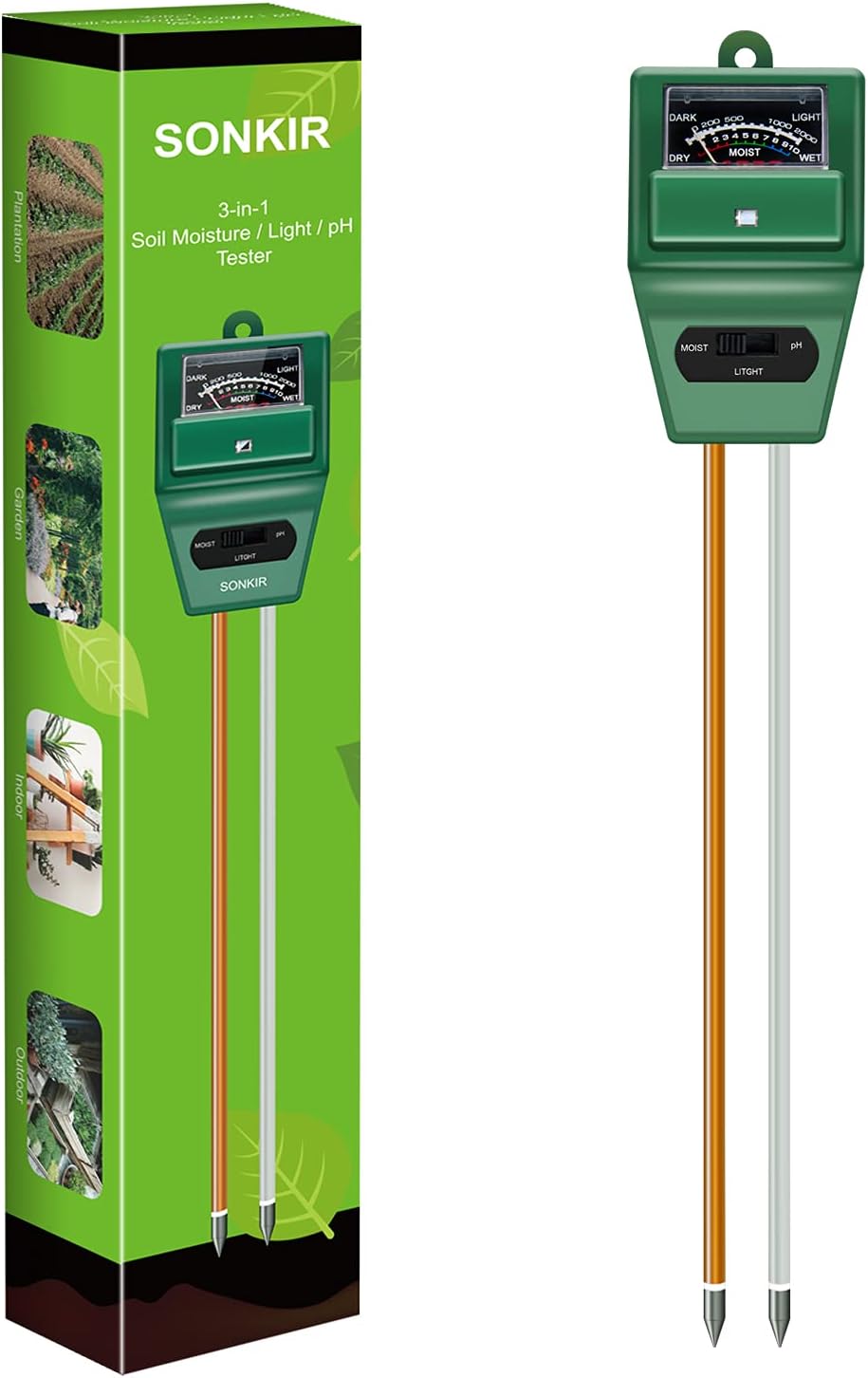
The SONKIR MS02 is a 3-in-1 soil meter made for checking soil moisture, soil pH, and sunlight level with a single analog dial. It is intended for practical plant care rather than lab-grade testing, making it a useful fit for homeowners, houseplant keepers, patio gardeners, and beginners who want a quick reference before watering or moving plants.
Its most useful everyday role is helping reduce guesswork around watering. The moisture scale runs from dry to wet, so gardeners can check below the surface instead of judging only by the top layer of soil. The pH function covers a listed range of 3.5 to 8, and the light setting can help compare growing spots for indoor plants, containers, vegetable beds, or lawn areas.
Based on the listed specifications, the meter measures 11.5 x 2 x 1.5 inches and weighs 2.89 ounces, so it should be easy to store with small garden tools or keep near a potting bench. The probe length is listed at 7.9 inches, and the instructions recommend inserting the probes about 6 to 7 inches into soil, then waiting about 10 minutes before reading the dial.
For small-space gardeners, this tool can be helpful when checking container soil that dries unevenly, comparing light levels on a windowsill, or monitoring raised-bed moisture after watering. In larger yards, it can serve as a quick reference for garden beds, lawns, and general soil checks, especially when plants show signs that water, light, or soil conditions may need attention.
There are important use limits to keep in mind. The product information says it is for soil only and should not be used to test pure water or other liquids. It also should not be forced into very hard soil or left in soil for long periods, and the probes should be wiped clean after each use. If the soil is extremely dry, the indicator may not move until the soil is watered before testing.
This is a sensible choice for gardeners who want a simple, battery-free way to gather basic soil-condition clues. Gardeners who need highly precise pH data for major soil amendments, crop planning, or diagnostic work may want to pair it with a more formal soil test, but for routine home plant care the MS02 offers a convenient starting point.
Best For / Avoid If
Best for buyers prioritizing
- Measures three common plant-care factors: soil moisture, soil pH, and sunlight level.
- Does not require batteries, charging, or digital setup.
- Compact and lightweight for use around indoor plants, outdoor containers, raised beds, gardens, and lawns.
Consider another option if
- Not intended for testing water or other liquids, including liquid pH readings.
- Very dry or very hard soil may prevent movement of the indicator or risk damaging the probes if forced.
- Gardeners needing laboratory-level pH accuracy may prefer a dedicated soil test kit or professional soil analysis.
Pros
- Tests the main home-garden soil factors many gardeners check before applying fertilizer or amendments.
- Multiple tests allow comparisons between different garden zones instead of relying on one sample.
- Visual color-card readings avoid the need for an electronic meter or battery-powered device.
- Reviewer feedback commonly mentions that the kit is helpful and generally easy to use when the directions are followed.
Cons
- Some gardeners may find the testing process more involved than a basic probe-style meter.
- Color comparison results can be less exact than a laboratory soil analysis, especially for gardeners who need precise nutrient values.
- Users who only want to check pH may prefer a simpler single-purpose option.
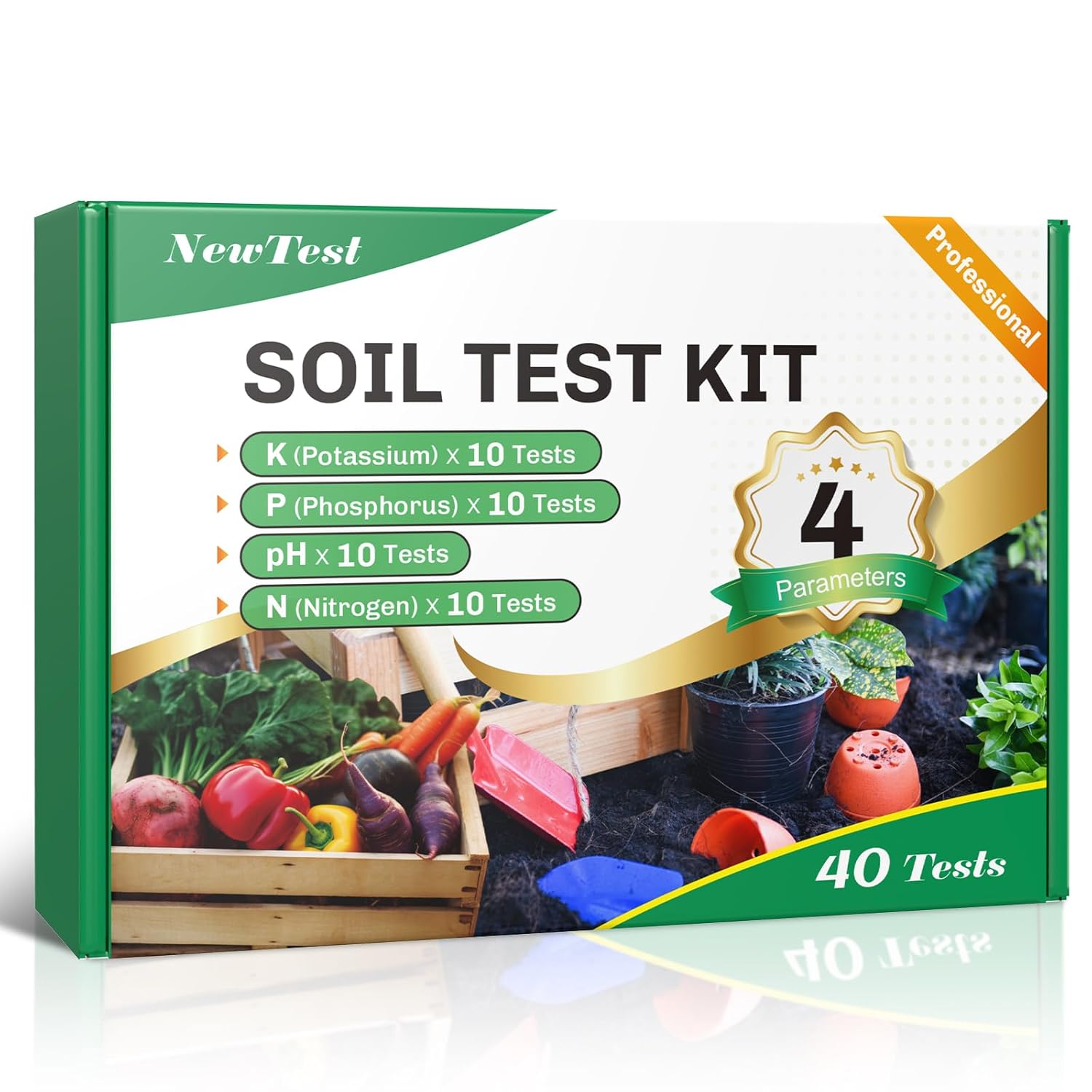
The NewTest 4-Parameter Soil Test Kit is designed for home gardeners who want to check pH, nitrogen, phosphorus, and potassium before making soil decisions. Based on the listed specifications, it includes 40 total tests, with 10 tests each for the four parameters. That makes it a practical fit for lawns, vegetable beds, flower borders, containers, compost checks, and other common backyard growing situations.
The most useful benefit is that it separates pH from the three primary plant nutrients, often shortened as NPK. For a beginner, this can help explain why a lawn is uneven, why a vegetable bed is not responding as expected, or whether a container mix may need adjustment. The product information indicates results are read by comparing test strips or liquids to a colorimetric card, so the kit provides range-based guidance rather than a digital readout.
NewTest lists a pH range of 3.5 to 9.0, which is broad enough for most home-garden troubleshooting. The included quick guide and detailed instructions are important because soil testing depends on careful sampling, clean handling, and following each step in order. Reviewers commonly mention that the instructions are usable, although a few note that the process can feel complicated or that reading results is not perfectly precise.
In everyday use, this kit makes the most sense when comparing several areas, such as a yellowing lawn patch against a greener section, one raised bed against another, or potting mix used for houseplants and patio containers. Because there are 10 tests for each parameter, a gardener can test more than one location instead of treating the whole yard as if the soil were identical everywhere.
The main limitation is that a color-comparison home kit should not be treated as a full replacement for a professional laboratory soil test when exact nutrient values are needed. It also requires more attention than simply inserting a probe into the soil. For best results, gardeners should read the instructions fully before starting, keep materials clean, and avoid making major amendment decisions from a single questionable sample.
Overall, the NewTest kit is a useful choice for homeowners and beginner-to-intermediate gardeners who want a more complete snapshot of soil condition than pH alone. Gardeners who need highly precise lab numbers, minimal handling, or only a quick pH check may be better served by a different testing approach.
Best For / Avoid If
Best for buyers prioritizing
- Tests the main home-garden soil factors many gardeners check before applying fertilizer or amendments.
- Multiple tests allow comparisons between different garden zones instead of relying on one sample.
- Visual color-card readings avoid the need for an electronic meter or battery-powered device.
Consider another option if
- Some gardeners may find the testing process more involved than a basic probe-style meter.
- Color comparison results can be less exact than a laboratory soil analysis, especially for gardeners who need precise nutrient values.
- Users who only want to check pH may prefer a simpler single-purpose option.

Pros
- Covers pH plus the three primary macronutrients commonly considered when planning fertilization.
- Provides multiple tests for repeat checks in different parts of a yard or garden.
- Includes the basic accessories needed to prepare and test soil samples at home.
- No calibration is listed, which may appeal to gardeners who do not want to manage an electronic meter.
Cons
- Some reviewers found the instructions confusing, so careful reading and organized setup may be needed before testing.
- Results depend on color chart comparison, which may be less clear for gardeners who prefer digital readouts or lab reports.
- The kit reports measurements but may not provide enough guidance for every gardener on ideal levels or exactly what amendments to apply.
The AKSBTEC 4-in-1 Soil Test Kit is a home soil testing kit for gardeners who want to check pH, nitrogen, phosphorus, and potassium without sending a sample to a lab. It is aimed at practical lawn and garden use, including vegetable beds, flower beds, turf areas, and potted plants. For beginners, the main appeal is having the four basic readings in one box rather than buying separate kits for each soil factor.
The product information indicates that the kit includes 40 total tests, divided into 10 tests each for pH, nitrogen, phosphorus, and potassium. That gives a homeowner enough test capacity to compare different parts of a yard, check raised beds separately, or retest after making soil changes. These readings can help guide fertilizing decisions, although the kit should be treated as a screening tool rather than a full professional soil analysis.
The included components are more complete than a simple probe-style meter. The box lists phosphorus test strips, nitrogen and pH test strips, centrifuge tubes, a grinding rod, dropper, spoon, potassium vial, graduated tube, reagent tablets, instructions, and a color chart. The listed size, 4.8 x 2 x 7.1 inches, and weight, 7.8 ounces, make it a compact item to keep with seed-starting supplies, fertilizers, or garden records.
In everyday use, this type of kit is most useful when you want to compare conditions across several growing areas. A gardener could sample a vegetable bed before planting, check a struggling lawn patch, or compare potting soil in containers with soil from an in-ground bed. The color chart format is also helpful for quick seasonal checks when you want some guidance before adding fertilizer.
The main caution is that chemical soil test kits require careful sample preparation and close attention to the correct reagent or strip. Reviewers were mixed on ease of use, with some saying the instructions were straightforward and others saying they were confusing or did not explain what to do with the results. Gardeners who want exact amendment recommendations may still prefer a local extension or lab soil test.
Overall, this AKSBTEC kit is a reasonable fit for homeowners and beginner-to-intermediate gardeners who want a compact, multi-factor soil check for routine garden planning. It is less ideal for anyone who wants a digital display, highly detailed soil chemistry, or step-by-step fertilizer prescriptions included with the results.
Best For / Avoid If
Best for buyers prioritizing
- Covers pH plus the three primary macronutrients commonly considered when planning fertilization.
- Provides multiple tests for repeat checks in different parts of a yard or garden.
- Includes the basic accessories needed to prepare and test soil samples at home.
Consider another option if
- Some reviewers found the instructions confusing, so careful reading and organized setup may be needed before testing.
- Results depend on color chart comparison, which may be less clear for gardeners who prefer digital readouts or lab reports.
- The kit reports measurements but may not provide enough guidance for every gardener on ideal levels or exactly what amendments to apply.

Pros
- Tests pH plus the three primary macronutrients commonly considered in garden soil care.
- Provides enough tests for comparing several beds, containers, or lawn areas during a growing season.
- Includes the basic accessories needed to perform the listed tests at home.
- Suitable for both indoor and outdoor plant-care situations according to the product information.
Cons
- Intended for preliminary home use, not professional quantitative soil analysis.
- Color-card results may require careful lighting and close attention to the instructions for consistent interpretation.
- Gardeners who need detailed micronutrient data or formal fertilizer recommendations may prefer a laboratory soil test.
The AAWipes JS04-40 is a 4-in-1 soil test kit for checking pH, nitrogen, phosphorus, and potassium in home growing areas. Based on the listed product information, it is intended for practical soil testing in gardens, lawns, yards, raised beds, pots, and indoor plant setups. It should suit homeowners, beginner gardeners, and anyone who wants a basic way to compare soil conditions before making plant-care decisions.
The main value of this kit is that it covers more than pH alone. Soil pH affects how available nutrients are to plants, while nitrogen, phosphorus, and potassium are key macronutrients commonly considered when planning fertilizer or amendment use. Having all four checks in one kit can help gardeners avoid guessing as much when a lawn looks tired, vegetables are not growing vigorously, or container plants need a seasonal soil review.
The kit includes 40 total tests, divided into 10 tests each for pH, nitrogen, phosphorus, and potassium. The listed accessories include two bottles of test strips, two test tubes, 40 tablets, a dropper, a stick, a color card, and instructions. That setup is useful for routine home sampling because it provides the small tools needed to prepare and compare samples without requiring separate test containers or color references.
For backyard and small-space gardeners, this type of kit can be especially helpful when comparing different planting zones. You might use it to check a vegetable bed before feeding, compare a raised bed with an in-ground bed, test soil from a container garden, or review lawn and shrub areas separately. It is also suitable for indoor and outdoor use according to the product data, which makes it relevant for houseplants, herbs, flowers, trees, shrubs, vegetables, and lawn care.
There are a few reasonable limitations to keep in mind. The product information notes that the kit is designed for preliminary home use and is not intended as a professional quantitative analysis. As with most color-comparison soil kits, users should follow the instructions carefully and read results in good lighting to reduce confusion. For major soil renovation, unusual plant problems, or detailed fertilizer planning, a laboratory soil test may still be the better choice.
Overall, the AAWipes JS04-40 is a sensible option for gardeners who want a simple, multi-parameter soil testing kit for everyday garden decisions. It is best for routine checking and comparison across beds, containers, and lawn areas, rather than for highly precise soil science work. Gardeners who only need pH may prefer a simpler pH-only kit, while those needing exact nutrient levels should consider professional testing.

Pros
- Large strip count supports routine pH monitoring across several garden areas.
- No batteries, probes, or calibration steps are listed, which keeps the process approachable for beginners.
- Works for a wide range of home growing spaces, from indoor pots to outdoor lawns and vegetable beds.
- Reviewers commonly mention that the strips are easy to use and work as described.
Cons
- The test requires measuring soil and water and waiting before dipping the strip, so it is not as immediate as pushing a probe into the ground.
- A separate container is needed for mixing the soil sample, and one reviewer noted that no mixing tube was included.
- Color-chart strip tests may give a range rather than a laboratory-style exact number, which may be less suitable for gardeners needing highly precise soil analysis.
The MERYDI soil pH test kit is a strip-based option for checking whether garden soil is more acidic or alkaline. It is intended for home soil testing in vegetable beds, flower beds, lawns, indoor planters, fruit tree areas, and shrub plantings. For beginners and homeowners, this type of kit can be a straightforward way to monitor pH before making soil amendments.
According to the product information, the kit includes 150 test strips and uses a color comparison chart on the bottle. The listed range covers common garden soil conditions, so it can help gardeners track pH differences between raised beds, containers, and yard soil. This is especially useful when you want to compare several planting areas instead of relying on one general reading for the whole yard.
The testing process requires collecting 10 grams of soil, adding 40 milliliters of water, waiting 20 minutes, dipping a strip for 2 to 3 seconds, and comparing the color to the chart. That method is simple, but it does require a small container and careful handling. The product instructions also note that results should be read in natural daylight, wet fingers should be kept out of the bottle, and strips should be stored in a cool, dry place.
In practical garden use, these strips make sense for checking a new raised bed mix, comparing soil in different vegetable rows, monitoring potted plants, or getting a general pH reading before planting flowers or lawn seed. Because the strips are single-use, gardeners can test multiple spots without reusing the same strip in different samples.
The main limitation is that color-strip tests are best viewed as a practical home monitoring tool, not a full laboratory soil report. One reviewer described the result as somewhat vague, and another pointed out that the kit requires separate measuring and mixing supplies. Gardeners who need nutrient analysis, exact pH values, or professional amendment recommendations may want a lab soil test or a more advanced testing system.
Overall, this MERYDI kit is a sensible choice for routine pH checks when you want many tests on hand and do not mind preparing a soil-and-water sample. It is best for homeowners, container gardeners, and raised-bed growers who want a quick reference point for soil acidity or alkalinity before making everyday gardening decisions.

Pros
- Measures multiple soil and growing-condition indicators in one digital device.
- Backlit display with large numbers may be easier to read than basic needle-style meters, a point several reviewers commonly mention.
- Works for indoor and outdoor plant care, including gardens, beds, potted plants, and succulents according to the product information.
- Fast listed reading process, with the manufacturer describing about 10 seconds after inserting the probe.
- Lightweight design should be easy to carry between rooms, containers, and garden beds.
Cons
- AAA batteries are required but not included.
- The probe should not be forced into very dry or hard soil, so compacted beds may need light moistening and a wait before measuring.
- Gardeners who need laboratory-grade pH, nutrient, EC, or TDS results may prefer dedicated testing equipment.
The Buladeke 7-in-1 Digital Soil Tester is a probe-style meter made for routine plant checks around the home garden. Based on the listed features, it measures soil moisture, pH, temperature, light intensity, and fertility, with EC and TDS functions also included. It is a practical fit for beginners, houseplant collectors, patio gardeners, and homeowners who want a quick snapshot of growing conditions before watering or adjusting plant placement.
The main value is convenience. Instead of using separate tools for moisture, light, and basic soil-condition checks, this meter puts several readings on one digital display. For everyday gardening, moisture is likely the most useful function, especially for containers, succulents, and indoor plants where the soil surface can look dry while the root zone is still damp. The pH, fertility, temperature, and light readings can also help flag when a plant may need closer attention.
The product information highlights a large LCD screen with a white backlight, clear numbers, intuitive symbols, and a low-battery warning. It runs on 4 x 1.5V AAA batteries, which are not included. The listed package dimensions are 11.61 x 2.68 x 1.85 inches, and the item weight is 5.6 ounces, so it should store easily with small garden tools or on a potting bench.
For use, the manufacturer says to insert the probe about 10 cm into the soil and wait about 10 seconds for a reading. That makes it useful for checking several pots, raised-bed sections, or garden rows during a watering round. It can also help compare light levels in different areas, such as a windowsill, patio corner, greenhouse bench, or outdoor bed, when deciding where to place plants with different light needs.
There are a few important cautions. The product notes that the tester must not be used directly to measure liquids, and if soil is too dry or hard, the probe should not be forced in. The recommended approach is to moisten the test area slightly and wait 10 minutes before measuring to avoid damaging the device. As with most home soil meters, gardeners needing highly precise nutrient, pH, EC, or TDS data should consider follow-up testing with dedicated equipment.
Overall, this Buladeke meter looks most useful as a quick decision aid for everyday plant care rather than a professional lab instrument. It is a good match for growers who want easier watering judgment, clearer digital readings, and multiple plant-condition checks in one lightweight tool. Gardeners working in very compacted soil or those requiring calibrated scientific measurements may be better served by more specialized testing methods.
Best For / Avoid If
Best for buyers prioritizing
- Measures multiple soil and growing-condition indicators in one digital device.
- Backlit display with large numbers may be easier to read than basic needle-style meters, a point several reviewers commonly mention.
- Works for indoor and outdoor plant care, including gardens, beds, potted plants, and succulents according to the product information.
Consider another option if
- AAA batteries are required but not included.
- The probe should not be forced into very dry or hard soil, so compacted beds may need light moistening and a wait before measuring.
- Gardeners who need laboratory-grade pH, nutrient, EC, or TDS results may prefer dedicated testing equipment.

Pros
- Tests the main soil nutrients gardeners commonly evaluate before planting or fertilizing.
- Includes more pH tests than nutrient tests, which is helpful because pH often varies across a yard or garden.
- Comes with interpretation resources, not just test materials, so results are easier to turn into practical next steps.
- Suitable for both garden analysis and soil science education based on the product information.
Cons
- The kit uses color chart interpretation, so careful lighting and attention may be needed when reading results.
- Gardeners who need laboratory-level soil analysis or micronutrient testing may prefer a professional soil lab.
- Nutrient tests are limited to 15 each, so very large properties or frequent testing routines could require replacement supplies sooner.
The LaMotte Model EL Turf and Garden Soil Test Kit is designed for gardeners who want to understand their soil before starting a planting, lawn, or amendment project. Based on the product information, it measures nitrogen, phosphorus, potassium, and soil pH, which are among the most useful starting points for making basic soil decisions.
For home gardeners, the main benefit is replacing guesswork with a more structured soil check. The kit includes 15 tests each for nitrogen, phosphorus, and potassium, plus 30 pH tests, so it can be used across multiple garden beds, lawn areas, or planting zones. That is especially helpful when one part of the yard grows well and another seems to struggle.
The included rapid test procedures, diagrammed instructions, and laminated color charts are important design features for routine use. Color-chart kits still require careful reading, but the supplied charts and instructions should make the process more approachable for beginners, garden clubs, classrooms, and homeowners who are new to soil testing.
The Garden Guide manual and LaMotte Soil Handbook add practical value because test results are only useful if gardeners know what to do with them. According to the listed details, these resources help interpret results and provide lime and fertilizer recommendations, which can support more informed soil preparation before planting vegetables, turf, ornamentals, or raised beds.
This kit is best suited to gardeners who want a reusable-style testing setup for common soil checks rather than a single-purpose quick read. It may be less suitable for growers who need a full laboratory soil report, micronutrient data, or highly precise professional analysis. Users should also handle testing materials carefully, follow the instructions closely, and keep the color charts clean and readable.
Overall, the LaMotte Model EL is a practical soil test kit for homeowners, educators, and beginner-to-intermediate gardeners who want clear information on NPK and pH before adding lime, fertilizer, or other amendments. If your goal is basic garden and turf soil planning with included interpretation guidance, the listed feature set is well aligned with that task.
Best For / Avoid If
Best for buyers prioritizing
- Tests the main soil nutrients gardeners commonly evaluate before planting or fertilizing.
- Includes more pH tests than nutrient tests, which is helpful because pH often varies across a yard or garden.
- Comes with interpretation resources, not just test materials, so results are easier to turn into practical next steps.
Consider another option if
- The kit uses color chart interpretation, so careful lighting and attention may be needed when reading results.
- Gardeners who need laboratory-level soil analysis or micronutrient testing may prefer a professional soil lab.
- Nutrient tests are limited to 15 each, so very large properties or frequent testing routines could require replacement supplies sooner.

Pros
- Covers pH plus the primary macronutrients nitrogen, phosphorus, and potassium.
- Enough included tests for several garden zones or repeat checks over time.
- Lightweight and compact for easy storage between testing sessions.
- Several reviewers describe it as simple, economical, and helpful for home gardening use.
Cons
- Some users report that the reagent labeling and instructions can be difficult to follow, so careful setup is important.
- Color-card style results may be less suitable for gardeners who want lab-level detail or highly precise numerical readings.
- Because each category includes 10 tests, larger properties or frequent testers may eventually need replacement supplies or another kit.
The DewildeTradingCo DTC-00057 is a 4-in-1 home soil test kit designed to check pH, nitrogen, phosphorus, and potassium in garden and lawn soil. It fits the needs of homeowners, vegetable gardeners, raised-bed growers, and houseplant owners who want a basic read on soil conditions before adding amendments or fertilizer.
The main value of this kit is that it covers the soil factors most often considered when plants are struggling or when a gardener is preparing a new bed. pH affects how available nutrients are to plants, while nitrogen, phosphorus, and potassium are key nutrients often referenced on fertilizer labels. Having all four checks in one kit can help reduce guesswork when planning routine soil care.
According to the listed product information, the kit includes 40 total tests, divided into 10 tests each for pH, nitrogen, phosphorus, and potassium. The included components are listed as 2 bottles of test strips, 2 test tubes, 40 tablets, a dropper, a stick, a color card, a quick guide, and detailed instructions. At 7 x 2 x 5 inches and 6.4 ounces, it should be easy to keep on a garage shelf, potting bench, or seed-starting station.
In everyday garden use, this type of kit is most practical for comparing several areas rather than relying on one sample to represent an entire yard. A gardener might check a vegetable bed before spring planting, compare a thin lawn area with a healthier patch, or test potting soil used for herbs and container flowers. It may also be helpful for small-space gardeners who manage several pots and raised beds with different soil histories.
The biggest caution is ease of interpretation. While the product is presented as beginner-friendly, some reviewers mention that identifying the correct reagents or reading the labeling can be tricky. For best results, gardeners should read the full instructions before opening components, keep tablets and bottles organized, use clean tools, and avoid mixing materials between tests.
Overall, this kit is a practical choice for gardeners who want a convenient home method for checking general soil direction across several planting areas. Those who need formal recommendations, exact nutrient values, or a detailed soil report for a large landscape may still prefer a professional lab test through a local extension service or soil laboratory.
Best For / Avoid If
Best for buyers prioritizing
- Covers pH plus the primary macronutrients nitrogen, phosphorus, and potassium.
- Enough included tests for several garden zones or repeat checks over time.
- Lightweight and compact for easy storage between testing sessions.
Consider another option if
- Some users report that the reagent labeling and instructions can be difficult to follow, so careful setup is important.
- Color-card style results may be less suitable for gardeners who want lab-level detail or highly precise numerical readings.
- Because each category includes 10 tests, larger properties or frequent testers may eventually need replacement supplies or another kit.

Pros
- Measures a broad set of growing conditions, including moisture, pH, fertility, light, soil temperature, air temperature, and humidity.
- Designed for both indoor and outdoor gardening uses, from houseplants to lawns and garden beds.
- LCD screen helps display temperature and humidity information clearly.
- Reviewers commonly mention that the readings are easy to understand and helpful for reducing guesswork around watering.
- Compact and lightweight enough for routine checks around pots, beds, and small growing spaces.
Cons
- Requires three batteries, and the product instructions indicate replacing or installing all three at the same time.
- It is not designed for testing liquid, so gardeners should only use it in soil as directed.
- The probe should not be forced into hard or very dry soil, since probe-style meters can be vulnerable to damage if pushed too aggressively.
The HSLGOVE 001 7-in-1 Soil Test Kit is a multipurpose soil meter made for everyday plant-care checks in home gardens, lawns, containers, and indoor growing spaces. Based on the product information, it measures soil moisture, pH, fertility, light, soil temperature, air temperature, and humidity, making it a practical choice for beginners who want a clearer picture of plant conditions before watering or fertilizing.
Its main benefit is convenience. Instead of relying only on finger tests or guessing from plant appearance, gardeners can insert the probe into soil and switch modes to check several key conditions. Moisture readings are especially useful for houseplants and containers, where overwatering is a common problem. The pH and fertility functions can also help guide general soil-care decisions, though gardeners making major amendments may still want a lab or dedicated soil test for confirmation.
The design combines a dial-style soil meter with an LCD display for temperature and humidity information. The listed probe length is about 6.8 inches, which should be useful for medium to large potted plants and many garden-bed checks. The product measures 11.5 x 2.9 x 1.5 inches and weighs 4.8 ounces, so it should be easy to store in a drawer, potting bench, greenhouse shelf, or small garden tote.
For everyday use, this meter fits a wide range of small-space and backyard tasks. A patio gardener could compare moisture levels between containers, a raised-bed gardener could check whether different areas are drying unevenly, and an indoor plant grower could use the light meter to evaluate plant placement. The air temperature and humidity readings may also be useful around seedlings, houseplants, or protected growing areas where conditions change quickly.
There are a few important cautions. The product information says this is not a water moisture meter, so it should not be used to test liquid. It also requires three batteries, and the instructions note that all three should be replaced or installed each time. As with any probe-style soil meter, it is wise to loosen very hard or dry soil first and insert the probe gently rather than forcing it, which can help reduce the chance of damaging the shaft or disturbing roots.
This is a sensible pick for gardeners who want an easy, all-in-one reference tool for routine plant care rather than a professional soil analysis device. Gardeners who need highly detailed nutrient reporting, laboratory-grade pH confirmation, or rugged field equipment for compacted farm soil may prefer a more specialized testing method.
Best For / Avoid If
Best for buyers prioritizing
- Measures a broad set of growing conditions, including moisture, pH, fertility, light, soil temperature, air temperature, and humidity.
- Designed for both indoor and outdoor gardening uses, from houseplants to lawns and garden beds.
- LCD screen helps display temperature and humidity information clearly.
Consider another option if
- Requires three batteries, and the product instructions indicate replacing or installing all three at the same time.
- It is not designed for testing liquid, so gardeners should only use it in soil as directed.
- The probe should not be forced into hard or very dry soil, since probe-style meters can be vulnerable to damage if pushed too aggressively.

Pros
- Combines multiple plant-care measurements in one soil meter.
- App connectivity may make readings easier to track than a basic analog probe.
- Works for a wide range of indoor and outdoor growing situations listed by the manufacturer.
- Rechargeable Type-C interface is convenient for routine garden use.
- Care instructions are straightforward, including wiping the probe and storing it dry after use.
Cons
- Requires Bluetooth, app use, and phone permissions, which may not appeal to gardeners who prefer a simple no-app meter.
- Readings require inserting the probe for 1 to 2 minutes and syncing in the app, so it is not an instant glance tool.
- The product information does not list measurement ranges, calibration details, waterproof rating, or battery runtime.
The KGLLIFE 6-in-1 Soil Test Kit is a digital soil meter made for checking several common growing conditions in one device. According to the product information, it measures soil pH, soil moisture, soil temperature, conductivity, light intensity, and relative humidity of the surrounding environment. That makes it a practical option for houseplant owners, balcony gardeners, vegetable growers, greenhouse users, and homeowners trying to make more informed care decisions.
The main benefit is the broader view it gives compared with a basic moisture-only meter. Moisture can tell you whether the root zone is dry or wet, but pH, conductivity, temperature, light, and humidity can also affect plant performance. The listed feature set suggests it can help gardeners compare readings with a plant’s preferred range before changing watering, fertilizer, or lighting routines.
This meter connects to the SoilX app through Bluetooth. The listed setup instructions say to press and hold the power button for 3 seconds, enable Bluetooth and location permissions, connect in the app, insert the probe into soil for 1 to 2 minutes, and then press Sync for more stable readings. An LED indicator shows power, pairing, and connection status, which should help users understand what the device is doing during setup.
For small-space gardening, this type of tool can be useful when checking potted herbs, succulents, flowers, balcony containers, or indoor foliage plants that dry unevenly. Outdoors, the product information lists use in vegetable gardens, lawns, greenhouses, and small farms, including crops and plants such as tomatoes, corn, strawberries, flowers, and succulents. It may be especially helpful when comparing conditions across several beds or containers rather than guessing by surface appearance alone.
There are a few practical cautions. The metal probe should be inserted vertically and should not be forced into hard rocks or compacted hard soil. After use, the probe should be wiped clean and the device stored dry to help preserve it. Gardeners should also note that the supplied information does not provide measurement ranges, calibration instructions, waterproof rating, or battery runtime, so those details should be checked before relying on it for more technical growing decisions.
Overall, this KGLLIFE soil meter is a sensible fit for gardeners who want a rechargeable, app-connected tool for routine plant checks and basic decision support. Gardeners who dislike phone apps, need lab-level soil analysis, or want a meter with clearly published calibration and range specifications may prefer a different option.
Best For / Avoid If
Best for buyers prioritizing
- Combines multiple plant-care measurements in one soil meter.
- App connectivity may make readings easier to track than a basic analog probe.
- Works for a wide range of indoor and outdoor growing situations listed by the manufacturer.
Consider another option if
- Requires Bluetooth, app use, and phone permissions, which may not appeal to gardeners who prefer a simple no-app meter.
- Readings require inserting the probe for 1 to 2 minutes and syncing in the app, so it is not an instant glance tool.
- The product information does not list measurement ranges, calibration details, waterproof rating, or battery runtime.
Kaufberatung für das beste Bodentest-Set für den Hausgarten
Legen Sie fest, was Sie messen möchten
Die erste Entscheidung lautet, ob Sie nur den pH-Wert des Bodens oder zusätzlich Informationen zu den Nährstoffen benötigen. Der pH-Wert beeinflusst, wie gut Pflanzen Nährstoffe aufnehmen können, während Messwerte für Stickstoff, Phosphor und Kalium helfen können, beim Düngerkauf nicht raten zu müssen.
Für ein vollständiges Bild der Nährstoffversorgung verwendet das MySoil Soil Test Kit eine professionelle Laboranalyse per Post und misst 13 pflanzenverfügbare Nährstoffwerte, darunter Stickstoff und pH-Wert. Optionen für zu Hause wie das LusterLeaf Rapitest Soil Test Kit, NewTest Soil Test Kit 4 Parameters, DewildeTradingCo Premium Soil Test Kit und LaMotte Model El konzentrieren sich je nach Set auf pH-Wert, Stickstoff, Phosphor und Kalium beziehungsweise Pottasche.
Wenn Sie hauptsächlich den Säuregrad in Beeten, Rasenflächen oder Töpfen überwachen möchten, können pH-Teststreifen wie das MERYDI Soil pH Test Kit und das DewildeTradingCo Soil Test Kit mit 100 pH-Streifen ausreichen. Digitale Messgeräte wie KGLLIFE, HSLGOVE und Buladeke liefern je nach aufgeführten Produkteigenschaften zusätzliche Werte wie Feuchtigkeit, Temperatur, Licht, Leitfähigkeit, Fruchtbarkeit, EC oder TDS.
Verstehen Sie Labor-Sets, chemische Tests, Teststreifen und Messgeräte
Sets mit Einsendung per Post eignen sich am besten für Gärtner, die detaillierte Empfehlungen statt nur einer Farbanzeige wünschen. Das MySoil Soil Test Kit enthält ein einmalig verwendbares Proben-Set, eine Anleitung, einen frankierten Rückumschlag an das Prüflabor sowie individuelle Empfehlungen dazu, was, wie viel und wann ausgebracht werden sollte.
Chemische Tests für zu Hause sind praktisch, wenn Sie wiederholt testen möchten, ohne auf Laborergebnisse zu warten. Das LaMotte Model El enthält schnelle Testverfahren, bebilderte Anleitungen, laminierte Farbtafeln sowie Tests für Stickstoff, Phosphor, Kalium und den pH-Wert des Bodens. Das LusterLeaf Rapitest verwendet ein Kapselsystem und Farbvergleichskarten für schnelle Ergebnisse zu Hause.
pH-Teststreifen sind in dieser Gruppe meist die einfachste und günstigste Variante, während digitale Messgeräte sich für schnelle Stichproben anbieten. Befolgen Sie bei jeder Option außerhalb einer Laboranalyse die Anleitung genau, lesen Sie Farbtafeln bei der vorgegebenen Beleuchtung ab und betrachten Sie einen einzelnen Messwert nicht als vollständige Beurteilung eines großen Gartens oder gemischten Anbauareals.
| Art des Sets | Am besten geeignet für | Unterstützte Beispiele aus den bereitgestellten Daten |
|---|---|---|
| Laboranalyse per Post | Gärtner, die Nährstoffwerte und Empfehlungen wünschen | MySoil Soil Test Kit |
| NPK- und pH-Set für zu Hause | Gemüsebeete, Rasenflächen und wiederholte saisonale Kontrollen | LusterLeaf Rapitest, LaMotte Model El, NewTest Soil Test Kit 4 Parameters, DewildeTradingCo Premium Soil Test Kit |
| pH-Teststreifen | Einfache Säuregradkontrollen für Rasen, Beete und Töpfe | MERYDI Soil pH Test Kit, DewildeTradingCo 100 Soil pH Test Strips |
| Digitales Multifunktionsmessgerät | Schnelle Kontrollen von pH-Wert, Feuchtigkeit, Licht, Temperatur und verwandten Messwerten | KGLLIFE 6-in-1, HSLGOVE 7-in-One, Buladeke 7-in-1 |
Passen Sie das Set an Ihren Gartenbereich an
Ein Gemüsegarten, eine Rasenfläche, ein Blumenbeet, ein Kompostbereich, eine Sammlung von Zimmerpflanzen und eine Terrasse mit Töpfen benötigen nicht immer denselben Testumfang. MySoil nennt als Einsatzbereiche Rasen und Turf, Gemüseanbau, Blumen, Kompost, Bäume, Reben, Zierpflanzen, Zimmerpflanzen, erdlose Substrate und Hydroponik. Das macht es zu einer vielseitigen Option, wenn Sie einen Laborbericht für verschiedene Anbausituationen wünschen.
Für kleine Flächen lassen sich pH-Teststreifen und kompakte digitale Messgeräte leichter aufbewahren und rund um Töpfe einsetzen. Die MERYDI-Streifen umfassen 150 Tests in einem pH-Bereich von 3 bis 9, während das pH-Teststreifen-Set von DewildeTradingCo 100 Streifen für einen Bereich von 3,5 bis 9 enthält. Digitale Messgeräte wie HSLGOVE und Buladeke können für Pflanzenbesitzer geeignet sein, die zusätzlich zum Boden-pH-Wert auch Feuchtigkeits- und Lichtwerte erfassen möchten.
Für größere Rasenflächen oder wiederholte Gartenkontrollen sollten Sie auf die Anzahl der enthaltenen Tests achten. LaMotte gibt jeweils 15 Tests für Stickstoff, Phosphor und Kalium sowie 30 Bodentests für den pH-Wert an. LusterLeaf, NewTest und das DewildeTradingCo Premium Soil Test Kit nennen jeweils insgesamt 40 Tests, die im Allgemeinen auf pH-Wert und wichtige Nährstofftests aufgeteilt sind.
Achten Sie auf gut lesbare Ergebnisse und klare Anleitungen
Anfänger sollten klare Anweisungen und eine einfache Auswertung priorisieren. Farbtests sind nur dann nützlich, wenn Sie die Probe sicher mit der enthaltenen Farbtafel vergleichen können. LaMotte enthält bebilderte Anleitungen und laminierte Farbtafeln, während LusterLeaf einfache, ausführliche Anweisungen sowie eine Liste der bevorzugten Boden-pH-Werte für mehr als 450 Pflanzen enthält.
NewTest hebt eine Kurzanleitung, ausführliche Anweisungen und die kolorimetrische Auswertung hervor. Das DewildeTradingCo Premium Soil Test Kit enthält laut Angabe eine Kurzanleitung, ausführliche Anweisungen, Reagenzgläser, Tabletten, eine Pipette, einen Stab und eine Farbkarte. Das kann für Gärtner interessant sein, die eine Komplettlösung für Bodentests zu Hause wünschen.
Digitale Messgeräte können den Farbvergleich überflüssig machen, bringen aber andere Arbeitsschritte mit sich. KGLLIFE verwendet eine Bluetooth-Verbindung über die SoilX-App und weist an, das Gerät 1 bis 2 Minuten einzuführen, bevor die Synchronisierung erfolgt. Buladeke nennt ein großes, hintergrundbeleuchtetes LCD-Display, während HSLGOVE eine Skala und ein LCD-Display für mehrere Boden- und Luftmesswerte kombiniert.
Berücksichtigen Sie Zugänglichkeit und Komfort
Für ältere Gärtner oder alle, die weniger Kleinteile wünschen, ist entscheidend, wie viel Mischen, Warten, Farbvergleichen, Einrichten einer App oder Versenden erforderlich ist. Sets zur Einsendung per Post erfordern zu Hause möglicherweise weniger Interpretation, während Streifen- und Kapsel-Sets sorgfältiges Abmessen und visuelles Vergleichen voraussetzen.
Große Displays und Hintergrundbeleuchtungen können hilfreich sein, wenn Zahlen im Freien oder bei wenig Licht abgelesen werden. Buladeke nennt ausdrücklich ein großes LCD-Display mit weißer Hintergrundbeleuchtung. Wenn Ihnen das Bücken schwerfällt, sammeln Sie Bodenproben möglichst in einer angenehmen Arbeitshöhe, etwa an einer Pflanzbank, und drücken Sie Sonden nicht mit Gewalt in harten Boden.
Befolgen Sie bei digitalen Sonden die Herstellerangaben zu Einstecktiefe und Bodenzustand. Buladeke weist darauf hin, die Sonde nicht in trockenen oder harten Boden zu zwingen und die Teststelle bei Bedarf vor der Messung leicht anzufeuchten. KGLLIFE empfiehlt ebenfalls, harte Steine oder harten Boden zu vermeiden und die Sonde nach der Verwendung abzuwischen.
Vermeiden Sie häufige Fehler bei Bodentests
Ein häufiger Fehler besteht darin, nur eine kleine Stelle zu testen und das Ergebnis auf den gesamten Garten zu übertragen. Die Bodenverhältnisse können sich zwischen Rasen, Hochbeet, Pflanzstreifen und Topfmischung unterscheiden. Wenn Ihr Set mehrere Tests ermöglicht, prüfen Sie die Bereiche getrennt, statt sehr unterschiedliche Flächen miteinander zu vermischen.
Ein weiterer Fehler ist, die Anweisungen zu Zeit und Wasserverhältnissen zu ignorieren. MERYDI weist an, eine 10-g-Bodenprobe zu entnehmen, 40 ml Wasser im Verhältnis 1:4 hinzuzufügen, 20 Minuten zu warten, den Streifen 2 bis 3 Sekunden einzutauchen und ihn mit der Farbtafel zu vergleichen. Die pH-Teststreifen von DewildeTradingCo erfordern, Erde mit Wasser zu vermischen, die Lösung 30 Minuten stehen zu lassen, einen Streifen 3 Sekunden einzutauchen, ihn anschließend 60 Sekunden waagerecht zu halten und dann zu vergleichen.
Verwenden Sie Bodentestergebnisse nicht als Freibrief für eine übermäßige Anwendung von Dünger, Kalk, Schwefel oder anderen Bodenverbesserern. Befolgen Sie Produktetiketten, örtliche Vorschriften und Herstellerangaben, insbesondere bei der Ausbringung von Bodenverbesserern in der Nähe von Nutzpflanzen, Haustieren, Kindern, Gewässern oder gemeinsamen Grundstücksgrenzen.
Planen Sie Pflege, Aufbewahrung und wiederholte Nutzung
Bodentestmaterialien müssen sauber und trocken bleiben. pH-Teststreifen sind nicht wiederverwendbar. MERYDI weist ausdrücklich darauf hin, nasse Finger aus der Flasche fernzuhalten und die Streifen an einem kühlen, trockenen Ort aufzubewahren. Farbtafeln, Kapseln, Tabletten und Reagenzgläser sollten zusammen aufbewahrt werden, damit das Set zu Beginn der Pflanzsaison einsatzbereit ist.
Digitale Sonden benötigen besondere Pflege, da die Sonde der arbeitende Teil des Geräts ist. KGLLIFE empfiehlt, die Sonde nach jeder Verwendung abzuwischen und trocken aufzubewahren. HSLGOVE weist auf den Batterieverbrauch und das Umschalten zwischen Modi hin, während Buladeke den Betrieb mit AAA-Batterien und eine Anzeige für niedrigen Batteriestand nennt.
Wenn Sie saisonal gärtnern, testen Sie vor wichtigen Entscheidungen zum Pflanzen oder Düngen und nicht erst, wenn die Pflanzen bereits Probleme zeigen. Notieren Sie frühere Messwerte, damit Sie pH-Wert, Nährstoffe, Feuchtigkeitsmuster und Entscheidungen zur Bodenverbesserung im Zeitverlauf vergleichen können, ohne sich auf Ihr Gedächtnis zu verlassen.
Wägen Sie den Preis gegen den Informationsumfang ab
Die bereitgestellte Preisspanne reicht von $8.99 – $99.92. Der Wert hängt daher davon ab, wie viele Informationen Sie benötigen. Ein günstiges pH-Teststreifen-Set kann für die Kontrolle des Säuregrads ausreichen, liefert aber nicht dieselben Nährstoffdetails oder Empfehlungen wie ein umfangreicheres Set.
MySoil kostet mehr als einfache Teststreifen, umfasst dafür aber eine Laboranalyse und individuelle Empfehlungen. LaMotte ist die teuerste aufgeführte Option und enthält wiederverwendbare Testmaterialien für NPK und pH sowie ein Garden Guide Manual und das LaMotte Soil Handbook. LusterLeaf und die 40-Test-Sets für zu Hause liegen zwischen einfachen Teststreifen und höherpreisigen Testsystemen.
Fragen Sie sich vor dem Kauf, ob Sie eine einmalige Diagnose, eine laufende Überwachung oder schnelle Kontrollen von Feuchtigkeit und Licht zusätzlich zur Bodenchemie benötigen. Diese Entscheidung ist meist wichtiger, als allein nach dem Preis auszuwählen.
Testmethode und Vertrauen
Dieser Ratgeber basiert auf einer recherchegestützten Produktanalyse und nicht auf praktischen Tests in einem Testgarten von Dove Creek Gardens. Im Juli 2026 haben wir die bereitgestellten Produktdaten auf ihre Relevanz für das beste Bodentest-Set für den Hausgarten geprüft und die Diskussion zu Artikeln ohne eindeutigen Bezug zu Bodentests oder mit zu wenigen bereitgestellten Informationen für eine Empfehlung ausgeschlossen.
Wir verglichen die aufgeführten technischen Daten, enthaltenen Testarten, sofern angegebenen Messbereiche, Anleitungen, Testanzahl, Methode zum Ablesen der Ergebnisse und vorgesehene Einsatzbereiche wie Rasen, Gemüsegärten, Blumen, Kompost, Zimmerpflanzen und Töpfe. Produkte, die pH-Wert, Stickstoff, Phosphor, Kalium, Feuchtigkeit, Fruchtbarkeit, Licht, Temperatur, Leitfähigkeit, EC oder TDS messen, wurden als relevant berücksichtigt, wenn das Angebot diese Messwerte mit Boden- oder Pflanzenpflege verband.
Rückmeldungen von Besitzern wurden anhand der bereitgestellten Sternebewertungen und Rezensionen berücksichtigt, aber Bewertungen allein wurden nicht als Leistungsnachweis behandelt. Ein Set mit einem klaren Einsatzzweck, eindeutig definierten Messwerten und praktischen Anleitungen kann für einen bestimmten Gärtner besser geeignet sein als ein Produkt mit mehr Funktionen, aber zusätzlichen Einrichtungsschritten.
Für diese Kategorie waren der Nutzen der Messwerte, die Verständlichkeit der Ergebnisse, die Zugänglichkeit für Anfänger, der Wert für wiederholte Tests, der Pflege- und Aufbewahrungsaufwand sowie die Frage, ob das Set sorgfältige Entscheidungen zur Bodenverbesserung unterstützt, ohne garantierte Pflanzenergebnisse zu versprechen, die wichtigsten Rankingfaktoren.
Abschließende Empfehlungen
Beste Gesamtwahl: Das MySoil Soil Test Kit, Unlock Your Lawn & Garden Potential, Complete & Accurate Nutrient and pH Analysis with Recommendations Tailored to Your Soil and Plant Needs eignet sich am besten für Gärtner, die einen umfassenderen Bericht und konkrete Empfehlungen zur Bodenverbesserung wünschen. Die Laboranalyse per Post misst 13 pflanzenverfügbare Nährstoffwerte, darunter Stickstoff und pH-Wert. Das Set enthält außerdem einen frankierten Rückumschlag und individuelle Empfehlungen.
Beste Wahl für Anfänger: Rapitest Soil Test Kit for Gardens, Vegetables, Flowers and Lawns. USA designed and assembled soil tester completely, quickly and accurately measures/analyzes soil pH acidity and garden nutrients ist eine praktische Option für zu Hause, wenn Sie schnelle Ergebnisse zu pH-Wert, Stickstoff, Phosphor und Pottasche wünschen. Es enthält 40 Tests, ein Kapselsystem, Farbvergleichskarten, ausführliche Anleitungen und eine Liste bevorzugter pH-Werte für Pflanzen.
Beste Wahl für kleine Flächen: Soil pH Test Kit,150 Test Strips(3-9 Range) for Testing Garden, Lawn,Vegetable Flower Beds,Gardening Dirt Yard,Quick Easy Soil pH Monitoring for Indoor Outdoor Plants ist eine kompakte, günstige Wahl für Gärtner, die nur den pH-Wert prüfen möchten. Für wiederholte NPK- und pH-Tests zu Hause kommen Soil Test Kit 4 Parameters: Professional Accurate 40 Tests Soil Testing Kits for Lawns Gardening Vegetable Garden for pH Nitrogen Phosphorus Potassium – Soil Tester for Garden Nutrients (40), Premium Soil Test Kit: 40 Complete Tests for Lawns, Gardens, and Vegetables. Tests for Ammonia Nitrogen, pH, Phosphorus, and Potassium. oder Lamotte Model El – Turf and Garden Soil Test Kit – 5679-01 infrage.
FAQ
Welches Bodentest-Set für den Hausgarten ist für Anfänger am besten geeignet?
Für Anfänger, die klare Ergebnisse zu Hause wünschen, ist das LusterLeaf Rapitest Soil Test Kit interessant, da es Tests für pH-Wert, Stickstoff, Phosphor und Pottasche sowie ausführliche Anleitungen und Farbvergleichskarten enthält. Gärtner, die Empfehlungen wünschen, anstatt die Ergebnisse selbst zu interpretieren, können das MySoil-Set zur Einsendung per Post bevorzugen.
Benötige ich nur einen pH-Test oder ein vollständiges Bodentest-Set für Nährstoffe?
Wählen Sie pH-Teststreifen, wenn Sie hauptsächlich den Säuregrad von Töpfen, Rasen oder Beeten prüfen möchten. Entscheiden Sie sich für ein pH- und NPK-Set, wenn Sie Düngungsentscheidungen treffen, schlechtes Wachstum untersuchen oder einen Gemüsegarten vor der Bepflanzung vorbereiten.
Sind digitale Bodenmessgeräte eine gute Wahl für den Hausgarten?
Digitale Messgeräte können für schnelle Kontrollen von Feuchtigkeit, pH-Wert, Temperatur, Licht und verwandten Messwerten nützlich sein, sofern diese Funktionen aufgeführt sind. Sie sind besonders praktisch für Zimmerpflanzen, Töpfe und kleine Beete. Drücken Sie Sonden jedoch nicht in harten Boden und befolgen Sie die Herstellerangaben genau.
Wie sollte ich ein Bodentest-Set für den Hausgarten aufbewahren?
Bewahren Sie Streifen, Tabletten, Kapseln, Farbkarten und Anleitungen sauber, trocken und zusammen auf. Wischen Sie bei digitalen Messgeräten die Sonde nach der Verwendung ab und lagern Sie sie trocken. Befolgen Sie dabei die Pflegehinweise des Herstellers.
Kann ein einzelner Bodentest den gesamten Garten repräsentieren?
Nicht immer. Rasen, Hochbeet, Blumenrabatte, Kompostbereich und Topfmischung können unterschiedliche Bodenbedingungen aufweisen. Wenn Ihr Set mehrere Tests enthält, prüfen Sie die Bereiche getrennt, damit Sie Entscheidungen zur Bodenverbesserung nicht auf Grundlage einer unrepräsentativen Probe treffen.
Welche Sicherheitsmaßnahmen sind bei der Verwendung von Bodentestergebnissen wichtig?
Verwenden Sie Bodentestergebnisse als Orientierung und nicht als Grund für eine übermäßige Anwendung von Bodenverbesserern. Befolgen Sie stets die Etiketten von Dünger, Kalk, Schwefel, Kompost oder anderen Bodenverbesserern sowie die Herstellerangaben und örtlichen Vorschriften, besonders in der Nähe von Nutzpflanzen, Kindern, Haustieren und abflussgefährdeten Bereichen.
Weitere Gartenrecherche
Entdecken Sie weitere praktische Ratgeber im Bereich Kompost, Erde & Mulch.
Erfahren Sie, wie Dove Creek Gardens Produkte recherchiert und vergleicht.