

Scegliere tra irrigazione a goccia e tubo poroso per le aiuole rialzate dipende soprattutto dal livello di controllo desiderato, dalla disposizione delle aiuole e dal lavoro di installazione che si è disposti a fare. Le aiuole rialzate si asciugano più rapidamente di quelle a terreno aperto, quindi un sistema di irrigazione semplice e costante può far risparmiare tempo e ridurre le incertezze dell’irrigazione manuale.
Per questa guida di luglio 2026, Dove Creek Gardens ha confrontato 20 schede prodotto fornite nella categoria Watering & Irrigation, selezionandole poi in base alla loro pertinenza per le aiuole rialzate. Le corrispondenze più utili erano kit di irrigazione a goccia, tubi con gocciolatori autocompensanti e veri tubi porosi o weeper hose; i tubi da giardino generici non sono stati considerati raccomandazioni per la principale attività di irrigazione delle aiuole rialzate. Se stai anche sostituendo il tubo che alimenta il sistema, consulta la nostra guida ai tubi da giardino.
I fattori principali sono la compatibilità del tubo o della tubazione, i requisiti di pressione, la copertura, lo stile di installazione, la prevenzione delle perdite, le dichiarazioni sull’efficienza idrica supportate dai dati del prodotto e la facilità di manutenzione o rimessaggio del sistema a fine stagione.
GrowYourGreenParadise 230FT Soaker Hose Drip Irrigation Kit for Root-Zone Watering CARPATHEN Soaker Hose Kit, Water Saving Soaker Hose System with 1/2" 50FT Main Line Tubing & Connectors for Deep Root Watering Your Garden, Raised Beds or Greenhouse FlexiHose 100 ft Expandable Garden Hose for Lightweight, Compact Watering Giraffe Tools Garden Hose 5/8", Water Hose Heavy Duty, Flexible, Lightweight Hybrid Hose with Swivel Handle, 25ft Male to Female Fittings, Burst 600 PSI Prices and availability can change. We may earn a commission from qualifying purchases.


Pros
- Complete kit format includes main tubing, soaker hose, connectors, end plugs, thread seal tape, and stakes.
- Designed for raised beds, greenhouses, flower borders, potted plants, vertical gardens, and lawn edges.
- Soaker-style watering can place moisture closer to the root zone than overhead watering.
- Several reviewers mention that setup was easy once they understood the layout.
- Flexible tubing supports curved or customized garden arrangements.
Cons
- One reviewer reported weak water delivery farther down a longer run, so gardeners with very long continuous layouts may need to plan branches carefully.
- Instructions may be limited or unclear based on reviewer feedback, which could slow first-time installation.
- Gardeners wanting timer-based automation or adjustable individual emitters may prefer a different drip system, since those features are not listed.
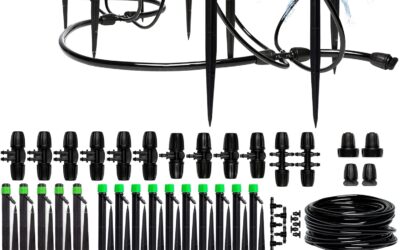
The GrowYourGreenParadise 230FT drip irrigation system is a water-pressure-driven soaker hose kit made for delivering water along garden rows, beds, borders, pots, and greenhouse plantings. Based on the listed specifications, it includes 33 feet of 5/16-inch main tubing and 197 feet of 1/4-inch soaker hose, making it a practical option for homeowners who want to build a custom watering layout rather than hand-water every plant.
The main gardening benefit is its micro-pore weeping design. Instead of using individual emitters that water only at set points, the soaker hose is intended to release water along the hose length and form a more continuous moisture band near the root zone. For vegetable beds, flower borders, and closely spaced plantings, that style can be useful because the hose can follow the planting line and reduce unnecessary spraying over leaves and open soil.
The kit is built around flexible tubing, rigid and flexible tubing connections, and a large set of included fittings. The supplied parts list includes reducing tees, 6-way connectors, multipurpose end plugs, end caps, thread seal tape, a Y-connector, and ground stakes. That gives gardeners room to branch the layout across multiple bed sections, hold lines in place, and close off unused ends, although careful planning before cutting tubing is still important.
In a typical backyard, this kit makes the most sense for raised beds, narrow borders, greenhouse benches, potted plant groupings, vertical gardens, and lawn edges where a bendable 1/4-inch line is easier to route than a full-size hose. It can be placed on the surface, under mulch, or buried according to the product information, which helps keep the setup neater in decorative beds or small-space gardens.
There are a few practical cautions. Some reviewers describe the system as easy to set up, but one reviewer noted that directions were not included and another reported reduced water delivery farther down a long run. For best results, gardeners should avoid assuming one very long continuous line will water evenly in every situation, check the layout during the first few watering sessions, and adjust branches or line lengths as needed.
Overall, this is a useful kit for gardeners who want a flexible soaker-style irrigation layout with many included fittings and a focus on root-zone watering. It is a better match for raised beds, greenhouse crops, borders, and container groupings than for gardeners who need a fully automated timer system, individually adjustable emitters, or guaranteed performance across a long unbranched run.
Pros
- Expandable design offers long reach while storing more compactly after use
- Lightweight construction is easier to handle than many rigid full-size hoses
- Brass 3/4 inch fittings suit common US outdoor spigots
- Reviewers commonly mention that it is easy to move, easy to store, and less prone to kinking
- Outer fabric and latex core are specified for added protection around typical garden obstacles
Cons
- Expandable hoses may require extra care, such as draining after use and avoiding prolonged pressure when not watering
- Some reviewers report leaks or breakage after one or more seasons, so longevity may vary with use and storage conditions
- The listed manufacturer warranty description says no warranty, which may matter to gardeners who want long-term replacement coverage
The FlexiHose 100 ft Expandable Garden Hose is a lightweight watering hose intended for everyday garden and yard tasks where reach and easy storage both matter. It is best suited to homeowners, patio gardeners, raised-bed growers, and anyone who finds a traditional 100 ft hose awkward to drag, coil, or store.
The main advantage is its expandable design. The product information indicates that the hose can expand up to three times its original length under standard water pressure, then shorten again when the water is turned off. For routine watering, that means it can reach across a yard or around planters during use without taking up the same amount of space between watering sessions.
Its 3/4 inch solid brass connectors are designed to fit typical outdoor garden taps in the US, and the hose uses a 3750D elastic outer fabric with a four-layer latex inner construction. Those details are useful for gardeners working around beds, corners, containers, and thorny plantings, although any fabric-covered expandable hose should still be kept away from sharp abrasion when possible.
In a backyard setting, this hose could be useful for watering vegetable beds, flower borders, shrubs near the house, or containers on a patio. Its compact retraction is also a practical benefit for small storage areas, hose pots, balconies with an outdoor tap, or gardeners who prefer not to wrestle with a stiff coil after each use.
There are a few care points to keep in mind. Expandable hoses continue to release water briefly as they contract, so it is sensible to turn off the spigot and let the hose drain before putting it away. Reviewers commonly praise the light handling and kink resistance, but some also report leaks or breakage over time, so careful storage out of harsh sun, avoiding abrasion, and not leaving it under pressure may help preserve it.
Overall, this is a convenient choice for gardeners who value light handling, long reach, and compact storage more than the heavy-duty feel of a traditional rubber hose. Gardeners who need a hose for constant pressure, rough dragging over hard surfaces, or maximum long-term durability may prefer a heavier conventional garden hose.

Pros
- Comes as a complete raised bed kit with regulator, adapter, emitter tubing, distribution tubing, fittings, stakes, and manual
- Low-volume drip watering targets the root zone and is listed by the manufacturer for up to 80 percent water savings
- 70 built-in emitters spaced 6 inches apart simplify layout for closely planted garden beds
- Compatible with an optional Rain Bird hose-end timer for gardeners who want scheduled watering
- Professional-grade resin components are described as built to last season after season
Cons
- The product information specifically warns not to extend the kit with extra 1/4-inch tubing, so larger gardens may need additional kits
- A timer is not included, so fully automatic watering requires a separate purchase
- The kit is sized around raised bed use and may be less suitable for long runs, large in-ground gardens, or complex multi-zone irrigation layouts
The Rain Bird GARDENKIT is a drip irrigation kit made for raised bed gardens, especially beds up to 4 x 8 feet. It is aimed at homeowners, beginner gardeners, and small-space growers who want a ready-to-assemble system for watering vegetables, herbs, flowers, or stock tank gardens from an outdoor faucet.
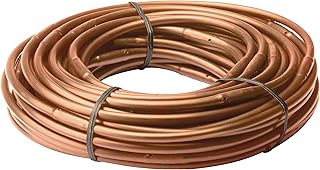
The main benefit is targeted, low-volume watering near the root zone. Based on the listed product information, the brown emitter tubing includes 70 built-in emitters spaced every 6 inches, and the pressure-compensating design is intended to provide even watering from end to end of the tubing run. This can be helpful in raised beds where consistent moisture matters and overhead sprinkling may waste water outside the planting area.
The kit includes a 3/4-inch faucet adapter, 25 psi pressure regulator with filter washer, 35 feet of 1/4-inch emitter tubing, 25 feet of 1/4-inch distribution tubing, couplers, elbows, end caps or goof plugs, tubing stakes, and an illustrated manual. Installation is meant to be straightforward: connect at the faucet, run the black distribution tubing to the bed, then place the brown emitter tubing around the plants. The manufacturer notes that warming the tubing in direct sun for about an hour can make it easier to unroll and work with.
For practical garden use, this kit makes sense for a single raised bed, a compact kitchen garden, or one or more small stock tank gardens within the listed tubing limits. The tubing may be staked on top of the soil for easy seasonal adjustment or buried for a neater appearance. Gardeners who travel, forget to hand-water, or want more consistent bed moisture can also add the Rain Bird 1ZEHTMR hose-end timer, which is sold separately.
The most important limitation is clearly stated in the product information: do not extend this kit by adding more 1/4-inch tubing, because reduced or inconsistent flow can result. Gardeners with larger layouts, long distances from the faucet, or multiple branches from a Y-splitter should plan on additional kits or a different irrigation design. As with any drip setup, it is also wise to check connections after installation, watch for displaced tubing, and drain or store components appropriately when freezing conditions are a concern.
Overall, the Rain Bird GARDENKIT is a practical choice for raised bed growers who want an organized drip system with the key faucet connection, pressure regulation, tubing, fittings, and stakes included. Gardeners building a large multi-bed irrigation network may prefer a more expandable system, but for a compact raised bed or stock tank garden, the listed components are well matched to the job.


Pros
- Modular two-hose layout gives more placement flexibility than a single fixed-length hose.
- Includes stakes and storage straps, so the kit is more complete for garden-bed installation.
- Flat, kink-resistant design is intended to sit neatly under mulch or along planting rows.
- Works with standard faucets, timers, and drip irrigation setups according to the product information.
Cons
- Best performance may require a pressure regulator, with the listing recommending 8 to 10 PSI for more even distribution.
- Gardeners should keep pressure below the listed care guidance and drain the hose before cold-condition storage.
- A flat soaker hose may be less suitable for lawns or areas where overhead watering is preferred.
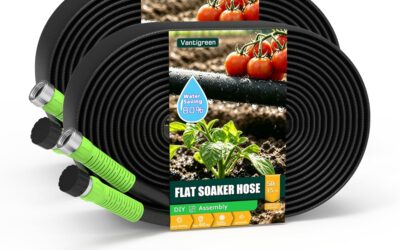
The BetterBotanicals 100 ft Flat Soaker Hose Kit is a soil-level watering setup for garden beds, raised beds, trees, and landscaping. It includes two 50 ft connectable hoses, so homeowners can run separate watering lines in different areas or join them for a longer layout.
The main benefit is slow, consistent moisture along the hose, which is useful for watering planting rows and mulched beds without relying on overhead spray. The product information recommends using a pressure regulator at 8 to 10 PSI for more even distribution, which is an important detail for gardeners who want steadier watering from end to end.
The flat black hose is listed as vinyl with a dual-layer construction, including a flexible inner tube and protective outer fabric. Its flat profile is intended to reduce coiling and twisting, while the included 16 steel stakes help secure the hose around curves, bed edges, and long runs.
For small yards and raised-bed gardens, the two-piece layout is especially useful because one 50 ft hose can serve a vegetable bed while the other handles shrubs, trees, or a second planting area. The hoses work with standard faucets, timers, and drip irrigation setups according to the listing, and the included end caps support basic layout changes.
As with most soaker hose systems, setup details matter. Proper washer placement can help prevent connection leaks, and the listing advises keeping pressure below 25 PSI, covering the hose with mulch, and storing it drained in colder conditions to extend service life.
This kit is a good match for gardeners who want a simple, flexible alternative to hand watering beds and landscape plantings. Gardeners who need broad lawn coverage, high-pressure watering, or a fully customized drip system with emitters may prefer a different irrigation option.


Pros
- Lightweight 12.8-ounce hose is easy to move, place, and store.
- Designed for efficient deep watering in garden beds and other tight spaces.
- Flexible flat profile can be routed around plants and along bed edges.
- Listed as suitable for above-ground or below-ground watering.
- Reviewers commonly mention that it is easy to set up and useful for small gardens or flower beds.
Cons
- At 25 feet, it may be too short for larger beds unless linked with additional hoses.
- Some reviewers report durability concerns such as leaks, splitting, or sun wear over time.
- Gardeners who need precise emitter spacing or zoned irrigation control may prefer a more configurable drip system.
The Gilmour 25-foot flat soaker hose is built for root-zone watering in garden beds, vegetable patches, flower borders, orchards, lawns, and foundation plantings. Instead of spraying water into the air, the hose is designed to weep moisture through its fabric jacket so water can soak into the soil close to where plants use it. Based on the listed specifications, it is especially well suited to homeowners and beginner gardeners who want a simple watering aid without setting up a full drip-irrigation kit.
The main benefit is targeted, low-profile watering. The product information states that water seeps out of all sides of the fabric cover, which can help reduce overspray onto paths, foliage, or unused areas compared with a sprinkler. The listing also describes it as clog resistant and water saving, and notes that it is intended for efficient deep watering in beds and other tight spaces. For vegetables, herbs, roses, shrubs, or densely planted borders, that style of slow soaking can be easier to manage than repeated hand watering.
This hose measures 25 feet long and is listed at about 0.62 inches wide, with a 12.8-ounce item weight. The flat design makes it easier to roll up for storage than many round hoses, and the flexible shape helps it snake through planted areas. The hose is made of vinyl, with the product description specifying 100% recycled vinyl and a fabric cover. The listing also says it can be placed above or below ground, and that it can be linked with other hoses for a longer DIY watering layout.
In a small backyard garden, this hose could be laid along a row of tomatoes, tucked through a flower bed, or looped around shrubs where sprinkler spray would be wasteful. In raised beds or narrow side-yard plantings, the 25-foot length is manageable and less cumbersome than a long conventional garden hose. Reviewers commonly mention easy setup and good maneuverability, though those comments should be read as user feedback rather than guaranteed performance for every yard or water-pressure setup.
The main limitations are length and long-term durability expectations. A single 25-foot hose may not cover a large vegetable garden, and gardeners with multiple beds will likely need additional hose sections or a separate irrigation plan. Some reviewers report leaking, splitting, seam problems, or sun-related wear, while others report getting multiple seasons with proper care. To protect the hose, it is sensible to avoid excessive water pressure, drain it after use when practical, and store it before freezing weather or prolonged off-season exposure.
Overall, this Gilmour flat soaker hose is a practical choice for gardeners who want an inexpensive, compact, and easy-to-route watering option for shorter beds and tight spaces. It is best for simple root-zone soaking rather than highly customized irrigation. Gardeners managing large layouts, high-pressure systems, or permanent multi-zone watering may want to compare it with a more robust drip system or heavier-duty soaker hose before deciding.


Guida all’acquisto: irrigazione a goccia o tubo poroso per aiuole rialzate
Irrigazione a goccia o tubo poroso: la differenza pratica
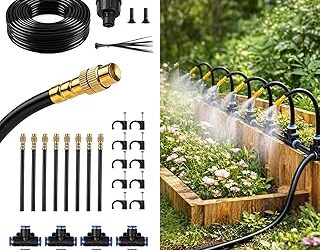
Nelle aiuole rialzate, l’irrigazione a goccia indica generalmente una tubazione con singoli gocciolatori o con una distanza prestabilita tra i gocciolatori integrati, che rilascia l’acqua in punti pianificati. Rain Bird GARDENKIT, per esempio, utilizza 35 piedi di tubo con gocciolatori e 70 gocciolatori integrati distanziati ogni 6 pollici, oltre a 25 piedi di tubo di distribuzione da 1/4 di pollice. Questo tipo di configurazione è utile quando si desiderano linee di irrigazione più prevedibili lungo un’aiuola definita.
Un tubo poroso o weeper hose rilascia umidità lungo gran parte della sua lunghezza. Gilmour 25′ Black Flat Weeper Soaker Hose viene descritto come un tubo che consente all’acqua di filtrare da tutti i lati del rivestimento in tessuto, mentre BetterBotanicals 100 FT Flat Soaker Hose è progettato per fornire umidità lenta e costante lungo il tubo. I tubi porosi sono spesso più semplici da disporre in un’aiuola, ma la pressione e la lunghezza del tubo possono influire sull’uniformità.
| Scelta | Utilizzo più adatto in base ai dati forniti | Compromesso da considerare |
|---|---|---|
| Kit di irrigazione a goccia o tubo con gocciolatori | Configurazioni pianificate per aiuole rialzate, più file e orticoltori che desiderano una distanza definita tra i gocciolatori o funzioni di compensazione della pressione | Più componenti e decisioni sulla disposizione durante l’installazione |
| Tubo poroso piatto o weeper hose | Aiuole semplici, bordure e orticoltori che desiderano una configurazione rapida per irrigare lungo una linea | L’uniformità dell’irrigazione può dipendere dal controllo della pressione, dalla lunghezza e dalla posizione |
Abbina il sistema alle dimensioni e alla disposizione dell’aiuola rialzata
Inizia dalla forma dell’aiuola. Una singola aiuola da 4 x 8 piedi è naturalmente adatta a Rain Bird GARDENKIT, poiché la scheda indica che contiene tutto il necessario per irrigare un orto rialzato da 4′ x 8′. Gli schemi illustrati inclusi possono inoltre aiutare i principianti che non vogliono progettare un sistema partendo da componenti separati.
Le installazioni più lunghe o con più zone del giardino possono richiedere kit con una maggiore quantità di tubazione. GrowYourGreenParadise Upgraded 230FT Drip Irrigation System include 33 piedi di tubo principale da 5/16 di pollice e 197 piedi di tubo poroso da 1/4 di pollice, mentre il kit BetterBotanicals offre due tubi porosi piatti collegabili da 50 piedi. Per le aiuole compatte, un’opzione più corta come Gilmour 25-foot flat weeper hose o Raindrip 50-foot soaker hose tubing può essere più facile da gestire.
Controlla i requisiti di pressione prima dell’acquisto
La pressione è importante perché i sistemi per aiuole rialzate devono rilasciare l’acqua lentamente, non spingerla con forza attraverso i raccordi. BetterBotanicals raccomanda specificamente di utilizzare un regolatore di pressione da 8 a 10 PSI per una distribuzione più uniforme e di mantenere la pressione al di sotto di 25 PSI per prolungare la durata del prodotto. È un’avvertenza utile per chi collega il sistema direttamente a un normale rubinetto esterno.
Rain Bird indica gocciolatori autocompensanti nel proprio kit per aiuole rialzate, mentre Rain Bird ET256-50S viene descritto come un tubo con gocciolatori autocompensanti da 1/4 di pollice, con una distanza di 6 pollici tra i gocciolatori. I sistemi autocompensanti meritano di essere presi in considerazione quando la distribuzione uniforme in tutta l’aiuola è una priorità, soprattutto se l’aiuola è lunga o la fonte d’acqua non è perfettamente stabile.
Valuta tubi, raccordi e prevenzione delle perdite
Molti problemi di irrigazione derivano da raccordi mancanti, rondelle allentate o installazioni eseguite frettolosamente. BetterBotanicals include due tubi collegabili con tappi terminali, 16 picchetti in acciaio e cinghie per il rimessaggio; i dati del prodotto indicano inoltre che il corretto posizionamento delle rondelle contribuisce a garantire connessioni sicure e senza perdite. Kalolary 100FT Soaker Hose Kit elenca raccordi, una valvola e un tappo terminale nel nome del prodotto, caratteristica che può essere utile se desideri un kit anziché un semplice tubo.
Per configurazioni più articolate, cerca kit che includano il tubo principale e i componenti per le diramazioni. GrowYourGreenParadise elenca un raccordo a Y, raccordi, tappi terminali, tee ridotti, raccordi a 6 vie, tappi terminali multiuso, nastro sigillante per filetti e picchetti da terreno. CARPATHEN propone un kit con tubo principale da 1/2 pollice e 50 piedi, oltre ai raccordi, per aiuole rialzate o serre. Se ti serve un tubo di alimentazione più lungo per raggiungere l’aiuola, la nostra guida ai tubi da giardino da 100 piedi può aiutarti a pianificare separatamente il lato della fonte d’acqua.
Valuta con attenzione le dichiarazioni sull’efficienza idrica
Diversi prodotti forniti riportano dichiarazioni sul risparmio d’acqua, ma i dettagli variano. Rain Bird afferma che il suo kit per aiuole rialzate irriga a basso volume vicino alle radici e offre fino all’80% di risparmio idrico. Anche Gilmour dichiara che il suo tubo da 25 piedi può far risparmiare l’80% d’acqua distribuendola direttamente alle radici delle piante. Kalolary riporta un risparmio dell’80% nel nome del prodotto.
Considera queste dichiarazioni come un punto di partenza, non come una garanzia per ogni giardino. Il consumo effettivo d’acqua dipende dalla durata di funzionamento del sistema, dall’eventuale copertura del tubo con pacciamatura, dal tipo di terreno, dalla distanza tra le piante e dal clima locale. Un timer può aiutare a mantenere la regolarità, mentre Dove Creek Gardens tratta altri strumenti per l’irrigazione nella sezione Watering & Irrigation.
Opzioni di installazione: in superficie, sotto la pacciamatura o interrata
L’installazione in superficie è la più semplice, perché consente di individuare rapidamente perdite, pieghe e zone asciutte. BetterBotanicals include picchetti in acciaio per mantenere il tubo piatto in posizione lungo curve e tratti lunghi, una caratteristica utile nelle aiuole rialzate, dove i tubi possono spostarsi durante la semina, il diserbo o la raccolta.
Alcune schede supportano l’uso coperto o interrato. Rain Bird afferma che il suo tubo può essere interrato o lasciato sopra il terreno. Gilmour indica che il tubo può essere installato sopra o sotto il terreno. GrowYourGreenParadise afferma che il tubo da 1/4 di pollice può essere disposto in superficie, sotto la pacciamatura o interrato. Se copri la tubazione, controlla il sistema all’inizio della stagione per evitare che perdite nascoste o sezioni ostruite passino inosservate.
Considerazioni sull’accessibilità e sul giardinaggio in piccoli spazi
Per le persone anziane o per chi desidera ridurre il bisogno di piegarsi e trasportare materiali, il sistema migliore è quello che rimane in posizione e non richiede spostamenti quotidiani. Tubi porosi piatti come BetterBotanicals 100 FT Flat Soaker Hose e Gilmour 25-foot flat weeper hose possono essere disposti lungo le file e lasciati in posizione durante la stagione di crescita. La scheda Gilmour indica inoltre che il design piatto è facile da arrotolare e riporre.
Chi fa giardinaggio in piccoli spazi dovrebbe evitare di acquistare una quantità di tubazione molto superiore a quella che può disporre ordinatamente. Un kit da 230 piedi può essere utile per più aiuole, bordure, vasi, giardini verticali o serre, secondo la scheda GrowYourGreenParadise, ma un’aiuola corta può essere più semplice da gestire con un’opzione da 25 o 50 piedi. Per terrazzi e stretti cortili laterali, anche il rimessaggio è importante; un supporto o un avvolgitubo da parete può tenere i tubi di alimentazione fuori dal passaggio, mentre la nostra guida agli avvolgitubo da giardino tratta questa parte dell’installazione.
Manutenzione, rimessaggio stagionale ed errori comuni
Gli errori comuni includono l’uso di una pressione eccessiva, la mancata installazione delle rondelle nei raccordi, l’estensione del sistema troppo lontano dal rubinetto e la dimenticanza di controllare l’estremità più lontana dell’aiuola. Nei tubi porosi, una distribuzione non uniforme può spesso dipendere da pressione, lunghezza o posizione. BetterBotanicals raccomanda specificamente un regolatore di pressione e il corretto posizionamento delle rondelle: due semplici accorgimenti che possono prevenire molti problemi.
A fine stagione, scarica l’acqua da tubi e tubazioni prima di riporli, soprattutto in presenza di temperature più rigide. BetterBotanicals raccomanda specificamente di riporre il tubo svuotato in condizioni fredde, mentre Gilmour sottolinea la facilità di rimessaggio per la stagione successiva. Prima di riporli, scollega con cautela i raccordi, rimuovi il terreno dai connettori e conserva insieme piccoli tappi o chiusure, così la preparazione sarà più semplice la primavera seguente.
Metodologia della ricerca e affidabilità
Questa guida si basa su un’analisi dei prodotti fondata sulla ricerca, non su test fisici. Dove Creek Gardens ha esaminato i titoli dei prodotti forniti, gli ASIN, i prezzi, le valutazioni, le descrizioni, le caratteristiche elencate e il numero di recensioni dei proprietari, selezionando poi i prodotti chiaramente pertinenti all’irrigazione a goccia o con tubo poroso per aiuole rialzate.
I prodotti costituiti da normali tubi da giardino o tubi espandibili multiuso non sono stati raccomandati come sistemi a goccia o porosi per aiuole rialzate, anche se possono essere utili come tubi di alimentazione. Le corrispondenze valide includevano kit a goccia per aiuole rialzate, tubi con gocciolatori da 1/4 di pollice, tubi porosi, tubi weeper piatti e kit con tubo poroso destinati ad aiuole, aiuole rialzate, serre, fioriere o bordure.
I fattori di classificazione erano specifici per la categoria: copertura, lunghezza della tubazione, indicazioni sulla pressione, distanza tra i gocciolatori quando indicata, completezza dei raccordi, dettagli sulla prevenzione delle perdite, flessibilità di installazione, indicazioni sul rimessaggio, dichiarazioni sul risparmio idrico solo quando esplicitamente riportate e adeguatezza per principianti o giardinieri con poco spazio. Il contenuto è stato aggiornato a luglio con i dati dei prodotti forniti per il 2026, inclusa la fascia di prezzo di $11.41 – $67.99 e marchi come Gilmour, FlexiHose, RainBird e altri.
Raccomandazioni finali
Scelta migliore in assoluto: Rain Bird GARDENKIT Drip Irrigation Raised Bed Garden Watering Kit è il sistema più indicato per un principiante che desidera un impianto a goccia progettato per le aiuole rialzate. La scheda indica che irriga un’aiuola rialzata da 4′ x 8′, include un tubo con 70 gocciolatori integrati distanziati ogni 6 pollici e utilizza gocciolatori autocompensanti per un’irrigazione uniforme in tutta l’aiuola.
Scelta più facile da installare: 100 FT Flat Soaker Hose (2 x 50 FT) – Drip Irrigation for Garden Beds, Raised Beds & Landscaping – Kink-Resistant, Even Watering, Includes 16 Steel Stakes & Storage Straps è una scelta valida se preferisci una disposizione con tubo poroso piatto, utilizzabile come due tubi separati da 50 piedi oppure collegata per raggiungere 100 piedi. I picchetti, i tappi terminali e le cinghie per il rimessaggio inclusi lo rendono pratico per aiuole rialzate, aiuole da giardino, alberi e configurazioni paesaggistiche.
Scelta per piccoli spazi: Gilmour 25′ Black Flat Weeper Soaker Hose for Garden Beds, Drip Irrigation Outdoor Hose, Flexible Garden Hose for Vegetable Gardens, Flower Beds, Lawns, and Orchards | Drip Irrigation Weeper Hose for Garden Beds, Vegetable Gardens & Orchards – Clog-Resistant, Water-Saving, Flexible è un’opzione più corta adatta alle aiuole compatte e agli spazi verdi ridotti. Chi sta realizzando una configurazione a goccia personalizzata può anche valutare Rain Bird ET256-50S Drip Irrigation Pressure Compensating 1/4″ Emitter Tubing, 6″ Emitter Spacing, 50 Roll, Brown oppure Raindrip 015005T 1/4-Inch by 50-Foot Soaker Hose Tubing for Drip Irrigation, Use in Vegetable Garden, Planters, and Borders, 50-Foot, Black.
Domande frequenti
È meglio l’irrigazione a goccia o un tubo poroso per le aiuole rialzate?
L’irrigazione a goccia è generalmente preferibile quando desideri una distanza pianificata tra i gocciolatori e un maggiore controllo della disposizione. Un tubo poroso è spesso più adatto quando vuoi una configurazione più semplice per irrigare lungo una linea, con meno componenti. Per una singola aiuola rialzata da 4′ x 8′, Rain Bird GARDENKIT è indicato specificamente per queste dimensioni, mentre i tubi porosi piatti possono adattarsi a disposizioni flessibili lungo le file.
Quanto tubo o tubazione serve per l’irrigazione a goccia o con tubo poroso nelle aiuole rialzate?
Misura il percorso che il tubo o la tubazione seguirà all’interno di ogni aiuola, non solo le dimensioni esterne. Le aiuole corte possono richiedere soltanto un prodotto da 25 o 50 piedi, mentre più aiuole possono giustificare un kit più grande, come il sistema GrowYourGreenParadise da 230 piedi o il tubo poroso BetterBotanicals da 100 piedi composto da due elementi.
Serve un regolatore di pressione per un tubo poroso in un’aiuola rialzata?
Dipende dal prodotto, ma il controllo della pressione è spesso importante. BetterBotanicals raccomanda un regolatore di pressione da 8 a 10 PSI per una distribuzione più uniforme e di mantenere la pressione al di sotto di 25 PSI per prolungare la durata del tubo. Segui sempre le istruzioni di installazione del produttore per il prodotto scelto.
Posso interrare il tubo per irrigazione a goccia o il tubo poroso in un’aiuola rialzata?
Alcuni dei prodotti forniti lo consentono. Rain Bird afferma che il suo tubo può essere interrato o lasciato sopra il terreno, Gilmour indica che il suo tubo può essere installato sopra o sotto il terreno e GrowYourGreenParadise afferma che la sua tubazione può essere disposta in superficie, sotto la pacciamatura o interrata. Se interri il sistema, controllalo regolarmente per evitare che perdite o sezioni ostruite rimangano nascoste.
Qual è l’opzione più semplice per i principianti?
Un kit completo è solitamente più semplice rispetto all’acquisto separato di tubi e raccordi. Rain Bird GARDENKIT include componenti per una configurazione destinata alle aiuole rialzate e un manuale illustrato, mentre BetterBotanicals include tubi collegabili, tappi terminali, picchetti e cinghie per il rimessaggio. I principianti dovrebbero scegliere il sistema che corrisponde più da vicino alle dimensioni della propria aiuola.
Come devo riporre un tubo poroso dopo la stagione?
Svuota il tubo, scollega con cautela i raccordi e conserva insieme tappi o chiusure terminali. BetterBotanicals raccomanda specificamente di riporre il tubo svuotato in condizioni fredde, mentre Gilmour indica che il design piatto è facile da arrotolare e riporre per la stagione successiva.